
ScienceBlogs is coming to an end. I don't know that there was ever a really official announcement of this, but the bloggers got email a while back letting us know that the site will be closing down. I've been absolutely getting crushed between work and the book-in-progress and getting Charlie the pupper, but I did manage to export and re-import the content to an archive site back on steelypips.org. (The theme there is an awful default WordPress one, but I'm too slammed with work to make it look better; the point is just to have an online archive for the temporary redirects to work with.)
I'm…


 drorzel |
It's been a couple of years since we lost the Queen of Niskayuna, and we've held off getting a dog until now because we were planning a big home renovation-- adding on to the mud room, creating a new bedroom on the second floor, and gutting and replacing the kitchen. This was quite the undertaking, and we would not have wanted to put a dog through that. It was bad enough putting us through that...
Withe the renovation complete, we started looking for a dog a month or so back, and eventually ended up working with a local rescue group with the brilliantly unsubtle name Help Orphan Puppies. This…
drorzel |
Another month, another set of blog posts. This one includes the highest traffic I think I've ever seen for a post, including the one that started me on the path to a book deal:
-- The ALPHA Experiment Records Another First In Measuring Antihydrogen: The good folks trapping antimatter at CERN have now measured the hyperfine spectrum of hydrogen, which is a good excuse to explain what that is and why it matters.
-- 7 Suggestions For Succeeding In Science In College: It's the time of year when lots of people give unsolicited advice to the college-bound, and who am I to buck that trend?
-- How To…
 drorzel |
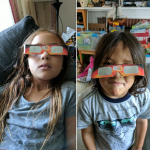
I keep falling down on my duty to provide cute-kid content, here; I also keep forgetting to post something about a nerdy bit of our morning routine. So, let's maximize the bird-to-stone ratio, and do them at the same time.
The Pip can be a Morning Dude at times, but SteelyKid is never very happy to get up. So on weekday mornings, we've developed a routine to ease the two of them into the day: SteelyKid has a radio alarm, and then I go in and gently shake her out of bed. I usually carry her downstairs to the couch, where she burrows into the cushions a bit; The Pip mostly comes downstairs…
 drorzel |
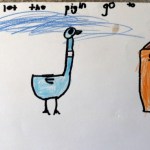
Our big home renovation has added a level of chaos to everything that's gotten in the way of my doing more regular cute-kid updates. And even more routine tasks, like photographing the giant pile of kid art that we had to move out of the dining room. Clearing stuff up for the next big stage of the renovation-- cabinets arrive tomorrow-- led me to this stuff, though, so I finally took pictures of a whole bunch of good stuff. (On the spiffy new tile floor in the kitchen, because the light was good there...)
The kids's school sends home portfolios of what they've done in art class for the year,…
drorzel |
Another month, another collection of blog posts for Forbes:
-- The Physics Of Century-Old Mirror Selfies: Back in the early 1900's there was a brief vogue for trick pictures showing the same person from five different angles; this post explains how to do that with mirrors.
-- Why Research By Undergraduates Is Important For Science And Students: A reply to an essay talking up the products of undergraduate research projects, arguing that the most valuable part of research is the effect on students.
-- What Does It Mean To Share 'Raw Data'?: Some thoughts on the uselessness of much "raw data" in…
 drorzel |
So, when last I posted an update on kid stuff, we were about to embark for a week in Mexico with family. As you would expect, I have a huge pile of pictures from this, but most of the cute-kid shots feature the kids with their cousins from Illinois, and I try to avoid posting photos of other people's children.
We had a good time, for the most part. The highlight for the kids was probably a "Swim with Dolphins" excursion. SteelyKid did one of these on last year's Disney cruise, but now The Pip is both old enough, and enjoys swimming. Technically, he wasn't tall enough (by maybe an inch) to do…
drorzel |
To make up for last month's long delay in posting, I'll knock out this month's recap of Forbes blog posts really quickly. Also, I still have Vacation Brain, so writing anything really new isn't in the cards...
-- What Should Non-Scientists Learn From Physics?: You probably won't be surprised to hear that, in my opinion, it's not a specific set of facts, but an attitude toward the world.
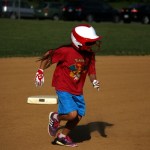
-- Softball Physics: How Far Can You Run While The Ball Is In The Air?: In which SteelyKid learning softball's "tag up" rule the hard way leads to an interesting problem in physics.
-- How Long Would A Fidget…
drorzel |
Much delayed, but this works out well because it'll give you something to read while we're away in Mexico on a family vacation. Here's what I wrote for Forbes in the merry month of May:
-- In Science, Probability Is More Certain Than You Think: Some thoughts on the common mistake people make in saying that science only predicts probabilities of future outcomes.
-- A "Cosmic Controversy" Is Mostly A Distraction: A lament about the neglect of science we know to be true versus more speculative stuff.
-- Why Do We Invent Historical Roots For Modern Science?: Claims of ancient origins for current…
 drorzel |
I've skipped a few weeks of cute-kid updates, largely because I was at DAMOP for a week, and then catching on stuff I missed while I was at DAMOP for a week. The principal activity during this stretch has been SteelyKid's softball, with a mad flurry of games at the end of the season to make up for all the rained-out games. This has been sort of stressful, but it also led to the greatest Google Photos animation ever, so...
Anyway, softball was fun, providing the opportunity for me to take no end of photos with my telephoto lens, some of which are pretty good. SteelyKid was way into running the…
 drorzel |
We took a rare long weekend to go to a family party for Memorial Day at my parents' (Kate and the kids always get the day off, but I usually have to teach; this year, I'm doing a team-taught class, and the other person was willing to cover my Monday spot), thus the lack of a weekly update post. The delay, however, allows for some quality nerd-parenting content, so it's a win all around...
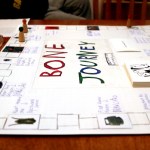
SteelyKid's third-grade class has been doing long-ish projects approximately monthly through the year, and the May project was to design and make a board game based on a book. SteelyKid picked the Bone…
 drorzel |
During my sabbatical last year, I decided to try to do a photo-a-day project, taking and sharing at least one good picture a day of something or another. The strict photo-a-day format fell victim to my general busy-ness and disorganization, but I did eventually complete the whole thing. In the final post of the series, I said I might have some wrap-up thoughts in a few days; that was several months ago.
Every time I need to clear some disk space, though, I'm reminded that I left that hanging, so I finally did something in the direction of a summative post, by uploading all the edited pictures…
 drorzel |
The big development of this week is that construction started on the Great Chateau Steelypips Renovation of 2017. We're extending one part of the back of the house about ten feet to gain a bedroom on the second floor, and gut-renovating the kitchen, dining room, and mud room. This is a massive undertaking, with a massive price tag (more than we paid for the house in 2002), and is going to be massively disruptive later this summer. Right now, it's very exciting, because we have an excavator and giant piles of dirt in our back yard:
The Pip looking at the excavator used to dig the foundation…
 drorzel |
At SteelyKid's softball game today, the Pip provided an ideal cute-kid photo to use as a springboard to some SCIENCE! Or at least, a graph... Anyway, here's the Little Dude showing off how tall he's gotten:
The Pip under Kate's coat.
OK, really he's hiding under Kate's raincoat (after two beautiful sunny days in a row, we're back to dreary rain today), but as a side effect of that process he's demonstrating that he's pretty tall. But exactly how tall?
We're having an addition put on the back of Chateau Steelypips, and our kitchen gutted and rebuilt, so we've been moving a lot of stuff…
 drorzel |
For a long time now, I've had a Sunday routine with the kids, where we go to the Schenectady Greenmarket and then to the Open Door (which is right next to the outdoor market, and a couple blocks from the indoor location), then to lunch at Panera, and usually grocery shopping. We have a standing deal that they get one book per week free, but if they want toys or a second book, it comes out of their allowance.
SteelyKid very consistently finds something to read, but The Pip was recently in a mode where he only wanted to read Pokemon books, and the Open Door doesn't carry those, so he would sulk…
drorzel |
Inside Higher Ed ran a piece yesterday from a Ph.D. student pleading for more useful data about job searching:
What we need are professional studies, not just anecdotal advice columns, about how hiring committees separate the frogs from the tadpoles. What was the average publication count of tenure-track hires by discipline? How did two Ph.D. graduates with the same references (a controlled variable) fare on the job market, and why? What percentage of tenure-track hires began with national conference interviews? These are testable unknowns, not divine mysteries.
From the age-old Jobtracks…
drorzel |
It's the first week of May, which means we're due to see flowers watered by all this damn rain soon, and also a recap of the various posts I wrote for Forbes during April:
-- Why Are There Too Many Papers In Theoretical Physics?: A look at the origins of "ambulance chasing" in high-energy theory, where dozens of people jump on the slightest hint of a new effect.
-- A Little Luck Is Essential For Success In Science: Some historical examples of physicists who succeeded thanks to a lucky break of one sort or another.
-- What Sorts Of Problems Are Quantum Computers Good For? Prompted by news of a…
 drorzel |
One of the things parents of multiple kids often talk about is how they don't end up doing the same things with second children that they did with their first. For example, I carried the weekly Appa-for-scale photos on with SteelyKid for a couple of years, but didn't last anywhere near that long with The Pip. Another thing I did with SteelyKid was to report fairly regularly here on cute stories she told me, and that kind of thing, which I've largely been failing to do with The Pip. the fact that I've fallen out of doing any kind of kid-blogging at all doesn't really make this any better...…
drorzel |
Another month, another batch of blog posts at Forbes:
-- In Physics, Infinity Is Easy But Ten Is Hard: Some thoughts on the odd fact that powerful math tricks make it easy to deal uncountably many interacting particles, while a smaller number would be a Really Hard Problem.
-- New Experiment Explores The Origin Of Probabilities In Quantum Physics: A write-up of an experiment using a multi-path interferometer to look for departures from the Born rule for calculating probabilities from wavefunctions.
-- The Most Important Science To Fund Is The Hardest To Explain: In light of the awful budget…
drorzel |
There was a kerfuffle in academic social media a bit earlier this week, kicked off by an anonymous Twitter feed dedicated to complaints about students (which I won't link to, as it's one of those stunt feeds that's mostly an exercise in maximizing clicks by maximizing dickishness). This triggered a bunch of sweeping declarations about the surpassing awfulness of all faculty who have ever thought poorly of a student (which I'm also not going to link, because they were mostly on Twitter and are now even more annoying to find than they were to read). It was a great week for muttered paraphrases…