


The abstract says it all:
Zombies are a popular figure in pop culture/entertainment and they are usually portrayed as being brought about through an outbreak or epidemic. Consequently, we model a zombie attack, using biological assumptions based on popular zombie movies. We introduce a basic model for zombie infection, determine equilibria and their stability, and illustrate the outcome with numerical solutions. We then refine the model to introduce a latent period of zombification, whereby humans are infected, but not infectious, before becoming undead. We then modify the model to include…
(I had this whole post ready talking about flexible representations, but now my computer is borked -- stupid monitor! -- so this is going to have to do.)
Tyler Cowen over at Marginal Revolution links to a piece by a former editor at American Economic Review telling all about how papers are accepted for publication. In economics this process may be slightly different, but I found the piece addressed several questions I had about the process.
I reject 10-15% of papers without refereeing, a so-called "desk rejection." This prompts some complaints - "I paid for those reviews with my submission…
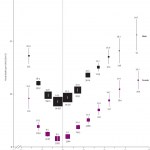
There is a great conversation going on at Megan McArdle's blog with Paul Campos, author of The Obesity Myth. I say great because it give me the opportunity to show how astonishingly wrong Campos in suggesting that the obesity at the lower end of the BMI spectrum -- not just morbid obesity -- is not bad for your health. Frankly, contrary to his statements, the data is definitive, and I am amazed about how he gets away with publishing this trash.
A core argument that Campos makes in the interview is that there is no negative consequences for going over what he considers the very arbitrary…
In neuroscience, we spend most of our time trying to understand the function of the "normal" brain -- whatever that means -- hence, we are most interested in the average. Under most occasions when scientists take an interest in the abnormal neurology, it is usually someone with who has something wrong with them -- has brain damage or a disorder of some kind. In these cases, we try and understand what brain functions they have difficulty performing as a way to understand what each part of the brain does (and hopefully to someday be able to help them).
The point is that when neurologists…
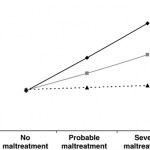
I wanted to draw attention to a new paper in JAMA recently because it reveals a lot about how conditional most of the statements we make in behavioral genetics are. Every time you hear a news article that says, "Gene for depression found," I want you to think about this case.
Risch et al. performed a meta-analysis on 14 studies that were looking at Serotonin Transporter (5-HTTLPR) genotype and number of stressful life events. These two factors were related to the subsequent risk for developing clinical depression. Their analysis found -- contrary to a very well known study, Caspi et al…
So Notorious has been a neuroscience student for a long, long time now, and he was cleaning out the (metaphorical in his case) attic the other day and realized he has a lot of extra notes lying around collecting dust. In what will no doubt be a vain attempt to not just toss them, he has decided to write some of this stuff down as an extended primer to the basics of neuroscience.
So here goes. The basic of the very basic: what types of cells is make up the brain? What do those cells do?
There are four types of cells that compose the brain -- that is aside from the cells that make up…
This guy is awesome. In fact, this guy makes me wish that awesome was a verb, so that I could say that "he awesomed around like there was no tomorrow."
Pop Sci reports that Carlos Owens of Wasilla, Alaska built his own 18 foot tall robotic exoskeleton in his backyard because...you know...he can. He acknowledges that it may have legitimate applications for the military or construction, but this ignores it's primary function: terrifying the villagers! Owens needs to work on his evil laugh. Muahahaha!
(Side note: the above clip is from Dr. Horrible's Sing-a-long blog which is both…
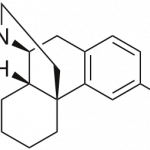
Notorious was having a little conversation with some friends, and someone asked a strange question: why would one want to abuse over-the-counter (OTC) medications such as Robitussin? OTC cold medication abuse is pretty common and the subject of considerable comment in pop culture -- not the least of which are a great song by MC Chris ("The Tussin") and one of the funniest clips in the show South Park ever (below the fold). The question wasn't so much about why those crazy kids do what they do, but rather what is the pharmacological mechanisms behind its effects?
So I wanted to write a…
Hi all! I wanted to take a moment say hello, and say how honored I am to join Sci and Evil here at Neurotopia. Some of you may know me as Jake Young formerly of the Pure Pedantry blog. Some of you, I may be writing to for the first time.
In either case, I am looking forward to talking about some fun neuroscience with all of you. Posting will be kind of sporadic because work is rough, but hopefully we will have a chance to really delve into neuroscience and medicine.
A note about the pseudonym: yes, I know that you know who I am. Yes, I am comfortable with that being an open secret…
Hi everyone,
I apologize for my long hiatus from blogging. Things have just been crazy at work lately. All the same it has given me some time to think about what I want from blogging, and where I see myself in the next several years.
For those of you who don't know I am an MD-PhD student which means that when I finish my PhD -- hopefully in about a year -- I will return to medical school. Anyone who has written a dissertation or gone through 3rd of medical school will tell you that neither are particularly conducive to large amounts of free time. So looking forward I have to take into…
Razib and I have a discussion up at Bloggingheads.tv about genetics and behavior as well as a brief discussion of neuroeconomics. Check it out below the fold:
There is a fascinating case study in Current Biology.
de Gelder et al. discuss a patient -- referred to as TN to protect his privacy -- who had two sequential strokes that damaged his brain. The parts of the brain that were damaged included the primary visual cortex in both hemispheres -- rendering the patient blind. However, the patient could still respond to some visual stimuli through a phenomenon called blindsight.
Even more interesting, the patient could still navigate around visual objects, while reporting being unable to see them and having no memory for what they were.
I have…
I don't think I am alone in saying that I often feel a little envy and schadenfreude towards my peers. Science is a particularly competitive business with few remunerative rewards, so a lot of my self-worth is tied to comparisons with my peer's successes and failures. I won't deny being envious when someone gets a Science paper. And while seeing the abject failure of my peers isn't high on my list of priorities, I won't deny the small satisfaction that I get when someone who breezed through their PhD gets taken down a peg.
These aren't happy-joy-joy emotions. They don't make me swell with…
A study discussed over at Live Science confirms what I have always suspected:
An eight-year study of 218 couples found 90 percent experienced a decrease in marital satisfaction once the first child was born.
"Couples who do not have children also show diminished marital quality over time," says Scott Stanley, research professor of psychology at University of Denver. "However, having a baby accelerates the deterioration, especially seen during periods of adjustment right after the birth of a child."
An unrelated study in 2006 of 13,000 people found parents are more depressed than non-parents.…
The title of this pre-publication paper is, "Evidence on the emergence of the brain's default network from 2-week-old to 2-year-old healthy pediatric subjects." The authors put kids in functional MRIs to measure resting state activity and detect the emergence of the default network.
While I am certain that it is very interesting research, I have a more technical question: minus sedation, how in Heaven's name did they get the kids to sit still long enough to collect the data? An fMRI is hardly a crib decorated with puppies and ducklings. You feel like you are about to be shot out of a…
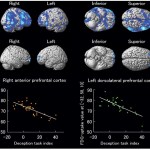
Neurological diseases can be strange in that they often have additional personality effects. If someone gets a cold, they sneeze a bunch but are basically the same person they were before the cold. In contrast, meningitis can include mental status and personality changes in its early stages -- including irritability and sleepiness. When a disease involves the brain, it can change who we are in addition to making us sick.
In this vein, I found this paper in the journal Brain particularly interesting. Abe et al. report that Parkinson's patients tell fewer lies than controls in a task where…
Nature Clinical Practice Neurology has a salient article on ethics and medicine. The article asks the question: is it ethical to confront an individual with whom you do not have an official doctor-patient relationship, if you think they have a medical problem? Should you or should you not tell them if you see a medical problem?
Neurology is unique among the medical specialties in that much of the clinical examination can be appreciated visually and taught by use of video recordings.3, 4 Since 2003, we have conducted a 'neurological localization course', during which participants are…
It's amazing what the kids are up to these days.
This one comes live from Mount Sinai (my present educational residence). Hubner et al., publishing in Science, use an infectious, fluorescent strain of HIV to watch the virus move from one cell to another. Their results are fascinating and may help us develop better ways to treat the disease.
(Full disclaimer: This research was performed in the Chen lab at Mount Sinai where my roommate presently works.)
It's funny how my biases work. I mean, I am not a microbiologist, but here is the bias that I had about how infections like HIV work: I…
What you think about during sex matters.
A guy who doesn't want to, ahem, proceed too quickly will think of baseball or something non-sex related. A girl who wants to proceed more quickly might focus on surrounding milieu of a loving environment. These are stereotypes, I know, but the fact that we have them does confirm that what we think about during sex matters: what we attend to changes the nature of the experience.
In this vein, Mind Hacks links to a great review of the role of attention in sex. Vaughan makes the point that we tend to view sexual dysfunction as a problem of…
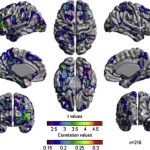
Numerous studies have attempted to correlate general intelligence with different anatomical measures. (You might even argue that the phrenologists were working in this vein.) Likewise many studies have attempted to relate intelligence to the function of different brain regions -- using techniques like fMRI or PET scanning. However, relatively few studies have attempted to correlate general intelligence with anatomical features of particular brains regions.
This is important because we know that the brain works not as regions operating in isolation, but as a set of neural systems…