

Introduction: A wise friend has told me more than once that "child development is not a linear process." For example, teeth come in batches, often in fours separated by a few months of non-teething. As another example, just because Minnow is sleeping peacefully in her crib as I started to type this doesn't mean that she will be a peaceful sleeper the next night. As a matter of fact, our journey toward the mythical sleeping through the night* has been anything but peaceful...and anything but linear.
Null Hypothesis: Child development, specifically duration of night-time sleep, is not a linear process.
Methods: The experiments consist of a time-series of observations on a single female infant, born January 26th, 2007. Treatments have consisted of co-sleeping, the no-cry sleep solution, an elimination diet to reduce allergens, and alternating periods of father and mother trying to put the infant to sleep, but never allowing the infant to "cry it out." The infant has been exposed to an irregular series of changes associated with normal child development, a cross-country move, and her mother's return to full-time work. There is no control infant, but meta-analysis of parenting literature and qualitative polling of other parents was conducted. (In non-technical terms: We've been co-sleeping with Minnow since birth, and we've generally been pretty happy with it, although it does have it's occasional down-sides. But with my work demands and desire to to stay up past 8 pm most nights, we've been trying to get Minnow to go to bed for the night in her crib. Then when she wakes up I generally bring her to bed with me.)
Results: After a period of 10 months, the infant still wakes up fairly quickly, and sometimes refuses to be put down at all.
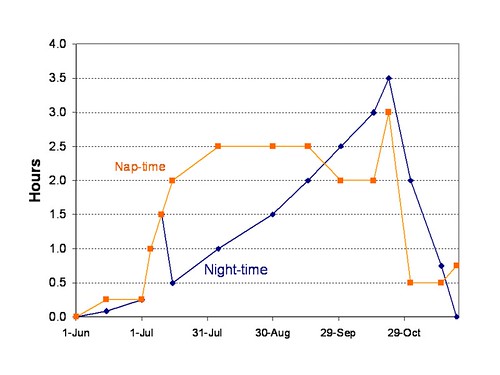
Figure 1. Day-time and night-time sleep of a single infant, excluding motion-induced car-seat sleep and sleep with a parent. Notice the non-linear progression.
For a while this fall, we were making progress. I could actually get most of a lecture written while she was asleep on her own. But in the last few weeks we've experienced a reversal of fortunes for reasons that aren't all together clear to us (it's not teething). Naps have also gone downhill, and we've become increasingly dependent on her falling asleep in the car on the way home from daycare, just so she gets one nap per day. (Those car-induced naps are not included in the figure.)
Discussion: An meta-analysis of the literature and informal polling of other parents suggests that the infant should be capable of sleeping much longer periods. Some other researchers suggest that infants as young as 3 months are sleeping through the night. We're not entirely sure how to get future night-time data to have a consistently upward slope, but we hope that the end of the semester will provide me with some additional energy to focus on the problem. In the meantime, I've had 75 minutes of free night-time time in the past 3 days. 45 minutes were spent on housework and 30 minutes were spent reading email.
Conclusions: The study infant differs statistically signficantly from the average infant in her age group in terms of sleep duration, and has not exhibited consistent progress in lengthening sleep duration. Something has to change in the infant's environment/stimuli for progress to be made and her mother to survive next semester. The null hypothesis is supported, child development is not a linear process.
*For those of you not in the know, "sleeping through the night" is defined as 5 hours.
Cute post, but man that sleep schedule (or lack thereof) stinks. You probably don't want all kinds of unsolicited advice, but I'll pass this on from my mom anyway (she gives great advice for these kinds of problems, having raised 7 kids). I've heard her say so many times that you have to be sure not to make nighttime waking periods fun for the baby. Feed them, change their pants, and put them back to bed without too much extraneous stimulation (not necessarily letting them cry it out). You probably already do that though. Anyway, good luck.
While I was in Peru for the adoption of my daughter, we shared a room. She slept in a basket (until I discovered the insects crawling about under the foam mattress, at which point I dumped the clothes out of a suitcase, lined it with towels, and put her to sleep in that). She would fall asleep as I fed her her bottle, and I would then put her down in her basket/suitcase. She would promptly wake up and begin to cry. I would wait for what seemed an interminable time and then give up and pick her up. Finally, desperate, one night I put her down and then left the room to sit in the hallway. I wanted to wait her out, and I set the stopwatch feature of my watch so that I would know how much time had really passed before I gave up. After a time, she stopped crying. To my relief, when I looked at my watch I saw that only a few minutes had passed. What had seemed like an interminable time had been actually a very brief period. So from that moment on, I would put her down, expecting her to cry a little and then to settle down. Within a few days, I could put her down and she would promptly settle without crying. Of course, my daughter was very young. At Minnow's age the 'cry it out' approach may not work because she has developed expectations of her parents that would leave her very upset if they ignored her when she cried.
ecogeofemme: At this point, unsolicited advice is fine. Yes, the sleep schedule sucks, but it actually means I get a lot more hours of sleep than I would without co-sleeping. They just happen to be very interupted hours. What really sucks is the lack of evening awake time for me.
As for "be sure not to make nighttime waking periods fun for the baby" - Minnow *doesn't want* to be waking up at night. She promptly goes back to sleep as soon as she's settled in my arms (or sometimes nursed). She just doesn't want to sleep alone.
Elf Eye: Congrats on your success getting your daughter to sleep (bugs in the mattress, ew!) We've tried brief periods of crying (usually while I'm shutting down the computer and going to the bathroom) to no avail. Our little girl is stubborn on more than just the sleep front.
Being a firm believer in co-sleeping and not crying it out (my daughter moved to the crib mattress on the floor at 15 months so I could go in and sleep next to her when she woke up in the middle of the night - my husband and I have a double bed so co-sleeping at this point can't be more than two hours or so or my arm falls asleep) I'll offer my trick - have you tried laying down in the bed with Minnow nursing (side-lying position) and then just slip the nipple out once she's asleep and slide quietly out of the bed? That way you don't move the sleeping child, and she still gets to fall asleep nursing.
No advice, just sympathy. My son and I could never manage to co-sleep - we were both too wriggly. I never got any sleep at all, and he didn't sleep much (and would never nurse while I was lying down). So we moved him to a bassinet/play yard beside our bed until he was, hmmm, maybe nine months? Then we had another nine months of frequent waking and me nursing him to sleep. Then we had another couple years of waking up a couple times per night. And now he usually sleeps all night, but I'll still hear "MOOOOOMMMMMMMMYYYYYY!!!!!" call me out of a deep sleep.
I decided, at some point, to throw all the advice books away. We tried everything (except crying it out). It didn't work. In the end, he got older, and became very fond of his stuffed blue puppy, and learned to fall asleep. But it wasn't easy.
Have you tried a stuffed animal or blanket? My husband and I slept with our daughter's stuffed animal and blanket for a few nights, to get our smell on it. Then, she uses those items for crib time (at night or during naps). (Of course, this was after she could roll over on her own, and we often take the blanket out before we go to sleep so she doesn't get wrapped up in it). When she wakes up, she still smells us and has something soft to cuddle. I think it has helped cut down the times we needed to get up with her during the night.
If I'm understanding this correctly, perhaps it's because she knows that when she wakes up, she gets to come in bed with you, is where the problem lies. Presumably, sleeping with you is preferable to sleeping alone. So, by taking her to bed with you, you're rewarding waking up. Maybe some sort of comfort item would help her, and/or comforting her while she remains in the crib, assuming she doesn't actually need anything, would be better than taking her out and taking her to bed with you.
check your email for my response.
Thanks for all of your responses. In response to many of you: we have a stuffed puppy that she loves dearly that sleeps with her when she is in the crib. We've also tried comforting her in her crib, but that just produces increasingly frantic screams. As for nursing her to sleep in bed and then slipping away, I'm concerned that she would wake up and fall out of bed if my husband and I weren't there right away. The short sleep cycling isn't limited to when she's on her own - it continues all night long. (grimace) But that's a different scientific study.
I'm hesitant to speculate along these lines, but could the increasingly frantic screams being comforted while remaining in the crib have to do with her knowing that this will get you to take her out, and in to your bed? I hate to suggest it, but here goes, that this may be a situation in which extinction is the best, (I really don't want to say it) only, method of solving this. Unless of course, you consider giving in an option. Since I have my dog sleeping in my bed because I couldn't stand to have him cry himself to sleep, then wake up early in the morning to go out, but just a little too late to go back to sleep after that, I clearly do consider giving in a great option.
But, if you do want her to sleep alone, but are uncomfortable with leaving her crying by herself, maybe going back to staying with her while she goes back to sleep would be better, even if she does produce increasingly frantic screams (and I have no doubts that she will) for some time.
On another random note that I don't think is helpful at all, I work with a child who tends to sleep better when his dog sleeps in his bed. Then again, he's 9, and I wouldn't put a dog in to a crib with a child... especially not one of Minnow's age. Maybe the dog in her room would help, if Princess Pup is a pretty sound sleeper herself.
I agree with Jen...it's so hard but in the long run Minnow will benefit from the longer sleeps. Our 1 year old had a similar pattern but she learned to fall asleep after a quick hug after a few months. It also helped to turn on a humidifier to keep her warm.
No advice but a possible cause - she may be having nightmares. I remember from my childhood having very bad nightmares and wakign up and wanting to be with my parents (and I had a very happy childhood so I don't know what caused the nightmares - I like to think it's because of my extreme intelligence. I have no reason for this correlation - it just makes me feel better.) I also suffered from insomnia which I now speculate came from the nightmares. When I was older (2-3 years) I had a pony that I would get up in the middle of the night and ride.
I had trouble with the infant that stays with me during the day - she would not, could not fall asleep on her own. Her parents not only wouldn't let her cry it out, they wouldn't let her fall asleep on her own in her bed - and they weren't cosleepers, they just preferred to rock her to sleep. Which I totally understand, since she's cute as a bug... but after six or eight months of this, it got tiresome, and they felt like I imagine you do.
Anyway - I couldn't handle it, with multiple other kids floating around needing attention, so I just started to put her in bed and let 'er scream, rubbing whatever body part was up and talking to her about anything and everything in a quiet voice. I never left her alone, and I never quit talking - I think one day I recited poetry to her, just so she knew I was still there. My arms would go numb from leaning over her crib and patting her backside while she flailed around and howled... but eventually, it started to work, and now she'll pass out after about a minute of the butt-pat. It's hard, because even though she isn't mine, my first response was always to pick her up and love on her, even though the up-down-up-down thing was just prolonging her awake time. I guess this goes along with the "comfort her in the crib" technique that a few others have mentioned, but for what it's worth, it totally worked with this kid.
This may freak you out, I hope it doesn't. F1-3 did not sleep through the night until she was 2 years old. I did not sleep more than about 2-3 hours in a row for more than 2 years (she made it hard to that during the last 6 weeks of my pregnancy too). Eventually she did start sleeping through the night, but now that she is potty-trained, I still have to get up several times a night to let her go to the bathroom. I had about 4 months decent sleep, now I'm back to shorter stretches. I tried everything you could possibly imagine. The only thing I could not, would not try, is to let her scream. I figured there is a reason she is crying. I don't know what it is, but I will not send my daughter a message that she can scream as much as she wants, but I will not listen. I just could not.
The thing that did help, is a very specific routine, one that never varies of bed time ritual. Take a warm bath, clean clothes, brush teeth, read book, sing a song, dance to the lullabies, a sip of water, bug hug for mommy and daddy, then tucking in, more hugs and kisses, and then we let the room. We have 3-cd changer in her room, which continuously replays the 3 cd's with lullabies we have in there (we rotate them out frequently). The volume is very low, but the idea was that the sound would be comforting to her when she wakes up, and have less trouble going back to sleep. Her problems of not sleeping through the night were also related to her sharing a room with F1-2, and they could keep each other awake. It's better now, but still not perfect.
This post cracked me up. Mostly because the non-linear development of Bean's sleep has been on my mind lately.
Also, you've been tagged. See my blog for details...
Ahh, the wonderful world of child rearing advice. Barely a solid datum to be found. Anecdotes advanced as TheGospelTruth (usually by M-in-law or GrMom). Absolutely maddening for a scientist parent I can tell you.
Okay so here's my anecdotal advice. That sleeping through the night thing is overrated. People who think they "know" how to make a child alter sleeping patterns are (excuse the offense) full of crap. Why?
Spawn the Eldest was a not atypical baby with one good solid chunk of sleep of 4-5 hrs with much "bad" sleeping (waking mom to nurse and dad, just 'cause) for the balance. we did a bunch of the supposed tried and true. a whole bunch. didn't work. (napping also went poorly with much stroller riding and car riding to initiate sleeping. ) yet, by about age 2.5, SpEld magically started sleeping like an absolute log. still does.
Spawn the Middle was similar except without the easy early-night aspect. Learning our lesson from the Elder, we just opted for do-middle's-thing from the get go. still waiting for log-like sleeping on this little delight..
Spawn the Youngest broke the mold. good sleeper for the most part. would actually put self back to sleep upon waking up. would go to sleep alone in crib. could even cry a bit to sleep (instead of escalating into screaming fit, as with the prior two) much, much less dependent on nursing to sleep.
I conclude the following. The kid is going to do what it is going to do. Some will be easily Ferberized. sure. some will respond to various versions of mother-in-law advice. sure. and Some. Will. Not.
You are not a failure as a parent if your kid isn't "sleeping through the night".
yes it is inconvenient. and sleep deprivation turns you into a gibbering idiot. this will pass. you will survive. and you will have a properly adjusted kid instead of whatever psychopathology Ferberizing produces (hmmmm, research project anyone?)
Like others have posted, this will either make you feel better or run screaming. But *neither* of my children 'slept through the night' until 18 months. And they didn't do it consistently until 2+ years. And the 4 year old doesn't 'sleep through the night' 7 days in a row even now (but at least he will easily go back to sleep once he's woken us up and led back to bed).
We co-slept, used a crib, had baby in our room, had baby in her own room, etc. And the only thing that really worked was the non-dairy diet and time. I think we feel like we should be doing Something in these cases, and we just can't, so we feel terrible. Kids are kids and it's just hard sometimes...
Will the baby sleep if you're holding it? While my son generally starting sleeping through the night by five months, he still would sometimes have those tougher nights. Our strategy was there was no reason for both of us to lose sleep at the same time. When he woke up screaming for non-feeding reasons, I would hold him and let him sleep while I sat in a chair in the living room. That way mommy could get a few more hours of straight sleep before the next feeding. I still have to do this sometimes (he's now 19 months old) when he's really sick and has problems sleeping lying down. We never did co-sleeping though (we would always put the baby in the crib or one of us would sit with him), so I don't know how attached your baby is to having both parents nearby.