

 SW Notes: This post was begun a few weeks ago...you know, in the break between semesters. But I've been delayed and delayed in getting it done, and today is a day of metaphorical desk-clearing. So I'm just going to put it up now, half complete and let you all finish discussing it in the comments section.
The scene: My car insurance office
Insurance agent: You work at Mystery U.? You're on break now for a couple weeks, right?
ScienceWoman: Well, sort of. Classes start back up in mid-January, but there's lots of work to be done before then.
Insurance agent: Oh.
That scene is hardly unique in or to my life. University employees seem to constantly battle the perception that we only work when classes are in session, and maybe we only work for the few hours a week we are actually in class.
Here at ScienceBlogs, the readers and bloggers are too smart to believe that sort of nonsense, but still as I approached Christmas with an appalling to-do list, I found myself wondering whether I was the only one who wouldn't manage to take a vacation during the time between semesters. So I asked you all to respond to a simple survey, so that I could quasi-scientifically gage the work habits of grad students, post-docs, and teaching faculty.
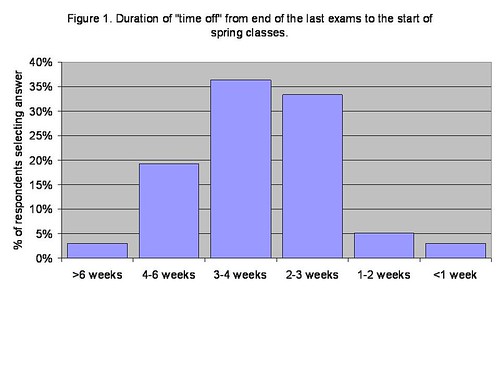
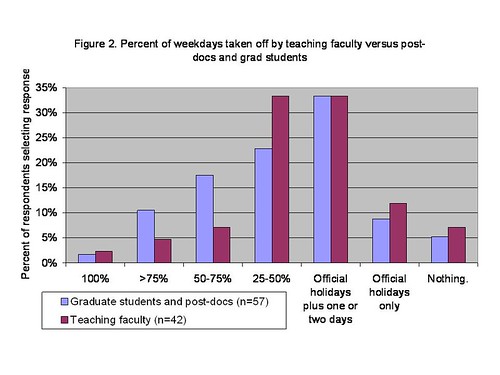
It turns out that I'm right with the rest of you. Though the median time between the last day of fall exams and the first day of class spring semester is 3 to 4 weeks (Figure 1), most of us are taking less than half of those weekdays off (Figure 2). On average, faculty report taking a bit more time off than graduate students and post-docs, but I wonder how much of that reflects faculty being more likely to have children out of school on vacation.
Figures below the fold.
Click to embiggen the pictures in Flickr.
Note: Yes, I know these are horrible default Excel graphs. Live with it.
Note: Yes, I realize there are several methodological problems with my survey questions. They became quite obvious as I graphed up the data. But that's what you get when you're doing a survey "for fun" and with no training in how to properly ask these sorts of questions. In any case, I still think the results are comforting revealing normalizing of my experience.
The perception that people who work in academia take exceptional amounts of time off is a component of popular anti-intellectualism. "We work for a living", Joe the plumber, etc.
My dad was a prof - faculty is a dangerous place for a workaholic.
Faculty often think support staff loll around during breaks too. One said to me; "It's nice they let you work over the summer" - our busiest time making new platform builds, installing new computers, rebuilding 450 computers, repairing A/V, etc. Same thing over winter break, I'm usually exhausted by the time the semester starts.
Highway workers probably get it the worst, though. Lots of jokes about one guy digging, five guys standing. A selection bias since we'll only notice them when they are standing.
I was raised on a ranch, where the animals own you and demand your attention every day. So I never really understood the concept of a vacation. In fact, I do not like the concept. Being a professor, I was, of course, doing what I wanted to do. So I did not like to go away from doing the things I wanted to do to go somewhere and do something I really did not care about. My wife is not in complete accord with these views. Now that I am retired, with sufficent advance notice, I can fit a vacation in without much trauma.