


Thank you to all the writers and commentators who contributed to this network. Happy trails.
An archive of my work for ScienceBlogs exists here: 314vault.wordpress.com.
If I post anything else on the internet it will be at medium.com/@k4lk1/ or twitter.com/k4lk1.
In the meantime I'm getting out my ink and quill.
Happy Halloween!
Life has been growing on Earth for about 4 billion years, and during that time there have been a handful of mass extinctions that have wiped out a large percentage of complex lifeforms. Asteroid impact, volcanic eruption, climate change, anoxia, and poison have dispatched untold numbers of once-successful species to total oblivion or a few lucky fossils. Species also die off regularly for much less spectacular reasons, and altogether about 98% of documented species no longer exist.
Cry me a river, you say, without all that death there would have been no gap for vertebrates, for…
This is a story with a happy ending, or at least a happy middle, because it isn’t over yet. Right after it began I found myself floating face down in the water, drifting very slowly with the current, trying to stand but hardly able to move my legs. Trying to swim, but unable to move my arms. One Mississippi two Mississippi three Mississippi four. I waited for my dad, standing a few feet away, to notice something was wrong. But as a younger person I had often played dead in the water, daring someone to be alarmed. Finally I turned my head to the side, my lips…
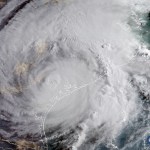
Hurricane Harvey visited a near-biblical deluge upon Houston, dropping over 40 inches of rain on parts of the city. The situation resulted from warmer ocean waters, more moisture in the atmosphere, and Houston's geography along with its preparedness for the disaster. Greg Laden shows hotter sea surface temperatures in the Tropics and the Gulf of Mexico allowed Harvey to gain extra strength as it formed and re-formed on its way to the United States. In another post, Greg asks if Houston's infrastructure could have been better-prepared for this type of rainfall, suggesting that "Houston is…
"Who fears or rejects vaccines, why do they do so, and how might we reach them to change their minds?" On Aetiology, Tara C. Smith answers these questions with a new paper written as a primer for those who want to stand up for vaccination. She says, "for many individuals on the vaccine-hesitant spectrum, it’s not only about misinformation, but also about group identity, previous experience with the health care field, and much more." The stakes of the vaccine debate are high. On Respectful Insolence, a mathematical model from Stanford shows that slight dips in uptake of the MMR vaccine would…
On Class M, James Hrynyshyn shows us how climate change will benefit the economies of some U.S. counties while damaging many others. This mostly has to do with location; coastal areas and southern latitudes are more threatened, with Florida poised to suffer worst of all. James writes, "we're not just talking about polar bears anymore. It's now about jobs, wages, infrastructure, crime." Meanwhile, William M. Connolley reports Antarctica's Larsen C ice shelf is 12% smaller due to a giant iceberg splitting off and heading (presumably) toward Miami. Greg Laden says denial of global warming has…
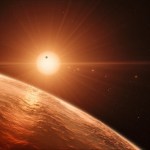
In February, exoplanet hunters announced the discovery of seven rocky planets orbiting a star called TRAPPIST-1 only forty light-years away. Compared to our sun, TRAPPIST-1 is tiny, and all its planets orbit closer than Mercury orbits Sol. But three of them are still in the Goldilocks zone that could be "just right" for life, and all seven planets could theoretically hold liquid water. While Ethan Siegel introduces the neighboring star system with spectacular illustrations from NASA and ESO, Greg Laden notes that the practice of saying these images are artistic interpretations "has…
Outrage at Donald Trump has coalesced around several political loci, including women's rights, immigration, environmentalism, and scientific endeavor at large. As Trump threatens to roll back regulations and de-fund universities, Mark Hoofnagle points out that science has always been political, increasingly so in an age when politicians control huge sums of money devoted to basic research. Despite major discoveries funded by taxpayer dollars, Mark says scientists have failed "to explain the benefits of basic science to the public and to our representatives in government, and failed to defend…
Donald Trump continues his blitz to fulfill all his campaign promises at once, leaving snowflakes aghast and deplorables cheering for the proto-fascism on parade at The White House. On International Holocaust Remembrance Day, Trump issued a statement "in the name of the perished" without any reference to Jews or anti-semitism, and while his Chief of Staff spun this omission a sign of inclusivity, Mark Hoofnagle writes on Denialism Blog that "this is part of a long history of Holocaust denial, in which the experience, memory, and truth of Jewish survivors and victims is diminished and denied…

In the latest of a series of appointments that are poised to contravene scientific and medical consensus, Donald Trump met with anti-vaccine advocate Robert F. Kennedy Jr. for the purpose of forming a commission on "vaccine safety." On The Pump Handle, Kim Krisberg says "Kennedy is a lawyer — not a scientist, doctor, child health expert or public health practitioner" yet Trump wants to charge him with "reviewing the safety of one of the greatest life-saving tools of the 20th century." Like Kennedy, Trump says that vaccines can cause autism, and as Orac notes on Respectful Insolence, "compared…
Despite a greater percentage of people knowing about (and agreeing with) scientific issues, denialism remains a powerful political and psychological force that threatens to have its heyday under President Trump. As Peter Gleick writes on Significant Figures, "good policy without good science is difficult; good policy with bad science is impossible." Peter asks: what is the best way for scientists to engage the republic? Through testimony? Social media? Pop star status like Sagan, Bill Nye, and Neil deGrasse Tyson? Or is the open letter an effective form of public outreach? Meanwhile, on…

Serving as an immediate prelude to the very first Star Wars film (A New Hope), Rogue One restores a measure of gravitas to the Star Wars canon that was seriously undermined by the goofiness of 2015's The Force Awakens. Rogue One is still a remarkable nostalgia trip, thanks to the digital recreation of familiar Rebel and Imperial hardware along with the likenesses of actors who first appeared in the original 1977 film. But without the need to consider future franchise opportunities for its stars, Rogue One is free to kill off all of its major characters, marking a narrative structure that…

A few scientific papers are retracted after they're published, such as this analysis of nuclear energy that appears to have been nixed for poor methodology and bad numbers on Stoat. William M. Connolley adds that because of the politics surrounding nuclear power in Europe, "this crude level of analysis would be unlikely to be useful." But on Respectful Insolence, Orac looks at an anti-vaccine abstract that was so awful the publisher decided to take it down before the paper could be published. Orac writes, "basically, this paper is crap, so much so that even a predatory open access publisher…

The election of Donald Trump to the Presidency of the U.S. caught nearly everyone by surprise, and fingers were immediately pointed in all directions as the election's losers looked to lay blame. Chad Orzel offers one relevant narrative: "There are a lot of people who feel like they’re being screwed by a system run for the benefit of people in big cities on the coasts who sneer at them as ignorant, racist hicks." Ethan Siegel extends an olive branch on Starts With a Bang, saying "we all have our biases, even if we ourselves are scientists," and encourages EVERYONE to accept the responsibility…

Today is about American tradition, and feeling grateful for all that we have been given. The first Thanksgiving represented the gratitude of American settlers towards the indigenous peoples who originally inhabited this country. It is about the men and women who came to North America on the Mayflower giving back to the men and women who helped them to survive in the 'new' world. It is about Tisquantum, a Patuxet enslaved by a Briton, sold in Spain, liberated by monks, and steeped in the English language before returning to his homeland and teaching the colonists to "catch eel and grow corn."…

The new film Arrival, based on a story by Ted Chiang, is unlike most any science fiction blockbuster at the box office these days. It's a tense, thoughtful, somber meditation on the human condition and the nature of a higher reality. In many ways, it is a religious film that deals with eschatology (the end times or judgment day).
Unlike Chad Orzel, I haven't read the source material, so I experienced the film with fresh eyes. I was immediately reminded of Philip K. Dick and his real-life experience of being 'touched by an angel.' Dick, both a life-long Christian and prolific author of…
On Aetiology, Tara C. Smith explores the story of Gaetan Dugas, a man who was long blamed for precipitating the AIDS epidemic in the United States. The vilification of Dugas had nothing to do with science; instead he was dubbed "patient zero" in a misinterpretation of his study moniker "patient O" (for Outside). Dugas' portrayal in the media turned him into a modern Typhoid Mary, but he was not an originator of the U.S. epidemic, as a 2007 molecular analysis proved and a new paper in Nature confirms. Smith writes "This is the real scandal and lingering tragedy of Dugas. His story was used to…
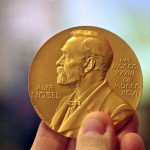
On Pharyngula, PZ Myers examines the work of Yoshinori Ohsumi, who was awarded the prize in Physiology for his studies of autophagy in yeast. Autophagy, or self-consumption, is a strategy used by all cells to recycle malfunctioning bits of themselves, or to survive during times of starvation. But autophagy is also involved in cancer metastasis and may play a role in other diseases such as Parkinson's. Meanwhile, the Nobel prize in Physics did not go to LIGO and the observation of gravitational waves as widely expected. Instead it was divided between three individuals for "theoretical…

The European Southern Observatory made major headlines with their discovery of an Earth-like exoplanet orbiting our nearest neighboring star. On Dynamics of Cats, Steinn Sigurðsson writes: "ESO researchers, using the radial velocity variability technique, have detected a quite robust signature of a planet with a mass of 1.3 Earth masses, or more, in a 11 day orbit around Proxima Centauri." The planet is within the red dwarf's habitability zone, but we don't yet know if it harbors an atmosphere or liquid water. Greg Laden writes "now that we have an Earth-like planet in our sights, perhaps…
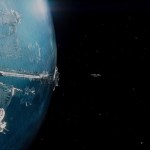
The centerpiece of the latest Star Trek film is a bright celestial bauble, a tremendous re-imagining of a Federation starbase, named Yorktown.
Yorktown is on the scale of a Death Star, but instead of incinerating worlds it is presumably dedicated to a lot of peace-mongering bureaucracy and some very nice apartment buildings. To quote Memory Alpha, "Yorktown's structure consisted of a matrix of city-sized interlocking rings and radiating arms enclosed in a spherical translucent surface; Enterprise doctor Leonard McCoy likened it to a giant 'snow globe' in space." At the center of it all the…