

Who is correct here? We don't know, you don't know, it is uncharted territory. Would you bet the entire human history and the existence of our solar system on it?
I wouldn't.--from a user comment on my old website on the topic of the Large Hadron Collider

Back when all the hype and hoopla concerning the LHC startup had people afraid that the Large Hadron Collider would create a black hole that would eat and destroy the Earth, I tried to quell some of these fears. At my old site, I wrote three articles explaining why the Earth was safe, and why -- even if the worst-case scenario came true -- we'd be completely fine. And I had forgotten about it, until last night's Daily Show came on.
| The Daily Show With Jon Stewart | M - Th 11p / 10c | |||
| Large Hadron Collider | ||||
|
||||
I had completely forgotten that Walter Wagner -- the crackpot at the center of the media firestorm -- participated in a spirited discussion on my old site. Thankfully, John Oliver was able to show how absurd this man and his contentions are.
But even with that, I was unprepared for this fallacy of an argument that came out of the interview:
John: So, roughly speaking, what are the chances that the world is going to be destroyed? One-in-a-million? One-in-a-billion?
Walter: Well, the best we can say right now is a one-in-two chance.
John: 50-50?
Walter: Yeah, 50-50... It's a chance, it's a 50-50 chance.
John: You come back to this 50-50 thing, what is it Walter?
Walter: Well, if you have something that can happen and something that won't necessarily happen, it's going to either happen or it's gonna not happen. And, so, it's kind of... best guess at this point.
John: I'm... not sure that's how probability works, Walter.
Yikes. Let me recap some major physics points, so that you understand what's going on, and why there's nothing to be afraid of. Let's take a look at our current understanding of physics. We have:
- three spatial dimensions,
- an extremely good and well-tested understanding of quantum mechanics,
- probed and established the known laws of physics up to energies 120 GeV (the equivalent of temperatures of 1,400 trillion degrees Celcius), and
- a very good understanding of how large black holes are formed and grow.
Most of the work establishing the particle physics understanding was done at Fermilab, a place where I've visited, spoken at, and even worked at for a brief time.
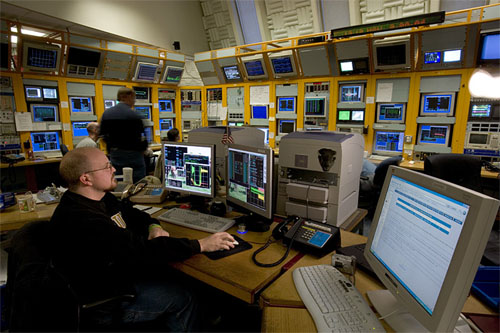
Now, let's go through what would need to happen at the LHC to create this doomsday scenario. First off, the honest truth: the LHC is going to achieve higher energies than Fermilab ever did. There are some very speculative papers out there that say that it is not completely ruled out that it's physically impossible to have extra dimensions at those energies. It is extremely unlikely and there's no evidence for it, but it hasn't experimentally been ruled out, because we haven't done the experiment. I wouldn't say there's a one-in-two chance that it's possible, but there's a small but finite probability that there are extra dimensions accessible at these energies.
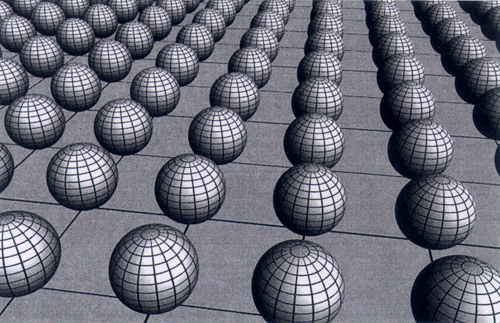
So if there are extra dimensions, it is conceivable that they could be of a specific type allowing the (again, very rare, but plausible) formation of a microscopic black hole. This black hole will have, at most, a mass equal to the energy of the proton-proton collision, or 2.5 x 10^-20 grams. Wow, that's a tiny, tiny, tiny black hole! Again, not a one-in-two chance, but not completely impossible.

But, even if you have extra dimensions of the right scale, and of the right type, and you make this black hole, you still have a problem: it's unstable. Due to the laws of quantum mechanics, this black hole is going to decay by a process known as Hawking radiation. For a black hole of mass 2.5 x 10^-20 grams, the decay time is about 10^-84 seconds, which is not even enough time to exist! For physics to be meaningful, we need a time of about 10^-43 seconds or longer. Translated into black hole mass, we'd need it to be at least 0.00002 grams to have even a chance of existing. To overcome this, you have to throw out the known laws of physics. These laws are so well-established that it's inconceivable that they'd be wrong -- it would be like waking up tomorrow and seeing the Sun rise in the West. This is where the zero-probability argument comes in. But, for argument's sake, let's assume there are some new laws of physics that we haven't conceived of yet that could make these black holes stable. Let's assume we make them, and they just fall through the center of the Earth and start eating whatever matter it encounters. What will happen?

Well, you can compute the rate at which this black hole will eat matter. Assuming it eats every proton, neutron, or electron that it comes in contact with -- and also taking into account its gravity, to see what it attracts -- it will eat about 66,000 protons and neutrons per second. That rate will be constant until the black hole becomes quite large; at about one billion metric tonnes, the black hole will start to grow faster. Capturing 66,000 nucleons per second, how long will it take to get the black hole up to even one kilogram? Three trillion years, which is much longer than the lifetime of the Sun or even the age of the Universe. So even if you make a black hole, and even if the laws of physics that we know are wrong and it lives forever, it is still harmless. So the Earth will still be okay.

So now you know what happens in the worst-case scenario, and now you know why we're safe. Moreover, you know that there is a zero probability that the Earth will be destroyed and eaten by a black hole. And a special thanks to my loyal reader Landon -- in an earlier time zone than I am -- for urging me to watch the Daily Show last night!
Nice!
I did this as a back of the napkin type calculation a few times on a few different forums to show that even if a black hole was produced it isn't big deal.
Thanks, nice to see I wasn't completely off.
Damn! There isn't even enough power in that black hole to even pull out a nose hair.
Fantastic writeup, Ethan.
I think Wagner file suit against Brookhaven National Laboratory to prevent them from using their Relativistic Heavy Ion Collider back in 1999. The guy is a total crackpot.
Great article. Aren't there Cosmic Ray collisions in the upper atmosphere that exceed that which will be obtained in the LHC?
There is even a huge assumption when you got the 66000. There is a nice paper which I have lost, that give interaction cross sections for micro black holes (in the alternate universe where they could exist) and concluded that given a few hundred TeV black hole you would essentially never interact with normal matter, on order of millions plus years. Of course what the heck, the event horizon is much smaller than proton radius, so it probably could sail right -through- a proton and maybe miss everything...
Nice article except the following quote which seems a bit strong considering physicists polled in 2004 had an average 10% doubt that Hawking Radiation would be found to exist.
"...this black hole is going to decay by a process known as Hawking radiation... These laws are so well-established that it's inconceivable that they'd be wrong --".
Perhaps the odds of danger are extremely low, I don't know, but I do know that Hawking Radiation being wrong is conceivable at least by several physics PHDs who published papers stating so.
Great blog! Bounced here from 'Pharyngula'...will be a regular reader. Already learned a lot. Thanks!
Nice recap of the science Ethan. But the most entertaining part was reading the exchanges between you and the End of the World folks over your previous posts. Epic!
My Daddy always told me, "you can't fix stupid."
"Would you bet the entire human history and the existence of our solar system on it? I wouldn't." ... s/he says, while driving a gas-guzzling SUV and eating fast food out of styrofoam containers, making no effort to change her/his ways, putting the idea of iceless Arctic summers out of her/his head... Suddenly we're not so concerned about the future of life on Earth, are we?
A group of physicists who actually know what they're doing doesn't worry me too much. There are more pressing matters to deal with.
Love this blog!!!
So you trust the physicists to judge how likely HR is to exist, but when the self same people then say that μBHs are infinitesimally likely to ever be formed anywhere, then they cannot possibly be right. So which is it? Do the physicists know what they're talking about or not?
Thanks for the great post, Ethan. Very nice to have the math explained. I've really been enjoying your blog here. Keep up the great work.
"Admionistrator, LHCfacts" said:
Which is another way of saying that there is an average of 90% certainty of Hawking Radiation from the survey. It should also be pointed out that such a survey is at least 5 years old, and there has been progress in physics since then.
Any comment as to why the Earth is still here since the planet has been routinely hit by particles possessing far more energy since it's formation? I saw the statement on your site, but they seem to be dodging the issue by assuming that the cosmic rays don't have any impacts.
Or how about the rate at which a black hole will grow, as mentioned above? I personally don't think it's likely for me (or anyone else) to be on the Earth in a trillion years, but maybe you have a plan to do so?
Finally, since you brought up probability, any comments on how Walter Wagner got his 50/50 estimate? IMO, that bit at the end of the video about the probability of reproducing was hilarious!
It all reminds me of how a small portion of physicists used to think that if fusion was ever created, that it would start a runaway reaction that would destroy the entire planet. IIRC.
"Administrator, lhcfacts.org" == JTankers. Just so you know. He's even hit my backwater blog, and tends to show up anyplace Google points you when you search for LHC.
Per Jim Tankersley's own execrable page (I read it so you don't have to!):
He also, elsewhere on the page, claims that it is a different situation with cosmic rays because they are not "stationary with repect to the Earth", while the LHC is. Beyond being geocentric, it's ridiculous to think that something that could either start eating the Earth from within e.g. a black hole, or something that could turn the planet into strange matter, would by necessity have to be geostationary and couldn't start the process while flying through the planet (and since it has nearly no mass, likely end up trapped by the planet anyway).
Sigh.
Could you explain why the rate of nucleon consumption by a micro blackhole would remain constant until the hole was about a billion metric tons?
Ben,
Yes. A micro black hole is tiny. Very, very tiny, and by that, I mean much, much smaller than a proton. As long as it's smaller than a proton, it's got roughly the same probability of striking a proton.
The three things that determine interaction rate are: density, cross-section, and velocity. The density of protons in the Earth is constant, the cross-sectional area for interaction is the same (because the cross-section of the black hole is negligible), and the velocity of the black hole with respect to Earth is roughly constant (determined by the Earth's motion). The first thing that starts to change is the cross-section of the black hole, but the black hole doesn't become comparable to the size of a proton until it's about 10^12 kilograms, or a billion metric tonnes.
There are definitely four documents in the media
which show that CERN representatives make
a zero risk statement, when they refer to the LHC experiment.
However there are other documents in the media which show
that there are scientists who say that the risk is not exact zero.
This is an important scientific contradiction {inconsistency}.
It cannot be that the contradiction continues
before exceeding the energy limit
of 2 TeV at the LHC experiment. - There should
be created a regulation for this and the further
cases like LHC (see Nick Bostrom).
Rudolf,
That's why you have to decide whose opinion counts. I've shown you a little bit of math and science that leads you to the conclusion that the risk is zero. Since this is what other people in my field (theoretical physics) have concluded, I tend to side with them.
The nice thing about theoretical physics is -- if you know what you're doing -- you can just figure it out for yourself. Nick Bostrom is not a physicist, so take what he says on the topic with a little salt.
Ethan, remember that famous line "inconceivable - I don't think it means what you think it does"?
For someone working in a field that had to add dark matter, dark energy and inflation to their preferred model to make the model meet observed data, you tend to be a bit optimistic in the current state of knowledge at times. Doesn't take from the fact that you're right on the black hole danger of course, but it does set you up for a big fall at some point.
Mu,
When the day comes, remember this conversation, and see how well different people handle it.
But the way it's always worked is that there's some unexplained evidence, you make a theory to account for it, and then you try to see what else the theory predicts and you test for it. But I don't think it's fair to throw up your hands and say we have no idea what's going on so anything is possible -- science is kind of the exact opposite of that.
At least, that's how I justify my opinions!
You were the one who wrote it was inconceivable that the laws are wrong ;). I was just cautioning on that, based on 20 years of science experience; I still learned that there is no nucleophilic aromatic substitution, they rewrote the textbooks later.
@Jason Thibeault:
Thank you, but I already read the LHCfacts site. That's why my comment to him was that he seemed to be trying to dodge the issue.
@ Mu:
No offense man, but you're comparing particle physics to organic chemistry? ;)
Mu,
The analogy isn't apt. You're talking about a reaction that people thought was forbidden, and yet there's a workaround. I'm talking about whether quantum mechanics works when space is curved. This wouldn't be a workaround, this would require us to turn off quantum mechanics in certain situations; the laws of nature don't just turn off, and if they do, I will eat my hat. (You will purchase said hat for me to eat; I will prepare and eat it.)
Jason and Zetetic,
Mr. Tankersley and I have discussed this on my old site. He thinks he knows physicist's opinions and conclusions better than I know physics, and we reached an impasse.
@ Ethan:
I suspected as much..... There is no changing some minds. I rather like the term "Morton's Demon" in describing such a mindset.
Even when the LHC has been online and running for years, there will still be those claiming that the next run, will be the one that destroys the Earth. Then it will be the next "Super Collider" that results in fear mongering all over again.
Somethings never change....
The wonderful thing is that Wagner's interesting use of logic is not even the best example in the anti-lhc lawsuit. I was curious enough to look up the documents filed with the Hawaiian court (they're online if you're curious). A Mr. Sancho submitted a document in which he advanced the following argument (from memory - apologies if I miss a step):
1) In a recent poll of physicists, 90% believed String Theory was correct therefore there is a 90% chance of black holes at the LHC.
2) Prof. S. Hawking says there will be Hawking Radiation.
3) Prof. A. Einstein doesn't say there will be Hawking Radiation.
4) Einstein > Hawking, => there will be no Hawking radiation - but lets be generous and give each a 50% chance of being right.
5) Therefore there is a 90% * 50% = 45% chance of the LHC destroying the planet.
I believe that may be the record for largest number of logical fallacies in a single argument. If I'm wrong please don't provide evidence, I don't think my brain could handle it.
Could you elaborate on this calculation a little more? I am especially curious as to when gravitational attraction of the black hole starts to cause an increase in its rate of mass consumption. How do you arrive at the 1 billion metric tonnes figure?
For example, at a mass of 1 kg, the black hole will cause a gravitational acceleration of 1g at a radius of 2.60811093 microns. The escape velocity at this radius of 2.608 microns would be 0.00715340034 m / s. Its been a while since I studied kinetic theory, but I imagine that if the black hole is traversing a fluid, even at temperatures typical of the center of the earth, it would capture a non-trivial fraction of molecules within this radius. Collisions amongst these captured molecules revolving in random orbits around the black hole would cause some fraction of these orbits to decay until the molecules fall prey to it. Fresh molecules outside of its gravitational reach would then rush to take their place because of the pressure drop caused by said consumption, giving it a continuous supply of mass to feed on, etc.
PS: Can black holes carry a charge imbalance and hence cause electrostatic attraction? I'm speculating that a micro black hole swimming in normal matter is unlikely to impact electrons and protons at equal rates.
I posted the following about 35 hours ago, but its failed to appear. So here goes another try with fewer links:
Could you elaborate on this calculation a little more? I am especially curious as to when gravitational attraction of the black hole starts to cause an increase in its rate of mass consumption. How do you arrive at the 1 billion metric tonnes figure?
For example, at a mass of 1 kg, the black hole will cause a gravitational acceleration of 1g at a radius of 2.60811093 microns [Google: sqrt(6.673*10^-11 N m^2 kg^-2 * 1 kg / (9.81 m/s^2)) ]. The escape velocity at this radius of 2.608 microns would be 0.00715340034 m/s [Google: sqrt( 2 * 9.81 m/s^2 * 2.60811093 microns) ]. Its been a while since I studied kinetic theory, but I imagine that if the black hole is traversing a fluid, even at temperatures typical of the center of the earth, it would capture a non-trivial fraction of molecules within this radius. Collisions amongst these captured molecules revolving in random orbits around the black hole would cause some fraction of these orbits to decay until the molecules fall prey to it. Fresh molecules outside of its gravitational reach would then rush to take their place because of the pressure drop caused by said consumption, giving it a continuous supply of mass to feed on, etc.
PS: Can black holes carry a charge imbalance and hence cause electrostatic attraction? I'm speculating that a micro black hole swimming in normal matter is unlikely to impact electrons and protons at equal rates.
Stagyar zil Doggo --
The radius of a black hole of mass 14 TeV/c^2 is what is actually at issue at the LHC. But the capture radius of a black hole is not the radius where acceleration towards the black hole exceeds Earth's surface gravity. The details depend on a model for gravity which is different from that given by General Relativity, and since there is no such evidence for a model, we can't compare likelihoods.
The calculation you actually want to do is one assuming hydrodynamic near-equilibrium of a fluid flowing into a 1 kg 4-dimensional (GR) black hole.
See appendix A, and equations 3.3, 3.16, 3.17 and A.19 of http://arxiv.org/abs/0806.3381
Assuming spherical symmetry and continuous hydrodynamic conditions, a 4-D black hole of mass 1 kg, in a fluid where the speed of sound is 1 km/s and masses 100 kg/liter is less than 5 ng/year. (In Earth's core, this number would be about 1000 times smaller.)
Google: what is 1152 pi^5 G^2 (1 kg)^2 (100 kg/liter)/(1 km/s)^3 in nanograms/year
In the article, it seems like the wrong method is used to calculate the mbh duration. How come CERNs calculation gives 1x10^27s - 1x10^28s? I would imagine because in the article calculation, the extra dimensions are not taken into account for their influence on the rate. I would suggest Ethan tries looking at the luminosity for his scenario. He would see the 4dim Hawking luminosity for this mbh would be catastrophic. Existence of a minimum time scale has been doubted.
Anyway, having looked at lhc risk for the last 8months, it seems that even CERNS evaporation calculation is highly questionable. Using an evaporation rate method more recommended in physics papers on mbhs, in a peer reviewed paper by Casadio/Harms 2002 - http://arxiv.org/abs/hep-th/0110255 - the lifetime of an mbh could be over 30 years for a Randall-Sundrum like micro physics. For the parameter used in the Casadio/Harms paper it seems quite likely the prospects would be catastrophic. This is because the paper by astrophycist Rainer Plaga http://arxiv.org/abs/0808.1415 gives a catastrophic prospect, itself using milder parameters from what was available.
Without such evaporation, CERN themselves give an accretion rate for the whole earth of 600,000years with quick accretion parameters for the Randall/Sundrum warped string theory model. So CERN bring in separate - astrophysical - arguments to discredit such a possibility. Arguments open to question.
Oh my god, thanks for this article! I'm not scared of the LHC anymore! FUCK U WAGNER! and this is true. I read on Wikipedia that it would have to me a perfect or inelastic collision to make a black hole anyway. plus it will be smaller then the proton. the black hole compared to a proton is like comparing a human body to an ant, a black ant. And i think the LHC either ways will start with a low energy test first i believe 450 GEV then go to 5 Tev and so on... 2010 will be full-on collisions! I found all this info at Cerns LHC schedule. Collisions will start at like November.
Aw Ethan, you're a spoilsport! I was captivated by the deliciously evil notion that LHC might create a black hole until I read your all-too-logical post debunking the idea. Now I'll just have to settle for the boring truth that LHC might help us to understand the very nature of the universe we live in... ho hum :)
SO MY BASIC QUESTION IS...(SINCE I DONT UNDERSTAND A SINGLE WORD UR ALL SAYING) ARE WE GOING TO DIE OR NOT? Is there going to be a black hole or not... I really dont want to die... and it would be nice for people like me who are scared about this clashing of particles, to but it in Barney style. Id appreciate it.. Thanks. BTW Happy New Year..
Pls get back with me on this... And make sure u have physical evidence for why it will or will not happen.. Thnaks
by the way... sry for all the spelling errors... i meant put** it in Barney style. and Thanks***
I just need u to put it in terms where i will understand.. Sorry was never a physics nerd.. I was more into the basic chemistry.. Guess im not smart enough.. I tried to understand but i still dont get it all.. so spell it out for me.. Thanks..
:( aw killjoy... I was really looking forward to a black hole swallowing our planet. I'm so disappointed.
we will in fact all die from a black hole 1 day considering active galaxys that travel along side the milky way will collide in a few billion years. but like he said it will not be created by this.
I thought to myself, Ethan doesn't know what he is talking about. Exponential growth--the black hole will double and double and that kind of growth ain't linear at all. Then I realized that gravity is the weakest of the four fundamental forces by many orders of magnitude. A small body, like Deimos, weighs 2 about trillion metric tons. A mass 1000th of that would have a correspondingly small gravitational field--even if its event horizon is protracted down to molecular size. A black hole the mass of the earth would be about the size of a marble. In other words, there wouldn't be any exponential growth until the hole was large enough to attract mass instead of simply chancing into it.
plz send me real black whole image and video.
The September 2008 dismissal of the US-based anti-LHC lawsuit, based on the District court's decision that the US Federal court had no jurisdiction because the US Government's funding of parts of the LHC did not amount to turning CERN construction and operation into a 'âmajor Federal actionâ within the meaning of the National Environmental Policy Act. 42 U.S.C. § 4332(2)(c)', was appealed. On August 24, 2010, the appeal was decided by a three-judge panel and unanimously affirmed on the grounds that the plaintiffs did not meet any of the three legs of standing to sue in Federal court: '(1) an âinjury in fact,â (2) âa causal connection between the injury and the conduct complained ofâ that is not attributable to âthe independent action of some third party not before the court,â and (3) a likelihood that a favorable decision will redress the injury' and, importantly, because 'CERN has never been properly served, and is not a party to this case' there was no one involved in the case who had a finger on the on/off button. This echoes the early questions of the District court concerning proper channels, a statement from the Swiss mission to the US, and concerns of Wagner's own process server.
Ultimately, the courts (like science) are evidence-based, and as the judges wrote: 'Speculative fear of future harm does not constitute an injury in fact sufficient to confer standing.' Which is what we have been telling Wagner (more or less) since before he filed.
The decision in text with a link to the PDF with nearby transcripts and audio of the appellate hearing and 2008 decision: http://sciforums.com/showthread.php?p=2609237#post2609237
-rpenner
OMG! BLACK HOLZ ARE SCARY! CAN YOU PLZ EXPLAIN AND WHY MY LETTERS ARE ALL CAPITOLS!!! MAYBE INSTEAD OF EXPLAINING THINGS LOGICALLY AND WITH SCIENCE YOU COULD JUST USE ALL LADY GAGA REFERENCES SO I CANZ UNDERSTAND. DOES SHE USE A VOCAL TRACK? DIDN't A BLACK HOLE CAUSE THE TUNGUSKA EXPLODY? PLZ EXPLAIN AGAIN AND INCLUDE A NOTE FROM YOUR MOTHER SO I CAN GET OUT OF SCHOOL FOR THE DAY. WILL THE WHOLE EARTH EXPLODE LIKE THAT OR WILL WE ALL JUST END UP IN SIBERIA? I HEAR THERE ARE LOTS OF MOSQUITOES. MOSQUITOES SCARE ME. PLZ INCLUDE SUB ATOMIC PICTURES OF NICHOL KIDMEN WITH YOU EVIDENCE OF SOMETHING THAT CANT HAPPEN.
I just stumbled upon a grand realization. If gravity is a particle, then something must be creating it. However gravitons must only travel in a perfectly straight line and never waiver from it's initial point of direction from it's source. I speculate, black holes, CREATE GRAVITONS, thus sending them out in all directions, and only in one direction. It's the only explanation for a universal constant of moving particles that affect matter the way gravity does.
i want to know about the CERN in details.
...but I like black holes.