

In 1862, an under-manned, under-equipped Mexican army defeated the French at the battle of Puebla on May 5th. Cinco de Mayo, started because of this event, has now become a widespread holiday in the US, where awareness and appreciation of Mexico and Mexican culture are of paramount importance.
So before you go out to Chi-Chi's or On the Border or whatever lousy, tasteless, watered-down margarita-hole you plan on going to, I'd like to share with you something real. This is personal, political, and particularly topical in the current economic crisis: this is about labor issues. Know who this guy is?

This is César Chávez, a Mexican-American farm worker, union leader and labor organizer. Unions are something very personal to me, as I've been in United Teachers Los Angeles (and been protected by them from a tyrannical principal), Graduates Assistants United, and even organized and led the students in the physics department at University of Florida -- successfully -- in the fight to overturn wage decreases. On the other hand, there are darker sides to unions in many industries, including corruption amongst union bosses, decreased productivity at manufacturing facilities, and decreased corporate profitability. The UAW is quickly becoming a classic example of all three of these flaws destroying an entire industry.

Why is unionization a grey area for everyone involved? Because ideally, we'd like to have a solution where companies treat their workers fairly and equitably, and provide them with a good quality of life, but also produce and sell quality products and services at a net profit. Some industries need more Union involvement, while others need less. But regardless, the corporations need their workers and the workers need their companies. The decision to unionized or not should be examined on a case-by-case basis -- by both employees and employers -- to determine what's best. But that's not what NSRC would tell you. There's a pending law known as the Employee Free Choice Act, which would make it easier for employees to unionize. After reading through it, I am for it.

This would particularly affect very large companies such as McDonald's and Wal-Mart, that engage in well-documented and questionable labor practices. It's especially relevant for companies that have a large, unskilled, low-income workforce. It is pretty much irrelevant for everyone else, save to say that it protects workers from being singled out for a pro-Union stance.
But the NRSC links to a terrible, terrible piece of research on the issue by this person at LECG. What is LECG?
LECG Corporation is a holding company of firms that testifies on behalf of corporations, produces studies for industry and government, and provides advice to many companies in the U.S. and internationally.
They're a corporate-backed group paid to produce pro-corporation "research." (And yes, they are for-profit.) And what do you think they concluded about the Employee Free Choice Act? From the article:
Thus, if EFCA passed today and resulted in an increase in unionization from the current rate of about 12% to 15%, then unionized workers would increase from 15.5 to 19.6 million while unemployment a year from now would rise by 1.5 million, to 10.4 million. If EFCA were to increase the percentage of private sector union membership by between 5 and 10 percentage points, as some have suggested, my analysis indicates that unemployment would increase by 2.3 to 5.4 million in the following year and the unemployment rate would increase by 1.5 to 3.5 percentage points in the following year.
The science of how they got those numbers is so abominable that I have to expose it here. This is their (greatly condensed) method:
- They take Canada as a model for the United States.
- They examine Canada's unionization rates as well as their unemployment rates and investment rates in companies, over the time period 1976-1997.
- They make a mathematical model of how unemployment changes as a function of many factors, and leave unionization as a free parameter.
- They then determine what effect unionization has on unemployment and investment rates.
This is -- first off -- completely unreasonable. Why? Canada is a lousy model for the United States. Let's compare, using data from LECG's paper, the unionization rates of the US and Canada. First, let's look at the US's unionization rate over time.
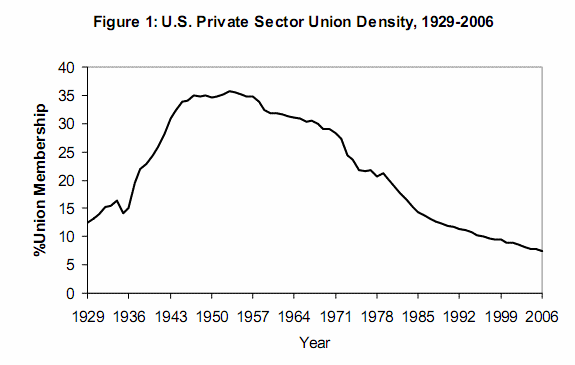
And now, since 1976, let's look at the US's and Canada's unionization rates side-by-side.

Do you notice how the US unionization rates have nothing to do with Canada's, and how the two aren't even comparable? Do you furthermore notice that -- from 1976 to 1997 (the carefully-chosen dates of the study) -- Canada's unionization rate is constant with only small fluctuations? These are both huge flaws, but the latter one really atrocious. Why?
They are attempting to manufacture a correlation between two things where one doesn't change appreciably over time!
Not only that, but there isn't even a shred of evidence for a causal relationship between unionization rates and unemployment. In other words, even if they found a correlation, it doesn't mean anything. But it gets worse. They model a system of only 22 data points with this equation:

Seriously, how does anyone take this seriously? And yet, corporations all over the world pay for and cite this "research." I'm outraged, and you should be, too. So this cinco de mayo, think about standing up for your fellow worker's choice to join a union, but definitely stand up against unsound science, math, and logic where you see it.
I'm studying for exams right now (so I shouldn't actually follow the links back to the study and check for myself) but I'm awfully curious. Is there any rationale given for why the researchers picked Canada as their model? Since the unionization rate of the United States actually changed over the time period in question (and it is the country they seem to be concerned with), why wouldn't they examine the data from the U.S.?
Mozglubov,
The obvious answer is that the US data didn't give them the conclusions that they wanted, but it isn't presented so we don't know.
I love it when scientists come out and say things like this. I really think that, starting from first principles, a rational, objective and inquisitive mind will generally fall into a more populist worldview than the mainstream.
As for the "study" that's just par for the course. Organizations on the political right do this sort of thing all the time. They hire their own scienticians to produce "research" that supports their political agenda, and try to cover their tracks. It's obscene. See evolution/creationism and global warming for more prominent examples. Unless you're very careful about what you read, it's so easy to be misled. Especially in more grey areas like economics. Propaganda is powerful.
Ethan, I really enjoy your posts, and am very pleased you are here at SB. I especially like that each of your findings, no matter what subject, are always based on logic and evidence. Keep up the great work!
While your analysis of the engineered study is sound, you really don't address the main problem with the EFCA. It's real problem is that it removes a worker's right to privacy. You certainly would reject a law that would reveal your vote in any other election. Why would you advocate for one that would remove that right from employees? A secret ballot is one of the requirements for any democratic process to function. It would be a horrible idea to remove it from the unionization process.
I'd just like to say a) EFCA does nothing to take away secret ballots, it only makes the choice between card-check to bring in a union (after which there would be secret ballots for union offices) and secret ballot to bring in the union one made by employees, not employers. Think of card-check as registering to vote, the way we all do in this country. b) I don't think the UAW is destroying the auto industry so much as the management of the auto industries have through their poor choices in what cars they manufacture.
Why do americans always belive the mafia will always takeover & control a union? This lie is the only problem that seems to hold back workers rights in u.s. & it sounds more like the "reds under the beds" mentality than fact! When you stop beliving this, you will see it is industries only justification against workers rights. & as this article shows - you can justify anything with enough money for dodgy studies & propaganda. Its like a u.s. election - the one who has the most money wins, it's not about truth or doing the right thing. It' about profit!
If you were wondering about the reason she chose Canada as her model for the effect of card check, you can find it in her report:
"Until 1976 all provinces employed a card check regime for union certification. Subsequent to 1976, several Canadian provinces began to experiment with regimes that required unions to win secret ballot elections, as is currently the case in the US. British Columbia alone changed its union certification procedure three times in the period 1976-2008: beginning with card checks from 1976-1984, moving to mandatory elections in 1984-1993, then back to card checks from 1993-2001, and finally settling on the voting system in 2001. (pp. 15-16)"
That also explains why 1976 is her start year.
I'm not saying she doesn't have a reason, nor that she doesn't give a reason.
But it's a lousy, terrible justification, and it doesn't make this comparison any more apt at all.
How is it a "lousy, terrible justification"? History has an example of a country switching from card check to a secret ballot. Dr. Layne-Farrar explains why she believes this country is similar enough to the United States to serve as a model for analysis. She cites similar industrial composition, similar openness to trade (especially to the US), and similar bargaining coverage. Obviously these facts do not convince you. Instead of dismissing them outright, could you briefly explain why?
FraLuPo,
Because that is, in no way, shape, or form, a dominant factor in determining unemployment rates. Her entire model is secretive and dependent on the parameters she chooses. She does not have enough data for her model to be a significant one. And this flimsy justification she gives belies the fact that there is no noticeable change in unionization rates over the time period she cites. Her reasons are reasonable, but not backed up by the data. And so that I why I am dismissive of them.
Thank you for your thoughtful reply.
If a data set doesn't support your preconceived notions and/or agenda, find a set that will and then push real hard.
Oxymoron of the day: Congress shall make no law...
thank you for your work in the us.