

Let's get something out in the open: not all science fiction is scientifically possible. Some of it is possible, but the laws of nature are pretty strict, and they prevent us from doing a number of things that -- in principle -- would be incredible to do. Examples on both sides, please?

You got it. Wall-crawling like Spider-Man? Totally possible. Just graft enough gecko fibers onto a person and not only will you be climbing walls, but also ice, oily surfaces, and even teflon!

Shrink rays? A la Fantastic Voyage? Completely impossible, unfortunately. Protons, neutrons, and electrons are stuck being the one-and-only size that the Universe demands they be; you can neither shrink nor grow them.
So yesterday, I was alerted that this story about Warp Drive hit the front page of Yahoo!
The warp drive, one of Star Trek's hallmark inventions, could someday become science instead of science fiction.

I'm not buying it at all, and for good reason. Let's take a look at why. First off, Einstein's relativity tells you that nothing physical -- matter, light, or energy in any form -- can move faster-than-light. All experiments and plausible physical theories have verified that to be 100% true. So if you want to traverse vast distances, what you'd have to do is bend spacetime severely enough to let you either exit it at one point and re-enter at another (left) or collapse the space in front of you so you can move forward more quickly (right).

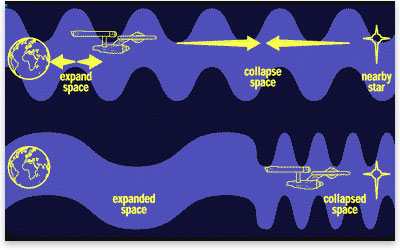
The exit-and-re-enter space is known as a wormhole, and it's what Stargate uses. The collapse-space-in-front-of-you is the idea of Warp Drive, and that's the famous form of transport used in the Star Trek incarnations. I haven't seen it yet, but I'm sure this is going to play a role in the new Star Trek movie.

Not only do we have no experimental or observational evidence for both of these, we also believe the both scenarios are physically impossible in principle. Wormholes can exist, at least in theory, just by having an arbitrarily strong gravitational field at two points in space that wind up connecting, and they would cause space to go from looking like a flat grid to looking like this:

To travel through it, all you'd have to do is pass through that bridge area. The insurmountable problem? The gravitational fields required to make such a bridge within our Universe are so strong that they would tear individual atoms apart! As there's no such thing in the Universe as something that can shield the gravitational force, this idea is doomed.
Now, what about warp drive?
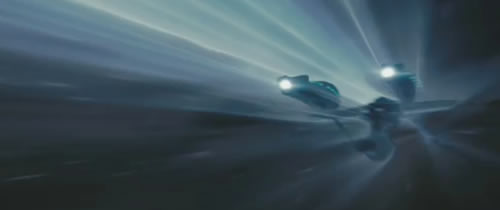
Again, all you need to do to "foreshorten" space in front of you and lengthen it behind you is to take that flat grid of space and make it look like this:
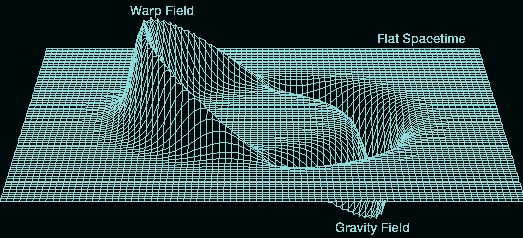
Which doesn't look too hard, at a first glance. There are a few major fundamental problems with this idea, though, which does, in fact, make it physically impossible. First off, it requires a vast amount of negative energy, which doesn't exist in this Universe. The only way we've ever even conceived of negative energy is to take something of enormously positive energy and then measure a small, negative change relative to that big, positive number. And second, if you actually want to move matter at this speed, you need to plunk it down at the speed you want it to move at. This is a catch-22, as it means that you need to be moving at warp speed already if you want to move at warp speed. There are other problems associated with this that may or may not be insurmountable, such as getting out of warp drive once you've gotten into it, whether the gravitational fields will crush you, and whether there's enough energy in the Universe to make this happen. But these two problems I've identified above ensure that this will remain in the realm of science fiction for a long, long time. And fiction is fine, but don't try to pass it off as reality.
So no, Yahoo!, it is impossible. And your reporting makes me question whether you should even get to have that exclamation point in your title. (It's mine!)
And, for all of my wonderful readers, since you've made it to the end of the article, I'm trying to get something started not just for me, but for all of scienceblogs: an easy way to digg, stumble, facebook, reddit, or del.icio.us a post that you like! Check out the little toolbar at the bottom of this post, and give it a whirl if you like! I hope to make this a part of all my future posts, and help give you the opportunity to share your favorite articles with the world!
|
 Del.icio.us
 Digg
Digg StumbleUpon
 Reddit
 Facebook
- Log in to post comments
Great...there goes my idea for Father's Day 2050.
You've totally ruined the movie for me.
(Not really.)
Oh, I did want to say, since you posted it: that's one fugly lookin' Enterprise in the fifth picture there. Bleah. Sorry, I'll go now.
Good on the Facebook, Stumble, et al links. I forward lots of sciblog content, but it's nice to have the option of having it properly formatted too :)
Yahoo doesn't write its own news stories. They just re-post stories written by other sources like the AP, Reuters, etc. The story you mentioned came from SPACE.com, so that site, not Yahoo, deserves your derision.
John Cramer has his Alternate View column also on the web.
He generally explains things so that a layman (like me) has a glimpse of understanding the problem, although he has to put in a twist of how it might be fitted into a sci-fi story since the column comes/came out in the Analog magazine
A Klingon and a Ferengi on a scooter? Now that I don't buy for a second;) Unless she is killing him with her breast Bat'leth
Just got back from the movie. It was enjoyable with comedy, drama, action, good special effects and sound but Kirk got beat up too often.
I guess quantum tunneling is also out of the question, especially for a ship of that size.
OK, Ethan, you have exclamation envy, so these are for you!!!!!!!
I guess getting beamed down to a planet's surface is out as well.
Darn
But look at it on the bright side. If we can't make it to Romulus, then they can't make it here either. No contact with other sentient (or viral) lifeforms in the Universe may be a GOOD thing. (Since even pig flu can rain on humanity's parade).
There's a lot more science problems in the movie, having ignored both the trek continuity and science consultants, leaving them bound and gagged to a chair
The space-diving sequence will give anyone headaches. Precision diving from orbit into atmosphere down a tether to an altitude of less than 10,000 feet face-first with no re-entry
Captain Killjoy of the U.S.S. Reality!!
A friend of mine asked me to design the science backdrop to a space opera/hardcore porn idea that he's developing and I came up with a better idea than either wormholes or warp drive. Instead my idea fudges some things about Higgs bosons and the uncertainty principle and instead collapses the entire ship into a single wave function and pushes it to another spacetime localization before expanding it again into a proper ship and doing it all again. :) Also can't work for real, but a fun idea anyway. You know, in case a scifi series with hardcore porn isn't fun enough on its own.
I'm actually a little disappointed, because I also saw this story, but on ScienceDaily, which in my experience is a pretty good source of science news, though I'm a student of biology and tend to only pay attention to stories I can relate to, and it seemed like they tended to report on actual peer reviewed research from the stories I saw. I didn't read the article you mention in depth because I knew it was just some mathematical, theoretical bullcrap for now, but knowing that it's impossible mathematical, theoretical bullcrap is annoying. Oh well. Thanks for the explanation.
People believe in lots of bullcrap.
At lest this way we get to choose when to suspend reality and what bullcrap to believe... for a couple of hours... for the purpose of entertainment.
I loved this last Star Trek movie. It's brilliant.
Good hard facts Ethin! - can you discount another drive for me? I've always liked Alan Dean Fosters (sci-fi author) KK drive idea: a gravity field generated in front of a ship "pulling" it forward ever faster (as the ship is "pulled" forward toward the gravity field in front of it, the ship pushes the field forward never able to catch up - just getting faster & faster). I think i've read that a (theoretical) gravity wave would move faster than light. Do you think you would be torn apart ? Or something else?
Rej, that one's easy to deal with. Gravitational waves -- in every theory known -- move at exactly the speed of light. So regardless of whether you can ride one or not (and the answer is no, at least for the gravitational waves we've theorized), it won't move you faster than light.
The technical reason is that gravitational waves exert not an attractive or repulsive (i.e., monopole) force, but a shearing (i.e., quadrupole) force only.
Great blog, Ethan! I've sent you out to my family and friends. Yes, that's friends, with an 's'.
Anyway, I have another faster than light question for you:
What about the 'spooky effect at a distance' coined by Einstein. I can't describe the physics very well, but I think it has something to do with virtual matter pairs which have a 'quantum entanglement and affect each others 'spin' or something, which appears to be a simultaneous event irregardless of distance.
Theoretically, if I have it right, if you separated a pair of these particles at opposite sides of the Universe, an effect on one of them would have simultaneous effect on its mate.
Which implies that perhaps there are some mysteries still beyond our ken, which might offer a solution to the problem of interstellar space flight?
Ethan, do any of the post-Einstein universe theories like string theory provide a hypothetical means of transport faster than light? The four dimensional case seems to be pretty much closed and shut, but with 11 dimensions, can you go brane-riding?
Ethan: is it obvious that "gecko fibers" would let adult humans walk on walls?
As an organism is scaled up in size, its mass (and weight) will scale as length cubed, while its surface area (and hence force of attachment to the wall via gecko fibers) will scale as length squared.
So as you scale up an organism, at some point the van der Waals force of the gecko fibers will be insufficient to counteract gravity. It's not obvious to me where an adult human would fall on that curve, but I'd bet against it working.
Of course, you could always change your method of attachment (say, velcro-style hooks on the human binding to velcro-style loops on the wall, big suction cups, etc.) to increase the force per unit surface area, but that's not as cool as walking up a glass wall.
Hi Ethan,
Since you've roundly crushed the dreams of this sci-fi fan (you big meanie), is there any possibility for FTL travel actually working? Having both aspirations of exploring distant solar systems and writing scientifically accurate sci-fi, what do you think offers the best chance for humanity actually physically exploring distant stars?
I guess we'll have to settle for light speed, unless you're going to rain on THAT parade too.....
There is a trick by which you can go faster than light. Measure the distance travelled on a map, measure the time taken by the clock you are carrying with you. After a year or so at one G you are travelling faster than light. Of course, if you actually measure your speed it's slower than light, but the faster than light trick is easier on the arithmetic and works perfectly. That is, until you get home, find out you left the light on and are in Big Trouble.
The trouble with this is that entanglement is very sensitive; any attempt to produce a particular effect on one particle breaks the entanglement.
For instance, if you measure the spin of the nearby particle, you'll find out that it's spin-up half the time, so its distant twin must be spin-down at the same times. But if you put it in a magnetic field or something to make it be spin-up, you break the entanglement, and you know nothing about its twin. Thus, there's no way to use this to send information faster than light.
It's like having a FTL text-messaging system, but the only things you're allowed to send are random strings of letters.
Hi Ethan,
Substituting my spidey sense for any actual detailed theoretical knowledge, I am moved to wonder aloud if you are not too hasty to cry "Impossible!" on at least one of your assertions.
Specifically, if ever it does turn out that gravity is delivered by the Higgs Boson, or indeed any other particle, can you categorically say it can not be blocked? Or even perhaps manufactured, ala artificial gravity? (Please disregard pesky issues about energy requirements or similar practical nuisances :)
TIA,
Coby,
Yes. Categorically, gravity cannot be blocked. What it would take is a real particle with negative mass, and hence with negative energy. These things do not exist in this world and are forbidden by a number of physical and mathematical theorems and conservation laws.
Now, if these theorems do not apply, the conservation laws are broken, tachyons are discovered and particles that are gravitationally repelled from mass are discovered, then I will be wrong, and this obstacle will be possible to be overcome. But that does not look to be the world we live in.
Anton and others, the FTL issue with information deserves its own post. Check back next week.
Well, you just killed God for me. Since I always thought of understanding the universe as the only way of understanding God it wouldn't make sense for God to create a universe forever out of our reach. Why not just paint the stars on a big sphere instead? NO possibility for FTL = no God.
u lot are a bunch of queres haha pussy
You can have other universes where the laws of physics are different and possibly create a conduit between the two universes. In that universe everything would always appear to be faster than light from our end and we would always appear to be faster than light to them. The arrow of time would also be opposite. Creating a bridge between the two universes would allow one to exit and re-enter one's universe at different points in space and time (including earlier ones- although this might evolve other timelines.) Stephen Hawking talks about a second time dimension called imaginary time that resolves the big bang singularity and calls for a universe that existed prior to the big bang and the cosmological constant calls for a cyclic universe that winds down a little with each cycle.
I prefer Max Planck to Albert Einstein myself. Einstein was wrong about quantum mechanics. Planck said that a new scientific theory only gains traction when the old generation dies off and a new generation grows up that is familiar with it.
"I prefer Max Planck to Albert Einstein myself. Einstein was wrong about quantum mechanics."
And Max's errors won't make you decide to prefer Einstein instead?
Why are you so fickle?