

Every once in awhile, I'll get an email from someone curious about getting into amateur astronomy, but with no idea where to begin. More often than not, it's from someone with a crappy telescope who's trying to salvage some utility out of a bad purchase/gift.
The truth of the matter is that most telescopes either cost a lot for automated, easy-to-use features, or require a lot of time and effort to learn to use them properly.
But lets say you'd like to start exploring the skies, and need some help with where to begin. If you're like most people, and not sure how seriously you're going to be about it, you'd probably like to do this with:
- Very little time invested,
- Very little money (i.e., less than $100),
- Very little clutter, and
- Very little hassle.
A noble aspiration, to be sure. What would I recommend to you?

Yes, seriously, a simple pair of binoculars. With a decent pair of hand-held binoculars, you can -- if you figure out where to look -- see the following things:

The International Space Station! This is an actual image taken with a digital camera through a pair of binoculars, and is what you'd see with your eyes through them. What else?
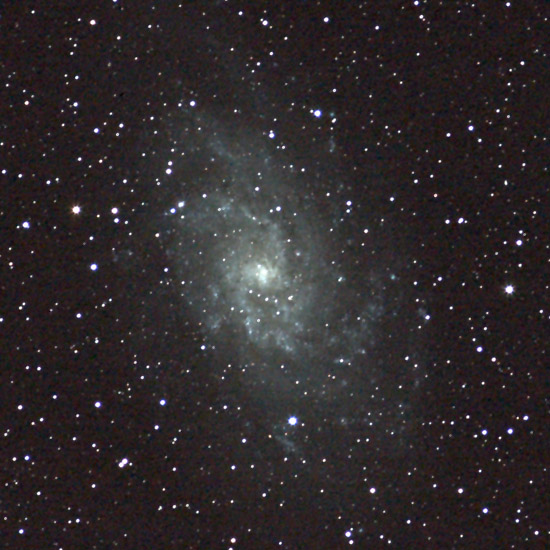
Other galaxies! You'll also be able to see, if you look at M33 (above), why they used to call them "Spiral Nebulae" before they knew what they were.

Stars! Not only will the number of stars you'll be able to see in a dark sky go from about 3,000 to about 100,000, but many stars, like Alberio (above), will be resolvable into their binary pairs! Alberio is particularly neat, because the two stars are both different colors and different sizes!
And that's without even looking at our own Solar System, which you absolutely must do if you're going to take a look at the night sky.

First off, even with a lousy pair of binoculars, you can see craters on the Moon! (Although probably not as many as are above.) You can also see things that it took astronomers hundreds of years to find -- like Uranus and Neptune -- just by finding out where to look. But there are three spectacular things that the Solar System has, that may make it worth investing in a tripod and a slightly better pair of binoculars. What are they?

1. Jupiter's Moons! You can see Jupiter's four Galilean Moons (Io, Europa, Ganymede, and Callisto) through a reasonable pair of binoculars during good viewing conditions. Sky & Telescope has a great interactive applet about observing the Moons, which you should check out if you want to know which ones you're looking at.

2. Saturn's Rings! No kidding. You can not only see Saturn's Rings, but if you're lucky (and I have never been so lucky with binoculars), you can also see Saturn's giant moon, Titan, one of the only moons in the Solar System with an atmosphere. But the most spectacular thing in the Solar System that you can find with binoculars?
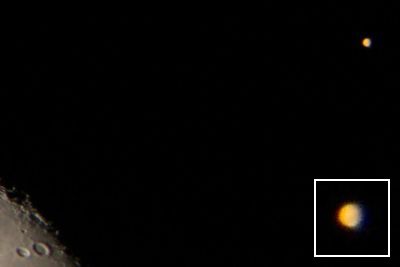
3. Mars' Polar Ice Caps! During the right time of the year, and when Mars is close enough, you can see the Polar Caps on Mars, as seen above through a pair of binoculars!
So, what should you look for in a pair of binoculars if you want to do this? Every pair of binoculars has two numbers, like 5x10, 7x35, 10x40, or 16x80. The first number is the magnification. If you're going to start out, a 7x magnification is probably pretty good, but anything higher than that and most people can't hold it steady enough with their hands. A few people can hold a 10x steady, but you'll definitely want a tripod if you go up beyond that.
The second number is the light-gathering power, or the diameter of the binocular lens. There is a huge difference in light-gathering power between some of these. A 35 mm aperture pair of binoculars is twice as powerful as a 25 mm pair, but a 50 mm pair is twice as powerful as a 35 mm pair and a 70 mm pair is again twice as powerful as a 50 mm pair! The trade-off? Weight. Pretty much anyone can hold a 40 mm pair of binoculars steady, it takes a bit of practice and finesse for a 50 mm pair, and if you're going to go above 50 mm, you'll want a tripod.
Just starting out? Never done this before? And interested in seeing as much as you can? Get a cheap pair of 7x50 binoculars. You can pretty easily find a pair for about $60, and less if you shop around. Want to splurge a little bit? Go for a 10x70 (or a 16x80) pair with a tripod. These are way easier and more convenient than telescopes, and a good pair of binoculars can get you further and farther (and can do it much faster and cheaper) than a mediocre telescope. You can find (older) advice here on buying binoculars, an angry rant against binoculars, and an excellent resource for binocular astronomy.
Want to know where things are? A star atlas would be nice, but -- honestly -- google sky can show you where everything you want to look at is for free. And if you're too lazy to look anything up, just point and look; the bright, unblinking points of light are planets, the ones that move slowly and evenly across the sky are satellites, and the dim, dusty trail is the Milky Way. You might be glad you got out and looked!
- Log in to post comments
In addition to Google Sky, Stelarium is another excellent free resource (that will work without an active net connection and has a built in red-light mode, among other great features.)
http://www.stellarium.org/
Nice post Ethan. I'll be out with my 10x50's tonight looking for "something." And when I am able to retrieve my new (used) celestron 8" I have a feeling the difference will be stunning... It's good that we can get acquainted with our universe with something so cheap (besides startswithabang), and readily available.
Great post Ethan! Very informative and useful for us beginners - makes me want to buy pair of binoculars first thing in the morning! Crappy telescope can only make its owner to give up (after few days of initial excitement). Mine is in the box now, under piano.
Greetings from Croatia!
I'd just like to second Dale Sheldon's recommendation of Stellarium. I've been using it in conjunction with my 1st and 2nd year Astronomy classes, and it works beautifully.
Dale and Brian,
I have only used Stellarium in a planetarium atmosphere, and I was very disappointed with the lack of customizability. But if it allows for those things now, and if you're happy with it, perhaps it's worth another look.
For my part, I prefer google sky for the user-friendliness and the searching ability, but it's good to have options. Thanks for the recommendation!
I love my 7x50 binocs. Seen some amazing things. And you get acquainted with the sky much better than you would with a scope.
And here's another rec for stellarium as well.
Ethan thank you, this is wonderful information for this layman! Next weekend I plan to be out in the Southern African bush - far away from city lights - with my 7x50.
Thank you Ethan!!! My girlfriend and I were just discussing this over the weekend - and she suggested binoculars. I was skeptical thinking I needed a decent telescope to see anything of interest... now I realise she was right (she's going to love this). Now if only it would stop raining!
Good post!
Some comments:
I've occasionally advised people to start by looking at the moon with binoculars, but I'm always particular to emphasize that what you can see changes dramatically over the month. The full moon (which I think is what most people will try looking at) is relatively boring.
I'm a little skeptical of your advice to see M33 with binoculars. I've observed it with 6" scopes, but I found it was a challenge for beginners to locate. The problem was heavy light-pollution, but most people will have the same problem. Perhaps I'm wrong, but I think it would be very hard to see with binoculars. If I remember, I'll pull out the binoculars later this year to try it myself.
I personally would replace M33 with M42 -- very easy to find and always impresses.
I love my binoculars, I use my binoculars for all sorts of star gazing, comet watching, scanning through the star clusters around eta Carina etc.. I've used them in projection mode to watch sunspots and solar eclipses. Binoculars are very versatile, easily portable (I take mine bushwalking) and as you say, they give more bang for your buck than an equivalently priced telescope.
I've also spent a lot of time sketching the Moon through binoculars, and your illustrations are ahhh... somewhat misleading. You will never see M33 like that through 10x50 binoculars, you will see a disk-shaped smudge, but no spiral arms, even Andromeda has no readily recognisable features. As you correctly say of the Moon image, "Although probably not as many [craters] as are above", the images you will see will be an order of magnitude smaller.
While you will see enormously more than the unaided eye, the illustrations give the wrong impression. Even for the high power binoculars, you may see Saturn's rings in 16x80 binoculars, but they won't look like your illustration, but be only just visible as independent rings with no structure.
Again, binoculars are really, really versatile and you can see so much with them. I love my binoculars. But you need to give people a better feel for what they will actually see, or they will be disappointed when they they take their binoculars out.
I will also give my vote for stellarium. It is pretty photorealistic, easily configurable, you can add new objects (comets and asteroids), with version 10, the search function works very well. Zooming into Jupiter and Saturn to display the moons works very well.
Scripting is currently an issue with version 10, as they haven't published the script language instructions, but it does have very powerful scripting (you just have to work out how to use it).
http://astroprofspage.com/ recently did a coupla posts on binocular shopping.
Mister Troll,
The biggest and easiest galaxy to see is M31, but the truth is, you need dark skies for just about all of the Messier objects. From where I am in Portland, binoculars won't help very much in seeing M33. But if I head about 20 miles (30 km) out of town, I can see M33.
Ian,
M33 and Saturn will not quite look as good as I've shown here, and the Moon will not look as good either. The problem is that I both don't have pictures of them personally through binoculars and I haven't been able to find free ones online.
My point -- which it seems that all of you got and agree with -- is that binoculars are easy to use, will help familiarize yourself with the sky, and can help you discover what's out there much more quickly and easily than a comparably priced telescope.
Ethan,
Thanks for this great post on getting people to look up into the night sky. I have been wavering on purchasing a decent telescope for a little over a year now and I never have because I just felt like a cheap telescope was not worth it and I couldn't afford a good telescope. I am certain that I will be able to talk my wife into letting me purchase a $60-70 pair of binoculars
A comment on free software to help you locate stellar objects: Google sky has been ported to at least one cell phone operating system. I currently have an Android powered phone and the using Google sky on that is amazing! I just point my phone at the area of the sky that I am looking at and it shows what I am looking at with stunning accuracy, no need to use my fist to count the number of degrees from the horizon to identify objects. As this is free on Android phones I am pretty sure that there must be something similar at a similar price point on the far more popular iPhone.
Ethan good article. Binoculars are a great way to get started.
But I think you need over 25 power to see the rings properly. You might be able to get a digital photo but don't expect to actually see the rings
Cheers Mang!
Fascinating post! I might have to splurge and get myself a pair of binoculars to see what's going on above my head.
That's really cool! I just took a Cultural Astronomy class and want to start tracking the movement of Venus, this ought to save me a bunch of dough.
Ethan
this is incredible, I will try the binoculars that we have at home. I would love to see the crates of the Moon, and the Jupiter, and Saturn's Rings!
When I have a misty day, like I lose my concentration, focus on what is really important, I just into the sky, and the realization that there are undefined wonderful spaces...fantastic starts and galaxies, that our Earth has its shape, and atmosphere...puts everything into the right place
thanks