

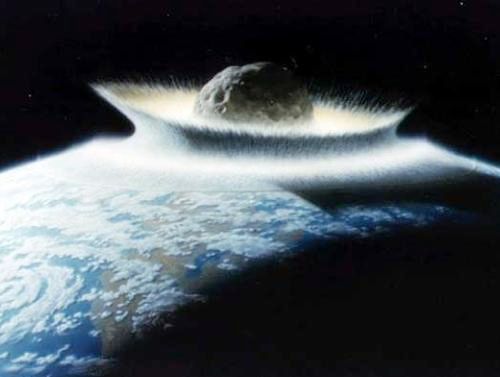
One of the scariest things that could happen to Earth is to be bombarded with an asteroid or comet, as the potential for damage is incredible.
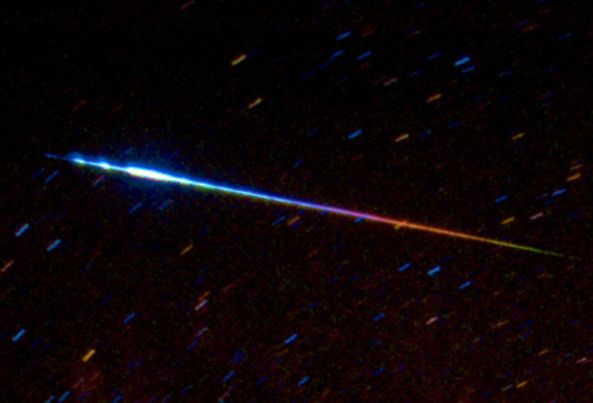
Well, it turns out that we get hit by tiny "space pebbles" all the time. Every time you see a shooting star, like the one below, it's actually a very small rock, often the size of a mere grain of sand, streaking through the Earth's atmosphere and disintegrating. The heat of vaporization is so intense that the object glows brighter than the stars in the sky, and -- however briefly -- these grains of sand and dust can outshine even the planets.
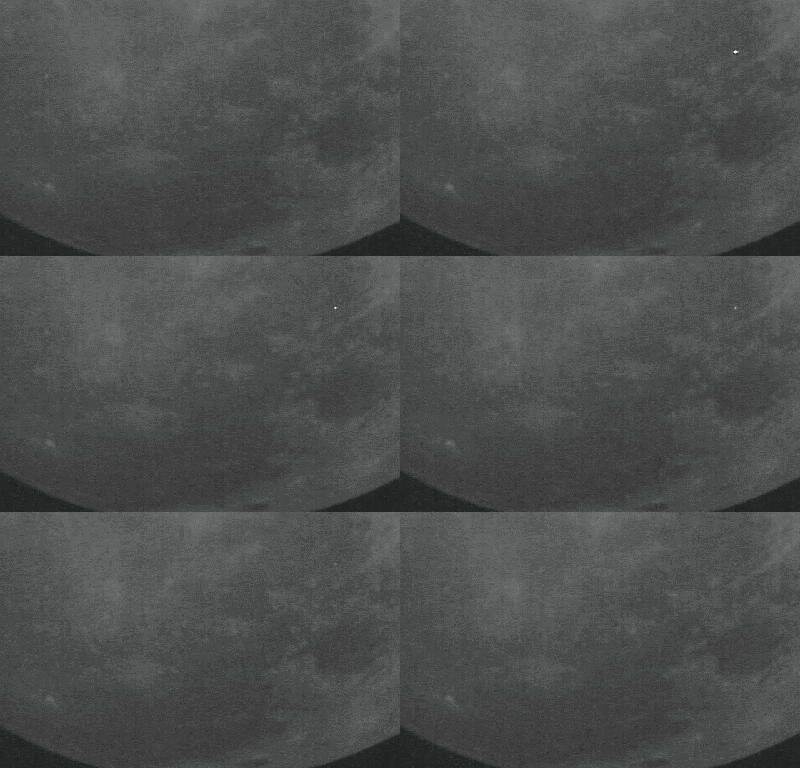
 filled with this type of dust. But every once in awhile, every rare once-in-a-long-time, the Earth and an icy comet will wind up in the same place at the same time. When this happens, you get a collision. We've never seen this happen at Earth's surface, although we know that this happened on the Moon in 2006 (it's documented), and we did see a comet collide with Jupiter back in 1994. Take a look at the Moon impact below:
Well, something large -- likely an icy rock like a comet -- came into contact with the Earth in the early summer of 1908. The collision is known as the Tunguska event. Based on everything we've been able to reconstruct, it entered the Earth's atmosphere, heated up, and -- somewhere over Siberia -- exploded due to the extreme heat. The devastation lasted for decades, as you can see from this 1927 picture from the ground beneath the explosion:
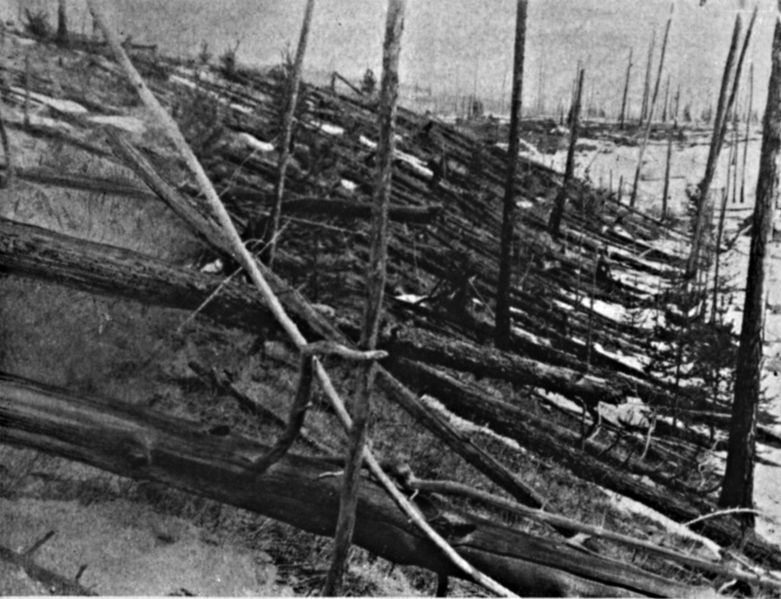
Trees were knocked down and burned for hundreds of kilometers, but there was no crater. Hence, this thing was probably made up of ice and/or carbon dioxide, things that expand and turn to gas when heated sufficiently. A build-up of pressure could easily cause such an explosion, and would explain the absence of a crater.
The thing that is perhaps surprising? This is common. The Earth gets hit by small meteoroids all the time. This phenomenon, known as an Air-Burst, is observed at least once a year by the US Air Force's Defense Support Program. But very large ones, like the Tunguska event, should be rare, occurring only once every few hundred years. A nice open-and-shut case, and a great piece of physics to learn.
And then I read this, which made my stomach turn almost as hard as it did when I read that hikers had discovered Bigfoot. Yuri Lavbin -- a scientist in self-proclamation only -- claims that:
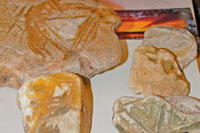
aliens downed the Tunguska meteorite 101 years ago to protect our planet from devastation. Yuri Lavbin says he found unusual quartz crystals at the site of the massive Siberian explosion. Ten crystals have holes in them, placed so the stones can be united in a chain, and other have drawings on them. "We don't have any technologies that can print such kind of drawings on crystals," said Lavbin. "We also found ferrum silicate that can not be produced anywhere, except in space."
So. This man, who tried to sell this story in 2004 to Time Magazine and in 2007 to the UK's The Register, is at it again. Let's check out his crystals:
And a picture of Yuri himself, holding what he claims to be "a fragment of an alien spacecraft":

Know what they look like to me? Rocks. I cannot put it better than Carl Sagan did so many years ago:
Extraordinary claims require extraordinary evidence.
And we've got bubkes here. Even UFO hunters think this is probably a hoax. I'll take the physical, reproducible, scientific explanation every day of the week, thank you. And if I can help you see why that's more interesting, more valid, and more right, I'm happy to do it.
And if you're in the mood for more astronomical goodness, check out the latest Carnival of Space; there have been more than two years worth of them now!
These theories go back a lot longer than this; at least this guy seems to think it was an comet, however downed by aliens it was. Alexander Kazantsev's short story "A Guest from the Universe," though apparently fiction, was taken as gospel by many, as popularized by Frank Edwards in Stranger than Science (my favorite book!). There was even an episode of the X-Files about it.
This was presented, of all places, on the Science Channel -- not the SciFi channel! -- as part of a one-hour special on Tunguska a few weeks ago.
It was covered straight, without even raised eyebrows.
I'm so glad that alien stopped the destruction of Earth.
BTW, what ever happened to that comet that was planning on hitting mars?
http://tinyurl.com/ol5oqg
I can see a face in that "fragment of an alien spacecraft"! It's a fragment of an alien itself!
And a "V" on one of the crystals! The aliens must've spoken English!
!!eleven!
"And a "V" on one of the crystals!"
The "V" is obviously followed by an "A", so therefore this proves that the University of Virginia senior class was behind all of this.
The "V" is obviously followed by an "A", so therefore this proves that the University of Virginia senior class was behind all of this.
No, it stands for something like "Vincit Astra" (not sure I'm spelling that right), which roughly translates as "The Star Conquers." (The A also might refer to a specific star.) It's a clear warning that the invasion fleet is coming about one photon round-trip time after the explosion (which puts the origin point at least 50 light-years away). Why the aliens (or pranksters, should this prove to be a hoax) would know Latin is left as an exercise for the reader ;-).
I suppose this is slightly more credible than the notion that Nikola Tesla caused Tunguska with an energy weapon.
Of course the cynic in me wants to say that if the UFO hunters don't believe it, then it can't be all wrong.
There was an entire "non-fiction" book by some nutter claiming it was an exploding flying saucer.
As I now recall, the nut's hypothesis was the flying saucer or its engine had somehow been damaged. The alien captian had deliberately steered the striken flying saucer over Sibera so that if it did explode, it'd be unlikely to harm too many humans, etc etc.
I apologise for not recalling either the author's or the book's name (this was back in high school in the mid-1970's), but it happened to be my introduction to the event. I didn't believe a word of what I read in that book, including (at first) that something even happened over Siberia 101 years ago.
My advice to YOU is not to let these idiots get to you.
If one were to get all worked up at every idiotic idea put forth there would no time to relax and think rationally.
I'm not so sure.
How do we know that the alien wasn't about to attack the Earth, and a passing comet saved us?
Hey, it's just as likely as anything else...
Everyone knows that Tesla was broadcasting a demonstration of his "coil" from Long Island to the North Pole to impress Admiral Perry when it overshot and hit Tunguska by mistake...why is this so hard for the scientific community to accept? The guy is holding the evidence up below your raised eyebrows...maybe your brows are too lowered? The aliens saved us again!! That's why I always send a Christmas card to the Reticulans...they're so unselfish.
So have they ever found any pieces of this thing? I see differing reports all the time, but the two Russian expiditions found nothing, as I recall.
Who the hell needs UFOs when the Universe is so damn strange all by itself....?
Actually an expedition last year found what appears to be a crater with an object buried at the bottom. Of course it's filled with water, and they lacked equipment to examine the depths. It's possible a return expedition with resources to go down there and get a look or a piece will be organized, but it will be expensive and difficult.
What he is holding does not look like rocks to me. But, I think I may know what it is... A few years ago, I found several fragments of "rock" exactly like what he is holding scattered around on my back yard. I picked them all up because I thought they might be pieces of a meteorite. But, when I asked around what I was told was that they were "slag". ..a by product of iron smelting. I still have no idea how they appeared on the surface of my lawn because I mow it regularly and they just suddenly appeared one day.
I would hope we would get enough notice of such an event to prevent it. We have come a long way so I think that's likely.
Alexander Kazantsev's short story "A Guest from the Universe," though apparently fiction, was taken as gospel by many, as popularized by Frank Edwards in Stranger than Science (my favorite book!). There was even an episode of the X-Files about it. http://www.mortgagescottsdalearizona.com It's possible a return expedition with resources to go down there and get a look or a piece will be organized, but it will be expensive and difficult.
The guy is holding the evidence up below your raised eyebrows...maybe your brows are too lowered lol! http://www.mortgagelasvegasnevada.com/cash-out-refinance.php
in some ways that first picture reminds me of a zip being popped? Just me? http://www.onlineforextradingstrategy.com/forex-megadroid-review.html
given whats happened with naturally occuring tsunami's around the world can you imagine the devastation of an impact like the one pictured? an you say world-killer?
well, this is kind of funny, but I would like to see the crystals first and know that we really cannot do such carvings yet.
anyway the idea of aliens colliding with the surface of the Earth, is possible. If we exist, why not others?
a nice thought:
Extraordinary claims require extraordinary evidence.
this extraordinary evidence is usually the simplest one, and of course the most difficult to notice
A few years ago, I found several fragments of "rock" exactly like what he is holding scattered around on my back yard. I picked them all up because I thought they might be pieces of a meteorite. But, when I asked around what I was told was that they were "slag" jimmy from http://www.floridarefinancemortgagerates.com
I've watched a number of documentaries, where scientists are worried about whether in the future, a major collision between a comet and earth might occur and whether there is anything anyone can do about this. This obviously is quite scary. deutsch französisch übersetzungen
i cannot imagine that earth can be bombarded with an asteroid,
it just like armageddon
Thanks for the post, but I also can't imagine the world being bombed like that.
I think your article is quite interesting, but I'm also not sure if I can imagine the world bombed like you say.
I would hope we would get enough notice of such an event to prevent it.
Let's hope that something like that will never happen to us.
As I now recall, the nut's hypothesis was the flying saucer or its engine had somehow been damaged. The alien captian had deliberately steered the striken flying saucer over Sibera so that if it did explode, it'd be unlikely to harm too many humans, etc.
Die Vorstellung eines Asteroiden-Einschlags ist sehr unheimlich, hoffentlich wird dies nicht so schnell wieder passieren.
Ja, ich hoffe auch, dass wir noch lange davon verschont bleiben.
well, this is kind of funny, but I would like to see the crystals first and know that we really cannot do such carvings yet.
These information are very frightening....
I can´t image that could happen..
Yes, I really hope that this never will happen to us.
Interesting way of thinking, but I like it!
Is this fictious or real?
As I now recall, the nut's hypothesis was the flying saucer or its engine had somehow been damaged. The alien captian had deliberately steered the striken flying saucer over Sibera so that if it did explode, it'd be unlikely to harm too many humans, etc.
lol... very funny :D
Dear Werbeargentur,
I don't know, if you had not understand this article, but I think, this is a very important and serious theme!
Dear SEO Praktikum,
Don't you think, that also in serious topics, there can be fun and amusement? Think about it!
Regards
Ja, ich hoffe auch, dass wir noch lange davon verschont bleiben.
I totally agree with you, i also can find amusement in there!
See you!
hey, you never know, I have a friend, a respected oldish man, who recently told me about an event that happened to him a few years ago. We would call it UFO, nobody believes him, because it was so unusual
Olemme kumppanisi call center
Avec vos connaissances riches, nous pouvons en savoir plus à partir de votre poste merveilleux.
Ja, ich hoffe auch, dass wir noch lange davon verschont bleiben.
Ja, ich hoffe auch, dass wir noch lange davon verschont bleiben.