

Amazing is an understatement when it comes to how much we've learned about our Universe in the last century. 90 years ago we confirmed general relativity, and got a whole new theory of gravity as a result. But, we still thought our Milky Way was the only galaxy in the Universe.
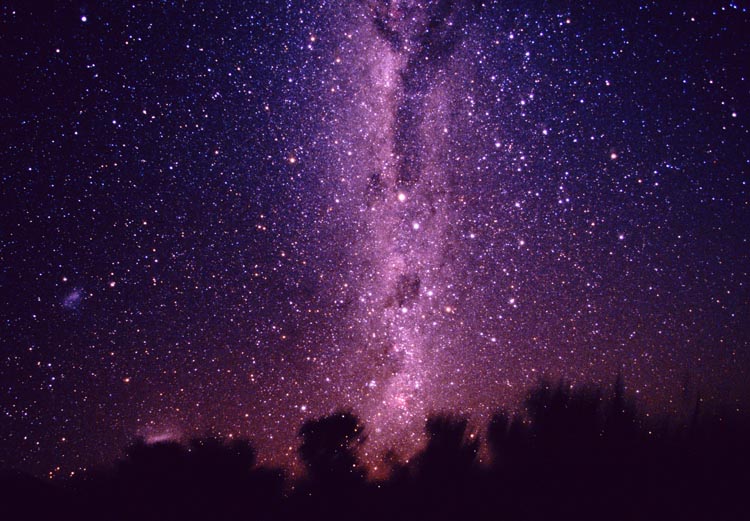
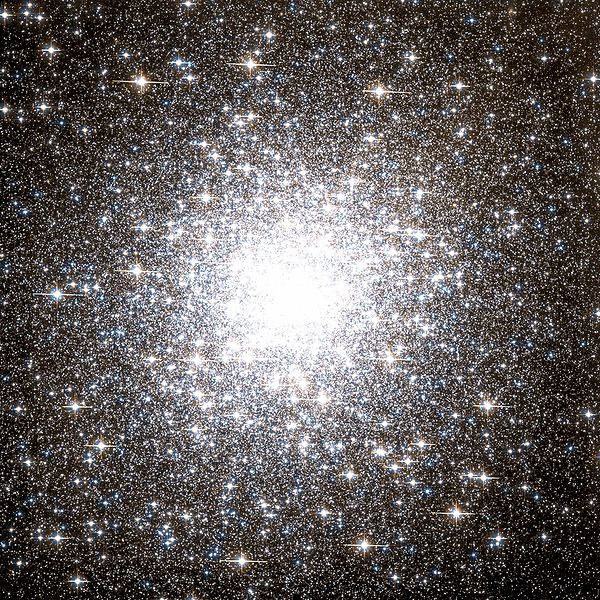
There were a few types of weird objects we knew of in great detail, such as the original 103 Messier objects. There were weird, spherical clusters of stars, like M2:
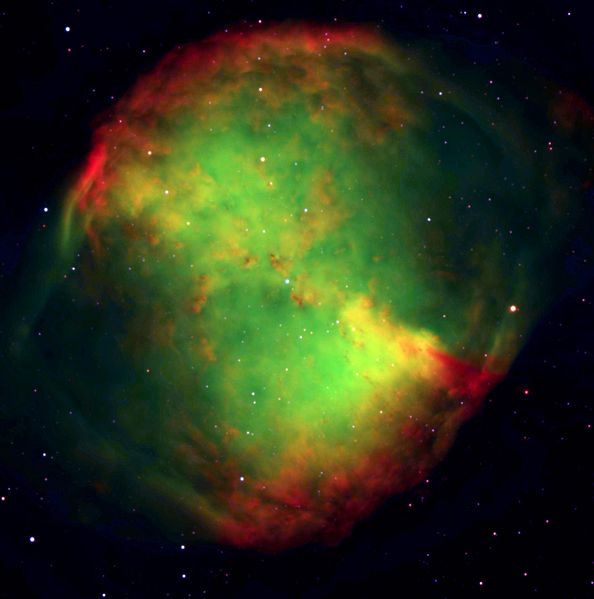
There were planetary nebulae, known to be the afterglows of dying or exploding stars, such as M27:
And then there were the much-debated "spiral nebulae," such as M31:
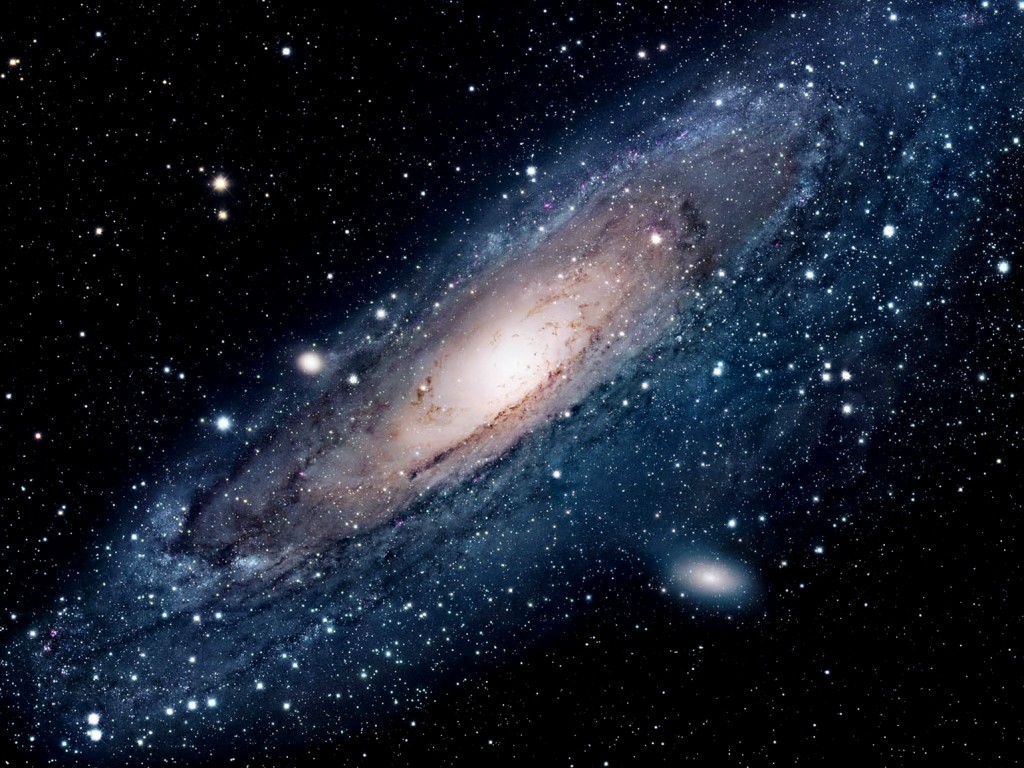
What were these Spiral Nebulae? Were they also dead stars, or clusters of some type, or (as was thought at the time) forming solar systems, or were they something different?
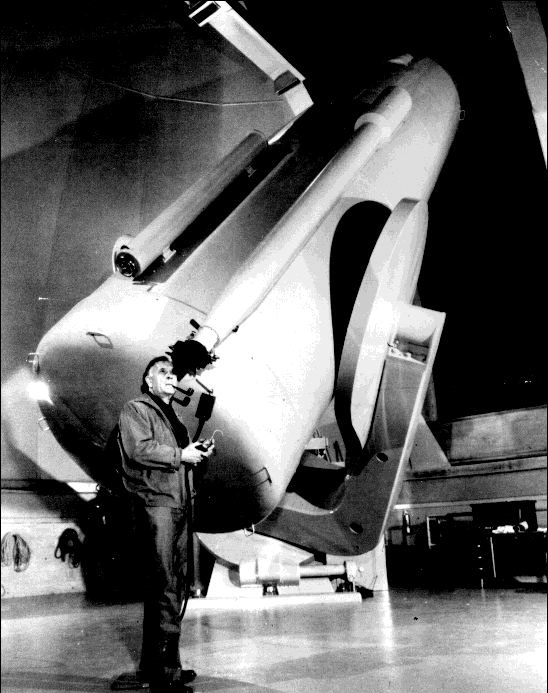
There was a Great Debate over the nature of these spiral nebulae, with no consensus reached. On one side, they were thought to be objects within our own galaxy, but the other side considered them island Universes, or objects outside of the Milky Way. In 1929, astronomer (and former boxing champion) Edwin Hubble set out to find the answer.
He watched this object for Novae, which had been seen in this object before. He figured that by keeping track of them, he could learn something about it. He saw one, and then two, and then three. And then, the unexpected happened. He saw a fourth one in the exact same location as the first! Why is this so unexpected? Because novae take thousands and thousands of years to recharge! That meant that this couldn't be a nova, it had to be a variable star! I've managed to track down a copy of Hubble's original data, where he originally marked it as a nova (N), and then crossed it out, with much excitement!
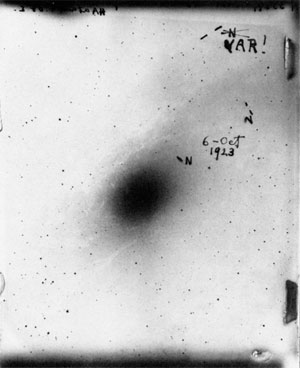
This was incredibly exciting, because this type of star (a Cepheid variable) was well understood, and allowed Hubble to determine that this object was well outside the Milky Way -- over 2 million (not billion, thanks DaleP) light-years away -- and was a galaxy all unto itself.
But Hubble didn't stop there. He went and surveyed a bunch of these spiral nebulae, this time looking for variable stars instead of novae. By observing the period and brightness of these variable stars, he could deduce their distance. He found that the galaxies that were farther away were also moving away from us at a faster rate! He graphed this, and reached an astonishing (and correct) conclusion:
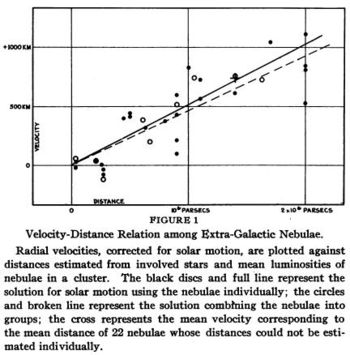
The farther away something is, the faster it moves away from us. Or, in other words, the Universe is expanding! Those of you who are sticklers for detail will note that Hubble's data only goes out to a whopping 2 Megaparsecs, and that Hubble got his units wrong on his graph (velocity should be in km/s, not km). By comparison, here's what a modern graph of velocity vs. distance looks like, out to hundreds of Megaparsecs:
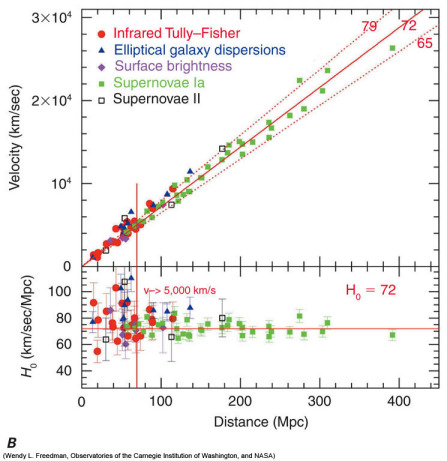
It's only been the last 80 years that we've known the Universe is expanding and that there are other galaxies than our own. Aren't you impressed at how far we've come?
You write:
this object was well outside the Milky Way -- over 2 billion light-years away
-----------
I think it is "2 million light-years".
I am very impressed with how far we've come, and with you. Thank you for writing this series of articles.
Another fine series, and another great example of why I love your blog!! Thank you!!
DaleP,
You are right! I am fixing it now; thanks for spotting it!
I am only commenting so you know there are more of us watching and reading and absorbing with little to say except thanks.
Ethan, once again, excellent work. These are very enlightening.
When I was a kid I picked up a copy of a 1919 Scientific American from a used book store in Portland Oregon. One small article caught my attention; the title was "Are Spiral Nebulae External Galaxies?" The mere question brought home forcefully how much smaller the universe my grandparents had grown up with was than the universe I grew up with.
More recently, we have come even further then is portrayed in this post. We now know that the rate of expansion of the universe is accelerating which has led to the hypothesis of the existence of dark energy. We also have found, through the discovery of gravitational focusing the existence of dark matter in the galaxies. Even more astonishing is the fact that dark energy and dark matter make up 95% of the mass of the universe. When I was a graduate student a million years ago, if someone had proclaimed that the visible matter in the universe only accounted for 5% of its mass, they would have been laughed off the stage.
It is very good idea! (replica christian louboutin)
You are right! I going to fix it now.
Ethan, once again, excellent work. These are very enlightening. louboutin
I am only commenting so you know there are more of us watching and reading and absorbing with little to say except thanks. ugg boots
It is very good idea!
Another fine series, and another great example of why I love your blog!! Thank you!!
http://www.ladyshoesstore.com/
You are right! I going to fix it now.
The focus on the univers is all wrong, people ask and assume that there is a reason. And the objects we see are but our far cry for Reason and doutb. The answer is simple, we are looking at our selves, into a mirror and into a many differnt states and outcomes of what was made.
The focus on the univers is all wrong, people ask and assume that there is a reason. And the objects we see are but our far cry for Reason and doutb. The answer is simple, we are looking at our selves, into a mirror and into a many differnt states and outcomes of what was made.
It is very good idea!
Another fine series, and another great example of why I love your blog!! Thank you!!
http://www.ladyshoesstore.com/
You are right! I going to fix it now.
We now know that the rate of expansion of the universe is accelerating which has led to the hypothesis of the existence of dark energy. We also have found, through the discovery of gravitational focusing the existence of dark matter in the galaxies
Extrapolation of the expansion of the universe backwards in time using general relativity yields an infinite density and temperature at a finite time in the past. This singularity signals the breakdown of general relativity. How closely we can extrapolate towards the singularity is debatedâcertainly not earlier than the Planck epoch.
The early hot, dense phase is itself referred to as "the Big Bang",and is considered the "birth" of our universe. Based on measurements of the expansion using Type Ia supernovae, measurements of temperature fluctuations in the cosmic microwave background, and measurements of the correlation function of galaxies, the universe has a calculated age of 13.73 ± 0.12 billion years.
The agreement of these three independent measurements strongly supports the ÎCDM model that describes in detail the contents of the universe.
It is very good idea!
Another fine series, and another great example of why I love your blog!! Thank you!!
http://www.ladyshoesstore.com/
You are right! I going to fix it now.
More recently, we have come even further then is portrayed in this post. We now know that the rate of expansion of the universe is accelerating which has led to the hypothesis of the existence of dark energy. We also have found, through the discovery of gravitational focusing the existence of dark matter in the galaxies. Even more astonishing is the fact that dark energy and dark matter make up 95% of the mass of the universe.
The focus on the univers is all wrong, people ask and assume that there is a reason. And the objects we see are but our far cry for Reason and doutb. The answer is simple, we are looking at our selves, into a mirror and into a many differnt states and outcomes of what was made.
The focus on the univers is all wrong, people ask and assume that there is a reason. And the objects we see are but our far cry for Reason and doutb. The answer is simple, we are looking at our selves, into a mirror and into a many differnt states and outcomes of what was made.
After a year, he signed on as a graduate student at Yerkes Observatory in Wisconsin and embarked on the work that would one day make him famous: studying faint, hazy blobs of light called nebulae (from the Latin word for cloud) that are visible through even a modest telescope.
The focus on the univers is all wrong, people ask and assume that there is a reason. And the objects we see are but our far cry for Reason and doutb. The answer is simple, we are looking at our selves, into a mirror and into a many differnt states and outcomes of what was made.
I see science and technology continuing to advance at an exponential rate. What is to be discovered will only be more amazing. It already is.
It is very good idea!
Another fine series, and another great example of why I love your blog!! Thank you!!
http://www.ladyshoesstore.com/
You are right! I going to fix it now.
News - Nike Air Max 87 Nike Air Max 90 Nike Air Max 93 Nike Air Max 95 Nike Air Max 97 Nike Air Max 180 Nike Air Max 2009 Nike Air Max 2010 ...
It is very good idea!
Another fine series, and another great example of why I love your blog!! Thank you!!
http://www.ladyshoesstore.com/
You are right! I going to fix it now.
It is very good idea!
Another fine series, and another great example of why I love your blog!! Thank you!!
http://www.ladyshoesstore.com/
You are right! I going to fix it now.