

There are many great discoveries that happened in the 1930s that changed our view of the Universe. From tiny discoveries (the neutron) to huge ones (Pluto), from theoretical explanations of antimatter to the neutrino to the start of quantum field theory, the 1930s were a great time for making new discoveries. But one man often gets left out of these discussions, IMO, because he was too far ahead of his time.

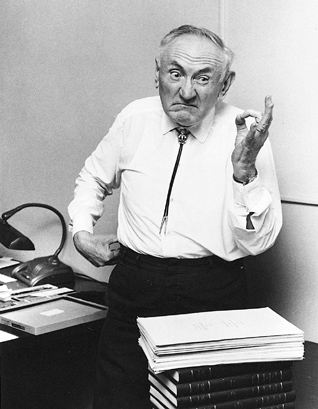
Meet Fritz Zwicky. Born in Bulgaria, a citizen of Switzerland, and did his best work at Caltech. (In fact, his daughter Barberina has noticed my old site!) Fritz was in the very tough spot of having a number of great (and correct) ideas that, by and large, people didn't take seriously. Whereas Boltzmann killed himself over this, Fritz went down another route. When asked in his later years about his detractors and those who wouldn't listen to him, he coined a new term:
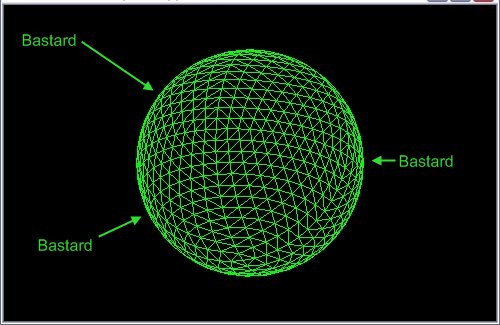
The Spherical Bastard. Why? Because no matter what direction you look at him from, he's still a bastard. See?
To quote from Wikipedia:
Zwicky described his colleagues "scatterbrains," "sycophants and plain thieves" who "have no love for any of the lone wolves who are not fawners and apple polishers," who "doctor their observational data to hide their shortcomings and to make the majority of the astronomers accept and believe in some of their most prejudicial and erroneous presentations and interpretations of facts," and who therefore publish "useless trash in the bulging astronomical journals."
All personal issues aside, Fritz really did a number of great things from the time Edwin Hubble figured out the expansion of the Universe. By 1939 -- still a whopping 70 years ago, mind you -- Fritz had come up with a theory of Supernovae, discovering how neutron stars are made along the way and pioneering their use to measure great distances in the Universe. He also figured out that galaxy clusters could act as gravitational lenses, over 40 years before any gravitational lensing was observed. But although these have been great tools for understanding the Universe, this was not his greatest contribution to science. His greatest discovery came from looking at the Coma cluster of galaxies. To Fritz, on a clear night, it probably looked something like this:

Nearly every point of light in this image is a galaxy. The Coma cluster consists of over 1,000 identified galaxies -- clumped together -- about 321 million light years away. When you look at another galaxy in this cluster, because you know how far away the cluster as a whole is, you can measure two very interesting things:
- The velocity of the galaxy relative to the center of the cluster, and
- The distance of the galaxy from the center of the cluster.
Why are these interesting? Think about our Solar System for a minute. Practically all of the mass is at the center (our Sun). By watching the planets move around the Sun -- by measuring their velocities around and distances from the Sun -- we can figure out the mass of the Sun. This has been known since the 1600s, because we know the Laws of Gravity.

Well, we can apply those same Laws of Gravity to figure out what the mass of this cluster is. You measure how fast these galaxies are moving, you measure how far they are from the cluster's center, and you can figure out how much mass is in the cluster. Sounds like a good plan. Well, that's exactly what Fritz did. Know what he found? They're all moving way too fast! The modern data, in good agreement with Fritz's, looks like this:
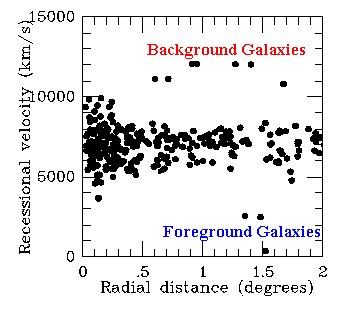
Not only did he find that they move so quickly, but that they move, according to his numbers, 160 times more quickly than you'd expect from all the visible matter in this cluster. So, in 1933, Fritz published a radical idea that well over 90% of the matter in these clusters was dark. And the theory of dark matter was born.
Know the amazing thing? Really, the only thing that's changed about this observation since 1933 is that we can see dimmer things. It turns out that it isn't a factor of 160, it's only about a factor of 50. But that's because, instead of the image above, the Coma Cluster now looks like this (and click to enlarge):


That's right, folks. If we had been on-the-ball about dark matter from when Fritz first wrote this up, we could have had a 40 year head start on understanding the dark side of the Universe. I can't help think that history would've been different...

But that's just speculation. The fact is that Fritz made this discovery, and whether he got credit for it or not at the time, he deserves the accolades in hindsight.
I wish my name was Fritz Zwicky. That's an awesome name (and an awesome guy, it seems).
Ethan, your post series are great. I loved the one about the Hubble camera, and I'm loving this one.
btw...
Religion=spherical stupidity?
Sounds like a great chance to plug some non-digital literature about Zwicky, if'n you gone done read any.
So Anakin Skywalker was a physicist who was years ahead of his time, but was ignored, so *that's* why he joined the Dark Side?
This isn't quite fair. In the 1930's one could have imagined that all the non-luminous matter in galaxy clusters was hot gas. That's dark, and it's matter, but it's not "dark matter".
I'm gonna make a comment that sounds, even to me, quite like a bit of quackery, but it was just a thought that occurred to me while reading this.
In the span of 70-80 years, our telescope technology has increased sufficiently that we've been able to accommodate for over half of the originally observed discrepancy in actual speeds and theoretical speeds. Could it be that with another century of advances in telescopic technology (new space telescope coming up soon!), we could eventually see enough dimmer matter to accommodate for all of the originally observed discrepancy? Maybe it's not dark matter after all, it's just dim matter.
Now, that being said, I'm just a layperson. I don't even pretend to try to keep up with what I assume to be mountains of evidence pointing to the existence of dark matter. Please, feel free to eviscerate my uneducated ramblings.
In all fairness to everyone else, we didn't know about a number of things, including:
-the total baryonic matter content of the Universe
-the rotational motions of galaxies
-what to make of the expanding Universe (we didn't have the Big Bang theory yet), and
-how much dim matter there is.
We know these things very well now, but this "problem" that Fritz observed was largely ignored for decades. It is now unambiguously a strong piece of evidence for non-luminous matter, and was back then, too. That's why it was a pity it was ignored instead of investigated.
And Phreack, it was a difference of a factor of 3 that we gained. We would need a difference of another factor of about 6 to get rid of non-baryonic dark matter today. The observations are too good, and it isn't going to happen.
That's why you're the theoretical astrophysicist and I'm the random dude without any sort of degree. Like I said, it sounded wrong to me as I was typing it, but you can't learn the answer if you don't ask the question :)
Thanks for the response though. I've been enjoying your blog since PZ linked it on pharyngula.
I know I'm just ringing the same bell here that everyone else is, but this series is really enjoyable. I'm looking forward to seeing who else wins the Ethan Siegel Person of the Decade award.
I too am ringing the bell. Thanks, Ethan!
I've been an astronomy/particle physics fan for years, and I've heard several times that Fritz Zwicky was ignored, even in his day, largely because he was seen as kind of a pushy
as***le. He was even harder to deal with than Wolfgang Pauli, another monster-ego of the day. Too bad, but there's politics even in science. Great article!
I've been an astronomy/particle physics fan for years, and I've heard several times that Fritz Zwicky was ignored, even in his day, largely because he was seen as kind of a pushy
as***le. He was even harder to deal with than Wolfgang Pauli, another monster-ego of the day. Too bad, but there's politics even in science. Great article!
I concur - great series.
Your wording had me wondering if Einstein really didn't make the prediction of gravitational lensing himself, as I remembered it. But Wikipedia claims he did, apparently Zwicky was the one which realized galaxy clusters would do it. [The year after Einstein "main streamed" the subject 1936. I see Orest Chwolson is credited for the first discussion already 1924.]
I know I'm just ringing the same bell here that everyone else is, but this series is really enjoyable. I'm looking forward to seeing who else wins the Ethan Siegel Person of the Decade award.
http://www.ladyshoesstore.com/This isn't quite fair. In the 1930's one could have imagined that all the non-luminous matter in galaxy clusters was hot gas. That's dark, and it's matter, but it's not "dark matter".
http://www.ladyshoesstore.com/This isn't quite fair. In the 1930's one could have imagined that all the non-luminous matter in galaxy clusters was hot gas. That's dark, and it's matter, but it's not "dark matter".
This is not the first post of you that I've read, and you never cease to amaze me. Thank you, and I look forward to reading more.
>>one man often gets left out of these discussions, IMO, because he was too far ahead of his time.<<
Could it be that Zwicky was also left out because he spoke of many contemporaries with huge distain. He was often right in his opinion, but demeaning colleagues and influential people has a big cost.
I really enjoyed his book: Discovery, Invention, Research Through the Morphological Approach. (I found Zwicky because scifi writer Robert Heinlein referred to Zwicky boxes, and the book describes them.)
http://www.ladyshoesstore.com/This isn't quite fair. In the 1930's one could have imagined that all the non-luminous matter in galaxy clusters was hot gas. That's dark, and it's matter, but it's not "dark matter".
http://www.ladyshoesstore.com/This isn't quite fair. In the 1930's one could have imagined that all the non-luminous matter in galaxy clusters was hot gas. That's dark, and it's matter, but it's not "dark matter".
http://www.ladyshoesstore.com/This isn't quite fair. In the 1930's one could have imagined that all the non-luminous matter in galaxy clusters was hot gas. That's dark, and it's matter, but it's not "dark matter".
http://www.ladyshoesstore.com/This isn't quite fair. In the 1930's one could have imagined that all the non-luminous matter in galaxy clusters was hot gas. That's dark, and it's matter, but it's not "dark matter".