

Many of you saw the pictures I posted Monday of colliding galaxy clusters. These pictures were spectacular, because they not only show galaxy clusters less than 200 million years after a collision (which is short, cosmically), they also show where the mass lies (traced in blue) and where the X-ray emitting areas are (pink). You get pictures like this one from the Bullet Cluster:
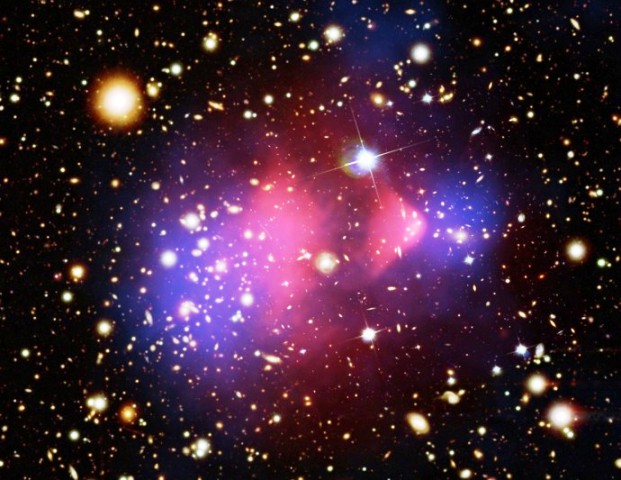
This one from MACS J0025:
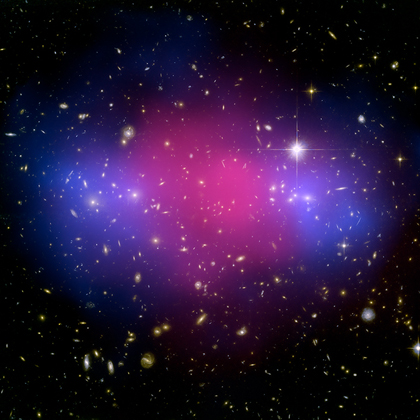
And this one from Abell 520:
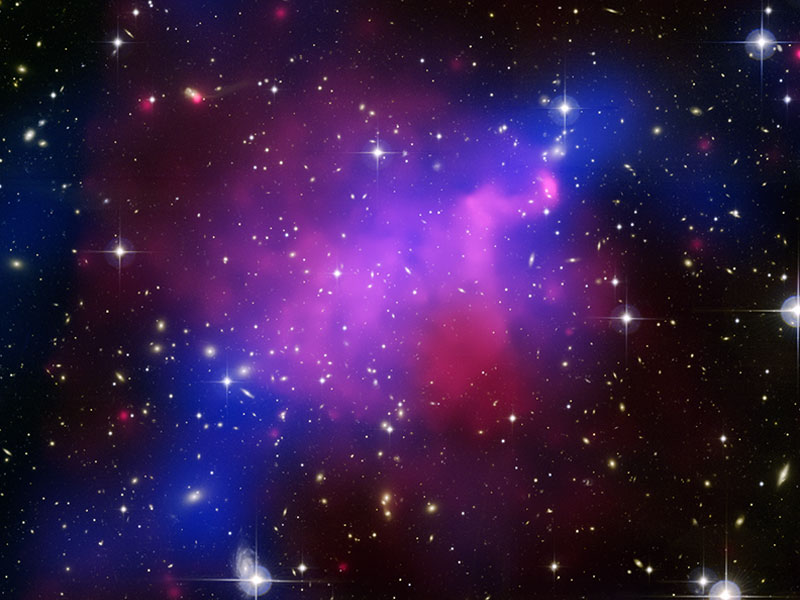
This is what happens when clusters collide, the normal matter gets separated from the dark matter! Let's tell you how.
Some normal matter is packed together in tight, dense little clumps. Good examples of this are stars and galaxies. When you run two large clusters (spanning millions of light years) into each other, these little clumps hardly ever hit each other, and move with a lot of momentum. What does this mean? They tend to miss one another, and they hardly get slowed down by the friction of moving through the other cluster. In other words, they behave like the little metal balls in a game of "Crossfire". They mostly just pass straight through to the other side.

That leaves us with the gas, which is where most of the normal matter is, and the dark matter. For all intents and purposes, these are distributed over the entire cluster, so they're very diffuse, but also omnipresent. The gas is still made up of protons, neutrons, and electrons, and these tiny particles interact with one another very easily. When they run into each other, they behave similarly to running two jets of water into each other:

There is a lot of friction between them, which (if you remember) both slows them down and also heats them up. The slowing down is why the X-ray-emitting gas is always in the middle of these clusters (in all three cases), and the heating is why the gas becomes energetic enough to emit X-rays! In other words, the gas goes "SPLAT!"
But what of the dark matter? Although it obeys the same gravitational laws of physics, it's missing the main source of friction -- electric charge! In fact, we're pretty sure that dark matter has practically no electromagnetic interactions at all. The friction between dark matter particles (as well as between dark matter and gas) is so small it might as well not even be there at all. Colliding dark matter with itself is as futile as colliding light beams with one another; they might as well not even be there!

But we've gone even further than that, and have simulated what would happen to both the normal, gaseous matter (in pink) and the dark matter that only has gravitational friction (in blue), when two clusters collide. The video is here, but I've taken some screen captures of the relevant parts.

Before the collision, you can see that the normal matter and dark matter line up very well with one another, and are both distributed in (roughly) spherical shapes over the entire cluster.

Until they start to collide, they both retain those shapes, and both the gas and dark matter remain in spheres. But all that changes once the collision starts...
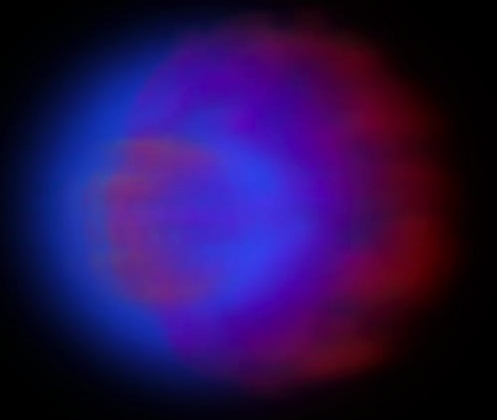
You can see, right away, that the dark matter (blue) just keeps moving straight through, effectively unimpeded by anything. But the gas (pink) collides with itself, slowing down (losing kinetic energy) and heating up (gaining thermal energy). This gets more pronounced as we go forward another couple of million years.

And the separation increases as the dark matter just continues to coast, and the gas continues to simply heat up and slow down.

And as the collision progresses, the dark matter eventually reverses direction and comes back towards the cluster. You don't see this in the Bullet cluster, which is in the early stages of the collision, but you can see it slightly in MACS J0025, which is in a slightly later stage, and it's very pronounced in Abell 520, which is in quite a late stage of its merger.
And there you have it. That's why colliding clusters do what they do, and that's why there needs to be some kind of collisionless, uncharged stuff that interacts gravitationally. We call it dark matter.
It has gravity like matter, and it's completely invisible, neither absorbing nor emitting light. So whether you love or hate the name, that's what it does, and this explanation is the only sensible one we've found for this phenomenon. Dark matter. Remember it.
- Log in to post comments
Interesting series of posts. (I appreciate the extra detail in this return to the dark matter issue.)
A few questions come to my mind:
Is it possible to determine the distance to the dark matter that's responsible for the lensing? (In other words, do the blue and red line up along the direction towards the colliding clusters? I guess "yes" but I gotta ask!)
What kind of clumpiness in the distribution of dark matter do we see if we look in other directions (not towards colliding clusters)? Is the distribution uniform or lumpy? Does dark matter line up with the visible matter except in cases of massive collisions? (Is it possible to tell? Without the x-rays generated by colliding gases, can we determine where the regular matter is and whether it lines up with the dark matter responsible for lensing?)
Why should the dark matter line up so well with the regular matter? From these posts I get the impression that dynamics very easily results in separation of dark and regular matter. So if regular matter has condensed in very lumpy galaxies/clusters/superclusters, should we expect that the dark matter also follows the same pattern of lumpiness? (Maybe it's a question of scale -- on the scale of superclusters, the lumpiness of the dark matter itself was responsible for drawing in the regular matter.)
If dark matter obeys gravity more or less like regular matter, why don't we see "dark stars" and "dark black holes" and "dark planets" and such?
Sure, the stars of course wouldn't shine, but so what -- we can detect black holes and planets even though they don't shine. And I guess also the dark stars and dark planets would always collapse into black holes, seeing as they have no electromagnetic forces causing friction and expansion to counteract the gravity.
Fascinating posts, btw...
I did some back of the envelope, order of magnitude type calculations trying to estimate the relative velocity of the clusters. I'm thinking that if we are talking distances on the order of a 10 million ly and a time frame of 200 million years then we have a velocity of about .05 c (about 15,000 Km/sec). No wonder the gas heats up to x-ray emitting temps.
Could it be that, simply, dark matter is immune to electromagnetic force (not neutrally charged but immune) the same way an electron is immune to strong nuclear force?
"That leaves us with the gas, which is where most of the normal matter is, ..."
this makes me a little bit curious. How do we know that? I am quite ignorant about astronomy, so I would like to know how we know what the ratio between stars&planets and gas in other galaxies is. Isn't gas relatively translucent? How can we really know what proportion of the extra mass that is measured is due to gas and what proportion is due to dark matter? Isn't there a possibility that apart from the hot X-ray emitting gas there is also a large amount of cold gas?
You alluded to this in part 2 of this series but only gave the answer, without explaining how we know this. I almost feel sorry for asking ignorant questions but I'd really like to know.
Remember, DM can transfer momentum and energy to "normal" matter [1] by gravitational coupling. That electromagnetic matter can engage in thermodynamically lossy exchanges, resulting in clumps of both dark and electromagnetic matter.
[1] Damned arrogant to call it that, considering how small a minority it is. I suppose a social/political parable would be possible.
Of course, these are very nice pictures and Ethan Siegel's explanation of dark matter is excellent; if dark matter exists. But all observed phenomenon can have many theoretical explanations. Siegel's analogy, "Colliding dark matter with itself is as futile as colliding light beams with one another; they might as well not even be there!", suggests that he believes that dark matter is bosonic. Well then why doesn't he suggest that gluons, W/Z, gravitons, or fermion superpartners as possible candidates? I don't believe in dark matter any more than I believe in cold fusion; but if Siegel believes in dark matter then he need to start hypothesizing some of it's testible properties, like is it boson or fermion of the standard model or of supersymmetry and why or why not. Let me hypothetically (I do not believe this) consider "dark matter" as best explained by gluons that escape proton and neutron confinement in the intense collision of galaxies as shown in the Bullet Cluster data. So why could't dark matter be gluons (specifically gluoballs), as bosons glueballs. On the other hand if Siegel thinks "dark matter" is fermions or superparticles then assert and defend that. Without some kind of such specific hypothesis, talking about dark matter is like talking about epicycles. Epicycels are an observed phenomenon; remember the word planet means wanderer; and the ancients, you and I can observe the wandering of planets; just so Siegel pictures show some kind of astronomical wandering after a galactic collision. Remember that all of the Ptolemaic data and observations are still valid and the terminology of sun and planet risings and settings is still used today, even the Ptolemaic calculations are still valid up to a certain level of precision; but despite such usefullness and agreement with data, the underlying theory of Ptolemy is seriously conceptually flawed. Alternative explanations of "dark matter" need to be discussed. Perhaps in Siegel's subspecialy of astrophysics, which is peer reviewed by others in his subspecialty, there is no disagreement; but what do physicist in other subspecialties think. Robert B. Laughlin in A Different Universe (Reinventing Physics from the Bottom Down) says, "I myself have come to suspect that all important outstanding problems in physics are emergent in nature, including particularly quantum gravity." Somewhere between the ideas of Fred I. Cooperstock and Robert B. Laughlin, I believe there is a more credible alternative explanation of the "dark matter" data. No one can dispute the evidence; but it's the interpretation of the evidence that is not convincing. For starts it would be nice if Siegel hypothesized the hypothetical spin of his hypothetical "dark matter" particles.
comment by Thomas Neil Neubert, author of A Critique of Pure Physics
If such collisions can really result in separation of components, that could create some interesting anolalous regions of space, couldn't it? For the moment assume three types of matter DM, diffuse gas, and condensed objects -mostly stars and blackholes. It looks like such collisions can separate out the gas, -but I'm assuming the condensed matter doesn't get separated from the DM, as the collisional dynamics is similar?. But even so, if the now DM less gas can undergo local contraction, we could end up with an anomalous DM free (or at least deficient) galaxcy cluster.
Mr. Troll,
All we know from the lensing data (i.e., where the mass is) is how much total mass is along our line-of-sight. We don't know where it exactly is along that line-of-sight from our observations. We need to use the other things we know to infer that piece of information.
Kevin,
These objects you talk about, like stars, black holes, and the like, only got that way because they were able to lose so much kinetic energy. Dark matter can't. Its clumps are diffuse; more like clouds than hailstones. They never collapse farther than that.
Jack,
The electron is "uncharged" to the strong force. (Quarks and gluons have "color" charge; the electron does not.) So dark matter, whatever it may be, has no electric charge and has no color charge, or we would have seen its interactions.
Beebeeo,
I don't know enough about how this is done to give you a quick, easily explainable answer. X-ray astronomers have been attempting to measure a parameter, fgas, for a long time, which is basically "what fraction of the mass of this thing is in its gas?" The most recent aggregate measurements I saw placed it between 11% and 17% of the total mass, across many galaxies and clusters, on average. Much more than stars, much less than the total. That's as much as I know without going into more detail than I care to.\
D.C.,
Don't forget that gravitational coupling is about 38 orders of magnitude weaker and less efficient than electromagnetic coupling. So if you want to estimate the time it takes to get things the size of stars, but made from dark matter, find out how long it takes to make a collapsed object and multiply it by 1038. We should all live so long. That's why dark matter objects are clumped diffusely.
Omega,
Look back at part #3 of this series. Look at the Bullet Cluster in the optical, and try to see where the galaxies are clustered. Then compare it to where the lensing data (blue) shows that the mass is. This is pretty much what you were talking about.
Thomas,
It is a common opinion among particle physicists that the standard model is sooooo good, that if there's a problem between particle physics and general relativity, GR must be wrong. And it's a common opinion among astrophysicists that GR is soooo good, that the problem must be in particle physics. In reality, they're both very, very good. That's why I studied both of them for so long.
I am trying very patiently to explain what the astrophysical evidence is, what is plausible, and what is implausible, along with why. If you have your mind made up that dark matter is nasty and you'll never believe it exists until we create, discover, and isolate it in the lab, that's your call. But if you want to challenge dark matter, you need an alternative that is -- in at least some way -- superior. I've already gone through the problems with Cooperstock & Tieu's paper; do you have an alternative? Please remember to read parts I-III and address those points, please.
"Diffusely" as in, "on the order of clusters?"
Exactly. Someone had asked why it was clumped at all, and the G->EM transfer was my answer. In fact, it would be worth comparing the sizes of the DM objects in question vs. their estimated ages.
friction, eh? thanks Ethan, quite grokable.
@Thomas
Regarding your dark matter suggestions:
-The W/Z boson lifetimes are of order 10^-25 s. Hopefully you can see the problem there.
-The gluon is massless. Massless particles don't lens very well.
-The graviton is also supposed to be massless (if it exists at all).
Fermion superpartners are an interesting possibility. Here's a random paper from 1995 I pulled off the arXiv: http://arxiv.org/abs/hep-ph/9506380
Next time you choose to enter the discussion, you might consider bringing with you more research (and fewer strawmen. And more paragraph breaks.)
So at the moment the gravitational effect is the only known interaction between the world we know and the dark matter? Is there any reason to believe it may be composed of electrically neutral particles like the neutron which can be encouraged to fall apart and then observed? How much dark matter is in the space between us and the moon?
@MadScientist: You mean, like, free-roaming neutrons? As opposed to the neutrons in the gas producing the x-rays.
@Naked Bunny: No, not even neutrons, just particles with no charge, but if they were neutrons then they'd need to be on their own with not too many protons or electrons wandering about (or else we'd have a lot of hydrogen appearing). The dark matter can't be neutrons or else the bomb physics wouldn't work; neutrons are slowed and scattered, they will not simply pass through other matter (though they pass more easily through some materials than others).
Remember that all of the Ptolemaic data and observations are still valid and the terminology of sun and planet risings and settings is still used today, even the Ptolemaic calculations are still valid up to a certain level of precision; but despite such usefullness and agreement with data, the underlying theory of Ptolemy is seriously conceptually flawed. Alternative explanations of "dark matter" need to be discussed. Perhaps in Siegel's subspecialy of astrophysics, which is peer reviewed by others in his subspecialty, there is no disagreement; but what do physicist in other subspecialties think. Robert B. Laughlin in A Different Universe (Reinventing Physics from the Bottom Down) says, "I myself have come to suspect that all important outstanding problems in physics are emergent in nature, including particularly quantum gravity." Somewhere between the ideas of Fred I
@MadScientist: Okay, I think I was putting the wrong emphasis on "like the neutron" in your first comment, which was why I was confused.
So -- amateur reader questions:
Has anyone come up with a science-fiction description of how life evolves in an area stripped of dark matter by such a collision? The value of gravity measured there differs, right? Anything else?
There's supposedly a 'great attractor' somewhere beyond the limit we can see at the edge of our visible universe; has anyone speculated that may actually be a large area of dark matter off to one side of the visible universe?
What happens if you get massive collisions during the period after a Big Bang -- do you get a universe with the dark matter off to extremes and the normal matter in the middle?
This stuff is so fascinating. Did some more reading on the neutron question (free neutrons are out, too short a half life time) but neutron starts would make a nice candidate, a 12 km ball can probably fly through a galactic cluster without hitting anything. Until I noticed the massive magnetic field those things have, opening the new question: How does something made up of neutral particles get a magnetic field?
How does something made up of neutral particles get a magnetic field?
The thing to remember about neutron stars is that they're not composed solely of neutrons. The surface is covered with compressed, degenerate plasma, basically superconducting fluid. The core may be a soup of free quarks, but I don't recall off the top of my head if that would contribute to the magnetic field.
http://www.lsw.uni-heidelberg.de/users/mcamenzi/NS_Mass.html
The electromagnetic force is what sticks atoms of normal matter together. Without electromagnetism, atoms would simply pass right through each other and keep going. (Until gravity slowed them down.) And that's the behavior observed with "dark matter".
@Mu: "How does something made up of neutral particles get a magnetic field?"
Additional to what Naked Bunny said: neutrons also have a magnetic field on their own (they have a "magnetic moment"), although they don't have an electric charge. Don't forget that neutrons are themselves composed of quarks, which do have an electric charge (and magnetic moments).
Article in New Scientist, with a very incorrect title given what is written below it, suggests interaction between matter and adrk matter may be stronger than thought.
http://www.newscientist.com/article/dn17892-galaxy-study-hints-at-crack…
Heya, does this little bit in new scientist have anything in it that you could address in the fourth installment?
http://www.newscientist.com/article/dn17892-galaxy-study-hints-at-crack…
Thanks
I was wondering where all the loons went - looks like they are over at newscientist. That comment thread is the hoots.
Ethan
My assumption is that particle physics is very very good and that general relativity is very very good and that quantum mechanics is very very good and that astronomical data is very very good. But my assumption is also that the "big bang" theory and the "dark matter" theory, though the best theories in town, are both seriously flawed (but let me not clutter your blog with my perhaps delusional reasoning).
I am open to the possibilty that "dark matter" will be one day described as some kind of "new" matter. That would be exciting. But if "dark matter" is to become more than a conundrum about astronomical descriptions; then I believe it must take account of the best ideas of General Relativity (hence Cooperstock) and the best ideas of particle physics (hence my asking for some hypothesized particle properties).
Your model of before, during and after galaxies collision must assume some kind of "dark matter" particle properties and statistics (I suspect point particles and Fermi-Dirac statistics) and some type of space time geometry(I suspect Euclidean flat space and flat positive time) and some kind of gravitational theory (I suspect essentially Newtonian gravity, i.e. Newtonian gravity which is trivially a type of general relativity). These important assumptions are all that is "known" about "dark matter". If you start with these assumptions; then you get a picture (i.e a description) of the "bullet cluster." But you do not tell us your models assumptions and hence your hypothesis. I am interested in knowing these assumptions; because their reasonableness will help me to be convinced or not of "dark matter" theory.
If a theory can't be well explained to a curious skeptical intelligent ameteur; then I believe the experts don't understand their theory well enough and yet are unwilling to say, "we just don't know."
I believe that "dark matter" theory is a correct descriptive theory like the Ptolemaic system; but that "dark matter" theory is conceptually seriously flawed. Neverhteless, being a correct descriptive science is a very worthy achievement and necessary for more robust theory development.
Best regards,
Thomas Neil Neubert
Have you considered John Moffats MOdified gravity theory in its latest form? I understand it is the closest of all the modified gravity theories in its agreement with observational data. Mr. Moffat published a paper concerning the bullet cluster here: http://arxiv.org/PS_cache/arxiv/pdf/1005/1005.2685v1.pdf
I understand it appears the gravitational lensing effect is explained, however his field equations come up short on the velocities of the collision. But in closing he lets us think later work may correct the problem.
Now with that question aside I want to ask why is it that when alternative models fall short they don't get "dark energy, dark matter, or dark flow" to fix them. It honestly appears to me like we are changing our universe to fit our math as opposed to fixing our math to explain our universe.
Why does our model depend so heavily on evidence that we cannot observe or even verify in any real way. I can understand the need to have models that work so we can in fact make predictions, however I don't understand why we don't keep our minds open to a better solution. Or even better why we aren't investing in finding a better solution, at what point do we give up the search and concede we will never detect dark matter or produce it? I'm not saying we won't but until we do we should really not count our chickens before they hatch you know.
Now I'm keeping an open mind, I say we all should until we get our feet on solid ground.
Thank you for your time and for answering my question about moffats paper, I'm really wondering about that and kind of need it dumbed down lol.