

The cradle rocks above an abyss, and common sense tells us that our existence is but a brief crack of light between two eternities of darkness. -Vladimir Nabokov
Last Friday, I posed a question to you, and you kindly responded by voting as to whether, when you crossed the event horizon of a black hole, the lights would stay on or go off. The results so far?

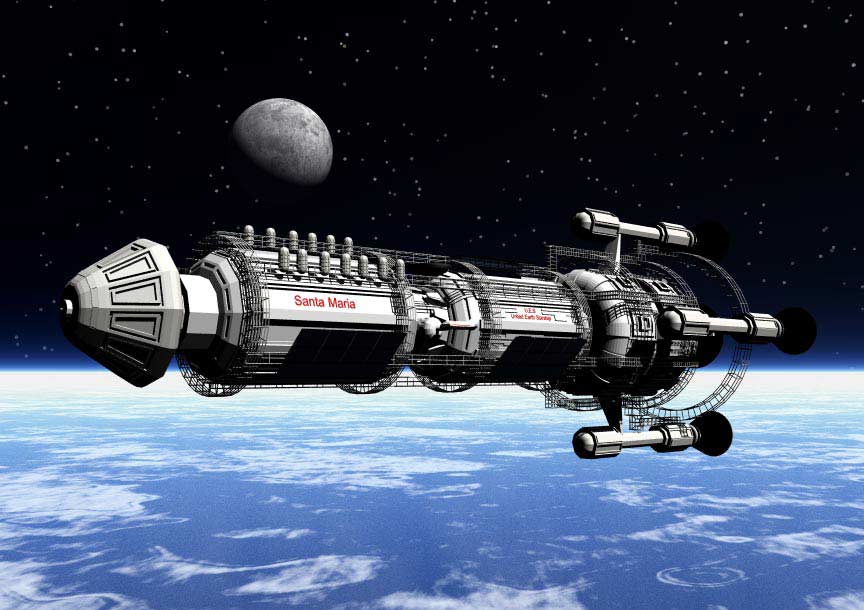
You could be in a strong gravitational field, like exists near a black hole. Or, you could be accelerating due to your engines. Or -- if you like your science with a little more fiction in it -- you could be accelerating because you're caught in a tractor beam.
No one doubts that the lights would stay on if you were simply accelerating, do they? Well, is crossing into the event horizon of a black hole any different?

Why don't we ask Al. In 1907, two years after publishing his special theory of relativity, Einstein had what he would later call, "my happiest thought." He had an insight that all accelerations were equivalent to an observer, regardless of what caused them and regardless of how fast the accelerations were.
He called this the principle of equivalence, and this is where we find our answer to the question.

It doesn't matter how big your acceleration is or what causes it. It doesn't matter what direction you accelerate in or how hostile your environment is. And, to give you the final answer, it doesn't matter whether you're inside of a black hole or not. As long as you still physically exist (i.e., you can neglect the tidal forces trying to tear you and your spaceship apart), the lights stay on!
And oddly enough, once you do cross the event horizon, if you want to maximize the time it takes for you to reach the center of the black hole, do you know what you should do to your ship's engines? Turn them off completely! Any extra acceleration you put out, even if it's directed perfectly away from the center of the black hole, will actually pull you in faster than if you turned all of your engines off. That's, umm... a survival tip that could buy you precious extra seconds to get to the end of The Count of Monte Cristo. (Spoiler alert.)
All human wisdom is contained in these two words -- wait and hope.
And that's how you know that the lights stay on!
"wait and hope"
not weight and hop?
Ethan, et al-
I was trying to explain to someone that as they sit there on the couch with me, we were both accelerating away from the Earth's center of gravity (with minuscule fluctuations from nearby objects and distant massive bodies). However, he wasn't buying it. I blame myself for explaining it poorly at the time, saying mainly that since acceleration and gravity are equivalent according to Al's principle of equivalence.
His argument was that we weren't moving relative to the center of gravity, but maintaining the same distance.
How else might it be explained so that it makes sense? Perhaps phrased that since in order to stop motion, an equal and opposite force must be applied to it, therefore to stop our acceleration to the earth's center, an equal accelerating force must be applied to us?
Ethan,
Could you explain that last part about turning off the engines? If I fire my rockets to take me away from the black hole and I end up moving at a faster rate towards the black hole, what happened to conservation of momentum?
I mean, yes, the principle of equivalence says that I can't tell the difference between accelerating under rocket power and accelerating because of gravity, but it seems like I should be able to tell the difference between accelerating at speed X and accelerating at speed X - Y, and so the equivalent state would be falling towards an object with weaker gravity, and hence a less accelerating effect.
Thanks,
Would it be fair to assume, though, that if you were to look outside your spaceship, if you looked inwards towards the singularity, you'd see absolutely nothing? Or would you get some bizarre lensing effects all around you, from photons being pulled into the event horizon and having their paths bent into spiral shapes?
(I've been wondering about this since writing about photon spheres last week...)
Wouldn't there be some kind of shift in the light's perceived wavelenght? if so, wouldn't it be possible that all the light we would see be beyond the visible spectrum?
I was once in a Gravitron (not a graviton), driven by a crazy carnie, and as it went faster and faster I noticed that all the colour started disappearing from my view. I think that was biological though.
Joe,
I'm not sure I can explain it exactly, but my picture is that the central singularity is something which lies ahead of you in whatever direction you look, so any acceleration will just take you towards it even faster.
Why do all those spaceship models look like dicks? I mean, the STS is a delta-winged blended body, and they still managed to make it look like a prick!
Not good. This idea not aplisiment.
@Jonathan
My, my... Freud would have had a field day with you!
Ethan - Could you at some point in the future do a post about how images are distorted as you approach the centre of a black hole.
The fact an image has no mass is irrelevant, right (hammer and feather from the tower of Pisa and all that)?
So at first I thought it would be exactly as tidal forces on any object (stretching vertically and squeezing horizontally), but then of course an image is made of photons travelling at c. So what exactly would happen?
Say I was looking at a book on the table in my spaceship, and they are closer to the centre than I am, and obviously one end of the book is closer to the centre than I am... What would I see? Is there a function by which I can transform the book into an image I would see under extreme gravity?
@sean hogge:
you and your friend are both mistaken. sitting on the couch, your velocity w.r.t. the earth is zero and the net force on you is zero, so by Newton's 2nd law, you are not accelerating.
however, since the earth is rotating, the surface of the earth is not an inertial reference frame. it can be approximated as one because the angular velocity of the earth is small, but strictly speaking the surface of the earth is an acclerated frame of reference.
in order to keep you in uniform circular motion with the surface of the earth, there must be a centripetal force acting on you. gravity is this centripetal force.
one more thing. the direction of the centripetal acceleration is towards the earths center of gravity, so you were only off by a negative sign!
Sean and rob,
First off, your net acceleration is very close to zero. You know this, because your velocity relative to the surface of the Earth isn't changing.
Although the Earth rotates, the force of gravity is not the only force acting on you; for that to be true, you'd need to be an orbiting satellite. You are on the surface of the Earth, and so the surface of the Earth pushes back on you. (We call this a "normal" force, and it is what is responsible for you feeling your own weight.)
Now, you would feel that same weight whether you were in your chair on Earth or whether you were in a chair that was accelerating at 9.8 meters/second^2. That is what the equivalence principle says.
Your centripetal acceleration is the difference in acceleration due to gravity and the normal force, which is something like 0.04 meters/second^2 at the equator. This predicts that "g" at the north pole should be 9.83 m/s^2, but should be 9.79 m/s^2 at the equator. This is actually what we observe, which is kind of awesome!
This predicts that "g" at the north pole should be 9.83 m/s^2, but should be 9.79 m/s^2 at the equator. This is actually what we observe, which is kind of awesome!
Not quite so awesome if you factor in the reduced polar radius. Won't the 0.1% difference account for about 25% of this?
Won't the 0.1% difference account for about 25% of this?
From my CRC handbook, the earth has an equatorial radius of 6378 km and a polar radius which is 21 km shorter, for a fractional difference of 0.0033. Gravitational force goes as r^-2, so double that for a fractional difference of 0.0066, meaning that oblateness alone should reduce gravitational acceleration by 0.065 m/s^2 at the equator compared with the poles. Meanwhile, your rotation speed at the equator is about 1700 km/h (40000 km in 24 hours), or 460 m/s, giving you a centripetal acceleration of about 0.034 m/s^2.
That's true if you're only interested in your own lifespan. But if you want to hang around in the black hole long enough to meet up with someone else who will jump in later, then you should fire the rockets.
Then you'll still be there at that later time, even though you're living for a shorter time. Gotta love relativity!
This topic relates closely to a question I've wondered about occasionally...
When we're standing here on the ground or falling down a deep hole toward the center of the earth, gravitational forces on all parts of our body are roughly the same since compared to the size of the radius our puny little 6' or so is pretty insignificant. As we fell down the hole gravity wouldn't really get stronger since a good bit of the earth would be increasingly over our heads.
But if we're falling into a black hole we're approaching an object so small that the distance from that object to the soles of our feet is going to be VERY different than the distance to the fuzz on the top of our head. Would our feet simply yank the rest of our body along for the ride or would we be torn apart?
This situation would seem to be somewhat different than Albert's spaceship... which is why it has puzzled me. Anyone here knowing more than I do have any thoughts? I may just be fundamentally misunderstanding/missing something about gravitational physics here... been a while since I studied it!
- MJM
We'd be torn apart. Limb from limb, then molecule from molecule, then atom from atom, . . . etc.
The difference between the pull on your head and your feet is known as a "tidal force" -- because it's the same phenomenon that causes the tides. (The sun and moon pull harder on the near side of the Earth than on the far side -- stretching the oceans away from a perfect sphere.)
At the center of a black hole, tidal forces become infinitely strong.
Physicalist, that's pretty much what I thought. But there's another aspect to this: as our velocity approaches the speed of light, time would "slow down" for us. Would we hit the bottom of the black hole before the end of the universe (in whatever form that end might take... heat death, big collapse, fizzledizzle, whatever) From the viewpoint of an external observer (er... well... if the external observer could actually observe anything inside a black hole) I would guess we'd fall pretty quickly and go splat at the "bottom." But from the viewpoint of the faller (ignoring being ripped apart by tidal forces) wouldn't the external universe just seem to enormously "speed up" toward its ending before the splat?
:?
MJM
well, our time always flows at the same rate "for us" -- that is, we always see our watch click once a second, etc. But I think I understand what you're getting at.
Actually, this has it backwards. An external observer would never "see" you cross the event horizon. Using the "natural" time coordinate of an external observer, you're stuck there at the event horizon for the entire future of the universe, you never make it inside. (Of course, we now know that these coordinates don't tell the whole story; they can't be used to describe the interior of a black hole at all.)
According to your watch, however, you pass through the event horizon and get torn apart by tidal forces at the central singularity quite quickly.
Given a standard classical black hole (i.e., one that doesn't disappear through Hawking radiation, for example), it is fairly accurate to say that you hit bottom at the end of the universe, and not before.
But this doesn't mean that "the external universe [would] seem to enormously "speed up" toward its ending before the splat."
As long as you're not accelerating, you wouldn't see any extra of the history of the universe. You'd just see a tiny bit more of what happened after you went through the event horizon.
However, if you were to undergo impossible accelerations away from the central singularity, then you would see more and more of what happens through all of time. But this arguably isn't a special feature of black holes per se: such impossible accelerations will take you to the end of the universe in a short amount of time even in normal spacetime (outside a black hole).
All these comments ignore an important property of strong gravitational fields - time dilatation!
Clocks slow down in a gravity field, as ours do relative to ones up in orbit. As you approach a black hole, your clock goes slower and slower - relative to an outside observer - and comes to a complete stop as you reach the event horizon - when our outside clocks are reading infinity! Of course, you don't obeve this as you fall in, but you see the outside universe acelerating time-wise.
Following this line of thought through, one concludes that nothing has yet fallen through an event horizon anywhere in thev universe - relative to our outside frome of reference. Matter accumulates around a super-massive object, collapsing slower and slower but never getting there. So we have dark grey holes, but not quite black holes. Of course, from the outside, you cannot tell the difference anyway.
In fact, in our reference frame, no black holes have formed yet, there are no event horizons and no singularities. But someone falling into one will have a different experience, hitting the event horizon as his clock ticks over 4.00pm and ours tick over infinity.
The British astronomer Fred Hoyle referred to these objects as "almost-black-holes", and the Russian cosmologists refer to them as frozen stars.
Don't pick on me! Blame Einstein. He developed the theory, and he didn't believe in them either!
Mike Holland
Ethan is not strictly correct about turing off your engines - please see
No Way Back: Maximizing survival time below the Schwarzschild event horizon
Geraint F. Lewis, Juliana Kwan
(Submitted on 8 May 2007 (v1), last revised 15 May 2007 (this version, v2))
It has long been known that once you cross the event horizon of a black hole, your destiny lies at the central singularity, irrespective of what you do. Furthermore, your demise will occur in a finite amount of proper time. In this paper, the use of rockets in extending the amount of time before the collision with the central singularity is examined. In general, the use of such rockets can increase your remaining time, but only up to a maximum value; this is at odds with the ``more you struggle, the less time you have'' statement that is sometimes discussed in relation to black holes. The derived equations are simple to solve numerically and the framework can be employed as a teaching tool for general relativity.
You see, the reason why you wouldn't be able to see if you fell into a black hole, is that it's gravity it's self is strong enough that even light can't escape.A small little lesson for the ones who don't know.
i wish we could send a apaceship into a blackhole to see what is in one it might be amazing