

I have come not to make war on the Italians, but to aid the Italians against Rome.
-Hannibal of Carthage
Today is Christmas Day, but did you know that this holiday, in addition to being a solstice celebration, has its origins in the second Punic War? Beginning in 218 B.C., the Romans suffered a number of, well, fairly crushing defeats at the hands of Hannibal of Carthage. You've probably heard the story of Hannibal crossing the Alps with elephants (although, according to some sources, only one survived), and invading Italy, making it all the way to the city walls of Rome.
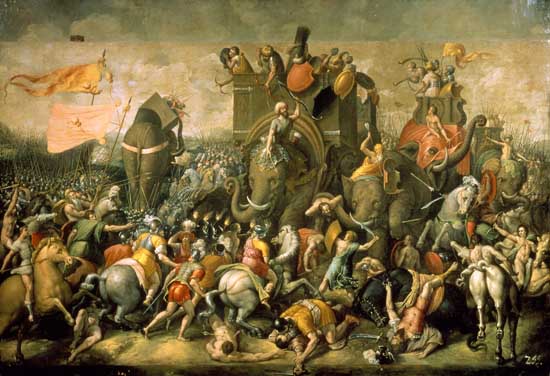
Roman morale was low, and there was much citizen unrest, as Hannibal's victories and conquests led to many switching allegiances. So what do you do, if you're a Roman leader?
You have a big festival when things are down, to raise morale! So in 217 B.C., they had the first Saturnalia, which involved role-switching games between masters and slaves, widespread gambling, feasts, a special market, the giving of presents, and, of course, sacrifices performed at the Temple of Saturn in the Roman Forum.
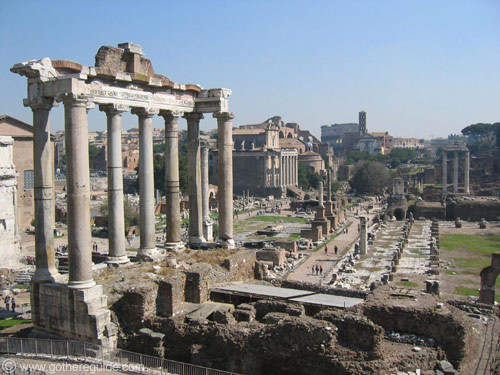
Why Saturn? Well, for a number of reasons, but one of them is Saturn's association with the idea of rebirth. How does that work? The Roman Saturn was the same as the Greek Kronos, leader of the Titans and ruler over the golden age of man. It was prophesied to Kronos that he would have a child that would be even greater than he was, who would overthrow him. So, each time Kronos' wife, Rhea, got pregnant and gave birth, Kronos would take the newborn child and eat it. Hades (Pluto), Poseidon (Neptune), Demeter (Ceres), Hera (Juno), and Hestia (Vesta) were all devoured.

But by time the sixth child, Zeus (Jupiter) came around, Rhea got wise, and fed Kronos a baby-shaped rock wrapped in a blanket. Zeus grew up in secrecy, raised an army of gods, monsters and titans, defeated his father, and rescued his brothers and sisters from their cannibal father's innards. Zeus and his siblings then ruled over the Earth, and that's the end of the story of Saturn.
So they celebrated it, and it grew -- almost immediately -- into a week long celebration. No less an emperor than Augustus faced the prospect of a revolt when he tried to pare it down to a 3-day-long celebration. And Saturnalia celebrated not only the rebirth of all of the major Roman Gods, but also the rebirth of the invincible Sun, which nicely corresponds with the Winter Solstice.

And that's the story of the Roman Saturnalia. But it shouldn't end there. After all, Saturn's had an incredibly interesting story to tell ever since the invention of the telescope, when Galileo described an oddball world with "ears".
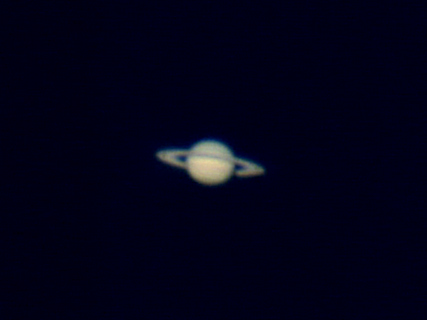
Well, what better way to celebrate this very old holiday than by looking at the planet whose namesake is what this holiday was once all about? Most modern amateur telescopes can do much better than Galileo, and will get a view of Saturn that looks something like this.
The spectacular Hubble Space Telescope, when it looks at Saturn, can get you an outright spectacular view, such as this.

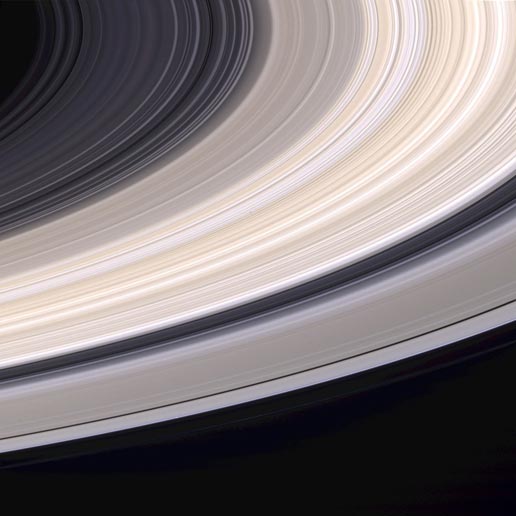
But even for Hubble, Saturn is still hundreds of millions of miles away. If you really want the best pictures of Saturn, your best bet is to go there, like Cassini did.
And what story of this distant, ringed world does Cassini have to tell? Better let the pictures -- even in monochrome -- speak for themselves.


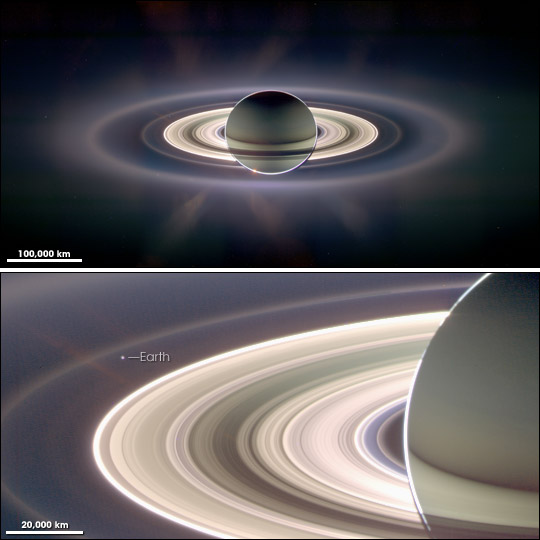
So a Happy Saturnalia to you all! Enjoy the holidays, and best wishes!
Happy Saturnalia to you too! I'm glad to see your Classics major paying off ;)
Thanks for the tales and the pictures.
Don't forget the anecdote when Galileo, much later after his initial observation, turned back to Saturn and found that the "ears" were no longer visible. "What is this?" he wrote in his notes, "Does Saturn still devour his children?"
What a thoroughly wonderful post.
The ears? That's for when Saturn is bad and strays out of orbit,
the gods can take him by the ears and march him back,
thus the expression "Bad boy Saturn".
Interesting article, and the pictures are awesome! One more tidbit of info: let's not forget the other way the Roman god Saturn is still with us. He's the namesake for the seventh day of the week, which for lots of us is our favorite day.
Whilst the ever improving images of Saturn are great theres something really special seeing the planet through your own telescope (even if it is a small one that doesn't get used much anymore!!).
..."thus the expression "Bad boy Saturn".
Oh, that old expression!
I thought for a moment you'd cite those other old expressions "grab ear marcher god" or "30 power ear detector"...
/;-)
The matter that exploded moved into the area the expansion had opened, because the expansion happened just before the big bang. The real question is where, when, what is happening on the other sidei-tunes