

It is marvelous indeed to watch on television the rings of Saturn close; and to speculate on what we may yet find at galaxy's edge. But in the process, we have lost the human element; not to mention the high hope of those quaint days when flight would create ''one world.'' Instead of one world, we have ''star wars,'' and a future in which dumb dented human toys will drift mindlessly about the cosmos long after our small planet's dead. -Gore Vidal
Someone woke up on the wrong side of the bed when they wrote that, didn't you, Mr. Vidal? Because the marvelous is right in front of us. Yesterday's Astronomy Picture of the Day was this shot, from 2005, of Saturn.
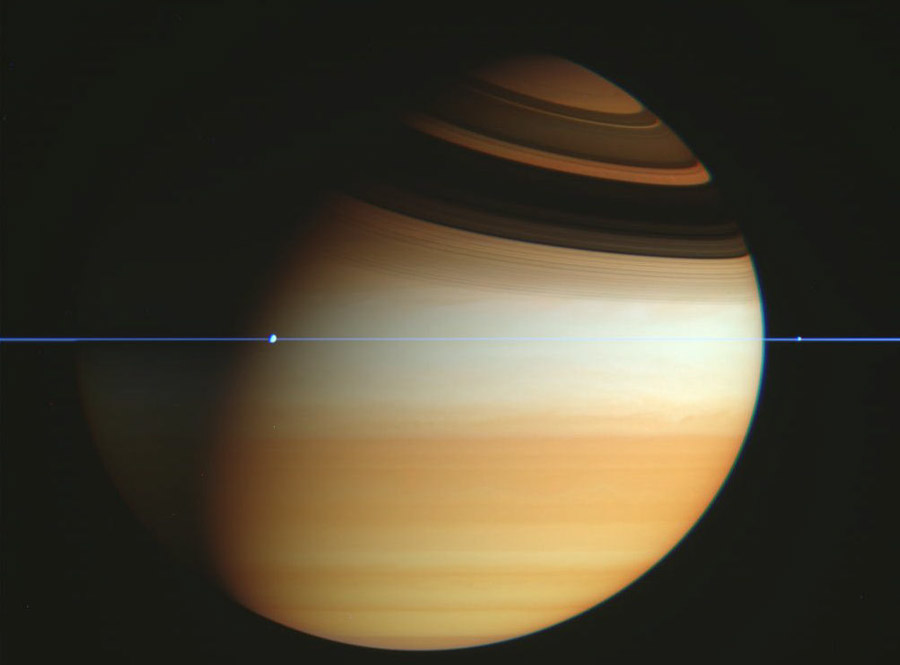
Looking at one picture like this, what strikes me is just how much we can learn about our giant, ringed neighbor just by looking at this shot. (Click here for the full-size image.) First off, the rings of Saturn are seen edge-on, and you can learn -- almost immediately -- that they are incredibly thin. Saturn's rings, as you're probably familiar with them, are huge and expansive, stretching out to be well over 200,000 km in diameter!


But let's take that section of the top image where the rings lie in a plane. Do you notice that there are a couple of Saturn's moons in there that seem to be far thicker than the ring plane?

It turns out that Saturn's rings, hundreds of thousands of kilometers wide, are estimated to be only 10 meters thick, or about the height of a pretty standard tree. To put that in perspective, if you scaled Saturn's Rings down so that they were the size of Texas (still huge), they would be 6 cm (2.3 inches) thick, or thinner than your forearm.

But you can learn even more about Saturn from this one image. Do you notice that there are stripes running horizontally across Saturn? Like all of the gas giants (and to a lesser extent, Earth), the atmosphere is broken up into bands that move at different relative speeds. (Voyager's famous time-lapse video of Jupiter is shown below to illustrate this.)
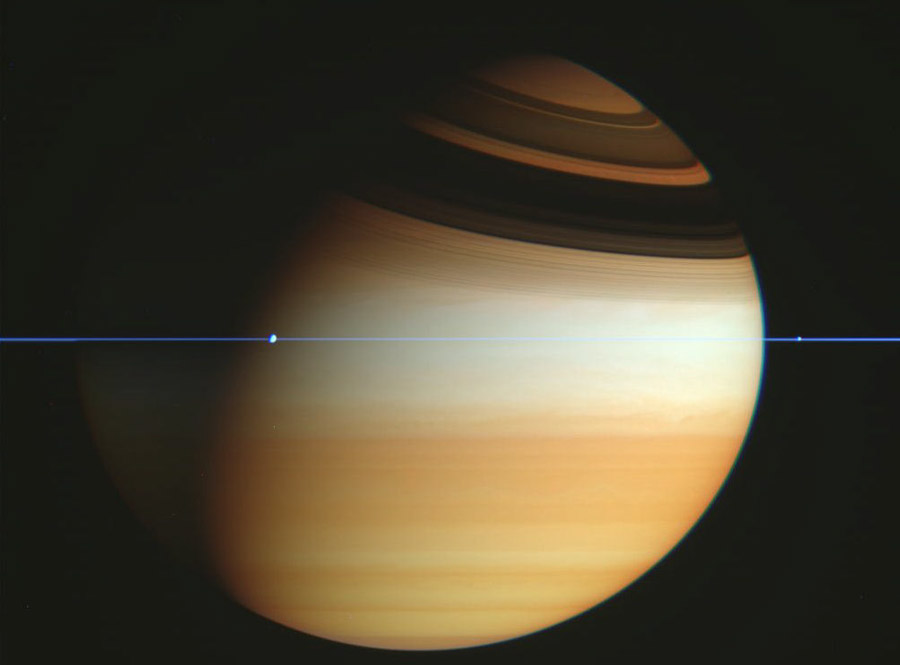
Oh no, my friends. Those are not the bands of Saturn's atmosphere. Take a look at the part of Saturn that's illuminated: can you figure out where the Sun is? Can you tell it comes from below and to the right of Saturn in this image?
Those dark bands around the North Pole of Saturn are shadows of its rings! You can see an amazing amount of detail in these shadows, including some very thin, diffuse outer rings that leave wispy shadows on the planet's surface.

So what do you do if you want to see a little more detail? All you have to do is let Cassini -- the spacecraft that took this picture -- travel around a little farther until you get a different angle. What can it show you then?
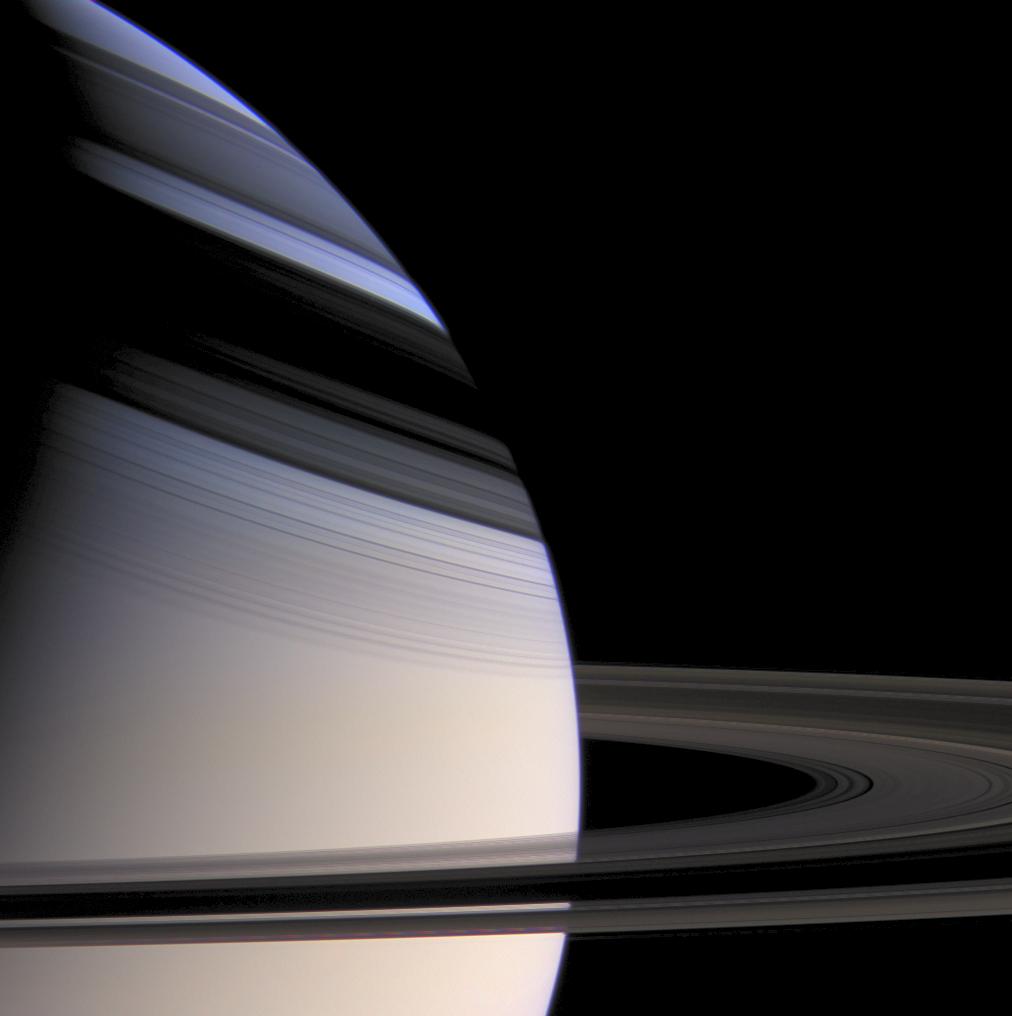
(And, of course, click for full-size.) Isn't that amazing? If all you had of Saturn was the one picture at the top, you would still be able to learn an amazing amount about this ringed wonder. So don't tell me we've lost the human element; we're more a part of the Solar System than ever before. Just remember to look up, and wonder, and think.

I agree, we've not lost the human element in our explorations gaseous giants in the farthest reaches of our solar system, but when our space programs says that we will not be sending human beings to our closest neighbors where they can survey the landscape with human eyes, traverse the terrain and determine -on site- those objects of interest over other more mundane objects, to feel the effects of gravity on human bones, and so on and on; to deprive human kind of these experiences which hold the availability of unplanned, and easily communicable experience is truly to have lost the human element in our space exploration. We have the capability and the resources and to defer this essential element of our exploration of the solar system due to something like a lack of funds, is atrocious IMO.
I'm not flaming you, Ethan, just our goals in space exploration in general. I'm still bitter at the Constellation debacle. We're shutting down our space program while Iran is starting theirs. Makes me want to scream.
edit: that was supposed to say "to defer this essential element of our exploration of the solar system TO ROBOTS due to something like a lack of funds, is atrocious IMO"
Ethan, I thought of you this morning when, during Olympic coverage, Brokaw was talking about the 1980 US Men's Hockey win, the "Miracle on Ice," as a moment so important that Americans still remember what they were doing when they heard. He went on to list other moments, the Kennedy and MLK assassinations, obviously, but not the moon landing.
My dad's recounting of being nine and staying up late to watch the broadcast of that mission was how I learned that there were such moments, events that sear the memory. I couldn't have been older than nine myself, and astronomy flew to the top of my list of interests after that conversation.
I wonder what's going on more deeply in American hearts and minds that we're collectively no longer seared by that moment. If it really is the common sentiment, it's no wonder there's little political will to pursue manned spaceflight.
For myself, that scratchy recording still brings tears to my eyes.
I confess - the Miracle on Ice didn't penetrate. I recall that it happened - I'm sure I was probably happy at the time - but I don't remember it. MLK, the same (too young, though I recall my father flying to his mother in Montgomery rather than driving with Tennessee plates that week). JFK, yes. RFK, yes. Moon landing, absolutely yes.
You wrote:
You can see an amazing amount of detail in these shadows, including some very thin, diffuse outer rings that leave wispy shadows on the planet's surface.
Are you referring to the shadows closest to Saturn's equator? I can't make out any diffuse ring shadows near the pole.
If those are the shadows you are referring to, aren't they of the _innermost_ rings?
Do we have any gravity surveys which cover any of the gas giant "eyes" such as that very constant amazing one on Jupiter?
I'm 56 years old. I was 16 when man walked on the moon. I'm still pissed that moon travel has not become routine. I expected that the moon would become the base for further solar system exploration.
My first view of Saturn in a 3 inch reflector was not a big deal. In college I saw it with a 20 inch reflector and was in awe. I had to know the dynamics that kept rings in such order!
Now I keep track of the probes and hope some life is found on one of those "laboratory" moons.
Thanks for the post!
Great comments, im glad there is still intelligent people intrested in this stuff.
I've just recently decided to major in Physics and it's nice to hear someone talk about the unknown and the future of discovery. Ever since I've made this decision I've become hyper-sensitive to articles and books where the author claims this field of science is almost "done," and I always find that disheartening.i-tunes