

You see, wire telegraph is a kind of a very, very long cat. You pull his tail in New York and his head is meowing in Los Angeles. Do you understand this? And radio operates exactly the same way: you send signals here, they receive them there. The only difference is that there is no cat. -Albert Einstein
One of the most exciting parts of any scientific field is to imagine what the next big discovery is going to be. In the late 1800s, we thought we were almost at the end of physics. We had Newton's laws for gravity, our entire system of classical mechanics for describing force and motion, and all of electricity and magnetism figured out thanks to Maxwell. There were just a few small problems.
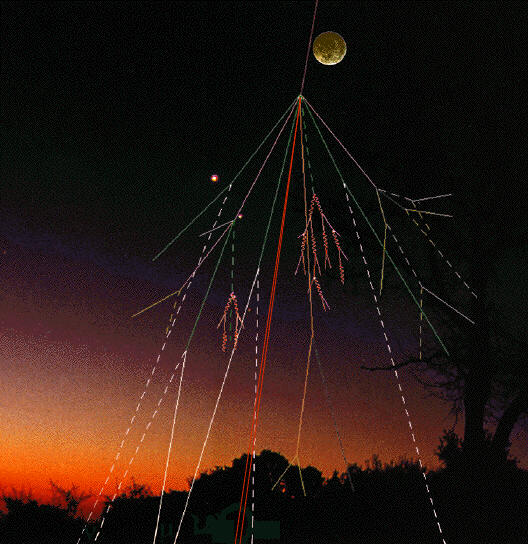
1.) When things moved close to the speed of light, our old laws of force and motion didn't work any more. Of course, this was a very, very fast speed, and while you could fix it by adding in the Lorentz-Fitzgerald factor, it took the revolutionary new physics of Special Relativity to explain mechanics successfully at high speeds.
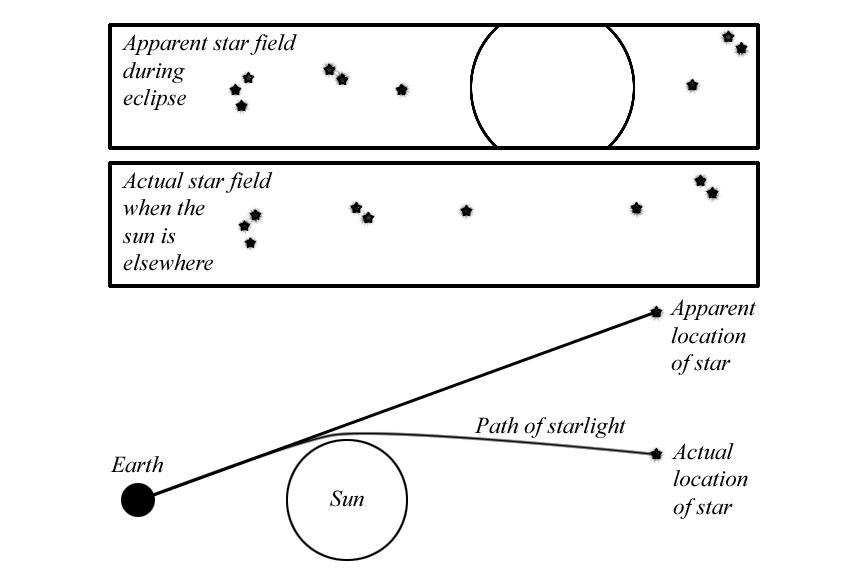
2.) When things are deep inside of strong gravitational fields, Newton's laws of gravity don't hold anymore. The orbit of Mercury was problematic, for one, but it was the observation of stars during an eclipse in 1919 that sealed the deal on this one. It turned out that Newton's law of gravity needed to be replaced by a new theory of gravity in many situations, known as General Relativity.
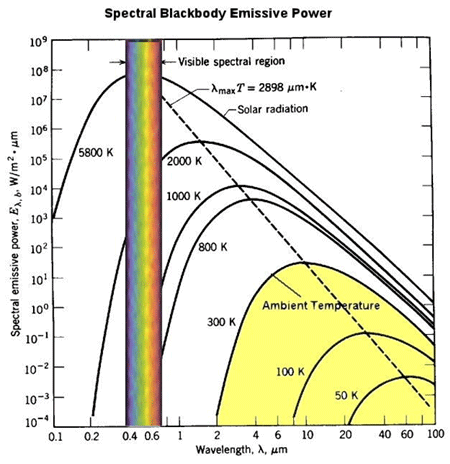
3.) Stars of different temperatures emit different wavelengths of light. So what, right? Like that could possibly be a big, unexpected deal. But in order to explain this, you need to understand blackbody radiation, and in order to do that, you need to develop quantum theory and quantum mechanics.
There are plenty of other examples: the discovery of antimatter and a successful explanation for it led to the development of relativistic quantum mechanics and quantum field theory, the entire zoo of baryons and mesons combined with deep inelastic scattering led to the development of the quark theory of matter and the standard model, and on my frontier, a myriad of observations have led to the understanding that our Universe is filled with dark matter and dark energy.
So what are some things that people are looking for today to usher in new laws of nature?
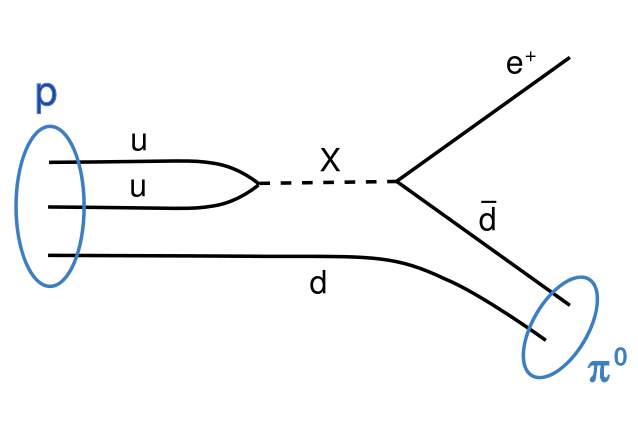
Can the proton decay? If we observe proton decay, it is some pretty strong evidence that there exists a Grand Unified Theory, where the strong force, the electromagnetic force and the weak force all become the same thing at a high enough energy.
Mind you, we've been looking for this since the 1980s, and all that we've discovered is that if the proton can decay, it has a half-life of at least 1034 years, a factor 1024 larger than the current lifetime of the Universe.
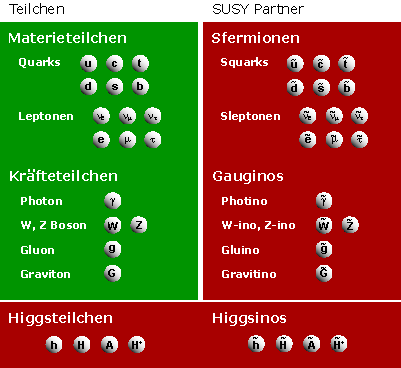
Does supersymmetry exist? One of the things people don't like about the Standard Model (above) is that there are different numbers of fermions and bosons, the two fundamental types of particles. There's a theory that states that these two types should be equivalent, so that for every fermion, there's a bosonic super-partner, and for every boson, there's a fermionic super-partner.
We've been searching for these since the 1980s as well, and we've found that if these superpartners do exist, they're all significantly heavier (by many orders of magnitude in most cases) than their "normal" counterparts. If the LHC fails to find them, we're going to need to seriously consider alternatives.
(Supersymmetry and Grand Unification, by the way, are fairly general predictions of string theory. If these fail to pan out, it will be a significant blow to string theory's viability.)

Why do neutrinos have mass? This is, arguably, the only non-astrophysical discovery that we've made that the Standard Model cannot explain: the massiveness of neutrinos. Is there a super-heavy particle out there to give our plain-old neutrino some mass? If so, we have a mechanism to explain it, but we have no further evidence for this phenomenon.
Can quarks be made up of even tinier particles? This possibility, known generally as technicolor, is one of the most exciting alternatives to the existence of the Higgs. In fact, if the Higgs doesn't exist, many theorists believe that technicolor is the only other viable options, which itself is highly constrained based on numerous observations.
So these are some of the trees we're barking up. Personally, I think that -- with the exception of neutrinos -- these are all likely to not pan out the way we expect. But this is the frontier of modern physics, and at this point, we simply don't know until we do the necessary experiments. The proton could live for 1035 years, for 10350 years, or -- in principle -- forever; we simply haven't tested it that far. So what's going to come next?
- Log in to post comments
More like this


I think there will be a few (2-3) exciting discoveries and many puzzling non-discoveries (no Higgs).
Question for Ethan:
What do you think of the work of Professor T Padmanabhan of the Inter University Centre for Astronomy and Astrophysics, Pune India? Promise or quackery or a bit of both?
Thanks for this post, Ethan. I've just recently decided to major in Physics and it's nice to hear someone talk about the unknown and the future of discovery. Ever since I've made this decision I've become hyper-sensitive to articles and books where the author claims this field of science is almost "done," and I always find that disheartening.
Squarks? Why could'nt you guys just stick to Latin.
But on a more serious hand, could someone explain why Proton decay would be evidence for GUT?
NewEnglandBob -
Are you referring to space as being emergent from the holographic principle? And gravity as an entropic force?
That would seem to change our fundamental understanding of things.
In any event, here are a few links on the subject for anyone who can explain the strengths and weaknesses:
http://arxiv.org/abs/0911.5004
http://arxiv.org/abs/1001.0785
http://arxiv.org/abs/1001.3668
To read them, click on one of the "Download" buttons in upper right corner.
"...all that we've discovered is that if the proton can decay, it has a half-life of at least 10^34 years..."
I'd be interested in an article that covered how we know that.
Or, maybe, I'll just try and look it up.
I think when the LHC attains enough power to raise the luminosity of jets,(parton production)that a world of useful knowledge will be obtained.
The constraint of jets production and quark gluon plasma should yield significant information to the nature of recombination and particle state structure.
Color Glass Condensate study will yield the coupling process of quark-gluon production and perhaps measure the time dilation of the condensate.
Jets is where the action is... We are the *Jet set*
Of course the LHC can be a very dangerous machine and progress should be made at a safe, slow speed.
Nice list. Just as Ulmer what he thinks. I'm sure his awesome powers of foresight will unveil what the future will bring in modern physics.
Seriously, though. Particle physics is squarely at the forefront of modern physics. That's largely why I grew uninterested in pursuing physics as a career. It's just too abstract without enough grounding in everyday experience. That doesn't lessen its importance at all, and I thank you and the other intrepid physicists out there learning about the tiniest pieces of matter.
I'm siding with the camp that thinks that the next big discovery will come from a completely unexpected source. Somewhere there will be a scientist that will be working on some relatively minor problem when they will look at the data and say, "Hey, that's weird." and by the time the dust has settled: a new profound law or way of looking at things will have emerged.
NoAstronomer,
If I have 18g of water in a cup, I have about 6x10^24 protons in that cup. If the average decay time of a proton was 10^24 years, I would expect, on average, 6 to decay in a year. If I observe the cup for a year with detectors that would be sensitive to proton decay, and got none, then I could conclude that the average decay time is more than 10^24 years -- and simple maths based on statistics of decay could give a better lower bound.
The basic way we know that proton decay is longer than 10^34 years is that we've been actively looking for proton decay for 30+ years and haven't seen a single decay, and we know how long we've been searching and in how many protons we've been searching in. If it were less than 10^34 years, we should have seen a decay by now.
@Blaise -- I would expect (for no good reason) that protons would have a half-life, and that one could pop off at any time. Has that possibility been included in the 10^34 yr estimate?
@Ethan -- I expect the unexpected. It seems that the most careful experimental strategies to prove one thing open completely unexpected doorways.
Tom
Four Higgs particles?!? I thought only one was postulated? There go my delusions of having been paying attention.
How?
(As long as you're not standing in the way of the beam. That would make it a Death Ray™, LOL.)
Of course! That's how the probability (how many ought to decay in a year) is calculated in the first place.
BTW, don't bother clicking on my name, I don't have a blog. I just have to pretend so I can comment on Pharyngula.
My understanding is that conservation of baryon number is a feature of the Standard Model, which leads to the proton being stable because it is the lowest-energy baryon. The issue with that theory is explaining how the baryon number got to be so high at the time of the Big Bang. GUT theories explain this by positing that baryon conservation can be violated, as part of the whole "symmetry breaking" thing that they love so much.
But, if the proton's half-life is experimentally determined to be too long, then that won't leave enough time for the presence of baryons in our universe to be explained. Thus the research into proton decay.
I believe this is the lower limit that would be required for the Super-Kamiokande experiements to have failed to observe any instances of proton decay (and still be within n standard deviations of plausibility).
A quantum enfolded many dimensional hologram universe makes total sense, and fractally it works at
all lengths from Planck to infinity.
I'm not totally convinced by String Theory (though cosmic strings seem a sound idea) but SUZY/Supersymmetry makes sense.
I predict we'll find bosons/neutralinos everywhere in our universe, and ordinary matter will be
proved to be just a condensing out of DM at levels sensitive to photons.
And DM will have a large Periodic Table of its own, visible matter will be just one DM 'element'.
At larger levels, why should there not be an infinite hierarchy of matter (and universes), with DM just a small
local 'element' one level up from baryonic matter?
I can't conceive of another model that makes any sense. Anyone else got a good thought experiment
hypothesis on fractals, infinity and DM?
Discuss............
The is still some question as to the exact mass of the neutrino.
Do non-relativistic neutrinos constitute dark matter?
Dark Matter may be more dynamic than we might expect or it could be so simple, people might say (well of course that's it.)
Personally, I think it's a great time to get into physics, it will never be a dead field.
Projects involved in the research of DM include KATRIN, MARE, GERDA...and PAMELA.
It's still an open field for the search for DM.
Lots of questions.
@sweetwater tom,
As has been stated, the 10^34y estimate is effectively a half-life.
Here's how the calculations work...
Proton decay can be assumed to follow a Poisson distribution, where each decay happens independently of each other. The Poisson distribution is characterized by λ, the average number of expected events in a given time, and k, the number of events we are looking for. λ is clearly related to the half-life T, in that the expected number of decays over the period of the half-life is 0.5, so 1 = 2Tλ or T = 1/(2λ). Getting a good estimate of λ automatically means we have a good estimate of T. λ has units of 1/Time.
The probability that over a period t no events will be recorded is p = p(0;tλ) = ((tλ)^0 e^(-tλ))/0! = e^(-tλ). If we have N simultaneous independent trials, the probability that no events will be observed is p^N = (e^(-tλ))^N = e^(-Ntλ).
For evaluating an experiment, p^N is the probability that the result was by chance. We can assume, for an experiment, that the value is whatever we want and solve for λ = (ln p^N)/-Nt. The smaller p^N, the larger λ is. If we set p^N to 5%, then we can compute an upper bound for λ with 95% confidence. It's all dependent on N and t. ln 0.05 = -3, so λ = 3/Nt or so. This means T = Nt/6 is a reasonable lower bound for T, the half-life of a proton.
The experiment KamiokaNDE was built to detect proton decay. KamiokaNDE started in 1983 and ran, well, I don't know how long it ran. It was replaced in 1996, so let's say it ran 10 years (t=10y). It contained 3000 tonnes of water, which by previous calculation contains about 10^24 protons per 3g, or N=10^33 protons for the full detector. No decaying protons were detected. Based on KamiokaNDE, a reasonable lowerbound for T is 10^34/6 years.
KamiokaNDE was replaced by another experiment called Super-Kamiokande. It was discovered that KamiokaNDE was an excellent design for a neutrino detector, and both it and Super-K were primarily used for neutrino observations, although both are also superbly sensitive for proton decay. Super-K is 10 times as big (30,000 tonnes of water), and has also run for about 10 years. By the same calculations above, this puts a reasonable lowerbound for T at 10^35/6 years.
I'm sure that my math is a bit more sloppy than a physicist who's been studying this for decades would be, but that's the general idea.
Technicolor? Really? I thought that was a typo for a bit as this is an old movie term. Can anyone explain why this Higgsless model is called Technicolor?
i personally don't like the technicolor theory. quarks are made of other particles? then what are those particles made of?
reminds me of the story about Feynman and the woman who said it's turtles all the way down. where does it stop?
then again, i am not a nuclear physicist, (condensed matter) so my opinion doesn't bother reality at all. if there are smaller particles then so be it!
check out the law of maximum entropy production, just introduced into the literature as the fourth law of thermodynamics:
The Fourth Law of Thermodynamics:
The Law of Maximum Entropy
Production (LMEP)
An Interview with Rod Swenson
Authors: Mayo Mart nez-Kahn a; Le n Mart nez-Castilla a
Affiliation:
a Facultad de Qu mica, Universidad Nacional Aut noma de M xico, M
xico
DOI: 10.1080/10407410903493160
Publication Frequency: 4 issues per year
Published in: Ecological Psychology, Volume 22, Issue
1 January 2010 , pages 69 - 87
Abstract
More than 20 years ago, Swenson (1988) proposed and elaborated the Law of Maximum
Entropy Production (LMEP) as the missing piece of physical or universal law that would
account for the ubiquitous and opportunistic transformation from disordered, or less ordered,
to more highly ordered states. Given Boltzmann's (1974) interpretation, the Second Law of
Thermodynamics has generally been interpreted as a âlaw of disorder.â Schr dinger (1945)
and Bertalanffy (1952) had shown, however, that the Second Law, viewed from the classical
perspective of Clausius (1865) and Thomson (1852), was not anathema to order. Ordered
flow, including life, was permissible as long as it produced enough entropy to compensate for
its own internal entropy reduction. The central problem remained, however: If the
spontaneous production of order was âinfinitely improbable,â as Boltzmann had surmised,
then why were ordered systems such a fundamental and characteristic property of the visible
world? LMEP provided the answer: Order production is inexorable because order produces
entropy faster than disorder. In Swenson (1989d), LMEP was given expression as a precise
law that could be demonstrated in falsifiable, experimental, physical terms. In Swenson and
Turvey (1991), LMEP was tied explicitly to the progressive emergence of living things with
their perception-action capabilities.
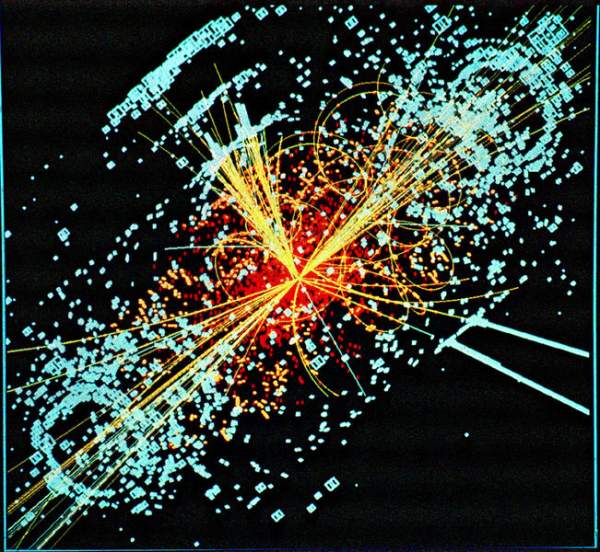
Ok, I'm dorky enough to have immediately recognized the image of a cosmic ray interacting with our atmosphere (due directly to a Fermilab lecture about the Pierre Auger Observatory) but I can't figure out how that fits in to the rest of the article. Can someone please give me some key words so that I can look this stuff up?
@Mena
The particles you see streaming out of the cosmic ray interaction have very short lifetimes, short enough that even travelling at their speed they would not have been able to make it to the surface of the Earth. But they did because of (as is written immediately below the picture) the effects of Special Relativity on high-speed mechanics. Specifically, SR predicts that fast-moving particles will experience time slower than slow-moving particles. While it might have taken 600 microsecond or so for a muon to travel the 100miles from Space to Earth in our reference frame, it takes less than 2.2 microseconds in it's frame, and thus it survives the journey.
Atmospheric Muon lifetimes are a classic example of how SR makes a difference. According to Wikipedia, muons were used to observe SR time dilation for the first time in 1941.
@sam baker: If this "fourth law of thermodynamics" is "a precise law that could be demonstrated in falsifiable, experimental, physical terms", then why wasn't this published in a physics journal, but in "Ecological Psychology"?
Any thoughts on gravity as an entropic force?
http://arxiv.org/abs/1001.0785
http://arxiv.org/abs/0911.5004
http://arxiv.org/abs/0911.5004
Thank you Blaise!
Re: Brian@12 and others
Brian's explanation is mostly right although the bit about baryon number in the universe is a red herring I think. As stated, if baryon number is conserved then the proton can't decay because it is the lightest baryon. (Actually quarks have baryon number but they can't exist as independent particles.) This is (mostly) true in the Standard Model just because of its minimal content, i.e. it's not required by any deep principal, it's just true for the particles so far observed.
A GUT theory invariably involves relating baryons (quarks) and leptons(electrons, neutrinos and their relatives), so quarks and leptons are not independent of each other in terms of charges(color, hypercharge, electric charge, weak quantum numbers, etc.) as they are in the standard model. Basically, since you can no longer distinguish quarks and leptons at a fundamental level (they appear distinct as a low energy phenomenon via spontaneous symmetry breaking), you can't assign any absolute baryon number since quarks carry baryon number and leptons don't. Therefore it is possible for protons to decay, although this can be very slow/rare for various reasons.
A bonus, additional motivation for this is that GUTs can possibly account for baryogenisis, the fact that there is more matter than anti-matter in the universe. Net baryon number is not zero, which is okay if you can convert baryons into leptons and vice versa (plus you need CP violation, but that is observed). The details can get complicated and I don't think it is proton-decay per se but they are related ideas.
David Hilbert: "I have tried to avoid long numerical computations, thereby following Riemann's postulate that proofs should be given through ideas and not voluminous computations."
Report on Number Theory, 1897.
Don't forget the large theoretical conundrum presented by the combination of Newtonian physics and Maxwell's EM: the first theory is Galilean invariant, and the second not.
I was wondering if the search for magnetic monopoles is still an active area of experimental physics. Have there been any findings or important experiments since Dr. Cabreras tantalizing observation back in the eighties?
dear bjoern
the article that i cited is a recent interview with Swenson. his original work can be found in a number of different journals and edited books including the interl journal of gen. systems; the ny academy of science; the Chemistry journal, and the edited work -- Cybernetics and applied science, among many others. the hard core physics community has been skeptical about LMEP because Swenson is not by training a physicist. but i have been assured in direct face to face conversation by his co-author and emminent scientist michael turvey -- look him up on wikipedia -- that LMEP is legit. of course, big ideas in science take a generation sometimes to take hold, just because LMEP hasn't reached mainstream audience after 20+ years isn't evidence one way or the other regarding its scientific merit. why don't you judge for yourself whether the law is demonstrated in falsifiable terms. be part of the answer not part of the naysayers....
on second thought ... if you want a physics journal ... check out the recent work by shripad mahulikar based on LMEP that is published in Physica Scripta, which is the world renown theoretical and experimental physics journal published by the Royal Swedish Academy of Science (Nobel Prize!!). you don't get much more establishment than that.
Physica Scripta. Vol. 70, 212â221, 2004
Conceptual Investigation of the Entropy Principle for Identification of Directives for Creation, Existence and Total Destruction of Order by S. P. Mahulikar and H. Herwig
according to Mahulikar, LMEP is a manifestation of multibody systems physically accessing new dimensions of space-time inaccessible by non-systems. system interactions literally bend space-time. two bodies bend space time as is evident in the flow concept of "gravity" and classical mechanics. LMEP is the bending of space time by a "system". LMEP solves the 3 body problem. LMEP is "the" unifying principle in science to the extent it explains "natural order" in all domains from the quantum to the super galactic, for example LMEP explains the ordering of the periodic table, it explains dust devils and whirlpoos as well as the spontaneous ordering of planets, stars and galaxies in the early universe, to the evolution of the earth biosphere and spontaneous order of culture and human economies.
My opinion doesn't bother reality at all. If there are in this universe smaller particles then so be it!
What I can't wrap my mind around is what was there before our universe. If our universe was taken out of the picture what would be left?
Is there a book that anyone could recommend that discusses finite/infinite universes. i find this discussion extremely interesting but when I try discussing it with anyone I get blank stares itunes.com
Well, and as relates to nlikid's question: One thing there logically cannot be: a strictly logical explanation of why the universe is the way it is, from first principles (ie, not as derived from some given model taken for granted from among various conceptual possibilities, but what model should be a manifest "universe" a priori. As the modal realist/MUH folks appreciate, logical analysis can't add extra pixie dust to a platonic model to explain why it should be "actualized" in a further, more substantial way. It just doesn't have, in principle, the tools to add more to the conceptual descriptions. That doesn't mean there can be any such pixie dust, just that it isn't accessible to logical analysis. For more see my piece Marcelo Gleiser Has a Point.
Math-savvy cosmologists have hijacked the definition of "space" and given "space" physical properties such as the ability to expand, just to make the math fit a particular theory. Common sense dictates that space has no physical properties. It is conceptually nothing but total emptiness that separates stuff occupying what we conceive geometrically as a volume. Said stuff being matter, energy, fields, forces, quantum particles, and anything else yet to be discovered.
The truth about the total universe will begin to emerge once we fully investigate the possibility that cosmological redshift is largely a very slow loss of energy due to hysteresis between the electrical and magnetic components of light as light travels thru the infinite vastness of space.
@Enn Norak #34: The "tired light" hypothesis was put forward by Fritz Zwicky back in the 1930's. There is plenty of actual research data testing the hypothesis, and it doesn't work.
It doesn't reproduce the systematic spectral shifts which are characteristic of the Doppler effect. It doesn't reproduce the dispersion in redshifts observed both nearby and in distant clusters. It doesn't produce a highly thermalized spectrum which is characteristic of the observed microwave background radiation.
@Michael Kelsey #35. Fritz Zwicky postulated that photons travelling thru space lose energy by gravitational interactions with masses encountered during their journey. This is different from my suggestion to investigate whether a minute amount of hysteresis exists between the electrical and magnetic components of light which should result in some loss of energy over time. Perhaps this hysteresis exists even though the electrical and magnetic components act synchronously. Perhaps these components are very slightly out of sync, to a sufficiently small degree beyond our ability to measure with current techniques.
If we can show that there is hysteresis between the electrical and magnetic components of light, we may also be able to show that the degree of hysteresis is different for different parts of the electromagnetic spectrum.
It is my understanding that the most accepted conclusions from research data testing in connection with Zwicky’s hypothesis were selected on the basis of the least number of assumptions and the best match with available data, and very likely did not include consideration of possible hysteresis inherent within electromagnetic radiation itself.
I suspect also that newer cosmological date since these tests will eventually have cosmologists revisit the question of “tired light” and the reasons therefor.
I’d like to add the following wrinkle to the discussion on cosmic redshift, namely that the observation of cosmic redshift may lead to the wrong conclusion if we assume that cosmic redshift is solely the result of the doppler effect Consider the following scenario: Three galaxiws, separated by some distance from each other are all moving, one behind the other, toward a disdant great attractor represented by point A. Let’ us label the galaxies as G1, G2, and G3 with G1 being the closest to point A and G3 the furthest from point A.
Since point A exerts a greater attractive gravitational force on the galaxy closer to it, we can say that G1 is accelerating faster than G2 which in turn is accelerating faster than G3 toward point A. Therefore, the distances separating the three galaxies are all increasing and observers in each of these galaxies observe a redshift of light originating from any of the other two galaxies.
Is the observer to conclude that the universe is expanding or that the universe is contracting with point A located roughly at the center of a big crunch already in progress.
Enn Norak,
I'm not saying you're idea is wrong (although I would strongly suspect that it is), but your idea is clearly contradictory with special relativity. If the photon does lose energy over time, that implies that the photon must actually experience the passage of time. According to special relativity, an object moving at speed c (as a photon does by definition) does not experience time. That is, if you could ride on a photon emitted from a distant star and measure the time it takes to reach the earth, the time you would measure would be zero. Photons, as measured in their own reference frame, move instantaneously from point to point. They do not therefore experience any passage of time. Thus, if they actually do experience a loss of energy over time, this result would invalidate special relativity. It looks like you have more work to do with your idea. You must now come up with a replacement for special relativity since your idea invalidates it. Your theory must allow for photons to experience passage of time while accounting correctly for all the other observations that SR correctly explains. Good luck with that.
Since you haven't managed to do this, then the theory falls over and needs no more consideration from anyone else.
This is in response to #38 and #39. The math associated with relativity may well lead us to conclude that photons can travel unlimited distances in zero time; however such conclusion would defy common sense and would require theory of relativity to be revisited to eliminate conclusions that lead us to believe in magic. Time is just a concept that allows us to analyze the chronology of sequential events. Rarely, two events can be truly simultaneous if difficult to measure their simultaneity with accuracy. We agree on Earth that photons take time to travel, albeit at light speed. If a photon''s departure from a distant source and its arrival on Earth were truly simultaneous i.e. zero travel time, then everything we see today is actually happening simultaneously at the point of origin of the corresponding light and we would not exist in our present form.
I have a similar problem with the expansion of space itself to account for flaws in our understanding of cosmic inflation. Space is just a concept of total emptiness between real stuff (e.g.matter, energy, forces, fields, quantum particles) separated from each other. If accelerating cosmic dispersion is really a manifestation of the expansion of space itself, there would have to be some sort of physical connection (a force?) between real stuff and space that drags real stuff along with the expansion of space which is not possible in pure empty space void of any properties that would allow such interaction.
The bottom line here is that we should not conjure up magical properties to account for discrepancies between theory and actual observations. We should look for physical explanations of mysteries that still elude us.
Nope, the maths doesn't say that. However you think it does. How?
What it DOES do is say that there is no elapsed time in the frame of reference between the photon source and destination.
Indeed it would.
If that were not actually YOUR statement that would do so, not the maths of SR.
Please attempt to work out the maths BEFORE making claims about how reliable it is.
The source of the problem is the same as the one causing the problem I quoted earlier: you.
Enn,
Common sense is a notoriously bad way of trying to find out about the universe. Our brains evolved to find the next banana and avoid the predators. That's where common sense comes from. It's a rather limited subset of phenomena that occur in the universe as a whole that forms our common sense. Contradicting common sense is hardly a reason to reject a scientific theory.
Just to clarify, I do not dispute that observers in different inertial frames of reference see things differently when observing light from a distant source in space; nor do I dispute the invariability of the speed of light. I am not out to discredit the theory of relativity in any way. I merely point out that some conclusions based on theory defy common sense and related observations may simply be illusions that require further investigation. I do not agree that math has nothing to do with it. Lorentz trnsformations associated with special relativity are very much mired in math. Empirical measurements to veryfy theory are also mathematical in nature.
Different theories about the origin, nature and fate of our universe abound and have resulted in a myriad of therories including branes, strings and multiple dimensions. The concept of empty space has been transformed into realities where space itself can expand and the “fabric of space” can rip violently apart under certain conditions. When a theory “does not add up” or defies common sense. leaps of logic are made in the metaphysical sense or by using plug figures (such as constants) in accompanying mathematical formulae to make everything fit the theory.
The problem with multiple dimensions is that the “two-dimentional” entities found in relevant literature are two-dimensional in concept only, they all still have some relatively small thickness. One can bend, twist , and fold any seemingly two-dimensional object in countless ways but the result is always another three-dimensional object. Even a string is one-dimensional in concept only as it must have a minute diameter in practice thereby making it three-dimensional in reality.
I believe that space is infinite with no defined center and no limiting borders. Everything currently positioned in space, whether moving or not, has always existed and will always continue to exist in one form or another, and in one inertial frame of reference or another. Similarly, time, a different concept from space, had no beginning and will never end. Clocks have been observed to speed up or slow down in different environments of speed or gravitation leading some to conclude (by means of metaphysical reasoning or mathematical calculations based on theory) that photons themselves can leap indefinite distances in zero time.
If a source of light such as a distant star emits light, then that light propagates thru space in concentric waves at light speed which does not vary in a vacuum. Any observer in a different inertial frame of reference to the source of light will observe a Doppler shift toward the ultraviolet if moving toward these waves; and any observer in an inertial frame of reference moving away from these waves will observe a Doppler shift toward the infrared end of the light spectrum. The speed of light is invariable but the Doppler effect depends on the observer’s motion relative to the light source.
Cosmologists are in disagreement as to whether sufficient matter exists to eventually reverse expansion and begin a new big crunch. I suspect that not all observed redshift is due to the Doppler effect. I suspect that photons have internal hysteresis between their electrical and magnetic compnonents that results in a very slow loss of energy, thus adding to the observed stretching of light waves toward the infrared. If true, then our conclusions about cosmological inflation may be inaccurate and we may actually already be in a beginning stage of the next big crunch. I believe that any big bang must have been preceded by a big crunch.
A big crunch may not necessarily occur only in a universe experiencing endless cycles of big bangs and big crunches. A big crunch can also occur if two universes collide and sufficient matter gets gravitationally bound in the area of collision to begin a whole new big crunch which in turn may end up repeating several cycles of big bangs and big crunches.
That, in a nutshell, is my contribution to cosmology. I leave it to more savvy professionals with greater resources at their disposal to investigate further.