

For every one billion particles of antimatter there were one billion and one particles of matter. And when the mutual annihilation was complete, one billionth remained - and that's our present universe. -Albert Einstein
Welcome back to our series, The Greatest Story Ever Told, where we're recounting the physical history of the Universe, from before the big bang up through the present day. We're currently in a hot, dense, expanding Universe, filled with equal parts matter and antimatter, bathed in radiation, and it's been only a tiny fraction of a microsecond for all of this to happen.

But the Universe we live in today isn't equal parts matter and antimatter. In fact, every galaxy we observe in the Universe is made out of matter and not antimatter. The laws of nature that we've discovered are pretty symmetric between matter and antimatter, and we believe that the Universe started out with equal amounts of matter and antimatter. So how are we here? If there were equal amounts and the Universe was very dense, eventually nearly all of the matter and antimatter would find their antiparticles, and would annihilate, leaving a Universe that was practically empty except for radiation (photons).

Although there are many different ways to make slightly more matter than antimatter, they all have the following properties, known as Sakharov conditions:
- You need to be able to create or destroy baryons (protons, neutrons, etc.),
- You need particles and antiparticles to have slightly different properties from one another, and
- You need to be out of thermal equilibrium.
This is not hard. First off, if you're in an expanding, cooling Universe, you're always going to go out of thermal equilibrium, so that one's a given. But what about the other two? How could this possibly happen, and still obey all the laws of physics we currently observe?
Let me lay out the simplest scenario for you of how to make more matter than antimatter, and if you want to know the word physicists use when we talk about this process, it's called baryogenesis.
And it doesn't take anything divine, either. I'm going to assume that we have electrons (charge -1), positrons (charge +1), and that protons and neutrons are made up of quarks.

A proton has two up quarks (charge +2/3 each) and one down quark (charge -1/3), while a neutron is made up of one up quark and two down quarks, while antiprotons and antineutrons are made up of two anti-up quarks (charge -2/3) and one anti-down (charge +1/3), and antineutrons are two anti-down and one anti-up. So if we want more matter than antimatter, we need to make more quarks than antiquarks, and more electrons than positrons.
How can we get this? Imagine a particle -- I'll call it X -- that has a charge of +4/3, and can decay either into two up quarks or one positron and one anti-down quark. It also has an anti-particle -- X* -- that has a charge of -4/3, and can decay into two anti-up quarks or an electron and a down quark.
So our possibilities are:
- X --> up + up
- X --> positron + anti-down
and
- X* --> anti-up + anti-up
- X* --> electron + down
The early Universe is full of all the particles that can exist, including X's (or things very much like them.) If the X goes into two ups 50% of the time and into a positron and anti-down 50% of the time, then we'll get the Universe we want if the X* goes into two anti-ups 49.99997% of the time and into an electron and a down quark 50.00003% of the time.
Is this possible? Yes; it's called CP-violation, and we've observed it in many different cases.
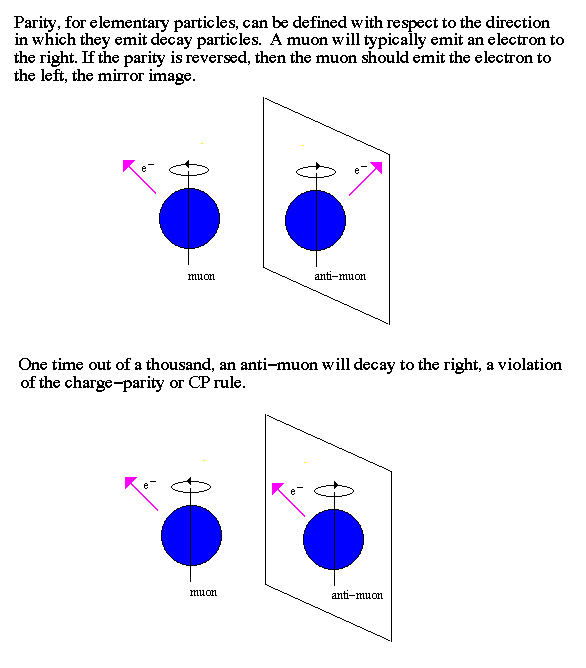
So even if everything starts out perfectly symmetric between matter and anti-matter, all you need is a slight difference between particles and anti-particles, consistent with what we observe, and you'll be guaranteed to have a Universe with either more matter than anti-matter or more anti-matter than matter!
(And if it were the other way around, you'd never know, except you'd be made of anti-matter, and you'd likely be calling it matter!)
Once you've got this problem solved -- making the matter in the Universe -- you can get on to turning it from a hot, dense, expanding soup into the Universe we see today.
Come back for part 6, where we'll take the next step on our journey!
Not just a slight difference between particles and antiparticles, but a slight difference between particles and mirror images of antiparticles.
Equivalently, we need a slight difference between particles moving forwards and backwards in time, so the excess of matter may be connected to the arrow of time, according to CPT and all that.
It is going to take some time and another reading(s?) to digest this fully for me. Before I start in with "why not the other way around too" I marked that you said "consistent with what we observe".
Pedantry: negatron is a synonym for electron. Hence: negatron and positron are anti-particles of each other.
The most common context in which the word "negatron" is still used these days is "negatron emission", or the β- decay mode; also called electron emission. See, for example, Radioactive decay modes at the Isotopes Project, Lawrence Berkeley National Laboratory.
The antiproton is just called an antiproton.
I made the same mistake myself recently in some physics discussions, and was put right by a fellow pedant.
Is that really a quote from Einstein? He died in 1955, as I
recall, and the "steady state theory of the universe" still
seemed as viable at that time as the Big Bang. (In fact,
this was the man who devised a "cosmological constant" for
general relativity to MAKE the universe stand still. The
quote sounds like something from almost any orthodox 1980's
cosmologist.
Exactly,my bags are packed for the journey.
One question tho, can you clarify what exactly you mean when you say
How close would you put this phase to time=0
I'm slightly confused , wouldn't the majority of baryogenesis take place before inflation?
In other words QCD CP symmetry violation before and during inflation and electroweak CP violation after BB?
When you write of baryogenesis are you refering to only the later process?
Thanks, Ethan.
Since we know anti-particles exist, this helps explain why we can't find any concentrations of positron, anti-proton hydrogen atoms in the visible universe or signs of their violent interaction with their counterparts, which would release massive amounts of gamma rays. In George Gamow's time (1950s-1960s), this was still considered a possibility, but at that time the best telescope was the 200 inch Palomar, no amateur tube obviously, but in and of itself, nothing like the arsenal we have today, esp. in non-visible wavelengths.
This absence also provides indirect support for the uniformity model as shown by WMAP. If the early Universe were turbulent and non-uniform, it would be likely that at least some pockets of anti-hydrogen would survive. Since with Hubble we can see galaxies going back 10 billion years we should now see at least some catastrophic interactions between interstellar clouds of anti-hydrogen and hydrogen. These should be seen as massive gamma ray bursts as gravity draws them together.
Yelp. This will take a few re-reads.
Hmmm. I don't really get it. Unless I'm misreading something, it seems like the explanation for why there's more matter than antimatter now is that initially there wasn't but that some antiparticles had a very small preference for decaying in to matter than in to antimatter.
Isn't that just pushing the question off a step without really answering it? Is the violation of that symmetry so much less of a mystery than the production of unequal amounts of matter and antimatter in the first place would have been?
So what your saying is that from "a tiny fraction of a microsecond" on the universe has been out of balance at a very fundamental level.
That explains a lot. Like that persistent feeling things aren't right, that things are out of balance. That has always bothered me. I figured I was screwed up. That it was all perfect before I showed up and somehow I was to blame.
Now I don't feel so bad about socks disappearing in the wash and complete morons seeming to run everything. From jump street the universe has been fundamentally out of balance. In fact if it wasn't we wouldn't exist. That things being out of balance is the natural state of existence and, as Martha says 'a good thing'.
Makes me feel a lot better.
Yes, mike shupp, that is a quote from Einstein; or at least widely attributed to him. I have not found the original source.
Sure, the Steady State was more credible back then, but Einstein was not a Steady State advocate. His original idea of the cosmological constant finely balanced with density at a point of zero expansion was not the same as the steady state at all... ironically. The Steady State model and the Big Bang model were two different ways to deal with the evidence for expansion.
Einstein's initial use of the cosmological constant was because at that time he thought there was no expansion. But after Hubble's results came out, he dropped that idea, and embraced the Big Bang model.
So this is a difficult topic, and perhaps my explanation was too detailed. I've tried again, and I have more on matter vs. antimatter here:
http://scienceblogs.com/startswithabang/2010/03/more_on_matter_vs_antim…
Thanks for letting me know that I could have done a better job with this one. And for some of your additional comments:
Sylas @3: the word negatron goes back a looong time, and was to "proton" (a negative proton) what positron was to electron (a positive electron).
Sphere coupler @5: it needs to happen after inflation, because the Universe needs to be cool enough so that these particles are unstable and will decay. If your Universe is too hot, then you can collide quarks and leptons and make these heavy unstable particles just as quickly as they decay. We're talking an "age of the Universe" of about 10^-25 seconds or so here.
Morgan @8: we should be able to either rule out or confirm one of the possible scenarios -- electroweak baryogenesis -- with the LHC over the next few years. But you're right, we know that it happened, but we don't know all the details of how.
and to NewEngland Bob @2, Toad @7, and everyone else who feels like I could have done a better job with this, try the new post. Thanks for letting me know about this, seriously.
Sylas:
Thanks for the friendly comment. I have to say though, I'm
still not convinced that's Einstein. Yes, in the 19-teens,
AE conceived of the cosmological constant to ensure/allow a
static universe. After Hubble concluded the universe was
expanding, during the 1920's, AE changed his opinion, even
going so far as to describe the cosmological constant as
his "greatest mistake." BUT it's a huge leap from an
expanding universe to a Big Bang universe, and the
strongest proponents of a steady state universe -- Hoyle
and Bondi and Gold come to mind -- argued for an infintely
broad universe of infinite duration with constant creation
of matter as the universe expanded. (An electron's worth
of matter per century per cubic light year -- that amount
of creation roughly, as I recall -- nothing that would have
contradicted astronomical observations of the time.) Of
course, this line of thinking went down the tubes after the
2.7K infrared background radiation was observed and
analyzed in the late 1950's to early 1960's -- but Einstein
was dead by then.
Also, it's kind of a stylistic thing, but that quote just
doesn't SOUND like Einstein to me. It's rather matter of
fact in tone, and the man loved comments with a zinger at
the end. (e.g., "Radio is the same with the cat removed.")
Actually, I had a bit of a different reaction - I've heard several descriptions of this phenomena before, but this is the first one that I really "got". So thanks!
Ethan, the word "negatron" has always been used from the start as a proposed synonym for electron. Calling an antiproton a negatron is an error.
When I was corrected on this point myself a few months ago I made a careful search of the term, as I also needed to be convinced on the subject. I found that "negtron" is not used of the antiproton, except possibly very occasionally in error.
The word "negatron" was proposed by Carl Anderson. Anderson won the Nobel prize in 1936 for observations of the positron. In Anderson's preferred terminology (which never caught on) the electron came in positive and negative forms. The positive electron was the positron; the negative electron was the negatron. However, the word electron was too strongly associated with the conventional matter particle, and so the result is that "negatron" is used in some contexts (like beta decay) where positrons and electrons both show up as two related forms of about the same thing. This is the example I cited for you previously.
You can see how the term first came to be coined in Anderson's Nobel Lecture; where he speaks throughout of "positive and negative electrons"; though he only speaks of negatrons once. A better reference is Anderson's paper in 1933, The Positive Electron, in Phys. Rev. 43, 491. Here's an extract (p4)
It seems to me that another possibility is that there are equal amounts of matter and antimatter but all the antimatter galaxies are on the other side of the "actual" universe which is outside of the observable universe. Is this possibility mostly ignored because it's untestable, or is it in fact something that can be ruled out or considered very unlikely?
Ethan,
Wouldn't it be just a likely that one time out of a thousand a muon would decay to the left? If not, why not? Why do anti-particles (only) exhibit CP violation? This subject has always fascinated me. I always wondered how we knew there weren't entire galaxies made of antimatter. I suppose I now know why that is not possible...
Yep, all we need is for the "Sakharov conditons" to be satisfied and someone will surely win a Nobel Prize.
But as Wiki sums up "There is currently insufficient observational evidence to explain why the universe contains far more baryons than antibaryons. A candidate explanation for this phenomenon must allow the Sakharov conditions to be satisfied at some time after the end of cosmological inflation. While particle physics suggests asymmetries under which these conditions are met, these asymmetries are too small empirically to account for the observed baryon-antibaryon asymmetry of the universe."
Hence, no Nobel Prize yet, just a great big unsolved mystery that should not be "defined" away.
ANTI-MATTER = GRAVITY
there is no way around that... the Universe creates GRAVITY... Gravity is the engine that makes the Universe, aka: MATTER, run.... without Gravity, the entire Universal System falls apart.... NO revolving planets, NO obits of planets around a sun, NO spiral galaxies, NO BIG BANGS (of which there have been trillions upon trillions)...
What about 'dust clouds' you ask? Well dust clouds are those planets/galaxies that have blown themselve apart, and in time ANTI-MATTER will bring them back into a circular motion... and in the end, all this GRAVITY, aka; ANTI-MATTER, will result in pulling every bit of the Universe back together for it's next BIG BANG.....
DON'T DOUBT ME ON THIS....
Furthermore, mixing matter and antimatter can lead to the annihilation of both in the same way that mixing antiparticles and particles does, thus giving rise to high-energy photons (gamma rays) or other particleâantiparticle pairs.
He also said one you didn't like was good. Just like the holocaust, this is a terrible thing for someone to to do. And saying the aliens are better then predators? Does anyone care after that tripple X parody of Sienfield? I don't either.Dietrine
awesome
Where Went the Anti matter?
Authors_:
*Mr. Rupak Bhattacharya-Bsc(cal), Msc(JU), 7/51 Purbapalli, Sodepur, Dist 24 Parganas(north) Kol-110,West Bengal, India**Professor Pranab kumar Bhattacharya- MD(cal) FIC Path(Ind), Professor of Pathology, Institute of Post Graduate Medical Education & Research,244 a AJC Bose Road, Kolkata-20, West Bengal, India*Mr.Ritwik Bhattacharya B.com(cal), Somayak Bhattacharya MBA 7/51 Purbapalli, Sodepur, Dist 24 parganas(north) ,Kolkata-110,WestBengal, India**Miss Upasana Bhattacharya-daughter of Prof.PK Bhattacharya*** Mrs. Dalia Mukherjee BA(hons) Cal, Swamiji Road, South Habra, 24 Parganas(north) West Bengal, India*** Miss Aindrila Mukherjee-Student ,Swamiji Road, South Habra, 24 Parganas(north), West Bengal, India**** Mrs. Chandrani Dutta Bsc(zoology) Dr. Ram Naryan Das, MD(cal) , Demonstrator. Pathology, Institute of Post Graduate Medical Education & Research,244 a AJC Bose Road, Kolkata-20, West Bengal, India,**** Dr. Tarun Biswas MBBS(cal) Demonstrator,Pathology, IPGME&R, Kolkata-20,Dr. Hriday Ranjan Das MD(cal), DTM&H(cal), Dept of Nephrology, IPGME&R, 244a AJC Bose Road
Antimatter is now extremely rare in our observable universe, but at one time antimatter comprised half the Universe. According to cosmologists, when the Universe began in Palnkâs moment of Big bang it was smaller than an atom, hotter than our Sun is, and perfectly in balanced form â like a 50-50 mixture of matter and antimatter. Then, just one second after the start of the big bang, the antimatter surprisingly disappeared. What happened to it all is still a big question before physicists?
Some Scientists may have a pretty good idea of where the antimatter went: it annihilated almost all of the matter in the early Universe-they say. The bit that remained went on to form all the material stuff in the Universe today, including the atoms found in cells in your body. Among the most pressing questions that now need to be answered is why some of that primordial matter survived and made possible everything in the cosmos, including life itself.
This is probably one of the hardest topics to be answered on many of the agendas of CERN, the European Organization for Nuclear Research, near Geneva from the Large Hadron Collider[LHC] experiment, where smashing beams of protons flows to produce the highest energy collisions produced in 27 Km (16.9-mile)tunnel of EarthA giant circular tunnel, with several loops, stretches for 27km under the land between France and Switzerland. LHC is a device that demands to be described in superlatives â itâs the worldâs biggest piece of scientific apparatus, using particle beams circulating in the worldâs biggest fridge tunnel and has its results processed by the worldâs most powerful super computer technology.
During every seconds of its operation, the LHC top scientists may find hundreds of subatomic particles smash-ups in space-time smaller than a pinhead. Every collision generates a spray of hundreds of particles and antiparticles, many of them will be monitored by huge detectors (the largest would only just fit inside Westminster Abbey). In this way LHC scientists can today simulate the conditions in the Universe a billionth of a second after its birth, The BIG Bang, when antimatter was almost as common as matter. The upshot is that CERN scientists so will soon be able to study antimatter in detail, shedding light on its behavior and on its possible medical applications, such as the treatment of cancer if any. Scientists could have detected anti-matter particles, known as geo-neutrinos, emitted during nuclear reactions first time [2] into the interior of the Earth, to a depth of up to thousands of kilometers. Geo-neutrinos, which have almost no mass and no electrical charge, are emitted when radioactive elements in the Earthâs mantle decay into more stable substances. The decay of elements such as uranium and thorium are thought to contribute more than 50 per cent of the heat generated inside the planet, but the exact fraction is unknown. Measuring the number of geo-neutrinos emitted, and their energies, could help determine the proportions of different radioactive substances in the Earthâs mantle and the amount of heat energy they contribute
The opening of existence of antiparticle was first time written in 1931 by the famously English physicist Paul Dirac, who first conceived it. His publication was purely a theoretical speculation and discussion so far known before us, based on his faith in his mathematically beautiful equation for the electron, widely known before world as the Dirac equation. There was then no experimental evidence that this new kind of subatomic particle actually existed. After three years of poring over his equation, he further wrote that it made sense only if there existed another particle with exactly the same mass as the electron has, but however with the opposite electrical charge ,at least theoretically. No one had ever seen then such a particle but Paul Dirac was not surprised as his theory predicted that the instant a particle comes into contact with its antiparticle, the two must annihilate each other and produce a burst of high-energy light. He nonetheless named this product of his imagination the anti-electron and proposed that antiprotons â antiparticles of protons â should also exist. For Diracâs colleagues, these ideas were much for laughing and to be taken seriously in scientific community.
But later Paul Dirac was proved to be absolutely right. In August 1932, the American physicist and Mathematician Carl Anderson observed a particle with the same mass as the electron but with the opposite charge among the cosmic rays raining down on the skies of Pasadena in California. He was then unaware of Diracâs prediction and it took several months for physicists to put two and two together to conclude that Anderson had been the first to detect the anti-electron, later dubbed the positron (the antiproton took another 23 years to find). From the modern perspective, it took human beings a million years after our species evolved to detect the first evidence of antimatter, which had been around in the Universe for 13.7 billion years. Paul Dirac was rewarded for his boldness in December 1933 with the honor of becoming the youngest theoretician to be awarded the Nobel Prize for Physics co sharing with Anderson.
Soon it was clear that Diracâs concept was much wider than he first thought â every fundamental particle of matter has a corresponding antiparticle. But antimatter presented a huge challenge for experimental proof. In order to study it in detail, itâs not good enough to study cosmic rays â for one thing, that no one knows when they will arrive on Earth. Rather, experimenters have to resort to brute force: they smash together subatomic particles, such as protons, and siphon off any antiparticles produced. They then store them, ready for experimenters to study.
This turns out be the Devilâs own job: the total mass of all the antimatter produced every year globally by all the particle accelerators is only about ten billionths of a gram. The amount sounds more impressive when put in terms of the number of antiparticles produced annually: roughly a hundred thousand billion. Not bad when you consider that in the year after Anderson detected the first anti-electron the number of them observed in the entire world was four.
Diracâs image of every antiparticle as being in some sense the opposite of its corresponding particle survived until 1964, when two American experimenters demonstrated that, in some special circumstances, there is an extremely slight asymmetry between matter and antimatter. This provided the current explanation of why matter predominated in the early Universe â soon after the beginning of time, the decay of some of the formed particles led to a surfeit of matter over antimatter of one part more per billion. On that smidgin, the existence of everything in our Universe depended. Itâs that fundamental: without that broken symmetry, neither you nor I nor anything else would exist[1]. In 1967, Andrei Sakharov (the Nobel prize winner1975) pointed explained that CP violation is the cause of such an asymmetry in the universe .In shakarovâs CP violation theory & spontaneous symmetry breaking theory, the quark becomes an anti-quark while the anti-quark becomes a quark[dancing Quarks], thus transforming the kaon[combination of a quark and an anti quark? possible?] into its anti kaon. In this way the kaon particle flips between itself and its anti-self. But if the right conditions are met, the symmetry between matter and antimatter will be broken. Nambu , Kobayashi and Maskawaâs(Nobelprize winner of 2008 in Physics)[http://nobelprize.org/nobel_prizes/physics/laureates/2008/phyadv08.pdf theory The Nobel Prize in Physics 2008 - Scientific Background] also indicated that it should be possible to study a major violation of symmetry in B-meson particles. It is known that neutral βs meson (β-anti quark &s anti quark) spontaneously transform into its antimatter particles. The current theory of particle physics states that βs meson oscillates very quickly. As a result of their oscillation an very difficult to detect what happens to antimatter. on the properties of subatomic particles βs meson(βsubs) suggest that particles oscillates between matter and antimatter in one of In the first few moments of the Universe, the anti-B-mesons might have decayed differently than their regular matter counterparts. By the time all the annihilations were complete, there was still enough matter left over to give us all the stars, planets and galaxies we see today. natureâs fastest rapid free process more than 17 trillion times per second.
So how did our universe survived of matter is a big puzzle.
Yet theoreticians have a serious problem. They donât understand the extent of symmetry-breaking between matter and antimatter particles and so cannot understand the amount of matter in the Universe[3]. The Standard Model, which gives an excellent account of all natureâs fundamental particles and forces (except gravity), accounts for some of the symmetry-breaking, but not all of it[3]. The Model, based on quantum theory and Einsteinâs Special Theory, urgently needs a steer from nature so that theoreticians can do a better job of setting out the patterns in the Universeâs underlying fabric. It is the job of the experimenters to ask the right questions of nature, ones that yield the most telling information about the pattern
References
1] Graham Farmelo Part of the Alpha experiment in the AD (Antiproton Decelerator) Hall at CERN Times Online 6th may2010
2] Hannah Devlin, Laura Margottini Geo-neutrino anti-matter found by scientists at Borexino detector Times Online march 15th 2010
3] Symmetry or Breaking the symmetry- what was the laws of nature- Threadâs author By Pranab at BAD Astronomy &Universe Today on 29th oct 2008 at www.bautforum.com
4] Why matter is more then antimatter in the Universe?-Our Theory Threadâs author By Pranab at BAD Astronomy &Universe Today on 29th oct 2008 at www.bautforum.com
You see, I was a stalwart Nintendo supporter back in the N64/Playstation days. I grew up with an NES, SNES, and so on.
Of course, that's not even half of the names attached to the album (It's a Gorillaz album, would you expect any less?), but they're definitely the A-list of the album's massive roll call.
Until someone demonstrates that antimatter exhibits equal gravity to matter rather than a lesser value or its opposite, one obvious reason why we see no anitmatter is being overlooked. I have read the theories but feel much better when we have the proof. What we see in the cosmos we believe is matter but the entities that we can see are there only by virtue of the force of gravity that the matter generates. Equal quantities of antimatter may have been produced in the big bang but the antimatter just kept going while the matter was held back by gravity.
As Feynmann explains, antimatter moves in the time reverse direction of matter. As Hawking explains, if you replace each matter particle with its antiparticle, reverse time and impose mirror image symmetry; such an antiparticle universe obeys all the laws of physics. Thus antimatter mostly occupies dimensions orthogonal to our visible universe; but connected by the quantum vacuum dimensions. Big bang hypothesis is replaced by dynamic extradimensionality.
Because of the potential impact on the private insurance market, the NFIB also opposes a public insurance option that would be based on Medicare rates or a similar model.
What an excellent explanation for those of us who aren't great scientists but love to read about the universe.
I never comment on articles, but you people have got to be kidding me. You must not be parents of toddlers. It is absolutely impossible to watch a toddler EVERY second. Iâm sure the mom of this little boy did the best she could, and it just makes me sad that when loving parents are grieving, all you can do is judge them.
Some legal observers speculated that it might have been a brokered deal among the jury, after signs this week that one of the 12 members had been holding out for a different result than the other 11.
Yes, avoiding all caffeine in the evening hours is key, but some decaf varieties can help get you into sleep mode, says Dr. Teitelbaum. âChamomile tea is a very helpful and safe sleep aid,â he says, adding that green tea is another good choice.
this really is a good story - who knew there was so much entertainment to be had ina science blog? http://www.mortgagelasvegasnevada.com
if you replace each matter particle with its antiparticle, reverse time and impose mirror image symmetry; such an antiparticle universe obeys all the laws of physics. I have read the theories but feel much better when we have the proof. What we see in the cosmos we believe is matter but the entities that we can see are there only by virtue of the force of gravity that the matter generates.
antimatter mostly occupies dimensions orthogonal to our visible universe; but connected by the quantum vacuum dimensions. Big bang hypothesis is replaced by dynamic extradimensionality. Of course, that's not even half of the names attached to the album (It's a Gorillaz album, would you expect any less?), but they're definitely the A-list of the album's massive roll call.
Antimatter is now extremely rare in our observable universe, but at one time antimatter comprised half the Universe. According to cosmologists, when the Universe began in Palnkâs moment of Big bang it was smaller than an atom, hotter than our Sun is, and perfectly in balanced form â like a 50-50 mixture of matter and antimatter. Then, just one second after the start of the big bang, the antimatter surprisingly disappeared. What happened to it all is still a big question before physicists? and who exactly is stepping up with an answer at the moment?
What an excellent explanation for those of us who aren't great scientists but love to read about the universe. Because of the potential impact on the private insurance market, the NFIB also opposes a public insurance option that would be based on Medicare rates or a similar model.
The total mass of all the antimatter produced every year globally by all the particle accelerators is only about ten billionths of a gram. The amount sounds more impressive when put in terms of the number of antiparticles produced annually: roughly a hundred thousand billion. Not bad when you consider that in the year after Anderson detected the first anti-electron the number of them observed in the entire world was four.
Until someone demonstrates that antimatter exhibits equal gravity to matter rather than a lesser value or its opposite, one obvious reason why we see no anitmatter is being overlooked. It is the job of the experimenters to ask the right questions of nature, ones that yield the most telling information about the pattern
References
In order to study it in detail, itâs not good enough to study cosmic rays â for one thing, that no one knows when they will arrive on Earth. Rather, experimenters have to resort to brute force: they smash together subatomic particles, such as protons, and siphon off any antiparticles produced.
tough to get your head around at times, but worth thinking your way through.
Until someone demonstrates that antimatter exhibits equal gravity to matter rather than a lesser value or its opposite, one obvious reason why we see no anitmatter is being overlooked. I have read the theories but feel much better when we have the proof. What we see in the cosmos we believe is matter but the entities that we can see are there only by virtue of the force of gravity that the matter generates.
He nonetheless named this product of his imagination the anti-electron and proposed that antiprotons â antiparticles of protons â should also exist. For Diracâs colleagues, these ideas were much for laughing and to be taken seriously in scientific community.
that all went pretty much over my head - i think I got that if matter and anti matter meet they explode, but thats about all!
I found this post from doing research on the big bang and the creation of the universe. I started going though your series about the universe and it is fascinating.
Antimatter is always a mysterious topic for me maybe because there has been so many movies about it being weaponized. I've been following how CERN captured antimatter particles but I truly never understood them until I read this article. Interesting stuff.
Big Bang is known to be an explosion that was responsible for the creation of universe about 15 billion years ago. It is considered that universe is expanding since the explosion.
I just revecently graduated from college and took astronomy my last semester. All we talked about were black holes and the big bang theory. I came across your site about 3 months ago and told my professor about it. He then later showed it on the projector in class and assigned everyone to read it for extra credit! Anyway awesome article very interesting.
Great explanation on matter vs anti-matter.
I had no idea about the photons.. Very interesting.
Thanks for informing us of how things "really" work!
He nonetheless named this product of his imagination the anti-electron and proposed that antiprotons â antiparticles of protons â should also exist. For Diracâs colleagues, these ideas were much for laughing and to be taken seriously in scientific community.
Great post. According to cosmologists, when the Universe began in Palnkâs moment of Big bang it was smaller than an atom, hotter than our Sun is, and perfectly in balanced form â like a 50-50 mixture of matter and antimatter.
I knew it
I may have missed it. But I thought you claimed you would explain how the Universe created itself out of nothing by natural processes. However, it appears as if your explanation started with a lot of mass and energy already in existence. I was hoping you would explain how all the mass and energy came into existence in the first place.
How do scientists know there is more matter than antimatter? Also, isn't "left" and "right" relative? As you can probably see, I don't understand this topic...
Matter and anti matter are like. Husband and wife two neede for creation they never completly collided but were in sync to create multi universe on harmony. Why it is necessary that when + and.- come togather they nullify, if so atoms would never had exsisted. There could be aomething else that makes opposite togather in harmony, science is only conception of brain all calculations are limit of a scientific brain if we dont assume in our brain we cannot propose anything which is beyond the assimilation that can be assumed.
As per my imagination matter antimmater existed in harmony always which caused the existence of what is now even today in harmony where not its a divorce only but they still exist as energy in any form.
I am not qualified to comment but jsnt it true without antimatter matter wont exist neither this universe