

"No matter how dark things seem to be or actually are, raise your sights and see the possibilites -- always see them -- for they are always there. -Norman Vincent Peale
Dark matter. I talk about it a lot here for a number of reasons. These include:
- the fact that it makes up about 85% of the mass of the Universe,
- the only way (so far) that it appears to interact with anything is gravitationally, and
- from our observations, we've learned that it's made up of slow-moving, massive particles.
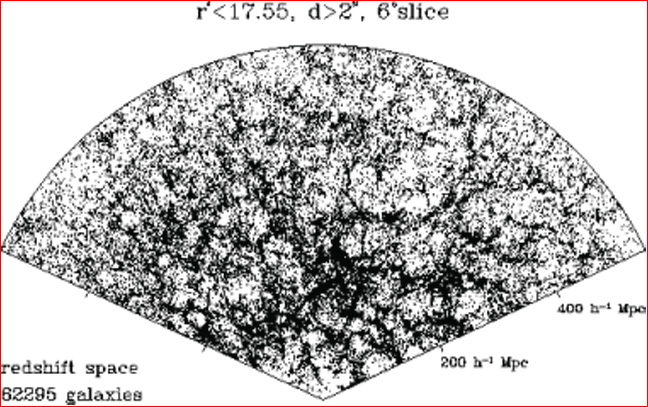
You put what we know about dark matter into a simulation, and it tells you what type of structure you expect to get out. For example, if you run a simulation on the scale of about a billion light years, you would expect galaxies to be distributed like so. (Image credit: Martin White.)
When you compare your simulation with what we actually observe, you get an idea of whether your theory makes sense or not. Here's a map of the observed galaxy distribution from the two-degree-field galaxy redshift survey. (Image credit: 2dFGRS team.)
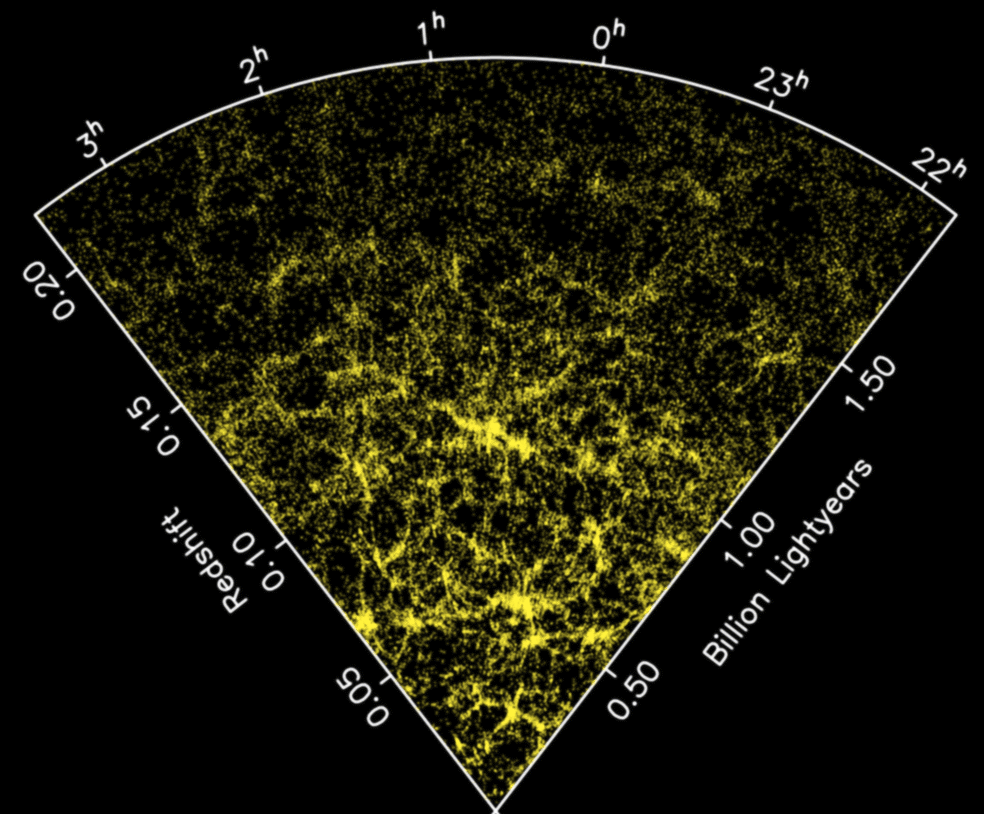
The agreement is spectacular! Well, what if we go down to a smaller scale, like say, down to the size of an individual galaxy? You have a pretty good idea of what a typical galaxy looks like; after all, we're in one!

What our simulations tell us is that -- pretty universally -- all galaxies should be surrounded by a huge, spherical halo of dark matter. How huge? It should extend out around a million light-years for a galaxy like ours. That is tremendous, considering that our galaxy is "only" about 50,000 light-years in radius.
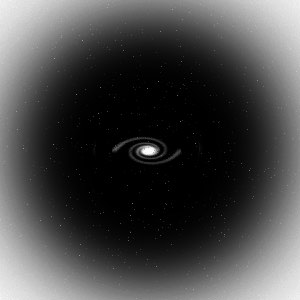
What's more than that is that our simulations tell us what the density of this dark matter halo should be like. Towards the edges, it should be very diffuse, but the density increases very quickly as you come in towards the disk of the galaxy, and then increases more slowly until you reach the center. And that's what our simulations tell us.
Not so fast, though. Does this make sense? A new paper out this week says perhaps not. You see, at the center of each galaxy (including our own!) lives a supermassive black hole, millions to billions of times as massive as our Sun. And, like all black holes, when matter falls into it (whether it's normal matter or dark matter), it cannot escape, and causes the black hole to grow larger and more massive.
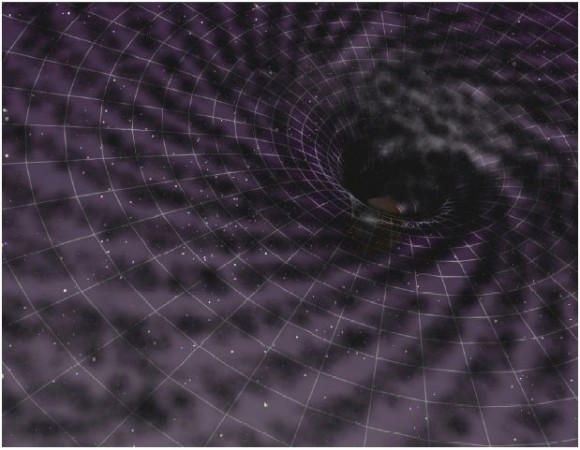

But this doesn't happen! So something is amiss. What gives? Do black holes simply not absorb dark matter? Improbable!
What it probably means is that something more complicated than our simulations are telling us is happening in the inner parts of these dark matter halos. We've had many clues (such as the rotation curves of spiral galaxies) that dark matter simulations get us close, but don't get it quite right.

This new paper appears to point toward the same idea: our simulations of dark matter get us close to the right answer most of the time, but there needs to be more to the story. It makes sense that what you'd ask next is what's actually going on. For example, how do these dark matter halos actually achieve a lower density in the center than we predict?
If you're wondering that, I congratulate you! You are now where I am: on the cutting edge of cosmology, trying to answer one of the open questions we have today. My best guess is that there's a process we haven't yet discovered where dark matter does interact by some means other than through its gravity; that could explain both of these discrepancies, and is a property predicted by many dark matter models. (The scientific term would be that the dark matter halo becomes isothermal.)
Amazing, isn't it? That looking at the most massive black holes in the Universe gives us clues to the nature of dark matter, but here we are! Any ideas on your end?
NewEnglandBob puts a big fat target on his chest:
Maybe dark matter is a to-be-defined field, and that field is a property of the black hole at the center of the galaxy.
I haven't read any of the technical papers, but....
....I assume that pure gravitational interaction is enough to get the angular momentum out of the dark matter right at the center? I know that most cosmological simulations of dark matter, anyway, use pretty large dark matter "particles", each of which represent what is truly a large number of dark matter particles.
If I were a betting man, I'd bet that there's some sort of "sixth force" (the fifth force being, of course, duct tape) interaction that happens between dark matter particles and each other, that baryonic particles don't feel, and that's modifying all of this. No clue how we'll figure that out, though.
So, I have a question science man: Can a black hole swallow a smaller black hole? And what happens when that occurs?
Something emitted from the galaxy akin to the solar wind in our system?
"The agreement is spectacular!" Really? The two images don't appear that close to me? Any statistical measures of spectacular you would like to share? My own guess is that dark matter may not be. What is clear is that our physics is not complete.
Well if I were a betting person...I could see the construction of a standard model for each generation of matter inclusively Dark,normal and black.Tho not exclusive from outside effects. Within each model containing states of matter as effected by the local environment.Each generation acting in it's own gravity spectrum and time constraints separated by declining event horizons and operation in dynamic parameters based upon ever changing specific mass differences.As far as Dark matter falling into a black hole... I personally think it highly improbable.I would think it more likely that the majority of dark matter would be converted by this changing environment and then enter black hole Generation.
Ethan,
First of all, this blog entry of yours is an example of great scientific reporting. It's explains (in a way that I think I am able understand)a very interesting hopeful result of THEORY. And it's not fuzzy wuzzy; it gives very specific data or/and image of theoretical phenomenon. And you begin by saying, "We don't understand everything." And you end saying, "Any ideas on your end?"
So no skepticism or complaints here.
NOW IN ANSWER TO YOUR QUESTION, "Any ideas on your end?" Let me very simply tell you how this dovetails with one of my ideas. But first let me emphasize a few things you have said. And first let me emphasize that this is SPECULATION!!
1) "simulations tell us... all galaxies should be surrounded by a huge, spherical halo of dark matter... a million light-years for a galaxy like ours. That is tremendous, considering that our galaxy is "only" about 50,000 light-years in radius "
Note: Within 1,000,000 lightyears of earth there are about 50 galaxies; thus dark matter is a extra-galactic phenomenon. Call this SPECULATION #1 (i.e assumption 1)
2) "Do black holes simply not absorb dark matter? Improbable!"
Well, this agrees with my theory. So yes, black holes simply do not absorb dark matter. THIS IS A CONCLUSION FROM MY THEORY, INTERPRETED A CERTAIN WAY WHICH I WILL NEXT EXPLAIN. But call this !!!! SPECULATION #2!!!!
OK, One of my ideas. Time is not a linear dimension from 0 (zero) to oo (infinity). First time is always a delta, e.g. +Dmin(+10^-25sec) to +Dmax(+10^16sec) in visible universe.
(this is the approximate temporal range of all scientific observations, so I do not speculate outside these timeframe)
My idea is that TIME IS A MOEBIUS DIMENSION. What this means is that time flows from
o +Dmin to +Dmax in our visible (sub)universe, then time flows from
o +Dmax to -Dmin in another subuniverse, then time flows from
o -Dmin to -Dmax in an antimatter subuniverse, then time flows from
0 -Dmax to +Dmin in another subuniverse
All total the Total Universe is
o 10-orthogonal-spatially-spherical-dimenisons and
o 1-Moebius-tempral-dimensional
REMEMBER FOLKS THIS IS SPECULATION (pg 147 to 148)
Now how does this fit with the dark matter calculation?
OK. All times measures at black-hole-event-horizons are +Dmin in our visible universe.
And in the cosmic cycle (SPECULATION!!!), all matter that leaves our visible universe via black-hole-event-horizons has the time property of +Dmin. And in the cosmic cycle (SPECULATION!!!), all matter that enters our visible universe via white-phenomenon-event-horizons (similar to white-holes) has the time property of +Dmax.
Now such +Dmax matter enters our visible universe anywhere; but since it has the time property = 13.7Billion years = 10^16; it is temporally (electromagnetically) invisible to us. However, via other dimensions may be gravitationally visible.
Specifically, event-horizons of black-holes are temporally incompatible with dark matter of time property +Dmax.
OK that's one of my ideas. This bit of dark matter theory was not part of my overall theory because I didn't have this data.
WARNING: MY IDEAS ARE ALL SPECULATIVE.
DISCLAIMER: MY IDEAS ARE SCIENTIFIC BASED (NO THEOLOGY IMPLIED) BJOERN (An excellent physicist has helpfully poked serious holes in some of my ideas. I thank him. Still I am convinced of the general soundness of my ideas.)
Follow the links if interested, my full text is online.
Ethan, I hope I haven't abused your hospitality. If so fell free to delete this comment. I'll make no further comment here about my idea. It's not the purpose of this blog.
Iâve been following your series on Dark Matter, and all comments received, with some interest. None of the responses youâve received so far were very adventurous. Most were pretty conventional and left us all in an unaltered state of confusion.
Perhaps itâs time to inject a bit of pure zaniness. A bit of thinking outside the tesseract to see if that will help us interpret the pattern of lights and shadows flickering on the walls of our dimly lit cave.
To start off with a bit of pure orthodoxy, as far as GR is concerned. The calculations are 100% correct. There is absolutely no need to question that aspect of GR. The only problem that remains is that GR no more actually explains how gravity works than most other theories of gravity.
Possibly, the only thing that would need to be reconsidered is one of the more unneeded conclusions that arises from the correctness of the GR calculations. To wit, because the calculations work perfectly well without having to take any other factor into account, space must, therefore, be totally empty of anything else that might be a direct cause of gravity.
To quote the late Richard Feynman: âIt is one of the peculiar aspects of the theory of gravitation, that it has both a field interpretation and a geometrical interpretation.â
The way that cold, neutral Dark Matter (DM) arranges itself into haloes around galaxies and galactic clusters suggests that it would be preferable to adopt a field interpretation.
There needs to be some force transference factor, perhaps vortices emanating from the fourth spatial dimension that act to produce a highly modified and localised form of âpushâ gravity. Similar, but not identical to Le Sage gravity, to actually explain the mechanics of how gravity works in three spatial dimensions.
DM does not behave in the same way as Normal Matter (NM). From astronomical observations of the patterns formed around galaxies and galactic clusters it appears to behave as if it were gravitationally repelled by NM. The shape of the DM halo that surrounds a galaxy might represent a region of space where the galaxyâs cloud of DM particles repelled by its NM reaches a state of near equilibrium with an equivalent repulsive force from the combined NM of surrounding galaxies.
A ârepulsiveâ DM particle gravity field should have the same effect of appearing to add to the mass of a galaxy as an âattractiveâ gravity field, even if the DM particle itself did not possess much, if any, intrinsic mass.
The two types of DM that have already been discovered in particle colliders on Earth are too small and insignificant to contribute much to the quantity of dark matter, nor do they appear to be strongly affected by NM, one way or another, in a gravitational sense.
Note: Here I refer to electron-positron pairs and proton-antiproton pairs that are regularly split apart and knocked out of the fourth spatial dimension in colliders.
The conventional explanation is that this phenomenon represents the âcreationâ of new matter at the collision point and that the validity of the mass energy equation proves that it must be so.
However, if the existence of a fourth spatial dimension can be accepted, particle pair splitting from the fourth spatial dimension would explain equally well how a fully developed proton and antiproton pair can sometimes appear, as if by magic, in the aftermath of a collision between two protons at a combined energy level in excess of 6.3 GeV. The mass energy equation would still balance and the matter âcreationâ explanation could be discarded.
The appearance of jets in colliders always indicates a head on collision between two protons. If there really were a particle creation law then a new proton-antiproton pair above the 6.3 Gev energy level would always be produced in such collisions, not just once in three million.
(Prediction: Not even a 6.3 TeV proton to proton collision will ever be able to (a) âcreateâ or (b) split more than one proton-antiproton pair at a time).
The most massive and the largest elementary particles thought to have been produced at the beginning of the universe were Dirac monopoles. About 10^11 of them.
The hypothesis is that most of the 10^11 monopoles quickly united to form massless, or near massless, monopole pairs (DM) with the characteristic of being very strongly gravitationally repelled by NM in Three Space.
Whatever âglueâ factor enables NM particles to be influenced by the gravitational force would, in the case of DM particles, be fully dedicated to ensuring the maximum attainable bond between the particle and its antiparticle so that monopole pairs, now united and invisible in the fourth spatial dimension as ultra light or massless DM particles, could no longer be gravitationally attracted to NM but would, instead, be repelled.
Such Four Space particles might be the most likely candidate for making up most of the DM in the universe. A particle that only reacts gravitationally with NM. Ultra Light Strongly Interacting Monopole (Pairs) or ULSIMs.
Possibly, the instant that most of the North and South monopoles coupled with each other when the universe first formed, was the cause of the sudden inflation which continues to this day.
Neutral and, perhaps, massless monopole pairs lurking as DM particles in the fourth spatial dimension that are strongly gravitationally repelled by NM should be physically large enough to be trapped and confined in containers made of NM, assuming that the estimated size range calculated for Dirac monopoles is close to accurate.
Should such large DM particles exist they would be so strongly repelled by NM that they would tend to move preferentially to regions of low gravitational density and well away from massive bodies such as planets. Perhaps the Lagrangian points would be a good place to try to harvest ULSIMs.
If nothing else, Iâve tried to be different.
Quoting Ethan from Part III of his Dark Matter series:
âGravity does not always line up with where the normal matter lives. This tells us that either, again, we need dark matter, or we need to accept that not only is General Relativity wrong, but that gravity works in a very bizarre way. We'd have to modify gravity an additional way to make it non-local, or to make things gravitate towards places where there isn't any mass! This is very unsettling, but it's the only way to reconcile these observations without using dark matter.â
Although Iâm interested in reading Ethanâs views, I would be interested in reading the views of others first, before Ethan provides his acolytes (if any) with a hint as to which way he will jump.
Umm ... the Big Bang is a Fraud !!!
Umm ... Einstein was wrong and my website proves it !!!
Umm ... I already thought of this years ago. But better !!!
Umm ... great post, Ethan. Thanks. You're doing some great work here.
[Select one.]
how do these dark matter halos actually achieve a lower density in the center than we predict?
given e=mc2, this must mean there's a leak in what we can measure as e or m beyond the leaks we already know about.
a meta leak?
this is very odd.
I am wondering, what exactly is a run away growth of a black hole?
As a black hole absorbs more mass, it grows larger, because its gravitational pull is thereby stronger and the event horizon expands. Since the halo is supposed to be roughly spherical and fairly dense at the center, then for every centimeter of halo that the black hole devoured, it would have enough mass to absorb more... and more... eventually, everything in its path, and most of the galaxy.
Which leads me to ask, do we have any examples of gravitational lensing from invisible objects? Because if so, then maybe in some cases there are galaxies that were engulfed by a runaway black hole!
Which leads me to ask, do we have any examples of gravitational lensing from invisible objects? Because if so, then maybe in some cases there are galaxies that were engulfed by a runaway black hole!
This is a great question. And it would seem that the Hubble Deep Field would show these if even if they were very uncommon. What you would see is a dark spot with smearing all around it. The Hubble Deep Field doesn't show anything like this.
I guess in response to "Any ideas on your end?" I could pose the question; what is there to learn from the interplay between dark matter and relativistic jets released from quasars and black holes,if any. I think atom interferometry has a good a chance as any to shed some light on how different matter can be. I think if we want to see further down the rabbit hole then the unorthodox combining of testing techniques may need to occur. Perhaps this would be of interest to some readers.
http://arxiv.org/PS_cache/arxiv/pdf/0712/0712.3703v1.pdf
Whats the origin of dark matter/energy?
Could it have anything to do with the matter/anti matter anhilation phase, this would appear to have enough energy to account for the dark stuff.
Can we account for where all the energy went?
Okay, I have an idea. I'm loathe to explain it: I don't have much of a mathematical understanding of the implications, or any theories as to "why" (no profound insight into a mechanism).
Dark matter always appears in halos. This is true of galaxies and clusters. Dark matter is absent (or near-absent) in some galaxies. Which means conventionally that it's been stripped away, and not all galaxies can be judged to have dark matter based on brightness alone.
Actually, I'd rather not broach it. It makes a few predictions - and that's really part of it. If I want to try and bring it into the open, I need to prove it has more than speculative coherence: it needs to properly fit the rotation curve, and predict the rotation curve of other galaxies. Right now, it's only observationally testable to a point, not rigorously mathematically testable. It does, however, predict a few differences that should be testable - but again, I'd rather have the math to back it up.
Which is part of my conundrum: I only got through basic calculus, and I also don't have a database of the specific information I need: just some physical data, measurements and parameters. Nothing spectacular or too out-there. Is there a publicly available database of, say, the general data on clusters, galaxies, and the structure of the "local" (say, few billion light years) clusters of galaxies?
Pat,Perhaps this will help.
http://www.sdss.org/publications/
Thank you, Sphere Coupler! Wow --- such a huge chunk of chewy, delicious data! Somebody could get lost... for years!
Remember to come up for air, this is only the tip of a *very large iceberg*.
I,ve always been a firm believer that:
no matter where you go, there you are,
then you can determine where you are,
then,
no matter where you go you are there.
So it's probley best to know where you are...
http://www.atlasoftheuniverse.com/12lys.html
Hope this helps in the understanding of what Eathan writes.
Usually we mean by 'runaway' a process that accelerates at an increasing rate. Since G falls off so rapidly with distance, a 'runaway' black hole would look more like a doddering grandfather going uphill than a baby buggy rolling down...
Does this news that galaxies (light matter) have been under counted by about a factor of 10 have any impact on your models?:
http://news.discovery.com/space/stars-universe-cosmos.html
Dark matter is actually the effect of virtual particles popping in and out of existence. Gravity curving space-time and some other force accounts for its distribution characteristics*
*I don't have a clue what I am talking about.
I don't see why black holes should absorb proportionally more dark matter than normal matter. In fact, since dark matter can't condense through gas viscosity or cooling from radiation emmission, black holes should absorb proportionally more normal matter than dark matter.
If dark matter started out with uniform density and not hotter than normal matter at the big bang, their densities should have been proportional throughout the early universe, until the time when galaxy and supercluster-sized masses of normal matter stated to condense. Then, each massive cluster of normal matter would have been able to hold onto its proportional share of dark matter, but be unable to condense it. I think of it as a true ideal gas, gravitationally bound to its normal matter counterpart, very cold and diffuse at the outer reaches, hotter (in the sense that the particles are moving faster) and denser in the middle where the normal matter condenses. Like comets in the solar system, most dark matter spends most of its time moving slowly out in the halo, but if it is gravitationally bound to a galaxy or cluster, it moves faster as it approaches the mass accumulation. The density of dark matter is higher in the interior, but not as much as it would be if it were like normal matter and could get rid of its kinetic energy.
Dark matter bound to a galaxy cluster or supercluster isn't necessarily bound to one galaxy, although the galaxy or even individual stars in the galaxy will gravitationally compress the ideal gas of dark matter in the vicnity. HMMM... If the sun's gravity slightly compresses the otherwise uniform dark matter in the local neighborhood, could that explain the Pioneer anomaly? This could be used to measure local dark matter density, or at least put limits on DM density and temperature...
Perhaps the way of getting around the galactic central massive black hole puzzle is that there is no dark matter, and John Moffat's theory of Modified Gravity (or something similar)
http://en.wikipedia.org/wiki/Scalar-tensor-vector_gravity
is correct. From what I understand of his theory, in a galaxy, gravity would be weakest at the centre, increase towards the edge and beyond to a certain distance and then decrease according to the reverse square law. So the apparent surrounding halo of dark matter is just the increased gravity surrounding the galaxy.
Jamie,
The one thing that I really like about science is that it is always changing due to new information (science is correct for its time)Sure models change and ideas flourish, if we obstinately hold on to past models because they are so beautifully accurate without accepting new data then science suffers...What will be will be, let no man hold back the progress of science.
Science evolves and we adapt...in time.
This is all over my head, but it's fascinating nonetheless.
A minor question: most of the reading (for non-scientists) that I have done on dark matter takes pains to carefully distinguish between dark matter and dark energy, with the current wisdom being that dark energy is the larger component of the two (over 60% compared to 30-something% for dark matter).
But here you just conflate them and call it all dark matter, which surprised me. I thought for sure someone would jump immediately on this, but none of the savvy scientists commenting here seems to care that you didn't distunguish between them.
Why is that?
yogi-one,
He doesn't conflate the two, he simply makes no mention of dark energy because it has nothing to do with his topic.
Oh, when you linked to arXiv on new developments on dark matter, I thought you'd discuss this one http://arxiv.org/abs/1003.3356 .
@Mu: The author of that paper suggests that intermediate-sized black hole make up most of dark matter, according to the abstract. But how is that proposal consistent with the data we have which says that most of the dark matter is non-baryonic? And how can it explain e. g. galactic rotation curves?
Somebody should really start a blog called peer review of n on-peer reviewed papers, or maybe someone has and I just don't know it.
Bjoern, I haven't the slightest idea. I'm dealing with interplanetary stuff at the most, and there normally only with material and deployment questions. I keep an eye on arXiv for entertainment only (so professing professional interest to justify time spent of course).
Something I've never been clear on is how dark matter assumes different densities, given the posited mechanism of interaction. Are the denser areas comprised of the same dark matter particles over time, or is this a phenomenon where the regional density is greater, but no one particle stays around for a significant period of time?
sterile neutrinos.
Couldn't it be as simple as the black hole clearing a lot of the dark matter in the center early on? Instead of being embedded in a sphere of dark matter, we would just be embedded in a sphere with a smaller center sphere devoid or nearly devoid of dark matter (because it's all fallen into the black hole). Wouldn't that in part explain why the supermassive black holes might be so massive???
Ideas on our end?
Let's try brane theory on for a while. If all this dark matter is actually standard baryonic matter on a different brane, and if it's correct to consider that the only force crossing branes is gravity, then none of this is a mystery.
If dark matter is in a different brane, with some degree of attenuation across branes, then other-brane matter will not collapse, but will instead orbit aimlessly near the physical space corresponding to our black hole.
Normal matter is but a candle flicker in the night
caught between the darkness and blackness
between the before and what will come
four percent of the whole is still alight
a thin Vail of wonder gives way to consciousness
the thoughts of stardust return wisdom
tho eternity we would see, yet dim grows our sight
we are made from the dead, the decaying matter
from the violent demise, understanding ensues
it is ordered chaos from birth until death
time in between, the parity spent
diminishing oscillations, excitation, and collapse
we are one and the same, the universe and I
The candle is us...as we flicker in the night
Sphere...Coupler
Has anyone in this giant gaggle of geniuses put forth the theory that perhaps dark matter is nothing more than non-dense non-illuminated matter?
Yeah, sure you can tell that there is something out there because it registers as a gravitational attractor, but does it really have to be so damn mysterious as what everyone is theorizing? Would it not make sense that the dark matter surrounding a galaxy is just more of the same matter that is within it? Some planetoids in our own solar system are only visible through massive instrumentation and very dimly reflected sunlight. Perhaps dark matter is just matter that is floating in the dark??
It may not be any more mysterious than a room with the lights turned out. The physicists are letting their imagination run away with them, methinks.
At what point of acceleration loss does dark matter attempt to convert to normal matter?
In a galaxy cluster does the bullet cluster indicate the near nuetral zone of matter acceleration due to the configuration of the mass of all galaxies contained within the cluster or gravitational influences in the local light year spectrum?
I believe these questions (that can be answered with todays technologies) is key to understanding the nature of dark matter.
Observing a timed, pulsed gama ray burst through clustered dark matter should resolve an acceleration-gravitation paradox and lead to a quantum analysis of the evolving parameters of transition.
Ethan, has there been any progress in this area?
Has there been any detailed analysis of the data collected from our probes presented in papers that I perhaps have missed?
http://grb.sonoma.edu/
"Has anyone in this giant gaggle of geniuses put forth the theory that perhaps dark matter is nothing more than non-dense non-illuminated matter?"
You must be the genius. Before you can claim your prize, a little reading, starting here: http://scienceblogs.com/startswithabang/2009/09/dark_matter_part_i_how_…
Hey Dave,
I found your post quite Illuminating.
Having not read Ethans post prior to date of discovery of this blog, which was not that long ago.
Within that post Ethan provides a link to his work(which somehow I had neglected to read) And I find that Ethan has written work in some of the areas "extensively" that intrigue me most concerning DM, and I've been too busy to...I guess I've got some reading to do.
:?)
*makes another cup of coffee*
Cool!
I just read "Probing dark matter sub-structure with Pulsar timing" arXiv 0702/0702546v2.pdf
Written by E. R. Siegel, M. P. Hertzberg, J. N. Fry
I now have a heightened and enlightened notion of Presque vu...gotta love it!
Dark Matter: We don't understand everything 3/26/2010
Well now, this looks promising...good ole CHANDRA.
A new view to add to the list.
http://chandra.harvard.edu/photo/2010/h2356/
Could a black hole's singularity be so dense that nothing really enters but if contact is made it separates the -/+ particles as well as creating dark matter? Which, might explain our expanding universe all of the negative particle show like --+--+--+ to infinity. This is the reason it would be too dense to actually swallow anything but instead create the space around us?
negative particles show like --+--+--+ to infinity. my bad.
Kevin, something simular is what I'm thinking, since a singularity cannot really exist and I think Hawking Radiation is only a partial story, virtual pairs might be created at the point of singularity attempt, this may be why matter is seperated by an exspanding space... as the virtual pairs seek to fluctuate towards the easiest path and that path would be created by the momentum of space, I was kind of waiting for Sir Hawking to come to this conclusion.
Fusion and itâs creation at the grandiose level
Could a black holeâs singularity be so dense that nothing really enters but if contact is made it separates the -/+ particles as well as creating dark matter/dark energy? Which, might explain our expanding universe (e.g. if all of the negative particles showed up like (- - + - + - - + - to infinity). Could this be the reason it would be too dense to actually swallow anything but, instead create the space around us? I would also guess that if the worldâs largest hadron collider actually gets turned on & does what is supposed to do, it might create a black hole that would not suck us in but would however be too heavy for our space. Then, it would basically just rip us apart by its massive density like an impenetrable piece of matter expanding from within. The reason that the expansion of the black hole doesnât envelope everything is that the space it creates stops it from doing so. For example, if somebody tried to hold up an anvil with a sheet of paper it would most certainly break through the paper. As for this anvil it is infinitely dense so it would continue to swell & create the matter around it. I also think thatâs why when a supernova happens a black hole is created; to help in the creation of new stars as well as the space for those stars and that is the reason the positive always outweighs the negatives.
Additional Details
*I am saying that upon the primal stages of the black holeâs birth it grabs the closest objects to them thereby destroying them in the process. Now at some point after this it will cease its negative gravitational pull on the surrounding objects at this point in time it will start in the creation of dark matter/ dark energy = positive/MOND. I am definitely not counting out the big bang theory in anyway with this thought.
*This is only a theoretical question for open minded individuals.
*"MOND" (for modified gravity)-push pull effect.
*You can find proof of theses black holes with radio telescopes E.G. the static noise reflected back from space.
* Also see Friedmann-Lemaître-Robertson-Walker metric
âLet the future tell the truth, and evaluate each one according to his work and accomplishments. The present is theirs; the future, for which I have really worked, is mine.â- Nikola Tesla
I just tried posting this & nothing showed so I apologize if it shows up twice.
After reading Sphere Coupler's comment I decided to write Sir Hawaking this message
posted below.
Sun, June 12, 2011 9:36:27 AM
Black Holes
From:
Jenni Alvey
View Contact
To:S.W.Hawking@damtp.cam.ac.uk
Hello Mr. Hawking,
My name is Kevin Alvey, I have used my wife's E-mail to send you this question that seems no one could answer for me & I thought you could help.
Could a black hole's singularity be so dense that nothing really enters but if contact is made it separates the -/+ particles as well as creating dark matter? Which, might explain our expanding universe all of the negative particles show like --+-+--+- to infinity. This is the reason it would be too dense to actually swallow anything but instead create the space around us? Please go easy on me I am just somebody who finds the whole idea of black holes intriguing & also think thats why when a supernova happens a black hole is created to help in the creation of new stars as well as the space for those stars. Thank you in advance for your time.
Respectfully,
Kevin Alvey
And the following message was his reply.
Sun, June 12, 2011 9:36:30 AM
Your recent email to Professor Hawking
From:
"S.W.Hawking@damtp.cam.ac.uk"
View Contact
To:jennireyloveskevin86@yahoo.com
Thank you for your email to Professor Hawking.
As you can imagine, Prof. Hawking receives many such every day. He very much regrets that due to the severe limitations he works under, and the enormous number of requests he receives, he is unable to compose a reply to every message, and we do not have the resources to deal with many of the specific scientific enquiries and theories we receive.
Please see the website http://www.hawking.org.uk for more
information about Professor Hawking, his life and his work.
Yours faithfully
Sam Blackburn
Technical Assistant to
Professor S W Hawking CH CBE FRS
Department of Applied Mathematics and Theoretical Physics,
University of Cambridge,
Cambridge,
CB3 0WA.
United Kingdom.
http://www.hawking.org.uk
I am now posting a link that reflects his most current theory labeled "The case for primordial black holes as dark matter".
http://arxiv.org/abs/1106.3875
coincidence? Anyways, I also wanted to thank Sphere Coupler for the positive feedback of my previous comment.
Here is another attachment dated June 27 from Carnegie Mellon who leads an international team in conducting the most detailed cosmological simulation to date by incorporating the physics of black holes into a highly sophisticated model running on a powerful
supercomputing system.
http://www.cmu.edu/news/archiv...e27_blackholes.shtml
Dark matter! hahaahaha in your head I persume you have a dark matter... hahaha what a man dark matter!