

"What is art but life upon the larger scale, the higher. When, graduating up in a spiral line of still expanding and ascending gyres, it pushes toward the intense significance of all things, hungry for the infinite?" -Elizabeth Barrett Browning
I don't mean to ask why the Milky Way is a spiral in an existential sort of way. You see, many galaxies, like our own, and also like Andromeda and the Triangulum Galaxy (below) -- our nearest galactic neighbors -- are spiral galaxies.
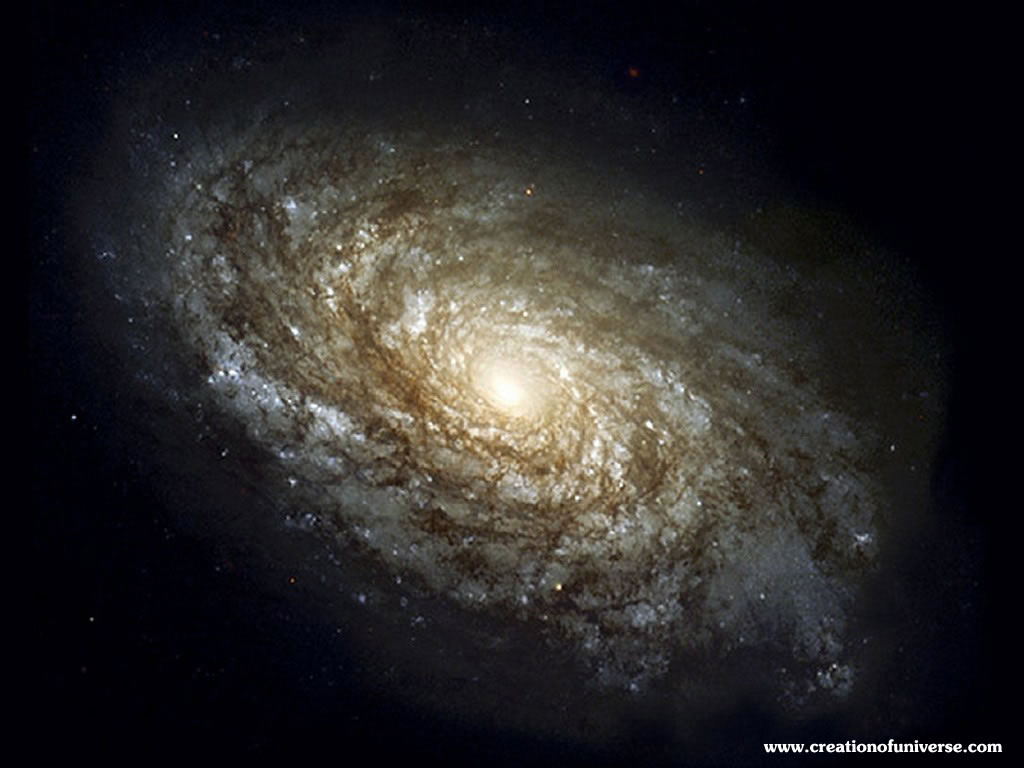
They're what I think of when I think of galaxies, and they're probably the first thing that pops into your head, too. But not all galaxies are spirals; a huge fraction of them, in fact, look vastly different. In fact, they look more like diffuse blobs than anything else.
They're known as elliptical galaxies, and my favorite picture of one is this guy: Centaurus A.

(You can thank the Canada-France-Hawaii telescope for this shot; it's easily the prettiest picture of Centaurus A I've ever seen!)
But why are we a spiral? Here we are, with our stars living in a plane, with great, dense spiral arms, and just a small bulge at our center. We find plenty of spiral galaxies edge-on, like this one:
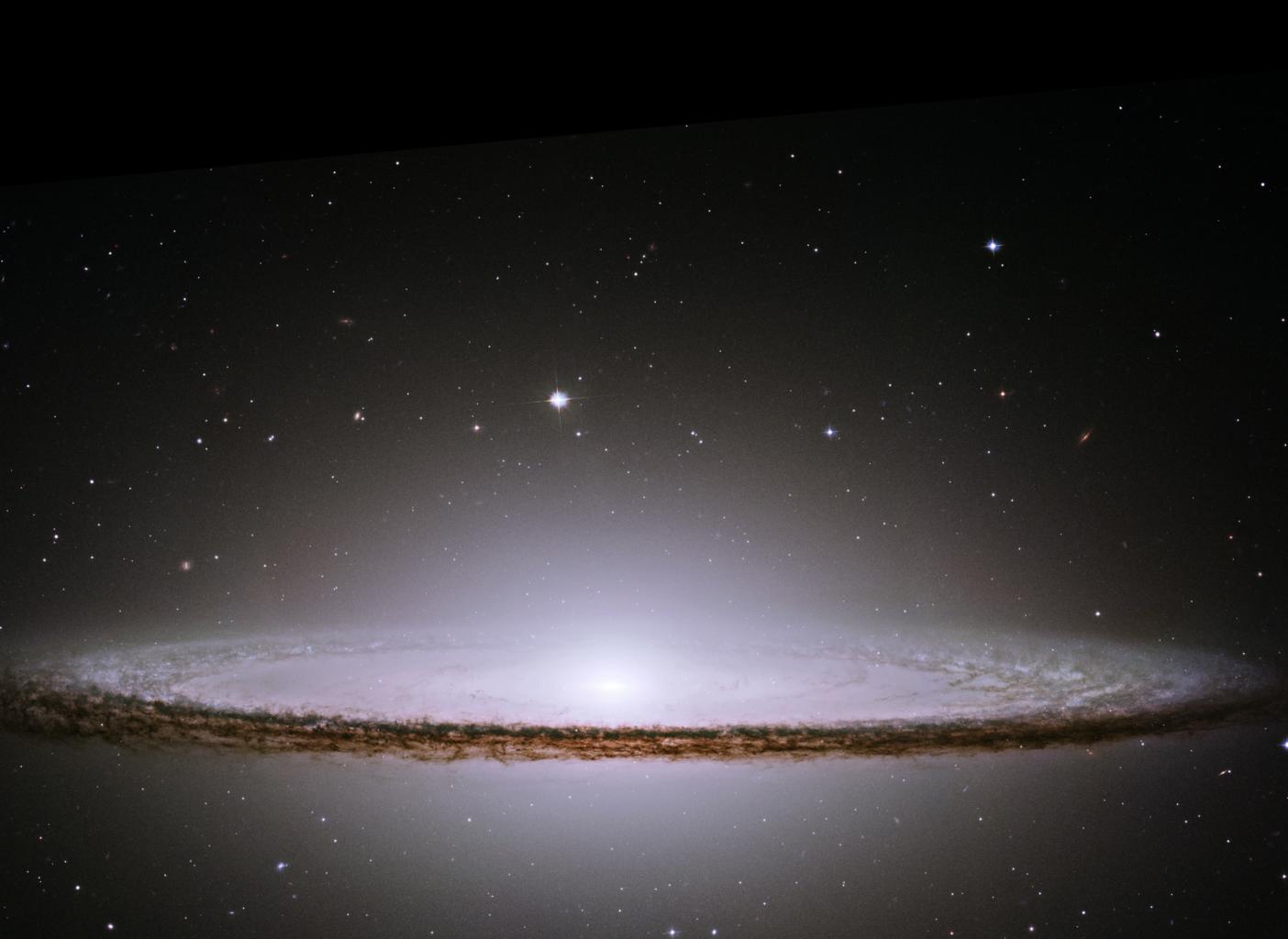
And what do we see? Well, if we take a picture of our galaxy from within it, it looks almost exactly the same!
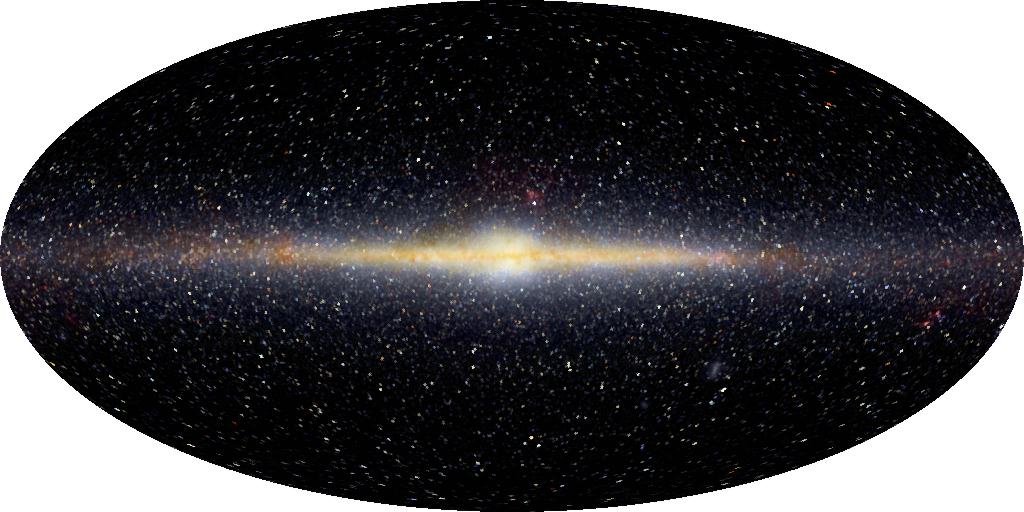
(And you can thank the old COBE satellite's infrared eyes for being able to see through our galaxy's dust!)
So why are we a spiral instead of an elliptical galaxy? Believe it or not, we think that nearly every galaxy started off as a spiral! Why's that? Well, before we were a galaxy, we were just a giant blob of matter, waiting to collapse under its own gravity.

However we started off, one side was inevitably shorter than the other two, and that direction collapsed first. The other two directions were large, however, which means we went from an ellipsoid down to a pancake-shaped object!
This is why most galaxies that we find in isolation -- known as field galaxies -- are spirals!
But what happens when these galaxies meet up with other large galaxies? They don't just pass like two ships in the night; gravity is not nearly so quiet when you get two massive objects close to one another. Take a look at the heart of Stephan's Quintet, and look particularly at the upper two galaxies in the center of the image.
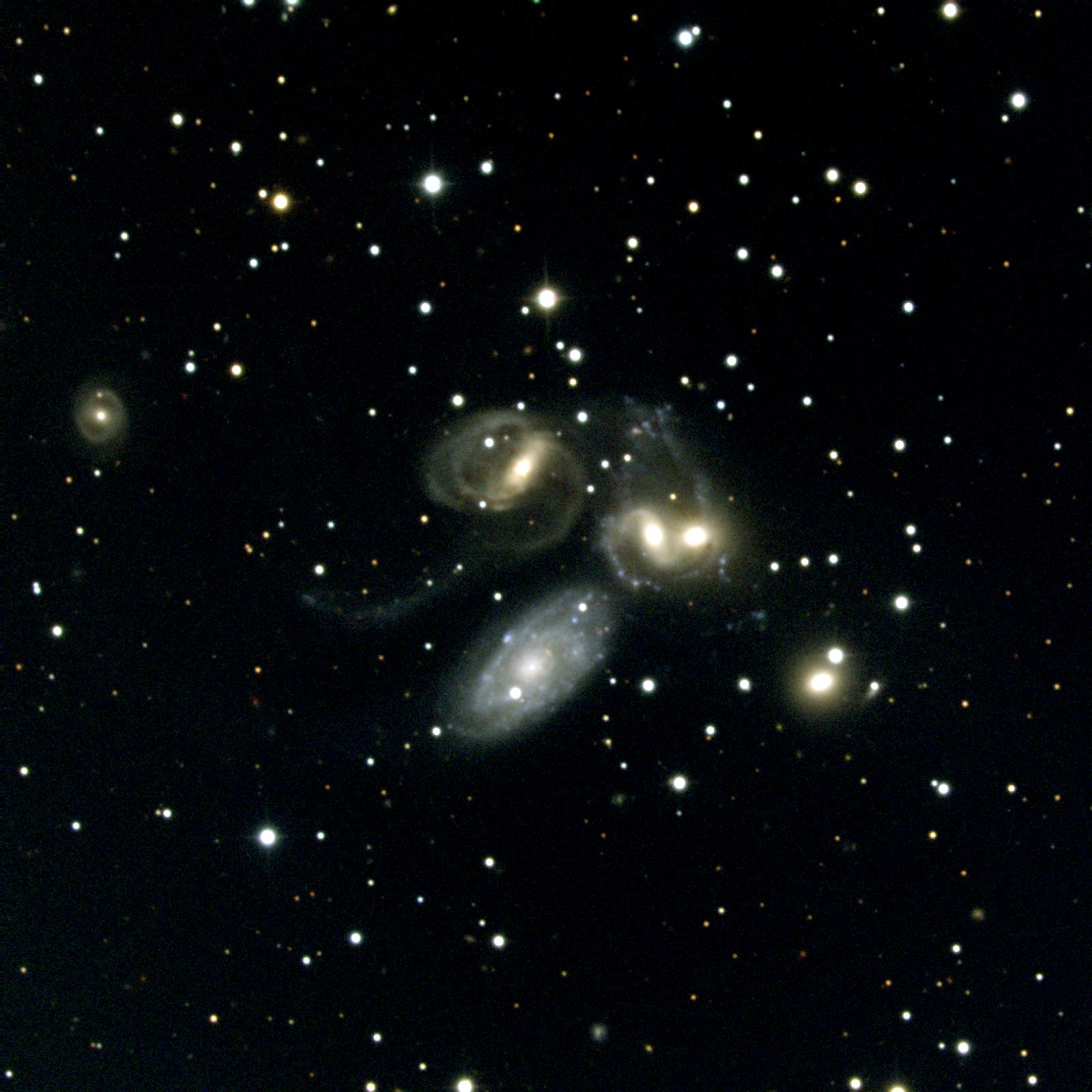
Let's take a closer look, but this time, let's superimpose X-ray light on top of this visible light image. Why? X-ray light comes from hot gas, and hot gas shows up when you have galaxy collisions! So if we see X-rays, it tells us that there was some part of these galaxies that just collided with another one!
So we look, and what do we see?
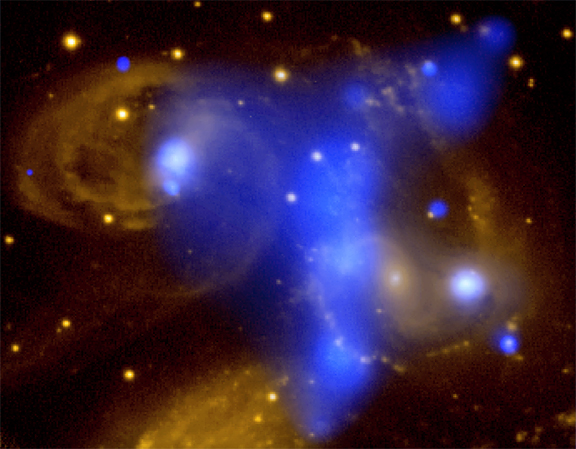
Awesome! There's totally evidence of a collision there! In fact, we can look out at all sorts of points in the Universe, and find galaxies in different stages of a major collision. You know what we find?
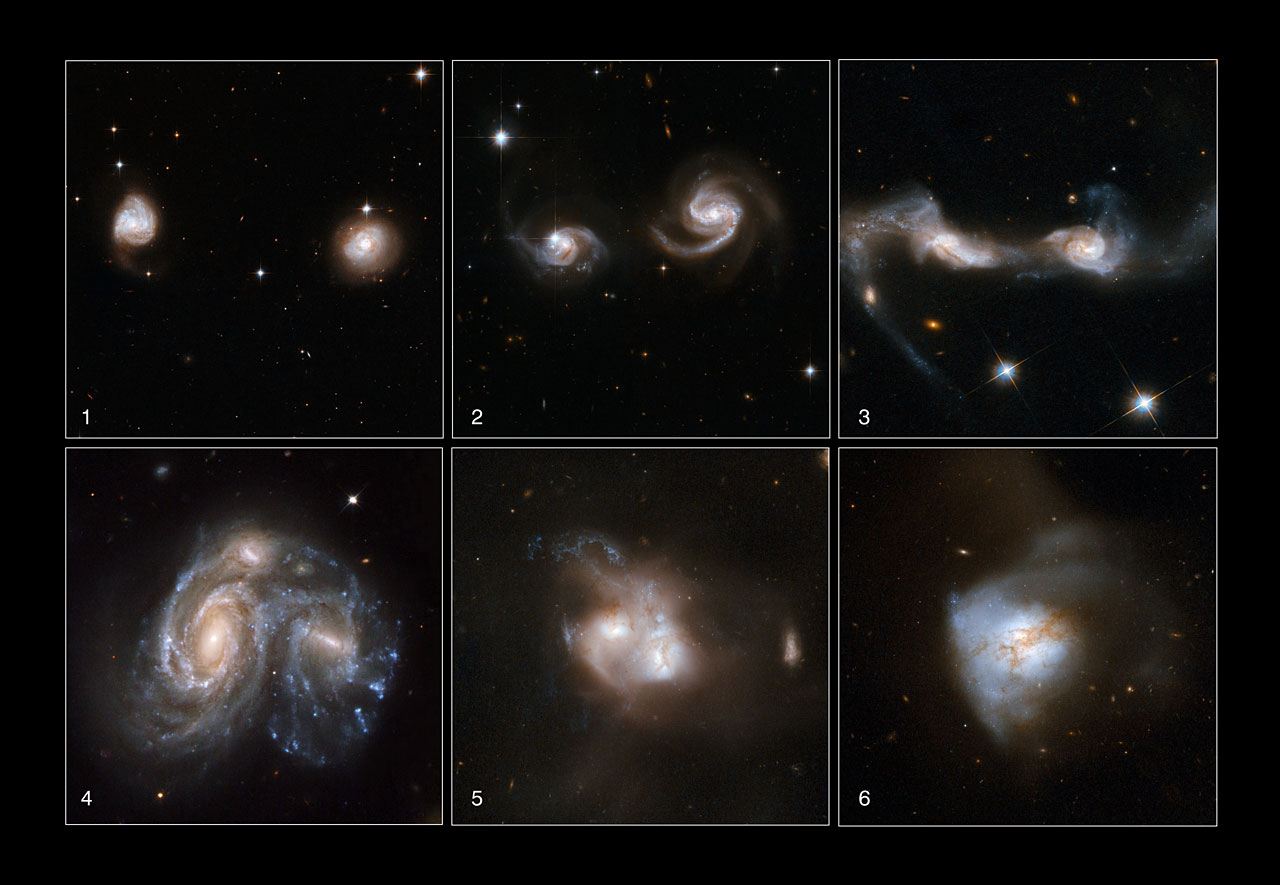
It looks like colliding spiral galaxies form elliptical galaxies! We call this hierarchical mergers, and this helps explain why we find elliptical galaxies mostly in dense clusters, and spirals most out in the sparse "field".
But perhaps a video simulation of two merging galaxies can show you this better than my words can.
This is your future, folks! Andromeda, our closest galaxy, is not only about the same size as us (more or less), but she's coming right for us! In a few billion years, the Milky Way and Andromeda will merge, and do you know what happens then? That's right, we'll be one giant elliptical galaxy, too!
So enjoy our spiral galaxy while we have it; it won't last forever!
I can't wait. I'm planning a BBQ to watch the collision.
This is your future, folks!
Well, in another 50000 years at max we'll be destroyed by the Reapers anyway!
Anyway, thanks for this cosmology tidbit, Ethan. Your blog remains one of the few Scienceblogs which really imparts interesting information to the public. This stuff keeps our software engineering coffee table going "ooh" :)
Ah, yes, "Reapers."
Forgive my ignorance, but shouldn't we expect an elliptical galaxy to reconfigure into a spiral, due to gravity and rotation, over a long enough time period?
Please direct all questions to the Reapers. They have assumed control of Starts With a Bang.
What effect, if any, does DM have on the colliding galaxies? Does it have 0 effect on any matter, or are there slight changes that result due to DM?
I have to say, Ethan, I enjoy blogs like yours so much more than other Scienceblogs that have just turned into self-important rants about "everything I hate".
This is fascinating to consider. Is there any data about what happens to the bodies within galaxies when they collide?
It might be a pointless question, since I've heard our Sun only has about the same life left in it as the imminent contact with Andromeda, but is there any chance that a tiny speck of life like Earth might come out of the collision unscathed?
For anyone who is interested, 40 years ago Poul Anderson wrote "Tau Zero", a fascinating and entirely plausible extrapolation of the time dilation effects which occur when a space ship approaches the speed of light. In this case, the occupants of the ship live long past the collision of our galaxy and Andromeda - in fact survive "the big crunch" and make it to the next universe!
Why are we a Spiral Galaxy?
Because we are outstanding in our field.
;?)
Have we been able to extrapolate the data so far,(out of the 10 million or so superclusters) to indicate the densest region (galaxy super cluster scale) in our Universe...papers?
Am I misinformed in thinking that the Milky Way is actually a "barred spiral" galaxy, and therefore that, e.g., Triangulum is not a suitable image for visualizing our neighborhood?
So a black hole in the center of a spiral galaxy would be a result of the spiral effect and not the cause of the spiraling itself? Is this due to the irregularities in the density of the particles within the cloud? So then gravity will assembles the particles based on density? Just want to make sure i'm understanding whats causing the spiral effect.
It is my understanding that the spiral "arms" are not regions of increased mass density, but they are regions of increased star formation. It is increased light from more stars due to waves of propagating star formation (likely driven by light pressure, solar wind, and super nova shocks).
I read that our local group of galaxies will eventually merge into some sort of super galaxy and that our group of galaxies, along with other nearby groups of galaxies are being pulled towards something called the "great attractor". We don't know what the great attractor is because it's over the hub on the other side of our galaxy, so we can't see it.
no, not desity of the galaxy arms I mean the initial dust cloud of particles.
In the image of the Stephan Quintet where the galaxies are interacting with one another, would the dust particles actually be pulled out of the galaxies?
As they will merge into an ellipictal, will further star formation occur? Or, because the gravitational interactions stripped the galaxies of dust particle prior, no new star formation will occur until several billions years into the future? If that were the case, it would take several billion years for the ellipictal galaxy too build up sizeable concentrations of dust particles through stellar events and star deaths in the formation of new dust nebulas, is that thinking correct?
Thank you, for the thought provoking article.
In the image of the Stephan Quintet where the galaxies are interacting with one another, would the dust particles actually be pulled out of the galaxies?
As they will merge into an ellipictal, will further star formation occur? Or, because the gravitational interactions stripped the galaxies of dust particle prior, no new star formation will occur until several billions years into the future? If that were the case, it would take several billion years for the ellipictal galaxy too build up sizeable concentrations of dust particles through stellar events and star deaths in the formation of new dust nebulas, is that thinking correct?
Thank you, for the thought provoking article.
I'm still not entirely clear on where the arms of the spiral come from. I understand why it's a disk, but why not a more uniform disk?
Thanks for the merging galaxies simulation video. Best seen for me up to now. Question.
How would you explain:
The Rise and Fall of CLG J02182-05102
For now, ClG J02182-05102 stands out as a greatly over-dense region of galaxies - a metropolis in a land of isolated villages. At its center regions loom red, monster galaxies containing about 10 times as many stars as our Milky Way galaxy. This puts them on par with the most mammoth galaxies in the nearby universe, which have grown fat through repeated mergers with other galaxies. These big galaxies are so uncharacteristic of those in the early universe that in some sense it is like finding modern skyscrapers in ancient Rome.
Wait - aren't there /fewer/ spirals as you go "back" in time (view more distant galaxies)?
...and wait again: by the logic of what's been presented, shouldn't there be more spirals going back in time, and fewer if any ellipticals and irregulars? If spirals combine to form ellipticals...
I second BenHead's question (#17). I'm also not really sure why there are spiral arms at all.
Could anyone explain this a bit?
Urban light pollution has robbed many of us of one of nature's grandest spectacles: the hazy glow of the Milky Way. But the opening days of autumn are the perfect time to find a dark sanctuary in the countryside and get reacquainted with our starry home. Nights are still warm, the air is getting drier, and the center of the galaxy, the brightest, thickest part, shimmers in the sky at the end of twilight.
that was amazing man
how many galaxies in our solar system ei.i hope you have more videos to get
I absolutely enjoyed this entire page down to the comments regarding it...thank you for the collaboration.
Quite an interesting article. I can always count on you to get my apocalyptic mind juices flowing. I knew that the Milky Way was an elliptical galaxy, and I also knew that there were elliptical galaxies. What I did not know, however, is that one was made up of the other. It's a good thing that Andromeda is still billions of years away. I don't imaging I would want to be here when the merger goes down. I really don't think that we have the infrastructure to support that kind of disaster recovery effort. We can barely handle a localized natural disaster, let alone a cosmic collision.
To the comments about why there are spiral arms:
The angular speed of rotation of the galactic disk varies as the distance from the center increases. This would mean that for the galaxy to be a uniform spinning disk, the stars farther away from the center would have to revolve extremely faster to keep up with those nearer to the center.
There's another theory which states that stars move in an elliptical orbit around the center, like comets would around our sun. The orbits are formed in such a way that in certain areas, the orbits come closer together, forming what appears to be spirals.
There's a picture and more explanation in the Spiral galaxy article in Wikipedia.
Those videos & pictures are absolutely amazing. I can't believe that all that is right above us & most people just take it for granted. I am fascinated by space & everything to do with space. In my honest opinion, just looking at the stars through a telescope beats watching television any day. Now if only there was a way to use Hubble telescope, then I would have a really good view.
Paráda
I would want to be here when the merger goes down. I really don't think that we have the infrastructure to support!!!
Well, in another 50000 years at max we'll be destroyed by the Reapers anyway!
My understanding with all I've read about these spiral Galaxies is that in the center is a black hole which eventually brings these into collision Question where is our black hole do we have one and where is this such a precise prediction of 50000 years for our collision coming from and with whom Andromeda?
The collision with Andromeda is due billion years. We won't be there by then. why worry?
nobody will be here, even our grand grand grand childrens, anyway human being likes to destroy everything on the way . Earth is not going to last that much
"My understanding with all I’ve read about these spiral Galaxies is that in the center is a black hole which eventually brings these into collision"
Your understanding is wrong.
Beyond the event horizon, there's no difference between a black hole and a big star.
Black holes *** DO NOT *** suck things in.
"Question where is our black hole do we have one "
Odd ordering.
If the first is answered (the answer is "Saggitarius A", then it answers the second.
"where is this such a precise prediction of 50000 years for our collision coming from"
Where did the question come from? Because nobody has made a prediction of 50,000 years for our collision.
"and with whom Andromeda?"
Another question answered by the answer to the other: since no such claim has been made, no such colliding object has been proposed to exist.
Well, seems to me that Galaxies could find us the way to get closer to our desires of proximity and hopes for a better future. I choose Sombrero Galaxy. What do you think?