

"To exist in this vast universe for a speck of time is the great gift of life. Our tiny sliver of time is our gift of life. It is our only life. The universe will go on, indifferent to our brief existence, but while we are here we touch not just part of that vastness, but also the lives around us." -Terry Goodkind
Our view of the Universe changed forever in the 1960s with the discovery of the cosmic microwave background, known today to be the leftover glow from the Big Bang. This microwave-wavelength radiation, coming uniformly from all directions in the sky, was discovered with this telescope.
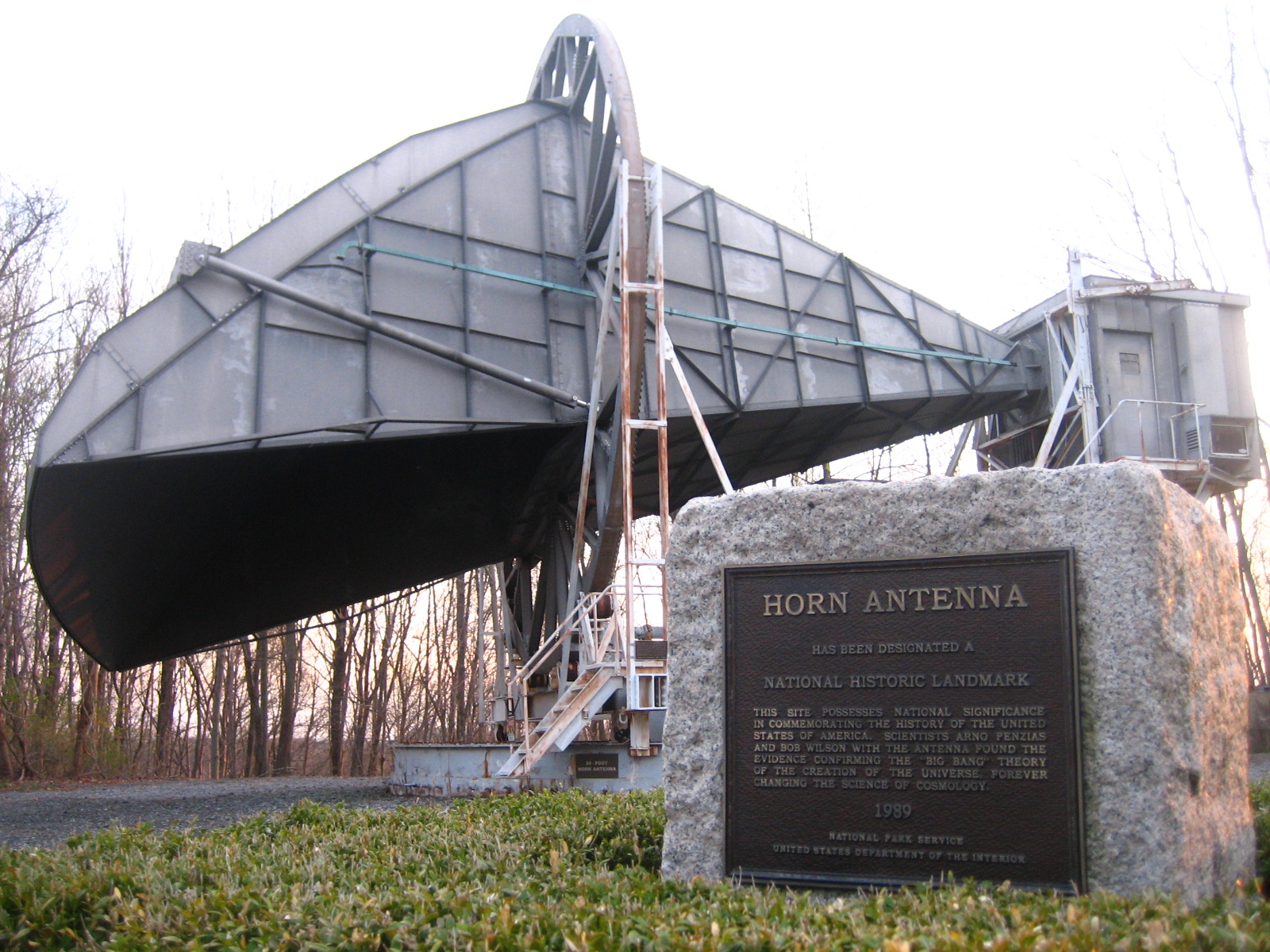
But it was only in relatively modern times that we were able to discover tiny, fundamental imperfections in the uniformity of this radiation. There have been two major missions -- both satellites -- that have taught us about what these imperfections look like across the whole sky.
The first one was the Cosmic Background Explorer, or COBE, satellite.
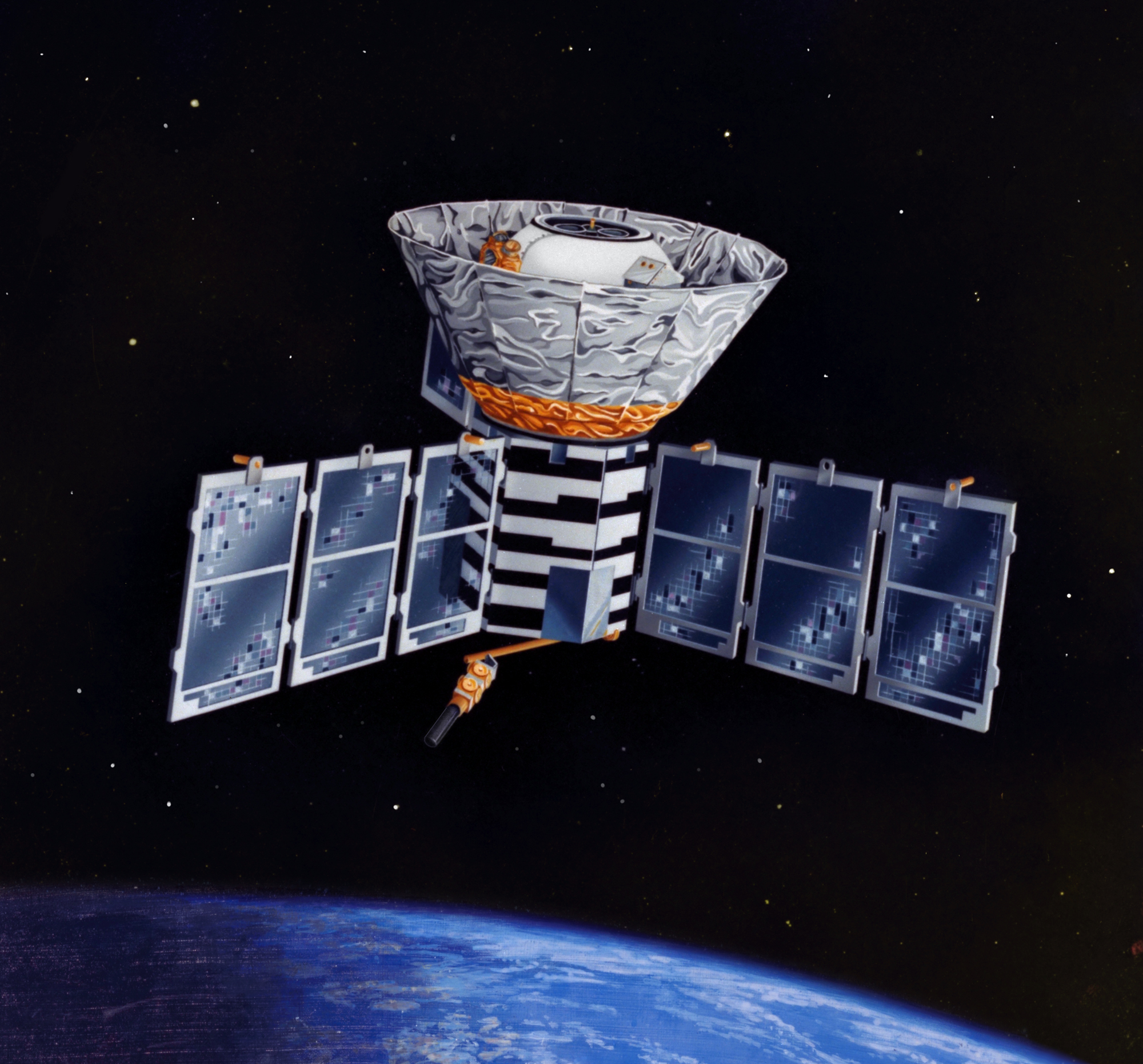
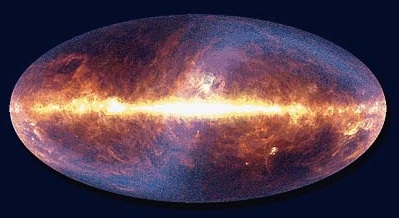
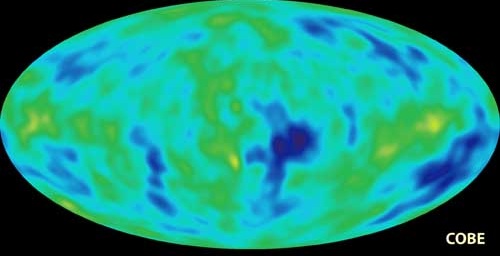
COBE was able to look at this leftover microwave radiation at three different frequencies with an angular resolution of just seven degrees. Visually (okay, in infrared), here's what COBE saw when it looked up at the sky.
We then tried to subtract out the stuff coming from our own galaxy and known sources. Why? Because we want to measure the picture that's leftover from the Big Bang, without any of the intervening stuff getting in the way. So if you look at the image below, the middle panel represents the "known stuff" from our galaxy that we subtract out, giving us the panel on the bottom as our best estimate of the extragalactic background in the Universe.
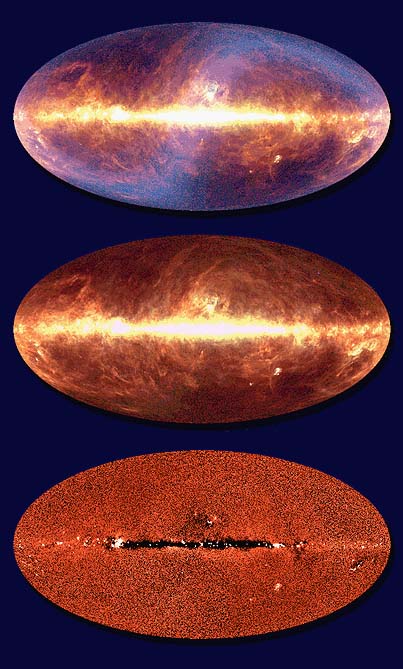
All of this stuff, the part from our galaxy and the part from extra-galactic sources, needs to be taken into account. Why? Because we're trying to measure the imperfections from the Big Bang, and that means only looking at the stuff from 13.7 billion years ago, not the stuff in between us and the microwave background.
So we apply this knowledge to remove the extragalactic sources, and make a temperature anisotropy map, where we can see, relatively, which spots are hotter and colder than average. This was done, and here are the final results from COBE, with the best background subtraction we were able to do.
This was in the 1990s. But in the 2000s, the next generation satellite, the Wilkinson Microwave Anisotropy Probe, or WMAP, came along.
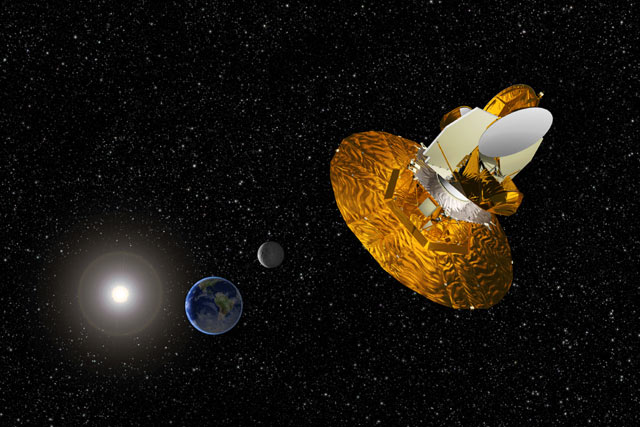
Instead of looking at three frequencies, WMAP looked at five. Instead of seven-degree resolution in microwave wavelengths, WMAP achieved half-a-degree resolution.
And it had much better luck subtracting its backgrounds -- both galactic and extragalactic -- than COBE did. Here's a WMAP poster that shows the galactic and extragalactic backgrounds and how they were subtracted off, if you care to click and enlarge it.
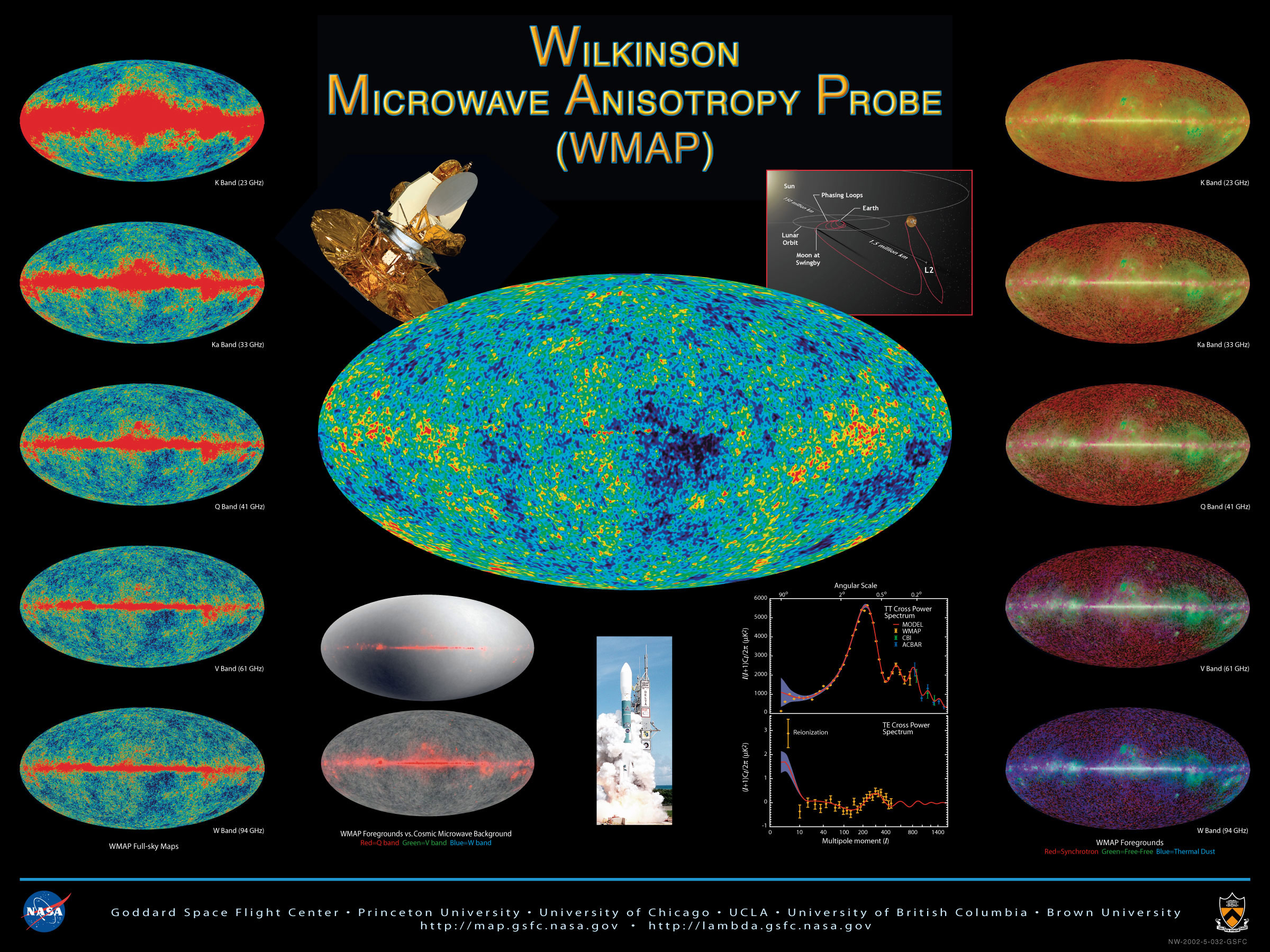
The results? WMAP was able to show us what the primordial imperfections in the radiation of the Universe were to unprecedented accuracy. (Although, to be 100% honest, I don't completely trust the galactic plane, and don't think you should, either.)
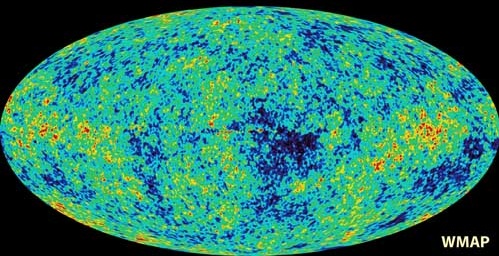
And we learned a whole lot from analyzing this data, including the best measurements of the age and composition of the Universe!
But there are plenty of other questions that WMAP and COBE haven't answered. For example:
- Is the light from the microwave background polarized, and if so, what can that teach us about gravitational waves?
- What's going on with smaller angular scales? (This is known as the Sunyaev-Zel'dovich Effect.) What can we learn about the effects of intergalactic gas on the microwave background from it?
- How does structure form from gravitational collapse? How quickly do gravitational potentials change in the Universe? Measuring the red- and blue-shifts of the cosmic background light due to collapsing galaxies and clusters should help answer this.
So what do we do? We come to the present day, where we've just recently launched the cosmic microwave background satellite for the 2010s. What is it? PLANCK, named after the famous German physicist Max Planck.
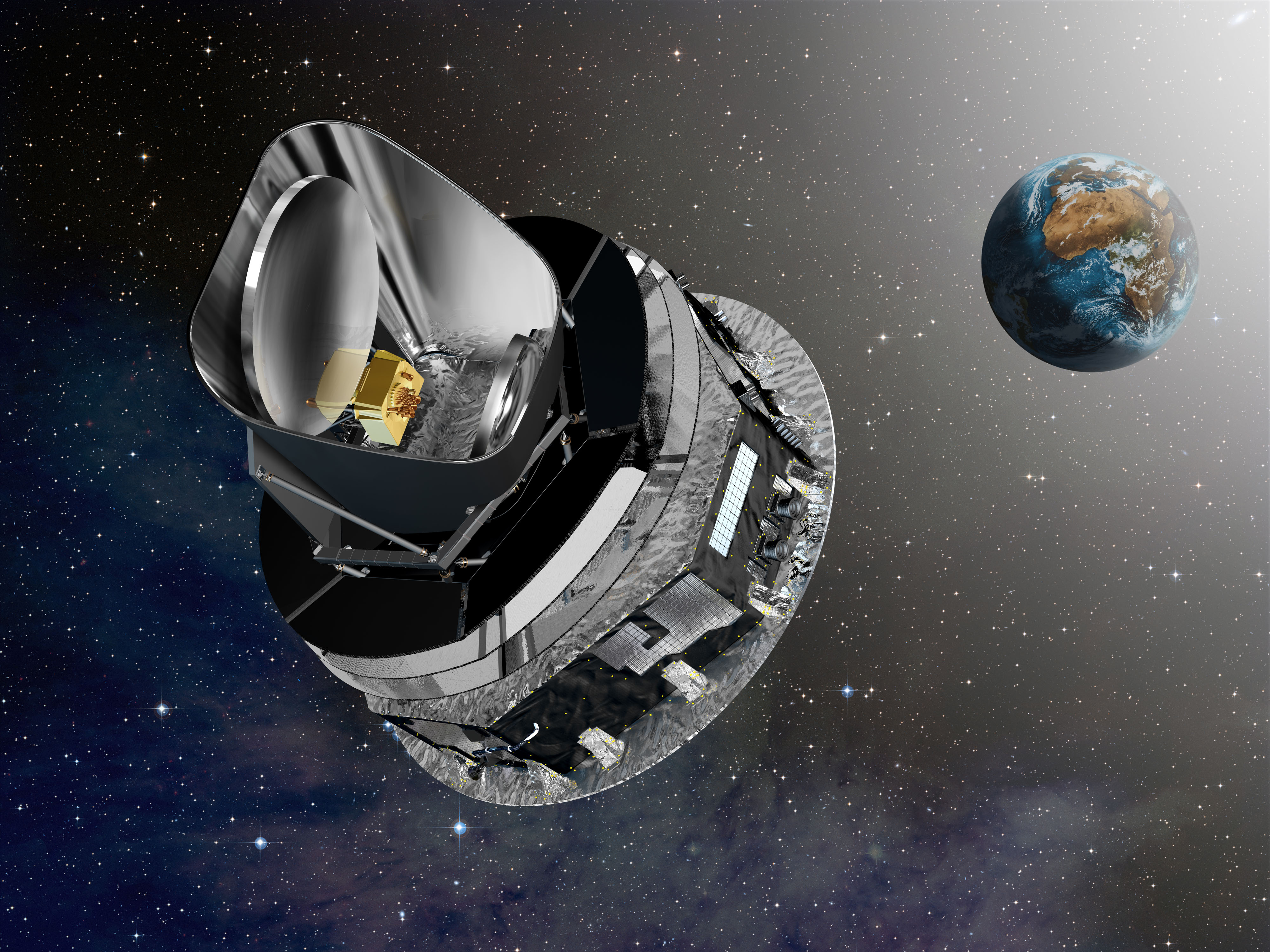
Well, instead of 3 or 5 wavelengths, Planck will measure nine. As sensitive as WMAP was, Planck will be a full 10 times more sensitive in its capabilities. It will be able to measure polarization. And instead of 0.5 degrees, Planck will be able to get down to sizes of under 0.2 degrees on the sky.
Well, what's with all of the hype? The European Space Agency has just released the results from Planck's all-sky survey, which will be used for galactic and extragalactic background subtraction. Want to see?
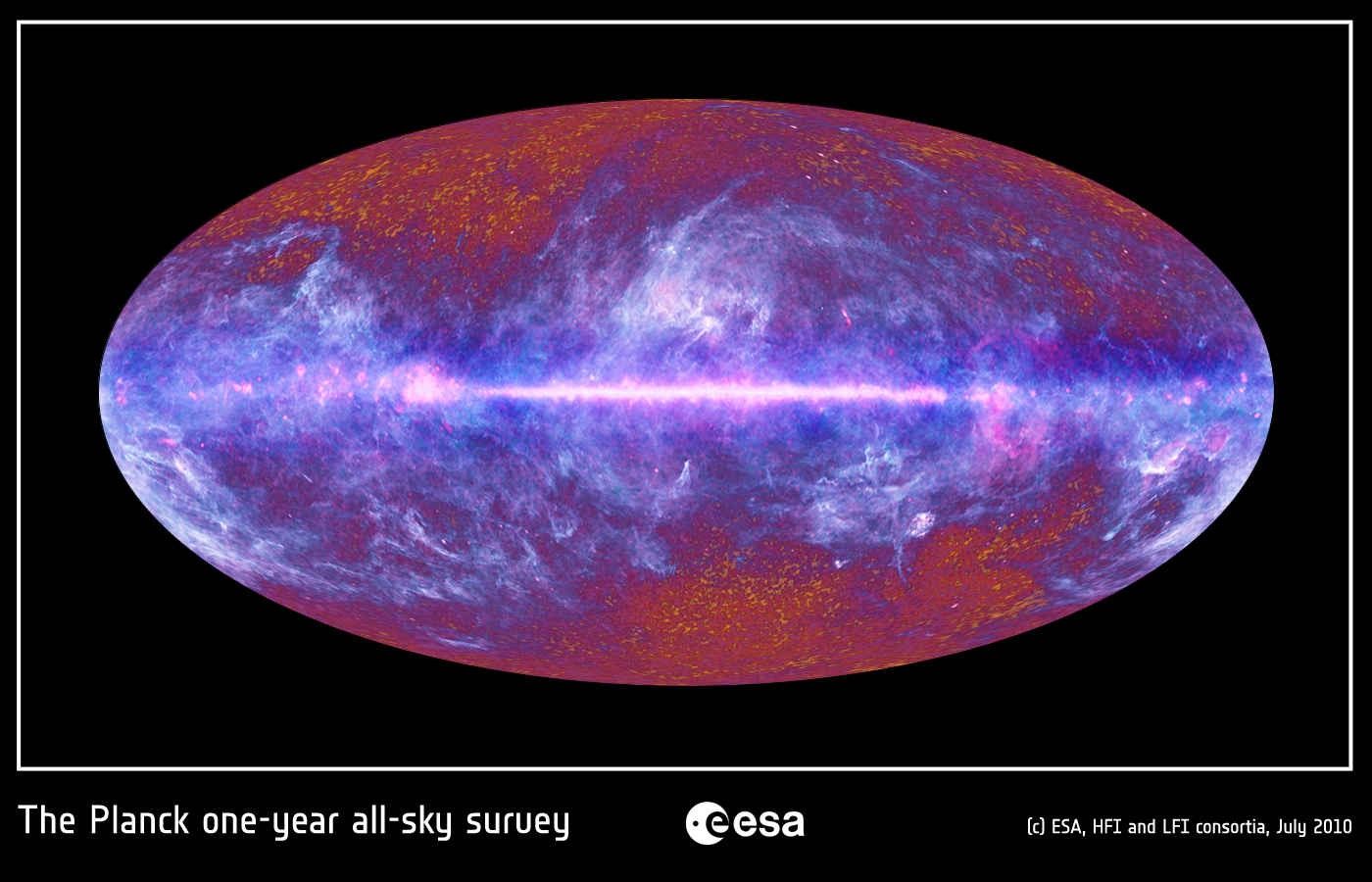
Of course, you should click on that picture to get the full, high-resolution version, because these features are spectacular.
For example, here's what some large-scale structure looks like towards the galactic center.
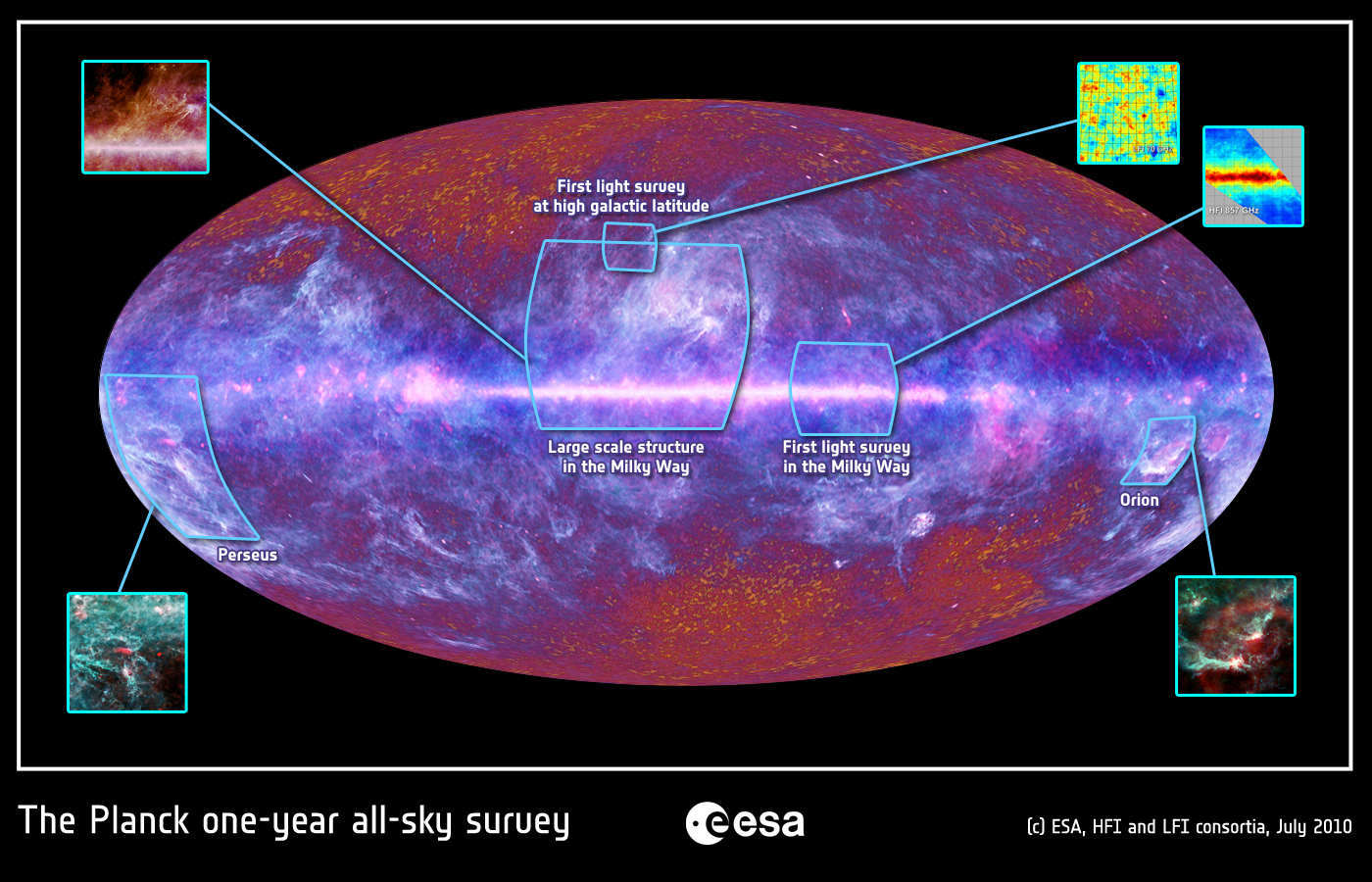
The European Space Agency has been good enough to put together a video (available at this link) of Planck and its first results, and also of showing the same image as above annotated with some of the more interesting things that Planck has seen.
There's little doubt that Planck will have lots to teach us about the Universe to much better accuracies than WMAP was ever capable of. Will there be any surprises or contradictions? We'll know for sure in 2012... until then, everything looks like it's right on schedule in perfect working order!
i like this site
Ethan,
What I would like to know is how large the area is that the sample is being drawn from. Is the WMAP and COBE a complete 360 degree view of what we can observe? Or is it a smaller sample of our total perspective.
but if we have to wait until 2012, the mayan prophecy will destroy the earth before we get to see the results!!11!!111!
p.s. seriously. wow. planck has some really nice resolution! i am curious about the polarization too!
agree with piyush and rob: wow.
"But there are plenty of other questions that WMAP and COBE haven't answered."
Of course, 2012 is not too long to wait for these answers; it's almost yesterday. But what I'd like to know for the 3 unanswered questions that you raise is: what do various theories predict? e.g. Do big bang theory, steady state theory, general relativity or any other theory predict polarized microwave background and what's the reasoning or physical principle involved?
Sounds like an exciting bunch of experimental results await us with Planck. Also is Planck one of these experiments that will continue to give us results for years and decades to come?
Thanks.
@Thomas: As far as I know, one can't say in general what the Big Bang Theory predicts for the polarization - that depends on the specific model for inflation one uses. So measuring the polarization should help differentiate between different models for inflation and/or other models like Steinhardt's "ekpyrotic universe". In the SS model by Hoyle et al., on the other hand, the CMBR is emitted by "iron whiskers" - I don't see any reason why one should expect *any* polarization in that model, since the orientations of these whiskers should be random.
Its my understanding that once the universe had gone from opaque to transparent, photons had been increasing while at the same time losing energy. What accounts for this loss of energy. where did it go? If its a result of the expansion, does that mean the photons energy gets imparted to the expansion itself thus increasing the rate of expansion while making the photon less energetic? I'm confused as to whats happening here.
@crd: There are two ways to see this: First, you can take the viewpoint of classical Newtonian gravity. There one would say that the "kinetic" energy of the photons decreases, whereas their gravitational potential energy increases (due to the expansion); the total energy is constant. Second, you can take the viewpoint of General Relativity. And there it's even simpler: total energy does not need to be conserved there, and hence the energy of the photons does not go anywhere - it simply vanishes.
@Bjoern
I thought that the law of conservation of enegery disallowed energy to simply vanish. However i do recall that Hawkings rebuttle to his statement that blackholes lose information and it was along these lines: Basically (theoritically) anything that can happen in our universe, can and will happen in a parallel universe. basically that in this dimension blackholes are in fact losing information, but else where there in a nother dimension is an almost idententical universe where everything is exaclty the same except the black hole that lost info in our universe is no losing that info in another dimension, therefor the info is still being preserved just in another location in spacetime. (At least thats how i understood it)
Regarding classical newtonian gravity: Is that an underlying part of CNG. The fact that when wavelength of a particle decreases, its gravitational potential energy increases?
I also heard a theory that implies gravity can travel thru branes. One theoretical astrophysist claims that the reason that gravity appears relativly weaker than one would expect on say an object as massive as the earth is b/c some of the gravity is being diluted as it passes thru branes. Perhaps light was/is somehow affected in a similar way. doubtful but i have no other ideas on the matter and would appreciate any input. Thanks.
@crd:
In "classical" physics, yes. But this law simply does not hold absolutely in General Relativity - essentially because it is not even possible to even *define* the total energy of the universe in a sensible, unique way. But this has nothing to do with loss of information in black holes.
It's more the other way round: if the gravitational potential energy increases (which means that the particle "climbs out" of a potential "well", i. e. travels away from a source of gravity), the kinetic energy decreases. And that implies that the momentum decreases, which in turn implies that the wavelength increases (not decreases, as you said).
These are *very* speculative ideas, with no supporting evidence so far. Could be right, but could also be wrong (and I'd guess it is wrong).
Thanks bjoern. Your the man. Where did u obtain ur education? What do u do for work? U seem very informed on several different aspects of science and was just curious.
@crd2: Thanks for the compliments! I got my PhD (theoretical particle physics) at the university of Heidelberg, Germany.
Sehr gut Herr Bjoern.
I just wanted to touch on my initial question @ 7. I was going through some old archives from The Silicon Valley Astronomy Lectures, and I found one from Oct. 4, 2006 given by Dr. Alex Filippenko. Well at the end of his lecture someone asked the exact question I did regarding red-shifted photons and the apparent "disappearing" energy.
Dr. Filippenko states that the energy is not lost at all, but the energy reduction is due to the fact that the photon is fighting its way through expanding space. Because the photon is doing working against the expanding universe the photon loses energy. He also states that the photons are literally slowing down the expansion of the universe and that without the presence of photons that the expansion would be happening at an even faster rate.
So I was on the right track only it slows the expansion rate instead of speeding it up which totally makes sense.
@crd2:
Well, that's essentially the Newtonian view I mentioned above, only stated in other words.
That's right, indeed.
I went to my college's library (which has a very limited selection) searching for books on the cosmos that are at the beginner level. I found a book published in 1977 written by Isaac Asimov titled The Collapsing Universe. I also picked up Cosmos by Carl Sagan. I was curious to know if any of you have any suggestions of authors who write for the novice. I'd especially like to hear Ethan's suggestions for books that really moved him, and helped point him in the direction of his current career path.
@crd2: Well, the book which made *me* study physics was this one (well, the German version of it):
http://www.amazon.com/Creation-Matter-Universe-Beginning-End/dp/0465014…
Many people also like Stephen Hawking's books (I don't) like "The universe in a nutshell" or "A short history of time". And I've also often heard that Weinberg's "The first three minutes" is an excellent read (but I haven't read it myself so far).
I did see The First Three Minutes in the library. Once I'm done digesting these 2 books I will check that one out next.
The fact that The Collapsing Universe was published in 1977, along with the title of the book itself, made me a bit hesitant to check it out, but I quickly realized a very large percentage of the content will still be current. And I figure that when I begin to learn the more recent theories that differ from the late 70's I will have a better knowledge base with which to grasp the new concepts. I'm still in the 1st few chapters of the book and he's going over atoms and how they form molecules. Subatomic level is as good a place to start as anywhere I suppose, but I will say it lacks the intrigue and grandeur that comes with the interactions of heavenly bodies. Still fascinating.
How this planck satellite has travelled so long to take a picture of universe? how come its possible,
Este ruido de fundo não poderia ser resquÃcios de descargas eletromagnéticas do espaço extra universo, como diz o blog:
www.olhandoouniverso.blogspot.com
I remember that earlier cosmic background radiation measurements (COBE?) showed that our galaxy had a relative velocity compared to the cosmic background. The images above do not appear to show any relative velocity. Is this corrected for, or is the red-shift too small to be visible in these pictures?