

"I do not feel obliged to believe that the same God who has endowed us with sense, reason, and intellect has intended us to forgo their use." -Galileo Galilei
Geez, Ethan, why don't you take on a bigger question?
This question of "fundamental things" has a special meaning to scientists and natural philosophers, going all the way back to Thales of Miletus, 2600 years ago, who began asking about the arche (αρχή), which is the "element" or "prime cause" of existing things.
Of course, the scientific enterprise was just beginning, so you can't fault Thales too much for coming up with "water". But I totally credit him with this great idea, that's governed all of scientific progress ever since:

This is the standard model. (Click above for a huge, poster-size image.) We have found a few different types of particles in the Universe with different masses, charges (both electrical and color), and spins (i.e., intrinsic angular momentum). As far as we know, these particles are "fundamental" in the sense that they cannot be broken down any further.
But they do more than exist. These particles also interact, which (in our language) means they exert forces on each other, and they sometimes also react in various ways, turning some fundamental particles into others. Three of the fundamental forces work by exchanging particles,
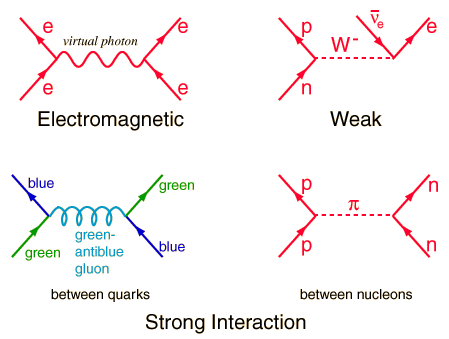
while gravity, lacking such a successful description of its force, works by mass (and other forms of energy) deforming spacetime.

So in a nutshell, that's how everything we know works. These indivisible components of the natural world, with just a few fundamental properties (like mass, charge, and energy) and laws under which they interact, make up everything we know of in the Universe.
There are also secondary quantities that, while we don't think of them as fundamental, play important roles in figuring out physical phenomena. I'm talking about quantities like Temperature. Heat, a form of energy, is what we think of as a fundamental quantity, but temperature is often more useful to talk about as a measurable quantity. For example, there are a number of people who get upset about the Sun's Corona because of its temperature.

"The Sun's Corona is at a higher temperature than the surface of the Sun. OH NO!" But the Sun's Corona is incredibly diffuse, and would do a far worse job of, say, cooking your pizza, than the Sun's surface would. Why? The Corona has far less heat and energy than the Sun's surface. Looking at fundamental quantities gives us an interesting perspective here. While there's an interesting question of "how" to be answered concerning the Corona, its high temperatures don't represent a fundamental problem with the way we think about the Universe.
In other words, we don't go home at night worried that our understanding of the Universe will never be complete because of the temperature of the Sun's Corona.

But gravity is a problem, in that sense. We don't know what causes it at a fundamental level. There are two major -- seemingly unrelated -- problems with it.
The first one is that general relativity is so mind-bogglingly difficult to work with. If I give you a flat, empty Universe, Einstein's theory of gravity tells me what any particle in that Universe will do. Namely, remain in motion, unchanged by anything around it.
BOR-ING! What if we put one point mass in that Universe?

Well, now things are hard. If you've just got a mass, you've got this spacetime. If your mass is also charged, you've got this one. Massive and spinning? Try here. And massive, spinning, and charged? That's this one.
You want to put a second mass in the Universe? Good luck with that analytically unsolvable problem. Our Universe, by the way, has about 1090 particles in it, so... well, in any case, that's the first problem with gravity.
What's the second?

We don't even know what causes gravity, at a fundamental level. Is there such a thing as a graviton? No one's sure. (Well, some people are sure, but those people aren't necessarily right.) Some people hope for a theory of quantum gravity, most of whom pin their hopes on string theory.
These ideas are not without their problems, which I won't go into here in detail. But there is a new idea out there this year, courtesy of Erik Verlinde.
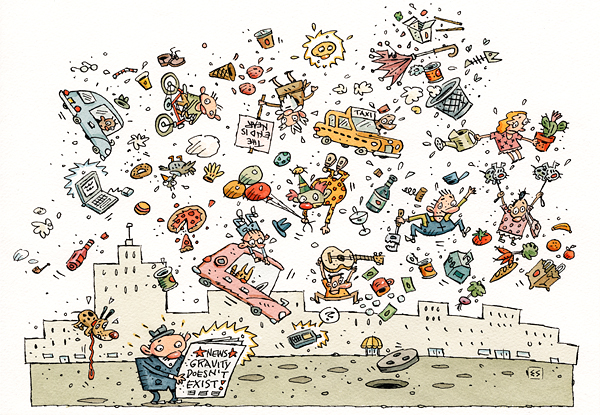
The basic idea is that gravity is just a consequence of thermodynamics. (For an explanation of how one could visualize this, go here.)
It's been getting a lot of press and a lot of people have been taking it up. I read the original paper and some follow-ups, and here's my take. I want to state that there's nothing that makes it inherently, obviously wrong. But there's a very important assumption that one needs to make in order to take this idea seriously, that may not be based in reality.

First, there's this idea that people throw around very frequently, known as duality. Here's a definition from wikipedia:
If two theories are related by a duality transformation, it means that the first theory can be transformed in some way so that it ends up looking just like the second theory. The two theories are then said to be dual to one another under that kind of transformation. Put differently, the two theories are mathematically different descriptions of the same phenomena.
Here's the deal, though. You can't just change your variables, say "I'm the dual of gravity," and be done with it. You need to ask yourself, "are my dual variables still physical descriptors of the same phenomenon?"
There's an old example from general relativity, back in our "Universe with one mass" model.
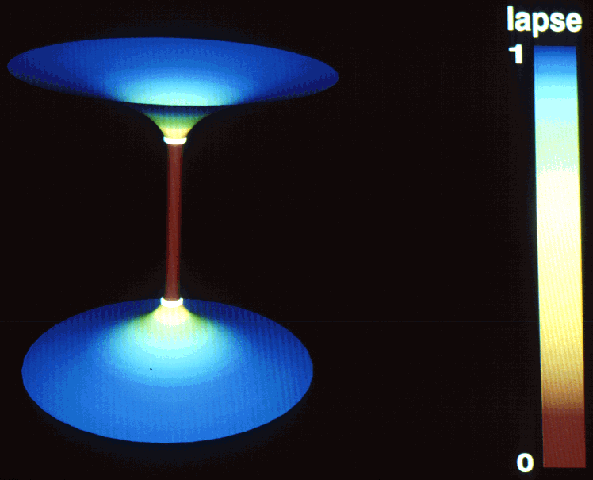
If I stand a distance r away from the black hole (of Schwarzschild radius R), I can describe any point in this Universe using the parameter r/R.
But dual to that is that at any point inside the Schwarzschild radius, which can be described by R/r. There's a huge problem with that, though.
We have no information about what goes on inside of that black hole, and whether our descriptions are accurate at all. The math looks the same, but the physics may be very, very different. In other words, what happens outside of the black hole is physically meaningful, and describes fundamental forces. The dual transformation, with the flipped variables? Not necessarily.
Verlinde's idea hinges on his assumption of the duality between gravity and thermodynamics (or entropy) being a physically valid one.
And if he's right, this could lead to some potentially interesting avenues of inquiry. But there's a huge difference between two things being mathematically equivalent and being physically equivalent, and I am not yet convinced of the latter. Especially because I don't think of entropy as being all that fundamental. If I take a physical system, I can measure its entropy, but I can measure its temperature, too. But if I give you the energy, positions, and momenta of every particle in there, you can give me the entropy. If you give me the entropy... the reverse isn't true.
But I've got this old-fashioned picture of how the Universe works in my head. In this picture, particles are the most fundamental things, and something's got to cause the forces between them. Are they other particles? Is it a curving of spacetime? Or is it something else? At this point, all of the ideas out there are speculative and purely mathematical, because nature is slow to give her clues away. So you'll hear more about these ideas from the news media and from scientists, because we just don't know yet.
So there is this new idea out there, and while it isn't necessarily crazy, it isn't necessarily right or physically meaningful either. Hope this helps give you a little perspective!
Especially because I don't think of entropy as being all that fundamental.
It's practical for physicists to believe that -- because entropy is very, very hard. But how can the direction of time be "not fundamental"?
You say, "If I take a physical system, I can measure its entropy, but I can measure its temperature, too. But if I give you the energy, positions, and momenta of every particle in there, you can give me the entropy".
But you can't give me those measures for any useful system -- it's not possible. Your information content to even give me a close approximation for a protein would be enormous, ignoring issues of velocity/momenta uncertainty limits.
But you can calculate the distribution of position, velocity and momenta to a high degree of accuracy -- and that is the entropy. For anything above the size of a few atoms -- all you have is distributions, which is the entropy for a model.
In terms of measurements, entropy is more "real" than your abstractions of position and momentum.
This is where physics has been driving itself crazy for more than a century -- physicists just don't like thermodynamics except as an "approximation". Everyone hates to think that the approximation is actually the "real" thing. Boltzmann killed himself over this, if I've got the story straight.
But for QM, the approximation did turn out to be the real thing. Maybe that principle applies more generally? That what's fundamental is the distribution, the ways one can count objects and not the objects themselves?
The phrase "entropy isn't fundamental" is hanging me up, since entropy at base is as purely mathematical as anything in physics can be. I suppose that may account in part for the attraction of a "thermodynamic centered" Theory of Everything, but that's another story for another day.
Some scientists claim that hydrogen, because it is so plentiful, is the basic building block of the universe. I dispute that. I say there is more stupidity than hydrogen, and that is the basic building block of the universe.
--Frank Zappa (1940-1993)
Exactly right! Entropy is after all just a measure of the availibility of energy levels, not a full description of the system giving those levels as you note.
@ frog:
That is not the question, since spacetime is emergent and then time is but another coordinate (say). The question is why one direction is singled out.
That can well happen locally in the inflationary universe, so that there are several "time arrows". Or in other words, it is the expansion of the (local) universe that sets the arrow and makes it possible for entropy to grow.
So it is very much not fundamental in any recognizable sense of the word.
Huh? Entropy is statistically given by S = k*ln (Ω), Ω = number of available microstates. [ "Statistical Physics", Mandl (1971), pp 40-42.]
There is a long way from your distributions (and why those; momenta and velocity is the same take or give a mass factor as long as mass is constant) to the number of microstates!
Black Holes are full of chocolaty goodness...
In my opinion as a system's theorist (as opposed to any sort of physicist 8-) is that the idea of a point singularity existing inside a black hole violates its own internal consistency. It is my opinion that black holes are likely more-or-less solid. This is caused by gravity induced time dilation.
Consider:
As the exhausted star collapses on itself because the radiation pressure stops pushing it outward, its density increases inversely to its volume. As density rises, the "gravity per unit volume" rises as well.
As gravity increases, time slows.
Once the gravity reaches the point where light can no longer escape, time slows to an effective infinity.
Once time is that slow, there is literally no time passing, so the collapse cannot proceed. That is, it "continues over time" but the interval of any point of external observation has increased to infinity. This means that from _anywhere_ out here, the singularity is somewhere in the unreachable future.
As mass continues to fall into the hole, the process continues. The hole grows to encompass larger and larger apparent volumes because, the mass is frozen at the event horizon having reached no-time equilibrium. The added mass increases the overall mass and causes the horizon to expand outward incrementally.
Because the entire mass profile is frozen in zero-time, the entire information energy set is still distinct.
In this condition the ultimate form of frame-dragging and mass interaction becomes likely. That is, since time is now zero due to gravity, any mass interactions with the contained mass become "mirror smooth", such as possible entanglements can only exist with external entities for Planck time or less.
Now since the mass is still right there at the surface, it can effectively reflect some energy if that energy is energetic enough to "bounce" but not massive enough to cause the boundary to expand enough to capture it.
These bounces would be happening at "near zero time", so an observer would see any such energy returned as a grossly attenuated event. Consider the flash of a supernova, it would rush in and break on the surface. Most of it would be absorbed, some would bounce at the surface, and some would bounce off of that bouncing energy (returning some of that energy to the surface etc ad infinitum). The fast wave in would become a slow continuous emission.
Accretion disks would tend to form because of frame dragging. This in turn would tend to spiral the energy inward. This in turn would make the regions perpendicular to the accretion disks "most sparse" of incoming energy. A vortex of sorts forms, where "bounce energy" can most easily escape as a jet.
Perhaps early in things, pre-inflation, "pre time" if you like, you could form a true point singularity, I don't know about that, but after that, once time exists its all eggshell and no egg.
The same model then explains the acceleration of the universe without "dark energy". With less gravity out on the edges, time runs faster. This looks like acceleration as the penetration of light places the origin objects "further and faster" as our time speeds up less than theirs as we both move further from the center of mass of the universe.
This simple model makes more sense than anything else I have been able to absorb.
Yea, I don't have the math to express it, but as a _system_ its super simple and workable.
The final conclusion of the system is, however, is slightly different than the big bang. That is, we all have heard that the big bang isn't an explosion _in_ space; it's an explosion _of_ space.
In fact, by this view, the big bang is most correctly an explosion _of_ _time_. The follow-on definitions of space only make sense in terms of that time, but then the precursor conditions and the "what's in the hole" questions become a unity operation. etc.
But maybe I am crazy.
Excellent post, and one I'll need to re-read a few times before I can grok much of it.
That said, perhaps the remaining questions about gravity are best answered by Intelligent Falling. ;D
The images going through my head after reading this blog are a bit complicated for words, but I will try to describe them using analogies.
Considering black holes, there are two ways of looking at them. In one way, they could be seen as portions of the universe that go to the base "time zero," the time point that the big bang occurred, and will all eventually grow in size until the universe is once again all within that point in time. However, in another way of looking at them, if we live in what could be termed a "membranous universe," where galaxies and most observed formations occur along lines (or threads) within the boundaries of the universe, the black holes could be akin to diverticuli forming microuniverse pouches along the colon of the greater universe. The matter entering the black hole returns to its chaotic energy state, looking at matter as simply a form of "ordered" energy, and energy within the black hole could be changing from a chaotic state to an ordered state and forming the building blocks for another "universe" within the "pouch," if nothing more than the elements of space dust.
As for the big bang itself, is it the result of a massive chaotic energy to ordered energy/matter transmutation, or the result of a thought of cognizant energy? God? Or "I think, therefore I explode?" And carrying the earlier analogy of a membranous universe further, if the universe were "alive," and some of the processes of star and galaxy creation were akin to cellular processes on a massive scale, would we know? And if there were more than one big bang event beyond what we know as the universe, would they press on the boundaries of our "universe," creating symmetrical ovals or circles, or would their formation be warped by other "big bang events," creating angular universes akin to some squared nebula we've observed in our universe, and would cause angular or linear inclusions into our universe if they collided with it?
My degrees are in biology and electronics technology, and I have an avid interest in string theory and astronomy, so my views of the nature of the universe are a bit skewed from the accepted norms. However, if you consider that mathematics is the DNA of the universe, and if you use that thought and look for the similarities between all that is in the universe, you may be surprised at what you find.
Thanks for the opportunity to throw my thoughts out there, for better or for worse.
Ethan, this might sound stupid but how do the elementary particles decohere from a wave to a particle in the first place? Why do fundamental particles exist at all? Is it that energy is buzzing around the universe in pockets and if enough of it spikes at one location it will spontaneously decohere from a wave into a particle? Why doesn't everything just stay a wave? Thanks
re: intelligent falling: one of the original Greek theories of gravity was that everything had a spirit/daemon in it and all the lesser spirits wanted to be close to the earth mother spirit. So the link is funny, but like all the real I.D. stuff, is just a rehashing of pre-rational reasoning. So it's not funny because, having been written, some non-zero number of "those people" will find it, and find it reasonable, and adhere to it.
Thanks Ethan.
I´ll have to reread this next week... it´s fiesta time in the Spanish village were I live, so the head isn´t very clear right now. Giving a whole new set of problems with gravity.
google "menorca" "fiestas" "mercadal" for some pictures and you´ll get the drift.
You seem to have a problem with entropy and gravity being dual that relates to the fact that entropy isn't fundamental (whatever that means). But perhaps then gravity is not fundamental (in the same sense) as entropy. If, as you suggest, particles are the most fundamental things, do we have any evidence (as opposed to hypothesis) for gravitons?
I haven't read the paper yet so I have a question: is the idea that entropy is a "force" in the time dimension (i.e. defines a direction in time) in the same way that gravity defines, locally, a direction in space (i.e. a force pulling in a single direction)?
@5: What you are overlooking is that the rate of passage of time depends on what frame you are in. To an observer looking from the outside at a particle falling into a black hole, yes, the process takes infinite time. To an observer who is himself falling into the black hole, it takes a finite amount of time to reach the Schwarzschild radius.
There are issues with the entropy content of black holes. Specifically, the fact that "black holes have no hair" (i.e., we can know nothing more about a black hole than its mass, charge, and angular momentum) seems to conflict with the principle that entropy should be a nondecreasing function of time in a closed system. What the status of that question is, I don't know as I am not an expert in that area, but I do know that some astrophysicists are worried about that question. There are mathematical issues with the singularity as well, and Einstein himself was aware of this fact.
If Verlinde is right and gravity is entwined with thermodynamics, how come I can't buy a Gravitywave oven? Huh? Huh? Huh? ;)
I just looked up Verlinde at wikipedia:
http://en.wikipedia.org/wiki/Erik_Verlinde
There's not much but get this - he has an identical twin brother! no wonder he's into duality!
In the past few decades, the new field of complexity---that is, the study of emergent properties of systems consisting of many sub-systems-- has gained increased popularity.
Verlinde's and others' interpretation of gravity as an emergent property of systems with mass/energy seems to be within this new scientific paradigm.
This seems to me to be akin to Newton's mechanistic/deterministic view of the behavior of physical systems, superseded by the probabilistic paradigm brought up by quantum mechanics.
I am completely unqualified to attest whether the new ideas are correct (I do not even understand them), but I think it would be really cool if Verlinde is right.
You haven't defined "fundamental." I'm thinking irreducible (not removable) instead. That is, if one began taking apart the universe, which "thing" if subtracted, would cause it to disappear?
CONT> from above: What I'm suggesting is that everything about the universe is fundamental. Anything that can be removed without the universe disappearing is not fundamental. If you removed all the equations written by humans to describe the universe, would the universe vanish? No. If you removed all humans or all life would the universe vanish? I doubt it.
If you perform a dual slit experiment in Verlinde's gravitational field, will you still see an interference pattern?
I think I enjoyed reading the comments on this post almost as much as the post.
bo moore: if I could remove something fundamental as we perceive the Universe today, I think that the removal of Black holes would have the most profound effect,if I'm allowed to consider them fundi but to make the universe vanish?
I would say the artifacts Space/time/gravity.I don't think I could separate these and remove one without removing all three.And if they were removed the remainder would have no funtional abilities and be just as good as vanished.but still not a good enough answer.
Cool thought experiment.
and that would be "functional" abilities,what was I thinking.
@13: Actually I am not overlooking the continued progress of time from the point of view of the particle falling in. [See paragraph starting "Once time is that slow..."]
The black hole will never reach that singularity because by the time enough time has passed "out here" for the zero-time advance from thick-wad-of-matter to singularity, all of "out here" will be gone to entropic nothingness. In so going, the total gravity per unit volume of the black hole will fall off and succeed in peeling the black hole like an onion.
Consider that we are inside gravity well of our primary, but we also _contribute_ to the gravity well of our system. The mass of the black hole is not the determinant of the full gravity it experiences. For instance, the gravitation experience of the super-massive black hole at the center of our galaxy is, in no small part, a function of the presence of the galaxy around it. That is, we keep the ambient gravitational pressure up.
Now mentally relax that pressure at the universal scale. That is, piece by piece pluck out the mass of the universe. This dissolution "raises" the gravity well to a less-gravity state. This would, in turn shrink the effective radius of the event horizon. The black hole would radiate some energy, which would surround the new smaller hole with pressure. But like melting ice, or indeed black body radiation from a closed surface, that energy would dissipate as well. The black hole shrinks some more, and so on.
Whenever any tidbit of the black hole passed outside the zero-time radius, it would basically be transformed into bounce energy.
Either the whole would evaporate in stages, or eventually there wouldn't be enough mass to to maintain zero time.
Once you lose the zero-time density the singularity is aborted because the density can no longer be achieved.
Somewhere in here we get into pulsar land. There is a good chance that the accretion disk matter always adding pro-spin momentum, or the conservation of spin multiplied by the decrease in angular distance, minus the chaotic nature of bounce energy interaction, would leave you with a lot of mass wanting to orbit its collective center a lot faster than it possibly can.
The pressure waves of orbital spin passing through a completely compressed mass with existent internal structure and surrounded by a shell of bounce with a vortex aperture at each poll, that sounds like a pulsar to me.
No matter how you slice it, the point singularity just doesn't work for me.
Essentially, those cone-shaped diagrams? Yea, those cones don't point into exotic space, they point into the future.
This, by the way, makes gravity an expression of time, or more particularly delta-t. Which, is also what you see if you reverse-think radioactive half-life. [e.g. if you think about how half-life doesn't think in terms of atoms, it thinks in terms of piles of attoms, when deciding if any one neutron will be emitted, you will realize that a system where mass, density, and gravity are all really "structural stability over time" with nice little detents for the various forms of things from nuclear composition on up.]
Think of it like this: Pretend there is a fundamental quantity called TOK. Every energy is concentration of TOK. Express every decay known in terms of TOK. Imagine TOK has the same limits to radiation and dissipation as everything else q.v. increases in volume slow radiation because the surface area increases at a smaller exponent than volume etc. Now all energy exchanges can be expressed in TOK and the more TOK you have in a volume the slower the exchange. Exchange can only take place where TOK has left the system, thereby producing a local density curve. There you have (1) gravity, (2) temporal dilation, and (3) time's arrow.
What is TOK? Well Einstein spoke of the Either, the actual material of space-time. TOK would be tension in that material.
So the big bang was an atypical concentration of TOK. It made a huge dimple in a timeless expanse of "essentially no TOK". Like a firecracker going off inside a swimming pool full of gelatin, this created an pocket. We are living in the creation of that pocket. That is after event zero, the universe we know is the massive blowout of TOK trying to dissipate, but limited by the rules of its own flow.
For all we know the ether is a tempest of TOK and like algae in a white-cap, we just cannot see the other waves in the storm.
But anyway. From a systems theory standpoint "time pressure" seems to be the Most Fundamental Thing.
I'm a layperson, so my thoughts can be pretty safely disregarded, but:
- Ya gotcher basic 2nd Law that entropy of a closed system increases over time.
- Each (entropy and time) being defined in terms of the other, why does this mean entropy drives the direction of the arrow of time, not that time drives the direction of increasing entropy, i.e., why (in my admittedly uninformed metaphorical conception) is entropy "more fundamental" than time?
I've kind of wondered the following for a longish time, and it may not make sense, but here goes:
- Space and time being combined in "spacetime," why doesn't the fact that one can only move positive distances in space set the arrow of time? (By "only move positive distances," I mean that whether one travels from Abilene to Biloxi or the reverse, one must travel a positive distance, or to say it another way, one can never travel closer to one's immediately previous position. Thus distance traveled, and the time necessary to do so, inevitably increases.)
re: the suns corona temperature...
boiling water is 212 degrees but steam can reach 1,000 degrees or more...right?
@ #16: re systems and sub-systems... RA, do you have a Web site or reference for the new field of complexity you refer to?
Just a question put out by a clueless, seriously uneducated little hack that just happens to find some personal joy in astronomy and physics. This is one of those what ifs.
What if, we built a model of the Universe that contained only one particle? Assuming all the forces are there as in the Universe we all know and love, the Strong Nuclear Force, the Weak Nuclear Force, the Electromagnetic Force, and even the force of Gravity, such as we understand it.
But in this Universe of one lonely particle, would the force of Gravity be a force at all without the presence of at least one other particle? I almost hate to say this, but we might call it the two to tango theory. Is Gravity not so much a force but a fundamental state of the Universe that only manifests with the presence of Matter? Something that cannot happen unless the right circumstances occur, much the same way a light bulb wonât glow unless we complete a circuit.
I can't think of any way to test the idea because I can't think of a way to measure the gravitational pull of a particle in isolation, seems to me it takes another particle to do that.
I'm just throwing this out as an idea and perhaps, in fact most likely, someone else is way ahead of me and could perhaps enlighten me a little.
This post has been a wonderful thought exercise. Ethan, you make me want to go back to school.
I'm wondering about the popular interpretation of the uncertainty principle, the one that states that without an observer, nothing exists: this presents a conundrum; if an observer is fundamental to the existence of the universe, where was the universe before there were any observers? This requires coming up with an observer from time zero - this is a daunting and unprovable requirement. So if one removed the UP, would the universe vanish?
@27: I think you are missing one point, an "observer" is required, but not necessarily a sentient one. Particles observe each other all the time.
It's not that nothing exists without observation, the truth is that most of the things that exist only need to be so well defined and no more so.
In macro terms, the hardest thing for someone with OCD to learn is that many, if not most, jobs worth doing are only worth doing about half way. Back on the quantum scale, the fact that photons don't know whether they are a particle or a wave moment-to-moment is the _point_ no the _problem_.
_My_ problem with uncertainty is the degree to which it makes smart people dumb. (not you bo moore). When working on problems like teleportation and replication, the science guys get all wrapped up in Heisenburg's blanket.
Who cares if all my electrons are exactly the same after transport. They aren't exactly the same moment by moment anyway.
If you ever opened one of Star trek's Heisenburg Compensators you would just find a note that read "who cares..."
We can find and measure atoms and molecules with plenty of precision an a true minimum of displacement. When making or transporting anything I suspect random distributions of spin, for the atoms and just "poring in enough electrons at random" would do nicely.
Ethan your Verlinde links are good links to links so we can understand Verlinde a little better than from just the NYT article. Verlinde's ideas seem sound and in a very helpful direction.
Your concern that Verlinde's assumption and hence model might not be "physically meaningful" are valid. Yet all models are not Nature. Even pictures of particles are models; just as pictures of waves are models. No one of course has photographed a photon or a neutrino yet the particle and wave models are still quite useful.
What Verlinde seems to have done (if you will) is to further materialize the idea of information (i.e. entorpy) in such a way that we can see how forces emerge from information or disorder. As well he has furthered the idea of emergence. Verlinde's ideas seem to helpfully break some more of our classical sense biases (geometric as well as reductionist).
Finally, just because no one has discovered the graviton, does not mean that Verlinde's ideas apply more to gravity than to the other 3 "fundamental" forces. It just means that perhaps physicists are more willing to test his ideas upon gravity; since so to speak there is nothing better out there and hence nothing to lose.
Now back to Ethan's "physically meaningful" comment. A physical theory of gravity (for example) must give some physical insight or prediction. I think Verlinde's ideas already give some physical insight. The key as with string theory will be is there some significant wow post or pre-diction.
Thanks for this post Ethan.
29) "Who cares if all my electrons are exactly the same after transport. They aren't exactly the same moment by moment anyway."
Its one thing to have things flowing naturally and changing over time. Quite another to spontaneously re-assemble trillions of particles that compose a living form. Sure, its ok if your electrons aren't exactly the same after arriving at ur destination, so long as u don't need to be alive once you arrive.
@26 I totally understand your "two-to-tango" reference in regards to one particle alone. However the fact that a second particle in not present in your example does not remove the potential for attraction if given the opportunity. The gravitational well doesn't cease to be just b/c nothing is around to feel the effects.
@27 To say that the early universe did not exist because no one was around to observe it.....come on, that's just a ridiculous remark. So by that same logic, if you punch me while I'm in a coma and I couldn't observe it does that mean I didn't get punched? Its the same thing as asking "If a tree falls in the forest...." of course it makse a sound. I've always had a hard time accepting that line of thought. Its comes across as too dismissive for me.
Heisenberg is out for a drive when he's stopped by a traffic cop.
The cop says, "Do you know how fast you were going?"
Heisenberg says, "No, but I know where I am."
Couldn't help myself. ;)
@31: Einstein is out for a drive when he's stopped by a traffic cop.
The cop says, "Do you know how fast you were going?"
Einstein says, "Well, *I* was stationary, but do you know how fast YOU were going?"
Badumbum.
@Ethan, I have to say, I'm surprised you didn't come down on this new hypothesis like a ton of bricks. It really struck me as theory running way, way, WAY out in front of what's possible to experimentally verify (in that it's building on many other currently unverifiable hypotheses). It doesn't help that it's also always seemed to me that the law of entropy gets applied far more places than I'd think it's applicable; or that the second law also implies that entropy is not only higher in the future, but in the past (i.e. that "now" is a local entropy minimum) which we don't believe to be the case; or that the only thing that strikes me as irreversible about gravity is falling into a black hole (and even then, I forget how Hawking radiation affects black hole entropy...); or...wouldn't the rate of entropy increase of the universe be changing over the course of its history (as total energy available to do work decreases), and wouldn't that lead to a changing gravitational constant if his hypothesis is correct, and haven't we ruled that out (even when weirdness like dark energy comes into play)?
I'm sure I don't know NEARLY enough to categorically deny this idea, but for all of these reasons it seems kinda crazy to me.
I want to point out that humans, physicists included, impute consciousness as a quality of almost every object we encounter: it's a consequence of language and social dependence. We are born helpless and unfinished. Parents and others create consciousness in children: consciousness is simply the act of responding to other humans. This focus on social interaction causes us to project consciousness onto the universe itself in the guise of gods or other supernatural beings. (UFO's anyone?)
When HUP, or any other scientific idea is let loose on the public, you can bet it will be interpreted animistically and magically - magical thinking is the basic language of the brain. There is a belief among many educated Americans that HUP states that without a human observer, reality does not exist: many have decided that this requirement proves that god exists. I'm relating this as a demonstration that the human brain is not oriented to understanding the underlying workings of the environment, but to manipulating our environment in a way that satisfies rather primitive instincts.
If we someday encounter alien "intelligent" life, I don't think we should expect it to be "conscious" as we define it. A living being might contain a boatload of information and use it to survive without needing to transform it into ideas, via language. I'm saying that consciousness is a survival strategy, not a tool for understanding the universe. We are limited by the nature of our brain, and may not be able to get beyond that unless we redesign the brain.
Particles being "aware" of each other does not imply consciousness, but something even more difficult to understand. How wonderful is that?
@Benhead,
You're correct that it's an extremely speculative idea. The reason I tend to come down hard on most speculative ideas is that they're often stated as fact. Verlinde was very cautious about this, stating that it's a very speculative idea.
Despite the (literally) thousands of papers written about duality, the AdS/CFT correspondence, and dual spaces, we have yet to find a shred of experimental evidence that duality is at all important for our Universe. In fact, for many cases, it's very easy to show that what you get is absurd.
String Theorists often cite that you can get General Relativity out of string theory, and that's simply a lie. You *can* get a 10-dimensional Brans-Dicke theory of gravity out of it, which becomes General Relativity if you remove six dimensions and take the Brans-Dicke parameter to infinity. But you need to do that ad hoc; the theory doesn't do it automatically.
For what it's worth, the idea seems crazy to me, too, but at least it isn't being sold as anything more than a new, crazy idea.
There is alot that can be learned from incorrect theory's. Thats whats beautiful about science. Being wrong isn't rarely a total loss.
@35: I'm glad you feel that way crd2, you were wrong twice in that posting. Allot: to portion out. "A lot": a bunch of stuff. "alot" is not any more a word that "alittle".
"incorrect theories"... apostrophe-s as in "theory's" is possessive and would indicate that the theory owned something that followed, unfortunately there was just a period.
(Sorry, but two pet peeves in one sentence was just too much to pass up there crd2. 8-)
This is ScienceBlogs, not GrammarBlogs. People want to read about scientific laws, not grammar rules.
And if you want to communicate about the scientific laws then learn the language you're speaking. Citing the flaws in someone's grammar should be a welcome criticism since it makes one aware of their failure to communicate properly. Only an intellectually lazy person would not seek to improve their proficiency and correct utilization of the rules of whichever language he or she chooses to communicate with.
When you say that your inattention to the rules of communication does not matter then you are shutting yourself out of the conversation you came here to partake in. It's akin to saying to the audience that you don't care enough about them, or the topic, to make it absolutely clear what you are meaning to say about it to them.
I suggest a different approach:
Let's generalize Einstein's brilliant realization that the path of light defines a straight line. Thus, the reality of space is defined by the means we use to measure it -- and remember the guy who said "To measure is to know".
Therefore, I suggest that we define the universe to be everything that is objectively knowable or perceivable. Which in turn leads to the conclusion that the fundamental constituent of the universe is information. Particles are secondary -- we measure particles by collecting information about them. And information is the single unifying element behind particles, forces, space, time, whatever. Throw in a conservation law for information along with the way information interacts with time, and you get 2nd Thermo.
"And if you want to communicate about the scientific laws then learn the language you're speaking."
So because I make a few spelling and grammar errors we can imply i don't know English, so much so that I need to "learn" how to speak it. That's a fair assumption.
"Citing the flaws in someones grammar should be a welcome criticism since it makes one aware of their failure to communicate properly."
There is a correct time and place for everything. I'm simply making the point that a public forum such as SCIENCEblogs (emphasis on science) may not be the right place for this conversation out of respect for others.
"Only an intellectually lazy person would not seek to improve their proficiency and correct utilization of the rules of whichever language he or she chooses to communicate with."
Judgemental, totally unfounded and insulting all in one sentence. Impressive.
"When you say that your inattention to the rules of communication does not matter then you are shutting yourself out of the conversation you came here to partake in. It's akin to saying to the audience that you don't care enough about them, or the topic, to make it absolutely clear what you are meaning to say about it to them."
Can you please show me where I said "...the rules of communication [do] not matter...." And again you make more generalizations about my character, suggesting that i don't care about the readers or the topic? Its amazing that you can draw so many conclusions with so little information.
I type extremely fast and sometime i miss the space bar and sometimes i haphazardly throw ' in where they don't belong. I'm will make my point again. This is not the correct place to have grammar lessons. If you would like to email me in private regarding this matter please let me know. Its not fair to everyone else. I will no longer comment on this matter unles you want to do so in private.
What's the Most Fundamental (Thing) in the Universe?
Distance...
Think about it, every thing has it or is effected by it.
Distance is a "thing" (Noumenon) Right?
Verlinde's 29 page paper here
http://arxiv.org/PS_cache/arxiv/pdf/1001/1001.0785v1.pdf
is very readable; though I'm just barely following.
Hopefully, its different way of deriving the same Newtonian and GR equations will give much more; as Verlinde suggests "But clearly, we need a better understanding of the theory to turn this in to a prediction."
The first step is to define your Universe. You cannot draw meaningful conclusions until you do. For example, is your universe = Universe = all that is seen and unseen? or is it universe = ours that is one of many? Is your Universe Eternal = timeless, size-less, weightless? or is it a thing = an object in space?
Depending on your definition[s], your observations will thu8s become special case = localized in your space-time environment = not necessarily so outside of that environment.
Me? I see Universe as a painted but invisible canvas that is slowly revealed by conscious experience.
We are all artists.
@28
@Rob White:
Find your writings most interesting.
Came here as a result of a search almost a year after most was written. So doubt you wiil read this, ie if there is no advise when posts are made----function.
What surprises me is that you class yourself as a systems person.
But can't imagine your knowledge of cosmology and astrophysics is typical for a systems person. Are they?
I worked as a systems engineer in in the sixties, and thought it died out then. Apparently not. (clients like JPL, NASA, Vandenberg AFB, PACAF, etc.))
Hey folks :) I'm not an educated fellow but I do enjoy trying to wrap my mind around this stuff. So if I sound ridiculous I apologise, but I figure this is as good away to improve my understanding for a hobby as doing classes. So thanx in advance for letting me pick your noodle!
@28
In regards to your statement about teleportation etc, I was wondering about your idea that not knowing, moment to moment, what state/position they are in, that the atoms/molecules/particles that make up an object don't need to 'be known' in order to reconstitute it accurately.
But if you cannot put the components back in the exact same state/position, are you going to get exactly the same object at the other end? I figure that 'simple' objects, like a metal rod, a ceramic dish, pane of glass could easily be mimicked as they tend to be a completely stable 'solid state' (for lack of a better term) object. But doesn't it become necessary to HAVE all those details copied accurately, if you intend to teleport something as biochemically complex as a brain? Wouldn't the constantly changing nature of that organic system, which for all intents and purposes contains the information that makes us US, need to be accurately replicated, down to the smallest component, its state, position, 'information energy' etc, in order to be 'YOU' at the other end?
The simulated universe has gained a lot of traction these days.
Especially when you look at development in artificial intelligence.
Let's imagine that we develop the capability to create such a simulation... everything that exist within the system would purely be information. So one could argue that information is the most fundamental thing in such a universe, more than strings, quarks or such. The 3 dimensions of space would be nothing more than information describing them.
However, we, as in the ones who create such a simulation exist within a universe bound by time, which would apply to anything we build within our universe. so perhaps time might be something even more fundamental than information.