

"Einstein was wrong when he said, 'God does not play dice.' Consideration of black holes suggests, not only that God does play dice, but that he sometimes confuses us by throwing them where they can't be seen." -Stephen Hawking
Welcome back to Starts With A Bang after a brief vacation! Apparently, I go away for a few days, and the world tries to turn all we know about supermassive black holes on its head!

Think about any galaxy like ours. Tens of thousands of light years across with great spiral arms, they house anywhere upwards of a hundred billion stars. If you take a good look at any large galaxy -- like NGC 1097 shown here -- you'll notice something very exciting about its center.
But you won't necessarily notice it in visible light; take a look at what happens if we look at NGC 1097 in the infrared.
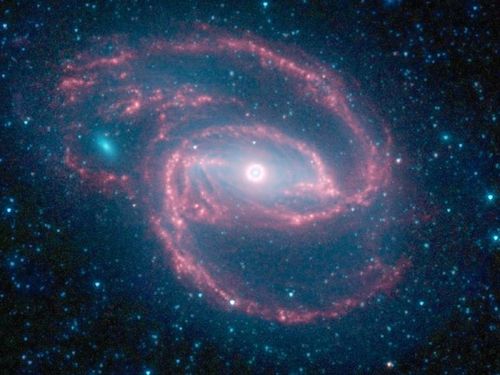
It's much more noticeable that there's something exciting going on at the center. What is it? Why, it's a supermassive black hole! We've got one at the center of our galaxy, of course, that we can actually measure by following the paths of individual stars orbiting around it!
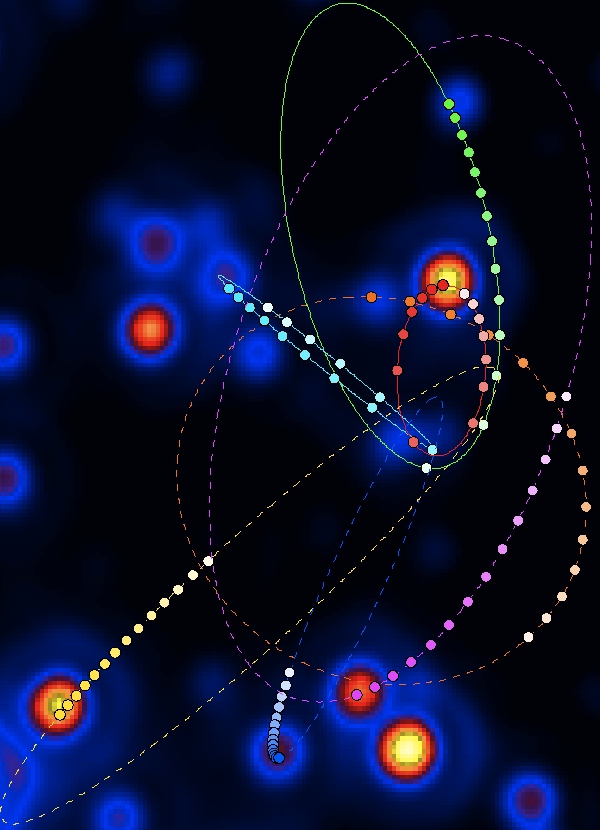
But what about other galaxies? How do we know how massive their central black holes are?
Let's take a look at a spectacular example in the relatively nearby Universe.

This is M87, a giant elliptical galaxy about a million light years in diameter. At the heart of the Virgo cluster, it's the largest galaxy around us for over a hundred million light years.
And so, you'd expect, there should be a giant black hole at the center. It might, you'd suppose, be much bigger than the one at the center of the Milky Way. But how could you tell? Let's remember what black holes do to the matter around them.
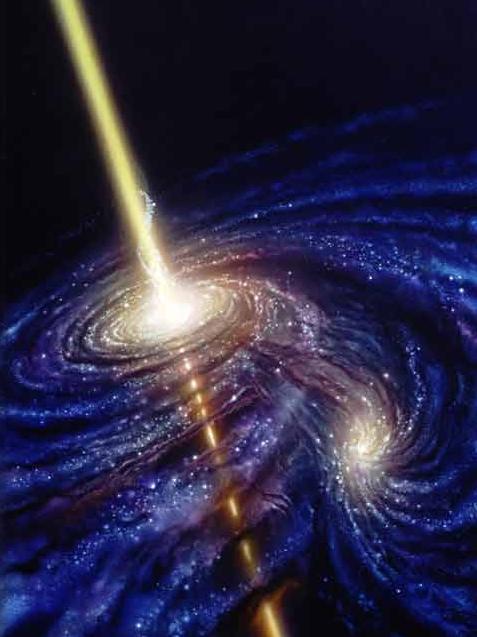
Matter should orbit the black hole, just like the planets orbit our Sun, in the same plane that the black hole rotates. But instead of making a perfectly stable accretion disk, gravity and dynamical friction will pull that matter in towards the center. And some of it will fall right on in, helping to grow the black hole.
But some of it gets shot out, perpendicular to the disk, in a great jet. Additionally, if a large object falls in, or if too much mass accretes in the disk, you can get a large, flaring outburst.
Well, if there's any galaxy that should show these features, it would be the largest one, with the (in theory) largest black hole, right?

Hell yeah it is! Take a look at the jet coming from M87; it's over 5,000 light years long and is moving nearly at the speed of light! It's so powerful that it appears to have knocked the central black hole nearly 100 light years away from the true galactic center in the opposite direction!
But what about those flaring outbursts I mentioned? Are those there? We need to use Chandra, and look in the X-ray to find out.
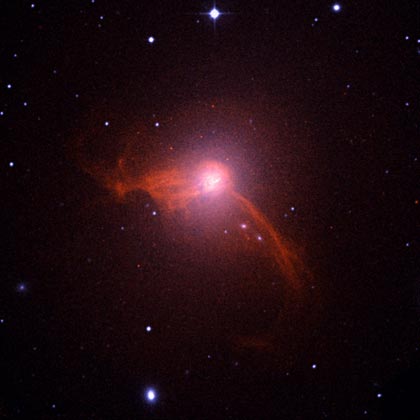
That's right; we see evidence of flares bursting out from the central black hole every 6 million years or so, with the hot gas tracing out those trails. We can also observe the speed that the disk revolves, and that helps us estimate the mass of the black hole, too.
Based on these types of observations, we previously estimated the mass of this black hole to be 6.4 billion times our Sun, but there's a new observation in town.

New measurements of the gas show that it's more likely that the black hole in M87 is 6.6 billion Suns. And this is remarkable to me!
Not the 3% increase over what we previously thought; obviously that's not such a big deal. But the fact that we are making new observations, and our conclusions, our results, what we understand these objects to be are hardly changing at all! In other words, we really think we're getting it right.
But that doesn't mean there aren't surprises out there.

Typically, the biggest galaxies (like M87) have the biggest black holes; a galaxy like ours is only 0.2% the mass of a monster like M87. And unsurprisingly, our black hole is only around 3 million solar masses, rather than the 6 or 7 billion that M87 has.
But up above is the relatively close-by galaxy, Heinze 2-10. A small, irregular galaxy with no well-defined core or bulge, it's often compared to the Large Magellanic Cloud (LMC), one of the small satellite galaxies slowly being dragged into our Milky Way.
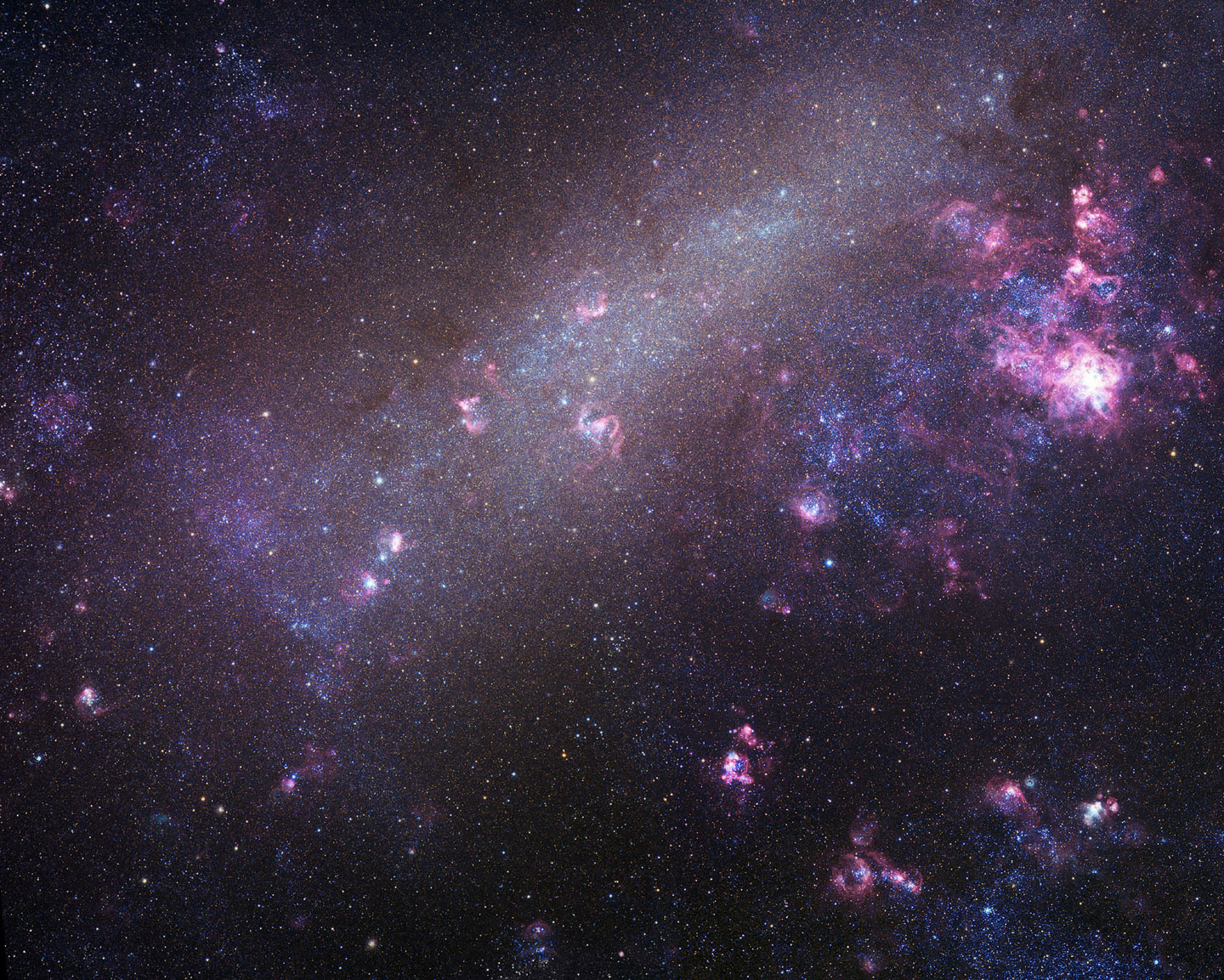
The LMC doesn't have a large jet, a central bulge, a fast-moving disk, or flares of gas coming from it at all. In fact, we've just kind of always assumed that you needed a large central bulge where big stars live, die, and merge together to make and grow a supermassive black hole.
But Amy Reines and her team took a closer look at Heinze 2-10, and what did she find?

Not only is there a black hole there, it's much bigger than we'd have expected: about one million Suns! What does this mean? Does it mean, as some speculate, that black holes form early on, and that galaxies often form around them?

Very, very unlikely. That would contradict what we know about structure formation. What's the much more likely explanation?

With billions of galaxies in the Universe, and billions of years for each of them to evolve, there is a great diversity among them. It's not like we found a billion solar mass black hole there; it's that we found a black hole a third the size of ours in a galaxy about a tenth the size of ours.
We're learning more about what's possible, and that's important. We're learning that you don't need a current central bulge to form a massive black hole, but that doesn't mean there wasn't one in the distant past. The Universe, remember, is a violent place.
But what does this mean for the largest black holes?

Overall, you'd still want to look to the largest galaxies for them. And this guy, IC 1101, is the largest galaxy ever discovered in the Universe, at more than 100 times the volume of supermassive M87!

With over 100 trillion stars, and an estimated mass a quadrillion times our Sun, that's the horse I'm betting on for the largest black hole in the Universe. We haven't found it yet, mostly because it's over a billion light years away, but with a black hole speculated to be tens of billions of times more massive than our Sun, that's the best scientific guess we've got!
Fascinating as always. One thought from it though - if we have such massive blackholes moving around; I've read that Hawking radiation is quicker for small black holes than larger - a (albeit wikipedia) check says 2 x 10^67 years for just a black hole of one solar mass to evaporate. So with such massive black holes, it'll take so long for them to evaporate, that could gravity eventually pull all these black holes together, which is counter to an ever expanding, cold, heat death universe? Or would the expansion be quicker than gravity can act on these bodies?
From the 5000 light year long plume traveling at ~c, the mass of the black hole, and the 100 light year displacement, can we compute anything interesting about the mass of the plume ejected?
Probably the latter. But having all the black holes in the universe collapse together doesn't counter the idea of the heat-death of the universe ... black holes have an extremely high entropy. Having all matter inside a single black hole would probably give the maximum entropy possible for the universe.
"It's so powerful that it appears to have knocked the central black hole nearly 100 light years away from the true galactic center in the opposite direction!"
I'm curious what mechanism would be responsible for moving the black hole? Wouldn't the black hole simply absorb any energy that a jet was exerting on the black hole? I thought the only way to interact with a black hole was through gravity, ie. rotating black holes. Great article, thanks much
Welcome back! Great write up. I've read this same story on Bad Astronomy as well as Universe Today but neither one come close to your explanation. Good stuff. Look forward to the next post.
@4: Great question. I cannot think of any reasonable explanation. How is that jet able to "push" the BH 100 light years away from the galactic center??
@4: I think this is just conservation of momentum, when the black hole 'absorbs' some energy, it also gets a bit of momentum.
Great article, as always!
Just a little question that popped into my mind while reading about that supermassive blackhole...
I understand every massive object sends out gravitational waves as it rotates, and I guess huge blackholes are no exception.
So, could the gravitational waves created by a supermassive blackhole be so powerful that the waves themselves form a moving singularity? I'm guessing that would be like a black hole with no real mass and moving at the speed of light!
Could this theoretically happen? Or does the structure of space-time prevent this somehow?
Saray ÃiftliÄi Genel Müdürü Hüseyin Teber, et fiyatlarının yükselmesi sonucu canlı hayvan ithalatı ve et ithalatının baÅlamasının, besicilik sektöründe belirsizliklere neden olduÄunu, et ithalatının sürmesinin de yerli üreticileri zor durumda bıraktıÄını anlattı
Wait . . . black holes flare from their poles?
This is what I get for not majoring in any science.
How does that work? Similar to the "slingshot effect," perhaps?
You might also ask how black holes can have charge or a magnetic field if gravity is the only way for one to interact with the rest of the universe. This is actually a good question and touches upon what it means to "interact" as opposed to "communicate". Sort of like the other big theory of the day, which similarly distinguishes between "correlations through entanglement" and "communicate".
Great post - and great blog.
There seems to be some discontent about the diameter of IC 1011 - noted at 5-6 million LY, which appears to include orbiting stars and galaxies. Others have suggested the true galactic diameter to be approximately 440,000 LY.
Any comments on which is correct?
This is a very interesting post! I did have a question about the burst that gets emitted perpendicular to the black hole: What is actually getting emitted? I thought light couldn't escape a black hole, how does this work?
@13: Whats getting emitted is light and particles. Nothing can escape the black hole once it crosses the event horizon, however a lot matter passes pretty friggin close without falling in. When it passes that close and doesn't get trapped we get a gravitational slingshot affect which sends particles zooming off at close to the speed of light.
"It's so powerful that it appears to have knocked the central black hole nearly 100 light years away from the true galactic center in the opposite direction!"
How is this possible, for a black hole horizon to not generate an geometrically opposite jet in equilibrium, unless perhaps the input magnitude is polar extreme, is there a definite reason for apparent shift in centrality?
Is this Black Hole not simply feeding, but being force fed more than is possible to consume and would this source also have to be of great density so as to be a somewhat fixed source and wouldn't that be more of an attractive force than the jet being a propulsion force?
The jet can not be the primary mover if it is reliant on the input mass that creates it.The input mass should be more relevant, though a combined effect is even more likely.
"Appears" seems to be the operative word here.
Jets are fascinating category of their own.
Black holes that hav been discovered 2 weeks ago ,, hw much damage can it do the neighbouring planets that are neraly close to them and that to us also ????
Can the radiations reach our Masgnetic field which can lead to any satellite & communication problems !!!!!
BLACK HOLES ARE DANGEROUS!!! I'm not becoming an astronaut, I'll be an artist! Besides, Black holes sucks random parts of space dust that's near it, and makes it space dust, but millions and millions of more pieces!
the pitures are so great
Please! Give me a brake! Black holes have never been directly observed!! those are just manifestations of matter falling onto a compact object "believed" to be a BH. All that BH talking is nothing more than speculation and sensationalism.
Astrophysicist PhD.
Fusion at its grandiose scale
Could a black hole's singularity be so dense that nothing really enters but if contact is made it separates the -/+ atoms as well as creating dark matter? Which, might explain our expanding universe (e.g. if all of the negative atoms showed up like --+-+--+- to infinity). Could this be the reason it would be too dense to actually swallow anything but, instead create the space around us? I would also like to state that if the worldâs largest hadron collider actually gets turned on & does what is supposed to do, it might create a black hole that would not suck us in but would however be too heavy for our space. Then, it would basically just rip us apart by its massive density like an impenetrable piece of matter expanding from within. The reason that the expansion of the black hole doesn't envelope everything is that the space it creates stops it from doing so. For example, if somebody tried to hold up an anvil with a sheet of paper it would most certainly break through the paper. As for this anvil it is infinitely dense so it would continue to swell & create the matter around it. I also think thatâs why when a supernova happens a black hole is created; to help in the creation of new stars as well as the space for those stars.
Additional Details
*I am saying that upon the primal stages of the black hole's birth it grabs the closest objects to them thereby destroying them in the process. Now at some point after this it will cease its gravitational pull on the surrounding objects at this point in time it will then start in the creation of dark matter.
*This is only a theoretical question for open minded individuals.
Through all the bloody politicians, bureaucrats..Never to be found in billion light years
where da fuk did u git dem cluas att??
Those pictures are seriously amazing, I'm not kidding I'm thinking of marrying one of them in particular, you know the one that's the black hole with blue-indigo shining stars and the golden beam of light, the jet, erupting from each side perpendicular to the flat swirl of massive stars, planets and debris.... ahhh.... lovely pictures to go along with awesome information, lots of little facts [actually they're 6.6 billion solar masses but whatever ;)] and even though I just turned 12 I can understand all of it and I'm interested, I could almost copy-paste and hand it in as mine [don't worry I won't im not a plagiarist] ... oh and could you possibly reply to "Napoleon" to watch his language and that only a primal beast lacking many human intelligence functions would refrain from using full sentences in that manner. Really.
Ok so bye ;) love your blog
Thank you so much, for explaining "big stuff" in such a friendly way. It was a Pure delight reading it :)