

"It took less than an hour to make the atoms, a few hundred million years to make the stars and planets, but five billion years to make man!" -George Gamow
Some people are never satisfied. After I wrote last time on the odds for cosmic inflation, I started noticing a flurry of comments on an older post about alternatives to the big bang. So, might as well go back to the basics, and ask what the odds are that the Big Bang is correct! Let's start by taking a look at what's out there in the Universe.
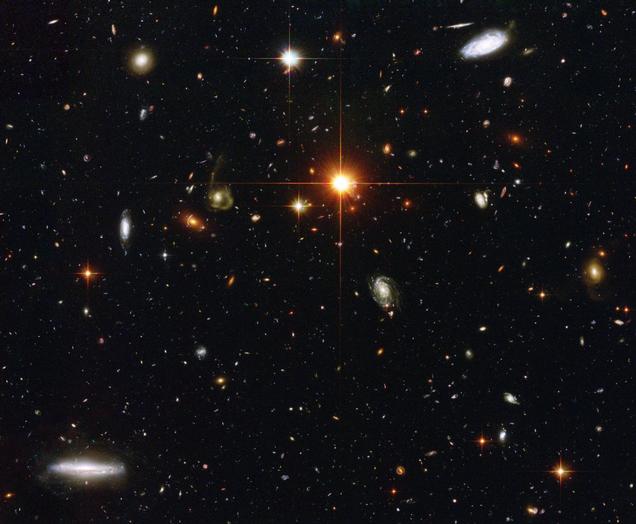
Image credit: Hubble Space Telescope.
Sure, we've got stars surrounding us: hundreds of billions of them in our galaxy alone. But out beyond the stars, as you can easily see with a telescope like Hubble, are a huge number of galaxies strewn about the Universe! We have a number of techniques available to us to measure how far away these galaxies are from us. The simplest one was discovered by Hubble himself: look at individual stars in that galaxy!
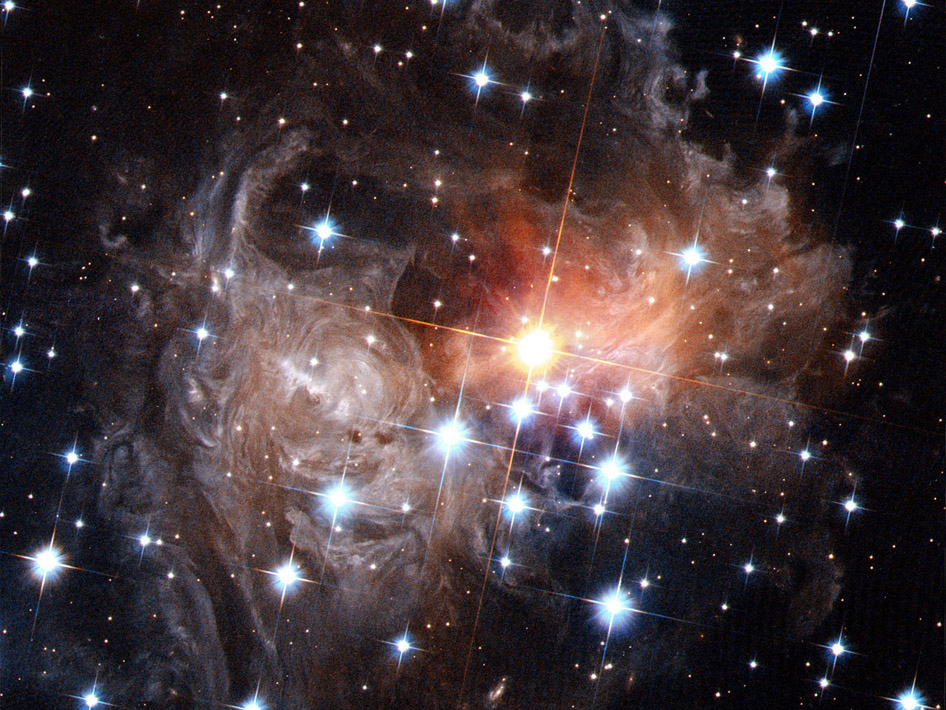
Image credit: NASA, ESA, H. Bond, STSci and Hubble Space Telecsope.
Stars do various well-studied things, from going nova to being variable stars of many types to the ever-impressive supernova, but they do them in very understandable ways! So if you see a star doing something, and you know how intrinsically bright the thing it's doing is, all you need to do is measure its apparent brightness! And just like that, because you understand how light works, you can figure out how far away that object is.
But we can do one better. Thanks to the fact that objects moving towards us have their light shift towards the blue end of the spectrum, while objects moving away from us have their light shift towards the red, we can measure the spectral lines from these galaxies and find whether they're moving towards us or away from us, and how quickly.
What do we find?
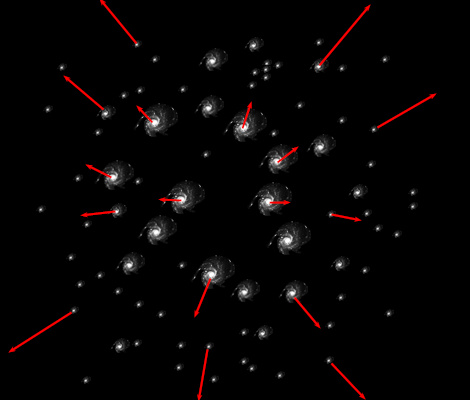
That the farther away a galaxy is from us, the faster it moves away from us! (Or, more accurately, the larger the observed redshift of that galaxy is.) Although Hubble had no way of knowing that it would, this relationship -- Hubble's Law -- is now known to hold for galaxies at distances well over a billion light years in all directions.
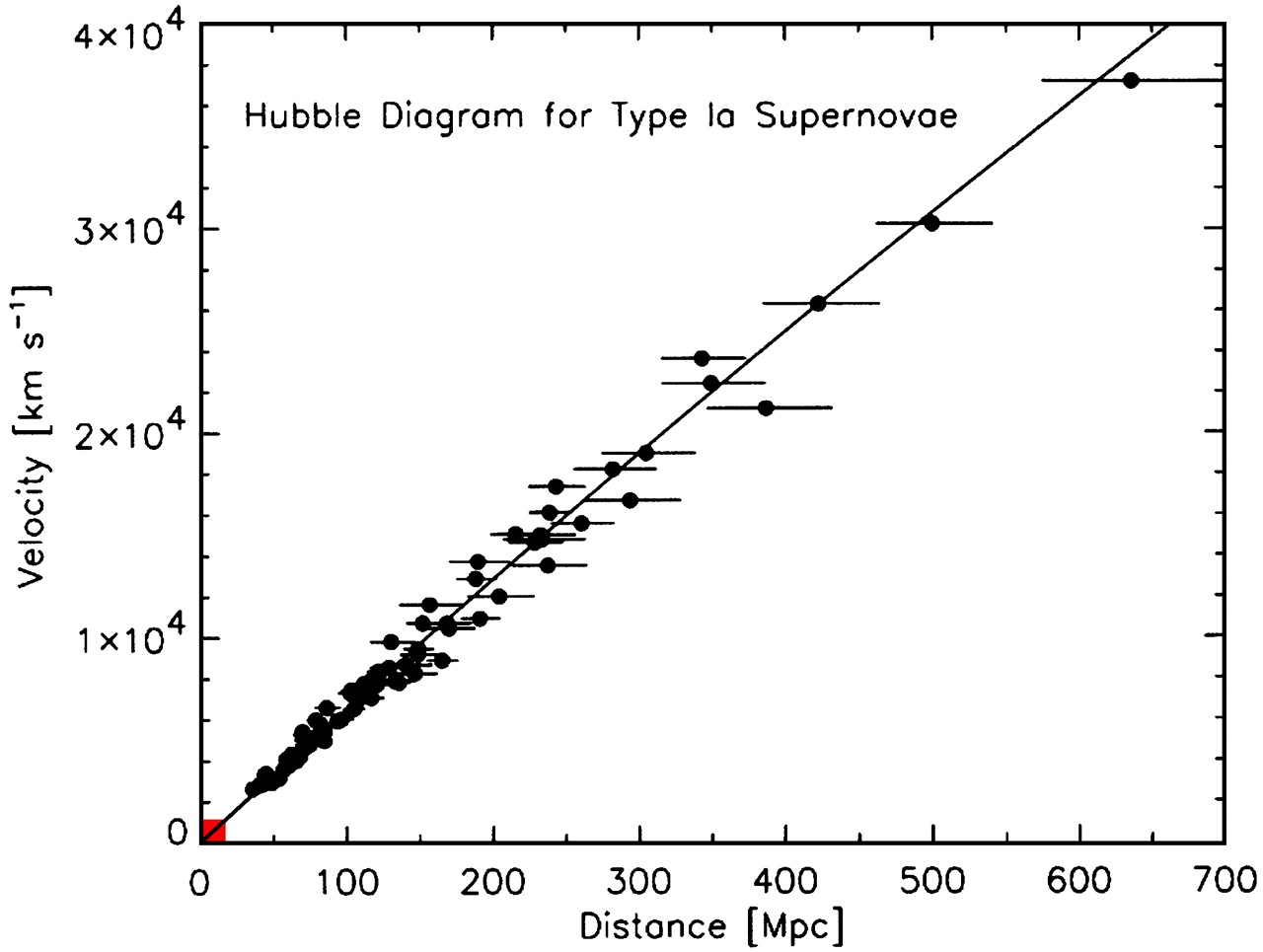
Image credit: Adam Riess et al. I think.
So what causes this? Why does it appear that the farther away things are from us, the more redshifted their light is? On its own, this observation permits many possible explanations, including that:
- light gets tired, and simply loses energy over time,
- the Universe oscillates, contracting and expanding over time, and we are simply close to an expanding portion of it,
- physical constants, such as the speed of light, or the gravitational constant, have changed over time,
- the Universe grows steadily and evenly, and creates new matter as it expands, and
- that the Universe is rotating rapidly, and that the galaxies that are moving away from us more quickly also have large -- unobservable -- translational motions.
All of these ideas predict different things that are, in principle, observable, and allow us to distinguish them from one another. But in the 1940s, George Gamow (and his students, Ralph Alpher and Robert Herman) had a different idea than all of these!

He said that the redshift was due to the fact that the Universe was expanding, and that the expansion rate was faster in the past! As the Universe moves forwards in time, it cools, expands, and slows down.
And like the alternatives, Gamow's theory made some amazing predictions. You see, if you go back in time and allow the Universe to get hotter and hotter, what happens?

Eventually, if you go back far enough, it became too hot to form stable, neutral atoms! In an expanding Universe, the radiation that ionized these atoms should, by now, be cool, uniform radiation that's redshifted well into the microwave part of the spectrum. And not only that, it should have a very specific spectral shape, known as a blackbody distribution.
But Gamow didn't stop there, although the observations weren't nearly ready in the 1940s.
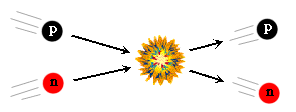
Image credit: Lawrence Berkeley Labs. And they did the next one, too.
What about individual atomic nuclei? At some point, it must have been so hot that even nuclei must have been blasted apart, and it would have been too hot to form anything more complex than individual protons, neutrons, or electrons!
But remember, the Universe is expanding and cooling, and at some point it gets cool enough that you can take that very first step: combine a proton and a neutron to make deuterium. Once you do that, you can start adding more protons and neutrons to make heavier elements!
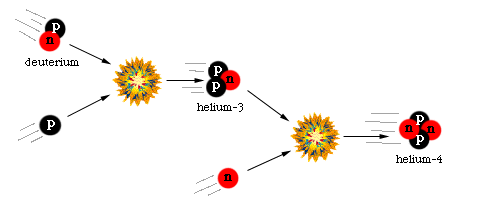
And perhaps, that was how many of the elements in the Universe were made!
Well, many of these rival theories were seriously considered for some time; after all, theories are great little tools for predicting what could happen, but you have to look to the data -- observations and experiments -- to determine which theories are best and most valid!
Well, 1964 was the beginning of the end for the alternatives. Why?
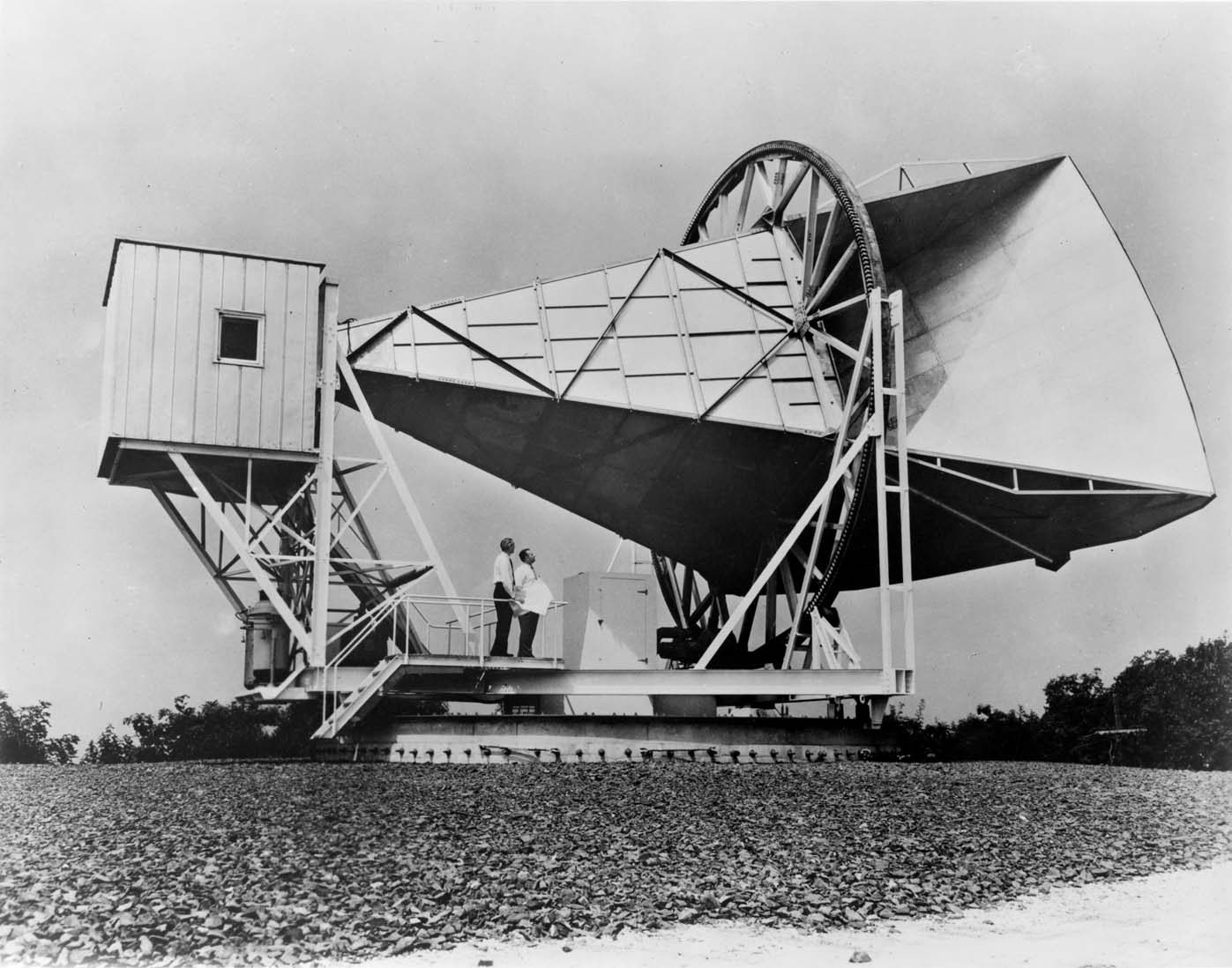
Arno Penzias and Bob Wilson, above, with the Horn Antenna, were working for Bell Labs, researching microwave radiation in the Universe. And what they found was that, while there were interesting microwave emissions from the plane of our galaxy, there was this low-temperature noise everywhere that they simply couldn't get rid of. (Even after, disgustingly, cleaning an incredible amount of bird droppings out of the antenna!)
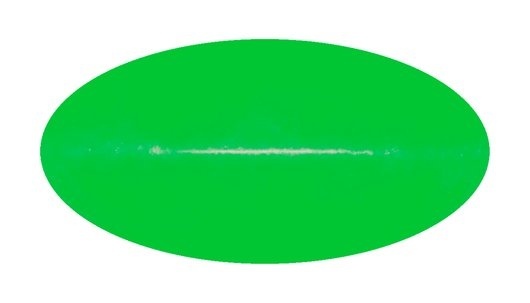
To be honest, they were puzzled by it, and weren't sure what could be causing this. But cosmologists knew what this was! It was Gamow's leftover glow from the Big Bang. But what would the spectrum of this radiation be? Believe it or not, it wasn't really accurately verified until the COBE mission in the 1990s! And what did it show?
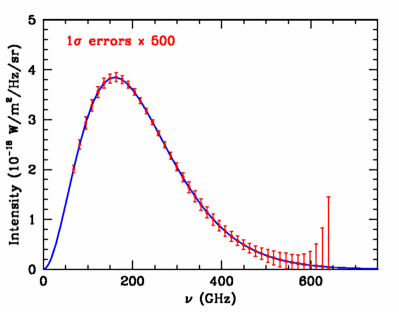
Image credit: COBE/FIRAS.
That the Big Bang got it right, to an unbelievable, indisputable precision!
And that last part? The light elements? We predict that it should make a Universe -- by mass -- of about 75-77% Hydrogen, 23-25% Helium, a small amount of Deuterium, Helium-3, and a very, very tiny amount of Lithium. What do we actually see?

Damn. I mean, this is just incredible! For a theory that just got its bare bones put together in the 1940s, the agreement with observations is outstanding! And the predictive power... yeesh. We can throw all sorts of exotic things into the Universe according to general relativity: magnetic monopoles, cosmic strings, domain walls, a cosmological constant, neutrinos, dark matter, dark radiation, spatial curvature, and textures, in addition to atoms and photons. They all lead to wildly different observations, ranging from large-scale structure...
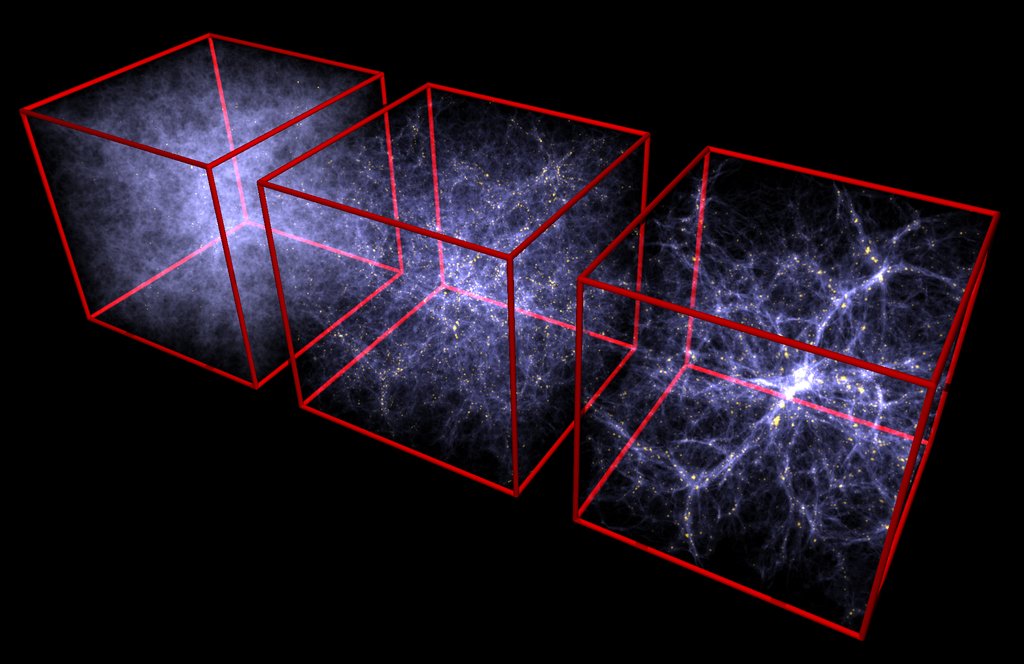
to fluctuations in the microwave background.

And what we find is that there's some dark matter, a cosmological constant, a small amount of neutrinos, and the rest is just atoms and photons. And it's all consistent with the Big Bang.
Don't like that the initial conditions of the Big Bang have to be fine-tuned to get a Universe that's full of this much stuff and hasn't recollapsed?


But I digress. What we've got here is the most successful theory of the Universe ever. All the alternatives fail miserably, including Tired Light, Hoyle's Steady-State Theory, and Alfven's Plasma Cosmology. (I see you, there, in the comments!)
If I were to give my odds, I would, conservatively, say that there's a 99.9% chance that the Big Bang was correct from when the Universe was a tiny fraction of a second old up to the present day. A variable speed of light cosmology might hold some promise, but it isn't clear those models don't also require a Big Bang! I'd give that one alternative about a 1-in-2000 shot of panning out, and all the others combined even longer odds. And that's why we really do think it all started with a bang!
- Log in to post comments
Your first link is a link of this article itself.
Since you are a scientist, I hope you will not mind a factual correction. (I was also mistaken about this until recently.)
The Augustine "quote" is not accurate. Look at Confessions Book 11, Section 12, paragraph 14 (e.g. here http://www9.georgetown.edu/faculty/jod/Englishconfessions.html ). Augustine ia paraphrasing someone else's answer like this and ** rejects ** it as not answering the question.
This is like attributing to you the words "light gets tired, and simply loses energy over time" which do, in fact appear above.
A small snit, I have been entertained and educated 99.999999% of the time by your posts.
drb
drb
Great post again, Ethan. Penzias and Wilson tried everything to get rid of that "noise" down to shoveling out all the pigeon droppings in that big horn dish of theirs. Now that is dedicated science and it is one of my favorite stories.
1) I am not a physicist or a cosmologist.
2) I love this blog and think it's highly educational and I learn quite a bit from it.
3) I'm not qualified to be critical of anybody's theory or hypothesis.
Now that that's out of the way, there's a 12 year old prodigy named Jacob Barnett who claims that the current Big Bang theory is not right. Apparently this kid is doing advanced math and astrophysics at Indiana University-Purdue University Indianapolis.
As I say, I have no idea how this claims hold up on the evidence, but among the more educated, are there any opinions?
Good content and great pics as always. I read in this article (link below) the the reason they cleaned off all the bird poop was entirely different than yours...
I got a kick out of this version of the story.
http://www.deepastronomy.com/cosmic-microwave-background-radiation-sick…
The first photo is hubble's deep field observation taken.in an area of "totally empty" space at an azmuthal angle of roughly the size of the moon. As you can see, many, many more galaxies and stars. The number of stars.....2.1 x 10 to the 23rd power! Here's a first on the Internet! So get ready! If a single star is a grain of sand, the volume of sand needed would be all the beaches of the continental USA, east and west coasts, at low tide, down 38 miles!! There are 5755 grains of beach sand per cubic centimeter (I've counted them!)
Ethan
You give a very good and balanced summary.
In particular, I agree when you say, "All the alternatives fail miserably, including Tired Light, Hoyle's Steady-State Theory, and Alfven's Plasma Cosmology." I quibble only with the word "All"; but yes, the major alternative theories have failed miserably.
Nor am I even proposing the version of the cyclic model such as Penrose or Steinbardt propose. (See for example Apr 2011, Scientific American: The Inflation Debate: Is the theory at the heart of modern cosmology deeply flawed? By Paul J. Steinhardt)
I agree that the big bang theory is a pragmatic framework within which a great many subtheories have been tested and continue to be tested. Nevertheless, I find the big bang theory inadequate.
The plethora of dogmatic statements of endorsements is the first problem. e.g. "there's a 99.9% chance that the Big Bang was correct from when the Universe was a tiny fraction of a second old up to the present day"
Physics has much to understand before any theory of the universe can claim even 50% certainty. The unknowns include:
-- dark matter
-- dark energy
-- inflation
-- extra spatial dimensions
-- the nature of time (e.g. F-theory)
-- quantum gravity
-- baryon asymmetry
-- quantum vacuum (including phase changes & Unruh's law)
-- the life cycle of galaxies (including globular clusters & very old nearby stars)
-- new insights from general relativity
-- appropriate use of complexity of mathematical models
-- problems with standard model of elementary particles
-- the shape of our visible universe (perhaps a 3-sphere)
-- might our visible universe really be anisotropic
Classical physics can't predict the results of a planned automobile collision; hence the need for experiment (e.g. crash test dummies). Yet you are 99.9% confident in the big bang theory from "from when the Universe was a tiny fraction of a second old up to the present day". Such belief is naive.
Without new experiment and observation, massive amounts of new evidence; there can not be resolution to any of the above open questions in physics. There is always conflicting evidence; otherwise why do science. Without new data; theory will be stuck in silos. Adherants of an 11-dimensional space time versus big bang theorist of an infinitely flat 4-d spacetime universe; etc.
Vern- There is "wrong" as in "needs to be modified," and "wrong" as in "needs to be scrapped." Which is the case for Jacob Barnett? Science is always fine-tuning theories, so it's important to know.
Good post. However one tiny mistake. It was Friedman who first proposed the Big Bang theory in 1922. And Lemaître (1927) was the first to propose that the expansion explains the redshift of galaxies.
We do not know nearly as much as we think we do, and much of what we know may not be so. Once we get gravity knocked, we might find that things are not quite as described here. That speed of light thing may be amended also. I hope to live long enough to see.
In any case, this is an interesting, optimistic article and I enjoyed it.
I don't understand the oft-repeated statements about what all we don't know. Is the point that there might be some new discovery that would invalidate the Big Bang theory? Certainly I expect new discoveries to be made that will require adjustments to the theory. But the way this business about "we don't really know" is presented seems to try to suggest that there is some piece of information that will scrap the Big Bang (or at least change it in some huge way).
What sort of thing could it be that would scrap the theory? It would have to modify many independent lines of evidence, and do so in a way that uniformly and consistently causes all of them to be reinterpreted in some new way in which they all support the new theory. In other words, every observation made needs to have at least two possible interpretations, equally likely, and we just happened to pick one because of the lack of this hypothetical new datum.
Take, for example, "Once we get gravity knocked, we might find that things are not quite as described here." We know to a great deal of precision how to describe gravity's effects, and these have been worked into the theory. What do you expect new knowledge about gravity to do? Scrap the Big Bang? No, it will just modify it, for that new gravitational theory will not affect the cosmic microwave background, the distribution of light elements...
(gotta go. bus has arrived.)
If there's an ultimate test for a scientific theory, it's that the theory makes accurate, unexpected predictions in separate fields. Maybe there's a theory which has done this successfully and still later has been proven false (not just in need of adjustment, such as NEwton's theory of gravity or classical wave mechanics, but downright false), but I don't know of one.
I think we can safely put the Big Bang in that category at this point.
drb: Thanks for the Augustine citation, the full quote is very interesting (I always enjoy peeks into ancient minds that show humans have always been just as human as right now).
But no April Fool's joke about the 12th dimension being discovered and invalidating string theory? I am disappoint.
The first photo is hubble's deep field observation taken.in an area of "totally empty" space at an azmuthal angle of roughly the size of the moon. As you can see, many, many more galaxies and stars. The number of stars.....2.1 x 10 to the 23rd power! Here's a first on the Internet! So get ready! If a single star is a grain of sand, the volume of sand needed would be all the beaches of the continental USA, east and west coasts, at low tide, down 38 miles!! There are 5755 grains of beach sand per cubic centimeter (I've counted them!)
# 11
Yep that's the idea. Human's current level of science is pretty embryonic; and many of its most prized theories (e.g. the big bang) will be completely scrapped.
Completely scrapped. Uh huh. Just like Newton's Laws of Motion.
Another good one. But is the no-boundary a problem now? I'll have to check the video!
# 4:
At a guess, it would mean the comment is dated April 1st.
# 7:
You claim remaining lack of knowledge means a theory is "uncertain". No, it doesn't, in fact LCDM has been tested to better than 3 sigma, which means a) it can predict observations to high certainty b) it is certain to be robust (since it has survived many individual tests).
# 15:
I read your comment as exactly the opposite to # 11, who seems to say that working theories will not be "completely scrapped" but embedded in new ones.
Also, our current level of science is far from embryonic, as the method in short order (~ 4 centuries!) have found its clip and the results now connect more or less seamlessly. The standard particle theory and the standard cosmology shows that we have mastered both the small and the large on everyday scales.
As physicist Sean Carroll notes, The Laws Underlying The Physics of Everyday Life Are Completely Understood:
"Not sure why people donât make a bigger deal out of this fact. [...]
All we need to account for everything we see in our everyday lives are a handful of particles â electrons, protons, and neutrons â interacting via a few forces â the nuclear forces, gravity, and electromagnetism â subject to the basic rules of quantum mechanics and general relativity. [...] Thatâs a remarkably short list of ingredients, to account for all the marvelous diversity of things we see in the world.
A hundred years ago it would have been easy to ask a basic question to which physics couldnât provide a satisfying answer. âWhat keeps this table from collapsing?â âWhy are there different elements?â âWhat kind of signal travels from the brain to your muscles?â But now we understand all that stuff. (Again, not the detailed way in which everything plays out, but the underlying principles.) Fifty years ago we more or less had it figured out, depending on how picky you want to be about the nuclear forces. But thereâs no question that the human goal of figuring out the basic rules by which the easily observable world works was one that was achieved once and for all in the twentieth century.
You might question the âonce and for allâ part of that formulation, but itâs solid. Of course revolutions can always happen, but thereâs every reason to believe that our current understanding is complete within the everyday realm. [...]
But getting the basic laws right is an extremely impressive accomplishment, especially for good old human beings who have only been doing science systematically for a few centuries. Way to go, human beings!"
Larsson @17
I totally agree with you. I think Neil Degrasse Tyson says it best in his bit about shaking people and yelling at them "how are you not awed by all this?"
Torbjörn Larsson, OM
You are correct, "All we need to account for everything we see in our everyday lives are a handful of particles â electrons, protons, and neutrons..." etc.
But the big bang theory isn't about everyday life!
The "big bang theory" is essentially a Cosmic Hooke's Law. But unlike Hooke's Law, the big bang theory can not be reduced to the 4 known forces and associated particles.
All of the four known forces and all of the known particles are not enough to put our Humpty Dumpty Universe together again.
Thus the inflation force, a Cosmic Hookean Force, was reverse engineered to explain otherwise unexplainable cosmic observations.
But unlike other reverse engineered theories, inflation sheds no insight upon other area of physics. It is pure fudge, that just makes our ignorance taste better.
Observations suggest that the standard models of particles and cosmology are incomplete. e.g. particles, forces, and/or energies are apparently missing.
Hooke's Law of 1660 was physics that was pure observation without explanation in terms of particles and forces.
Until cosmic observations can be explained explicitly (e.g. known particles); the big bang theory is little more than a Cosmic Hooke's Law, i.e. embryonic, 1660 physics.
Perhaps 21st century physics will learn how to put Humpty Dumpty together.
"...That the Big Bang got it right, to an unbelievable, indisputable precision!"
The general abundances of light elements in space were roughly known prior to the theory of BB nucleosynthesis(BBN). When Hoyle and others developed the theory of stellar nucleosynthesis the initial BBN model was being altered to match the difference between generally known abundances of these elements and those abundances that could not be explained by stellar nucleosynthesis. The original version included a lot more elements being created in the Big Bang. This was a "retrodiction," or another cool word which would describe the development of a theory for predicting something already observed and explained and then developing theory accordingly.
The problem now with the BBN theory seems to be that some of these abundances, particularly the abundance of lithium 6 and other isotopes no longer match observed reality since these abundances are now known with better precision. Presently the most well-known of these BBN problems is the Lithium 6 problem. There is roughly a 1000 times more of common lithium than BBN predicts. The known abundances of deuterium is also a problem with BBN. Many believe that dark matter is needed to solve this problem.
In the above quote I believe the words "got it right" and "indisputable" are exaggerations. The frequencies of light elements can be explained in a number of different ways, but all generally agree that these relative abundances cannot occur based upon stellar nucleosynthesis and supernova nucleosynthesis alone. Additional creation source(s)/ mechanisms are needed but not necessarily BBN which is the most presently accepted theory but is certainly not the only possible scientific explanation.
As a whole, however, I think that Ethan's articles are interesting to read, well documented, and have cool interesting graphics, as well as being educational concerning the latest ideas concerning the Big Bang model.
The tired light concept accounts for the red shift with distance and also for the cosmic radiation background, in a stable universe neither dark energy nor dark matter are required, If the universe is expanding we have to assume galactic rotation is faster than observed due to the Doppler shift, but if it is not expanding galactic rotational speed is as observed, plus an expanding universe causes us to estimate larger galactic sizes so minus expansion nether dark energy nore dark matter is required. James Paul Wesley came up with a self renewing cosmology that involves super massive black holes rupturing upon approach due to the gravitational null between them and spewing out enough mass to create a galaxy, the quasars are formulated as such collisions, the red shifted light the result of the super massive black holes gravitational effect on the light which gets "tired" by continually giving some of its energy to strengthening gravitation energy during its life, thus they are not all distant and are related to the birth of galaxies. Ongoing super Nova explosions as well as quasars force heavy elements into existence continually, the 13.5 billion year "history" is really the limit to the reach of light, since there is no beginning or end in this scenario there is no need to state when these should occur or have occurred
@Wesley #21: No, the tired light hypothesis does *NOT* account for the CMB, nor does it reproduce any other observation.
Scattering of light (the mechanism required for energy loss in the absence of cosmological redshift) would lead to images of distant objects blurred far more than is observed.
Scattering of light cannot produce a thermal spectrum (the fundamental feature of the CMB).
Tired light does not reproduce the observed time dilation of cosmolgical sources, which correlates with their measured redshift (for example, the change in duration of GRBs as a function of distance/redshift).
Tired light cannot account for the observed evolutionary changes in galaxy morphology and surface brightness.
Where precisely did your massive black holes acquire their mass in the first place? Quasars today are far, far better understood than they were in the 1960s (when the ideas you quote originated). In particular, quasars as merely distant AGNs is quite well supported with observational evidence.
You lost me at 99.9% chance that the big bang was correct. The fact that there has never been a time since the supposed big bang where nothing has produced something should be enough to dissuade any reader from considering this a credible blog. That's why it's accurately called a theory.