

Intel Science Talent Search Winner: Mr. Bush, please save Hubble.
Then-President Bush: Is Hubble in trouble?
Oh my, yes, for those of you who don't know, Hubble is, in fact, in trouble once again. To set the mood, I've got one of the best songs about it: Ray LaMontagne's
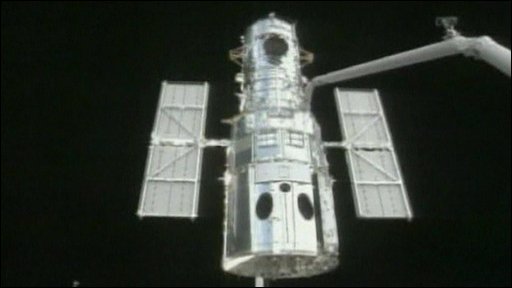
For the uninitiated, Hubble -- imaged here from the Space Shuttle Atlantis -- is not only the telescope that changed the Universe, it is the single most scientifically productive piece of equipment of all time. That's right, as Neil de Grasse Tyson wrote,
More research papers have been published using its data than have ever been published for any other scientific instrument in any discipline.

Originally designed to measure the motion of and distances to galaxies and determine the expansion rate of the Universe, Hubble did so with unprecedented precision. Before Hubble -- no joke -- people argued whether the Hubble constant was fifty km/s/Mpc, with an age approaching 20 billion years, or one hundred km/s/Mpc, with an age closer to 10 billion years.

Now? Thanks to Hubble (and Wendy Freedman, leader of the Hubble Key Project), it might be 70, and it might be 75, but it isn't far off from either of those. And as for age, it might be 13.5 billion years old, or it might be 14 billion years old, but it's almost definitely not outside that range. And beyond that, through ultra-distant supernovae measurements, it provided the first major piece of evidence for dark energy, or the observation that the Universe isn't just expanding, but accelerating! It also captured all of the images in the remainder of this post -- including the beautiful interacting galaxies Arp 147 above -- and is the first and only optical (i.e., visible light) telescope in space.
Hubble, amazingly, has taken some of the best, highest-resolution pictures of everything ranging from planets in our own solar system under the most spectacular conditions,

to dusty regions of space where new stars are forming as we speak,

to clusters of galaxies and the beautiful effect of gravitational lensing, which are the great arcs of background galaxies (often coming in multiple images) that you see below,

to the most distant objects ever measured in the Hubble Deep Field and Ultra Deep Field images!

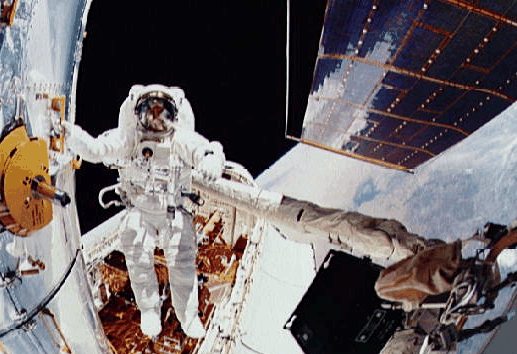
And the science is still coming in! Just last month, it was announced that there's a new value for the Hubble constant with an error of only 3.3% (the lowest ever), and that one major alternative to dark energy is ruled out, all thanks to Hubble still going strong after 21 years. Part of why it's lasted so long is that it's in low-Earth orbit, so we can service it to repair or upgrade it, and have done so four times.
Well, Hubble's replacement, the embattled James Webb, is an infrared telescope. And while it will be amazing and an improvement over Hubble for some things, there are many things that can only be done in the optical, and we are still learning from them and have plenty more we'd like to do.
Facebook to the rescue? There's a group calling themselves The Official Petition to Save the Hubble Space Telescope, and their description is as follows:
Guys, we are presented with a terrible, imposing threat. This threat concerns the loss of the Hubble Space Telescope! Join if you are passionate about this group and hate all the infrared bastards out there.
They've got loads of photos and videos from Hubble, as well as some smack-talk for the other portions of the electromagnetic spectrum!
Regardless of how it turns out, we should all appreciate Hubble for all it's done and all it continues to do, and if it were up to me, I would save the most coveted telescope in all of human history for as long as it's still the best optical telescope ever created! (And it still is!)
I've heard it proposed that Hubble be moved to the ISS, which sounds reasonable, but I don't know what the problems with that might be. I know it's not going to get any more servicing missions where it is, with no more Shuttle.
As I recall, the ISS orbit is much lower (Hubble is as high up as the shuttle can go, and if there was a problem during a servicing mission, the shuttle did not have an âabort to ISSâ option (please correct me if I'm mistaken, that's all from memory)). That presumably means more atmospheric drag, which I also presume Hubble isn't design for.
I dunno, it might be realistic and possible, butâ¦
Does the FB group have any suggestions on how to service / save Hubble without any shuttle?
@Nemo, if I recall they've looked at putting other observatories on the ISS before and decided it wouldn't work because there's too much vibration in ISS that would make it very difficult to take images.
Ah, Hubble... I find so much pleasure in the pictures taken by Hubble... So much pleasure that when I look at them it almost feels like I'm cheating on my boyfriend. :P
Is there a non-facebook version of this petition?
Pretty good return on Cold War spy sat technology investment!
Hubble is in a different orbital plane than the space station (28.5 versus 51.5 degrees). As a result it would take nearly as much energy to change the plane as to launch the whole thing again. Out of plane manouvers are very energy intensive, this is why the shuttle launch window to the space station is 10 mins once a day, thats when the plane of the space station is over KSC.
Changing the orbit of Hubble is not realistic, for the reasons quoted above. However, with the new hardware (Falcon 9 being just one) or with adapted old hardware (launching the old Soviet-era R-7 from Kourou with a Soyuz capsule modified to grab the telescope -it may require a second launch to carry replacement gyros etc, but should be doable)*.
The real threat may be bureaucratic infighting inside NASA. Funds for Hubble repair might be seen as rivals to the funding of the James Webb Space Telescope, so they might decide to de-orbit it to create a fait accompli.
*The simplest way may be to dock a standard Soyuz with a repair module containing airlock, extra fuel, spare parts and manipulating arms compareable to the ISS Canadarm.
Search, e.g. "Save Hubble", and you'll find nothing current. Absolutely nothing!!
So granted all the good stuff from the past; why save Hubble?
I see Ethan's words, "it's still the best optical telescope ever created!" Nice but!!
The James Webb Space Telescope is a great replacement. I wouldn't petition to save the Hubble until the James Webb is successfully launched in 2016 or 20xx!!
Budgets are under attack; so hunker down to keep the James Webb Space Telescope.
"Although key components of the (JWST)telescope will be finished by the end of 2011, integration of those parts, construction of the spacecraft bus and years of testing are still to come. The mission has been mired in budget and schedule trouble since NASA formally green-lighted the project in 2008, and problems were brewing even before then. The rising costs caught the attention of Congress this year... The Casani report said NASA needed to commit $250 million more to JWST in both 2011 and 2012, just to achieve a launch date in September 2015. Elizabeth Robinson, NASA's chief financial officer, told Congress last month she doesn't expect that funding to materialize this year... Final NASA approval would come a few months later, when the 2011 and 2012 federal budgets are better understood." http://spaceflightnow.com/news/n1101/17jwst/
Ouch!! Forget Hubble, it's great history. Focus on the James Webb Space Telescope.
" NASAâs James Webb Space Telescope (JWST) would not launch before 2016 at the earliest if funding for the flagship-class astronomy mission remains flat at the $375 million level President Barack Obama requested for 2012, according to agency officials." http://www.spacenews.com/civil/budget-request-jwst.html
Double ouch!!!
If the only options are "save the Hubble" (i.e. by having humans service it) and "don't have a Hubble", then I'm all for saving the Hubble.
But the ugly truth is that it would probably be cheaper to put up a new identical-capability telescope via an unmanned rocket than it would be to send up humans to service that one.
Granted the repairs of the first telescope made for thrilling TV (and I'm not being sarcastic: I never imagined that a video about a dropped screw would have had me on the edge of my seat) but is that really the metric by which we're making scientific decisions? Just make (via the spare parts from the first) another one and launch it.
We have no means to service the Hubble platform; the current Shuttle age is at an end. Sure I'm being pedantic, but I have to disagree with de Grasse Tyson - Hubble is a platform and over the years it has served many instruments; it is not 'an instrument'.
I see a few options - if the ISS is being funded until 2020, go ahead and build a telescope which can operate from the ISS. (The catch is that by the time funding is secured and the thing is built, 2020 would have come and gone.) Another option is to simply build a Hubble-like replacement and launch these babies every decade or so. The scientists involved with Hubble would know best about what may still be learned from the various instruments. There is much to learn from the infrared and if the JWT is ever launched it will be the largest IR telescope in space. If it has extremely low temperature cryogenic detectors it will offer quite a few advantages over the Herschel space telescope. Herschel is already an incredible improvement on Spitzer.
Also keep in mind that much of the Hubble platform uses obsolete technology; the parts supply is running down. Radios have been upgraded, the INS systems have been replaced with spares - and there was a struggle to piece together enough working units for the last major overhaul, and various other components are simply ageing and will not be replaceable when they fail. It's time to build a new bird. It was a very well planned series of missions and has run much longer than originally envisioned, but it is getting old.
Ditch the ISS! It costs far too much to keep up there and cost far too much to build in the first place. We could have 20+ Hubbles for the price of one ISS. :(