

"I have departed from this planet and I have left behind my poor earthly ones with their occupations which are as many as they are useless; at last I am living in the scintillating splendor of the stars, each of which used to seem to me as large as millions of suns." -Jules Massenet
Each star in the night sky, just a distant, shining point of light, holds the same potential as our Sun. The potential for other worlds, for life, for civilization both as we know it and as we can only imagine it. On a clear, dark night, the possibilities seem almost limitless.

Image credit: ForestWander, Summit Lake, West Virginia.
If you had asked me, 20 years ago, about the possibilities, I would have been able to tell you a wonderful story about what other worlds there could be around other stars. But it isn't the early 1990s anymore; we've detected planets orbiting other stars!
In fact, we have two major ways to do it: stellar wobble and planetary transits. Let's go over what they are, and what they tell us.

Image credit: European Southern Observatory, as well as the image below.
You likely think of our Sun as being fixed in space, with the planets orbiting around it. To an excellent approximation, this is true; after all, the Sun has about 99.8% of the mass in our Solar System! But in reality, just as the Sun's gravity pulls the other planets towards it, the other planets gravitationally pull on the Sun. If Jupiter were much larger than it is, our Solar System would look, instead, like the animation above.
Now -- this is really important -- if you were very far away from the Sun and it were orbiting with another massive body, what would you see?

Well, if you were edge-on (as opposed to face-on) to that system, you'd see the Sun moving towards you for part of its motion, and moving away from you for the other part. As far as light is concerned, when the star is moving towards you, the light gets blue-shifted, while when it moves away from you, it gets red-shifted.
Watch this red-blue-red-blue oscillating pattern over enough time, and you can measure the
- masses of any orbiting planets, by the magnitude of the shift, and
- the distance from each planet to the star, by the period of the shift (and knowing Kepler's Laws).
Unsurprisingly, the first planets ever discovered by this method were very massive and very close to their parent stars, because that's the easiest kind to see using this method! But we have a second method...

Image credit: AstroGuy, a.k.a. Jason Rowe.
Planetary transit! Normally, when you watch a star, you get a roughly constant amount of light coming from it. But if something passes in front of that star, it can block a certain percentage of the light. If your measurements are sensitive enough, you can detect even tiny changes in the amount of light emitted.
And again, if your alignment is perfect enough, planets in other Solar Systems will pass in front of their parent star, blocking the light, and allowing you to learn:
- the radius of the planet, by measuring the amount of light blocked, and
- the distance from the planet to the star, by measuring its period.
We used to talk about planetary transits only for Mercury and Venus, because they're the only ones -- as seen from Earth -- that can block our Sun. (And it is spectacular!)

Image credit: Shigemi Numazawa, JPL. That's Japan Planetarium Lab, not the other JPL.
But this is how the Kepler Mission is currently finding planets, and all told, we've got over 1,500 planets we've now discovered outside of our Solar System!
And we've discovered some interesting things. Not just small, rocky planets like our four inner ones: Mercury, Venus, Earth and Mars.

(Although, we have discovered ones like this.)
And not just large, gas giants, like Jupiter, Saturn, Uranus and Neptune, although we have discovered planets like those.

We also detect planets that are "in-between." In other words, they appear to be much more massive than the rocky planets we have, but they don't appear to be as large as the gas giants we have.
What to make of these so-called super-Earths?
Well, if we really wanted to know what was going on, we'd be able to measure a planet by both methods: wobble and transit. If that were the case, we'd know its mass and it's radius, and be able to say something definitive about that planet's density, and perhaps, if we knew enough, what it was made out of!

Take a look at 55 Cancri, or rho cancri, a magnitude 6 star (just barely visible to the naked eye under ideal dark conditions) in the constellation of Cancer the Crab. (Its location, above, was compiled using the free-and-awesome-software stellarium.)
At only 40 light-years away, it is the brightest star in the night sky known to have planets orbiting it. First detected via the wobble method, we've been able to deduce at least four five planets orbiting it.
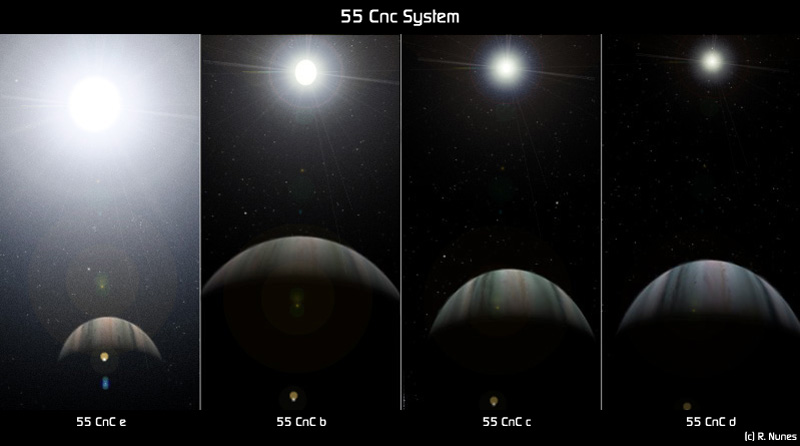
Image credit: R. Nunes and wikipedia.
And while the outer four planets are gas giants like Jupiter, the innermost one is one of these super-Earths.

But what's really remarkable? We've just measured -- for the first time -- transit and wobble due to this innermost planet! The transit is brand-spankin' new, and marks the first time we've ever measured mass (via wobble) and size (via transit) for the same extra-solar planet!
So, what can we learn about it?

It's really dense! At 10.9 g/cm3, it's nearly double the density of Earth, the densest planet in our Solar System. It weighs in at more than eight times the mass of Earth, but is only 63% larger in radius than we are! How did it get like that?
It turns out that -- rather than being something like a ball of metal -- this is likely the dense, compressed core of a gas giant like Jupiter! Take a look at a cutaway of Jupiter to see what I'm talking about.

Rather than gas all the way down, Jupiter has a solid core, but a gaseous atmosphere. But if you brought Jupiter too close to the Sun, it would wind up like Mercury: stripped of all its atmosphere by the incredible pressure of the Sun!

Image credit: Mark Garlick.
But unlike Mercury, what's left behind -- the dense, rocky core -- would be far more massive and dense than any planet we have today. In this particular case, the core is probably compatible with this body having originally been a Saturn-sized planet. But with its atmosphere stripped away, all that's left is a small core barely larger than Earth, but far more massive and dense!
Thanks to Jon over at Universe Today for breaking this story, and I hope you all enjoyed learning about this new "first" for astronomy!
Cool, Ethan!
From where I work I can see the Lick Observatory on Mt. Hamilton, where doppler measurements of this type were first carried out. (And they say James Lick was crazy for building his observatory on top of a mountain.)
In the illustration for the Second Method, the bottom of the light curve is U-shaped. Why is that? I would have expected that once the planet (or second star) is completely in front of the star, the measured light would be the same for the whole transit. Does the star's light output vary with the angle from the surface?
Yes, the star's brightness does vary with angle. The phenomenom is called limb darkening and is observed on the sun. A star is made of gas and isn't perfectly opaque, so looking straight down on the centre of the disk you see deeper into the star than when you look at the edges (the limb) and you are looking in at a sharp angle. The deeper into the star, the hotter it is, so the limb is cooler and darker than the centre of the disk.
Great article - one of the best on exo-planets I've ever read.
Thank you Ethan for this article. By the way, is an oceanic planet with no icecrust (or other kind of crust) and no atmosphere possible?
Great article! Is the idea that gravitational interactions managed to drop a gas giant down close to the star? Or could a gas giant have formed that close, and then have its outer layers blown away as the star reached fusion?
Pronoein @4
At the very least you would get a thin water vapor atmosphere.
Re #4; Watch the wonderfully eccentric Julius Sumner Miller demonstrate that it's not possible for a planet to have an ocean but no atmosphere.
Hydrogen isn't a metal. What's going on here?
@7: Hydrogen does have a metallic phase at sufficiently high pressures, such as you would find deep inside a Jupiter-type planet. The phase is described as metallic because electrons are free to move about the way they can move in ordinary metals.
@4: Most substances have a triple point, a particular temperature and pressure where solid, liquid, and gas phases coexist. (Helium is an exception; its solid phase can only exist at substantially higher pressures than Earth's atmosphere.) Below that pressure, there is no liquid phase. Atmospheric pressure on Earth is below the triple point pressure for carbon dioxide, so "dry ice" sublimes to the gas phase without passing through a liquid phase. The triple point pressure for water is quite a bit lower, fortunately, but not zero.
Great article! Is the idea that gravitational interactions managed to drop a gas giant down close to the star? Or could a gas giant have formed that close, and then have its outer layers blown away as the star reached fusion?
Pronoein @4
At the very least you would get a thin water vapor atmosphere.
Really excellent science.
The term super-Earth seems inappropriate, at least for this apparently uninhabitable intermediate planet.
I assume a man couldn't stand up or even walk in the gravity of such a planet and that a man would be fried and blinded by the two suns even with the best of spacesuits.
NOT the first time mass and radius is measured for a particular exoplanet.
Not even close.
ShadowWalkyr @7, look at the location of hydrogen in the periodic table. There is a reason it is placed on the left hand side.
At only 40 light-years away, it is the brightest star in the night sky known to have planets orbiting it.
55 cancri is not the brightest (or even closest, if that was a typo) star with known extra-solar planets. 40 ly away, apparent magnitude 6, absolute magnitude 13. What about Pollux or Fomalhaut, for instance? Both have at least one planet (Fomalhaut has several), both are closer than 55 cancri (34 and 25 ly), and both are brighter in both absolute and apparent magnitude (around magnitude 1 or 2, both apparent and absolute - smaller magnitude = brighter). Fomalhaut b has even been imaged at visible wavelengths. There might be brighter, closer examples. Those two are just off the top of the head.
Ah but is it really dense? MOST observations in the optical range say it is, but in the latest arXiv batch it turns out the transit has been detected in the infrared with Spitzer, and there is a 3 sigma difference in the calculated radius of the planet. They end up with a lower density than the Earth, which taken at face value implies the planet has a substantial volatile content (estimated at roughly 20%). Whether this is plausible for such a hot planet is another matter.
Obamaânın terörle mücadele danıÅmanı John Brennan, Beyaz Sarayâda düzenlediÄi basın toplantısında, âDakikalar günler kadar uzundu ve BaÅkan ekiplerimizin güvenliÄi için çok endiÅe ettiâ açıklamasında bulundu
Probably worth pointing out that Jupiter's core isn't a certainty, and if it exists, it probably isn't solid at those temperatures and pressures. 'Silicate' != 'solid'.
And, yes, apart from the Kepler candidates, pretty well all transiting planets have been confirmed by the doppler method: indeed, that's roughly (transit timing aside) the difference between a planet candidate and a confirmed planet.
Major flaw in your design. That unseen planet? I can see it. It's right there guys. It's right here in my room!