

John Oliver: So, roughly speaking, what are the chances that the world is going to be destroyed? One-in-a-million? One-in-a-billion?
Walter Wagner: Well, the best we can say right now is a one-in-two chance.
John: 50-50?
Walter: Yeah, 50-50... It's a chance, it's a 50-50 chance.
John: You come back to this 50-50 thing, what is it Walter?
Walter: Well, if you have something that can happen and something that won't necessarily happen, it's going to either happen or it's gonna not happen. And, so, it's kind of... best guess at this point.
John: I'm... not sure that's how probability works, Walter. -The Daily Show
At its simplest, most fundamental level, it's hard to imagine anything simpler than the particle physicist's favorite toy, the collider. Just take two things moving very quickly in opposite directions, and smash them together!
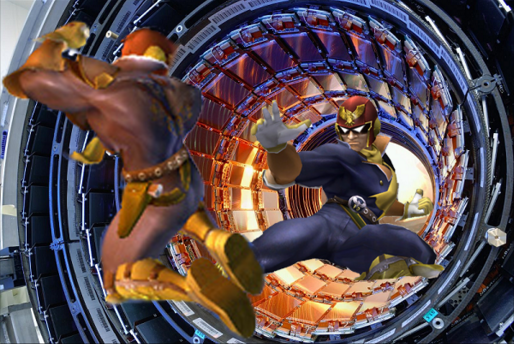
Okay, okay, two particles. Take two particles and smash them together. Why would you want to do that?
Because the more energy you give these guys, the more energy is available to create new matter, perhaps even to create some rare, never-before-seen particles of ultra-high, unstable masses!
The key, of course, is twofold: getting to those incredibly high energies and also being able to detect the stuff that comes out! Now, the big collider that everyone knows about is, of course, the Large Hadron Collider, or LHC for short.
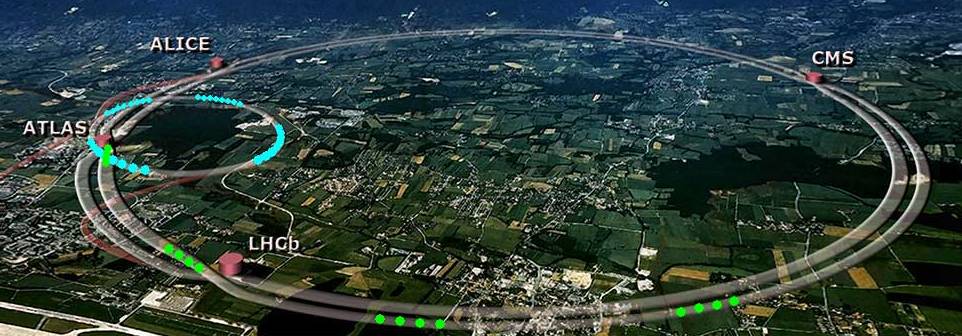
At 26 kilometers in circumference, it's certainly one of the largest particle accelerators in the world. But, I'm sure you're curious, how does it work?
Well, any type of accelerator has three things to worry about:
- You need to accelerate this particle, and that's going to take a force. For all the accelerators we use, that force comes from electric fields acting on the particle's charge. The more massive the particle, the bigger the electric field you need to accelerate it.
- You need to make sure you can steer these particles, and that takes magnetic fields. If you want your particles to go faster and you need to bend them into a circle, you're going to need ever stronger magnetic fields. And...
- You need to overcome the limits of synchrotron radiation. (This one's tricky; more on it later.)
So, you ask, how do we do all this? Let's head on into the tunnel and have a look!
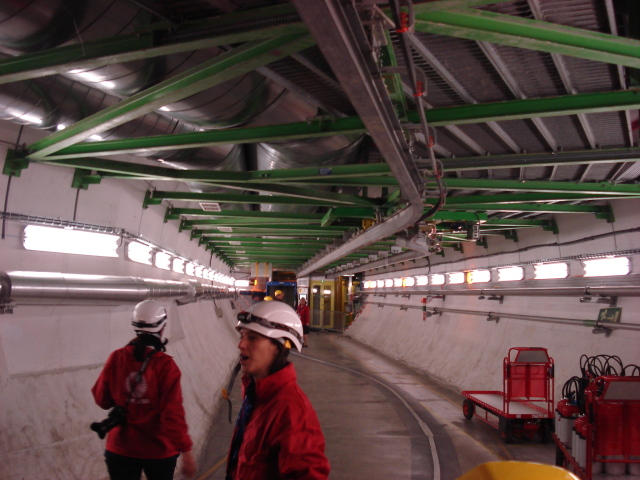
This is the huge, curved tunnel that houses the LHC. (The second most powerful collider on Earth, Fermilab, has one that looks just like this, but it's only about 7 km in circumference.)
Once you've got your big circle, you need to accelerate your particles up to speed and keep them moving in the circular path you need! How do we do that?

Giant electromagnets! Yes, seriously. An electromagnet is special, because you can vary the amount of magnetism it generates simply by varying the amount of current in the electromagnet. This means, as you get that particle moving faster and faster, you can ramp that magnet up to keep it moving in the same circle! And, as long as you've got an electric field going in there, too, you can get that particle going as fast as you want!
That is, of course, limited by the strength of your magnet and the radius of your collider. With superconducting electromagnets, it's going to be tough to beat what they're doing at the LHC. Even at that, what they're doing at the LHC barely beats what they've been doing at Fermilab for nearly 20 years!
So, you say, maybe I'll just build a bigger collider!

Why not build one around the circumference of a whole planet, in fact?! Well, that's where prohibitive cost comes in. Can we find a clever way to probe the nature of matter without having to spend hundreds of billions of dollars to do it?
Those of you who've been following particle physics for some time, you may remember that the LHC hasn't always been the rage at CERN. There was a large collider in the same tunnel there before.
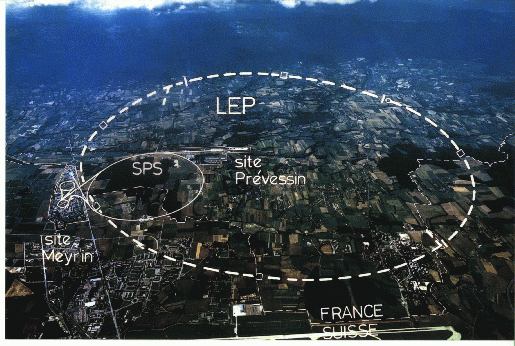
The Large Electron Positron (LEP) collider! However, instead of using protons, LEP used electrons and anti-electrons (positrons). At first thought, you might think this is a huge advantage, and in a lot of ways, it is.

Unlike protons, where you've got three quarks and a myriad of gluons splitting up the energy, the electron (and the positron) is just a single point, containing all of the energy and momentum. Also, although they have the same charge, the electron is only 1/1836th as massive as the proton, meaning that if you apply the same force to an electron and a proton, the electron will accelerate 1836 times as much!
How can you go wrong, you ask, and why aren't all colliders using electrons and positrons?
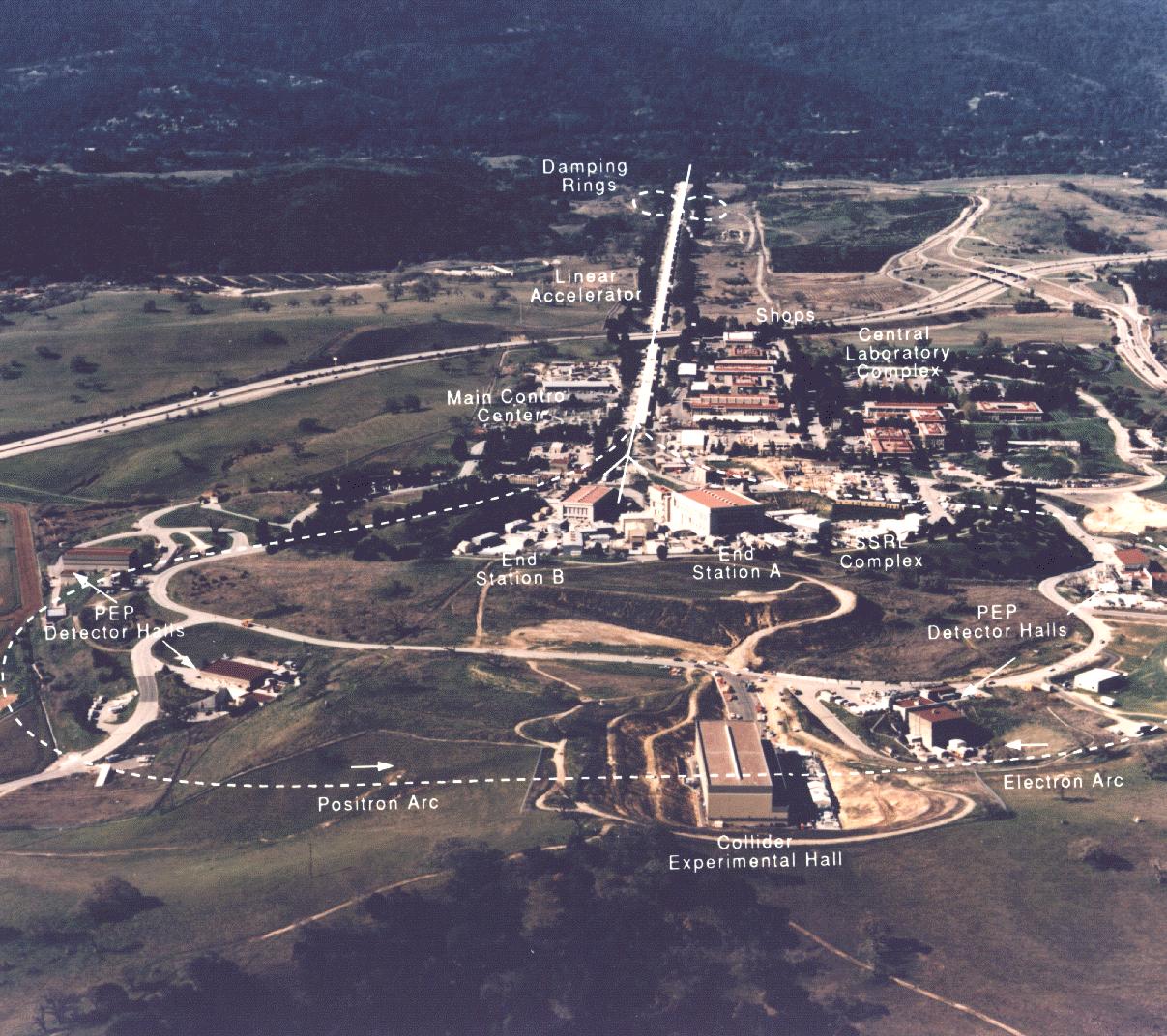
It wasn't just LEP, many of the older colliders did. The Stanford Linear Accelerator Center (SLAC), above, was one, and the proposed International Linear Collider (ILC), below, would be another.
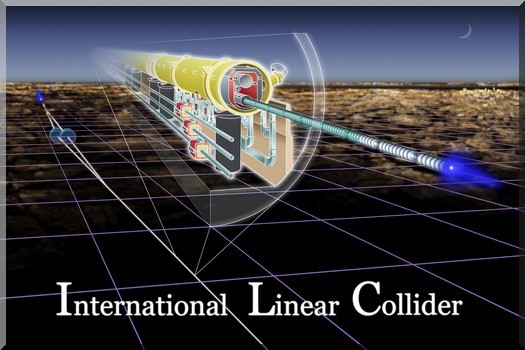
But they're straight lines! Sure, you don't need the fancy electromagnets, but you only get one chance to accelerate them! Why would I spend all my money trying to build a super-long, super powerful beam, wasting it all on these accelerating cavities:

Image credit: DESY.
Why not just put these in a giant circular path? Well, that's where synchrotron radiation will get you. You see, when you put a charged particle in a magnetic field, the field doesn't just steer it. It also causes it to emit radiation. For a proton, it isn't a big deal; the fact that the proton is so massive means the radiation emitted is negligible. But for an electron...
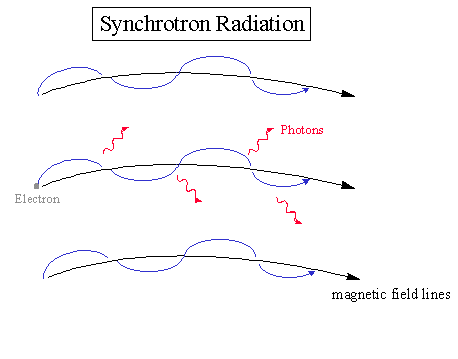
Well, an electron simply can't handle a strong magnetic field; it will radiate its energy away and will simply refuse to go faster unless you turn the field off. Which is why we need to put it in a straight line.
And for some reason, those are the only options people talk about. Either go from the Large Hadron Collider up to a Very Large Hadron Collider for protons (which people have been talking about since at least 1997, when I first started out in physics), or go back to electrons and build a huge Linear Collider.
There is, of course, another option. What if we could find a particle that had the best of both worlds? What if there were a single particle (not a composite one, like the proton) that carried all the mass, energy, and momentum of a system, would respond to electric and magnetic fields, but wouldn't give off synchrotron radiation like an electron. Ideally, this would be a particle that was the same (magnitude) charge as either an electron or a proton, but with a mass in between the two; much heavier than an electron but still lighter than the proton.
Any ideas?
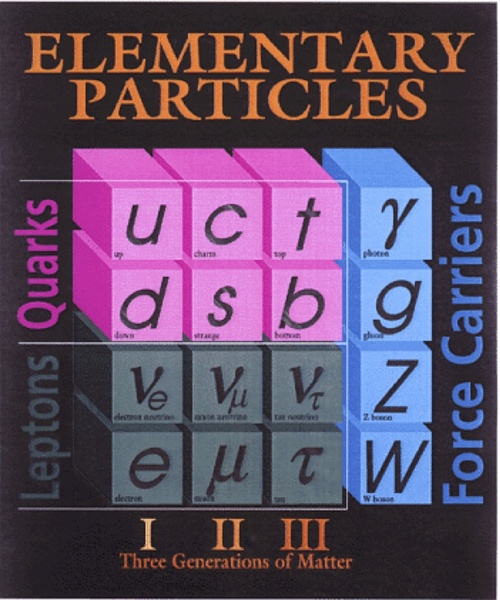
That's what a muon is! Why not go and build a giant muon collider?!
At 207 times the mass of the electron, synchrotron radiation is no longer an issue. But there is an issue: the muon is unstable!
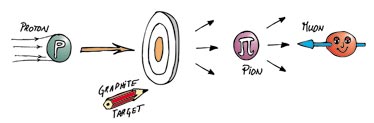
Image credit: H. Keller.
They're easy enough to make, but with a mean lifetime of only 2.2 microseconds, what chance will we have to accelerate them and collide them before they decay away?

Image credit: James Schombert at University of Oregon.
It's actually really simple. Make them moving relativistically, or close to the speed of light! Because of time dilation, as long as you get them moving fast enough, they'll live long enough to do whatever you want them to.
Now, if only we had a place to make them relativistically and then put them, immediately, into some sort of accelerator. If only...
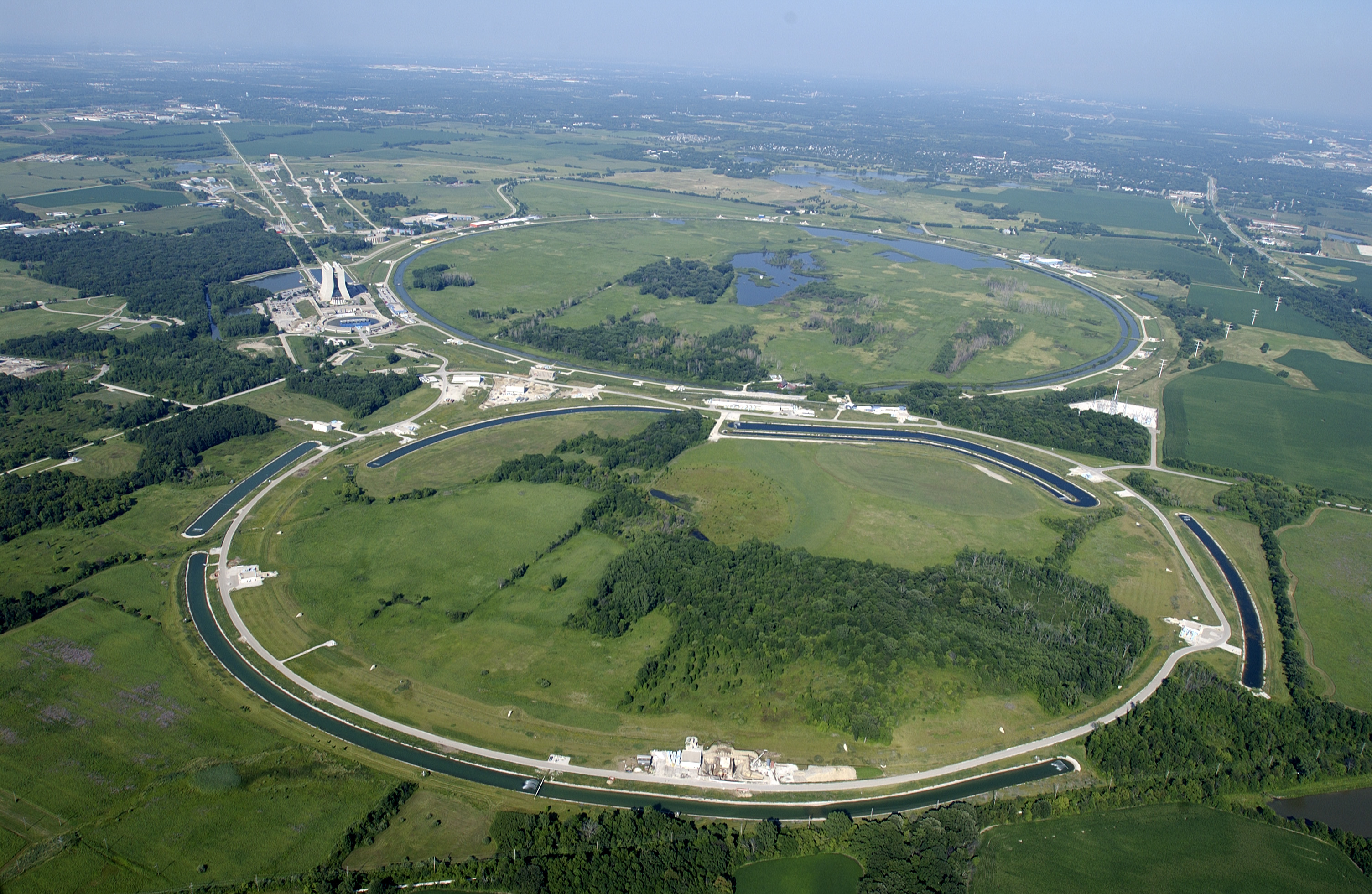
Why hello there, Fermilab. With your high-luminosity main injector, looking like the perfect candidate to create relativistic muons, and your soon-to-be-decommissioned main ring (a.k.a. Tevatron) just waiting to be repurposed for such an exciting project.
There's already a team trying to figure out how to make this happen, and I admit, there are many technical challenges to overcome. But the future of colliders isn't in building them ever bigger and more expensive, it's in building them smarter. As long as you can get an interesting luminosity -- or a high enough collision rate (which, with the main injector now in place, shouldn't be a problem) -- this could very well be the future of particle physics!
Good ol' Wally Wagner. That crank used to scan Google 24/7, looking for mentions of his name. He even had a pet sycophant, J. Tankers. Two creepy blog stalkers, for sure - even showed up at my little nothing blog to chant their ludicrous LHC doomsday mantra. They had a "cult" mentality about them. In any case, Wagner has richly deserved all the scorn he has received.
Actually, I vote for the collider on the moon. That's just one step closer to an interstellar death ray! We build the complete, final ray on Mimas.
I recommend you look up the MICE experiment being run at RAL in the UK (Muon 'cooling' to allow collimation of a muon beam) which is a major stage to making useable muon colliders, MuSIC/COMET/PRISM/PRIME which are a series of (planned) experiments in Japan to inspect ultra rare decays of muons, as well as muon FFAGs (type of accelerator somewhere between a cyclotron and a synchrotron). Another one is EMMA which is being build in the UK which is also looking at muon FFAG design.
... also worth a look are plasma-wakefield accelerators which have (theoretical) acceleration gradients of GeV/m compared to current RF cavities which are MeV/m (I think): basically using PW acceleration you can make a linear electron collider in hundreds of m rather than Km..
hope this was interesting: I'd write more but it's 02:30...
If you mean a collider that goes around the entire circumference of the moon, I'd definitely support that.
On May 16 2011 STS-134 will deliver AMS-2 Alpha Magnetic Spectrometer to the International space station. AMS-2 is a detector that has been in the works for a long time, it's mission (in brief) is to look for Dark Matter, Anti-particle and measure relativistic cosmic rays(particle precipitation)sub-atomic particle from inner and outer space.This Probe/detector will measure already naturally accelerated particles and follow up on the heels of AMS-1.
That's next Monday!
And I hope congress finds the courage to fund the continuation of assets such as the Tevatron Muon collider and other great physics experiments, one of which holds some intrigue for me, since it is in the design stages and may be part of the JDEM mission proposals that has had some bad funding luck, that probe/detector is SNAP, the SuperNova Acceleration Probe.
If we don't work to keep projects like this alive then what?...we sit on the sidelines and watch the world go by?
I don't think America is ready for that armchair just yet!
Captain Falcon joke? I'm in love.
So what's the difference in what you see when muons collide, rather than protons? Or electrons, come to think of it?
@Sphere Coupler
It certainly makes more sense to look for Invisible Dark Matter in space rather than the bottom of a deep mine.
Do you (or does anyone else) know how an Invisible Dark Matter particle, of unknown mass, that only reacts with the other matter gravitationally, will be detected by the device? (Assuming there's some IDM flying around in low Earth orbit).
Wiki on the AMS-2 project was of absolutely no help here. There was a mention in passing of maybe finding 'neutralinos', but no actual explanation of how.
Yes, Fermilab must build a muon collider. Yes, there is much unproven technology and in best case construction won't begin until 2020. But scientific tour de forces are never wasted; there is always technological, business, community and economic spin-off from fundamental scientific research and leadership.
"Despite their optimism, physicists... must first solve the thorniest problem of a muon collider... trying to work out how to get a hot cloud of muons to line up and march along in the cool, narrow beam needed for acceleration before all the muons decay." Nov 2009
"The long-term MC development plan presented to P5 comprises three important steps toward bringing the high-energy physics frontier back to the U.S.:
i) a study to demonstrate MC feasibility by 2014;
ii) a subsequent program of muon beam demonstration experiments, component tests, and prototyping over the following 7â10 years; and
iii) the start of MC construction in the early-to-mid 2020s...
A lepton collider with sufficient energy and luminosity would facilitate:
ï· understanding the mechanism behind mass generation and electroweak symmetry breaking
ï· searching for, and perhaps discovering, supersymmetric particles and confirming their nature
ï· hunting for signs of extra space-time dimensions and quantum gravity...
The present annual level of DOE support for all MC- and NF-related R&D in the U.S. is about $10M. Thus, the requested funding for the R&D program proposed here corresponds to a 50% increase in annual funding for the ânominalâ profile, or up to a 90% increase for an âaugmentedâ program that would deliver the results in less time." R&D PROPOSAL FOR THE NATIONAL MUON ACCELERATOR PROGRAM Revision 4g; February 9, 2010
The muon collider seems like a bargain to me.
Let's not lose the Fermilab muon collider opportunity.
Every accelerator design has theoretical and experimental strengths. A muon collider provides unique techical challenges to build; but it will also offer unique theoretical and experimental opportunities, as well as unique spin-off opportunities.
The AMS is a multi-detector of sorts, itâs designed to be very sensitive to particles such as cosmic rays and components of cosmic ray flux which may be one part in a billion. The search for anti-matter in space should be rewarding since the particles will not have traveled through all of the spheres (such as ionosphere, and atmosphere) When particles travel through earths shields (we are in effect shielded from these rays by the spheres such as the magnetosphere. This probe/detector will measure itâs environment to a high degree.
Amongst many benefits, it will teach us more about the environment we (you and I) hope to travel through someday. It weighs over 7 tons and is a one of a kind instrument. This is a particle physics experiment along the lines of the LHC and Tevatron only nature (the cosmos) does the accelerating instead of massive magnets.
Excerpt from NASA;
In 1999, AMS-01 established a new upper limit of 10-6 for the antihelium/helium flux ratio in the universe. AMS-02 will search with a sensitivity of 10-9, an improvement of three orders of magnitude, sufficient to reach the edge of the expanding universe and resolve the issue definitively.
I agree there is not much info in the wiki about the specs of the 15 subsystems and the main detectors, you have to dig, MIT is one the north American participants in the collaboration, and then dig some moreâ¦
http://web.mit.edu/lns/research/emi.html
Six Quarks have been found by experiments on earths surface and other so called stranglets have been theorized. My personal interest is in the detection of anti-quarks and one of these six quarks arranged in a close orbital structure to each other in a pre-meson arrangement. A Meson is a Quark and an anti-Quark. This arrangement of close coupled yet never fully coupled particles should give a signature that I think the AMS-2 may be sensitive.. If not then the results of this detector may indicate what changes need to be made for successful detection. The data produced by this sensor is in the range of 7 Gigabits per second.
Wagner had a point. Things either do happen or they do not happen, if you look at how life occurs on a momentary basis. And the truth of the matter is that this experiment is being done to learn something new. The safety of this project is based upon what can be accounted for, not what might happen that is a surprise or that contradicts scientific prediction.
This one guy, Tom Weiler, got out in the news about 2 or 3 months ago. He was going off about using "singlets" to possibly communicate back through time.
For me, this created a few concerns:
1. Him being right and that feat actually being possible.
2. If it were possible to influence the past, could it simply happen by accident.
3. People interpreting the news articles; people thinking that the Bible or Koran might suddenly just cease to exist, and the extreme actions that might be taken in such an event.
I've been advocating that all of this research be moved to space. The LHC is an idea and a concept that has now been built and tested a few times. It might have cost money, and labor, but the end product exists aside from labor and cost.
It is materials put into specific form and for a specific purpose: discovery.
Of course, the real problem here is that there aren't any large hadrons to collide. Now if only they'd built a small hadron collider....
Is there a way to accomplish the goal of creating new, high mass particles without a collider? Maybe by providing energy to virtual particles?
I like the moon collider:
no need for vacuum tubes (10^-15 torr already)
plenty of unused surface to use solar power
plenty of shaded craters for well-chilled detectors
no one to complain about the occasional micro black hole eating a couple of city blocks
"the electron is only 1/1836th as massive as the proton, meaning that if you apply the same force to an electron and a proton, the electron will accelerate 1836 times as much" - well... it is NOT true.
Libyaâda NATO güçlerinin 30 Nisanâda Kaddafiânin küçük oÄlu Seyfülarap ile 3 torununun öldürüldüÄü Trablusâtaki sarayına düzenlenen saldırıdan bu yana hiç ortaya çıkmayan, hatta cenazeye bile katılmayan Kaddafiânin de aynı saldırıda aÄır yaralandıÄı veya öldüÄü öne sürülüyor
Merkezi ABDâde bulunan internet siteleri aracılıÄı ile MHPâli bazı üst düzey yöneticilerin son bir ay içinde gizli kamera kayıtlarının kamuoyuna yansıtılmasına iliÅkin tartıÅmalar sürerken son olarak da Genel BaÅkan Yardımcısı Bülent Didinmez ile eski Ä°stanbul Ä°l BaÅkanı Ä°hsan Barutçuânun, görüntülerin internete sızdırılması üzerine MHP lideri Devlet Bahçeli parti kadrolarında deÄiÅikliÄe gitme konusunda harekete geçti
Freddy Putnik @ 11
When your only reason to move all physics research off planet is motivated by the fears of crazy non-physicists, what do you say when some crazy non-physicists say that laboratory physics research has the potential to destroy the sun, the galaxy or the universe and so your plan is not safe enough?
When you raise the reason that some crazy non-physicist will invent reasons to take offense at a theoretical physics paper, are you not advocating putting a veto on all human endeavors into the hands of a tiny crazy minority?
Wagner had an idea, not a point. He rejected arguing like a scientist and thus abandoned the search for truth. He rejected arguing like a lawyer and thus abandoned supporting his cause for personal aggrandizement of his ego. He has since abandoned his claims without apology or explanation or even explicit retraction. He cut and run from the "cause" because he was only talking to hear his own voice and to be worshiped as a savior. I was there in Honolulu to hear Wagner make the same abuse of statistics quoted above in the June 17, 2010 appeal hearing.
http://sciforums.com/showthread.php?p=2571435#post2571435
@ 11:48 into the audiofile
The time for Wagner to have petitioned the Supreme Court to hear his reasons why the case should not have been thrown out in 2008 have long since past with no action from Wagner. At no point has he talked about the physics of a specific disaster model because his interest was in keeping his audience ignorant, fearful, and dependent on his soi disant authority.
And it's not like spreading baseless fears is harmless activity. Reportedly, at the peak of the 2008 anti-LHC press campaign, an Indian girl reportedly committed suicide due to the news coverage. Thousands of dollars were expended, including sending Mr. John Arbab of the US DoJ to Honolulu and the hours he spent on just the appeal and the $220.55 in xerography charges the government hopes to recover from Wagner. And I got reintroduced to the fried McDonald's apple and cherry turnovers which they still sell in Honolulu. So, yeah, not harmless at all, Mr. Wagner.
"That's no moon..."
#18 rpenner
Now I know what #11 was talking about and who Wagner is.
Thank you for the link and your explanation.
Well said.
I'd like to see them move the LHC into space too...
But only when it's a fully functional Stargate...
;?) *snark*
If anomalous events should happen, the ones at risk are the scientist taking the risk...
don't worry be happy
add the http
://www.youtube.com/watch?v=acFMtKZ8LZk&feature=related
Alan L
AMS-2, more info
http://irfu.cea.fr/Meetings/TeVPA/slides/21_07_am_Kounine.pdf
I hope that they will find this intriguing Higgs boson with this powerful instrument. We don,t know the future, but i hope it's powerful enough.