

"Dang it, I am sick and tired of everyone's asinine ideas about me. I'm not a redneck, and I'm not some Hollywood jerk. I'm something else entirely. I'm... I'm complicated!" -Hank Hill
One of the most common questions I get from writing all I do about the Universe is whether or not I believe in a higher power, in any religion, whether I'm an atheist, etc. And up until this point, I've always declined to answer, on the grounds that it really shouldn't matter for what I do. But I've also declined to answer because, well, my own personal views don't really align very well with the views I've ever heard anyone else espouse, and I believe that the wonders of the Universe are for everyone, regardless of what your beliefs -- religious or otherwise -- are.
But since this remains something that many of you are curious about, this weekend I am willing to open up to you about it. As always, I've got a song for you. This week's selection is an older one -- from Dire Straits -- and should help set the mood:
So, let's get right into it. What am I?

First and foremost, I'm Jewish. For me, that doesn't necessarily mean I believe anything that the Jewish faith tells me to believe: I don't keep Kosher, I don't believe in the Hebrew God, and the only sense I think I'm part of the "chosen" is the Fiddler on the Roof sense, "I know, I know. We are Your chosen people. But, once in a while, can't You choose someone else?"
But I'm Jewish just as surely as a black person is black, a homosexual is gay, or a woman is female. When millions of people have been persecuted, vilified, tortured and murdered -- and the prejudice towards you still exists today (and on occasion nastily shows up either in comments or hate mail) -- just for being born the way they are, I would be ashamed of myself if I didn't stand up for them, and for myself, too. (I have a long record of this.) It's where I get my sense of justice from.
"As long as justice and injustice have not terminated their ever renewing fight for ascendancy in the affairs of mankind, human beings must be willing, when need is, to do battle for the one against the other." -John Stuart Mill
This feeling -- as evidenced by Dr. King and many, many other non-Jews -- isn't exclusive to Judaism. But personally, I don't know that I would feel this way, this strongly, if I weren't Jewish. But I am. I've never been ashamed to say it, and when someone asks me what religion I am, "Jewish" is always the first answer out of my mouth.
And I know plenty of people -- Jews, Muslims, Christians, Hindus, etc. -- who benefit in all sorts of personal and communal ways from their religion. (It may even be a majority of people I know, but I don't tend to ask.) But simply identifying as "Jewish" doesn't mean I look to Judaism for answers to my questions about this world or this Universe.

"If we long to believe that the stars rise and set for us, that we are the reason there is a Universe, does science do us a disservice in deflating our conceits?" -Carl Sagan
Because if you want to know how anything works, you have to do the work and learn in order to figure it out. That's what the entire enterprise of science is: observing, testing, and experimenting with the Universe in order to figure out how it works.
And perhaps unbelievably, that works. The fundamental laws of nature are the same today as they were 400 years ago, and they're the same on Earth as they are in interplanetary space! It didn't necessarily have to be this way, but it is. And we can go even beyond that, to make the following statement that applies, as far as we know, to the entire Universe:
There is no observed phenomenon in this Universe that cannot, in principle, be scientifically explained by natural laws and processes.
In other words, although it often takes a lifetime's worth of work to understand how, everything that has ever happened in this Universe requires nothing more than the laws of nature to explain them. And in that sense, I also call myself an atheist.
This is why I was particularly outraged by Rick Perry yesterday. The idea that you can fix natural problems -- and I include man-made problems, like the economy, when I say natural -- solely by praying for them to get better is absurd. You have to do the hard work required to fix it, and as a precursor to that, you need to have done the hard work to understand what's wrong with it in the first place. You must think, and you must be competent in your knowledge and your reasoning.
I believe the best way to solve problems and explain phenomena is to look to what is known about the Universe and to apply those laws, axioms, and prior results to the problem at hand. And in that sense, I am definitely an atheist.
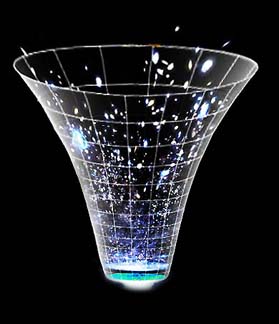
And there's one more question that comes up when people ask me about my beliefs: Do you believe in God?
And this is a tough one, because "God" is not something that means the same thing to everyone who uses it. When your favorite football team needs their opponent to miss their final kick to win the big game, I don't believe that anyone's God has anything to do with the outcome.
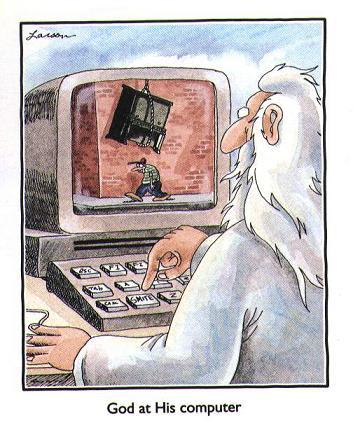
Image credit: Gary Larson. And -- FTR -- not in a God like this.
As far as everything in the known Universe goes, from inflation (before the Big Bang) to today to our future heat death, I don't believe in any sort of being or entity that has played any sort of role in how it's played out. Even Einstein had issues with his conception of God:
"That deep emotional conviction of the presence of a superior reasoning power, which is revealed in the incomprehensible universe, forms my idea of God." -Albert Einstein
But where did our inflating spacetime come from? What happens on sub-Planckian or super-horizon distance scales? Speculations abound, of course, but a type 4 multiverse, a primeval singularity or an infinity of 10-dimensional Calabi-Yau manifolds have about as much observable evidence for them as angels bowling, if you get my drift. That doesn't mean they aren't interesting questions to ask, and that doesn't mean that the scientific speculations don't have some good motivations for them, but it means that we need to be willing to admit that:
- We don't know the answers to these questions.
- We don't know where to look to find the answers to these questions.
- And we don't know whether the Universe accessible to us even -- in principle -- contains the information that would provide any indication of how to answer these questions.
So we'll look, of course. And we'll do all the theoretical work to try and tease potential observable tests out of these various ideas.
I am agnostic as to the answer to these or any other metaphysical questions, in the sense that I not only don't know, but I don't even know whether or not it's possible to know. But people don't tend to ask me what I "know" about these questions, they want to know what I believe.
Fine.
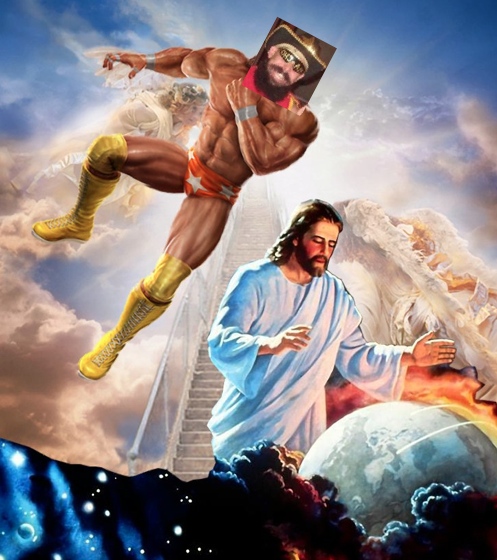
Well, when I think about our Universe, I think there likely was some organizing force or principle that somehow led to the existence of the state that eventually created the Universe as we know it today. I don't have a good name or description (or even a hunch) as to what this force or principle is, so I call it God. And so -- in a sense that (probably) nobody else uses the word -- yes, I believe in God. (I don't know, however, what to make of the picture one of my fans made, below, except to say that I'm pretty sure I love it.)
So I don't have any idea what to even call myself as far as religions or beliefs go. Am I a Jew? An Atheist? A Deist? A Jewish Atheist who believes in God, but not in your God?
Regardless of what you believe, I hope you feel at home here. So long as you're willing to learn about the things you yourself are not an expert in, and so long as the Universe itself fascinates you, you're always welcome to join me on this grand adventure. And now that I've said my piece, you're all more than welcome to tell me how it breaks down for you, what you agree/disagree with, and anything else you care to mention. I'd love to know what you think, or in this case, believe.
It occurs to me that, when people ask if you believe in God, they don't care if you merely believe in an organizing force. They want to know if that organizing force is also a conscious and willed entity. So while I'm inclined to agree that people generally don't mean the same thing when they talk about God, the important parts with respect to society are quite straightforward.
Awesome Ethan! I am Catholic and I am very at home with you being you and me being me and that we are human beings, who respect and embrace diversity on all levels. Thank you for sharing. I appreciate your blog very much!
Dianne Phillips..aka. scienegranny :-)
Carl Sagan, when pressed by a believer for an answer to this question, would always whittle them down to some silly description of an anthropomorphic caucasian deity hanging out on a cloud counting sparrow falls, then reply "I have seen no evidence for the existence of such a creature." Believe as you will, or not believe, but always always ask questions. Be curious, but be prepared for an answer that may surprise you. Thanks for your great work Ethan! Shalom.
I've spent hours debating this question with a good friend of mine. As far as I can tell, our beliefs are very similar to each other (and to you as it turns out), but he chooses to say he believes in god, and I don't. Ultimately, I get stuck on the idea that words need to communicate something, and using a word that so many people will misinterpret or use their own meaning for unless I meticulously spell it out each time just seems like a bad idea.
I'm always surprised by this kind of deism. It seems like a very strange place to decide to stop thinking - pure question begging of the cosmological argument form. Because your "organising principle" now just needs another "organising principle" to explan where it came from⦠ad infinitum. Surprised that a scientist like yourself wouldn't want to Occams razor that stack of recursive nonsense out of their worldview.
Deism only seems useful to me if you are going to use it to pretend to justify one theism or another. It doesn't seem even vaguely useful or satisfying on its own to me.
@rjw:
No, it doesn't. Why would you think you know that about Ethan's "organising principle?" He may have thought of this already, you know.
In my opinion, whether theist or atheist we should like a better way of confronting this infinite recursion; our present notions of causality really don't cut it, even in the cosmological realm.
Sounds like a deist to me. I'd be curious why you think the label doesn't fit well, but then it doesn't really matter what label people choose. No two beliefs are ever the same....for what should be obvious reasons.
Thanks for sharing your beliefs in a very reasoned manner, I spent 40 years as an agnostic with a similar reliance on my own rationality but fortunately a few years ago the Lord opened my eyes and I realized that while you can't prove there is a God the preponderance of evidence is that there is and secondarily if there isn't one the eternal outlook is pretty bleak. I think it takes more faith to be an atheist than an agnostic or Christian so I stayed on the fence as an agnostic until the Lord helped me take the next step. If I am wrong then I will have still spent the remainder of my life trying to help and love others as Jesus instructed and will just be in nothingness with everyone else while if I am right those who don't accept Him have a very long time in unpleasant circumstances to regret it. I have found Tim Keller's book, The Reason for God: Belief in an Age of Skepticism particularly helpful and wish I had had it 48 years ago. Thank you for the opportunity to discuss and you will be in my prayers.
I think I am very similar to you in viewpoint, and if I were to call something "god" it would be the natural order of the universe.
And I do think that the natural order of the universe is a mysterious, complex, and amazing thing. An amazing thing that has given risen to matter, life, forces, and love. But while I see that I do not think any anthropomorphic entity is behind it. And I do not think that we will ever have all the answers we want about the universe.
Unlike the great religions, I am happy with this ignorance. And I am comfortable with the idea that we cannot know certain kinds of information. That we simply don't know why we're here, and we probably never truly will.
Well, you sounded like an atheist until "fine." I think you can probably be described as a culturally Jewish Deist. I'm just curious as to why you think it's necessary to go further than "I don't know" and make up an "organizing force" which you call God? Why is it likely, and why even call it "God" (with a capital G...a term with so much baggage..is it supernatural and conscious)?
Thanks for the post. It's always valuable to hear great scientists make those points.
I can't help but note that your ultimate "god=organizing principle" is a "god of the gaps" that your other points can be used to argue against. Can I call it the "god of the gap of infinite regression?"
I'm an agnostic atheist, or an ignostic, depending on the "god" in question. I guess we would probably believe about the same thing in that regard, though it seems we are divided by a common language:
And you're an atheist Jew. ;)
I think if you tried to give a more coherent description of what you're talking about, the "god" word wouldn't be needed. It confuses the issue more than anything else.
Gods, and other supernatural entities/forces, are supposed to be irreducibly mental. So, if you tried to get to the meat of what this "god" thing is supposed to be, there's not supposed to be any meat. It's worse than turtles-all-the-way-down, in a way. Gods are supposed to be abstractions-all-the-way-down, with no mechanisms or working parts, and nothing but a lot of bad sophistry to back them up. The religious like it this way, since it helps to shield the ideas from scrutiny, though of course it still fails on a number of counts, not least because there seems to be no way for such a "thing" to interact with the physical world....
And weren't you trying to describe something that, if it exists, would interact with the physical world, something that's a causal force or organization that's consistent with physical laws? Whatever the idea is, it certainly doesn't sound like a god, even if it's an answer to the same kind of questions, because it isn't just some vague abstraction or personal being you've dreamed up. It would be like saying "Zeus" and "electromagnetism" are equivalent because they're both attempted explanations of lightning.
So, if you're talking about something equivalent to electromagnetism, rather than Zeus, it helps to be clear about that and what makes it different. It also won't give people the wrong impression about scientific explanations or validate their religious nonsense.
@Luc Duval: That's not a "God of the Gaps" argument. It's a "God OR some other as-yet undiscovered force of the gaps" argument. The Universe either A) had to be caused by God or B) by some force that we do not yet understand. Either way, that which is currently know or observable cannot account for the cause of the Big Bang. It's not a God of the Gaps argument when you also include the alternative of God as the cause of a natural phenomena.
Or C) the universe has always existed, or D) our notion of causation is incorrect.
Well it is if you literally say "I call it God" for the supposed first cause, like Ethan did.... and Aquinas, for that matter. You could even call it "Santa" if you like:
The difference is that it's not necessarily based on the assumption a first cause must be a person (though naming it "God" is basically just that), but it's still a gaps-style argument from ignorance.
Ethan said:
"I think there likely was some organizing force or principle that somehow led to the existence of the state that eventually created the Universe as we know it today. I don't have a good name or description (or even a hunch) as to what this force or principle is, so I call it God."
That would be the God of the gaps. And then of course the question as to where that organizing force originated would have to be asked, and so on, and so on.
And then as far as you being Jewish, It sounds more like you feel culturally attached simply by virtue of birth which is totally understandable. You claim that you feel the need to stand up for the persecuted and that's where you got your sense of justice. I'd say that you have a sense of justice and fairness and you are applying it appropriately, being Jewish has nothing to do with it. I'm an atheist and I feel the same way about people being unfairly persecuted or mistreated, but I don't claim that being an atheist is the reason I feel that way.
Personally I would have expected you to say you were an agnostic just to be politically correct, since science claims that saying "I don't know" is okay. I would have also expected you to follow that with the claim that you were an atheist, because there is no evidence whatsoever that shows that an organizing force or god exist or is needed to explain what we know so far. I'd expect that you put god at the same level as leprechauns, unicorns and fairies or any other number of make believe things that can't be "proven" not to exist.
I've dropped your rating to AA+, but I will continue to read your blog because you kick-ass at explaining the stuff you do know about.
Lol. That is an epic picture, Ethan. 'Elbow from the Sky on Jesus!!'
"So I don't have any idea what to even call myself as far as religions or beliefs go. Am I a Jew? An Atheist? A Deist? A Jewish Atheist who believes in God, but not in your God?"
Based on what you've said here and here( http://startswithabang.com/?p=1598 ), it seems to me you're an agnostic atheist Jew. Regardless of your true position, I do feel at home here. I love your blog, Ethan. Thanks for sharing.
By the way, what do you think of Discovery's Curiosity (episode 1 - Did god Create the Universe? Stephen Hawking: 'No')?
I struggled for years to convince myself that I am not an atheist, until a friend pointed out that if I expanded my definition of "god" exponentially, I eventually believe in it. But the definition has to be pretty darn broad.
It's brave of you to display your beliefs here so honestly, Ethan. I always enjoy your posts!
Welcome to the small "a" atheist club, although your attack on Perry was a bit gratuitous.
Too bad a lot of the people that tried to "fix" the economy, didn't just pray instead. There is something to be said for humility before complexity, and for calling for more morality in fearful circumstances, the circumstances where the risks of breakdowns of morality are the greatest, and the appeals of simplistic demagogic solutions might gain traction.
Thanks Ethan, for the clarity of your writing and your honesty.
I was a life long atheist and, to the surprise of colleagues and friends alike, embraced Catholicism some five years ago. This is not the place to defend my motivations or to debate theism. Though I think that I can put up powerful, reasoned defense.
Rather what I want to note is the reaction. My scientific colleagues subjected me to scorn and derision. There was no attempt at inquiry or understanding. On reading through the many science blogs I see exactly the same tendency, an angry, derisive, scornful dismissive attitude. What is remarkable is the intensity and emotional content of the attacks on any form of religious faith.
It seems excessive and unwarranted in the light of my own experience. What I found in the Christian community that I embraced truly amazed me. First the content of the teachings centered wholly around love, tolerance, respect and forgiveness. What was bad about that? Then I found that they administered many soup kitchens, schools, a hospice and old age homes. The two churches (of different denominations) closest to my home do similar work. And as I look around I see that there are innumerable small religious communities, all in their own small way doing something to help the unfortunate.
To say that I was astonished at the sincerity of belief, and extent of good that was done, is to put it mildly. Then I contrast it with the angry, scornful, dismissive derision of the atheists and I am left with a powerful feeling of cognitive dissonance. I no longer care if atheists are wrong or right. I simply want to be part of a powerful force for good. Now I have heard the many arguments about the wrongs of religion. There is only one problem. I don't see it in my experience, in fact I see the exact opposite and that is good enough for me.
"My scientific colleagues subjected me to scorn and derision."
Don't take scorn and derision over the BAD IDEAS you were espousing and scorn and derision you're taking as a personal attack.
If you were to proclaim that 2+2=banana then you'd get scorn and derision.
Claiming there's a god is nearly as daft.
"There was no attempt at inquiry or understanding"
What's to know? You became a believer. You don't have any proof or evidence that anyone else has not tried to use to prove the reality of God (or whoever) before. I bet you didn't even tell anyone you had something new to impart, did you.
"What I found in the Christian community that I embraced truly amazed me. First the content of the teachings centered wholly around love, tolerance, respect and forgiveness."
Well, first of all, you're confirming THEIR faith, not having one of your own. Secondly, have a look at Glen Beck, Westboro Baptist Church or most of the christians on telly when gay marriage is being discussed.
And what is there to "forgive"? Did you join and steal the tea money?
"Then I found that they administered many soup kitchens, schools, a hospice and old age homes."
So do atheists. And Buddhists, Islamists, Wiccans, FSMers, Jedi Knights and so on. However, the religious feel persecuted because running a home they're not allowed to forbid gay people from paying to stay in there.
When Mother Theresa wanted to ease the suffering in the slums, she COULD have done one simple thing to reduce the problems MASSIVELY: exhort people to use contraceptives. But when it comes to what she wants (eased suffering) and what she believed (contraception is evil), her faith won out without breaking sweat.
"Then I contrast it with the angry, scornful, dismissive derision of the atheists"
The same atheists who also run hospices, soup kitchens, foreign aid, and so on?
Or are there scornful atheists, nice atheists, scornful xtians and nice xtians?
Why do you believe that is NOT the case?
"Now I have heard the many arguments about the wrongs of religion. There is only one problem. I don't see it in my experience"
Church of Scientology members don't see the wrongs of their religion.
"I realized that while you can't prove there is a God the preponderance of evidence is that there is"
What evidence is that?
Or do you have to believe in the evidence before you can see the evidence?
#20,21, Wow, you have just confirmed my point.
@22 Not exactly, you just have not understood theirs. Also the argument that in order to be good you have to be religious is getting tiresome. And there is a huge amount of arrogance implicit in that belief. It's really offensive...
psmith, you just ignored mine.
Proving my point.
It's funny how people see those words "organizing principle" and argue what that makes Ethan... without having the foggiest idea what HE means by it! I wonder if he's frustrated. I would be.
I could also argue--vehemently--both on the question that the Catholic Church is generally a force for good and that atheism has not been. There's a lot of evidence that would call into question both of those points that psmith is ignoring. But I'm not really interested in having that argument here, because no one is going to convince the other--it's all anecdotal, and in truth if it gives psmith a warm fuzzy feeling to help people through the Church it's probably for the best. I just wish he had tried to organize atheists the same way, if it was important to him, rather than identifying with a worldview I believe is wrong.
Believing in a higher power is a great way to get people to open up to each other and feel a sense of belonging and purpose in their lives. If you've never been part of a church (especially a modern one), I invite you to give it a try, if only to see how the people around you are behaving and interacting with each other.
The great tragedy of our time is that the prominent religions of the world are based on revelation or scripture, which puts them in direct conflict with scientific literacy. Let's hope this madness will one day be replaced by a religion that resembles Carl Sagan's "Cosmos" or Brian Cox' "Wonders of the Universe".
Atheist, here. Strong atheist, but still there is a tiny bit of a reason for error and that would be some sort of undeniable evidence that I am wrong. I am also agnostic about Thor or fairies in the garden.
Even a "personal revelation," given to me would not be such evidence because I have learned about about how our brains can play tricks on our mind and rather convincingly at that.
I think your definition of God, Ethan, is very common among physicists, such as referring to the Higgs' boson as the "god particle."
Thanks for this post, I had suspected as much for some reason, but it is always cool when people come out an tell us.
psmith, your story is very similar to mine. I was astounded by the anonymous unheralded good things -- many of them requiring significant cost in time, money and personal engagement, and NOT requiring proselytization -- managed and carried out by the people I found in religious communities. It was not at all what I thought it would be like.
You are not alone. Don't know if you read Elaine Howard Ecklund's book 'Science versus Religion: What Scientists Really Think,' but to me what was interesting was how many scientists had spiritual or religious convictions but were keeping them secret from their colleagues due to the kinds of reactions you describe.
Ethan, I've been reading and enjoying your blog since before you came on ScienceBlogs.
Oh, and AJKamper, nothing is to stop atheists from organizing for social justice and the alleviation of poverty and environmental degradation and so forth. I think Hemant Mehta has something going, I'm sure there are many other secular groups as well.
"Believing in a higher power is a great way to get people to open up to each other and feel a sense of belonging and purpose in their lives."
Nothing drives a good man to do evil better than having religion.
Having the ONLY true faith is a great way to hate humans because you can then call them non-humans and make war upon them.
"Oh, and AJKamper, nothing is to stop atheists from organizing for social justice and the alleviation of poverty and environmental degradation and so forth."
And atheists AREorganising for social justice and the alleviation of poverty and environmental degradation and so forth.
Additionally, their faith doesn't mean persecuting gays, lesbians, atheists, heretics or alternate faiths.
It's funny how many "faithful" feel that there's a hell but can't let God put the bad people (tm) there and have to instead push them in.
@Anna:
Oh, I know. I just meant that if psmith didn't see it, then he could have done something about it himself!
While born into Judiasm, when someone asks I usually give my religion as Pastafarian. Or Zen Druid - meditating under trees that aren't there.
Regardless, this insight into the Person behind the Scientist has, if anything, raised my respect for you even more Ethan.
Keep up the fine fine writing.
-M
Thanks for sharing your views! It's always nice to share what and why people believe. Btw - I'm an Atheist, but support everyones views and opinions so long as they aren't shoved down anyones throat. :)
#33, Mike, I think you hit just the right note: respect. We should respect each others' choices, and respect each others' rationale.
Beyond that, I see a huge world of suffering. All I can do is exhort all, regardless of ideological label (or absence of), to do something, anything, but do something.
On my daily walk with my dogs I passed one of the two churches I alluded to. Outside was a crowd of the unfortunate collecting boxes that would sustain them for the next week. They don't care what ideological label is put on the box but they do care about what is in the box.
"We should respect each others' choices, and respect each others' rationale."
What is there to respect? After all, the Unabomber made choices, had a rationale.
Respect is earned, not demanded.
And despite your homily about "They don't care what ideological label is put on the box", as AJKamper said, you could have organised a box yourself without waiting to become Born Again.
The problem with religious people is not that they want to have their religion.
The problem with religious people is that they want other people to have their religion.
If the religious kept their beliefs in their homes and "places of worship", there wouldn't be any problems. But that's not what the rabidly religious want, they want the tyranny of the majority and the ability to tell everyone else, "join, leave or die".
In the absence of a testable "god", religion is nothing more than an ideology like communism is an ideology. And throughout history, every atrocity perpetrated was by those who claimed absolute certainty from an absolute authority, whether "god" or "the party".
.
psmith: "I think you hit just the right note: respect."
Wrong. The only respect that a religion deserves is the right to have it, and the religious already get that. The religious aren't seeking respect, they want deference and obedience from those who don't belong to their cults.
If I say, "Feces christ is a myth," it is no different than saying, "NASCRASH sucks", "Lady Gaga is an untalented moron" or "Smokers are buttheads". Chosen behaviours and preferences like music, sports or politics are not exempt from criticism, and anyone who used violence against a critic would go to prison.
Why is religious bu**sh** exempt from criticism? "Because it's exempt?" That is the answer of a two year old child, which is exactly how the religious behave when they hear criticism of their beliefs.
If religion had any merit, it would welcome questions and answer them. The strongest argument is the one with the facts to answer questions, not the one with the physical strength to stop questions from being asked.
.
So Ethan, you're an atheist. It's just that you can't admit it yet...
I was raised Catholic, but I gave up the religion in my teens. I simply can't bring myself to associate with religious people when I see them hanging out outside the malls, preaching sermons, who simply lie. Just the other day on the bus I overheard a self professed preacher try to justify Christianity in the "fact" that if the moon were "1 and a half inch closer or further from us" (1 and a half inches specifically, trying to clarity I said 1 inch, and he corrected me, 1 and a half) then the whole solar system would go out of whack. It's just not true. And when I try to correct these people, telling them I've looked into these matters and politely tell them they are wrong, they simply talk over me and continue to spout out misinformation. He was actually harrasing a young lady that it was very obvious she did not want to talk to him, which is why I interupted, and tried to keep him occupied until she got off. Yes, I understand that this is not all religious people, and yes I understand that there are many who have no conflict with thier beliefs and science. Honestly I'd read about people like this on blogs like Pharyngula and on youtube and such, but I never thought I'd really see them around, in my own neighborhood. And I have been seeing them more and more recently. This may be simply because I'm paying more attention but I can't say for sure. There is another guy that hangs out at the bus station I'm at regularly, and I always see him talking to people. I've conversed with him before, and he simply gives false information. Giant skeletons that were found prove Genesis (which was a photoshop contest winner), dinosaur bones found with blood still intact (inside the bone, I think he meant marrow, but he said blood), the arc was in fact found, so on and so on. He's a nice guy and the conversation was civil, but he's just either grossly misinformed or lying. When I point out to him where he's wrong, he just ignores what I say.
Personally, I don't need a god or even a vague notion of a deistic god to find fulfillment in my life.
Great post, Ethan. It's a wonderful universe, and I'm certainly a fan of you helping me understand it just a tiny bit. May you be touched by his noodle appendage.......
Here's the most convincing proof there is no God: Rick Perry.
No self-respecting diety would ever have created this putz. He's an embarassment to the State of Texas. Yet, the citizens of the Great State have elected him 5 times. One must remember, though, we also elected George Bush, who is further confirmation there is no God.
Your blog, Ethan, is my favorite. You explain complicated matters in a way even George Bush could understand them ... ok, that was way too extreme. Sorry.
Although, as you said, it's not important to what is one's religion, I think we have to speak up about the problems which are created by solid religious minds in our world. So, I think the problem is, people who believe in a religion in traditional style can not digest current world situation properly and make serious problems for other people. I agree it's good to respect others religion, but it's essential to criticize them too. It's necessary to put light on every idea and theory, religion is not an exception. It must be the headline of discussion because it's not just for you and me or some minor people. Many many people are living in the name of a religion and must be get aware about what they are living with deeply.
I can believe this was Posted at 4:20 PM, and its a metaphysical discussion on the existence of god.
I can be the only one that is amused by this, right?
One question for Ethan.
Actually, I didn't get what do you (and many like you)want to insist on using the world "God". Let's give up this word for those believe in a creator such has thought in their holy book. I'm so happy Muslims are used to telling Allah instead of God. Because theirs is very different from others. And good other people come up with other names... make it easier to distinguish; I don't know let's just call what our believe as unknown power "X43ty2" or "M2Xi76" or something else, but different and without the weight of the God word and history of this word. it's better, I think.
Whether we believe in "god" or "not;-god" we are all stuck facing the great mysteries of the universe and self; we all must figure out how to live a worthy life.
There is no one consistent story either religious or scientific that all hangs together and tells the whole story without giant gaping holes of ignorance and misunderstanding.
After an airplane conversation with a small town Baptist M.D. about god and the universe; I said "I know atheist physicist who would accept your definition of god."
He said, "I know."
I asked, "Can you discuss your understanding of god with the people in your church?"
He said, "No."
I asked, "Are you able to discuss your understanding of god with your wife?"
He said, "No."
Words like "god", "not-god", "universe" have many definitions and meanings; and our individual understanding changes as we learn. How could it be otherwise?
Who is to say that my "god" or "not-god" is less religious than your "god"?
Theology is dogma, religion is a way of life (belief is to "be-lived.")
I also think that creationism, and bible (or koran) literallism is a very, very bad thing for the human race. I understand if people want to take inspiration from these books, but to take them literally is just simply self denial. I fear that it will eventaully drag the human race back into the bronze age of superstition and ignorance that it came from. I fear for the world that my grandchildren and great grandchildren (and so on) will have to live in.
@Terry Girardot,
Even if Perry and Bush manage to proofs of a negative, they may also be evidence of the value of religion for the social animal, as a sign of increased probability of integrity in leaders. Credible proclamations of commitments to principle have their appeal, even if they are simplistic and lame. John Kerry's situational ethics did not inspire confidence or trust, who can remember whether he was for the war, before or after he was against it? Hmmm, perhaps the more simplistic, the better for credibility. John Kerry, Barack Obama, G.W. Bush and Perry all claim to believe in God, but which ones professions of faith are the most believable, and which were just made out of political expediency? Which would be most likely to mock the idea of prayer for our economy, like many here, in private if not in public?
Even though there is no evidence for the existence of the God of the major religions, there is evidence for the existence of believers in that God, and religious belief is arguably the human norm.
I'm just this old guy with an obsolete psychology degree, who loves science and loves to learn random stuff. So I read blogs like yours and I find out about stuff like supermassive black holes surrounded with galaxies that huge masses of water, or jets of energy hundreds of light years long, or humongous underground crystals that are beautiful as well as cool - and I think how tiny I am and how cool the universe is and how beautiful and fascinating it is - thanks to The Hubble, the universe is like having an unlimited ticket to the "all insanely wicked show" 24x7. And, what's cooler than all that is that the whole thing appears to be organized with some fairly straightforward (considering what they've accomplished!) rules and it's mostly, really, nothingness.
If someone made the proposition to me that "god is another name for the 'incredible coolness of everything'" then I guess I'd believe in god. But I don't need that. Because it sounds like physical law is god enough for me. When I ponder that the 'big bang' caused galaxies that collide and volkswagens and puppies - well - who needs to worship something? I guess you could say that I'm from the "church of slack-jawed amazement."
PS- I love your blog.
Can I call it the "god of the gap of infinite regression?"
It's more like the integral god - sliced smaller and smaller with less and less of a role in anything, to the point where its limits approach zero. Eventually we'll just assume it away and all the math will still work, so - poof - no more need for that particular variable.
Even if Perry and Bush manage to proofs of a negative, they may also be evidence of the value of religion for the social animal, as a sign of increased probability of integrity in leaders.
Or it may be that the value of religion was that it was a primitive form of political control. Because the idea of state authority emerging from a social mandate hadn't been advanced, yet, it was easier for Hammurabi to say that he ruled because Marduk wanted him to. It saves a huge amount of back-talk and it allows political authorities to appear to exist for the good of the masses without having to appeal directly to force. "God says I am your anointed leader" is somehow easier to swallow than "That guy with the spear over there says I am your leader." I've always seen religion as a left-over brain-hack that really should have been discarded once the ancient Greeks started to invent political science.
That religious dogma appeals to authoritarians and that authoritarian leaders often wrap themselves in a mantle of religiousity (or patriotism, which, in its mindless exceptionalism is pretty much indistinguishable from religion) ought to tell you something.
@Marcus Ranum,
I agree about the past, but there is some truth to American exceptionalism. Here the religious right is fanatical about limited government, and constitutional checks and balances. They are the classical liberals of old, not trusting fallen human nature with power or authority.
It is the left which retains the vestiges of the divine rights of kings, except they imbue that right in the collective, the race, the class, the exploited or the Hegelian state. It is the left that believes that nations have rights, the left had irrational respect for Saddam's sovereignty, and still believes in the fictional sovereignty that Pakistan claims for its tribal lands, and the left that claims dictatorships have the right to serve on United Nations human rights commissions. It may be the religious that invented original sin to burden us all, but it is the "atheistic" left that cling to collective guilt and demand solidarity in order to achieve collective salvation. It is the left which centralize power and place their faith and authority in leaders and technocrats. If is the left which makes personality cults of Chavez, Gore, Chomsky, Castro and Che. Leftists aren't true atheists at all, they just have new gods. Perhaps they shouldn't be blamed, religious belief is arguably the human norm.
@africangenesis -
I think that simplistic labels like left/right break down when you start to actually think for yourself a little bit. Your caricature of "the left" seems a bit exaggerated, but let's work with it a minute - you appear to be agreeing with me, to the extent that you're equating "the left" with authoritarianism.
So, is coming up with laughable straw-men also a thing that "the left" do? Or is that what "the right" do?
FYI - generally, when you're arguing with an epicurean anarchist, telling them that one side or another believes in 'limited government' is just going to get you laughed at.
Cool. Closely matches my philosophy.
btw, for some reason I could almost hear you channeling Al Pacino from his movie, And Justice for All. :)
I do feel at home here; in fact, I love it here. I check your blog daily, hoping you have something new posted. And I really, really appreciate the hard work you put into it. Thank you.
@Marcus Ranum,
I was agreeing with you to the extent that in the past religion was a form of authoritarian control, but that changed with congregationalism and a commitment to the priesthood of the believer, which became far more dominant in the United States than in Europe.
As to epicurean anarchism, unless you have found some way to limit participatory democracy without government, then you will end up with a conscript society where everyone must perform the task assigned to them or imposed upon them. Individual preferences are taken into account only at the will of the group. Dissent and protest will only be tolerated if the group is OK with it, and most likely will be severely suppressed. There will be total material equality if the democracy wills it, but it is free to will something else. So, superficially there is a difference between a totalitarian dictatorship and an anarchist participatory democracy. However, from the perspective of the individual within it there is no difference.
The founders had plenty of experience with the divine right of kings and saw past it to see that the problem wasn't tied to royal blood or religion, but to the hubris that comes when humans have unchecked power.
@CR (14), cheers.
@Marcus Ranum (50), "the integral god", hehe.
Hello all,
thought I might just chime in with a few things. First off, @psmith -
As much as you are clearly going about your new found christianity in a peaceful thoughtful way, you must admit it is pretty understandable that people who value science will not be impressed with your faith. The initial reaction most atheists have to lost athiests, is that really, you should know better. If I die by falling off a cliff while drunk, I really should know better than to get that drunk near a cliff! If you had said you believe in the POSSIBILITY of God, that would be ok, but to actually go all the way to the other extreme of catholicism is... well... just a little bit crazy. I'm struggling to think of an analogy for this type of behaviour... PETA activist to Tea Party member perhaps?
Anyway my 2 cents on the larger scale topic of belief. For me this means attempting to define something that is absolutely unknowable. Even if we get a definition of "the force that created the big bang", whatever that may be, there is still the lingering issue of why does anything exist at all? The issue of "god" and the universe, is no less amazing than the coffee cup I'm holding now. The fact that anything at all exists is the big question to me, and the term "god" in this case is expanded out to the point of "god"="existence of anything".
Yet one has to handle both the inner and outer implications of this, and I tend to like this way of bridging these opposing thoughts - "You are the universe experiencing itself". This is (in a way), a modern western rendition of "thou are that".
Anyway, personally I found these things to be quite a problem, as the commonly accepted "god" of the masses, i.e, old guy in a throne up in the clouds, was clearly ridiculous, but to find any thoughts beyond this is incredibly difficult as there isn't much discussion on the subject that isn't either A, supernatural, or B, pointless moralising. I was only able to find traction at all with the works of Alan Watts, and Joseph Campbell, who are essentially western buddhist philosophers, which means there isn't an ounce of superstition in any of it, yet still has an ability to shed light on the subject, even if it's through a method of paradox.
@PeterC, #58
You said:
"...As much as you are clearly going about your new found christianity in a peaceful thoughtful way, you must admit it is pretty understandable that people who value science will not be impressed with your faith. The initial reaction most atheists have to lost atheists, is that really, you should know better."
Thanks for the "peaceful, thoughtful" comment, it is something we should all strive for.
"...understandable that people who value science will not be impressed with your faith." Their reaction seemed a little disproportionate.
As for the "you should know better", well, that is the whole point. I have been there and thoroughly examined every atheist argument. And, by the application of sincere, careful, thoughtful analysis come to very different conclusions. The subject is far broader, deeper and more nuanced than the reasoning on display in the comments of this blog.
All I wish to do is flag the fact that sincere, thoughtful people can reach different conclusions and that these conclusions can motivate a world of good.
"you appear to be agreeing with me, to the extent that you're equating "the left" with authoritarianism."
So George W Bush was on the left?!?!?!?!
"The subject is far broader, deeper and more nuanced than the reasoning on display in the comments of this blog."
Or, in other words, you're talking bullshit.
"thoughtful people can reach different conclusions and that these conclusions can motivate a world of good"
Yup, agree there.
And that conclusion doesn't have to be "there is a god". Funny how you think that atheists don't do any good, though.
Wow,
Don't be confused, despite G.W. Bush's support for federal involvement in education, immigration reform, expansion of Medicare to include a drug benefit, and nation building, he was more in the center than on the left. The contrast with Obama should have made that clear.
Bloody hell.
I *thought* you were nuts, but that's just proven it.
"GWB is more in the center than the left"!?!?!?!?!
Wow, the Overton Window has, for some idiots, has put Atilla the Hun off the extreme left...
Ethan, your blog is a welcome place, a learning place, an open place and a physics/astronomy place. I came for the physics and the astronomy; but I keep coming for the welcome, learning and openness.
And I keep writing, even on topics that I wouldn't otherwise comment; because it is your blog and I am part of your community. So I stretch myself and see if I have something appropriate to add to the discussion.
I was raised as a Catholic; left the church as an atheist at a young age. Today neither theist nor atheist nor agnostic are labels that are useful to or descriptive of me. But I am religious in my approach to life. I am also philosophic and scientific. I am also stubborn but I am not fundamentalist; because deep deep down despite all of the excellent detail observation, experiment and theory; I believe that our universe is fundamentally indecipherable. Thus our learning is always tentative; scientifically, morally, psychologically, politically whatever way we look at the world.
As a young man, I would argue to convince of my point of view. But today I know it is not my place to undermine what another might believe. I will discuss religion and science with most anyone but I never will try to undermine their core beliefs. Nor will I let another undermine my core beliefs. But in discussion, in understanding, in getting to know one another we change one another.
I am influenced, changed by knowing, learning from and understanding another.
Oh on the god question. God is like the Feynman path over all definitions of god and not god. God and not god are like the particle and wave of quantum mechanics. What god, gods or not gods yield understanding or are appropriate may vary by circumstances. Yes, I am a religious chameleon (which is very different than being a hypocrite). As a religious chameleon, what I believe and how I express it is determined by who I am talking with (e.g. a child, a physicist, or very Catholic friend) and whether I wish to agree or disagree with them (always respectfully).
I was raised Christian, but after starting college as a science major I became an atheist. At the same time I didn't feel that atheism fully described my beliefs, or sense of wonder and awe about existence.
So now I see myself as a panentheist, a variation of pantheism, the belief that everything in existence is part of God and that God is the ground of all being. I like panentheism a lot, it focuses on what we know to exist (mater/energy), and leaves open the possibility of something more beyond the universe and beyond philosophical naturalism, but makes no claims either way.
For me, Neil Degrass Tysons God of the Gaps video on Youtube sums it up perfectly. Most of the great thinkers of the past were indeed believers in Intellegent Design. Copernicus, Kepler, Newton. They each figured something out about the universe, and yet, what they still could not explain, they attributed to God. We see this pattern throughout history, and we see that every time, eventually, the mystery can be explained by natural processes. Since we know and understand that this pattern, why do we not just say "we don't know yet"? I have no problem with not knowing something. I find it's usually the people who think that they do know everything that actually who know very little.
I also don't believe that there is anything in nature that is "unknowable". We are not seperate from the universe, we are the universe. To quote Sagan, "we are a way for the cosmos to know itself". I believe that given enough time, with curiosity and bravery, we can know the answers to these hard questions. We just need to get over our own petty squabbles before we'll be able to try.
"God and not god are like the particle and wave of quantum mechanics"
I've actually thought about that proposition before. Maybe there is a duality in nature, for some, there is a god, for others, there isnt. The problem with that argument is that there is definitaive and measurable evidence for both the wave and the particle properties of electromagnatism. There's none of the god aspect.
It's not much of a God, though, Matt, is it?
After all, it won't change because you ask it. It won't notice you're there, and won't notice you've gone. It won't give you anything other than consequences and freedom.
And as such, is a God in the same way as my tablecloth is a brand of antiperspirant.
@africangenisis
Yeah, if you're willing to assume that's how things would have to go, that makes sense. Though I'd quibble and say that what you're describing is really not that "anarchy = dictatorship" but rather that "anarchies easily collapse into dictatorship" - which can be said of all political systems. The problem isn't anarchism, it's keeping other political systems from filling the power-vacuum anarchism implicitly creates.
I've never followed the argument that smaller is inherently better, when it comes to government. Simply because an absolutist monarchy can be very small and efficient - in fact you can eliminate all branches of the government except the police/military and a single executive - but usually the only person completely in favor of that is the monarch.
Primum movens, eh? Ok, for extra credit - how did you arrive at that conclusion? And show your work! :)
i don't believe in god. straight up athiest--no agnostic wishy-washiness.
when people ask me why i don't even consider the possiblity of a god, i ask them if they believe in the easter bunny. can a rational person *really* believe in an anthropomorphized lagomorph that delivers eggs once a year?
it is the same for me. i find it as easy to not believe in god as religous people find it not to believe in the easter bunny, and for the same reason: it's preposterous.
@Marcus Ranum,
The advantage of keeping government small, is that you have more time and warning when a small government decides to try to go big, than when a big government decides to go bad.
We need more than the hope of good intentions in human societies. In any human community some will be more persuasive and accumulate more influence. And as F.A. Hayek noted in "Road to Serfdom", certain type tends to rise to the top.
Although natural observed phenomena can be explained by the laws of nature, it's the organizing principle that is fascinating, what David Bohm called the implicate order, juxtaposed to the observable, explicate order.
Or Paul Davies' analogy to a computer operating system in his book The Mind of God.
It's hard not to envision some kind of Giant Planner.
Humans declaring definitively the way it is, or isn't, is too often tied to those humans' personal hopes of specialness and desire to feel secure through belief.
Finding security within a fixed belief system is not for me. Plus there are a lot of scamsters in that field. Labeling yourself with some term like atheist or agnostic seems to me equally naive.
I go with the crowd that says discovery is ongoing and we may not even have the intellectual equipment to grok It The All and Everything.
I'm comfortable with (even enamored of) uncertainty.
You may find this article very informative and useful of realizing that God is a metaphor for something within all of us,
http://divineradiancefellowship.blogspot.com/2010/07/spirit-of-god-life…
Please find time to read the other articles on the blog.
@ Wow: [quote]It's not much of a God, though, Matt, is it?
After all, it won't change because you ask it. It won't notice you're there, and won't notice you've gone. It won't give you anything other than consequences and freedom.
And as such, is a God in the same way as my tablecloth is a brand of antiperspirant.[/quote]
It's certainly not a classical theistic God, which has been the main view in western history. However there is more than one definition of God, and it is a shame that so much attention was given to theism which has some serious disconnects with reality/evidence. I myself choose to label the underlying laws of nature as part of God or God (depending on if there's something outside of our own universe), almost like a variation of Einstein's God.
I'll agree that it is very atheistic and/or deistic, and some see it as "sexed up atheism". There is no incentive to offer praise, worship or prayer as you would a theistic God. On the other hand, there cannot be a bigger definition of God than panentheism as God is everything in existence both natural and any supernatural components that may exist.
Ethan, I feel at home here and enjoy your blog immensely. I think you hit the crux of it. There is very likely some organizing force behind our universe or multiverse. And I am always surprised to find that physicists are so consistently atheist since all that I read about astrophysics naturally leads me to a clear notion that a higher power indeed exists. I know that Stephen Hawking is a brilliant man. I also find him to be stupid (with regard to his clear repudiation of any existence of God). Perhaps its because I don't have a Phd. that I am so parochial in my thinking, but for a non-physicist I ravenously consume as much information in this area as possible. It all leads me to God, a creator, a higher power...
Of course evoking an impersonal "organizing principle or force" is an oxymoron. It attributes personal intelligent design to an impersonal entity. This is no different than saying "nature designs" or "evolution engineered." The only explanation for there being evidence of design (including beings that can ask this question) other than a personal God is resort to infinity. This random arrangement of molecules is one of an infinite number of random arrangements, so given an infinite number of multiverses this one was bound to happen and so here we are, the anthopic principle. But even this case fails, because there is nothing special about this random set. Radio static and Mozart are essentially the same thing. The answer to the question "why is there something rather than nothing?" is "there isn't. Both Mr. Siegel and Mr. Sagans brilliant thoughts are likewise nothing. We are thus left with a choice between seeing the universe and ourselves as either the creation of a personal creator or as nothingness.
Thanks for sharing. Your journey through these questions is most interesting.
My own journey took me on a very different path but somehow I have arrived at a similar place. I was raised by agnostics and exposed to all religious traditions, major and minor. I found most of them to have points of value, but none of them to be completely convincing. Taking them all together, it did seem that by their very ubiquity they indicated that there was something or someone out there, behind it all, and that it behooved me to try to get in touch with that.
Later I came to feel that real spiritual progress could not be made by cherry picking and cobbling together one's own set of beliefs. Rightly or wrongly, I decided that one had to commit to a particular tradition in order to delve deeply. So I committed to Christianity and followed those disciplines as best I could for three decades.
Along the way I have followed a layman's passion for science, partly fueled by the fact that certain sciences -- chiefly cosmology -- were poaching on religion's territory. It looked like science might finally be about to answer some fundamental questions that up until now had been the exclusive province of theology and philosophy.
As it turned out, Stephen Hawking and most other prominent cosmologists have concluded that, like Laplace, they "have no need of that hypothesis" (i.e., no need of God). They believe the universe or multiverse or whatever it turns out to be can be adequately explained solely by reference to natural law. And to give them their due, it does appear there are fewer and fewer gaps for God to hide in.
Maybe it's my own failure of imagination or understanding, but I still find it hard to comprehend creation out of nothing as a scientific concept. If it makes any sense at all, it makes more sense to me as a religious concept.
Anyway, the net result was that, while I could probably never be an atheist, I was knocked back from Christianity to some form of agnosticism. While I may not be able to know, I sense that there is something behind it all, call it an organizing force or principle as you do. God is as good a name as any for it, though what you and I mean by that may not agree and nobody else agrees with us either.
That intuition or hunch is not much to go on.
I admire the efforts of those like Stuart Kauffman who recognize that it is harder and harder for most thoughtful people to maintain one of the traditional religious faiths in our time. Kauffman's book "Reinventing the Sacred" is a brave attempt to find some workable substitute for the old traditions. It's sort of a combo platter of modern science and pantheism -- worshipping the universe. I can certainly think of worse things to worship, but I'm afraid I can't quite go there with him. (Incidentally, quite part from his new religious synthesis, Kauffman's book is valuable because it contains a very clever refutation of reductionism.)
So there you have it. It seems you and I have come by different roads to pretty much the same destination. I'm not sure what that means. But I thank you for having this conversation. In my book scientists like you who are pushing the boundaries of our knowledge ever outward are among the greatest heroes of humanity. Which makes that mash-up picture of you by your fans fairly accurate.
It may sound like I am avoiding the issue, but I kinda, sorta, believe that there is something in the Universe with which I can put myself in accord. It ain't the old guy with the beard, it is more a sense of Beauty and Elagance. Now, I am aware that the Universe could just as easily be perceived as hostile and malevalent....... and at times Nature certainly is. Still, I bask in those moments that seem to proclaim the 'rightness' of this existence. That life (individual life) is not eternal can be seen as making it all the more precious. Eternal life seems more likely to be a curse than a blessing and I cannot see how the mind, spirit, or soul (as one wishes) could ever be separated from our physical body. Not for everyone for sure, but MYSTERY and AWE can stand in for God for some.
Russell #76
That is much too negative. How about:
"We are thus left with a choice between seeing the universe and ourselves as either the creation of a personal creator or as a wonderful explainable somethingness."
Oops "wonderful unexplainable somethingness.:\"
"It's hard not to envision some kind of Giant Planner."
The hard bit is making that Grand Planner something believable.
Also, on this whole "please respect us" note. Problem:
When the religious want respect, they want the respect of a believer. I.e. "Respect I'm right and believe it's true".
However, scientists are giving religion the respect that they do for their own "religion": question it and see if it's a good explanation.
Now, the religious don't seem to need to accord the science the respect they want to see, do they, despite the scientists giving them the respect they give for other people's science.
"I myself choose to label the underlying laws of nature as part of God or God (depending on if there's something outside of our own universe), almost like a variation of Einstein's God."
That's called "Deism", Matt.
And it's not Einstein's God, he doesn't believe there is one, deistically or not. Einstein uses "God" because the press who are pandering to a highly christianised readership insist on asking him about God. Seth's "There is very likely some organizing force behind our universe or multiverse." is very much a deist proposition and is 100%rejected by Einstein. There's no "organising force" any more than a pile of sand "organises" itself into a cone when you pour it carefully in one spot. I.e. the forces of friction and gravity.
"This random arrangement of molecules is one of an infinite number of random arrangements, so given an infinite number of multiverses this one was bound to happen and so here we are, the anthopic principle."
Nope.
Evolution will work to make a product that works better. The random arrangement works worse and won't be considered.
There's no need for an anthropic principle in evolution. It's an inevitable result of the mutation assessed against a background of competing energy users.
Wow
Once, we get beyond stereotyping, slogans and soundbytes; we find people, usually real people.
I am an outsider to all organized religion. I do not try to proselytize nor will I tolerate being proselytized to; but I will discuss with most anyone who button holes me on the street or knocks on my door.
But I have a few of ground rules.
- I will not try to change your core beliefs (because they are important to you); and you will probably not change mine.
- I will listen to your ideas of god, the universe, morality; but you must listen to mine.
- I will not make a contribution nor read or take your pamphlet; I will only discuss.
Surprisingly, even among such dedicated proselytizers, 90% agree to discuss. And as I listen to their creationism; they listen to the developmental stages of a human being from single cell to gill slits and a tail to you. Most did not know, and I reassure; what difference does it make if your god created man in this world in 7 days or 15 billion years. And I learn that they just spent 3 months in Haiti or the Bronx, doing missionary work and building a school.
Now pardon me; but any narrow minded person, who knocks on doors for 3 months gets his mind opened up a little bit.
Mocking and name calling ends discussion; and reinforces a viscious cycle of misunderstanding.
As for promoting my beliefs, I seldom do. Even among my children from the time they were old enough to understand; I allowed them to believe whatever they wanted too (unless it was harmful to them). It wasn't until they were perhaps twenty that I would even answer their questions as to what I believed. Rather I would ask and probe as to what they believed.
"Once, we get beyond stereotyping, slogans and soundbytes; we find people, usually real people."
Aye.
Problem is that because religion not only has The One Right Answer, it is also The Answer From The Creator Of All Things and that any successful religion requires converts (see, for example, the RCC DEMAND that mothers HAVE to raise their children under the RCC faith), it has to make a slogan to show that "THEY" aren't actually humans.
I've tried that second point of yours. But, oddly enough, though they're quite willing to give me their books on their faith, they're not willing to read Terry Pratchett's Small Gods (I've not yet managed to get one to even pick up "Good Omens").
"Now pardon me; but any narrow minded person, who knocks on doors for 3 months gets his mind opened up a little bit."
Unfortunately, this isn't the case in the majority. Most cling ever more tightly to their faith when it's questioned.
"Mocking and name calling ends discussion;"
Mocking a not-even-half-baked mantra is the only course. To discuss an idea the idea must be expressed clearly, else there is nothing to discuss and mockery is the only possible recourse.
Wow
As a 20 year old righteous atheist science major I had a conversation with a 40 year old woman scientist in her lab. At the beginning, it was a discussion of science and I did not know of her strong religious beliefs. But the discussion moved to religion; and I smashed and mocked her beliefs to bits. At the end of the conversation, she "couldn't express a clear idea"; all she could do was shake her clenched fist and say, "How dare you?"
And she was right, How dare I?
Even if an adult believes in the tooth fairy; how dare I mock or disparage them?
About fifteen years ago in Harlem, a 25 year old disheveled black man asked me (a white middle aged white guy) for money. I decided to give $5 in exchange for a story. It could be fact or fiction; but it had to be an important story to him.
He took the $5 and immediately answered, "Hansel and Gretel."
And I say to myself, "This son of a bitch is mocking me; I've been hustled, what kind of fool does he think I am?" But I calmly ask, "Why is Hansel and Gretel important to you?"
And he answers, "Because of its sense of justice."
Pow, right between the eyes, he blows me away. My mind races through the story of the wicked witch trying to fatten and eat the children; and how they trick her and push her into the oven. Such a fairytale sense of justice!
So, my point, when someone tells you that they believe in some half baked mantra; ask them, "why is that important to you?" Once in a while you may get your eyes knocked wide opened; that young man in Harlem earned that $5.
Three of my brothers still go to Catholic church, one goes to a fundamentalist evangelical type church. I am an outsider to all organized religion.
When I was 18 I walk home from Sunday mass one day; and my mother asks, "Where are your brothers?"
I say, "They're still in church."
My mother asks, "Why aren't you in church?"
I say, "There is nothing for me there."
My mother says, "You mean today."
I say, "I mean never."
She asks, "What will I tell your younger brothers?"
I say, "That I'm a good person and that I live according to my beliefs."
Leaving one's church may be easy or hard. For me it was very hard, it took me another 10 years to be comfortable with who I was. I know how hard it is to leave a social institution that has been a part of your whole life that gives you a sense of community and purpose. I never encourage anyone to leave their religion without thinking about it a lot, I tell my story and ask them to reflect upon theirs; you can leave tomorrow or the next day.
My family accepts my disbelief and have learned to accept my questions. Just yesterday, appropriate to the phone conversation with a brother I ask, "Do you believe in abortion?" He says, "No, I'm pro-life." I say, "Oh, I didn't know?" That was enough; my father has been proselytizing "pro-abortion" to my brother's "pro-life friend" and driving my brother crazy; but the real discussion is my father's mental deterioration.
It's a hard trick, I'm still learning to be able to ask people about their beliefs without raising walls of suspicion and anger. I learned to inquire, be interested and curious without being condescending, judgmental, disparaging and argumentative. But I still screw up and some friend or family member won't talk with me for a year.
I like boxing. I don't like the injuries, so I'm against it; but I like it. But I hate an uneven boxing match. I mean just stop the fight; I don't need to see Roberto Duran massacre someone. I've never been to a live boxing match except between myself, my brothers and friends as kids in the back yard. And I seldom watch sports on tv.
Now my point is this, I can overwhelm some people in an argument and others can overwhelm me; but nobody learns anything important in a verbal massacre.
Now back to your point, "To discuss an idea the idea must be expressed clearly." If someone can't clearly express their idea; I try to listen like they are my brother or daughter or mother. And I try to help them to articulate what they feel and think. And feelings are a big part of beliefs. How else was I to know my Mom (who died last year)? And I wanted to and knew my Mom; even her pains as a little girl and her relation with her parents, her friends and my father.
I never accept (or for that matter buy) a book that I am unlikely to read. I'll just say, "No thank you. I won't read it. It will go in the garbage. But I will listen to what you have to say." Now in my experience with street corner proselytizers: I don't stop; if they want to discuss; then they are welcome to walk along with me. And of those walking or those knocking at my front door; only about 10% cut the discussion short. Fine, they do understand me; they just don't want to know me any further.
In a slightly longer conversation, they still might slam the door in my face for some thought-virus they catch from me. What thought-virus?
e.g. A man next to me on a plane not saying a word, just reading his holy book; I read my book. At meal time he starts a righteous religious conversation. I ask, "Do you believe in freedom of religion?" I have never met a person who does not believe in freedom of religion. He said, "Yes."
Then I ask, "Specifically, do you believe in freedom of religion for the most important people in your life. Your wife, your children."
With that, the man says, "Now I understand you." He picks up his holy book and doesn't say another word to me on the entire flight.
Regarding, "The One Right Answer, it is also The Answer From The Creator Of All Things". If I am not trying to convert you or win an argument; even most fundamentalist can be engaged in dialogue.
To my question, ""Specifically, do you believe in freedom of religion for the most important people in your life. Your wife, your children." Another young fundamentalist Christian, who had knocked on my front door, struggled in pain. He stammered, "Well I don't know. I mean I love my wife. I suppose if she decided to leave our church I'd have to let her. But it is such an important part of my life. I don't know how I would. What about our children. It would just be so painful. It'd be worse than a divorce."
How can I not respect such a man's honesty. It isn't a matter of what I believe versus what he believes; it is that I understand feeling alone, helpless, rejected. My question caused him to reflect honestly upon something very painful for him to even imagine.
What can I say? You love your wife and your children; you'd never want to lose that even if one of you changes. I've been divorced, I recommend it only as a last resort. In life, we all change, learn, grow in big and little ways. You and I, though strangers with totally different beliefs, can understand and respect one another. This conversation about religion is an example, despite our difference this conversation is important to both of us. We must make an even greater effort to know and understand the people closest to us. You may not like that your child smokes, you may not be able to do anything about it; but you do want to be part of the conversation.
Back up to comment #46, yes that's me to; keep it hush hush. I understand his choosing to be an outsider within his church and family. There was something more important to him than expressing his own beliefs.
For most of us, there are many things in life that are more important than our own personal beliefs or even what such and such an authority says.
Sometimes I just interject, "Well let me tell you what Willie Wonka has to say about this and that." Then clear my throat and the conversation magically moves from the battlefield to something more important.
"And she was right, How dare I?"
No, she wasn't right.
If you get mocked for believing that Santa still brings you presents, how dare they!
If you get mocked for believing that HIV doesn't cause aids therefore no need for drugs, how dare they!
You have EVERY RIGHT to do as you did. HOW DARE SHE (and you!) decide you were wrong to do that just because they WANTED to believe in the BS.
"Even if an adult believes in the tooth fairy; how dare I mock or disparage them?"
Why should it be "daring" to do so?
It's no more daring than to tell a child 4 plus 4 is not 9 and is instead 8.
"So, my point, when someone tells you that they believe in some half baked mantra; ask them, "why is that important to you?""
No, ask them to bake it.
If they don't even know what they believe (to say nothing of why they believe it), why should it be important to anyone?
If they can't even express their ideas coherently, it can't be very important to them.
But that's the problem with them. And with your apologetics.
They see the request to fully bake their ideas as "mockery".
If they don't even know what they believe in, how can it be important to them?
Yes, thank you for telling us that you were born Jewish. You share the same heritage as Richard Simmons or Gene Simmons, the Three Stooges, Tony Curtis, the Son of Sam killer, and many others, not that it matters.
And, no, it's not the same thing as being black or female. Those are physical characteristics that can't be changed easily. You can blend in with the generically called "white" crowd. Sure, you may have Mediterranean features, but that doesn't necessarily define who you are, physically.
Other than being born into a family who's ancestors professed a specific faith, you have complete freedom not to be identified by your past. You can invent a complete self, independent of your familial past.
Consequently, since you reject an all-encompassing god, your ejaculations above make you a typical atheist. It might make you feel good to tell people you are Jewish, even though you have nothing to do with the religion. That's your choice.
As for the existence of GOD or a god, I've always looked at chaos theory and non-linear systems as God-mode. People like to talk about miracles, but the existence of the above allows for small perturbations, indistinguishable from noise, to manifest large changes that more ignorant or wishful thinkers, call miracles.
"I've always looked at chaos theory and non-linear systems as God-mode"
Care to bake that idea even just a little bit more?
"but the existence of the above allows for small perturbations, indistinguishable from noise, to manifest large changes"
But small random changes in the main produce NO change. Think of the fuzzy law of large numbers. Large deviations from a mean of 3.5 in the average of a large numbers of small random numbers rolled by dice becomes less and less possible as you increase the number of throws.
ANY discussion of God requires a concrete representation of what you mean and why everyone else would recognise that as "a" god. Otherwise you may as well call it cauliflower cheese as god.
To be clear, your statement of belief in "God" (expressed as a negative, i.e., God is that unknown entity that created everything) is entirely consistent with the philosoply of St. Thomas Aquinas and Catholic theologians throughout the ages. The "God" you distance yourself from (i.e., the God who moves footballs) has as much to do with the Christian God as the stork has to do with pregnant women.
Wow
Why are you so angry?
I guarantee that I am ten times angrier than you.
Do you even know what or who you are psychologically, consciously? Physically? Tell us your story; your hypothesis of your place in the universe.
Are you the 100 trillion cells of your human body or do you include the 1000 trillion bacteria cells that roam and infest symbiotically your every physical crevices inside and out? Just how far out into the environment does the you extend. Where is that physical boundary between you and not you?
Where is that psychological boundary as well? Do you have any idea of your psychological origins which warps as they inform your every perception? and conclusion? So the photon tells your eye which tells some neurons which tell some neural network which informs what who exactly where. Do you pretend to have solved the problem of consciousness and perceptions? Do tell, with or without disparaging psychology; who or what is doing the percieving in your world view?
Do you think at rock bottom that the big bang is more solid literally or metaphorically than Santa Claus. A universe from nothing; you LITERALLY believe that. Yes it is the best scientific theory but even an excellent scientific theory is only a toy world.
What it boils down to is this.
You are righteous, angry and smart; but you think that the your definition of the word "Is", is the only definition.
Start with Clinton or Heideggar or anyone or anywhere else; but learn something or just continue your mantra of anger without change for the next 50 years.
We await your, "Words of Wisdom" Mr. WOW!!
@psmith - Sorry if my initial comment came across as something of an attack. While your response doesn't seem to be taking it that way (thank you), I still think I went a bit overboard, and I apologise.
Anyway, I must admit I am now coloured curious. You stated that you were a lifelong athiest, but then converted to catholicism around 5 years ago. Why catholicism? I personally find a lot of peace in buddhist teachings for example (not the best example as certain flavours of buddhism are athiest), but am still 100% athiest. I can even see certain teachings within the bible to be helpful.
Essentially what is confusing me is that it's possible to define certain "steps" to atheism. I.e:
To be an athiest test:
1. Do you believe in a certain regligion?
2. Do you believe it's possible for any of our human religions to be true?
3. Do you believe in a Judeo/Christian God?
4. Do you believe in the possibility of a God that cares for humanity?
5. Do you believe in a creator at all?
If "no" to all, then you're an athiest. Although admittedly that last one is a little bit of a grey area.
The way I've tried to structure the above, is that if you answer "no" to the last question, then all the previous answers automatically become "no" as well.
Now for me, I think I could answer question #5 as a maybe, because if you believe that one universe can spawn another through black hole creation, then our "creator" might be "Steve", who is the dude running the LHC in his universe. When running his particle smasher, he created a miniature black hole, which was our universe! So yeah... that's a bit of a maybe.
Yet in your case you've stated that you've gone to catholicism... I just find that so curious, I mean... Did you first think, oh well, MAYBE there is a creator? And then from there you thought MAYBE god cares? Or was it a jump from one side to the other?
regards,
Genuinely curious Pete.
"Why are you so angry?"
Why were YOU so angry? YOU were the one saying "How DARE I".
Since you want to know what stories people have, shall I tell you of the bandersnatch? Then I can let you know about the Jabberwocky. After that, Heffalumps.
If not, why did you decide that religions were so different and needed to be known?
[i] Because if you want to know how anything works, you have to do the work and learn in order to figure it out. [/i]
Suppose the "anything" that has my attention is any particular great civilization. Examples are Egypt, Israel, the Asian subcontinent, China or the U.S. Further suppose that I want to know what sparked the founding of and nurture/maintenance of said civilization. I notice in studying the civilization that like all others in history, its founding was INSPIRED (check the etymology of that word) by what has been called a Divine Spark, which is obvious from the study of relevant art and literature. I propose that you scientific materialists on this board will be at a distinct disadvantage in the quest to "figure it out" in this example. However, you are at a distinct advantage, most of you, living in a mostly prosperous civilization which pays you well for your work, and whose believing citizens are INSPIRED to get up every morning and raise families and do the humdrum work that helps keep a great civilization going.
Well, you've disappointed some Christians and even more atheists, it looks like to me from the 94 comments I've read. However, I also think that is a biased sample because a lot of Christians whom I know would not read a science blog.
Personally, the idea that there has to be some "spark" behind the basic laws which run our universe has never done anything for me. It seems more like an excuse for not having an explanation (the "God ate my homework" excuse) rather than an explanation - but that's just me. I tend to think that there might be some random process which generates physical laws and naturally in that case we live in a universe such that its laws make our existence possible, but ultimately at some point (the random process point, for example), stuff just happens - without any "spark".
Which could be wrong of course, but it seems to me a lot of the motivation for saying there had to be some "spark" is the ego thing - the desire for humans to be special and the reason the universe exists, rather than just a natural part of the universe.
Anyway, as I look about me every day, everything I see seems quite consistent with my philosophy. I look at humans, with all their flaws and their big egos and that seems to me exactly the sort of creature which would emerge in a natural universe by rational processes such as evolution. Altruism and compassion (mirror neurons) make sense, as does the territorial instinct that people here display in defending their beliefs. I certainly don't see such consistence with the claims of those who believe in a personal god.
A million years from now (I'd be willing to bet if such a bet were possible), we'll all be gone and the universe will continue on without us. That used to depress me a little, but after all the years of having people cancel my votes for the better electoral candidates in favor of people like Perry, I really can't see it as much of a tragedy any more.
Hello, Ethan. Speaking as a Jew from the atheist-socialist wing of the party (by birth) I find it easy to understand where you are coming from.
But as a scientist you are failing. Scientists do experiments to determine whether things are true or false, don't they, Ethan? They don't just speculate, which is what you are doing in this article. How about doing an experiment to determine whether or not God exists?
Would you be willing to do one? Please think hard before reading on. Would you undertake an experiment? What if the experiment, if successful, threatened to strip you of your pride in your achievements? What if the outcome humbled you?
Would you still do the experiment?
Frankly, I doubt it. I've spoken to Jewish atheists and proposed the experiment, but none of them would ever try it. These were highly intelligent people with advanced degrees. Scientists, engineers, intellectuals.
All unwilling to do a simple experiment to determine whether God exists.
How about you, Ethan?
Here's the experiment:
Get on your knees and pray to God for something you want desperately.
Doesn't matter what it is. A better job. A new discovery. Health for you or a friend.
Repeat the experiment for 30 days running.
Then stop and observe your universe. See what happens.
I don't think you'll do that, Ethan.
Until you do, though, I don't think you should be speculating on the existence of God.
@Bobs: I think you have misunderstood Ethan's stated beliefs. Your experiment would test the existence of a personal god which loves Ethan and will give him stuff if he begs for it long enough. (More general versions of the that experiment have of course already been done and compared to what would occur randomly.) Ethan never said he believed in such a god. In fact, he specifically said he did not.
Also, scientists are allowed to speculate. Was Einstein a scientist? Recall that he said he was convinced his theory of General Relativity was correct before any experiments were done to test it, and in fact never did any experiments himself. Some people are great speculators and some are great experimenters. Science needs both to advance.
Wow,
"That's called "Deism", Matt.
And it's not Einstein's God, he doesn't believe there is one, deistically or not. Einstein uses "God" because the press who are pandering to a highly christianised readership insist on asking him about God. Seth's "There is very likely some organizing force behind our universe or multiverse." is very much a deist proposition and is 100%rejected by Einstein. There's no "organising force" any more than a pile of sand "organises" itself into a cone when you pour it carefully in one spot. I.e. the forces of friction and gravity."
I would say that my belief has deistic aspects, but it is not wholly deistic. The idea that everything is part of God is foreign in deism. I don't know if there's an "organizing force", I just simply believe that the ground of all being is best described as "God". Perhaps it is a misnomer as I'm not talking about a deity or entity as commonly understood. If you recall from my first post I said I was an atheist who felt that atheism doesn't fully describe my beliefs or encapsulate the awe and wonder I have for what we've seen in reality so far, and the mysteries of the cosmos we have yet to uncover. Thus I describe myself as a Panentheist.
P.S.
I didn't say that my beliefs were the same as Einstein's, only that it is similar to his version of God. There are differences and I didn't mean to suggest that they are the same.
Thanks to the author for sharing such a personal insight. As a self-possessed younger man I withdrew from religion because of the people who were engaged in religious activities. Their actions, demeanor and the parodies constructed by others tended to repel me.
Once I matured, I learned to look at life through my own eyes not just the lens provided by others. I was able to make a distinction between religion, institutions created and governed by fallen men and the ture God they cloaked in the Bible.
I tolerate religion which, is often good, so that I might be closer to God and His son Jesus (yes I am a Christian).
Lastly, what I have learned as a non-scientist is that there are billions of galaxies each with billions of stars. This gives me great comfort knowing that the universe, enormous beyond reasoning, has plenty of room for heaven.
BobS.
What is your own experience about the praying experiment, any major changes.
There can´t be a person on this planet that would not want this to work, i Guess it´s the lack of changes that make many of us stop trying after a while. There sure is a lot of things to start praying about otherwise, cant´s say it looks like it works if one look at the world today, perhaps this is the result of the experiment you are talking about.
This require a god that want you to pray, mine do not. Why would he.
Thanks fore sharing Ethan, a complicated topic. Who knows.
I always remember this fresh, authentic musing related by T.E. Lawrence,
"Auda set us on to talk of telescopes -- of the great ones -- and of how man in three hundred years had so far advanced from his first essay that now he built glasses as long as a tent, through which he counted thousands of unknown stars. . . 'What will now happen with this knowledge?' asked Mohammed. 'We shall set to, and many learned and some clever men together will make glasses as more powerful than ours, as ours than Galileo's; and yet more hundreds of astronomers will distinguish and reckon yet more thousands of now unseen stars, mapping them, and giving each one its name. When we see them all, there will be no night in heaven.' 'Why are the Westerners always wanting all?' provokingly said Auda. 'Behind our few stars we can see God, who is not behind your millions.' 'We want the world's end, Auda.' 'But that is God's,' complained Zaal, half angry. . . Auda broke in on him. 'Lads, we know our districts, our camels, our women. The excess and the glory are to God. If the end of wisdom is to add star to star our foolishness is pleasing."
-- from Seven Pillars of Wisdom, T. E. Lawrence (p. 282)
re: "God at His computer" by Gary Larson
http://www.huffingtonpost.com/michael-gilmour/the-far-side-of-religion-…
The Far Side of Religion: Notes on the Prophet Gary Larson
by Michael Gilmour
Posted: 7/7/11 01:41 PM ET
*
There appears to be at least eight perspectives with regard to origins:
ATHEISTIC NATURALISM God does not exist. There is no real design
(only apparent design) and nature is all there is. eg. Carl Sagan: "The
Cosmos is all that is, or ever was, or ever will be."
AGNOSTIC NATURALISM One is unsure whether God exists. Though nature
may not be all there is, nature is all that matters.
THEISTIC NATURALISM God exists. He designed the natural laws. There is no
design in the strict sense, and although _in principle_ nature is not all
that matters, _in effect_ it is.
THEISTIC EVOLUTION (WEAK DESIGN). God designed the natural laws so that
their ordinary operation would result in the intended outcome.
THEISTIC EVOLUTION (STRONG DESIGN).To ensure the intended outcome, God not
only designed the natural laws, but also determined their initial conditions.
INTERVENTION To ensure the intended outcome, God not only designed the
natural laws and determined their initial conditions, but also intervened
in subsequent conditions.
SPECIAL CREATION [old universe/old earth/recent global flood] To ensure
the intended outcome, God designed the natural laws, determined their
initial conditions, and intervened in subsequent conditions. God created
the universe billions of years ago. Although micro-evolution /speciation
occur, it is viewed as variation within created "kinds" (baramins) eg. the
cat "kind". Macro-evolution has never occurred.
SPECIAL CREATION [young universe/young earth/recent global flood] To
ensure the intended outcome, God designed the natural laws, determined their
initial conditions, and intervened in subsequent conditions. God created
the universe only thousands (not billions) of years ago. Although
micro-evolution /speciation occur, it is viewed as variation within
created "kinds" (baramins) eg. the cat "kind". Macro-evolution has never
occurred.
Note: Many creationists and proponents of intelligent design prefer the
term micro-variation to micro-evolution, because they argue no net
"evolution" (vertical evolution: information-building evolution) has
occured.
---
Phillip Johnson ["Darwin on Trial"] says naturalists define words like
"evolution" and "science" in such a way that naturalism is true by
definition. Johnson said in World magazine:
"Evolutionary science is based on naturalism and draws philosophical
conclusions to that base. That's why any theistic evolution is inherently
superficial. It leads people into naturalistic thinking, and they don't
realize it." (Nov. 22, 1997, p.13)
http://www.worldmag.com/articles/1390
"The idea that everything is part of God is foreign in deism."
No, deism comes in at least two forms, Matt. One where the deity is uninterested negligent and intelligent but separate from the creation. And one where the deity is the actuality of the universe but is intelligent.
The "deism" of Einstein is a deity that doesn't exist, the universe is not aware of itself therefore is no deity. But the universe DOES exist in and of itself. And when pushed to label the universe something to a religious media (I.e. all media that doesn't want to be banned by the religious) will call it "God".
You *seem* to be asserting that this universe-God is aware and intent, even if not separate from the universe even in part. That's still deism. If you don't believe the universe has purpose (as in "purports to do things" rather than "it just happens, like rocks fall down"), then that isn't deism, but that's not clear.
If you still wish to label it something, call it coleslaw. At least people won't dump a load of context on it that you didn't intend: "God" has a virulently different meaning to someone, so avoid it.
"How about doing an experiment to determine whether or not God exists?"
Done lots.
One example was to see if praying for someone's recovery helped them recover from surgery.
No effect was discovered.
"and whose believing citizens are INSPIRED to get up every morning and raise families and do the humdrum work that helps keep a great civilization going."
Such people get up because if they don't go to work, they get sacked and they're unable to eat.
Starvation is a much greater inspiration than religion.
And all those cool things that we can do now that ensures that we can get to work have clean water, good health and plenty to eat? Science did that. Not religion. Science.
Religions have not gone extinct; because they have been beneficial.
Institutions, ideas, beliefs which are not beneficial (to at least some humans) go extinct, bankrupt or simply fade away. Religious institutions and ideas are no different than science, business, art or politics in this regard.
Only excellent drama of ancient Greece has survived. How could it be otherwise?
Usage determines the relevance and the meaning of a word, institution, idea. Change the usage; and the relevance and meaning of the word, idea, institution changes.
A word, institution or idea can evade extinction by being great of by evolving.
To argue that one of the most used words in the English language is a meaningless idea; is a fools errand. You can not kill a celebrity-idea with bad press.
Trilobites did pretty well for quite a long time without science or religion. But humans have had a penchant for both from the beginning. In the beginning was the word and the wheel. The why, what, wheel, world, weapon were right there on the eight day.
Of course "word" evolved to "world" and of course, universe is the "one"-"verse" or "one"-"word". Do you see how incestuous the ideas of religion and science are?
And of course, the "literal truth" and the "metaphorical truth" are simply two sides of the same coin. Like the complementarity of particle and wave.
But fundamentalist of both the religious and the scientific type want to claim that they own the literal truth and that the metaphorical truth is nonsense. What nonsense, there is no story, no literature without both the literal and the metaphorical?
I mean Godel's incompleteness theory for Christ's sake.
"Religions have not gone extinct; because they have been beneficial."
False.
They've not gone extinct because they replicate better than other religions.
Christmas is a pagan festival, as is Easter (where do you think the bunny comes from?). They are now christian festivals because those who worshipped them as pagans were killed.
It's rather hard to survive as a religion when all the people believing it have died.
"Institutions, ideas, beliefs which are not beneficial (to at least some humans)"
Yup, Roman Catholicism benefitted the bishops who were made hugely wealthy and powerful. This allowed them to hire thugs to ensure that only their religion flourished.
"To argue that one of the most used words in the English language is a meaningless idea"
Religion?It's not one of the most used words in the English language by a LONG chalk.
And we have "Ogre" in the english language. And they don't exist either.
So why is it false to say that religion is a worthless idea? NOTE: meaningless may be the wrong word: it means a lot to a lot of people, but it means a sky fairy cares for them but will burn them for eternity if they don't follow some arbitrary commands and fail to love that being.
Do your parents torture you for not loving them? If they did, would you call it love? Would others take you away from that abusive parent to save you?
"And of course, the "literal truth" and the "metaphorical truth" are simply two sides of the same coin."
Now *THERE* is a meaningless idea.
"But fundamentalist of both the religious and the scientific type want to claim that they own the literal truth and that the metaphorical truth is nonsense."
Wow, how many errors can you pack in one sentence?
1) Scientific fundamentalist DOES NOT EXIST.
2) Science DOES NOT claim to own the literal truth. It is looking for it. A concrete example of error #1: false equivalency
3) Metaphorical truth is nonsense because it doesn't mean a thing
"there is no story, no literature without both the literal and the metaphorical?"
There's a story, but story != truth. story != facts. story != useful.
The STORY of a sky fairy burning you in fire for all eternity is a story.
It's also bullshit.
Story and truth are orthogonal.
Only if the heavens above can be measured and the foundations of the earth below be searched out will I reject all the descendants of Israel.
Why would that be necessary?
Do you believe that God is an actual being under the earth's surface? Or that he is really up in the sky but just a lot further away?
What if we find him only to find out that he was bored and made shit up to pass the time and has been hiding for the past 2000-ish years out of shame?
Some people believe that there is a God who is eternal. Some people believe that there are eternal laws of science.
In whichever way belief is defended, belief remains a belief.
One belief-system (God) has been merely replaced by another belief-system (laws of science).
A joke:
In olden-golden days the saying was: When there was nothing, there was God. When there will be nothing again, there will still be God.
But then came the scientists and changed everything. The above saying also changed to this: When there was nothing, there were quantum laws. When there will be nothing again, there will still be quantum laws.
These quantum laws are spaceless, timeless, changeless, all-pervading, eternal, unborn, uncreated and immaterial. Only that these laws lack consciousness. In every other respect they are just like God.
These quantum laws are spaceless, timeless and immaterial, because when there was no space, no time and no matter, there were still these quantum laws. (Alexander Vilenkinâs model)
These quantum laws are all-pervading, because these laws act equally everywhere.
These quantum laws are scientists' God.
Amen.
N.B. Scientists will have a nervous break-down if some day they come to know that quantum laws are not eternal.
"Some people believe that there are eternal laws of science."
Show me one.
"In whichever way belief is defended, belief remains a belief."
Do you believe tables are flat?
Is that the same belief as believing there is an eternal being loving you in a pit of flame and sulphur?
"One belief-system (God) has been merely replaced by another belief-system (laws of science)."
This is what the religious believe, since that allows them to pretend that science is no better than religion and therefore they're justified.
They are not.
"When there will be nothing again, there will still be quantum laws."
Do you mean "still space", as "nothing"?
And science doesn't bother with questions like "what will be there when nothing is left?" because it's a pointless question.
That science can't or won't answer it is better than religion which can't answer it either, but insists on being allowed to try.
"These quantum laws are scientists' God."
Only to the same sense that a good sharp saw is a carpenter's God.
"N.B. Scientists will have a nervous break-down if some day they come to know that quantum laws are not eternal."
They will? How do you know?Are you one, or have you canvassed them or proved that quantum laws are NOT eternal?
PS why do you now say that they aren't eternal when you've spent 99%of your post saying they were eternal (and therefore God)?
Is your brain not working so good? A common consequence of using religion to do your thinking for you.