

"Men occasionally stumble over the truth, but most of them pick themselves up and hurry off as if nothing had happened." -Winston Churchill
It's often said that you can't get something from nothing. And while this may be true for most practical applications of your life, it isn't true for our physical Universe.

And I don't just mean some tiny part of it; I mean all of it. When you take a look at the Universe out there, whether you're looking at the wonders of this world or all that we can see for billions of light years, it's hard not to wonder -- at some point -- where it all came from.

Image credit: FORS Deep Field, ESO Very Large Telescope, retrieved from imprs-astro.mpg.de.
And so we try to answer it scientifically. In order to do that, we want to start with a scientific definition of nothing. In our nearby Universe, nothing is hard to come by. We are surrounded by matter, radiation, and energy everywhere we look. Even if we blocked it all out -- creating a perfect, cold, isolated vacuum -- we still wouldn't have nothing.

We would still exist in curved spacetime. The very presence of nearby objects with mass or energy distorts the very fabric of the Universe, meaning that if we want to truly achieve a state of physical nothingness, we cannot have anything in our Universe at all.
Physically, that ideal case would be true nothingness. No matter, no radiation, no energy, no spatial curvature. We can imagine existing in completely empty, void space, infinitely far away from the nearest star, galaxy, atom or photon. The spacetime around us, rather than having curvature to it, would appear as completely flat.

The only physical freedom that such nothingness could have is the freedom to expand or contract, depending on the nature of this nothingness. Recently, Edward Feser picked on me -- among others such as Hawking, but me in particular -- for using this scientific definition of nothing. (Which yes, I'm fully aware is not the same as philosophical nothingness, which I explicitly stated in the fourth sentence of the post Feser criticizes.)
Yet it is a form of this very nothingness that I have just imagined with you that -- to the best of our scientific knowledge -- the entire Universe is born from, and that it will return to in the distant future.
Here's how.

You removed all the matter, energy, and sources of curvature from your Universe. You are left with empty spacetime. On large scales -- where "large" means larger than the size of a subatomic particle like a proton -- spacetime indeed looks like that flat grid we referred to earlier. But if you start looking at ever smaller scales, this picture breaks down.
On the tiniest physical scales -- the Planck scale -- spacetime isn't flat at all. Empty space itself vibrates and curves, and there is a fundamental uncertainty in the energy content -- at any given time -- of nothingness.

This quantum vacuum -- on these very small scales -- manifests this fundamental uncertainty by spontaneously creating pairs of particles-and-antiparticles for very brief amounts of time.
Everywhere. All the time. Even in empty space.
This is not merely some theoretical quantum prediction.

Image credit: NASA/Michelle Murphy (WYLE).
This is experimental fact. We can artificially create a vacuum chamber (like the world's largest one, above) that is -- while imperfect -- good enough to detect the physical effects of these spontaneously created particle-antiparticle pairs.
Take a vacuum, and inside of it, place two parallel, uncharged metal plates.
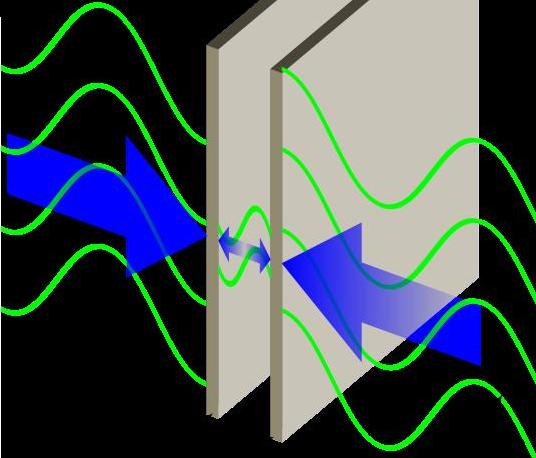
In the absence of these vacuum fluctuations, you would expect the force between the plates to be dominated by gravitation. But if you bring these plates close enough together, you find that these vacuum fluctuations cause the plates to attract one another! This attractive force is purely quantum in nature, and is the surefire experimental evidence -- that's been around since 1948 -- that this is the physical nature of nothingness.
Now, combine this with the one thing this empty spacetime is allowed to do: expand.

Image credit: Flickr user Absolute Chaos; apologies that the animation is so large!
These fluctuations -- if the Universe is expanding quickly enough -- can get caught up in the expansion of spacetime so thoroughly that they do not re-annihilate, but instead get stretched across the empty spacetime of your Universe!
If the Early Universe existed in a metastable, or false vacuum, state, it would continue to stretch these quantum fluctuations across the Universe -- on all scales -- for as long as you remained in that state.
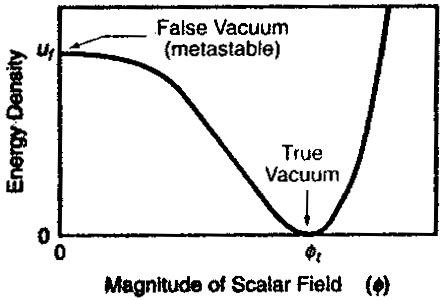
Image credit: Ned Wright, and see his cosmology tutorial for more details on this.
But this state does not last forever; there is a more stable state that the Universe will eventually find, just as a ball placed atop the hill above will eventually roll down into the valley below. When this happens, matter and energy spontaneously generate during the transition from the metastable state to the more stable state, through a process known as reheating.
These quantum fluctuations -- that were stretched across the Universe -- now become regions where matter/energy is initially slightly more or less dense than it is on average.
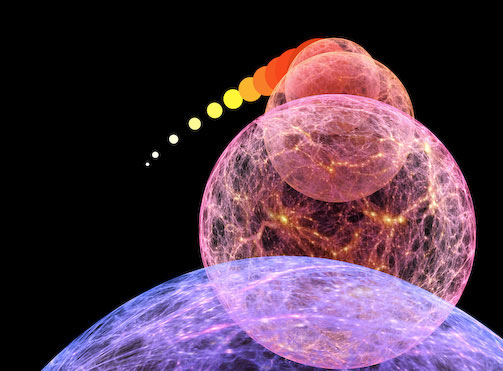
And as the Universe ages, the more dense regions grow and grow -- under the influence of gravity and over many millions and then billions of years -- into the stars, galaxies and clusters that fill our Universe today.

Image credit: CLEF-SSH.
By the time we arrive at today, we've obtained the Universe we currently exist in. We started from literally nothing; from empty spacetime containing solely the energy of the quantum vacuum, and have arrived at our Universe today, with its billions of galaxies, stars, and all that ever was or will be here on Earth.

Image credit: Bob Haslett.
And one of the most amazing things about all of this is that the Universe as we see it now is still expanding. Not only expanding, but it still contains a small amount of this energy of nothingness.
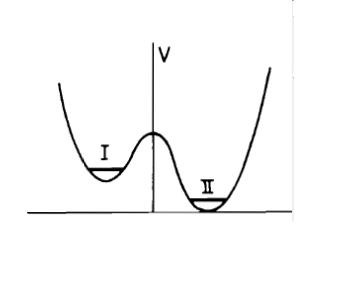
We have not fallen into the lowest possible valley of nothingness (region II); contrariwise, we still have some non-zero fundamental energy to spacetime. This fundamental fabric of spacetime -- the Universe devoid of matter, energy, radiation, and anything else you can imagine -- will eventually, as the stars burn and die and the galaxies separate and every unstable thing decays away, return to a cold, flat, empty, expanding state of nothingness once again.
For the more philosophically inclined among you, I give you Alan Watts, who has this to say about nothingness:
Nothingness is really like the nothingness of space, which contains the whole Universe. All the Sun and the stars and the mountains and rivers and the good men and the bad men and the animals and the insects, the whole bit: all are contained in the void. So out of this void comes everything, and you're it.
This entire Universe came from one form of nothing, this entire Universe will eventually return to a slightly different form of nothing, and despite the paradoxical nature of this, here it all is.
Out of this void comes everything, and you're it.
Regarding the Casimir Effect...how does one know it really is the result of the quantum vacuum and not something like quantum changes in neutrino or antineutrino fluxes?
How does the Casimir Effect negate warping of spacetime, since any experiment occurs on Earth?
But even if the Casimir Effect is due to the vacuum, that isn't evidence that the Universe came from the vacuum...that is still largely hypothetical, right?
Ethan,
So in the 5th picture, that pink-blueish stuff is space-time, rigth? which is something, rigth?
Subject of a future post?
That's a pretty something-y kind of nothing.
Paulino and Mark,
That's kind of the point. Take everything away -- matter, radiation, curvature, neutrinos, antimatter, etc. -- and you're left with nothing.
And that "nothing" that you're left with is very, very interesting from a physical point of view.
There are many physicists who make their living studying nothing, and there is an awful lot to study.
Could the flat spacetime to which our universe eventually return potentially instantiate another universe? If so, wouldn't this imply some kind of cosmological cycle?
That is without doubt one of the coolest articles I ever read.
Ethan: I liked the article, but perhaps you could develop some sort of classification scheme to distinguish the different levels of confidence/understanding/controversy there is in the scientific community about the different things you write about?
I think today's post is a lot more speculative and much less well established than many of the other things you write about, no?
What is Spacetime? Is it not "something"?
Nothing is a highly entangled state.
yes but why is there some uncertainty rather than no uncertainty?
But how is the flat spacetime itself created? Surely, if you view the Big Bang as a quantum fluctuation, you have to explain how spacetime itself can fluctuate out of pure, absolute nothingness, not out of physical background of QFT with all the messy fluctuations on the Planck scale, but out of absolute absence of anything, including spacetime itself.
Hi Ethan,
I had no idea you were an Alan Watts fan! After searching my entire life for some kind of explanation for existence that doesn't require QED/QCD/Spacetime, etc, I finally discovered Alan Watts.
I'd been blown away by some amazing philosophers such as Nietzsche (who really was awesome), but I'd never found any philosophy that really spoke to me directly. Everything was more of just a curiosity (similar to physics in a way).
Discovering Alan Watts was literally the most earth-shattering event of my life, and I'm just so pumped to see you include him at the end of this post.
On the same vein of thought, Joseph Campbell is brilliant as well. These 2 guys can speak of existence in a way no-one else I have found can do.
Thanks again for all your hard work, I simply adore your blog.
These are all good comments and questions, and unfortunately most of the "whys" that have come up do not have certain answers.
TylerD @5, we have no idea what the Universe does on super-horizon (bigger than about 10^27 meters) or sub-Planckian (smaller than about 10^-35 meters) scales. That is certainly a speculative possibility, although no evidence exists either for it or against it at this time.
AC @7, this is -- the philosophical interpretation excepted -- the best story we have for the Universe. The early initial state of nothing? That's the theory of cosmic inflation, which gave rise to the Big Bang. The coming final state of nothing? That's the Universe's heat death, due to dark energy. And everything else in between is simply solid quantum physics.
Guttoe @11, you can create spacetime -- at least mathematically -- from a pre-existing state of nothingness. However, in technical-speak, an inflating spacetime is past-timelike-incomplete, which is to say it must have either been eternally like that in the past or must have sprung from a different, pre-existing state.
PeterC @12, what amazes me most about this is that Watts died in 1973, 7 years before the theory of inflation was first put forth and 25 years before the discovery of dark energy! (Although a different type of heat death was much discussed by that point.) Yet with what physics knows today, I would conservatively opine that his philosophy on existence is the closest one we have to physical reality.
Great post. I thought of the youtube of Krauss (A Universe from Nothing), but the soundtrack was driving me mad. The phrases are taken from here: http://www.youtube.com/watch?v=zVSS_CzkyEg
Ethan,
The standard version of the Big Bang's beginning is much better than the one you are now presenting, even though I think that explanation is also wrong. In the original version there was no such thing as before the beginning in a finite universe. Accordingly there could be no changes or time before the first change or time interval.
Your explanation of "nothingness" is unrelated to true nothingness, in my opinion. Nothingness does not mean the ZPF. Something could never come from nothing, but the universe could have theoretically been created from the ZPF which is as far away from "nothing" as the present universe is.
@Ethan,
that was a quick response! I couldn't agree more that Watt's take on reality is the best take on reality from the viewpoint of personal "existence". The way he describes reality as "wriggling" seems to me such an apt way to think of energy/matter. For whatever reason, "wriggling" seems to allow the imagination to run with more freedom than say "the seething virtual particles popping in and out of existence", or any other worded description I've come across.
Although I must admit I'm a little surprised this didn't come up in your recent discussion on God/religion. Watt's statement "You are the universe experiencing itself", is as profound a statement I have ever come across, but I guess it can be easily interpreted in a way not connected with reality... I guess this is pretty tricky territory as many of these concepts have found their way into some rather silly new-age philosophies, muddying the waters with "crystal powers" or whatever other madenss has been dreamt up by these people.
I actually took the time to read "the tao of physics", which unfortunately was a bit of a dissapointment as it did go rather new-agey... Hmmm, perhaps it's best just to stick to the physics.
Either way, thanks again for the wonderful blog, your fast reply, and your wonderful descriptions of reality!
Hi Ethan,
I love this most recent posting as it makes quite an understandable explanation of nothingness. Your description of nothing has helped me understand it better, so +1 for educational value. :)
As I understand it, Edward Feser's argument from philosophy is not about the fact that the physical universe popped into existence from nothing, but the laws of physics had to exist before all of the universe popped in, and as those laws of physics are not eternal (how can he know?) they must have been created. So his argument is that god created the rules that allowed the universe to pop into existence. Mind you, he also has stated in other posts that god is also necessary to continually maintain the existence of everything in the universe otherwise everything would cease to exist. Weird, huh?
Anyway, perhaps you would like to comment on the origin of the rules or laws of physics? I have only a rudimentary knowledge of the subject, but I would have thought that the rules are not eternal, but are only virtual models of the properties that are stable in our universe (and in others?) After all, if a rule results in an unstable universe, that universe would decay and either its contents would have to change, thereby changing the rules, or collapse on itself and cease to exist (returning to a different nothing, perhaps, from which another universe may pop out of the quantum foam?) Or, is this where the M-Theory that Hawking wrote about in The Grand Design comes from: that they are really just all possible combinations of the rules, and we happen to live in an instantiation of one of those combinations?
This definition you give of nothing does not seem to be nothing. At its heart it would seem there is some kind of energy field (and nothing but an energy field). I would not call that nothing or nothingness.
You talk about the 'fundamental uncertainty of the energy content of nothingness'. So nothingness contains energy but that is not my definition of nothingness.
But I agree with Edward Feser's assessment 'Siegel be a whiz-bang crackerjack physicist'.
OMG! Let's just hope there are no future GOP presidential candidates that read this blog... I can just see that statement in some political ad promoting cuts in the funding of scientific research .;^)
"So nothingness contains energy but that is not my definition of nothingness."
Nope, that's incorrect, but a common misconception.
Since you cannot KNOW PRECISELY what energy a given space contains, there is an error bar on your measurement.
So even if there is zero energy in there, you have an error bar in that measurement.
It's still zero, plus or minus x.
"Anyway, perhaps you would like to comment on the origin of the rules or laws of physics? "
It may be they are emergent properties. The existence of a rotation of the earth "creates" a north and south pole, but until there was rotation, they didn't exist.
See, for example, the laws of Langton's Ant.
http://en.wikipedia.org/wiki/Langton%27s_ant
The only way to find out what the law is that describes the evolving pattern is to watch it. But the repeating ladder stage law of "langton physics" exists.
But not until you have Langton's Ant walking about.
"Something could never come from nothing, but the universe could have theoretically been created from the ZPF which is as far away from "nothing" as the present universe is."
Think of this:
the existence of mass causes space to bend. mass and energy are equivalent. if you have zero energy you have a variation in that energy and therefore a variation in space bendingness. if you get a strange confluence (e.g. what if you have TWO virtual pairs in a space that intersect with each other: being so small, the chance of this happening is miniscule, and maybe that allows the pair or at least one bit of it to live long enough to affect the reality) you may find that space is allowed to bend. and that bending means that there's negative gravitational energy in the system now, therefore you can have more REAL matter exist out of that virtual soup.
BANG.
And now that real matter exists, it has bent space so space exists, events now have relation to each other so time exists. And the laws come out of what turned up here like the laws of the USA came out of people turning up on that continent.
This won't be the reason, but it shows how something can happen.
Nothing is a very specific and unusual state for anything to be in.
"Regarding the Casimir Effect...how does one know it really is the result of the quantum vacuum and not something like quantum changes in neutrino or antineutrino fluxes?"
Tomato tomahto.
Quantum changes in the neutrino flux is the result of quantum vacuum fluctuations.
Your question boils down to "what's the difference between a duck's legs and a duck's brown legs?".
You've stated it's not quantum fluctuations, it's quantum fluctuations AS ONLY ONE TYPE of fluctuation.
The real problem is the origin of the laws of physics. Clearly they precede the inflation since they describe the origin of the inflation and its process.
So, are they eternal? That has profound metaphysical implications. Why? What makes them eternal? But if they are not eternal, how could they have been created?
Then there is the nature of the laws of physics. They are rich in order, symmetry and information. Even more astonishingly they are parsimonious. And incredibly they lend themselves to exact mathematical description.
Are we to believe that this information rich and mathematically exact set of laws of order and symmetry is the product of the random nothingness you describe? Can we believe in beautiful order arising from absolute randomness? How could that happen?
Some prominent physicists say the laws of physics 'just are'. The problem is that one can only make this claim if you have good reason for dismissing all alternative possible explanations.
Then others say that the laws are 'merely' observed regularities that we observe as the result of an exceedingly lucky throw of the multiverse dice. From the principle of mediocrity (why should our bubble universe be truly exceptional) we would in that case expect a mediocre result. But that is not what we see. We don't see a mishmash of ill fitting, inconsistent non-parsimonious laws that lack exact mathematical description.
We see quite the opposite. The nature, mathematical exactness and predictive power of the laws of physics suggest that they are far, far more than 'mere' observed regularities.
It is when we examine the origin and nature of the laws of physics that we confront the most profound questions of our existence. They suggest that the entirety of existence is grounded in rationality and not total randomness.
"The real problem is the origin of the laws of physics."
It may be your problem, it's not any proof that it's real.
"Clearly they precede the inflation since they describe the origin of the inflation and its process."
The North Pole makes no sense until you have a spinning planet.
They don't have to precede in that order, they can arise.
Just like the laws against drink-driving exist purely because we invented cars. Until then, you could only be drunk.
"Are we to believe that this information rich and mathematically exact set of laws of order and symmetry is the product of the random nothingness you describe?"
Yes.
Because we have CHOSEN those laws to write down.
We CHOSE to write them down in maths.
We haven't written the QM wave for a cat, though.
So the laws of physics of being a cat isn't parsimonious, hasn't been solved in maths and aren't included in our Physics toolset. We have biology (or behavioural psychology) for those.
"The problem is that one can only make this claim if you have good reason for dismissing all alternative possible explanations."
We do. Parsimony for one.
"But that is not what we see."
We do.
http://science.nasa.gov/astrophysics/focus-areas/what-is-dark-energy/
And, of course, the behaviour of cats.
Neither clean and simple.
"We see quite the opposite."
YOU see quite the opposite.
"The nature, mathematical exactness and predictive power of the laws of physics suggest that they are far, far more than 'mere' observed regularities."
That is not what you observe, that's what you believe.
"They suggest that the entirety of existence is grounded in rationality and not total randomness."
Maybe only because we ask rational questions in physics terms and where we can't, we ask different rational questions in biology terms.
We choose the order we seek.
There was nothing before I was born and there will be nothing after it. And yet I want so many things in the brief interlude between nothingness.
#20, you say
"Since you cannot KNOW PRECISELY what energy a given space contains, there is an error bar on your measurement.
So even if there is zero energy in there, you have an error bar in that measurement.
It's still zero, plus or minus x."
Aren't you aware of the logical incoherence of your statement?
Nothing means nothing, it cannot be described, it has no properties and it has no process.
The moment you describe it and attribute properties or a process you are no longer talking about NOTHING.
This is a most interesting variant of preconceptual science. I delight in watching the logical incongruities that ensue.
@25
""Regarding the Casimir Effect...how does one know it really is the result of the quantum vacuum and not something like quantum changes in neutrino or antineutrino fluxes?"
Tomato tomahto."
No...we can measure neutrinos and have a pretty good understanding of them. If the Casimir Effect is really the result of neutrinos, then it is not evidence of the quantum vacuum. However, since neutrinos are very difficult to detect, I don't see how anyone can say with any certainty.
How does one say there are no neutrinos in a given volume of Earth? Is any observed effect more likely to be from neutrinos or from "nothing"?
#20, to enlarge on my point about nothingness:
Brian Green, in his book, The Hidden Reality, Chapter 3 - The Inflationary Universe, describes a pre-big bang "universe" suffused with an energy field, the inflaton field.
To give a feel for what he says I quote a small part:
"Second, weâve so far barely touched on the quantum aspect of quantum field theory. The inflaton field, like everything else in our quantum universe, is subject to quantum uncertainty. This means that its value will undergo random quantum jitters, momentarily rising a little here and dropping a little there. In everyday situations, quantum jitters are too small to notice. But calculations show that the larger the energy an inflaton has, the greater the fluctuations it will experience from quantum uncertainty. And since the inflatonâs energy content during the inflationary burst was extremely high, the jitters in the early universe were big and dominant."
Now my point is that this quantum "universe" is filled with an inflaton field subject to constant quantum jitters.
Now clearly what is described could hardly be called "nothing". If it was "nothing" we would not be describing anything. An inflaton field, containing energy and subject to quantum jitters, is not "NOTHING".
Of course you may, if you wish, define "NOTHING" to mean just that. But what's the point? Then you will just be playing with words.
@29 psmith:
Inflatons are also hypothetical. I trust Greene doesn't consider them reality just yet.
#30, yes, Greene quite explicitly states that the inflaton field is hypothetical. But then all explanations of pre-big bang cosmology are hypothetical.
@31 psmith:
Ok, considering the book's title included the word "Reality", I was concerned it might not.
And if you recall Ethan's first couple of sentences:
"It's often said that you can't get something from nothing. And while this may be true for most practical applications of your life, it isn't true for our physical Universe."
Ethan seems to forget what is hypothetical and what is not.
#32, I suspect the whole problem is that we are attaching different meanings to the word "nothing". I am using the word in the purist sense of the total absence of anything, whatsoever, whereas I would guess that Ethan means something along the lines of the absence of the things described by the standard particle model.
Isn't that what you're doing: playing with words? If you have some issue with the word, then call it something else. That has nothing to do with the science here.
To me, it looks like there is real evidence for this sort "nothing" (or whatever you decide to name it -- Jesus, maybe), and it is as close to your absolute, utterly-vacant concept of "nothing" that the universe gets.
If you insist there must be some absolute Nothingâ¢, then where's your evidence for it (or the lack of it, I guess)? And where's your evidence that would have anything to do with the origin of the universe? If the origin of the universe doesn't match your preconceptions, do you think the universe cares?
"Aren't you aware of the logical incoherence of your statement?"
No.
One option is that there is one and I missed it, or there isn't one to miss.
"Nothing means nothing, it cannot be described, it has no properties and it has no process."
Yes it HAS property. It has the property of nothing within the region being attested.
You are thinking that "Nothing" is like "dark" as most humans talk of it: a real thing in and of itself. Or like a hole (which Ringo has in his pocket and takes out to show the viewers in Yellow Submarine). But it isn't a thing in and of itself, it's a description of a volume.
If that volume has "nothing" in it, then it has the property described, it has no process in the same way as a static mass has no process (which statement is completely assinine and free of content).
"I delight in watching the logical incongruities that ensue."
Given you're creating them, there's no need for you to come here. You could just sit there on your own and be delighted.
@33 psmith
No, I understand the difference in meanings. There is no evidence that the Universe came from Evan's meaning of nothing. It is purely speculative.
Regarding your meaning of nothing, such a nothing may not and may not have ever existed. It may just be an abstract concept. Or, it may be a potential physical reality.
We just don't know.
@27 psmith
And yet here you are in the process of describing it.
So you're not talking about NOTHING anymore either, what are you talking about then?
You apparently aren't aware of the logical incoherence of yours. Ethan offers science, measurements and well-thought out ideas. You're offering philisophical quibbling over words and ill-conceived objections. I'll stick with science, thanks. It has a much better track record than philosophy.
My views on this matter are perhaps more metaphysical than scientific, but I would say there is no such thing as nothingâ and your "scientific" definition of nothingness is just imagination. It is very tempting to compare space to nothingness, but as you say, space is full of radiation. I postulate that space is in fact formed by radiation. From singularity our Universe has diversified, but it has always been an everythingness; nothingness is just an idea.
"but as you say, space is full of radiation."
Not when it's empty. Or dark in there.
"and your "scientific" definition of nothingness is just imagination."
It isn't imagination that is making the plates push closer in the Casmir effect.
Evanescent waves in a refracting media aren't imagination since you can bring them back to reality by placing another refracting medium close to the reflecting surface. But they aren't measurable without that change in the system. A probe won't see any electromagnetic disturbance.
Whenever the problem of before the big bang occurs, I like to ask one simple question:
What's North of the North Pole?
@38 Wes
So based on nothing, you're imagining your own reality and ignoring the science clearly described in the blog post.
A very clear case of projection.
Nice post, good explanation. But let me quibble.
Defining the quantum vacuum as a physical nothing seems a bit disingenuous to me.
The center of a cosmic void a billion lightyears from the nearest star may be as perfect a quantum vacuum as this universe can get; but it is quite different than a philosophical void "completely empty, void space, infinitely far away from the nearest star, galaxy, atom or photon." Hence no observer and apparatus. Not even a photon??
Without matter and energy, the idea of scale, dimension, curvature and rotation are arbitrary properties of a mathematical model. What would Hilbert or Clifford say?
Alan Watts' philosophy is brilliant; but tell me more about the Casimir effect, the Unruh effect, the quantum vacuum and rotation of and in the quantum vacuum?
Here, a rotating physical sphere is slowed in the quantum vacuum. Nice.
http://www.newscientist.com/article/mg20927994.100-vacuum-has-friction-…
What happens to a photon (whose intrinsic spin can't be slowed) as it traverses a quantum vacuum? Maybe it redshifts a little bit? Due to what, Unruh effect, Casimir effect? Frame dragging? I don't know. Has anyone hypothesized or experimented about rotating quantum vacuums and photons or vice versa?
Santa, of course. He must've been the Lawgiver, who imposed this Law of North Poles upon the Nothingâ¢. It's like how Congress writes laws in the U.S., except in this case I have decided that the origin of physical laws is Santa, not multiple human beings for which we have evidence. Because I just can't be honest enough with myself to admit that I'm utterly confused and have no idea what I'm talking about. It just can't be that science and math actually work, because then I wouldn't be able to pretend my half-baked sophistry is anything other than useless. No, no matter how little I understand it, this is all "speculation." Yeah, that's the ticket. Therefore, Santa.
@42 OKThen
You have provided another example of thinking that something has happened, when it is only proposed. From your link:
"Could this effect be tested in the lab? Manjavacas says the experiment would require an ultra-high vacuum and high-precision lasers to trap the nanoparticles, conditions that are "demanding but reachable in the foreseeable future".
Yet, you say:
"Here, a rotating physical sphere is slowed in the quantum vacuum. Nice."
"Hence no observer and apparatus. Not even a photon??"
Or a space where after all the photons you've accounted for, what's left.
And you don't have to observe something to perceive it to exist. The Lamb Shift is a good experiment that shows something not there (an orbital electron as opposed to a smeared out unmoving probability field) is perceived.
A non-empty nothing is different from a nothing where quantum fluctuations exist.
And experiments are ways to test the theory, to see if a process can show up those differences.
@44 healthphysicist
Yes, I should have said, "Here,(according to a "fully quantum-mechanical theory within the framework of quantum electrodynamics, assuming that the response of the particle is governed by bosonic excitations such as phonons and plasmons" calculations show that a rotating physical sphere is slowed in the quantum vacuum. Nice theoretical work. I look forward to the experimental confirmation."
The calculations were published in Phys. Rev. A.. Please do inform if there has been a rebuttal, or if this calculation is questioned or controversial?
@45 Wow
Presumably you are trying to agree or disagree with me; but I have no idea.
If you guys have a problem with nothingness in a universe described by quantum physics, that's your problem. Science doesn't wait for quibbling philosophers and theologians clutching to erroneous platonic ideals and dancing angels.
dude.....you have so blown my mind. I need to digest much of this and incorporate it into my brain. Because all I can think now is shhhhiiiiiiitttttttttt........really? Thank you ever so much for this awesome article.
@1 (and elsewhere) healthphysicist,
The reason we know it is the Casimir effect is that we can calculate the size of the effect according to the quantum theory which describes, among other things, the Casimir effect, and (if you are careful) you get the right answer compared with the observed results of two plate experiments.
Saying it could be neutrinos is kind of a non-hypothesis. One: because neutrinos are electrically neutral and so don't have the right size and direction of effect to explain the experiments. And two: neutrinos are also described by quantum theory, which would predict a Casimir effect anyhow. Actually, there probably must be a Casimir-ish effect of virtual neutrino-antineutrino pairs popping out of the vacuum and maybe inducing some sort of weak force polarization, but I suspect it would be far too small to observe at our current level of detection.
As for space time warping, that is indeed still present near the earths surface, and even if the two plates were in the utmost vacuum far removed from every other mass they would create a small warping just by virtue of existing. But we know how to calculate those gravitational effects and they don't account for the force on the plates.
So basically, you have a predicted effect predicated on the quantum theory which already successfully describes an unfathomably huge array of phenomena, and you have experimental results that match the calculated size of the effect. Either it's the Casimir effect or by an amazing coincidence it is an unknown phenomena that looks exactly like it while the expected Casimir effect is in abeyance for no known reason.
And Ethan would know more than I about the status of vacuum cosmology, but my impression is that observations and theoretical models of large scale structure formation, the cosmic microwave background spectrum and such are all consistent with a universe that arose from quantum fluctuations. So it's a theory that satisfies some testable predictions, although it is probably legitimate to remain agnostic pending further evidence.
"Let Being be..." Martin Heidegger
"Whereof one cannot speak, thereof one must be silent." Ludwig Wittgenstein
Two apt quotes to go along with Alan Watts, one of my faves also (along with Nietzsche).
Alan Watts... Alan Schmatts!
Here's the true meaning of nothing,
http://www.youtube.com/watch?v=WlBiLNN1NhQ
(And the Watts piece was stunning, thanks :-)))
@50 josh
The Casimir Effect is so weak, that is usually isn't detected at all, and sometimes it is repulsive and sometimes attractive. The scales are so small that the roughness and reflectivity of the metal has to be corrected for. Let alone direct measurement errors of the movement, and measurement of stray radiation.
Is it more likely the plates are actually moving from "nothing" or from "something" which has been incorrectly accounted for?
I mention neutrinos, because they are difficult to detect and if there were a neutrino interaction in which some of its energy were absorbed in the apparatus, this might cause the same effect as expected with virtual photons. Similarly, a stray non-virtual photon might do the same thing.
So how does one know, if the effect is due to virtual photons from nothing and not non-virtual energy from something?
@53 healthphysicist
Between two parallel plates the Casimir Effect is attractive, but at least in theory there may be some repulsive configurations with the right substances and shapes. Calculations for even mildly complicated shapes get hard fast and experiments have to be done carefully. Nonetheless, the theory and experiment agree.
The plates are moving from the effect of virtual particles or vacuum polarization or however you prefer to describe the sum of the effects of a quantum field theory which appears to accurately describe our reality and which has a ground state, called the vacuum, which would seem to be well approximated by the space between two plates in an extremely low pressure chamber shielded from outside forces.
Neutrinos are difficult to detect, but we know how they interact and what you would need is a calculation based on those known properties which accounts for the observed effect at least as well as the Casimir calculations. You can't just observe a predicted and verified effect and attribute it to stray noise from real photons or neutrinos which have no reason that I can think of to cause a consistent attractive force of the measured size.
Now keep in mind, virtual vs. real particles is not the same as nothing vs. a real thing. 'Real' particles refers to detected particles which have the proper relativistic mass-momentum-energy relationship for, e.g., an electron. 'Virtual' particles are detected less directly, (through the Casimir effect among other things), and can be 'off-shell', which means that their energy-momentum relationship doesn't have to match the rest mass of a 'real' electron. (Or whatever particle type we're considering.)
So I agree that saying virtual particles come from nothing can be a bit misleading. The quantum vacuum is not nothing in that it is described by a set of rules that tell you how it can change to produce something else or interact with something else. But it is a nothing in that it can be a complete absence of what we normally think of as 'things'. The absolute or metaphysical 'nothing' is really not ever an interesting concept. It is by definition, not an answer to the question 'where did this come from'. As soon as one provides a 'where', one can declare that that is not nothing. That kind of argument from a priori definition doesn't really tell you anything about the universe.
So scientist have shown that the universe as we know it can, at least plausibly, come from a state vastly different from and not reducible to our everyday experience, but that state, which is defined and governed by a set of abstract rules encoded in mathematical physics can give rise to our everyday experience. You can still reasonably ask, 'can that set of rules be reduced to something even more fundamental' or 'can we conceive of another set of rules and is there a reason why we see this set and not another'. The current answer is 'we're working on it'. It's nice however to step back and appreciate how far we've come.
It occurs to me that this is a bit like the ether theory. Before the Michelson-Morley experiment and the advent of relativity, scientists knew that light propagated in a wave-like manner and posited a 'substance' called ether that filled space through which light moves much as waves move through water. Such a substance could also have a movement relative to earth and that would show up with the proper experiment. No such movement was detected and no other evidence was ever found for the ether.
Instead we eventually learned that light behaves relativistically and we talk about light propagating in the vacuum (no reference to the QM vacuum necessary here). The relativistic vacuum isn't nothing, in the sense that light does move through it according a set or rules. Space-time is a 'thing' with numerical properties in our equations. But it isn't a thing in the way ether was thought to be. Ether was supposed to be, like water, some 'stuff' filling or sitting on fixed space. But there is no fixed space and no detectable properties of an ether that can be seperated from the properties of space itself, so we just talk about a vacuum or space-time now. Along the same lines, the QM vacuum is what is there when nothing else is there.
Guys! Girls!! Can you please go back to science. It started there, if you ALL recall...and now cascading to nothing, gosh!!
@54/55 josh
You said:
"....which would seem to be well approximated by the space between two plates in an extremely low pressure chamber shielded from outside forces."
But they are not shielded againt neutrinos and likely not from photons (I've read descriptions of a couple of setups, and photons were not addressed). I hadn't even considered the warping of space-time, which Ethan mentioned above.
I understand and agree that if one could show that they had actually established the quantum vacuum first....and then demonstrated the Casimir Effect within it, that would be demonstrative evidence of virtual photons.
But if an experiment ignores the effects of photons and neutrinos (and space time), then the experiment isn't representing the vacuum.
If the results of such an experiment match closely to an expected value...how closely would it match in a true vacuum?
09:12 BJT
åæä¹ç§ä¹å¥½ï¼ä¸é©¬å½åä¹ç½¢ï¼ä¸çï¼å®å®é½å¨ååï¼äººç±»ä¹å¨è¿åãåæ»çï¼æ²è§çï¼æ æä½ä¸ºçï¼ä¸å¸é£é¡ºçè§ç¹é½æ¯é误çãä¸çä¸ç©æ²¡ææ°¸è¿ç常èå°åå常败å°åï¼æ¿æ²»ï¼ç»æµï¼åäºï¼æåï¼ç§æï¼ä½è²ç«èµï¼ãããããæ失ä¹ä¼æå¾ï¼æ¢è¨ä¹å¨ä¸å®æä¹ä¸è®²ï¼ç¾å½æå¾å°çï¼ä¹å¯è½æ£æ¯ä»æè¦å¤±å»çï¼èä¸å½æè¦å¤±å»çä¹å¯è½æ£æ¯ä»æè¦å¾å°çãåå¼ï¼æ¸¸æï¼ä»»ä½å½å®¶åæ¿åä¹é½ä¼å¦æ¤ãè¿å°±æ¯äººç±»ç¤¾ä¼çåå±å²ï¼ç»æµåå±è½¨è¿¹æ²çº¿ï¼å®å®åå±æ¬è´¨ãè¿ä»ä¸ºæ¢ï¼äººç±»ç¤¾ä¼å¯¹äºå®è§åå¾®è§çç 究åæ¢ç´¢ååæéï¼è¯¸å¦åºæ¬ç²åï¼å®å®çç¸ï¼äººç±»åºå åè°±ççï¼ä½å°±å¶æ¬è´¨æ¥è®²ï¼è¶âæåâ-æç¢åºï¼è¿ç§éè¦çèªç¶ç°è±¡åèªç¶çæ®éåå¨çè§ååå®çæ¯ä¸çº¦èåçï¼æ¯ä¸åå¡åçéè¦åç°ãèè¿å¯¹äºäººç±»åç»æµç¤¾ä¼ä¸æ£æ¯æ大çå¯è¿ªåå解ç ï¼011ã8ã19äº ç½é©¬
"From the principle of mediocrity (why should our bubble universe be truly exceptional) we would in that case expect a mediocre result. But that is not what we see. We don't see a mishmash of ill fitting, inconsistent non-parsimonious laws that lack exact mathematical description."
See Anthropic, Principle. What we have a right to expect of our universe and its laws is that they allow for the existence of (semi-)rational creatures who could evolve the neural capacity to perceive patterns in nature and make predictions based on those perceptions which will be conducive to their survival and reproduction. Because otherwise we wouldn't be here to observe this universe and its laws.
It's a simple inversion of viewpoint. Instead of wondering why our universe should happen to cater to the mathematical talent some humans have (i.e, in its most general form, the ability to think - as I always say, when you're deciding whether to put on your socks or shoes first, you're doing math), ask yourself why wouldn't creatures capable of doing math evolve in a universe which follows mathematical rules. The true supernatural miracle, it seems to me, would be the reverse (creatures evolved with mathematical ability in a universe where the ability was useless).
On a related note, I see HP is still on his hobbyhorse of arguing that nothing (no pun intended) in science can be proved absolutely - no matter how many times we try to explain that science isn't about proof, it's about the weight of evidence (and show him a mountain of evidence).
@ 50, 54, 55 Josh
Nice explanations.
Clear, concise and reasoned.
Thanks for the education.
It seems that "nothing" is ill defined. Here are a few variations.
Nothing is a region of space of zero dimensions, with zero matter and zero energy. ( Matter is superfluous in the definition.) .
Nothing is a region of space in 3 dimensions with zero energy. ( 3 dimensions is my bias since I live in 3D + Time). Given that our Universe is full of energy (gravity included, and gravity theoretically goes to infinity) there is no region in our universe that fits this definition.
Nothing is a region of space of N dimensions with zero energy. N > 4. ( Bumping up the dimensions introduces the possibility of a dimension that may not be full of energy and therefore has some region with nothing.)
Nothing is a theoretical concept which in reality is non-existent in the multiverse. ( Why would there be nothing rather than something? We've never seen "nothing" in our Universe, so why presuppose it is the default state?)
Problems with the definition, when dimensions are introduced, is that something? What are dimensions, are they part of nothing ( no energy ) or are they physical laws ( dimensions limiting motion in space-time)?
Often cosmologists say that space-time started with the Big Bang. There must be something equivalent to time prior to the Big Bang for the Big Bang to occur ( what does stretching of space mean without time? How do quantum fluctuations occur without time? How does space inflate without it? ) How does time or physical laws affect the definition of nothing ( are physical laws something and therefore if they exist then nothing does not exist) I guess we need a definition of something as well and an understanding of physical laws ( are they just rules or are they "things" ).
@54, Josh
That clarifies the issue nicely, thanks.
Kalam Cosmological argument (variation)
Everything that has a beginning of its existence has a cause of its existence.
(2) The universe has a beginning of its existence.( The universe isn't a thing, it's a set of things, Physical Laws describing how energy interacts in the universes dimensions, but we'll ignore this gaping hole in the argument.)
Therefore:
(3) The universe has a cause of its existence.
(4) If the universe has a cause of its existence then that cause is Leprechauns. ( Naked assertion.)
Therefore:
(5) Leprechauns exist.
@61, Bill,
Thanks for that additional clarification. It really helps to carefully define our terms. Intellectual rigour is a thing of beauty.
"Nothing is a region of space of zero dimensions, with zero matter and zero energy."
This is a false definition.
"Nothing is a region of space in 3 dimensions with zero energy."
This is the correct definition.
"Given that our Universe is full of energy ... there is no region in our universe that fits this definition."
This is a false conclusion.
It is impossible for a natural object to be cooler than the temperature of the MWB 2.7K. However, we CAN artificially cool things to microkelvins above absolute zero.
Just because we can't get an absolute nothing naturally, doesn't mean absolutely nothing doesn't exist.
"We've never seen "nothing" in our Universe"
And we've never seen an electron. This isn't proving a single damn thing.
"Problems with the definition, when dimensions are introduced, is that something?"
No, because space isn't a thing. It some place to be a thing in (to paraphrase Terry Pratchett).
"There must be something equivalent to time prior to the Big Bang for the Big Bang to occur"
No, because as you said in the same damn post: space-time started with the Big Bang. If there's no time, then there's no "before".
Again, what's north of the north pole?
"How do quantum fluctuations occur without time?"
Maybe the fluctuation causes time to exist in, but for so small a time it only exists within the plank length, never transmitting any information outside that region, therefore doesn't, in any meaningful sense, exist.
That you don't know is merely indication that you aren't a cosmologist. Not that cosmology is wrong.
"How does space inflate without it?"
Inflation happened AFTER time started. Therefore you've written a strawman here.
"How does time or physical laws affect the definition of nothing"
How does this make nothing nonsensical? If it were answered, or unanswerable, what would be the result of that response? Nothing. Therefore a pointless question meant to make you look smart and cosmologists look stupid.
"are physical laws something and therefore if they exist then nothing does not exist"
Physical laws are not something. The physical laws are how things interact. You don't have laws against smoking on a plane until after you've invented smoking and planes.
"I guess we need a definition of something as well and an understanding of physical laws"
We have them. You don't, but that doesn't mean they don't exist. Just that you don't know them.
Intellectual rigour is missing.
But psmith likes it.
"What we have a right to expect of our universe and its laws is that they allow for the existence of (semi-)rational creatures who could evolve the neural capacity to perceive patterns in nature and make predictions based on those perceptions which will be conducive to their survival and reproduction."
It also may have taken over 4.5 billion years to get to that point. Certainly for the first 3 billion years, it would be IMPOSSIBLE to get enough complexity into a creature to be able to perceive the physical laws and formulate them. And almost definitely for another 500 million years after that.
34
Isn't that what you're doing: playing with words? If you have some issue with the word, then call it something else. That has nothing to do with the science here.
To me, it looks like there is real evidence for this sort "nothing" (or whatever you decide to name it -- Jesus, maybe), and it is as close to your absolute, utterly-vacant concept of "nothing" that the universe gets.
If you insist there must be some absolute Nothingâ¢, then where's your evidence for it (or the lack of it, I guess)? And where's your evidence that would have anything to do with the origin of the universe? If the origin of the universe doesn't match your preconceptions, do you think the universe cares?
Posted by: CR | August 17, 2011 10:15 AM
He didn't insist that there was absolute nothing, but that the meaning of the word nothing is "devoid of anything."
You and WoW sure have a difficult time with understanding this. Nothing is a concept, not a physical thing. Just go look it up in any dictionary, for crying out loud. It means having no value or properties. No space, no time, get it?
It doesn't have quantum fluctuations, it doesn't have Cassimer effects, it doesn't have fields, it doesn't have volume, it doesn't have potential or possibility, it doesn't have potential to change, degrade, evolve, tunnel, it doesn't have any single thing or state or property.
And it is a definition, an idea, a concept. But these are merely descriptions! Descriptions are not properties in and of themselves!!
Empty space and time filled with potentials, fluctuations, is not nothing. Space plus time does not equal nothing.
Let me address this confused utterance:
Whatever. We are talking about "not the universe," not the universe. Outside of the universe. Outside of space=time. Crikey, I think you and Wow(and whoever else) cannot wrap your heads around the, what seems simple to me, concept.
'Close to nothing as our universe gets' is infinitely different than nothing. It is something, just like matter and energy and fields, the 'as close to nothing' is not close at all. Close to nothing is closer to everything than to nothing, LOL.
BTW, Wow, your question, "what's north of the north pole" is bad. Ursa major, for one thing, Perhaps you meant 'what's north of north' in which case the answer is farther north. North is a direction, it is not a place. You're trying to ask something like 'what's vector of vector?'
You people with your sanctimonious, pedantry really bother me. Nothing looks more foolish than a fool calling something simple foolish.
The universe came from 'x' - big deal. I don't care how esoteric 'x' is, it is still trite. It is just something that our something came from.
Now there was either always something, or there was, at some point, nothing.
Nothing is a profound and very deeply disturbing concept. It makes physical theories look like a game of X's and O's.
"Instead we eventually learned that light behaves relativistically and we talk about light propagating in the vacuum."
Not actually the interesting bit.
We learned that an electromagnetic force can propagate ITSELF. It isn't that it can propagate in a vacuum, that's merely the RESULT of the really cool thing. The electromagnetic wave can propagate itself. No need for a medium.
The electric field changes, causes a magnetic field to change "ahead" of the photon. The changing magnetic field causes a changing electric field "ahead" of the photon. Which causes a changing magnetic field ...
The revelation was that the photon could propagate itself and therefore you didn't need a medium.
Sound doesn't propagate itself. It needs something to produce the pressure force ahead of the soundfront and cannot cause itself.
But because an electric field change causes a magnetic field change and vice versa (it wouldn't work if a magnetic field change didn't cause an electric field), light CAN cause itself to propagate.
"We are talking about "not the universe," not the universe. Outside of the universe. Outside of space=time."
No, we're talking about IN the universe. Not outside of it, not outside of space-time.
"BTW, Wow, your question, "what's north of the north pole" is bad."
Indeed. It's as bad as "What happened before the Big Bang". It was the point of it.
"Ursa major, for one thing"
Nope, that's not north of the north pole. It's south of the north pole.
http://en.wikipedia.org/wiki/Ursa_Major
Declination less than 90N.
"Perhaps you meant 'what's north of north'"
No, I meant North of the North Pole.
"in which case the answer is farther north."
No, it isn't. By definition everywhere is south when you're at the north pole.
"North is a direction, it is not a place."
Indeed it is, which is why I said "North of the North Pole", not "North of Manchester".
"You're trying to ask something like 'what's vector of vector?'"
No, you were the one who is trying to get me to ask that. Remember, YOUR statement earlier?
"Perhaps you meant 'what's north of north'"
YOU were saying there "perhaps you meant 'what's vector of vector'" but then started saying how stupid I am for asking what's vector of vector. YOU asked that question, not me, dumbass.
"Now there was either always something, or there was, at some point, nothing."
Nope.
Before time started, there was no point in time to have nothing.
Unless you meant "point in space" not "point in time" which is stupid.
@68 Wow
That is a very nice explanation.
"The electric field changes, causes a magnetic field to change "ahead" of the photon. The changing magnetic field causes a changing electric field "ahead" of the photon. Which causes a changing magnetic field .."
Yes that does all make sense.
But I have a question, related questions.
I assume that your explanation is according to classical electromagnetic theory. Yes?
And assuming also that this is a description of the classical wave aspect of a photon. Yes? My questions..
How would you express the propagation of a photon (i.e. an electromagnetic field) in QED? I really have no idea.
One idea as I understand QED; is that a solitary electron is not a theoretical possible solution to QED. QED demands that there be at least three and maybe one positron as well. I'm just repeating and not really understanding. So my question: is there (according to QED) ever only be one photon, or must there always be 3 electrons and a photon, or maybe 3 photons and 3 electrons or maybe just 3 photons? But I really don't know.
But to my point, if 3 photons are a theoretical requirement for a QED solution; then in QED: how does your description @68 change? My assumption is that the causal sequence that you've described disappears somehow, because causal sequences are classical description not quantum; but in the QED formulation such indeterminancy must be present from beginning to end of the wave propagation. Somehow no E causes B causes E and so on; because somehow indetermnacy is intrinsic in every moment.
I suppose the simple (fudged) quantum answer is E follows B follows e.. but with probabilities at each step. and yes, yes; but I suspect QED's answer is more complex and subtle and yes what about 3 photons since 3 electrons for a QED solution.
So Wow, that those are my questions. Perhaps not clearly stated. But feel free to clarifuy my question. Do not quibble with my words; because I am not quibbling. I have clearly stated that I do not know and I would like to a bit more (short of going through in detail a whole QED text).
Net: I would like to know; how to tell the QED story for the propagation of a photon.
I would appreciate the education from Wow or anyone. Thanks.
"How would you express the propagation of a photon (i.e. an electromagnetic field) in QED?"
I assume you're talking about a Schroedinger's equation (QM, not QED). The problem with this is that you're having to understand waves at a very fundamental level, as a mathematical construct.
But the short of it is that the field equation for any quantum particle causes it to exist in a region and if it has motion, the QM equation merely has that region be "more likely" in one direction. And the result of that makes movement.
That is, in QM nothing needs a medium to propagate, but sound waves are movements of particles and you apply QM to those particles, not the sound pressure wave.
NOTE: Not only does a proper response require someone with a more complete understanding, blogging software isn't the best medium to get an answer across.
Someone more au fait with QED may know that this treatment DOES treat photon propagation differently, but AFAIR, QED doesn't change E/M interactions and propagation.
Short version: the above post was the best I can manage.
@Wow, posting #22,
I like your postings because, in my opinion, there is consistent logic involved. That being said, I think the whole idea being presented here, that the universe was created from nothing(the ZPF), is entirely ridiculous. The reason for my statement is that if the ZPF was the cause of our universe, then what caused the ZPF. A circular logic and reasoning that leads to an infinite universe model of some kind. If the universe is infinite in times past then simply state it. Why does one need the ZPF to create it if it was infinite concerning times past. Just do like the countless other infinite-cosmology models and religions do, just state that the universe had no cause, or that the cause of the universe, had no cause for itself.
This explanation is straight forward theory, whether right or wrong. The present idea being presented here is certainly the direction that mainstream theory is presently leaning, granted, but it says nothing concerning a prime mover (first cause), which is the basis for such an argument in the first place.
The original "finite beginning" BB model, I believe, is much sounder in logic and theory (even though I think it is also wrong). One simply states that the beginning entity had the innate potential energy to go bang. No exterior cause would be needed, and any cause would be a violation of the word "finite," concerning time.
I think the finite time idea is correct.
Wow @68,
Relativity isn't an interesting bit? :) But I don't think you actually disagree with me. To say that light can propagate itself is to say that it can propagate in vacuum as far as I can see. I agree that there is no medium apart from spacetime itself. Or you might say that spacetime itself is just part of the description of the behavior of light (and other fields).
The thing is, if you give a wave equation description to a body of water, waves propagate themselves in the water. A peak at one point in space at time T0 causes a peak at a nearby point at time T0+ because it follows the wave equation. But, of course, there are other ways to look at water. The wave equations are really a 'zoomed out' description of the macro properties of a collective phenomenon, they can be explained in terms of more detailed and general descriptions that we call gravity and electromagnetic forces. Moreover, we can step outside a body of water so we think of both water and land (and vacuum) as sitting in a larger description called space. With light we can't step outside the space in which it propagates and (classical E&M) light is only described by the wave equations that tell you how it moves in spacetime.
So to say that light propagates itself is to say that a wave equation description is complete, which is to say that it behaves as a wave whose medium is space itself, which is to say it can propagate in vacuum.
OKThen @70,
I'll take a stab at the QED propagation. I'm not sure what you're getting at with 3 electrons and 1 positron or some such, so feel free to ask for clarification or point me at a source on that.
QED, as well as QCD and really any theory within or appended to the Standard Model of particle physics, is a relativistic quantum field theory. Note that that is 'only' special relativity, gravity is not incorporated consistently. Essentially, the field theory describes the state that the universe is in as a set of values (field strengths) at every point in spacetime, and the theory tells you how those values change as you move from one point in spacetime to another.
Since it's a quantum theory, those values tell you the probability of detecting particular particles with particular quantum numbers like spin, charge, momentum, etc. at the given spacetime point. (The issue of what 'you' are and when you detect things leads to a discussion of Many Worlds or other interpretations, let's put that aside for now and adopt 'probability of detection' as a working description.)
Okay, so for the theory to tell you anything it needs some input: we have to posit a particular state at some region of spacetime and then we can predict the state at another. So suppose we imagine a state that corresponds to 100% probability of detecting a photon at point X0 at time T0. Because the fields have wavelike descriptions, that state cannot persist to a later time. Think of it like a symmetrical hill of water, like a drop just added to a flat lake. It will immediately begin to spread in all directions, except it is not water that is spreading here but probability. This is the origin of the uncertainty relationships, the state of exact position detection must have a momentum spread in all directions because the governing wave equations say the probability of detection at all X0+ around X0 is non-zero for any T0+.
However, this is where relativity comes in, the equations are such that if you detect a photon at spacetime (X0,T0), that cannot effect your probabilities of detection at coordinate (X1,T1) if X1,T1 is outside the light cone. For example if X1-X0 is greater than T1-T0 times the speed of light. So relativistic causality is preserved.
Now the really cool thing is, in order to get this to work mathematically for charged particles like an electron, you have to introduce a particle of opposite charge and equal mass, which is the positron, i.e. you predict antimatter just from the requirements of a relativistic quantum theory. Furthermore, in order to have locally conserved charges,( so the total charge in some arbitrarily small region of space can only move in or out of another region next to it, it can't be created or destroyed) you have to introduce a photon if you have a charged electron, and that photon has to interact in certain ways with all charged particles and we call it the 'carrier' of the electromagnetic force. When you work out how all those interactions sum up in aggregate probabilities, you get, macroscopically, classical, special relativistic, electromagnetism.
@psmith, posting #24
"The real problem is the origin of the laws of physics. Clearly they precede the inflation since they describe the origin of the inflation and its process."
"So, are they eternal (the laws of physics)? That has profound metaphysical implications. Why? What makes them eternal? But if they are not eternal, how could they have been created?"
The logic is that first one must assume that the Inflation hypothesis is valid. If so there seemingly could have been some manner of creation concerning the laws of physics being created concurrently with the beginning bang, or that the laws began with Inflation, or that they are innate to the Zero Point Field, and that according to the hypothesis being presented, they seemingly would have existed before the bang. Or another possibility is that it's all wrong :(
"Then there is the nature of the laws of physics. They are rich in order, symmetry and information. Even more astonishingly they are parsimonious."
Your language of description is eloquent :) but order, symmetry, information, and parsimony are seemingly intelligent judgments based upon perspectives and opinions alone.
"And incredibly they lend themselves to exact mathematical description."
Some math formulations lend themselves to simple and very close formulation, like the inverse square "laws" of light, magnetism, and gravity -- but exact they are not. In the quantum world there are often substantial tolerances concerning predictions. In the macro-world the same may be the case. The prime example is gravity as it effects rotation velocities in a spiral galaxy. Dark matter or not, predictions concerning stellar orbital velocities cannot presently be made simply by using gravity formulations.
"Are we to believe that this information rich and mathematically exact set of laws of order and symmetry is the product of the random nothingness you describe? Can we believe in beautiful order arising from absolute randomness? How could that happen?"
I think your general skepticism is justified even though both "beauty" and "order" are in the eye of the beholder :), right?
"Some prominent physicists say the laws of physics 'just are'. The problem is that one can only make this claim if you have good reason for dismissing all alternative possible explanations."
These are the guys we have to look out for ;-( I totally agree with your logic here, and the general gist of your posting :)
"Then others say that the laws are 'merely' observed regularities that we observe as the result of an exceedingly lucky throw of the multiverse dice. From the principle of mediocrity (why should our bubble universe be truly exceptional) we would in that case expect a mediocre result. But that is not what we see. We don't see a mishmash of ill fitting, inconsistent non-parsimonious laws that lack exact mathematical description.
We see quite the opposite. The nature, mathematical exactness and predictive power of the laws of physics suggest that they are far, far more than 'mere' observed regularities."
I also think that that kind of reasoning that you have described, is lacking :(
"It is when we examine the origin and nature of the laws of physics that we confront the most profound questions of our existence. They suggest that the entirety of existence is grounded in rationality and not total randomness."
Sounds right to me :)
healthphysicist @57,
First let me say that I'm not an expert on the theoretical or experimental side when it comes to the Casimir effect. (Although I work on the same floor as a professor who is.) So I can't give you detailed explanations of the various experimental setups or tell you everything that has been calculated with what error bars and so on.
Nonetheless, I'm not sure what you're hung up on. One shields from photons, basically, by turning out the lights and closing the door. :) Neutrinos are harder to shield from, you have to go deep underground to limit the flux from the sun or from cosmic rays for instance, but by the same token they have virtually no effect on your experiment. More importantly, whatever stray photons or neutrinos there might be, they are noise. They don't cause an average attractive force between two plates. The effect is small (or only becomes large at very small distances) so if scientists say they have detected it, I take it that they have adequately controlled for any sources of noise to see a clear signal above statistical fluctuations from random photon collisions or whatnot.
We already have evidence for virtual particles in the theoretical corrections to scattering amplitudes that are required to get calculation and experiment to agree to the precision we have in QED.
Maybe you are worried that if even a single stray particle is in the room we can't call it a 'true' vacuum? Think of an everyday, ordinary atmospheric vacuum, no quantum shenanigans. We can't create that exactly, not with the best pumps and tightest seals. There would still be some forlorn molecules of air in our best vacuum chamber; what's more, there would always be some measure of uncertainty as to how pure our vacuum was. The vacuum is a theoretical state which we may approach arbitrarily closely, but the fact that we are never exactly there doesn't prevent us from talking about it when it is a consistent and neccessary part of our theory.
The quantum vacuum is the theoretical ground state of a universe described by an interacting quantum field theory. In principle, if there is an excited state, like say a single observed particle, anywhere in the universe then we are not technically in the ground state, never mind experimental shielding. But of course, if a single photon out near the crab nebula could drastically effect our lives here we wouldn't have a good theory based on our experiences. So the effect of that stray photon is negligible and the effects of whatever noise may exist in a Casimir experiment can be made negligible, to the extent that calculations with the theoretical quantum vacuum are an excellent approximation to whatever is 'really' happening.
Wow
First a thank you for trying to answer my question. Much appreciated.
Now I've got to focus on Josh's answer.
I expect to get a welcome education.
Josh
Thank you. You answered my question.
I will have to reread your answer.
You say, " I'm not sure what you're getting at with 3 electrons and 1 positron or some such" Well exactly what I was getting at was your last paragraph where you have to intorduce a positron and a photon. I may be misremembering and I can't put my hands on a reference source. Might have been Feynman's QED which I'll have to dig out at the library and it might have had to do with renormalization. Mind you I try but I only scaratch the surface of QED and may entire misunderstand.
But my point was this. It seemed that QED might not allow a solution for a solitary photon. And that seems to be implied in what you are saying in the last paragraph. I mean if an electron implies a positron and necessitates a photon. Can't I just draw up the Feynman diagram electron, positron and photon and say take hold of the photon and say a photon implies the electron and positron.
So I think you answered my question. But I may be twisting and taking your meaning and the meaning of QED to far. Maybe QED is perfectly happy with a solitary photon. And that was only important because in my original response to Wow; I was thinking that maybe due to QED formulation and renormalization and such a solitary photon was maybe not a legitimate solution (i.e. there has to be two charged m particles).
So enough from me. Perhaps, I'm just talking in circle. Just trying to understand. I defer to your explanation.
Thanks.
OKThen @ 78
Okay, I think I understand your question and hopefully this helps:
I guess it depends on what you mean by a photon. I mean, here in the known universe a photon is a spin-1, massless particle that transforms under a U(1) gauge group in association with EM charged particles. Which is a fancy way of saying that it does what we want it to do in a consistent model of observed EM phenomena.
The cool thing I mentioned is that, even if we had never seen a photon itself (which would be ahistorical), but we had reason to think there were electrons with conserved charges and relativistic movement, we would have to put photons into our theory to make it consistent. So if you write down QED with something that looks like an electron, you also have photons. But the QED theory describes what 'can' be detected and with what probability. So a solution to QED, in the sense that it is an allowable state, would be a single photon propagating through space. But that photon can always potentially split into an electron-positron pair. That pair can also recombine, so if you measure a single photon at one point, and then a single photon at another point within the firsts light cone, all you ever 'see' directly is a single photon, but all the configurations where it split into e+ e- and recombined between the two points are implicitly there in a quantum theory.
On the other hand, let's say you don't know or care about electrons and charge. You can write down a quantum theory for a spin-1 massless particle that travels through space like we usually think of a photon as doing. That 'photon' does not imply that you have to have electrons, because we aren't requiring it as part of local charge conservation (or ,equivalently, as a gauge symmetry). (I think actually you could write down a gauge symmetric theory but without any charged particles, which would be like saying that there is charge conservation but no possible charges to conserve!) What you have in that case is a non-interacting theory. So 'photons' would exist but each individual one would carry on its merry way completely unaffected by and unaffecting every other particle, including other photons. Obviously, we wouldn't be around to detect such particles. Or, if you add such a particle to our theoretical description of the universe, we would never see it.
I tried to post a further explanation for OKThen but it is being held for moderation for some reason. Does scienceblogs have some default post or word per time limit to fight spam?
To #65
You're making assertions not arguments. ( But, First let me thank you for responding to my posting.)
My discussion more succinctly stated: Nothing is a region of N dimensional space where there is no energy, N => 0. I expressed N for 0,3 and N>4 as a means of discussion.
" Nothing is a region of space of zero dimensions, with zero matter and zero energy."
This is a false definition.
It is a definition. It's truth or falsity is your opinion, unless you specify a good counter argument. Simply asserting it's false, is just contradiction. Can you demonstrate how many dimensions existed before the Big Bang?( Don't get me wrong, I'd be quite happy with an argument that dismantles my definition, given a good argument and sound logic.)
"Nothing is a region of space in 3 dimensions with zero energy."
This is the correct definition.
"Given that our Universe is full of energy ... there is no region in our universe that fits this definition."
> This is a false conclusion.
I'm quite curious and hope you respond. You believe that "Nothing" is a region of space in 3 dimensions with zero energy, but you contend the conclusion above is incorrect. You did leave out the important bit, which was in my original post, that gravity is a form of energy and it theoretically goes to infinity therefore, since you believe that "Nothing" is a region of 3D space with no energy, and gravity extends infinitely, then there is no place in the universe that meets the definition.
More to the point, we only know that N=3 + time, so larger or Smaller N's are speculation, but there is benefit to introduce various values for N on a hypothetical basis to see what we discover.
Thanks for the interesting discussion.
'
That seems rather unlikely, given the contempt of science that is the hallmark of Republicanism. But even if say Michele Bachmann or Rick Perry did read this blog, you could just point out to them that Biblegod supposedly magically poofed the universe into existence from nothingness. So the scientific study of nothing is actually very Christian!
*sigh*
Recently, Edward Feser picked on me -- among others such as Hawking, but me in particular -- for using this scientific definition of nothing. (Which yes, I'm fully aware is not the same as philosophical nothingness, which I explicitly stated in the fourth sentence of the post Feser criticizes.)
You didn't seem to be fully aware, and it seems you still didn't grasp the problem: It wasn't the fact that you used a particular and qualified definition of nothing, but what you thought you could show by using that definition. Here's what you said:
And, most often when people bring this up to me, it's in an attempt to prove the existence of God -- and the insufficiency of the Big Bang -- by pointing to the Universe. Well, let's take this question as seriously as our knowledge allows us to. (And by that, I mean physically, rather than philosophically or theologically.) In physics, can you get something for nothing? And if so, what can you and can't you get?
Insofar as you tried to respond to cosmological philosophical arguments for the existence of God (a Prime Mover, etc) by changing the definition of nothing to a "scientific" definition and as a scientific question, you mangled the cosmological arguments and gave a clear indication that no, you really didn't know what you were talking about on this subject.
You give that much away when you reference cosmological arguments for God's existence, then immediately follow them up with 'alright, let's reply to this question - but let's drop the philosophical definition of nothingness and swap in a scientific definition and change the argument to frame it scientifically'. This is like an exterminator telling you that there are no bugs in your house, then proving him wrong by loading up Windows ME and pointing at all the bugs in it. You've change the definition, and the framing, beyond what was intended.
Now if you'd say "You can get something from nothing! But, the sort of nothing I'm talking about differs from the philosophical and theological uses of the term, so this really doesn't touch on, much less refute, those arguments" you'd be accurate. But then, that wouldn't be nearly as interesting a blog entry, eh?
*Yawn*
You think cosmological arguments still need refuting? It is incoherent, much like concepts of a deity. Enough said.
Maybe I should be more generous. Go ahead: provide your favorite cosmological argument. Let's see what happens. Explain why a magic man done it. If you think there is evidence for a god, then make sure it is scientific, empirical evidence, since anything else will guarantee your argument is useless wanking.
For the benefit of any GOP presidential canditate who may read this of late. In summary, the preceding discussions begin from nothing (scientifically). Then God said, "Let there be Light!!"... and there was this chaos in our discussion.
Much ado about nothing, to quote the Bard. While Atheist Fundamentalists have fun there is a world of suffering out there.
Just a block down from where I live, the destitute are starting to gather this morning, outside a church where they will be given boxes of food and groceries. A little further away another church in my locality will be organising a soup kitchen. Later this morning I drive to a nearby town to visit a home for the mentally handicapped, also supported by the church in that town. And in another nearby town a school for autistic children will be busy on the premises of the local Catholic Church.
And so it goes on in town after town after town. Wherever I look I find these quiet, unsung heroes, ordinary people motivated by an extraordinary idea, that good exists, that it should be given expression in love, support and help for the unfortunate. Each person, in his own small way, doing what he can to make the world a better place.
They deserve your help, not the snide, snarky comments.
psmith:
"Atheist Fundamentalists" is a contradiction in terms. There are no fundamentals in atheism, since it's just a lack of belief in gods. So, if an atheist proposes some fundamental belief or tenet, it must be external to atheism; thus the "fundamentalist" should modify that external factor and not atheism.
Anyway, has anyone here claimed the world is not full of suffering? I think even the good Dr. Pangloss might have admitted that much by the end of the story, despite his ludicrous claim that it is the best of all possible worlds.
Speaking of which, how do you reconcile this with your attempts at theodicy? (RCC, is that right?) If you knew of some source of goodness, then I suppose you would know what it has been up to all these years (if anything), given that the world is full of suffering. Or is pretending this is the case a way to make yourself feel better or to do good things?
Of course people deserve our help. If you're insinuating atheists don't help people, that's simply false.
Can it not possibly be the case the the world is indifferent to us, and we ourselves have to care for each other, in whatever limited way we can while we're alive? How is this ethical position not in better standing than one like yours which is on such shaky ground?
And what does any of that have to do with the comments, the subject of the thread, cosmology, or science in general? It seems to me it's entirely irrelevant, unless you're interested in making an appeal to consequences based on the assumption your deity is real and will reward or punish people for their beliefs.
While Atheist Fundamentalists have fun there is a world of suffering out there.
Atheists, agnostics, and other non-Christians, "fundamentalist" or not, are quite aware of that suffering, thankyoverymuch. We're also quite aware that a large chunk of that suffering is being caused or exacerbated by the actions of people who claim to believe in an all-powerful compassionate God. So the next time you see the suffering masses, just ask yourself how badly they were suffering BEFORE the Party of God took over for eight years. And take your self-righteousness somewhere else.
In post #87 I said
Every now and then they get the recognition they deserve. In 1988 the young Sister Ethel Normoyle, a member of the Little Company of Mary, went to the desperately poor shanty town of Missionvale, in Port Elizabeth(South Africa), to tend to the needs of the sick and destitute. 23 years later she is still there, working devotedly to help the unfortunate.
This year she was recognised as a finalist in the South African Women of the Year awards. See the full story here.
While Atheist Fundamentalists win debating points there are people(of all persuasions), motivated by the power of good and love, who do what they can to make a difference.
So tell us, psmith, how much good does lying about science and mindlessly bashing "Atheist Fundamentalists" do for any of the suffering masses you're going on about? Ever ask yourself how much money right-wing "Christians" spend on propaganda, and how many more kids could have been fed or cared for with that money?
Also, if you really cared for the poor as much as you say you do, you wouldn't be using them as props to bash people you know nothing about. "We help the poor" does not justify the chronic and disgraceful violations of Christ's teachings I've observed from the radical right. (It's also the same excuse the Catholic Church uses to dodge responsibility for their child-rape scandals.)
@Raging, #91. I am making no claims for myself. I am simply accurately reporting what I see in my local community. What I have seen has won my admiration and was instrumental in moving me away from a stance of life long atheism.
My point is that I have seen sincere and good people, trying to make a difference, motivated by an admirable moral code, and, in my opinion, they do not deserve to be demonised by Atheist Fundamentalists.
If we must debate their belief systems I think it should be done in a thoughtful and respectful way with the intent of fostering a productive exchange of ideas, experiences and insights.
If you really need an outlet for your combative instincts I would suggest, among other things, legislating for gun control, reducing carbon emissions, reducing the preposterous wealth imbalance, improving the education system, spending more on science, bringing Big Pharma under control, etc, etc. These are serious problems that need our urgent attention. Let us rather spend our energy on the things that matter now.
Most atheists don't believe in demons. And as I said before, there aren't "atheist fundamentalists" (does capitalization matter?) except perhaps as some kind of mythical creature in your mind. Do you notice how these negative terms derive from religion?
Again, I have to remark that I know lots of good and sincere atheists who are motivated to do good for good reason.
How you think any of this relates to the origins of the universe, I still have no idea...
One of the problems is that there are few if any thoughtful and respectful religious ideas; and given this, people respect religion far too much. Such bad ideas have to be actively disrespected. The whole notion of "respect" loses all meaning when any belief can be maintained a respected for any reason.
Now, I do know and love lots of religious friends and family. My argument is with religious ideas, not religious people. The way I respect them, in order to have a productive dialogue, is by frankly telling them their ideas are wrong or make no sense if I think that is the case. If the religious want to hide their ideas behind faith and bad logic, that's their problem. I'm still going to be honest to myself and to them, and will not let their problem thinking critically about their beliefs become mine. I would consider it a sign of respect if they would do the same and drop all of the games.
"with the intent of fostering a productive exchange of ideas, experiences and insights."
Oddly enough, it's the religions that refuse to listen. The religions that insist they be heard (what, though, of Pastafarianism?). It's religion that doesn't WANT ideas, refuses to ask questions and wants science to shut up.
You don't get your hands chopped off for disrespecting Albert Einstein. You don't get hung for wondering if Newton was a scientist or not.
But you DO if you disrespect religion.
You don't think Christians do this? Go and walk in a Southern States township wearing a pro-gay t-shirt.
The problem? The xtian bible insists that gays are bad.
Nobody gathers a crowd around some religious person's funeral and shouts out "There's nothing there!". Religions do.
And, oddly enough, the ones wanting you to read about their faith won't read, for example, The God Delusion or Good Omens.
Seems like they don't WANT an exchange of ideas, experiences and insights.
PS what insight can you have from believing in a sky fairy?
> "" Nothing is a region of space of zero dimensions, with zero matter and zero energy."
> This is a false definition."
> It is a definition.
It is also false.
> It's truth or falsity is your opinion, unless you specify a good counter argument.
Ah, the old Humpty-dumpty argument. No. The definition of nothing for the purposes of Quantum Mechanics by definition is not a zero-dimensional space. It has dimensions. Maybe lots of them.
"Given that our Universe is full of energy ... there is no region in our universe that fits this definition."
> "This is a false conclusion."
> I'm quite curious and hope you respond. You believe that "Nothing" is a region of space in 3 dimensions with zero energy,
Yes.
> but you contend the conclusion above is incorrect.
Also yes.
> You did leave out the important bit, which was in my original post, that gravity is a form of energy
Nope, it's potential energy. This is schoolboy level physics, for chrissakes! And in a QM sense, gravity is the exchange of gravitons.
> it theoretically goes to infinity
It has an infinite range. And moves at the speed of light.
> since you believe that "Nothing" is a region of 3D space with no energy, and gravity extends infinitely,
Correct so far.
> then there is no place in the universe that meets the definition."
And there you fall over. That doesn't follow that even if there's no place that meets that definition that the definition doesn't exist.
There's no place in the universe that is below 2.7K. We can cool a small area of it, though. And we haven't managed to get to absolute zero.
Does this mean that you insist that absolute zero doesn't exist?
Or is your conclusion in error?
Hint: it's the latter.
Josh: "To say that light can propagate itself is to say that it can propagate in vacuum as far as I can see."
It's a little deeper than that, josh. It's that it makes itself move. It isn't that it propagates through a vacuum, that is merely the consequence of it making itself move. A medium isn't needed.
"I agree that there is no medium apart from spacetime itself. Or you might say that spacetime itself is just part of the description of the behavior of light (and other fields)."
I would paraphrase Douglas Adams here: spacetime is somewhere for things to move in (NOTE: This is why "Nothing" can't have zero dimensions by definition. There's nowhere for nothing to exist. Or, looking at it the other way round, if there are zero dimensions, then everywhere has nothing in it.). I.e. light moves through spacetime because it has to: no movement, no moving electric field. No moving electric field, no moving magnetic field. No moving magnetic field, no electric field...
It also "explains" inflation. It's not that two points got far apart, just that the space over which the electric field was changing over got bigger. Everything still had the same amount of spacetime to move over, so they didn't *actually* move, but the extent got bigger.
@80 Josh
Well I misunderstood that but now I understand it a little better. Thank you.
@Raging, #91. I am making no claims for myself. I am simply accurately reporting what I see in my local community.
Fine. "Report," please, the names of those "Fundamentalist Atheists" you're going on about, and what, specifically, they said or did that offends you so. Is your complaint based on any real people or events at all, or just the prejudice you learned to parrot?
A fundamentalist is "an extreme conservative, especially one who attacks any deviation from certain doctrines and practices he considers essential."
And that fundamentalist attitude can be applied to any body of knowledge or belief: religious, political , educational, athesitic, scientific.
Let me first describe judicial fundamentalist and then a scientific fundamentalist.
I met this fundamentalist judge at a friends wedding. I remarked, "It must be hard being a judge knowing that sometimes the jury makes the wrong decision." And the judge thundered, "Our judicial system is always correct. There is never a need to wonder; by definition every verdict is correct." Well the conversation became somewhat awkward; and I am told by others at the table that for a while they thought the judge would strangle me because of my questions.
In 1983 Subrahmanyan Chandrasekhar recieved a Nobel Prize in Physics, in part for his work on black holes between in the 1930's.
Sir Arthur Eddington was the great man of astronomy and an informal mentor to the young Chandrasaker. Chandrasekhar shared his research paper to be presented at a meeting of the Royal Astronomy Society with Eddington; Eddington would not discuss his own presentation with Chandrasaker. Chandrasaker spoke first; Eddington followed and smashed and humilitated Chandrasakher's work.
As Arthur I Miller says in wiki, "Chandra's discovery might well have transformed and accelerated developments in both physics and astrophysics in the 1930s. Instead, Eddington's heavy-handed intervention lent weighty support to the conservative community astrophysicists, who steadfastly refused even to consider the idea that stars might collapse to nothing. As a result, Chandra's work was almost forgotten."
Chadrasekhar was so discredited by Eddington, that Chandrasekhar could not get a physics job in England; nor in the study of black holes. He moved to the US and became an expert in other fields. He left the study of black holes for 30 years. Ultimately of course, Chandrasekhar recieved a nobel prize for his work.
Kip Thorne, in Black Holes & Time Warps spends pages 149 to 163 discussing the Chandrasekhar/Eddington relationship. Let me share a few quotes. "After dinner (the day before) Eddington himself sought Chandrasekhar out and said, "I've asked Smart to give you half and hour tomorrow instead of the customary fifteen minutes."
In his presentation Eddington said, "Dr. Chandrasekhar had got this result before, but he has rubbed it in in his last paper; and when discussing it with him, I felt driven to the conclusion that this was almost a reductio ad absurdum of the relativistic degeneracy formula. Various accidents may intervene to save the star, but I want more protection than that. I think there should be a law of Nature to prevent a star from behaving in this absurd way!"
Then Eddington proceeded to develop his fudge theory; which no astronomer dared to contract for fear of his career until after Eddington died in 1944.
To continue quoting Thorne, Chandrasekhar wrote to many physicists for help, "Rosenfeld replied two days later that he and Bohr were convinced that Eddington was wrong and Chandrasekhar right. Rosenfeld wrote,"Bohr and I are absolutely unable to see any meaning in Eddington's statements.""
Thorne continues, "But for astronomers, the matter was not so clear... Eddington's authority held sway... Eddington stuck to his guns... He so deeply wanted there to "be a law of Nature to prevent a star from behaving in this absurd way" that he continued to believe for the rest of his life that there is such a law--when, in fact, there is none."
Thorne quotes Chandrasekhar, "As you can imagine, it was a very discouraging experience for me--to find myself in a controvery with the leading figure of astronomy and to have my work completely and totally discredited by the astronomical community... It was better for me to change my field of interest and go into something else."
Years later Chandrasekhar said, "Take Eddington. He was a great man. He said that there must be a law of nature to prevent a star from becoming a black hole. Why should he say that? Just because he thought it was bad? Why does he assume that he has a way of deciding what laws of nature should be?" pg 610 from Treasury of Physics, Astronomy and Mathematics by Ferris.
So yes, I think that there are fundamentalist scientists and there is no better example than of Sir Arthur Eddington in his treatment of Chandrasekhar.
Chandra says, "You know, when Rayleigh was sixty-seven, his son asked him what he thought about the famous remark by Thomas Huxley--that a man of sixty in science does more harm than good. Rayleigh thought about it a great deal and said, "Well, I don't see why that should be so, provided you do what you understand and do not contradict young people.' I don't think Einstein could have said that, or Dirac, or Heisenberg. Eddington wouldn't have said that. There is a certain modesty in that remark... Certainly Rayleigh did not add any really great fundamental insights like Einstein or Maxwell. but his influence on science was enormous... not spectacular but always important... a certain modesty toward understanding nature is a precondition to the continued pursuit of science."
"A fundamentalist is "an extreme conservative, especially one who attacks any deviation from certain doctrines and practices he considers essential.""
No it isn't.
"And that fundamentalist attitude can be applied to any body of knowledge or belief: religious, political , educational, athesitic, scientific."
Except it can't for atheism since there is no doctrine or practice considered essential to atheism.
PS on your fundamental atheists
#1 is a judge, a fundamentalist judge. Not atheism. The right of the judicial branch
#2 is a self-absorbed arsehole, not an atheist position.
And you've never met the man either.
@100 Wow
Sometimes you seem reasonable; but mostly your words are your same rage mantra. No new insight, no new thought, no genuine question; just your rage mantra.
Fundamentalist - definition #2 from Webster's Third International Dictionary unabridged, pg 921. So please source your preferred definition.
Applying definition #2, I view Eddington as a fundamentalist scientist.
I labeled Eddington a fundamentalist scientist (not atheist.)
To the end of his life, Eddington was personally cordial to Chandrasekhar. Eddington's professional destruction and humiliation of Chandrasakher was not personal; it was just the business of science to destroy Chandrasekhar's heretical ideas.
"An extreme atheist, one who has unshakable faith in the absence of God... I live with my faith that there is no God! Shut up! Go to Hell!... Extreme Atheists: Are very argumentative about their views and will attack anyone who dares mention their faith." from the Urban dictionary.
Of course you disagree; you do not admit your faith is atheism.
Some prefer the term extreme;
you apparently prefer the term "self-absorbed asshole";
I prefer the term fundamentalist atheist or scientist.
"It turns out that just as belief in a God of love is no absolute barrier against hateful activity, so too the ideology of atheism is no cure for human evil."
Wow,
Please thunder your mantra of rage at the atrocities of some of the worlds most famous atheists,e.g. Joseph Stalin and Mao Tse Tung. Or minor atheist such as yourself.
Since atheism is your idoelogy; and since you are dedicated to truth; please give your opinion about atheist atrocities and minor failings. Show us your integrity.
People struggle in this life. Cut them a break. Why?
Read SuperCooperators by Nowak, he is a foremost mathematical evolutionary biologist. Maybe you'll learn a half dozen ways that cooperation is essential for a complex organism such as yourself. You say that you read science.
Your fundamentalist atheism, extreme atheism, "self-absorbed asshole" atheism is boring. A broken record is more insightful than your mantra of rage.
Change, learn, bring some intelligence to your comments. Or what???
You will be ignored.
"No new insight, no new thought, no genuine question; just your rage mantra."
OK, Then. Your words are meaningless. You assert people are atheist fundamentalist, which is an intent to paint them in black and vilify them, yet you can't find any atheist fundamentalist, even though you haven't been able to see any.
The reason why you see rage in others is because you're a blithering buffon and completely ignorant.
This completely straight statement of evident fact seems to you like rage mantra because you CANNOT entertain the idea that maybe you're wrong.
Tough titties, kid. You're a moron.
"I labeled Eddington a fundamentalist scientist (not atheist.)"
In response to someone asking for an example of a fundamental atheist.
THIS is why you're a moronic idiot.
When responding elsewhere to some creationist waffle about the Universe being "created by a Timeless Entity out of nothing" at the time of the Big Bang I suggested that modern cosmology indicates, in effect, that although inflation arose from a situation in which positive and negative energy summed to zero in this Universe (which seems to be how Guth, Krauss and others describe it) that there was no "philosophical" Nothingness causally anterior to that situation.
As I understand current cosmological explanations for the lay person, whether or not there are multiple budding universes in a Multiverse, or time reversed bounces described in some Loop Quantum Gravity hypotheses, or various other changing/developing scenarios, there is no situation corresponding with "a total absence of any fields, energy, forces or dimensions".
Is that correct?
I understand that in this area of discussion, "causation" is affected by Quantum weirdness, that there are problems in using the word "before" if spacetime has not inflated and that Relativistic math breaks down as one reverses towards the big Bang, but I don't recall any cosmologist denying that, in some sense, "reality" is eternal/unbounded in the past.
If there is at some point a situation where there are simply "laws of physics", I would tentatively understand that to mean a situation where "relationships which can be expressed mathematically" exist - but between what entities?
Is "eternal unbounded reality" in which Universes may develop just a "brute force fact" which we should provisionally accept? (Not that I have any problem in accepting that).
"there is no situation corresponding with "a total absence of any fields, energy, forces or dimensions".
Is that correct?"
In quantum terms, this is correct.
"but I don't recall any cosmologist denying that, in some sense, "reality" is eternal/unbounded in the past."
You probably don't recall then denying that dentistry is a bad idea.
The creation of spacetime means that there is no "before" the big bang, just like there's no North of the North Pole (even though one tried, and failed miserably, to answer that one).
It's a definitional problem.
In maths, what do you get when you divide zero by zero? Depends on your definition of those zeros. If the zero is the rest mass of a photon and the zero is the inverse of the number you multiply mass by in special relativity when something goes at the speed of light, then you get a non-zero, non-infinite, definite number.
"I would tentatively understand that to mean a situation where "relationships which can be expressed mathematically" exist - but between what entities?"
Between the two (or more) entities that get involved in the relationship.
If it's EM, then the photon and a charged particle (photons being of zero charge don't interact with other photons, see). If it's the strong nuclear force, then it's between two very close nucleons, a distant nucleon doesn't get involved.
"Is "eternal unbounded reality" in which Universes may develop just a "brute force fact" which we should provisionally accept?"
Since you never get to infinity, there's no answer to that "eternal". We can look to see if the universe isn't going to do anything other than expand for the forseeable future. However, what about black holes? What will happen to them when their "event horizon" starts retreating at nearly the speed of light by the expansion of the universe?
This is why, to the layman, the maths of physics seems so perfectly congruent to the problems: we decide what problems we will apply the maths to. If it doesn't work harmoniously, we look for another reaction or a different mathematical model.
Only if the heavens above can be measured and the foundations of the earth below be searched out will I reject all the descendants of Israel.
Thanks for the input, Wow.
Origin of the Universe
There is no origin of the Universe!
Traditional sciences believe that, there is a beginning and end of Universe, Interpreting that as coincidence, unseen and miraculous power.
And I am saying that the matter is linked to perceiving of the six appeared human consciousness which is:
1.Weighted
2.Audible
3.Visible
4.Smellable
5.Tangible
6.Tasteable
The human consciousness is the origin of the Universe, his center, his image and the source of cosmic creativity.
Knowing that requires knowing the truth of mankind which reveals the secret of the Universe.
Details and evidence are hidden in my subjective knowledge.
No, you dangerous heretic, they're hidden in MY subjective knowledge! Everyone born before ME is automatically hosed. As is every woman who refused my offer of "enlightenment"...
There can be basically two types of universe: (1) universe created by God, supposing that there is a God; (2) universe not created by God, supposing that there is no God. Again universe created by God can also be of three types:
(1a) Universe in which God need not have to intervene at all after its creation. This is the best type of universe that can be created by God.
(1b) Universe in which God has actually intervened from time to time, but his intervention is a bare minimum.
(1c) Universe that cannot function at all without Godâs very frequent intervention. This is the worst type of universe that can be created by God.
Therefore we see that there can be four distinct types of universes, and our universe may be any one of the above four types: (1a), (1b), (1c), (2). In case of (1a), scientists will be able to give natural explanation for each and every physical event that has happened in the universe after its origin, because after its creation there is no intervention by God at any moment of its functioning. Only giving natural explanation for its coming into existence will be problematic. In case of (1b) also, most of the events will be easily explained away, without imagining that there is any hand of God behind these events. But for those events where God had actually intervened, scientists will never be able to give any natural explanation. Also explaining origin of the universe will be equally problematic. But in case of (1c), most of the events will remain unexplained, as in this case God had to intervene very frequently. This type of universe will be just like the one as envisaged by Newton: "Gravity explains the motions of the planets, but it cannot explain who set the planets in motion. God governs all things and knows all that is or can be done." So we can with confidence say that our universe is not of this type, otherwise scientists could not have found natural explanation for most of the physical events. In case of type (2) universe, here also there will be natural explanation for each and every physical event, and there will be natural explanation for the origin of the universe also. So from the mere fact that scientists have so far been able to give natural explanation for each and every physical event, it cannot be concluded that our universe is a type (2) universe, because this can be a type (1a) universe as well. The only difference between type (1a) and type (2) universe is this: whereas in case of (1a) no natural explanation will ever be possible for the origin of the universe, it will not be so in case of (2). Therefore until and unless scientists can give a natural explanation for the origin of the universe, they cannot claim that it is a type (2) universe. And so, until and unless scientists can give this explanation, they can neither claim that the so-called void is a true void. So scientists cannot proceed to give a natural explanation for the origin of the universe with an a priori assumption that the void is a real void, because their failure or success in giving this explanation will only determine as to whether this is a real void or not.
A wordier god-of-the-gaps argument is still a god-of-the-gaps argument.
People. Nature does not care about your beliefs, whether you're a christian, an atheist, a buddhist, muslim, jew, etc.. Admittedly, the pestering problem with the cat is quite 'mysterious', but that's technically another question-and has nothing to do with what you think it is or should be. It appears certain, however, that to begin 'from' nothing is quite arbitrary.
To Ethan, how can we speak of something unknowable? While we can connect the future with the past, where do we really begin? Would it be asking too much if the end is the beginning? If it's another beginning, how come end? Will the string theory pr
"The very presence of nearby objects with mass or energy distorts the very fabric of the Universe"
Could you elaborate on that?
I thought that the gravity curvature or the tensorial field were just virtual tools to map where and how the forces would exert their influence on mass or energy.
Is it meaningful to talk about space itself as if it had its own independent structure, or is it just a colloquial shortcut?
"These fluctuations -- if the Universe is expanding quickly enough -- can get caught up in the expansion of spacetime so thoroughly that they do not re-annihilate, but instead get stretched across the empty spacetime of your Universe! "
I don't understand. These fluctuations concern very small quantities of energy and matter, so unless the expansion of space also increase their significance, the current universe should have almost no mass and no energy. Or is the sum of all masses and energy of the universe nearly equal to zero? Does the diverging/expanding at high speeds cause some sort of apparent energy? (an energy and mass that would disappear if you use a system of dynamical coordinates that would expand at the same speed as the universe's?)
Also (also asked in post #61), speaking about energy fluctuations require time. I thought that time was born with the big bang, but it seems that it's a precondition now?
65: "Maybe the fluctuation causes time to exist in, but for so small a time it only exists within the plank length, never transmitting any information outside that region, therefore doesn't, in any meaningful sense, exist."
But the fluctuation made it to an expanding universe, so it must have been above plank length and meaningful, no?
Also, doesn't causation of something implies time?
Oh dear, the Atheist Fundamentalists are still going at it hammer and tong. A bit obsessive, what.
So where are these fundamentalist atheists?
We've had one try at naming any, but they were none of them fundamentalist atheists.
I guess it's a fundamental dogma of fundamentalist xtians that there are fundamentalist atheists, so that they can feel better about themselves.
"Also (also asked in post #61), speaking about energy fluctuations require time. I thought that time was born with the big bang, but it seems that it's a precondition now?"
Language is a bit pointless to explain precisely the meaning, because it was invented to tell other monkeys about the fruit in another tree.
You'll need to look at the mathematics for a precise definition of what current cosmology is. Consider that statement something of the order of Carl Sagan's proposition that the Jovian atmosphere could hold floaters and sinkers living in the upper atmosphere.
"But the fluctuation made it to an expanding universe, so it must have been above plank length and meaningful, no?"
No.
The virtual particles don't interact with anything long enough for the discrepancy to be noticed. They still interact, however.
The universe is today above the plank length. It was at some point before no more than the plank length. What happened before that is no more knowable than what is north of the north pole.
"Only giving natural explanation for its coming into existence will be problematic"
Less problematic than explaining who God's Mum was, however.
NOTE: Religion doesn't answer any questions that science fails to answer either. Whether God exists or not has nothing to do with how you should live your life.
"And so, until and unless scientists can give this explanation, they can neither claim that the so-called void is a true void."
Why?
We don't KNOW what gravity is, yet we still name it.
And they DO identify a void as "that which has nothing else in it", which according to QM means only virtual particles.
That there are virtual particles doesn't make it a non-void.
Language is a bit pointless to explain precisely the meaning[...]. You'll need to look at the mathematics for a precise definition of what current cosmology is."
Feynman thought that you don't have a clear understanding of something until you can explain it in layman's terms. You seem to think the contrary. I respect your point of view but in this case there's no point in keeping a discussion.
"The virtual particles don't interact with anything long enough for the discrepancy to be noticed. They still interact, however."
Are you using the "virtual particle" in replacement of "fluctuation"?
"The universe is today above the plank length. It was at some point before no more than the plank length. What happened before that is no more knowable than what is north of the north pole."
Ok, I understand your correction. But according to what Ethan said in this article, something below plank length was bloated into the size of the universe . Thus it's just a change of scale; there were no change of the sum of energy and mass. Everything was already inside the original fluctuation before space expanded, all the mass and energy which fill the universe were once below plank length. Is that correct?
Gah.
Planck, dammit. As in Max Planck.
If Max Planck were alive today, he'd prefer the blog title 'The Philosophy of Nothing. The Physics of Everything'. Then, maybe, we would have avoided unnecessary misunderstanding here.
Thanks for the link to the Feser post.
It was devastating.
Nice to see that the philosophers are finally waking up to the mushrooming epicycles of the best-buy cosmology, which have long since crossed over into the realm of metaphysics.
Dr; George Ellis smells it too:
"The extreme case is multiverse proposals, where no direct observational tests of the hypothesis are possible, as the supposed other universes cannot be seen by any observations whatever, and the assumed underlying physics is also untested and indeed probably untestable.
"In this context one must re-evaluate what the core of science is: can one maintain one has a genuine scientific theory when direct and indeed indirect tests of the theory are impossible? If one claims this, one is altering what one means by science. One should be very careful before so doing."
Indeed.
09:12 BJT
åæä¹ç§ä¹å¥½ï¼ä¸é©¬å½åä¹ç½¢ï¼ä¸çï¼å®å®é½å¨ååï¼äººç±»ä¹å¨è¿åãåæ»çï¼æ²è§çï¼æ æä½ä¸ºçï¼ä¸å¸é£é¡ºçè§ç¹é½æ¯é误çãä¸çä¸ç©æ²¡ææ°¸è¿ç常èå°åå常败å°åï¼æ¿æ²»ï¼ç»æµï¼åäºï¼æåï¼ç§æï¼ä½è²ç«èµï¼ãããããæ失ä¹ä¼æå¾ï¼æ¢è¨ä¹å¨ä¸å®æä¹ä¸è®²ï¼ç¾å½æå¾å°çï¼ä¹å¯è½æ£æ¯ä»æè¦å¤±å»çï¼èä¸å½æè¦å¤±å»çä¹å¯è½æ£æ¯ä»æè¦å¾å°çãåå¼ï¼æ¸¸æï¼ä»»ä½å½å®¶åæ¿åä¹é½ä¼å¦æ¤ãè¿å°±æ¯äººç±»ç¤¾ä¼çåå±å²ï¼ç»æµåå±è½¨è¿¹æ²çº¿ï¼å®å®åå±æ¬è´¨ãè¿ä»ä¸ºæ¢ï¼äººç±»ç¤¾ä¼å¯¹äºå®è§åå¾®è§çç 究åæ¢ç´¢ååæéï¼è¯¸å¦åºæ¬ç²åï¼å®å®çç¸ï¼äººç±»åºå åè°±ççï¼ä½å°±å¶æ¬è´¨æ¥è®²ï¼è¶âæåâ-æç¢åºï¼è¿ç§éè¦çèªç¶ç°è±¡åèªç¶çæ®éåå¨çè§ååå®çæ¯ä¸çº¦èåçï¼æ¯ä¸åå¡åçéè¦åç°ãèè¿å¯¹äºäººç±»åç»æµç¤¾ä¼ä¸æ£æ¯æ大çå¯è¿ªåå解ç ï¼011ã8ã19äº ç½é©¬
09:12 BJT
åæä¹ç§ä¹å¥½ï¼ä¸é©¬å½åä¹ç½¢ï¼ä¸çï¼å®å®é½å¨ååï¼äººç±»ä¹å¨è¿åãåæ»çï¼æ²è§çï¼æ æä½ä¸ºçï¼ä¸å¸é£é¡ºçè§ç¹é½æ¯é误çãä¸çä¸ç©æ²¡ææ°¸è¿ç常èå°åå常败å°åï¼æ¿æ²»ï¼ç»æµï¼åäºï¼æåï¼ç§æï¼ä½è²ç«èµï¼ãããããæ失ä¹ä¼æå¾ï¼æ¢è¨ä¹å¨ä¸å®æä¹ä¸è®²ï¼ç¾å½æå¾å°çï¼ä¹å¯è½æ£æ¯ä»æè¦å¤±å»çï¼èä¸å½æè¦å¤±å»çä¹å¯è½æ£æ¯ä»æè¦å¾å°çãåå¼ï¼æ¸¸æï¼ä»»ä½å½å®¶åæ¿åä¹é½ä¼å¦æ¤ãè¿å°±æ¯äººç±»ç¤¾ä¼çåå±å²ï¼ç»æµåå±è½¨è¿¹æ²çº¿ï¼å®å®åå±æ¬è´¨ãè¿ä»ä¸ºæ¢ï¼äººç±»ç¤¾ä¼å¯¹äºå®è§åå¾®è§çç 究åæ¢ç´¢ååæéï¼è¯¸å¦åºæ¬ç²åï¼å®å®çç¸ï¼äººç±»åºå åè°±ççï¼ä½å°±å¶æ¬è´¨æ¥è®²ï¼è¶âæåâ-æç¢åºï¼è¿ç§éè¦çèªç¶ç°è±¡åèªç¶çæ®éåå¨çè§ååå®çæ¯ä¸çº¦èåçï¼æ¯ä¸åå¡åçéè¦åç°ãèè¿å¯¹äºäººç±»åç»æµç¤¾ä¼ä¸æ£æ¯æ大çå¯è¿ªåå解ç ï¼011ã8ã19äº ç½é©¬
There is a very big flaw here. It assumes that a vacuum represents absolute nothing.
However within a vacuum whilst there is no matter there is still time, space, energy (radio waves etc / random heat energy), and the laws of nature. Therefore this is not an accurate representation of actual nothing. Therefore it follows that the conclusion is false.
Sorry to burst your bubble
Thank you Dr.Ethan for your great efforts in this blog.
How a universe come from nothing(literally nothing even no vacuum fluctuations) is not a philosophical question, it is an intuitive and logical one. You can't remove it out from your mind just by saying I am going to consider only what I can measure or observe.
Nope, busymind, you can do exactly that.
Indeed to convince snybodt else you're right, you have to, and for there to be any point to it, it would have to be repeatable too.
Here is an interesting article on this subject.
http://www.slate.com/articles/health_and_science/the_spectator/2012/07/…
I cant believe that people can get so caught up on the science of the physical universe and warping it to meet their beliefs, that no offense intended, you and many others can be so learned in so many things yet say statements so ignorant. Or maybe your just changing the definition of nothing... so what I understand is your nothing which is really space and time contain all matter which is concealed to and expansion when every thing comes out. In that case I ask where did this "nothing" come from? I get the sense that you were insinuating that it is eternally in a circular life of expanding, forming, expanding while degrading then contracting and repeat. in such case looking at this process from far away I would still ask where did this matter or what ever you call it in its sole space and time form come from?
And if newtons law is every thing degrades as we can see, wouldn't this "nothing" (space and time) package eventually loose strength or energy as well and degrade. I'm really not trying to be insulting in any way it just is far from any kind of logic. (correct me if I'm wrong not only as a whole but on any improper statements) I have been very interested in all views of theology and philosophy yet the idea of something from nothing has really blown my mind in the sense that people believe it.
Also I think your missing a piece on I01-16- Quantum foam where there is just a blank space above and that Is the transition to the next step I would like to yet never heard an answer to. You must take away space and time from that diagram because how can you have time in an eternal state of space forming and contracting? Because you would be talking about eternity in which case either
A. Space and time is some how eternal
or B. You space time diagram came from literal nothing(let me define nothing...NOT ANY THING : NO thing I.E. NO SPACE OR TIME, NO MATTER by any means of hiding it in a flawed definition of what you say nothing is which is space and time which is basic science to be something. you cant chart or graph nothing you can measure nothing. nothing can pull nothing or vacuum nothing into something understand where I'm coming from?
There is no time before from which to come forth from.
It's weird that you want to define reality in terms for which your language is ill equipped to discourse in and for which your experience is massively too limited to grasp, yet you complain that OTHERS are swell-headed and arrogant?!?!?
You got me on the typo I realized after I clicked submit.
If you believe this then the beginning of all matter if in fact the quantum foam in the diagram referred to as Nothing or nothingness where all matter time and space is conceal which in its self a oxymoron as the word quantum means "Something that can be counted or measured."A quantity or amount.
2. A specified portion. (If scientist are changing terms then they should be stated as in legal paper work. or publish their own dictionary so people you are trying to pursued can understand what you mean ) but by dictionary terms quantum foam is not the state of nothing or nothingness .
And I said ignorant statements meaning void of basic logic.
This is all weak theory at best not scientific proven theory but mentally constructed theory. Is there in fact a way to have absolute nothingness to put this to the test ? Even vacuum sealed champers isn't true nothingness.
"There is no time before from which to come forth from."
SPACETIME is any mathematical model that combines space and time into a single continuum.
"PHYSICALLY, that ideal case would be true NOTHINGNESS. No matter, no radiation, no energy, no spatial curvature. We can imagine existing in completely empty, void space, infinitely far away from the nearest star, galaxy, atom or photon. The SPACETIME around us, rather than having curvature to it, would appear as completely flat."
Do you see the problem with your response of removing time from space when the writer of this blog or information said it him self would be be together and flat?
Also do you not see physical nothingness to be another oxymoron, unless he is changing the definition of physically
i'm not trying to be insulting its my honest opinion that these statements lack any basic reasoning skill. No need to be upset on either end I'm trying to learn here not just be a stickler arguing just to argue these are ligament questions and concerns if you think I'm ill-equipped to continue a rational conversation then I suppose you can void my questions and leave me in the blind. Though I would still like to understand where your coming from. I apologize for being offensive I could have worded my perspective on this nothingness logic a little different.
how there be no time before spacetime if it is a repeating process. The farthest back this guy goes in explaining is to spacetime nothingness.
I didn't add Can on accident. *how can there be...
Why yes, interpreting scientific concepts using common vernacular dictionary definitions often results in misunderstandings or outright oxymorons. "Black Hole"? Holes can't have a color! Scientists say such ignorant things!
Ethan was quite clear what he meant by "nothingness" -- the scientific definition. And they have published a dictionary -- they're called science textbooks.
And it is actually you who is trying to take the time out of space-time, by asking where it came from, as in what was there before that caused space-time to come to be after. But asking what came before space-time is meaningless, since time is part of space-time and the idea of "before" only has meaning within that context.
A similar question that has meaning and I think relates to your query might be this: Why is there space-time, and why does it follow the rules of general relativity and quantum mechanics?
Nobody knows.
Perfect thats all I was really looking for I said but i guess the proper question is the one you stated. Honestly you are the first (I'm assuming none religious) person I have talked to who has been able to say nobody knows, not that I was looking for that answer but its honesty alot of people just dont want to say. When I have looked into different religions theologies Atheism If that is the right word as well I always bring it down to the core basics before discussing any other aspect. And in several years of looking for an answer you have been the first to give me one in this philosophy.Christian Muslims and others have told me No body knows as well I just dont like being treated like its a stupid question and having the subject turn into some other rabbit trail of an argument. No one has told me No body knows so I just kept searching for a reasonable answer.
and just to get a quick verification nothingness is spacetime correct?
I've done alot of research in this looked for scientific definitions though i didnt a link to a scientific dictionary Point is with all this information the core basics remains the physical world came from nothing on its own I really just find it very difficult to believe
all this does is point me to a creator and narrows my search of finding who he is. I just cant see how and effect can happen without a cause no matter how in depth you get with the terminology I do how ever agree something came from void you may be on to something here but ultimately there has to be the possibility of a supreme being that set it in effect and that shouldnt be ruled out as it is also unknown scientifically.
I do very much appreciate all of your time every one and it makes for some good unbiased conversation between a muslim,atheist and christian friends of mine who are all seeking truth through logic
" Honestly you are the first (I’m assuming none religious) person I have talked to who has been able to say nobody knows,"
You have certainly heard "nobody knows" come out of a scientist's mouth before, especially on the origin of the universe and the question of *why* the universe appears to operate on the rules that it does. Maybe nobody has answered that to your specific question, but that's because the question isn't the right one, and scientists/technical minded people are often more likely to answer the question you asked, not the one you meant.
"I just cant see how and effect can happen without a cause"
Well me either but that's because I can't even form the question without incorporating some concept of time. Since time is a feature of our universe, a question that assumes time but not our universe is at least going out on an unsupported limb, and at most is completely meaningless.
I can understand that on a certain intellectual level, but it doesn't help me picture it any better. Doesn't mean it's wrong, either, just because my primitive monkey brain has a hard time grasping it.
"there has to be the possibility of a supreme being that set it in effect and that shouldnt be ruled out as it is also unknown scientifically. "
Well two things:
1) Science can't rule out unscientific hypothesis, it's true, which also means there's no scientific reason to believe a creator exists.
2) Obviously "how can effect happen without cause?" applies to the existence of this creator. A universe can't just poof into existence, but an omnipotent sentient being can? Doesn't really make sense. This just emphasizes how it isn't a scientific argument that points towards a creator.
Okay make that three things:
3) I am religious, but I find the "God of the Gaps" form of faith to be ridiculously weak as history just shows these gaps keep shrinking and shrinking, and the quest to find some scientific, rational reason for God's existence to be contrary to faith. Trying to do so is just how we end up having people denying basic science because otherwise their precious Gaps vanish. Besides, when the only gap left is to literally go back to the beginning of the universe and say "where did this come from?", answer that question with "God" because there's no scientific answer yet, then studiously ignoring the obvious follow on question, then the problem isn't the gaps in science, now is it?
If you want to find the creator, look within, and within those around you. Don't look to science. Oh and don't be surprised when your thinly veiled "So, there's gotta be a god then" "science" questions are met with some amount of irritation.
“I just cant see how and effect can happen without a cause”
And people couldn't see how the world could be round: the people at the bottom would just fall off...
“there has to be the possibility of a supreme being that set it in effect and that shouldnt be ruled out as it is also unknown scientifically. ”
Who hasn't had a cause, apparently...
cf: "I just cant see how and effect can happen without a cause”
Ya so you should be right on track with me with the possibility of a God creating every thing. Seeing as how something came from nothing being ok with you. Then God always being in existence or spontaneously coming to be should be a possibility as well as a litany of infinite possibilities. Yet most atheist rules them out.
Rarely these days do you find some one who is seeking truth with out twisting the facts to meet there beliefs.
People couldn't see how the earth is round just like it seems to be you cant see how there could be a eternal God.
I also notice you don't answer any questions thus rendering our conversation useless.
So I guess you're right on track with use that there's no need for a god since you agree that things can exist without a cause making them exist.
I notice you don't admit that, though.
Coward.
Another way we get GMOs wrong is how we grow them.
We don't drop a few out and see how well they do, we get billions of acres grown at one time.
It's a bit late to find out that it doesn't work quite as we expected at that point, isn't it.
Also no group of people I have ever talked to get more pissed off/offended then atheist defending nothingness its amazing. I can accept other people having different views or ideas though it may seem against logic to me. if every thing is nothingness like Allan Watts say your wasting your time. I guess believing that you came from nothing thus your worthless kinda sucks and would put a chip on your shoulder. I believe I'm am created by God and loved by Him and I just like to verify it by researching into other possibilities. Nothingness being
the worst thus far. I really feel bad for you guys because people who really believe and have a relationship with God have peace and joy you will never understand. Thats a Fact. either God is real or the people who wrote the bible knew the human mind so well they knew what it would take for people to gain morals and love one another. Which is why America was founded so I hope you enjoy your God given freedom which will probably more and more be taken away as our nation rejects him.
Patrick Henry, the great orator who said on the floor of the House of Burgesses in Virginia, "Give me liberty or give me death" also said,
It cannot be emphasized too strongly or too often that this great nation was founded, not by religionists, but by Christians, not on religions, but on the Gospel of Jesus Christ!
Thomas Jefferson.
"And can the liberties of a nation be thought secure when we have removed their only firm basis, a conviction in the minds of the people that these liberties are of the Gift of God?"
"Man will ultimately be governed by God or by tyrants." politics
Benjamin Franklin.
My trust is in God creator of the universe and your is in man a Mistake of the universe. I really wish you knew true joy peace...
so incase you insult me again or whatever this is my final statement as this is not worth my time.
I do pray that some day you or any one else on here come to experience the true love of God...
Prove there IS a God, creator of the universe.
Otherwise you're trusting in Galactus.
Your ravings are insane. Please stop, you need psychiatric help IMMEDIATELY, you're a danger to those who care about you.
REALLY?
How many atheists have gotten so angry at it they've burned people alive to shut them up?
You faithiests have.
How many atheists go round trolling the local churches?
None.
What would happen if they do? Flowers and cake?
Hell no.
You're a fruitcake, loon. Get the hell back to your asylum.
I think nothing is the wrong word. Perhaps indistinguishable things coming into distinguishable sets over time is a better description.
Nothing = Nothing
pd, that is one phrasing of the vacuum fluctuation, more accurately, but less intelligibly to the layman, described by the uncertainty principle.
If something exists for a short time to be indistinguishable from random error in measurement, then it can be said to have existed for no more than the minimum amount of time before you can notice it was there.
Jessica, it's more
Nothing = Didn't notice anything.
or
Nothing ~ Nothing
But feel free to point to nothing. you'll find it hiding somewhere in the space dimension orthogonal to the x, y and z coordinate system of your body.
"3) I am religious, but I find the “God of the Gaps” form of faith to be ridiculously weak as history just shows these gaps keep shrinking and shrinking"
While here, CB, I find most vocal people of religion (often not faith, just religion) entirely skip the elephant they're not acknowledging:
Either God exists or doesn't. Anyone's faith or lack thereof does not change that. And every attempt to beg favours from it if it exists is hubris and if he doesn't it's a waste of time: create your own miracles in how you live your life.
In either case, the existence or not of god is not one of faith any more than the existence of kitchen table is. It does or doesn't.
How big is nothing? What would it look like if we could observe it? Where did it come from? In the absence of everything does nothing actually become something, by definition? Has nothing always existed? How did matter and energy come from complete nothing? If nothing can spawn a universe, then it must be something.
I'm tired of scientists pulling mathematical models from their theoretical asses. Perhaps we should stop challenging our finite brains to ponder and quantify the infinite. Until not too long ago, nobody knew of dark energy and dark matter. Where were all those solid mathematical models and glowing theories, then? The real question is not about finding the universal truth; it's about the finite reality of life, a lack of meaning and the ultimate death of our egos.
"In the absence of everything does nothing actually become something, by definition?"
Quantum fluctuations means something can come from nothing.
Try reading the topic before commenting on it, dear.
Explain quantum fluctuations in detail, please. Not in theory, but in a concrete, plausible, provable, un-refutable, not faith-based definition.
@STM #160: Your straw-man use of "faith-based definition" reveals your willful ignorance. If you have the desire to actually learn new concepts "in detail" as you request, then you will invest the same amount of time and energy to learn them as the experts have. In my case, that's 12 years of public school, followed by a four year bachelor's degree in physics, followed by an eight year Ph.D. in experimental particle physics, followed by a post-doctoral position in the field, or a total of roughly 22 years of education, or 14 years of adult study in my field of expertise.
If you are unwilling to invest that level of effort, then you _have_to_ take some information as "because the experts have figured it out."
Are you able to explain the detailed operation of, design, and build a commercial jet aircraft by yourself? Or do you have a "faith-based" reliance that the aircraft you fly in will function properly and get you to your destination?
Have you been to medical school and practice medicine for a living? Or do you have a "faith-based" reliance that your doctor can properly and successfully diagnose and treat your illnesses?
Assuming that you can figure out, by pulling information out of your own ass, a field of study which working experts take a decade or more to learn, is an insult to those experts, including myself. It is a clear demonstration that you have no actual knowledge or understanding to contribute to this discussion, and are exercising your own fallacious argument from ignorance to reinforce yourself.
Why don't you just answer a simple question? Is the ultimate answer to the origin of everything a theory or a reality? I don't believe a PhD is required to receive an answer that isn't shrouded in physicist-ese or drenched in egotistical protestations.
And, by the way, I don't need to graduate from medical school to know when a doctor is a quack. After 69 years of life experience and a more than a sufficient intellect, I put my faith in very little. I am just as capable of doing research and deciding what my ultimate diagnosis could be, and have done just that. There's a reason doctors have a "practice". With all your advanced degrees, can you repair teeth, or take a company public?
Yes, you can do calculus, and I can't. But, you haven't cornered the market on intellect or abstract thinking. What you know today, may be quite different tomorrow; or don't you expect to make additional discoveries that may, in fact, up end your "solid theories?" Don't be smug. There was a time when doctor's didn't think they needed to wash their hands, and the best minds of the ancient world knew only a fraction of what the universe consisted of. I am proposing you know more than they did, but it's still only a fraction.
And, I have no faith in the fact that an airplane will get to it's destination. Sure, the aerodynamics should work, but human error exists. Does your field of endeavor lack human error?
It's sad you have to quote your education beginning with 12 years of public school. Is that supposed to impress me? You don't know me, or what I know. Your supposition of my capabilities and your own weak ego have exposed your shortcomings, despite all your "advanced" degrees. I am as entitled to my own perception and awareness of the possible realities of the universe as you are to your arrogant, and ultimately "theoretical" assumptions.
"Explain quantum fluctuations in detail, please."
Join a science graduate course first, please.
"And, by the way, I don’t need to graduate from medical school to know when a doctor is a quack."
You DO have to do so if you want to know, in detail, how the immune system identifies and counteracts an invasive species.
Meanwhile I can tell a crank a mile off.
You are one.
@STM #160 "I am as entitled to my own perception and awareness of the possible realities of the universe as you are to your arrogant, ......"
Of course you are, but the point of Science is to establish whether such perception is grounded in reality. You can believe what you like, but what use is it if the Universe disagrees with you?
And additional discoveries don't invalidate current Theories, they merely restrict the scope of their applicability. Your electrician will tell you that when you throw a light switch an electric current will flow through the bulb, heat up the filament and make it emit a continous stream of light. He's wrong, but right enough to wire up and light your house.
If you put a photo detector in the room and shield it from the light with darker and darker glass, you will eventually see light arrive as a series of well defined small packets. If you shield it with a barrier with two slits it, each of those packets will appear to come through both slits. The light propagates as both a particle and a wave. It is neither, but can be modelled as either depending on the conditions under which its behaviour is being predicted..
There is no such thing as an electric current. If challenged a smart electrician might concede it is actually equivalent to a flow of electrons in the other direction, He's wrong there too, but as long as you don't try and rapidly change the size or direction of this current, either model provides a useful way of validating your perceptions. But electrons don't flow through the wires A better model is that an electron is put in to one end, and a different electron pops out of the other, rather like the balls in Newtons cradle. But electromagnetic energy somehow leaks out to space in the process
So are you contesting that the Casimir effect is real and measurable? If not, how do you explain ite effects within the limitation of your perceptions?
STM,
I don't believe Michael Kelsey claimed that he had the ability to repair teeth, take a company public, or to do any of a number of other things that others are capable of. I am pretty sure that he could not do these things; he has chosen to pursue a career in science, not dentistry or investment banking. Certainly the ability to understand theoretical physics does not imply the ability to do any of those things. That's why we have division of labor. The body of all human knowledge is much too large for any one individual to come even close to knowing enough to be proficient in many areas.
Having said that, why is it that you think it should be easy for a physicist to explain a complex theoretical phenomenon in layman's terms, and in a manner that you find acceptable? Would a dentist be able to describe a complex dental procedure without going all theoretical and "dentisty" about it? In any field, there is a certain level of background knowledge one must possess to acquire an in-depth understanding of that field, whether that be theoretical physics, dentistry, investment banking or anything else. Since your original question was about theoretical physics, others were merely posting what it would take for you to gain that background knowledge.
In a world where there are no absolutes, when viewed from a quantum level, how can anything be written in stone? And, if a physicist can't explain in laymen's terms what he is doing, what's the point? And, yes, with an IQ in the 140 range, I do believe a dentist could explain complex procedures I would understand, even when he's being "dentisty".
I don't need to know the mechanics of the math to understand the concepts of theories. Perhaps you could derive a spark of possibility from somebody who is, actually, unencumbered by the restrictive thinking of working within the parameters of established theories and mathematics.
As scientists, I would think you would be open to all ideas. Perhaps I'm mistaken.
Here are some of the ideas I have pondered years ago, long before they were ever widely contemplated:
Could black holes in our universe be the conduits to other universes, where they release the captured energy, a kind of white hole, or perhaps a new "Big Bang in the other universe?"
Could we travel in a vehicle, being propelled by a laser? Assuming the occupants were surrounded by a warp field, would that make it possible to travel at the speed of light and beyond, even though present physical laws seem to point to light speed as the ultimate speed limit?
But, of course, I understand these are just the ramblings of a mathematical peon.
This entire string of comments began when I asked if somebody could actually define "nothing" and how something could evolve from nothing. Do quantum fluctuations qualify as something? If so, does that undermine the true meaning of nothing? If these questions can't be answered with more than theories, then please define what a theory is? I have lots of untested theories. I don't, however, believe them to be the "Gospel". Does performing experiments, no matter how intricate they may be, define every aspect of a theory well enough to take it out of the realm of being a "theory?"
Yes, it's amazing what we have learned from your work, including the "Higgs Boson". But it seems to me the goal post is always moving forward, and the desire for the inevitable "touchdown" will always be just out of reach, and that is at the heart of my original, somewhat existential, query.
David L.
Is light a particle or a wave? Or is it both? The answer is available on the Discovery Science Channel. In this modern era, information is readily available on all topics.
My perceptions are based on the data I am exposed to. I do not think in a vacuum.
Do the limits of your perception keep you from defining creation? And I don't mean that in a theological way.
Is light a particle or a wave? Or is it both? The answer is available on the Discovery Science Channel. In this modern era, information is readily available on all topics.
I think this is at the root of your problem STM. You watch a program which could be subtitled "Wave-Particle duality for Dummies." and expect it to give you the same level of understanding as a research scientist with a lifetimes experience in that area. Information is readily available, but there is vastly more than any individual can assimilate. I don't know what conclusion your Discovery Science Channel program came to, but the correct answer is NEITHER. Electromagnetic radiation behaves in a way that has no direct analogue in our everyday experience. It is convenient to describe its behaviour it terms of EITHER a particle or a wave under the appropriate conditions. I'm not sure BOTH is ever a meaningful concept as it has no analogue in our world
Has the Discovery Science Channel explained the Casimir Effect to your satisfaction?
"Do the limits of your perception keep you from defining creation? And I don’t mean that in a theological way."
What way do you mean it? I presume you mean scientifically rather that semantically, but the former is rather dependant on the latter.
Can I speculate about what I can not observe? Certainly, but where does it get me unless it tells me where to find confirmatory evidence? Can I speculate about what no one can ever observe? Yes, but again, where does it unless those things were in the past and have left confirmatory evidence in the present. Speculating about anything else will forever remain a mere consequence of the unique set of connections that make up my brain.
@STM
as for wave/particle duality, if viewed experimentaly in case of photon detectors, light will always behave as particle. Thus in that sense it IS a particle. If you look at refraction, wavelength etc.. it does behave as waves. But all QED is particles. So you accept it and use that knowledge. Physics doesn't answer the "why" part, but it does the "how" part.
p.s.
that same "duality" applies to everything, not just light. Matter as well. To the scales our energies can reach anyway. So in that sense... everything is "strange" the same way ;)
p.p.s.
discovery is good for taking your first steps, but like David said... when you scratch the surface it's very superficial. Youtube lectures however are great, you have MIT, Stanford, Caltech, perimeter etc etc etc.... full blown courses all there to learn, that in companioship with wiki and arxiv and then you have a solid framework. You are correct, the info is there, just is a bit more deep and serious than NatGeo and Disc.
Listen, I have no intentions of becoming a physicist. I do, however, have the ability to think and search for answers, even those without possible solutions. Does a physicist have to be a dietician to question the nutritional value of a food? Does food knowledge make the dietician superior to the physicist and render the question and answer moot because of the physicist's lack of an in depth nutritional education?
Do I have to be a physicist to question the validity of "theories" when I realize strange and inexplicable things occur on a quantum level, and no one knows the true nature of the universe? I believe I have the right to question the theories that evolve, even if I'm not educated in the scientific approach, as to how those "theories" were formulated.
We all live in the same reality, whatever that might be. And, until you can tell me definitively what that reality is, you are no more ahead of the game than I am.
@STM
You do not have the ability to search for answers if you have no knowledge of the field you are searching the answers in.
Yes, physicist or anyone else for that matter has to have some knowledge in nutritional science in order to question something, otherwise it's useless. What are you questioning if you do not know what you are talking about? No?
"Does food knowledge make the dietician superior to the physicist and render the question and answer moot because of the physicist’s lack of an in depth nutritional education? "
Superior no, but does it render the question moot.. absolutely. If dietician needs to use terms and knowledge te physicists lacks in that example.
"Do I have to be a physicist to question the validity of “theories”"
Absolutely. Otherwise who are you to "validate" or refute anything if you do not have the knowledge or experience to do so?
" I believe I have the right to question the theories that evolve"
we all have the right to question, it's just that you might not like the answers, especially when they show that YOU (not the theory) is what requires more work.
"In a world where there are no absolutes, when viewed from a quantum level, how can anything be written in stone?"
You cannot absolutely predict the next roll of a truly random six sided dice.
Yet you can answer many questions about the dice rolls in aggregate.
Thermodymanics, that which tells you that the thermometer is measuring temperature, is a similar question of something that is absolutely random yet gives conclusions that are "set in stone".
@STM "Does a physicist have to be a dietician to question the nutritional value of a food?"
As a physics graduate, my dietary advice would be to eat as much saturated fat as possible to maximise fuel efficiency, and avoid non-starch polysaccharides at all costs. There really is little point having to accelerate a gut full of dietary fibre every time you try and move. If I postulated my theory to a dietician I am sure he would smile politely and try to convince me that things were a little bit more complicated than that, but I'm also sure he would come around to my way of thinking once I had established my IQ was higher than his.
No, of course I don't think like that but are you sure that you don't? Dieticians are constantly changing their theories as to what is good for me (at least as reported in the popular press) but across their profession they are still more knowledgeable on the subject than I am. I might even be tempted give more credence to those dieticians whose opinions are closer to mine, and I certainly retain the right to determine how I balance the risk to my health against my pleasure from the food, but I can only contest the data if I know enough to do it in their language .
First Law of Nutrition:
That which tastes really good is more likely than not to be bad for you! :)
Second law:
Food contains no calories if eaten on the move.
My wife's favorite: Calories don't count if you say you don't want any, but you just eat from your spouse's serving.
How does that gel with the "Something tasting good is bad for you" when tied to "Someone else's food always looks better than yours"?
Maybe there's some calorific meta-law...
STM,
Well which is it? In one post you say you want an in-depth answer to your questions. When others (including me) have told you that you'll need more educational background to understand such an in-depth answer, you then say you want a "discovery channel" level answer. Which one do you want?
Regarding the changing nature of scientific theories, that's a feature, not a bug as the computer people would say. Scientific theories change because we find out new things about the universe. When we find out something new that doesn't fit a particular theory, we must modify that theory to fit the data. I think it's more valid to think of theories as useful or not useful rather than right or wrong. Nobody is claiming that we have everything 100% right. Rather, the claim is that the theory we have is the best fit for the data as we know it, it is useful for helping us understand other experimental results, it is useful for helping determine the direction of future research, and we don't really have any ideas that work better.
We have all seen the argument on here that your scientific theories are always changing while my religious belief is eternal, therefore, my belief is correct and all your scientific theories are wrong. I'm not claiming that's what you are doing, but we've all seen it enough that we react in a bit of a hostile fashion when we think we're seeing it again.
Now, I really don't wish to come off in insulting fashion. I too am not a physicist of any kind, so what I write about educational background applies to me equally as well as it does to you. So if it really is in-depth answers you want, I cannot help you. If you want "discovery channel" answers, I can probably be of assistance (at least to some degree). Be careful, however, with the questions you ask. We tend to answer the question you actually ask on here, not the question you think you've asked or the question you should have asked.
Okay, STM, your original question was "explain quantum fluctuations in detail". I will give an attempt at a "dicovery channel" level answer. Quantum mechanics tells us that there are pairs of observable quantities that we cannot measure to arbitrary levels of precision. Among these the most well-known is the position and the momentum of an entity. Another such pair is energy and duration. That is, any time we measure something, we do so over some duration of time. If we measure over an increasingly shorter duration, we have a greater uncertainty in the energy of the system we measure.
Now, imagine we take a small volume of vacuum and observe it. If we observe it for a long enough time, we essentially will observe an energy of zero. However, if we observe this piece of vacuum for shorter and shorter times, we will measure energies that are not precisely zero. If we measure small enough bits of vacuum for short enough times, we may even have a large enough uncertainty in the energy of that piece of vacuum that we may observe a particle in that piece of vacuum.
Whether or not a particle is actually observed, we do observe that there are random fluctuations in the energy of empty space over short times. These are what we refer to as quantum fluctuations. Such fluctuations are gravitationally active and can gravitationally attract other energy, just like any other energy.
From this idea, we would predict that two metal plates sitting in empty space would tend to feel an attractive force. Like I've stated before, I am incapable of giving in-depth proof, but basically there's more vacuum outside the plates than there is between them. Therefore, there would be more particles formed outside the plates than between them, and those particles would push the plates toward each other. The attractive force between the plates would be very small, but measurable. This experiment has been done, and the Casimir Effect, as this is known has been confirmed.
Thanks, Sean T. I get the idea, but take exception to the suggestion of a "Discovery Channel" level of explanation. Is there no middle ground between "Discovery" and advanced calculus for us mere mortals?
Let's get one thing straight, I am not religious, nor do I believe in God. My questions and perceptions, come from a desire to understand what this is all about, and it certainly has nothing to do with theology. Although I appreciate the discoveries that are made, I remain frustrated and question the theories, precisely because they are theories.
The quest for the "Big Answer" seems futile. Whether the universe expands or contracts, blinks out, or goes on forever, it will have no bearing on my existence, in the end; but, inquiring minds want to know.
Isn't the same quantum physics applicable to us? The random nature of particles being observed, and the connection between two particles, light years apart, reacting to each other, suggests the possibility of an undiscovered scientific discipline, or has it already been explained? Is it possible our quantum relationship with the universe is altering the very fabric of reality through our observations of it?
My questions may be esoteric in nature, but that doesn't mean I'm not looking for a scientific answer, as opposed to a philosophical one. Isn't it the esoteric contemplation that leads to the concrete desire to solve the problem.
Perhaps, I've stumbled onto the wrong blog. There seems to be no left-brain - right brain connections here. Is this a place to exchange ideas, or to be overwhelmed with smug assertions, by those who contemplate their own superior status? I'm deeply sorry if I've made it necessary to stoop down to my educationally deprived and intellectually challenged level to coddle me, and my pathetic questions.
I have no desire to engage in dueling egos. I was looking for a place to ask questions and, hopefully, have a meaningful dialogue. Clearly, this is not the place.
@STM
You've been shown the middle ground by me, so that's why I'm replying. But you considered that being a physicist. In reality that is the middle ground. You can read and watch lectures without the need to do a single calculus. You will not have a degree or know how to calculate something, but you will come to see and know "what it's all about". There is no more middle than that. To get your head around QM without going to collage takes all in all maybe couple of weeks, to come to know the broader details takes much more, but in one month of reading and watching you can learn x100 times more then what you know now. That's still a far cry from 10 years of collage/post grad. If you don't want to invest even that tiny amount of time, that's your deal. Don't blame science or this blog or us for it.
After couple of weeks of educating yourself on what you want to know, you will probably come to answer 90% of the questions you have, yourself. The rest 10% you will definately get answered here, but then you will know what to ask.
Don't get offended by comments about Disc, but the fact is that many popular science shows get some thing portrayed very... loosely. So if you want to know.. you have to learn.. like in anything else in life. It's one thing to say "how can you say this and this when i saw this dude say such and such"... and another to say "ok, this person gives such and such definition, those people say such and such, these others say something else, I tried to find an answer myself, but got stuck at such and such problem".... then people here know what you're asking and will explain.
@STM I have no desire to engage in dueling egos. I was looking for a place to ask questions and, hopefully, have a meaningful dialogue. Clearly, this is not the place.
Oh it is the place if that is what you want to do. It is a Science Blog, and there are many people here scattered all the way across your middle ground prepared to help your understanding if you are here to learn. But if your intention is to tell working astro-physicits that they have it all wrong on the basis of what you have seen on the Discovery channel then you are right, it is not the place.
STM,
Perhaps your problem with them being "just theories" is that you have a misperception about what science does. Science does not, and cannot, offer definative proof of anything. It's ALWAYS going to give you "just theories".
However, the term theory probably means something different than what you think it does. To non-scientists, theory is commonly used in the same sense as scientists use the term "hypothesis", that is it's a provisional answer that remains to be tested. While there is always more testing to be done (we can never perform an infinite number of observations, so the next one may invalidate everything), we are quite a bit more confident in theories than the common usage of the term would indicate. To scientists a theory is a well-tested, coherent set of ideas or principles that explains a fairly broad range of observations, usually in a simple or elegant manner, and is not contradicted by any known observation, at least not one within its scope of applicability.
While that may seem wordy and verbose, basically what it boils down to is that theories are the end goal of science. If you were to develop an idea into a theory that is accepted by the scientific community, you would typically become a well-known scientist and probably a Nobel prize winner. That's why we still remember scientists like Einstein, Darwin, Heisenburg, Bohr, and so on. Those were the scientists who developed accepted theories.
What non-scientists generally think of when they think of more certain conclusions are laws. They generally think of theories progressing with further testing to become laws. That is not really how it works, though. Theories don't become laws, and in some sense laws are a bit lower on the totem pole than theories anyway. Laws are merely descriptions of observed regularities. Theories are attempts to explain those observations. Think of gravity as an example. Newton developed the original law of gravity. This was merely a mathematical formula that summarized the observed regularity that all bodies attract one another. It's not to say that this was unimportant, but this was merely a description of a phenomenon; there was nothing in Newton's physics that tried to explain WHY bodies attract. That was left for Einstein's theory of general relativity, which explained gravitational attraction as being due to the curvature of spacetime by energy. Note that this theory also served as a correction to the previous law in this case.
"Just a theory" is another one of these "fighting phrases" we typically here as scientists when someone is trying to argue against science in general (and evolution in particular). Again, I'm not accusing you of being a creationist or attempting to engage in a sneaky bit of theology here, but most of the science-minded individuals reading this blog have seen this line of argument before, so if they get hostile with you, that's probably why.
Ack! Typing too fast without thinking. One of those "fighting phrases" we typically HEAR ... (Darn, I am typing on a desktop CPU so I can't even blame autocorrect) :)
Sean T,
Thanks for taking the time to explain. But, stop digging up the sod, looking for theology. There is none. And, another thing, I am not a science neophyte. I have taken many college level pre-med science courses. Let me affirm, again, I do not believe in God, have no religious persuasion, and I'm comfortable with evolution, global warming, and the "Theory of Relativity." Even Einstein used to perform thought experiments. I believe it was that practice that led to his development of "Special Relativity."
While I'm no Einstein, I also like to think of the possibilities. I happen to be a fine artist, and have done many paintings, in my lifetime. When I think of "theories," I imagine they are the end product of supposition and experimentation. Much the same way as the creation of art. Two artists can have the same canvas, brushes, and assortment of colors, yet each one will create a different work. That is the human element. Science is not unlike art. How is it that two scientists can tinker with the same forms of mathematics and come up with different answers? Why aren't all theories summarily accepted by the scientific community? Is it because they can be challenged, altered, and, with new data, evolve? That is my concept of a theory. They are mutable. Of course, laws are static. If I throw an apple into the air 1000 times, I'm pretty sure it won't keep going up, even once.
But, you do have to wonder, how we get consistency from chaos? That's the magic. My musings are not about the nuts and bolts of things, but, rather, how the threading got onto the bolts, in the first place.
David L
Here's a little tidbit for you. I'm in the middle of writing a sci-fi novel, and the main character happens to be an astrophysicist. It's necessary for me to do a certain amount of research to make my story plausible. But, at the same time it's not necessary for my work to emulate Newton's "Phylosphiae Naturalis Principia Mathematica."
You should be grateful to the Discovery Channel; it exposes millions of people to your rarified profession, and the ideas that are important to you. I don't need the simplified science of the Discovery Channel to inform me of the possibility that an astrophysicist could be wrong.
But, it's not my intention to judge whether someone's work is right or wrong. I'm sure you have many peers that can do that. Is it even possible that I could ask a question that might not be judged as dismissive, and might, actually, stir a moment of contemplation, in the mind of an astrophysicist? I thought it might be in the realm, to have a discussion about the nature of the universe - minus the calculus. I believe, it is you that is being dismissive.
"But, you do have to wonder, how we get consistency from chaos? That’s the magic."
No.. it's not magic. It's Quantum Mechanics... and most people here have a pretty solid image of how all of that takes place. And why you can throw the ball 1000 times and not once does it go up on it's own. Again, nothing magical or unknown. It's not because some "law" makes it so. We know why that happens. And we can also calculate how much energy is needed for the ball to break that "law".
You are making one very big error. Treating your lack of knowledge in some fields as a general level of knowledge. Not trying to put you down or anything, but your previous replies have very big gaps in understadning, yet nowhere do you acknowledge it's your issue. You seem to project is as a science issue in general.
STM, I'm not trying to impute any theology on what you've said. I'm merely trying to prepare you (and so far you haven't seen much of it) for the possibility that some on here might treat what you've said in a hostile fashion because OTHERS who are being theological use those very same type of arguments. I don't know you, so I have no reason not to believe what you've said about not believing in God and all, but your general tone sounds almost exactly like those who are religious and are trying to knock down science from a religious position.
Consider your correctly pointing out that theories are mutable. That is technically correct, but misses the point. As the computer people would say, that's a feature not a bug. Without this feature, science really would be not much different than religion as a source of knowledge about the universe. Dogma would become set in stone for centuries and new observations would have to be ignored when they disagree with the dogma. It seems that you are saying that we should be less trusting of the results of science because they might be wrong. However, that is really the opposite of how it should be. The results from ANY field of knowledge might well be wrong. Science simply recognizes this truth and is self-correcting. AFAIK, science is the ONLY method of knowledge acquisition that does this. (BTW, I am referring to science in a general sense of anything that utilizes a method of testing hypotheses by trying to find falsifying data, not just the traditional physics, chemistry, biology, etc. That is, there can be a scientific study of history, language, economics, etc. so long as such a study involves testing ideas by attempting to find data that falsifies them.)
Now, that also doesn't mean that the opposite is true, which is what you seem to be implying. That is, it's not really true that THEORIES are just overturned commonly. Again, I think you are thinking more of hypotheses. Those indeed are fluid, but nobody is going to object to questioning relatively untested hypotheses. In fact, that's what's expected of scientists.
Theories, on the other hand are a different animal, something more like a middle ground between hypothesis and religious dogma. Nobody denies that any of our current theories might be in need of improvement. However, actually doing it is a tremendously involved project, far more than just coming on a science blog and asking a few questions. Overturning a theory represents a true revolution in science. Think about the development of relativity, replacing Newton's physics, for instance. It's generally a once in several generation type of event.
Since you've stated your background is in fine arts, consider the idea that DaVinci painted La Giaconda. That idea from fine arts is more in line with a scientific theory. You might be accustomed to considering that idea to be immutable truth, but perhaps someday someone will find a sketch of La Giaconda in a diary attributed to Michalangelo. The diary might then also state the identity of the woman he planned to paint and the techniques that he planned to use to paint her. That would certainly cast doubt on the idea that Da Vinci was the painter, would it not? I would agree that such a find is unlikely, though. Most likely, the THEORY that Da Vinci painted La Giaconda is correct; it accounts for all known observations. Obviously, my example is ridiculous, though, and if I went on a blog where people discuss art and put that example out there, it would rightly be ridiculed, even though I could argue like you do that the knowledge of who painted La Giaconda is not really set in stone, but fluid. The only real difference between art and science is that science recognizes the fact that its theories might be wrong.
While current scientific theories might be wrong, though, it's almost certainly beyond either of our capabilities to demonstrate this. To do this most likely requires the educational background and lifetime dedication to the field that was described to you earlier in this discussion. Even amongst those with the requisite knowledge and dedication such overturning of a theory is unlikely. That's why we remember scientists like Einstein, Plank, Bohr, Heisenburg, and others. They're the ones who overturned existing theories.
"that some on here might treat what you’ve said in a hostile fashion because OTHERS who are being theological use those very same type of arguments"
They're called "dogwhistles" and how many times has someone come along to, for example, any scientific discussion on AGW with a "I only want to learn" to subsequently rant and rave about how this New World Order conspiracy is PROVEN DAMN YOU!!!!
?
So someone can trot along and say "I'd like to learn" but if they don't, then there's zero need to treat their claims as honest or reliable.
Sinisa,
Thank you for your input. You mentioned quantum mechanics, but aren't there aspects of it that still need exploration and definition? And, your assumption that I believe a "law" makes something happen, is erroneous. I am fully aware that a law is the definition of repeated, experimental observations.
I am not as scientifically challenged, as you may believe. I am, and have always been oriented toward science. I, actually, have a very analytical mind. I can, believe it or not, grasp most concepts quite well. Unfortunately, it's the nuts and bolts of mathematics that elude me.
Clearly, we are all born with different abilities. I am an artist, writer, restorer of fine antiques, and have a very high mechanical aptitude. You seem to be gifted in the "nuts and bolts" of analytical and mathematical thinking.
When I say "magical," I don't mean it literally. I am aware of quantum mechanics. It sounds like you have lost touch with the "awe" of the universe surrounding us. How can that be? I would think a scientist would be the most aware of the amazing occurrences that take place; from black holes to stellar nurseries.
Also, do not mistake the word "magical" for some allusion to a creator. I don't know what I have to say to remove that nonsense from this interaction. I can imagine this might be a venue for subversive "creationists", I just don't happen to be one of them.
I definitely have a lack of knowledge in the hard "science" aspects, but please don't underestimate my ability to have conceptual "gaps" filled by someone willing to teach.
I was hoping to engage in a dialogue of concepts, rather than mathematical formulae.
Sean T,
I truly enjoy our discussions. You mentioned the possibility of La Giaconda suddenly being attributed to Michelangelo. I don't know how an art blog would respond, but, I can tell you I would find that very interesting, and it would not rock my world.
New things are being discovered every day. Take the field of archeology. It seems like a constant progression of finds keeps altering dates and perceptions of civilization.
Isn't science kind of like a spinal cord. The cord (like laws and theories) is stable but the input from the nerves is capricious. The spinal cord sends this information to the brain, (the scientists) where all stimuli must be taken into account. This is the point of my whole discourse. It's not that science is stumbling or questionable. That's ridiculous. Thank goodness for scientific discovery. Who amongst us would like to return to a time before space exploration and antibiotics? Certainly, not me. I am still looking forward to the possibility of having a meaningful interaction, on this blog. You have given me the most reasonable, middle ground approach, and I appreciate that.
@STM
I am sorry for misinterpreting your use of word "magical". I came to associate it with "unknown" and thus in the realm of "super-natural". Instead of "astounding" or "wondrous", as I now see how you meant to use it. By all means, the admiration for this clock-work of Universe is present every day.
As for aspects that need exploration, of course there are. But what are you aiming at? Your first couple of posts were quite rude and even insulting to scientists that are here. So am wondering what are you trying to achieve? To learn, discuss or mock people who have dedicated their lives to it, just like you dedicated yours to art?
I am not a physicist, I'm a graphic designer but am amateur astronomer and very interested in physics. I am your middle ground. I read and learned, just like everyone else here. I don't have all the answers, but am grateful beyond words that blog like this exists. Where people working i.e. for NASA or CERN or in Universities come, talk and are willing to share knowledge and point people for free. I can sit at my home and talk with NASA scientist... how awesome is that! Something like this was beyond imagination just 30-40 years ago.
So use this, don't diss it.
STM
I don't see how anything I have said could come across as criticism of the Discovery Channel. It is an excellent introduction for the layman. It is pointing him to the roads to further learning, and although there is a possibility that an astrophysicist (incidentally, I'm an Engineer, not an Astrophysicist) could be wrong, the chances that this newly educated layman could point out his error is vanishingly small.
Curiously, in my previous post I almost included a comment along the lines of "unless you want to discuss the sort of fanciful outcomes not precluded by current mathematics, so beloved of Sci-Fi writers". Surely if you want to invent new Physics, you can only make it plausible to a readership less knowledgeable than yourself, or do you anticipate an Astrophysicist's enjoyment in watching Star Trek is dependant on him being able to say "yeh, that could happen". The writer's skill is making the story entertaining despite its implausibility The Infinite Improbability Drive may have been a comedic invention, but to an Astrophysicist looking at them rationally, a Warp Drive or a Transporter is just as implausible.
So if you want to discuss Sci-Fi possibilities some may be prepared to join in, but as others have said sites like this have no shortage of visitors who seem to think they can point out the bleeding obvious to a world full of experts too blinkered to see it. If we have established you are not one of them, you might get constructive responses to your Sci-Fi ideas.
David L,
Sci-fi today, can be sci-fact tomorrow. I think it was Orville Wright who might have said that.
Are you suggesting that science has come so far, that what's implausible now, must always remain so? Knowledge has peaked? Is it completely out of the realm that a layman could inspire something new? Wow! That's haughty.
@ STM
maybe you're on the wrong blog? Since this one deals with science mostly and not really fiction. And not what might be if certain things weren't as they are.
Just saying... plenty of sci-fi and writers blogs on the net. This one is about physics today. So it might be that you are looking for for things that just aren't on this blog.
"Sci-fi today, can be sci-fact tomorrow"
Well wait until that tomorrow comes round, then post again.
Considering nobody wrote anything on this blog for two months, until I showed up, I would say I've had an "awakening" influence. Perhaps, you should be thanking me. You all take yourselves entirely too seriously, and reside in a rarified bubble of self-importance.
I've decided to vacate this venue, so you can all go back to sparing your fingertips from the irritation of the keyboard. I've enjoyed certain posts and certain "posters", but, on the whole, I would say you deserve the interaction you evoke.
The very fact that you perceive meaningful ideas and "intellect" as things that can only occur with formal education, (which by the way, I have) reflects a lack of "awareness quotient," which no amount of schooling can instill.
If I can leave you with even one reflective thought, it will have been worth it, for me, to have dealt with this amount of hubris.
I think you will miss my "electricity", and I mean that in a purely "unscientific way."
"Considering nobody wrote anything on this blog for two months, until I showed up"
Considering that is completely made up self-serving bullshit, what point is there reading it beyond that fragment of text?
Considering that it has absolutely no bearing on your sci fi postings and petulant narcissistic demands being anything even vaguely appropriate to a science blog, even it were true, rather than just fiction, how would reading further be of any use whatsoever?
See:
http://www.urbandictionary.com/define.php?term=necroposting
1. necroposting
On a message board, posting something irrelevent on a really old topic to bring it to the top of the list topics. name comes from the fact that you are bringing it back from the dead, thus Necro. a practice common among n00blars.
Having read some of the comments on this blog, I have come to the realisation that the moment thinking occurs the state of nothing as we mean nothing to be, ceases to exist.
Thus whilst there is thinking a state of nothingness can only exist in description but not in reality.
In order for nothing to exist all thinking and awareness must cease. Even then, because our thinking and awareness can cease in death, does not mean that thinking and awareness everywhere has ceased. Also the fact that there is in our mental make up an everywhere, means that the term "nothing" in it's true conception is impossible. Had it been possible we would not be around to concieve it.
Thus my final resolution on the subject is that something in some form or another has always existed and so has time. The term "forever" however difficult it is to fathom is much more plausible that trying to fathom or explain a beginning from nothing. Between infinity or nothing I would choose infinity (no beginning and no end). If there was a beginning it could only have occurred from something prior and something before that.....so I'm sure you all, so far get my gist.
If I were to try to bring nothing to some sort of reality, the best way is to consider how it was before one was born.
Still I can't help but think that even the above explanation is side stepping the issue. Yes "infinity" is easier to accept than "nothing" but now we are still left with trying to explain infinity and not merely accept it.
Again maybe like nothing it only exists when thought is put to it. It was said in a blog above that because we are able to think in mathmatical terms we have been lead to believe that maths exists and that therefore some sort of superior intelligence (God) created it.
This maths however can only explain the terms nothing or infinity abstractly, so maybe our logic is not as great as we think. It is possible that our logic being self induced is inadaquate to deal with this problem. Just as an ant could never invent a motor car, our brains in their current form will never solve these riddles. Because the riddles themselves are man made we may be not only on the wrong page but in the wrong book. Come on people lets try to think out of the box on this issue.
eg. say the people in a reel of film or DVD, could think like we do, would they ever come to the conclusion that they were merely existing in a DVD. What existed outside that DVD would cause them endless thought and speculation, just the same position that we find ourselves in, so our chances of ever getting all the answers could in fact be nil. Our senses whilst being very sharp, are only good enough to ensure our survival. Maybe our brains also have the same limitations. There is great room for improvement, that is what keeps us going, but that improvement has a ceiling. The realisation of this ceiling may never arise, nevertheless this ceiling could exist and if it did, all our hope of ever finding out the answers will be gone. The leap from this ceiling to true knowledge could be too great for our speciss in its current form to handle.
"In order for nothing to exist all thinking and awareness must cease. ...
Thus my final resolution on the subject is that something in some form or another has always existed and so has time"
The latter does not follow from the former.
Before life to be aware or think, there was no awareness or thinking going on, therefore by your definition, "nothing" existed then.
basically this article could have concluded with so...
we can by reason say there cant be nothing as it is a certain state that by definition requires no uncertainty to exist or it has to be definable in the contex of the observation from something that does exist
example
mostly nothing is what are universe is...
if the universe came from nothing or is going to nothing
or it expanded from nothing ,
...whats outside it ?
xeno's principle reflects on this problem it is both philosophical and physical , nature is dualistic
my two cents personally....
the real thing to remember here is
the opposite of something is not nothing
it is anything
i wanted to also add i got into something similar on a
c# programing
forum over the proper definition and usage of a
a origin verses a offset point and vector being stringent to follow math terminology instead of practicality ie point was a integer proper but not practical in the context of its use
anyways
were as mathematically when we look at a integer
we by definition define things as
nothing 0 ,
everything or a whole 1,
multiples of wholes 1*2 = 2
Nothing is from where i come and Nothing is to where i will return.
I dont agree with his idea that nothing is everything. Everthing comes from nothing. not the same thing. Nothing truly is a void without...
‘Give me one free miracle, and we'll explain the rest.’”
is what Terence McKenna rightly said of the
'something from nothing' nonsense, spouted by some modern scientists
So does this mean that, when our universe expands fast enough, it will prevent the virtual particles from annihilating and create another universe? And this universe will eventually expand fast enough to do the same ad infinitum?
Some of my thoughts on nothing
The more I think about it, one of the most important areas of investigation for scientists should be “nothing” yet it would appear that very little thought or scientific investigation is being focused in this very interesting area.
By that I don’t mean they should sit about and drink tea doing pointless crossword puzzles doing "nothing". I mean they should be investigating something that is the very foundation of existence itself. “NOTHING”
The Taoist philosopher Lao Tse wrote.
Thirty spokes meet in the hub,
but the empty space between them
is the essence of the wheel.
Pots are formed from clay,
but the empty space between it
is the essence of the pot.
Walls with windows and doors form the house,
but the empty space within it
is the essence of the house
While Lao Tse’s observations hold a universal truth, they were not scientifically correct. The space he observes is not “empty” it is in effect a less dense version of the spoke, or clay etc. The apparent empty space is awash with dust, protons, atoms, misc life forms and energy, so it’s not as “empty” at it seems.
However, flawed as Lao Tse’s observation may in that sense it gives support to the observation that it is not the matter/energy construct of the Universe that makes it the Universe, but the “nothing” between the matter/energy that is the true essence of the Universe.
It's worth noting that Grammatically, the word "nothing" is an indefinite pronoun, which means that it refers to something, so even at a “words” level, “nothing” is something.
The philosopher Leucippus (early 5th century BC), basing his conclusions on his observations of everyday motion and change, suggested, quite logically, that there could be no motion without a “nothing” to move in. This in itself makes “nothing” a logical “something” and as such Leucippus was the first to state that "nothing" has some sort of a reality attached to it.
On the subject of philosophers, the old philosophical question of “Why is there something rather than nothing?” misses the point that “nothing” is just another form of something, so there is only something. Perhaps it should be " Why is there something rather than non existance"
There are a few states that we might initially consider “nothing”, for example:-
Non existence, this can be confused with “nothing” so best to get this out of the way first. Non existence is not “nothing” in any shape or form, it’s certainly not a “state” it’s simply not existing. This is a truly infinite concept, as there are an infinite number of things that don’t exist. In fact non existence itself does not exist, as it’s simply a human concept, while “nothing” actually does exist as an independent “state” regardless of the impossibility of human observation. To see it means it contains something in order to make it observational, which instantly destroys its “nothing” status.
An empty space, inside a glass jar with nothing in it, for example, would seem to represent nothing, but as its really full of energy, particles, protons, various molecules, atoms, and minute bits of matter to small for the eye to see it actually contains quite a lot, and can’t be considered as being anywhere close to “nothing”
A Vacuum, this form of nothing is simply a space that has been evacuated of all air and other atom based matter, but just to view it must still contain protons which are passing through it, plus other radiating particles, radio waves, gravity, etc. So again this is not exactly “nothing” as it is a space filled with something, certainly lots of movement of energetic particles.
A Quantum Vacuum, is a sort of vacuum state that contains no physical particles at all, but does contain a seething mass of energy, going in and out of existence continuously and very rapidly, so fast that it does not violate the law of conservation of mass/energy that says you don’t get something from nothing. This is thought to be created by particles and antiparticle popping in and out of existence, cancelling each other out creating energy. Again it’s not truly nothing as it contains considerable amounts of energy.
“Nothing”, so take away the air, the particles, and the energy, and you then truly have “nothing” and this is the true foundation for all existence, it certainly is not non existence, as something actually exists in a form ready to receive energy, particles and the like. So true “nothing” is actually “something”, a sort of potential container for all the various “something’s” connected with existence.
I must admit at this stage to the possibility that “nothing” as described above does not in fact exist as that the state of “nothing” a sort of something without properties, energy or mass is difficult to comprehend, however my following musings may make this easier to accept.
One of the irrefutable arguments that nothing is actually something is the fact that non existence can never be created from something, in fact non existence cannot be created at all as it does not and never has existed. so whatever is left after taking everything out of something must still be something no matter how difficult it is to detect. However the remaining nothing must have some very strange properties as it actually has no properties at all, no up down right or left, plus no size as in order to be a container for everything it must be both infinite and minuet at the same time.
Based on the law of conservation of energy. Which states that, “energy can neither be created (produced) nor destroyed by itself, it can only be transformed”. Based on the logic that energy can be transformed and as such taken from and added to anything, logically it can also be transformed and taken from a quantum vacuum leaving only the state of pure “nothing” ready to absorb more material and/or energy.
The inclusion of “nothing” may cast some light on the current confusion over the accelerating nature of the expansion of the Universe, with various theories being put forward to explain what is driving this accelerating expansion, something which does fit in with the standard understanding of the “big bang” that allegedly created the Universe. The current prevailing theory being “black energy” is driving the expansion of the Universe, this “black energy” seems to be a companion to “black matter” something which seems to make up 90% of the Universe.
Problem is no one has a clue as to what “black matter” or “black energy” actually is, but the argument goes, “whatever it is it must be there as something is messing up our (scientists) calculations which are based on various (very shaky) unshakable laws of physics”
It’s a bit like Sir Isaac Newton saying that the apple fell from the tree because an invisible undetectable being pulled it from the tree and placed it on the ground. Clearly that theory would fit the facts, and difficult to disprove, should we believe in the possibility of invisible, undetectable beings that move stuff about. But this is the 21st century, and we don’t believe in things like that now, we have moved into a more scientific era, now we believe in the possibility of invisible, undetectable stuff that moves things about. Not a lot of movement there then.
Two possible flaws in the theory that “black energy” is driving the expanding Universe is that it would not necessarily drive an accelerating expanding universe, it would be more likely to drive a de-accelerating Universe as the energy dissipates as the Universe gets bigger. In addition if this “black energy” is relatively evenly spread throughout the Universe then it could be expected that all parts of the Universe would expand at the same rate from the centre to the furthest reaches of the distant visible galaxies.
However, neither of these two states exists, as recent observations confirm. Using Hubble’s Constant (the standard way of measuring the cosmic expansion) the further out we look the faster the galaxies are racing away from the centre. The analysis of the light from distant stars would indicate that the rate of expansion increases by about 1km/h for every 13 light years from the centre, while at the most extreme distant visible galaxies many billions of light years away they seem to be travelling at sizable fractions of the speed of light. And that’s the distant visible galaxies, beyond that again are more invisible galaxies, invisible due to their extreme distance, a distance that would imply even faster expansion speeds. Given that the distant visible galaxies are travelling at sizable fractions of the speed of light with the expansion speed decreasing towards the centre of the Universe, then its logical to assume that any galaxies beyond the distant visible galaxies would be expanding even faster than them perhaps to the “assumed” limit of just below the speed of light, or perhaps, if I am correct in my theories, faster than the speed of light. Unfortunately, given that our observations of such matters are currently limited by the speed of light, then there is no possibility of observing galaxies travelling at or exceeding the speed of light.
So what is a better explanation? Clearly there are only likely to be two reasons for the expansion of anything, it’s either being pushed or pulled. Current theory on the expanding Universe suggests that it’s being pushed by black energy that exists throughout the entire Universe, that’s an invisible undetectable mysterious force with no actual proof of its existence, only the observation of the possible effects of this mysterious force. It’s a bit like God, no proof of his existence, but observations of the effect of a possible God all around us, life, the Universe, everything, it requires “faith” in both cases.
But what if the Universe is being pulled outwards at an ever expanding rate, with everything connected by the effects of gravity (similar to everything being connected to everything else by elastic bands the bigger bands connected to the larger objects). This would explain the accelerating nature of the expansion of the Universe as well as the actual expansion itself. A bit like a balloon skin, as a balloon expands the outer skin expands faster than any other part of its interior, with the speed receding towards the centre of the balloon, exactly as the Universe appears to be expanding.
A possible explanation is that our Universe exists like a bubble floating in an infinite amount of “nothing” and the nature of nothing seems to be that should any “something” be anywhere near, it will be drawn into it. As this “bubble” Universe would be surrounded by “nothing” then the boundaries of the Universe would be sucked into this infinite nothing at the speed of light, or faster, and just as the skin of a balloon will expand outwards faster than the centre when being inflated, the speed of inflation will slow down the closer to the centre of the Universe you observe, in fact the exact centre of the Universe (which, again is only a concept, as there is such thing as an actual centre of anything, but that’s another story) will either not be expanding at all, or, if it is, at the very least infinitely slowly.
So what happens next? Logically it would seem that the boundaries of the Universe would continue to expand at the speed of light dragging the rest behind it, thinning out the Universe as it goes until the Universe, as we know it, would simply consist of individual atoms, protons and bursts of energy drifting further and further apart in an ever thinning quantum vacuum.
Perhaps, after an almost infinite period of time, this dilution of the Universe will become so great that in fact all that in practice is left is an infinite “nothing” primed and ready to trigger whatever natural law it is that abhors such an infinite “nothing” and produce another “big bang”. So the saying, based on years of observation of the natural state of things, "nature abhors a vacuum" may be even truer than we think.
One possible mechanism that could bring about this recurring “big bang” could be curvature, not a sort of permanent spacetime curvature, which was once a popular theory to explain the infinite size of the universe, but fell out of favour. But curvature of “something” moving through a medium. Assume that anything moving through space in an expanding Universe as described above had a slight natural curve to its line of travel, so small that current science has yet to detect it. The reason? I don’t know, but call it a yet undiscovered natural law, similar to the theory of the non existing centre of anything perhaps its impossiable for anything to travel in a straight line. It is also worth noting that in General Relativity it is still assumed that spacetime is curved by the presence of matter (energy), and there is a lot of matter/energy floating about out there.
That being the case, then eventually that “something” be it matter or energy would arrive back where it started, in the case of the Universe the that would be the location of the “big bang”
All that matter and energy arriving at one small point at the speed of light, or greater, would create something that physics could not yet describe, but for the sake of argument call it a super stupendous black hole, pulling everything into it, including the very energy underlying the quantum vacuum, leaving only a super black hole in the middle of pure “nothing”
A black hole that by its very mass is constricted into a nearly infinitely small size, that at some stage unable get any smaller explodes into the “nothing” surrounding it, an expansion faster than the speed of light on the “nothing/something border, slowing to the speed of light within the newly created Universe.
This “big bang” creating in turn another expanding Universe, a “big bang” that, should this theory be correct is, and was, only one of an infinite number of “big bangs”
The ability to create and influence the “big bang” could explain another possible feature of “nothing”, this could be the ability of “something” to move in it faster than the speed of light.
Light is considered as a constant only because it always moves at approx 186 thousand miles per second in a vacuum, the vacuum of space.
However in air it’s a bit slower say 180 thousand miles a second, in water its approx 140 thousand miles a second, while in glass its 124 thousand miles a second.
So what I hear you say, well, the facts would suggest that as the speed of light varies depending on the medium it’s travelling in a downwards direction, why should the 186 thousand miles a second be the fastest upward limit it can travel.
Logic dictates that the denser the material the slower light travels, but the vacuum that is considered the medium that light can move at its top limit also contains something that light must negotiate in its journey, the particles, protons etc in a normal vacuum plus the energy underlying quantum vacuum. Compared to pure nothing this must be like a very thick soup to light and this soup like feature must affect light in some way, and that effect is to slow it down.
So if 186 thousand miles a second is the speed light is slowed down to by the particles, protons etc in a normal vacuum plus energy in the quantum vacuum, then light has a potential to go much faster.
So what happens if the particles, protons etc in a normal vacuum and the energy in the quantum vacuum is not there and there is just pure “nothing”, logically light will travel faster.
Now, bearing that in mind, consider one of the puzzles of the big bang, how the Universe got so big in such a short space of time. Called “Inflation”, and for all the calculations to work it has to assume that in the first split seconds of the creation of the Universe it needed to expand faster than the speed of light.
But how could that be? Nothing moves faster than the speed of light, but that’s in a vacuum. What if at the initial stages of the expansion of the Universe it was expanding into pure “nothing”, and it would be logical to assume that before the creation of energy or matter there was just “nothing” so the speed of light would be a lot faster.
At this point it may also be worth addressing the world of Quantum Physics where experiments with entangled photons (light) shot in different directions along fibre optics were still showing all the signs of entanglement after hitting their separate detectors miles apart. For that to happen, this quantum phenomenon must have been travelling faster than the speed of light. In fact, the math involved suggests that information between protons was exchanged at an astonishing 10,000 times the speed of light if not outright instantaneously, in fact such entangled protons would be capable of exchanging information almost instantly even if they were light years apart . So much for the limitations of the “speed of light”
Then as the Universe expanded thus creating “something” in “nothing” that very something put the quantum drag on light and slowed it back down to 186 thousand miles a second. Thus in the first few split seconds of the Universe it expanded faster than the speed of light, before settling down to the more mundane speed of 186 thousand miles a second within it, with the boundaries where it continues to expand into “nothing”, still moving faster than the speed of light.
I would suggest that this is a more logical theory for the unexplained accelerating expansion of the Universe than the many so far postulated.
While all of the above explains the existence of nothing and its importance in the scheme of things it still does not explain what it is. To do so we now enter the weird world of Field Theory for more explanations.
Field Theory suggests that nothing is actually “Everything” every man, woman, sun, moon, atom, or particle. So how can nothing be everything that exists, Field Theory would suggest that every one of the 61 elementary particles, bosons, protons, gluons, etc, and especially Higgs, that exists has a field that extends infinitely in all directions, all existing at the same time in the same place. (think of it as infinite oceans all within each other). None of these field have mass so therefore to all intents do not exist in what we would know as the “real” world. It was recently apparently proven by experiments carried out at the Large Hadron Collider at CERN in Switzerland that the Higgs Boson exists and gives mass and energy to all other particles.
So all these fields exist with no mass at the same time in the same place, the fact that they have no mass and therefore no existence in the “real world” allowing this occupation of the same place in time and space to happen.
This apparent “nothing” is the actual source/factory of “everything”, and mass and energy comes into existence via local fluctuations in these infinite fields allowing interaction of the Higgs boson field with some or all of the other fields. This fluctuation could be many light years across, in fact in our case the size of the entire Universe, and this interaction with the Higgs Boson creates all the energy and mass in all the particles in our known Universe. These particles in turn form the atoms that are the building blocks of all matter, including us, so we are nothing more than a random burp in an infinite particle field with no mass.
All that we are and ever will be is simply this random fluctuation in an infinite everlasting and apparently non-existent ocean like field where something with no mass or energy, is given mass and energy by interacting with something else that has no mass or energy, something from nothing so to speak.
While it first appears that “nothing” is the container for “everything” it now seems that “nothing” may actually be “everything” just waiting to happen
so what's that basic fundamental energy?
Necromancy, r.k.
That energy is necromantic energy.
To Bob Stewart, UK:
Thank you so much for your comments about nothing. I was so glad to stumble upon them that I had to comment before even reading your comments in their entirety, which I certainly will do.
I have thought many of the same thoughts you have expressed. Moreover, I have found it exceedingly difficult to convey to others my views that nothing is not a something. I tend to talk more from the "Existence" perspective, where the capital "E" distinguishes the term from individual things, events or processes; Existence refers to the most fundamental level of reality. I recently had an opportunity to address this in an email to someone in the context of a discussion of the Big Bang. I wrote to him the following:
Our drive to reveal the origins of things has taken us from finding evidence of an expanding (and, now, an accelerating) universe back to the Big Bang, to speculation on a more encompassing multi-verse, to antecedent quantum fluctuations and, more primordial still, to quantum potential. Each of these "stages," or whatever you choose to call them, shares the characteristic of being a "what"-- a thing, an event, a process, or such. In all cases, each takes for granted the underlying assumption of "Existence." This "Existence," with a capital "E," is not the mere "existence" of any given thing, process or event. It's the most basic characteristic of reality viewed from any perspective. In the absence of Existence, it's all a very, very short story. So, the question, "Why is there something rather than nothing?" turns out to be bogus. "Nothing" is not the (or even "an") alternative to "Existence." "Nothing" has no reality whatsoever! Try to consider for a moment persistent (a term used only loosely) "Nothingness"--no time, no space, no "whats" whatsoever, forever and always (again, terms used only loosely). It's not even the concept of "emptiness," since that implies some containment, which likewise is absent. So, "Nothingness" is absurd, meaningless, and self-contradictory. Only "Existence" is.
The consequence of all this is that, if there is no alternative to Existence, then Existence is a necessity. In other words, Existence cannot not be. If something cannot not be, then it is unconditioned and requires no cause. This does not rule out the Big Bang as a "localized" event within a temporally unbounded Existence. (End of self-quote.)
Again, thanks for your comments.
FB
The major flaw in this conversation is that as soon as you start as sentence with "Nothing is................" you are implying that nothing is something, and if nothing is something it can't be nothing, there for it either simultaneously exists as something and nothing at the same time, or neither something or nothing, ever existed, exist now, ever will exist, or ever had, have, or will have the possiblity of existing. Therefore, it is theoretically impossible for "Nothing from Nothing Leaves Nothing" to be a true statement.
@Bob Stewart, Question Bob? Is there a place anywhere, where gravity doesn't exist? The only way that "nothing" could exist, is if gravity also doesn't exist, if by being a "place" where gravity doesn't exist, the fact that it is place, implies that nothing is something.
From everything that I have read on this subject, I don't see how there can be such a thing as "nothing". In order for there to be nothing (no thing), there can't be any thing, and this just simply doesn't seem possible. If you take away absolutely everything, piece by piece of literally everything (including gravity), the only thing left is an empty void. This empty void is still a "something". Which would lead me to think that "nothing" is just a term used to describe "some thing".
Then you haven't understood what you've read.
Just because we have a name for it doesn't mean it's a real thing. What material particle is love? Justice? Envy?
Which would lead me to think that “nothing” is just a term used to describe “some thing”
No, nothing is the word we use to label the nonexistence of anything. It can more commonly mean a lack of one thing expected or previously there.
@216 Josh
To remove absolutely everything means removing the void also. As WOW says, it's only terminology.
A Fundamental Flaw in the Thesis: A Universe from Nothing
Most of the modern physicists maintain that the universe has actually originated from nothing, thus requiring no supernatural agency for its creation. Here their logic is something like this: as they have found that the total energy of the universe is zero, so they have argued that no outside agent was at all necessary to provide the initial input energy for starting the universe; therefore, it can simply originate from nothing. If the total energy of the universe were having some very big non-zero value, then it would not have been possible for them to maintain the same thing that the universe had actually originated from nothing. Because in that case they would have to explain as to where all the energies of this universe had come from, because all those energies cannot simply come from nothing. However, the total energy being zero, this problem no longer bothers them. Although the total energy of the universe is always zero, still there are lots of energies in this universe, all originating from nothing in the form of positive and negative energies, thus keeping the total energy of the universe always zero. The same thing can be said about matter also. As the total matter of the universe is zero, so they say that all the matter of the universe can simply come from nothing, because zero does not have to come from anything. But what shall we have to say about space and time? Can nothing generate so much of space and time that we find in this universe? Or, was there some supernatural agent that had actually provided space and time to our universe? Or, would they say the same thing about space and time also that as the total space as well as the total time of the universe is indeed zero, so space and time can simply come from nothing? Was it then that space had actually originated from nothing in the form of positive space and negative space, thus keeping the total space of the universe always zero? Was it the same case for time also? Can it also be said about time that it has actually originated from nothing in the form of positive time and negative time, thus keeping the total time of the universe always zero? If there are negative space and negative time, then where are they? Are they in this universe? If they are not, then how come that so much of space and so much of time have simply come from nothing? Scientists believe that from nothing, nothing comes. The universe started with zero energy and zero matter, and its total energy and total matter always remain zero. Neither any extra energy nor any extra matter added to, or subtracted from, the initial zero value of them. So, from nothing, nothing has actually come. But if there is neither any negative space nor any negative time in our universe to counterbalance the positive space and the positive time respectively, then there is a real problem here. This is because here nothing has given rise to something really positive.
To remove this imbalance in the quantity of space and time, scientist Victor J Stenger has proposed in an article (The Other Side of Time, 2000) that there is another side of time, opposite to our time axis. As our universe goes on expanding from zero time to positive infinity, so in the other side of time there is another universe that goes on expanding from zero time to negative infinity. If in our universe space and time are considered to be positive space and positive time, then in the universe located in the other side of time space and time can be considered to be negative space and negative time, thus keeping the total space and the total time always zero. Two objections can be raised against this proposed solution. First of all, this can never be verified, and Stenger himself admitted that: “…this scenario cannot be proven, just presented as a possibility that provides a non-supernatural alternative to the theistic creation.” This is tantamount to saying something like this: we suffer lots of injustice in our earthly life. All this will be properly compensated for in our heavenly after-life. Even if it is true, it can never be verified, and therefore it will purely be an act of faith if we accept it as true and live accordingly. So, we cannot accept Stenger’s proposal as a viable solution here, because it will also be an act of faith. The second objection is that initially both energy and matter were zero when the universe originated from nothing and that the total energy and the total matter of the universe always remain zero in this very universe. We have not gone to the other side of time for seeking a solution to any possible imbalance that could have arisen in the totality of these two entities. So, why should we have to go to the other side of time for setting right the imbalance that is definitely there in case of space and time? Why cannot the total space and the total time of this universe always remain zero in this very universe itself? Perhaps there is some substance in this universe that helps keep the total space and the total time of the universe always zero. At least Einstein’s general theory of relativity suggests something like that. At one place Einstein has written about GTR: “When forced to summarize the general theory of relativity in one sentence: Time and space and gravitation have no separate existence from matter.” If time and space and gravitation cannot have any separate existence from matter, then the total matter of the universe being always zero, the total time, the total space and the total gravitation of the universe should also always remain zero. Therefore we can say that there is definitely some substance in this universe due to the presence of which the total space and the total time of the universe always remain zero. And so, we need not have to go to the other side of time at all for setting right any imbalance or asymmetry that can be there either in case of space or in case of time. Due to the presence of this substance we can say that the universe starting from nothing with zero space, zero time, zero matter and zero energy will always contain zero total space, zero total time, zero total matter and zero total energy, thus not showing any asymmetry or imbalance anywhere.
But what is this substance? Whence has it originated? What are its properties? These are the questions that are to be answered by scientists only. As a layperson, I can say this much only: so long as scientists will fail to provide a suitable answer to these questions, science will remain incomplete. Only time will decide whether science will be able to offer a natural solution here or whether we will have to seek a supernatural solution for this. But one thing is certain: there is a real problem here, and Victor J Stenger was the only scientist who was well aware of this problem.
Zero elevado a 0 = 1
For me absolute nothingness would be inherently unstable, I believe this to be cause by the idea that constants are a feature of something not nothing, if absolute nothingness existed it to me seems it wouldn't be able to be constantly nothing and would thus become something.
"A Fundamental Flaw in the Thesis: A Universe from Nothing"
The fundamental flaw is in your rather long and tired argument.
Such as this:
"because all those energies cannot simply come from nothing. "
Really? Prove it.
And if it didn't come from nothing, where did THAT come from?
And that isn't the only science theory on the subject that "there was absolutely nothing anywhere". Claims based on faulty comprehension are inherently fatally flawed.
You equate 'empty space time' with 'nothing'; that is philosophically and scientifically unsound. It is as though you show us the empty hat and then pull out a rabbit 'from nothing' ignoring of course the existence of the hat.
There is no accepted definition even of the process of 'thought' - there is no human conception possible of the properties of 'nothing'.
Hey, author of this article, what about my proposal, below:
Dear Sir: Forgive me, but you are a math expert, so I ask you, do you understand the math manipulations of physicists like the experts of quantum mechanics?
You see, I always know that these folks are doing math, but I am sure an expert in math must have a lot to say about the liberties they take with math so that they even come out with the declaration that the universe came forth from nothing -- when I know for a human certainty, the universe did not come forth from nothing, but it came forth from at least zero, and zero is not nothing; whereas nothing is nothing, namely, non-existence -- so, when nothing is invoked, we must all keep already silent, no more talking since nothing is in this context the default status of things in the world, i.e. non-existence; ergo, there is no existence whatsoever, that includes us the talkers.
So, when I read about how these physicists are saying that as matter and anti-matter are equal, then (correct me if I am mistaken) they cancel each other out, and wherefore nothing is the origin of the universe, no need to posit any God, creator and operator of the universe and of everything that has a beginning.
My point is this (and I hope you reply to my question, please use my email address, mdejess@gmail.com) why don't you professional mathematicians do critique on the math employed by physicists, to show what is wrong and of course what is right with their mathematical operations or shall I use the word, manipulations.
You see, it is folks like these people, physicists, whom ordinary people (are you also ordinary people) dare not question, because they are so very good and solid with their math.
Thanks in advance for your reply if you reply.
Ingredients for nothing ( serves 0):
Space
Time
Uncertain energy+Expansion
Hmmmmmm . . . . yeah that's not nothing.
You talk about "nothing" being a completely and utterly NIL state of being. No energy, matter, anti-matter, time.....absolute, total, physical(being defined as ANYTHING labeled by physics) nothingness. If there is no energy, how can there be quantum energy? If there is no matter, how can there be physical particles? If there is no time, how can there be movement of particles that occurs only IN time? If there is no tike.....how can there be an occurrence of dimensional measurement whether 2d , 3d, or 1000d? Whether Planck, Einstein, Hawking, Holt, or anyone else says "nothing" then implies or boldly states that there was energy of any kind in that "nothing" , they are double talking... this experiment with uncharged metal plates in a "nearly perfect vacuum" cannot simulate nothing because they are mostly assuredly " something". Even the Heisenberg Uncertainty does not explain the occurence of something from nothing because the " vibrations" of PARTICLES into and out of 'existence' means there is STILL somehing there; whether it be energy, matter, anti-matter, negative energy, or anything else with a physical or quantum explanation. Nothingness means a completely static state of non being. If there is nothing there, there can BE no energy. Without energy/matter, there can be no movement: and without movement, there can be no space/time. Time is the measurement of matter moving through space. So....IMVHO, You and all scientologists/ physicists/ etc. who expound upon your own learnedness, and push your hypotheses with rabid cynicism towards Creationists, are grasping at straws to validate your belief in your own infallibility. The Universe, and all it's trappings were Created. Consider your own experiment to 'create' something from nothing....Even if you WERE to create energy out of total nothingness as described above, There was SOMEONE there to create it, and YOU were the CREATOR.. "God hath made man in His own image. In His image He hath CREATED him"
Consider one of the simplest and most understood "Laws" of physics: Newton's 1st - "a body at rest tends to stay at rest, unless acted upon by an external force"
Now, contrariwise and obviously, a body at rest is most assuredly NOT 'nothing'. But, for all intents and purposes (since we live in a physical universe filled with LOTS of somethings) true nothingness is unachievable: but as an abstract exercise, lets imagine for a moment, that were you able to describe nothingness in any certain physical terms, that it was an unending expansion of non-being expanding from a singularity of non-being through non-being into non-being...
Now, let's take another journey. Imagine the absence of that expansion, where it just freezes and you are left with a static and stagnant unstate of nonbeing. There can be no movement, for there is nothing to move; i.e. no energy, nor heat, nor light, nor even darkness....Lets call this complete and total absence of everything, even absence, 'The Grey'.
Where I understand the concept of QM Vacuum Fluctuations, those fluctuations would STILL have to exist/non-exist inside this static 'Grey', which would violate the concept of The 'Grey' in the first place.
In order to influence this static Grey, something OUTSIDE The Grey would have to act upon it, for if it were something inside the grey that existed in any form, even as a field, it would not be The Grey, and the concept is flawed. Just as a ball will remain 'static' until acted upon by a force external to it, The Grey will remain The Grey, unless an external Force acts upon it.
Now.... we have The Grey just there/not there being/notbeing The Grey. It is stable because there is nothing inside it to destabilize it.
'Nature abhors a vacuum'... The Grey is NOT a vacuum, it is/is not The Grey. Nature does not exist inside The Grey. Nature is a foreign concept, not yet INTRODUCED into The Grey.
To make this imagining easier, Imagine The Grey as a footprint in the dust on the surface of the moon...How long will that footprint remain? Until it is acted upon by an outside force, is the answer.
So, The Grey is just there/not there in it's continued non-existence. It WILL remain so, in stasis, until energy is introduced by an external force(whatever YOU decide that force to be). Even the Ancients understood, if even basically, that there was an external force outside the physical universe that was responsible for the sudden and dramatic transformation of non-being into being.
Now, let us discuss the term 'outside the physical universe'. Obviously, this is a difficult state to describe or quantify with any clarity because we exist and gain knowledge and understanding, through science, IN the physical universe. You canot use terminology from the physical universe to quantify it, because it exists beyond the physical, yet it was able to influence and cause the blossoming into existence of the physical from The Grey.
Now, whether you want to call it the Tones of The Universe, Quantum Fluctuations, or The Voice of God is up to you. But keep in mind that where any kind of fluctuation indicates a waveform( Quantum Fluctuations, Tones of the Universe, or the Voice of God). Our direct and most easily understood correlation is the waveform of sound. So when the Ancients wrote that the physical universe was 'spoken' into existence, They meant it.
There is no god, those voices you hear are the same ones that ISIS hear when they blow buildings up, crash planes into skyscrapers and behead western heathens.
It's the same voice that told Peter Sutcliffe to murder those women.
It's the voice in your head that sane people don't believe is anyone other than themselves.
Seems an appropriate place to put this in response to the ever-resurrecting thread:
BRANES.
LMAO!!! Can you not see the obvious fact that no matter what experiments you contrive to explain away the nature of the beginning of the Universe, it is still an 'intelligent' being who is contriving those experiments. So, no matter what you attempt to prove by applying your knowledge, you are only proving that it can be accomplished when you or any other scientist MANUFACTURES a specific set of circumstances that allows you to achieve your desired result. It is STILL proving that an ' intelligent CREATOR' is required to manufacture those circumstances in order that they may be observed. So, in your ever more ardent attempts to disprove the existence of an all powerful CREATOR by manufacturing circumstances that do not occur naturally, you are in fact, arguing FOR the existence of our CREATOR. If Nature abhors a vacuum, and you create a vacuum, it was still created by an intelligent being capable of manipulating the natural order through an application OF that intelligence. It is the same for ANY experiment that is created in a lab((closely monitored static environment) The Grey?): It required, you, an 'intelligent being' to manufacture the circumstances that allowed the successful conduction of said experiment. Take a step out of the proverbial trees, climb the proverbial mountain, and see the actual forest for what it is. I do not mean to be disrespectful toward anyone's education, demographic, belief system(or lack thereof), parentage, ancestry, or accomplishments in any way. However, the obvious MUST be stated. Any experiment or set of numbers can be manipulated by the addition or subtraction of key elements, the manufacturing of key circumstances by a rigorous application of knowledge gained. Yet, no matter how ardently you deny the existence of a Creator, there is STILL the act of creation that you are undertaking to disprove the need for intelligent Creation. So, in closing, if it requires a set of closely monitored, stringent circumstances to be created for an experiment to be successfully conducted, chances are it required an intelligent being to manufacture those circumstances. Just stating the obviius, guys.
"it is still an ‘intelligent’ being who is contriving those experiments"
Yes, I know that. Your claim i don't realise it is wrong.
So what do you say now, now your belief in what I know is proven wrong (since if anyone knows what I think it will be me).
"if it requires a set of closely monitored, stringent circumstances to be created for an experiment to be successfully conducted,"
Then you need to prove the prior clause: does it require a set of closely monitored, blah blah blah?
Prove it.
That's the beauty of it. I do not need to. Scientists prove it for me EVERY TIME they manufacture these circumstances. You now have me stuck on a playback loop. I can say it in a few different languages if you wish, but the point is very clear and concise. If an intelligent scientist had to manufacture it in order for it to be brought into observable reality in a lab, why is it SO DIFFICULT to take that one step further and infer from it, that it required intelligent creation? CERN CREATED matter/antimatter in their particle collider out of 'nothing' ( the popular scientific concept of nothing anyway) Yet, it still required the intelligent application of knowledge gained to do so. I can list oh so many more examples but it would be redundant. It doesnt matter whether you created it in a lab, through the intelligent manipulation of numbers and variables on a blackboard/whiteboard. YOU, an intelligent being, still created it.
"That’s the beauty of it. I do not need to. Scientists prove it for me EVERY TIME they manufacture these circumstances."
Not at all. You've simply chosen the explanation that there must have been an intelligence behind things and are grasping for something you believe supports it.
The leap from "it takes an intelligence to describe X" to "therefore X was designed by an intelligence" is not a valid step.
"That’s the beauty of it. I do not need to"
You do if you want your conclusion to be accepted, and without that, belief in your assertion is irrational and unfounded.
Sure, you don't have to. But there's no need to accept your claims either.
" If an intelligent scientist had to manufacture it in order for it to be brought into observable reality "
Lightning existed in observable reality looooong before any intelligent scientist had to "manufatcure" the explanation of it.
(Spoiler alert: it wasn't god doing it.)
So your assertion here is 100% falsified and any claim based on its veracity is likewise falsified.
We can sit here and argue in circles all day long and never have to concede the validity of either point. The other school will always find an argument to defend the camp that their identity is founded upon and it will degenerate from thought out arguments to circles of " uh-huh! uh-uh". I merely wanted to point out the fact that, IMVHO, Science argues FOR Intelligent Creation every time it is forced to manufacture circumstances to elicit a prescribed result by the very act OF creating those circumstances. Thank you. I humbly bow out.
Not when you proudly disclaim any desire or need to prove your case, yup.
But that's your fault, not ours.
Sorry, Jimmy, but your argument is a load of crap. Your mistake is that you assume that the necessity of an intelligently designed experimental apparatus to generate a phenomenon indicates that an intelligently designed apparatus is the ONLY way to generate that phenomenon. That is typically true only locally in space and time. The surface of the earth at the current time is not particularly representative of the universe as a whole, you know. Certainly on the earth's surface now it requires a fairly elaborate and intelligently designed apparatus to generate matter, but in the universe a fraction of a second after the big bang, such events occurred spontaneously without any need for any elaborately designed apparatus.
Of course, I know your next move; the universe IS an elaborate and intelligently designed apparatus. However, besides your assertion, what's the evidence of this? This is science, not religion. To be taken seriously, you need evidence. How would the universe look different if it were designed rather than not designed? What would we observe in a designed universe that we would not observe in a non-designed one? Once you answer that question, we can then look at the universe and see who's right.
If you can't answer that question, and I strongly suspect you can't, then the hypothesis of a designed universe is not a scientifically testable one. In that case, save it for church; don't bother us here about it. If we can test it and see if it's true, then great, it is certainly of scientific interest. If we can't test it, we don't care; it's not science.
Science didn't manufacture organic molecules found in space rocks and supernovae spectrum, we just found those. It didn't manufacture the decay chains found in U and Th containing minerals, we just found those. It didn't manufacture descent with modification; we observe that every day. And a CERN experiment isn't needed to produce or view anti-matter; you can pick up any half-decent gamma spectrometer and see it in the 511 kev annihilation peak. Beta spectrometers see it too.
This is like someone suggesting that a photograph of a lizard implies it takes a camera to create a lizard.
BRANES
Love it.
Listen guys, I am not trying to evangelize. I will do me and you do you. If you want to put your faith in scientific experiments that always have a 'generous tolerance for results within certain parameters', that's your business. You know as well as I that,according to Christian Faith, a LOT of the questions and answers lie in the arena of true faith(belief without concrete proof of existence). And that is a chance I am willing to take.
On another point, some of you have had sincere and rational responses to my questions and assertions regarding Creationist hypothesis ( using your lingo here). But some of you have been completely irrational(you know who you are) because, as soon as you read the name 'God' or see Creationist and intelligence in the same sentence, you immediately get rabidly defensive and hostile; citing things like ISIS bombings, skyscraper attacks, insanity etc.; yet, the one maintaining composure and tolerance in the face of adversity is the one you claim to be irrational and unstable. "eyebrow raised"....
Incidentally, and this is what I mean by irrational, I posited a strong argument with various circumstances and legitimate questions and points, yet all you saw was " Intelligently Created" as if that alone were grounds to dismiss my questions as inconsequential. Those of you who reasonably requested proof of my further assumptions, I thank you for your sincere and well thought out responses. To those of you who cite 'religious mania' and 'extremist behaviour', consider your OWN mania and behaviour when faced with a simple question and thought out assertion( the scenario regarding the 'Grey'). You oint the ringer at me and scream in terror because the big bad christian said 'God' in a very scientific question and assertion, ignored the question altogether, and ran for your bomb shelter. Scientist? You? I think not. You are as much the 'religious extremist' as you accuse me of being; even though your religion is that of physical proof.
"Listen guys, I am not trying to evangelize."
We never accused you of it.
Just of talking complete unsubstantiated bollocks. Which is you doing you.
"according to Christian Faith, a LOT of the questions and answers lie in the arena of true faith"
And according to the sane, there's no question or answer that lie in the arena of true faith.
Mostly because there's no such thing as true faith. Only self deception and insanity.
So, again, rather than address the question, you remain hostile and irrational simply because I am Christian. And correct me if I am wrong, but 'insanity' is described as engaging and re-engaging in the same behaviours while expecting a different result.
Does this not describe repeating the same scientific experiments over and over again, all the while, expecting the results to change?
We are ALL insane to one degree or another and anyone who is convinced of his/her own unconditional sanity, is truly barking mad.
Answer me this, i beg you. IS my scenario and question truly irrelevant in the eyes of your science based solely on the fact that it was asked by a Creationist? IS your science that closed-minded? If so, how do you equate that with science's quest for knowledge? You are as the Roman Catholic Church was when confronted with Copernicus' and Galileio's assertions that the Earth revolved around the Sun.
You deem it inconsequestial and heretical because it does not fit in with your narrow view and 'cast in stone' beliefs.
The question remains; If 'The Grey' were a completely static state of no possibilities whatsoever(including 'Quantum Vacuum Fluctuations'), what external factor could have influenced the sudden and violent explosion of matter into existence and the exponential increase in size is so short a cosmological time frame?
"you remain hostile and irrational simply because I am Christian"
Nope. I remain sane and against your asinine assertions that you make only because of your indoctrination into the cult of christianity (whichever of the multitude of sects you reside in, the number of such sects being itself proof against your god existing).
" And correct me if I am wrong, but ‘insanity’ is described as engaging and re-engaging in the same behaviours while expecting a different result."
Yes, like coming to a science blog and posting faithiest BS expecting THIS time to be treated with the unearned respect you insist you deserve.
"IS my scenario and question truly irrelevant in the eyes of your science based solely on the fact that it was asked by a Creationist?"
No, it;s because it's an irrational question of absolutely no intelligible merit whatsoever. It usually comes from creationists, and its the cult propagated dogma that causes you to both think it rational AND that it must be valid that makes creationists keep doing it.
And expecting a different result from last time.
"The question remains; If ‘The Grey’ were a completely static state of no possibilities whatsoever(including ‘Quantum Vacuum Fluctuations’),..."
The question remains completely insane bollocks without any coherence.
Along with your other assertions that you avoid dealing with but pretend aren't there.
Right...It is inane and asinine and has no scientific merit to point out the unmitigated FACT that if you posit that the universe came from nothing and then say that there was something as consequestial as QVF contained in that 'nothing', then it wasn't nothing....it was a state consisting of fluctuations. And if there were fluctuations that must mean that there was something there to fluctuate, which means that the nothing you assert was in fact something that you 1) either have yet to define , or 2) are afraid of defining and so put blinders on, defend your willful ignorance rabidly, and resist any delving into that possibility.
Again, Roman Catholic Church vs. Copernicus/Galileio. Until you can put aside your own belief in your own infallibility and truly open your mind to ALL possibilities, you cannot legitimately call yourself a scientist. At best you are a guided missile, following a laser-straight path toward sure knowledge of Oblivion; at worst you are an extremist whose zeal and fervor for 'knowledge of all existence' will lead to those behaviours of which you accuse me.
You may say the same of me, of course. But who is asking questions and who is deflecting, berating, and remaining close-minded? I am here for answers, just as you say you are, otherwise I would be quoting verse and scripture at you, warning you of the dangers of Hell, and demanding that you submit to my superiority on the grounds of my religion. I have been respectful, calm, patient, and contained.
You contend that my questions are inane; the ramblings of a warped mind indoctrinated with propaganda that limits the scope of my understanding and abilities. Yet, here I am seeking answers from your 'learnedness' in the most respectful manner possible.
You prove only that you are close-minded, indoctrinated, and limited in scope. It is said that in an infinite universe, the possibilities are infinite. But you seem to take that to mean 'within a limited scope'. You cannot have it both ways.
"It is inane and asinine and has no scientific merit to point out the unmitigated FACT that if you posit that the universe came from nothing ..."
It is insane to chop your claims about like that and think that nobody will notice.
" truly open your mind to ALL possibilities"
Ever opened your mind to the possibility you're nuts? Or wrong? I expect you will assert that you have considered if you're wrong, but since it has made no difference to you, there's absolutely no evidence that you have, and no difference if you had not.
Which means the insistence you make there is invalid, since whether you do or don't doesn't change anything and is therefore pointless.
"You contend that my questions are inane; the ramblings of a warped mind indoctrinated with propaganda that limits the scope of my understanding and abilities."
I also answered your question "Is it because I'm a creotard?".
Funny how answering your questions never changed a thing, it disappeared into that epistemological black hole of your indoctrination like it never happened.
"You prove only that you are close-minded, indoctrinated, and limited in scope."
Blank assertion is false.
And which question was it that was answered? Surely not the questions about the merits of your 'nothing' that contained something as consequestial as QVF. And absolutely not my hypothetical question about my concept of 'The Grey'.
All I keep reading and re-reading is " AAAAHHHHHHHHHRRRRFGGGGGHHHHH!!!!!!!! INSANE GOD-LOVER!!!!!!!!! RUN TO YOUR BOMBSHELTER UNTIL THE PADDYWAGON COLLECTS THE FRUITCAKE!!!!! HIS QUESTIONS ARE INCONSEQUENTIAL BECAUSE HE BELIEVES IN GOD!!!!!! PUT ON YOUR SCBA's SO HE DOESN'T CONTAMINATE YOU!!!!!!!! HE'S NOT GOOD ENOUGH FOR OUR CLUB!!!!!!!!etc, etc, ad infinitum...
Scientist my shiny white bottocks.
Your flounce didn't last long, did it.
"And which question was it that was answered?"
If you were unable to read, why did you complain about what I wrote???
Now that you have proof you do not read the posts, will you change your opinions and stop bullshitting and complaining, and open your mind to the fact that you are just blind to any view you find personally uncomfortable?
Oh, I read the posts. But, as I said, all I got was the fearful exclamations of intolerance that you unceremoniously ejectex from your pie-hole. Not once did you define WHY you assume that it is inane and insane. But thank you for your clarification of your mind-set.
"All I keep reading and re-reading is ” AAAAHHHHHHHHHRRRRFGGGGGHHHHH!!!!!!!! INSANE GOD-LOVER!!!!!!!!! ..."
And completely closed to any other thought on our side. Yet you have no access to anyone else's thoughts.
Ever consider you ARE insane? Open your mind to THAT possibility.
So, Hogwarts is real, a cetacean biologist and two whales were abducted by a time-traveling Klingon ship in 1986, and human religions are all the result of a couple of bored aliens dicking around with ape DNA.
We can't discount any possibilities.
HAHA!!! That is truly funny. But, the sad truth is that the only Klingons are the ones that are swarming around the orifice that you prefer to speak from( but they DO exist), scientists in legitimate fields give panspermia at least some credence, The 1986 Cetacean biologist was at least true to her field of study, we time-travel every time we look to the stars and see the light that was put forth in past epochs, and ridicule is the last resort of the weak-minded.
Yes, I am a weak-minded human as well for having ridiculed you in turn. But, at least I can admit that while it is within the realm of scientific possibility that creation didnt occur in exactly the way I think it did( having only a human understanding), you are so arrogant and convinced or your own righteousness(loosely used) you refuse to accept the more and more evident plausibility that you are as full of shit as you say I am. :-D
"Oh, I read the posts. But, as I said, all I got was the fearful exclamations of intolerance "
But didnt get the question you asked that was answered. Even a second time.
You are the intolerant one, since you refuse to see what reality puts in your way.
And intolerance to arrogant assholes such as yourself is completely warranted.
Fuck off or go to this place where your bullshit and hate are at least not off topic:
http://scienceblogs.com/startswithabang/2012/09/23/weekend-diversion-yo…
Jimmy: the only Klingons are the ones that are swarming around the orifice that you prefer to speak from
Jimmy earlier: all I got was the fearful exclamations of intolerance that you unceremoniously ejectex from your pie-hole
Jimmy doesn't listen to jimmy either. He must get really pissed off at himself ignoring himself.
But what can you expect from a moron.
You are correct. I stated that I was wrong in ridiculing you in turn, and I apologise for any offense given. It is very difficult not to respond to negativity with like negativity. I humbly ask your forgiveness.
Just as your education predisposes you to one school of thought to the exclusion of all others. Mine does as well. But, and I take this as a personal lesson as well, does an explosion of negativity ever produce positive results?
You can determine, however incorrectly, that a faithful belief in a Creator precludes successful application of deductive or inductive reasoning skills. But, that is just not so.
Back to the point made before, no matter how ardently you defend the assertion that a chicken with a featherduster tied to it's tailfeathers is really a peacock, it is still a chicken: in much the same way that 'nothing' that contains QVF(or anything else) is NOT nothing. It is still, and forever will be a something.
"In much the same way that ‘nothing’ that contains QVF(or anything else) is NOT nothing. It is still, and forever will be a something."
Pulling off all the pointless crap, the above is all you have left.
So what? You call that "something". Go ahead. There are other models that don't have that, and even the standard model with the BB produced by quantum fluctuations don't describe that.
So what?
So what? So, you cannot cite 'nothing' and in the same breath explain the existence of something contained in that nothing, because you then infer that the 'nothing' described is a container for the phenomena you describe.
The only logical conclusion is that something existed apart from the 'nothing' and influenced it to become something more than it was. In logical deduction, when you eliminate all other possibilities, whatever is left, no matter how implausible, must be he truth.
And we are back to the external forced that influenced the change/transformation from nothing to the universe as we know it.
The point is very simple. Something from absolute nothingness only works if there is an external factor. So rather than say you have a completely static state of nonbeing that contained QVF: why not use your language to more effectiveness by saying that the QVF passed through the 'nothing'; destabilizing it and causing the absorption of pure energy into it creating a volatile chain reaction that propagated outward faster than the speed of light? That propagation is still occuring to and beyond the then finite borders of the existing physical universe.
As difficult as that may be to visualize, it is still more logical that Quantum Vacuum Fluctuations existing within said completely static state of nonbeing which precludes energetic movement in any form.
You cannot have even a potentially energetic state of nonexistence and call it nothing. A stick of TNT is a potentially energetic object to be sure, but it will not explode unless it is influenced by an outside factor.
"So what? So, you cannot cite ‘nothing’ and in the same breath explain the existence of something contained in that nothing"
Where is that done?
"And we are back to the external forced that influenced the change/transformation from nothing to the universe as we know it."
That is your assertion, and its not even coherent language.
"why not use your language to more effectiveness by saying that the QVF passed through the ‘nothing’; destabilizing it and...."
And now we're back to the babble of bollocks from you.
That is why we don't do that: because it's nonsense and incoherent.
"destabilizing it and causing the absorption of pure energy into it creating a volatile chain reaction that propagated outward faster than the speed of light? That propagation is still occuring to and beyond the then finite borders of the existing physical universe."
We don't say that because that's demonstrably false.
"This apparent “nothing” is the actual source/factory of “everything”, and mass and energy comes into existence via local fluctuations in these infinite fields allowing interaction of the Higgs boson field with some or all of the other fields. This fluctuation could be many light years across, in fact in our case the size of the entire Universe, and this interaction with the Higgs Boson creates all the energy and mass in all the particles in our known Universe. These particles in turn form the atoms that are the building blocks of all matter, including us, so we are nothing more than a random burp in an infinite particle field with no mass.
All that we are and ever will be is simply this random fluctuation in an infinite everlasting and apparently non-existent ocean like field where something with no mass or energy, is given mass and energy by interacting with something else that has no mass or energy, something from nothing so to speak."
An "infinite particle field with no mass" still implies a field of particles: an existence in the physical realm where physical laws still hold sway.
A better way to describe 'nothing' in no uncertain terms, is to say "a complete and total absence of anything that can be defined by physics, references to physical existences in any form, up to and including energetic fields, particles, or cheese sandwiches"
A complete and total physical nothingness does not preclude the existence of a different type of existence, a different dimension hitherto undiscovered or proven. Though it does require a certain agility of mind and abstract thinking.
Call it insanity if you will, call it flights of fancy, dementia, ignorance, Narnia, heresy, or whatever else lets you sleep better at night. You may even call it ignorance.
But the only truly ignorant person is the one who insists that they know everything there is to know. Inversely, the only truly learned person is the one who is willing to admit his own ignorance. I know for an unarguable fact that I haven't all or even many of the answers. We all are here to learn, but to truly learn you have to keep an open mind. I will bow out of this forum and cease pointing out the obvious. Thank you for your time, consideration, and even your ridicule. For, it has me more convinced than ever that though science can explain many things in the physical realm, it doesn't and will never have all the answers.
Yup, I have and will continue to do so, with or without your permission, because they are accurate assumptions of where your wild-ass claims come from.
Science doesn't claim to have or even to GET all the answers. Unlike moronic faithiests like yourself.
The only place your comment there comes from is your caricature of science so that you can ignore reality and cuddle your delusional indoctrinations to your chest and protect them from having to face reality
So your god is the only truly ignorant person.
You couldn't leave well enough alone.
You insult my beliefs because you feel they are at odds with yours. You ridicule me for my belief in God and would ridicule anyone else who's belief in any religion that caused them to disagree in any way with scientific postulations. You browbeat others with your assumed intelligence because you say you believe in nothing, you have no faith in anything beyond your own experience, ability to prove, or justify.
Yet, your rabid fanaticism in defense of science proclaims that though you claim atheism, your god is science. You pay homage to science, you breathe science, you bow to science, and you even pray to science(though you call it experimentation). You ritualize the behaviours of your religion and claim that though you have yet to find them, science has all the answers(i.e. knows everything). You call my God ignorant because I claim that He is omniscient; believing all the while that all answers are available through Science......
You hypocrite....
What is the difference between you and I, aside from the obvious fact that I logically point out inconsistencies in your reasoning while you irrationally attack me instead of being objective as a 'scientist' is supposed to be.
You ask me to prove the existence of God...can you explain the advent of consciousness? Can you explain why, when so-called Nature 'evolved' everything from random single chains of various amino acids in a primordial sea to all the complex life-forms that exist today, humankind is the only so-called 'self-aware' and 'conscious' creature on the face of the earth? Can you explain the difference between yourself and a baby gorilla taught to understand and speak sign language? Can you explain the various cultures from all over the world who have the same 'myths' regarding the Creation before the advent of Christianity, the destruction of the world through a Deluge, popular belief that mankind is the master of the earth, and above all how life exists on earth when no scientific model created can recreate the spontaneous combinatiin of the necessary ingredients to create life as we know it?
You, and others like you, disparage(once again) anything outside your limited scope of experience without explaining why you believe it to be false and expect to be hearkened unto as teachers. TEACH ME then, you hypocrite.
Give me a reason for things like mercy, forgiveness, love, acceptance, loyalty, joy, beauty, consciousness, curiosity, the ability to rise above mere animal instinct, and so on and so forth.
Does the gazelle tolerate the lion? Does an ameoba percieve beauty? Can a wild boar reason out the origin of lightning? Does the tiger have mercy on the monkey? Alot of these answers are 'yes' as long as they are taught. So how were we taught? Why Humans instead of gorillas? Surely, a balance loving Nature would not choose to allow the evolution of such a warlike, destructive species. If life came from chaos and disorder, why are we driven to establish order? What makes us different from all the hundreds of thousands of species that are? Why would nature choose consciousness over instinct? Instinct has more equilibrium.
Anyway...love what you love, hate what you hate, know what you think you know, enjoy what brings you joy and appreciate the beauty around you. I guess if your identity is founded on cynicism, disbelief, discord, chaos theory, and oblivion, there is nothing I can say or do to urge, cajole, or coerce you into opening your eyes to the absolute beauty of a Created universe. Joy and peace to you in your eternal sleep.
IOW "WAAAAH! YOU NOT LET ME WIIIIINNNNNNN!"
No, I insult them because they're not merely ridiculous but abhorrent to any normal human being. It's why there aren't many bible literalists around any more, and they're all extremists.
Nope. Clearly you haven't the faintest clue what god is.
Yeah, didn't I tell you that this was YOUR assertion, not anyone else's. More proof you read what you want to believe is there, fuck reality. Moron.
Is that you're wedded to unreality and I'm not.
Instinct can't plan ahead. In the words of Hannibal Smith: I love it when a plan comes together.
Consciousness allows social gatherings and reasoning. Even if you prefer to run away from reasoning if it separates you from your fellow cult members.
No and no.
Do we see the ultra violet markings of flowers? No. Your point?
Maybe in the indoctrination sessions you attended. Maybe you're just making that shit up. It's not "yes" in the real world where everyone else eats their tea.
What makes the ant different from the hundreds of thousands of species that are? Your query is meaningless and gets nowhere.
Proof plz
But as you have so clearly shown, you ignorant streak of shit, you don't WANT to be taught. You don't even read what's in front of you if you prefer to see a different reality.
You can be led to water, but you then go whining about whether this is drinkable, and whether there's some better water under the mountains on the horizon where you will grow wings and wear infinity gauntlets.
To be taught, you have to be willing to listen.
You aren't.
Mercy
Cats when they win let their opponent get up and run off. Wolves will fight and the loser will be "forgiven" their transgressions against the pack leader.
So not just humans do it. Can't be anything special about humans, then, this "mercy" you want to be taught about.
Think of why the wolf pack leader lets the upstart off with what you know about those animals.
A social structure with more members is stronger than one with fewer members.
forgiveness
That's just mercy again.
Love
Swans mate for life. Many animals pine at the death of a loved one. There's a Youtube clip of a monkey at the side of the road looking destitute whilst holding their dead baby in their arms as if it were alive.
Again, not special to humans.
Think of why the monkey did what it did.
The higher the investment and the fewer the children, the more you need instinct to make you care for the babies you do produce so that they survive, because without babies, your species ends with your generation.
acceptance
Go back to that mercy part. Why did the loser accept defeat and the rule of the pack leader?
Because a social structure requires you accept compromise positions or the rule over you by others when the alternative is less safe.
loyalty
And why do the rest of the wolf pack accept the rule of the pack leader.
Same reason as acceptance.
And please explain disloyalty.
joy
In what? You can get joy chemically. A rush of chemicals.
Joy is a positive reinforcement for certain actions. The chemicals released can be added separately.
beauty
A lady warthog gets hot under the collar at the looks of a huge hairy male warthog.
You not so much. I hope.
Bower birds decorate the ground as other animals decorate themselves with markings.
Since the markings are abstract, but are required to help promote the species, and there's no problem with getting a boner at the patterns of light on another species, as long as the patterns of light produced by your own kind ALSO give you a boner, beauty doesn't have to restrict itself to your own species' appearance.
consciousness
Every animal with a big and complex brain gets this. And the amount of it for each animal depends on the brain complexity.
Consciousness is therefore a byproduct of a big complex brain.
curiosity
Either you know by instinct what something is for, or you try using it (or tasting it, or approaching it...). This is curiosity. Since instinct can only go so far and is only very slowly adaptable to a changing situation (see flightless birds on remote islands), curiosity allows more rapid adaption at the risk of losing some members at a young age.
"Curiosity killed the cat".
instinct
This is predictable so if you're up against something that has greater ability to be problematic (e.g. a lion for physical strength, another human in social conflict), then the one limited to instinct is at a distinct disadvantage, and rising above that instinct to do the "unexpected" means that you will survive and pass this trait on to your children.
---
ALL of your points are available to animals to a greater or lesser degree, some absent because there's just not the equipment to deal with it (like we have no photoreceptors in our eyes for IR or UV light).
Your presentation of them seems predicated that these are somehow things that separate "us" from "them".
They don't.
This HAS been taught to you, or has been available to you to find out for over 200 years.
You either avoided it, were sheltered from it or ignored the teaching you were given to arise at your present state.
Because your cult makes you feel better thinking you're special and loved, and this is the stick used to beat you if you even consider not accepting their rule over you.
Ever wonder why Scientology works, given that you KNOW it's a load of crap and a horrible cult?
Ever thought that they think the same about you?
Would the gap between 0 and 1/infinity be a void space, perhaps the mathematical analogue of a quantum space?