

"The heart, Ramone. Don't forget the heart. Aim for the heart, or you'll never stop me." -Clint Eastwood, in A Fistful of Dollars
Sometimes, the greatest things that art, music, or even astronomy has to offer are the traditional standards that have been around for a very long time. Only, a new interpretation sheds a different light on the meaning, feeling or depth that comes along with it. Take the traditional song Columbus Stockade Blues, where the late Jeff Hickey performs my favorite version, recorded as:

Image credit: Palomar Observatory / CalTech.
The stars themselves form an open cluster, and are always visible, even in terrible seeing conditions.
The dusty, cloudy nebula, on the other hand, requires a bit of finesse. The nebula itself is actually colored, and appears reddish with slightly better magnification and seeing conditions.

Image credit: John Nassr at Stardust Observatory.
But what if we look in closer to the heart of this nebula? Let's take a look at a multi-wavelength, false-color photo of the Eagle Nebula. Rather than just being a blob of light-and-dark spots, a tremendously rich structure starts to reveal itself.

Image credit: T. A. Rector & B. A. Wolpa, NOAO, AURA.
Yes, it's very dusty and absolutely full of newborn stars of all different masses, colors and sizes. It has particularly many short-lived, hot blue stars because they haven't been around long enough to burn up their fuel and die.
And the discerning observer may notice, towards the center of this picture, a couple of areas that appear to have some interesting, column-like structures in there.

Image credit: same as above, and click for a huge version!
Well, you weren't the only one who noticed! In fact, these two regions, outlined above, are two of the most famous pictures that the Hubble Space Telescope has ever taken! There are the Pillars of Creation, below.

Image credit: J. Hester & P. Scowen, STScI, ESA, NASA.
What's going on in here? As the Hubble Site explains,
The pillars are in some ways akin to buttes in the desert, where basalt and other dense rock have protected a region from erosion, while the surrounding landscape has been worn away over millennia. In this celestial case, it is especially dense clouds of molecular hydrogen gas (two atoms of hydrogen in each molecule) and dust that have survived longer than their surroundings in the face of a flood of ultraviolet light from hot, massive newborn stars (off the top edge of the picture). This process is called "photoevaporation." This ultraviolet light is also responsible for illuminating the convoluted surfaces of the columns and the ghostly streamers of gas boiling away from their surfaces, producing the dramatic visual effects that highlight the three-dimensional nature of the clouds. The tallest pillar (left) is about about 4 light-years long from base to tip.
As the pillars themselves are slowly eroded away by the ultraviolet light, small globules of even denser gas buried within the pillars are uncovered. These globules have been dubbed "EGGs." EGGs is an acronym for "Evaporating Gaseous Globules," but it is also a word that describes what these objects are. Forming inside at least some of the EGGs are embryonic stars -- stars that abruptly stop growing when the EGGs are uncovered and they are separated from the larger reservoir of gas from which they were drawing mass. Eventually, the stars themselves emerge from the EGGs as the EGGs themselves succumb to photoevaporation.
But the other large, single pillar is known as The Fairy, and it paints its own spectacular picture.
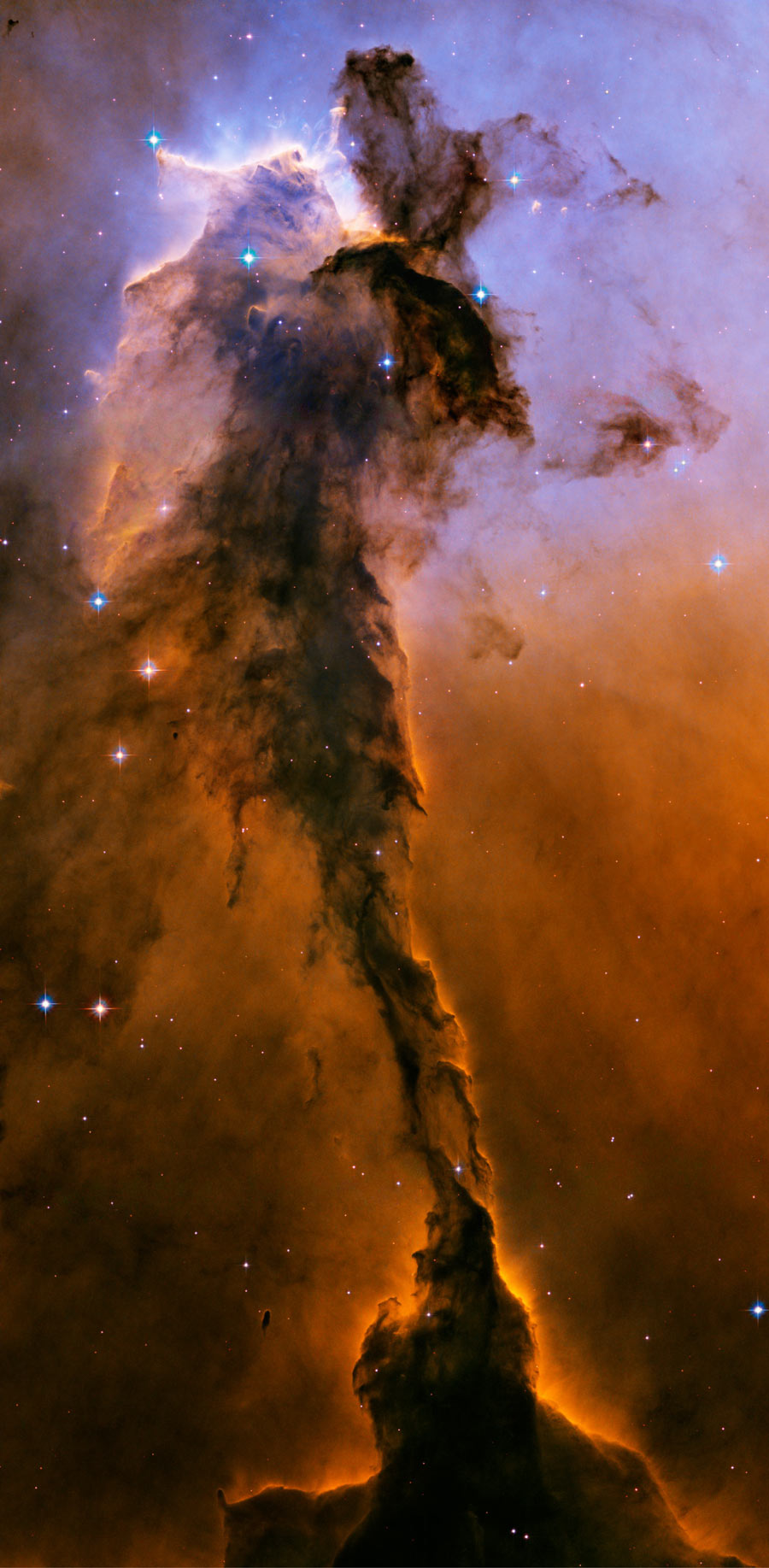
Image Credit: The Hubble Heritage Team, (STScI/AURA), ESA, NASA.
And that's a little bit of beauty to share with you this weekend, cutting right to the heart of the matter!
Beautiful, heartbreakly so. I want to behold with mine own eyes. I want my FTL starship, RIGHT NOW!
When I first saw Hubble's "Pillars of Creation" I had an epiphany about the vastness of the universe. It was also an endless source of frustration, when showed it too people and most of the reactions I got was "Yeah, cool..."
@Mark- unfortunately if you had your FTL starship, you would travel all that distance only to find them gone. Apparently they were destroyed by the shock waves of a supernova, but here on Earth we still get to see the show for another thousand years or so...
Balderdash! If you have an FTL transport available you need only travel away (not towards) the expired event you wish to observe and then you can watch the whole thing happen as it catches up with you. Enjoy the trip!
tipe bah ya :D
... and be back in time to rescue Lois Lane! :)
I have to reread the Hubble section about photoevaporation and evaporating gaseous globules. Nice photos too.
"and then you can watch the whole thing happen as it catches up with you."
A bigger telescope would be required, mind.
Only if the heavens above can be measured and the foundations of the earth below be searched out will I reject all the descendants of Israel.
It's breathtaking !
I want to get a large version printed to canvas for my wall, but can't seem to find and with high enough resolution - any idea ?
absolutely unbelievable....don't you feel very very very small and insignificant? i have no word to define the feelings growing inside of me watching these pictures...
@ wow
Im sure if one could acquire an FTL starship, obtaining a bigger telescope wouldn't be a prob.
And if you visited the Great Wizzard, he'd give you a brain no prob.
If you had an FTL starship that could travel more than 6,000 times the speed of light you'd reach the pillars before the supposed supernova took place, unlikely to find one but nice to think about :)
Breathtaking picture