

"When you make the finding yourself -- even if you're the last person on Earth to see the light -- you'll never forget it." -Carl Sagan
When we talk about dark matter and its alternatives, we are talking about no less a task than explaining the structure of every large object in the Universe. This means every one of the billions of galaxies, including the way they form, merge, and cluster together.
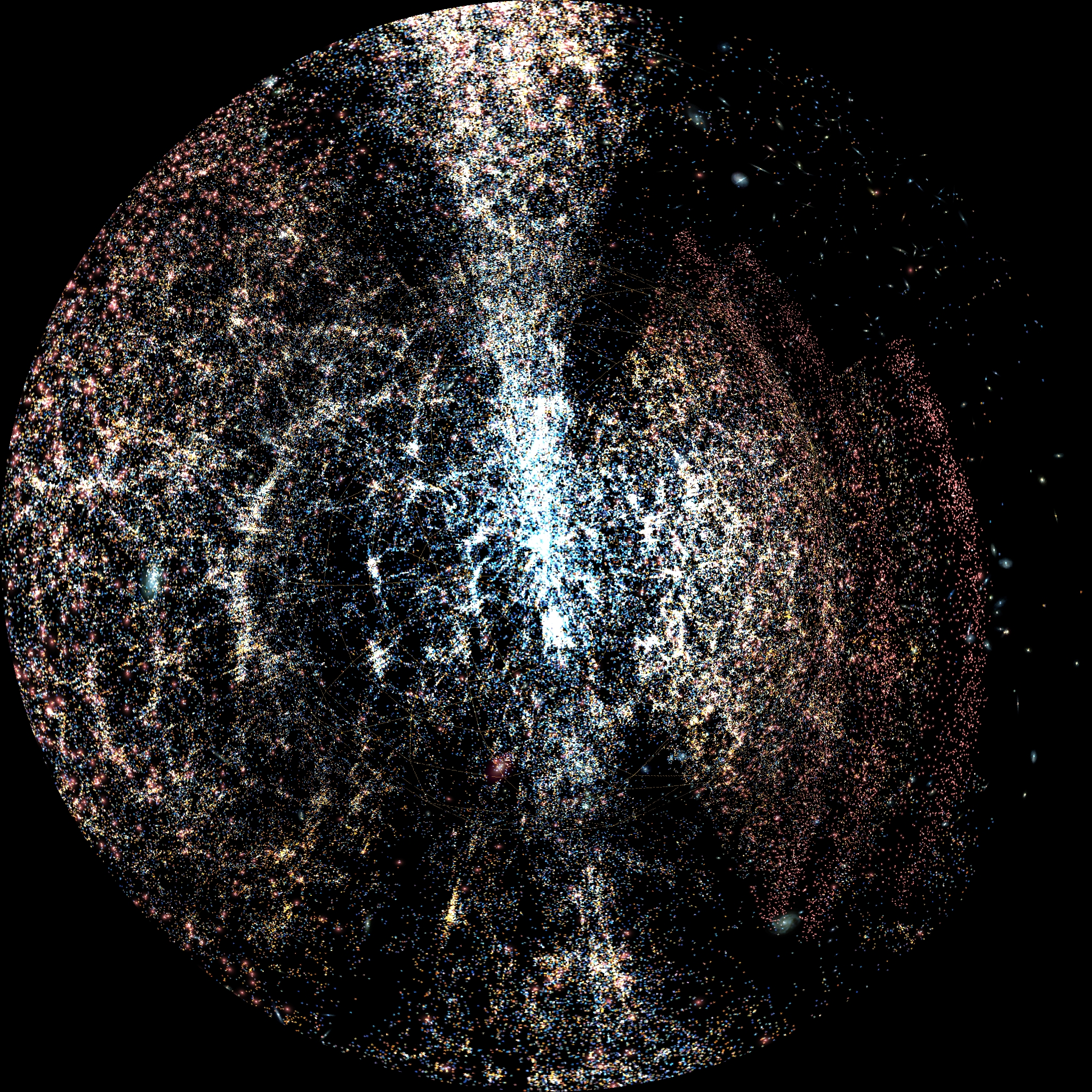
Image credit: Mark Subbarao, Dinoj Surendran, and Randy Landsberg for the SDSS team.
On the largest scales -- where each pixel in the map above represents an entire galaxy -- dark matter blows all of its competitors away. In terms of explaining the large-scale structure of the Universe, not a single one of dark matter's alternatives comes close to mirroring its success.
But of course, that doesn't stop the sensationalist headlines from rolling in. We are understandably uncomfortable with the notion that we are not the most important thing in the Universe. We were against the Earth not being the Universe's center, we were against the Sun just being another run-of-the-mill star, we were against the spiral nebulae in the sky being other galaxies just like our own, and now we're against all the matter we know in the Universe -- protons, neutrons, and electrons -- being relatively unimportant compared to the amount of dark matter in our Universe.

Image credit: AAAS / Science, retrieved from francisthemulenews.wordpress.com.
And while dark matter's been the only successful game in town on large scales -- for galaxy clusters, for supercluster and filaments, for the fluctuations in the microwave background, for big bang nucleosynthesis, for gravitational lensing, etc. -- its alternatives have held the advantage in one spot: for individual galaxies.
In what way is this the case?
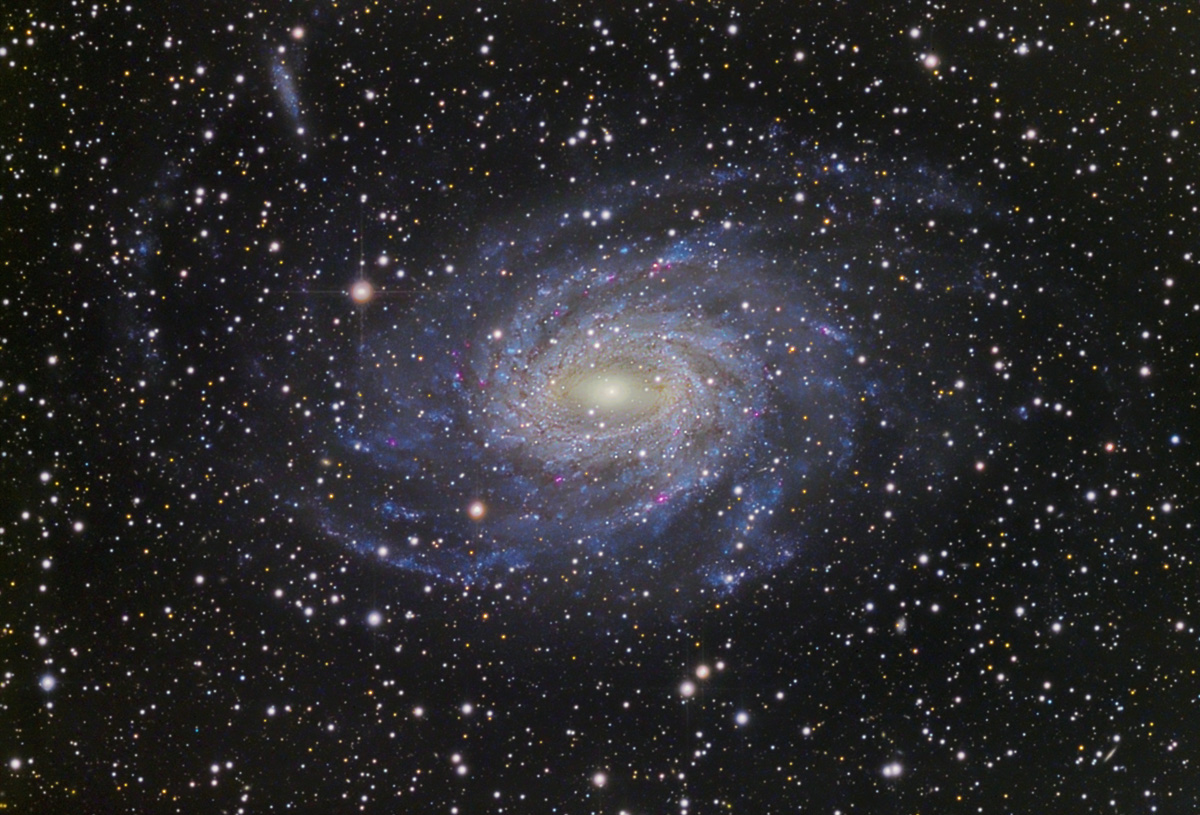
Image credit: Bernd Flach-Wilken & Volker Wendel.
Above is spiral galaxy NGC 6744, often referred to as the Milky Way's twin. Although somewhat larger than our own galaxy, to the best of our measurements the structure of our galaxy, including the central bar and sweeping spiral arms, are the best match to this one out of all the known galaxies surveyed.
When we look out at spiral galaxies, we discover a relationship between the speed at which the galaxy rotates and the distance from the galaxy's core. This relationship is very simple, and is better described by an empirical, phenomenological (i.e., not physically motivated, but data-motivated) model known as MOdified Newtonian Dynamics. There are a number of ways to obtain MOND, including by postulating some type of gravitational dielectric medium in the vacuum of space.

When you shove an insulator in an electric field, it's made out of matter, which in turn is comprised of positive (nuclear) and negative (electron) charges. The insulator responds to the electric field, polarizes as shown above, and changes the electric potential of space.
The analogy would hold for gravitation if there were negative gravitational masses, or some type of gravitational dielectric. This is an idea that's been around for a while, and Dragan Hajdukovic's new paper has been getting quite the buzz for claiming that perhaps virtual antimatter particles in fact do just this, and behave as though they have negative mass. This could, in fact, explain why individual galaxies look the way they do.
What are the problems? Well, when we've modeled our structure formation for individual galaxies, using dark matter and normal matter in the expected ratios, we arrive at a few problems.

Image credit: Ned Wright's cosmology tutorial.
First off, it takes a while for these galaxies to become very bright. When we look back in the Universe, we see extremely bright galaxies -- some even brighter than the Milky Way is now -- when the Universe is just one or two billion years old! It was thought that Milky Way-like galaxies would need more time to form than that, and that they'd run out of gas to form new stars too early if they formed so brightly back then. Furthermore, simulations always gave us central bulges that were too big and too bright to be explained by conventional dark matter, and perhaps not-quite-right structure for the grand spiral arms.
Wouldn't it be some news if we could solve these problems, and explain the galaxies in our Universe -- the last great difficulty for dark matter -- without having to resort to any of the alternatives?
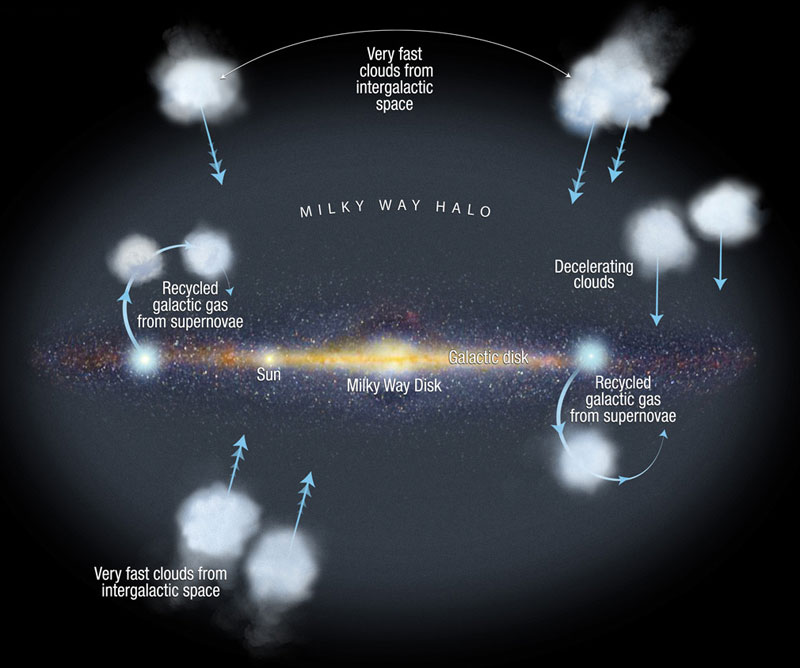
Image credit: NASA.
Well, as I said at the start, haters to the left! We've just successfully figured out where the new material to form the Milky Way's young stars is coming from: high-velocity intergalactic gas clouds! About a Sun's worth of gas falls into the Milky Way (on average) every year, and this resupplies the Milky Way's gas reserves, which get eaten up as new stars form over billions of years.
But what about the other, larger mystery? What about reproducing the structure of the Milky Way itself?
SUCCESS!!!!!

I know that some of you will never be convinced, not until a ball of dark matter can physically hit you in the face and make you cry, but this is a huge advance for dark matter! There are still alternatives worth considering, but they've got a long way to go before they stack up.
And so on this day, even as my parent company disses dark matter and promotes the alternatives, I say, "Haters to the left," and happily bask in yet another outstanding success for the best theory for structure in the Universe: dark matter.
I don't have a problem with dark matter. After all, the world is full of things that took us a while to be able to sense, from the rest of the eletromagnetic spectrum outside of visible light to scents and smells to the weak and strong nuclear forces (yes, i'm aware that those arise from baryonic matter).
I'm more dubious of dark energy. I think that it is aether of our time. But on very large scales, there could well be other forces that show, so i could be quite wrong.
Do we have any evidence that dark energy is a real force versus a condition of our incorrect/poor modelling of the universe?
The evidence for Dark Energy is that the models keep working to explain the observations. More than one line of evidence points towards it. There's no slam-dunk like it the way there is for Dark Matter. However, thus far, nobody's really been able to come up with an alternative that lots of people find compelling.
I, however, would not be surprised if it turns out that Dark Energy isn't really a fluid (or vacuum energy, or whatever), but that it is a pointer to our models of gravity not being quite right on the whole-Universe scale. But if I had to bet, I would bet a nickel (my maximum bet-- I won one off of Ethan once) that Dark Energy is in fact real, and that it is in fact simply vacuum energy.
-Rob
I have never understood this difference between gravitational and inertial mass. Reading it again on Wikipedia, I don't see why there is a necessity of differentiating them.
For example, is there an equivalent in electric charges? A "gravitational" electric charge and an "inertial" electric charge?
Pathetic! This is what physics has been reduced to!?! Playing the hate card like a whining Creationist!?! How about giving us a decent summary of the Eris model, and also explaining the Pioneer anomaly?
It struck me as just a little hypocritical that you would condemn the writer for using the "hate card" and then immediately start talking about "whining creationist"(i am not a creationist by the way). It seems like you are willing to throw a little hate around yourself..........
Collin:
Chill the fuck out and re-read this post. I see no point where Ethan "plays the hate card like a whiny creationist."
"Haters to the left" is an internet meme.
http://knowyourmeme.com/memes/haters-to-the-left#.TmGwv44hWSo
@4: Collin, I think your off base. 95% of the post was all legitimate material. Leave it to a true hater to nit pick and call a good write up 'pathetic.'
@ Dr. Knop,
Can you tell us more about the nature of the bet? I feel as though I remember you mentioning this in the comments on another post. And I still think it would be nice to have you do a guest-post on SWAB. (if Ethan would allow it and you oblige)
I don't mean to aggravate all the astronomers and stargazers out there, but I've lately come to think that astronomy is futile. This is why: compared to the observable universe, we're incredibly tiny. Now imagine that we're creatures on an even tinier scale, for example as if we were living on a mitochondrion inside a cell. Then our "astronomers" would be observing and recording events that take place in "the universe" - in reality the cytoplasm of the cell that we're in. But those observations of moving, combining, and exploding objects, incredibly far away to our eyes, while interesting in themselves would not be able to explain the function of all those moving parts, which we know is to express proteins as part of a gigantic, complex system that would be unimaginable and incomprehensible to creatures living on a mitochondrion.
In order to even try an explanation you have to be at a level that is "above" that which is observed so that we can see how the parts work together, and to what purpose. This is impossible in astronomy. So these days I view astronomy photos like art, some are attractive visually, and some not. But I do not think of them as "science" other than the technology that took the pictures. I'd be interested to know if anybody has any thoughts on this.
Hail, Eris!
The old news, which the article says a lot about, is that dark matter explains many things about the universe but MOND seemed to explain galactic rotation better. The new discovery, which is only briefly mentioned at the end, is the Eris Model explaining galactic rotation using dark matter. And the rest is an emotional attack against MOND proponents.
If Ethan doesn't the Eris Model described yet, he could either have posted the link with a little teaser, or he could've waited. Instead he wrote an article in which the Eris Model, the news-worthy subject, is only a little detail near the end.
And there is still nothing about the Pioneer anomaly.
People who only believe things that hit them in the face wouldn't be reading ScienceBlogs in the first place. A new modification of a theory is convincing to an audience when there's a rational argument for it on the audience's level.
I don't come here with a codebook of "Internet Memes". I come with an interest in science. Some hypotheses have more scientific merit than others, and as an average reader I defer to rational judgments about them from experts.
If an extension of dark matter theory can explain galactic rotation as well as MOND, this is a great improvement in science. The question, which Ethan sidesteps, is whether the Eris Model is in fact such an explanation. I didn't even know there was such a thing as the Eris Model until the end of the article.
So I'm a hater? Well, I thought a good article is supposed to state a thesis, expound on it, and reach a conclusion. This article does nothing of the sort. So I guess you're right; I hate it when an author I've trusted for science, on a site I've trusted for science, suddenly dispenses with journalistic decorum and replaces his explanatory skills with commercial-style persuasion.
"We were against the Earth not being the Universe's center, we were against the Sun just being another run-of-the-mill star, we were against the spiral nebulae in the sky being other galaxies just like our own, and now we're against all the matter we know in the Universe -- protons, neutrons, and electrons -- being relatively unimportant compared to the amount of dark matter"
That is just pathetic. And a fallacy as big as a galaxy.
May i suggest: "haters to the back", including Ethan Siegel.
Thanks.
Thanks Ethan. Not only do you keep us up to date but you carefully explain the background in your trademark, lucid style.
Of course, being left handed, I question your metaphor. We are sinister and we are are gauche but please do not invite the haters to join us. It is bad enough that some studies show we have a shorter life span than our biologically blessed right handed brothers.
And if you wonder where you stand on this matter, try the Edinburgh Handedness Inventory
@Collin: WRT the Pioneer anomaly, you might try looking at this:
http://blogs.discovermagazine.com/cosmicvariance/2011/03/31/gravity-wor…
And BTW: although I agree with Ethan that MOND probably doesn't work, and although I think the idea of Dark Matter is correct, I nevertheless agree with you that the term "hater" isn't appropriate at all here (regardless if it's an "internet meme" or not).
I totally agree with Bjoern!
To my point of view, Dark Matter as a so far separate model is just the beginning. We now should start to find out how to integrate it into a better model of baryonic mass and its gravitation.
Simply ruling out MoND and thus telling "there is no ununderstood gravity" seems not appropriate to physicists. MoND just gave us an important hint, how simple a problem could be solved (and nature is simple), although it does not solve all problems and it solved them only heuristically, mathematically, without a relation to actual physics, only to observations.
To my opinion this hint shows us that there is a simple, so far ununderstood physical reason based on baryonic mass and its gravity, which leads us to a similar, but then and finally physically based model.
BTW: The simulation of ERIS results in a too flat milky way.
To me this result seems obvious as long as you work with Dark Matter as autonomous particles: they sooner or later will deformate from halo to disk, as baryonic matter does.
Collin, I imagine that you're right concerning the rules of articles. But this isn't an article - it's a blog post. While it is true that many people treat them as being the same, they aren't. I too would be interested in the supposed merits and flaws of this Eris model, but Ethan is by no means constrained to write about them. Ever. Journalistic decorum? There has to be a journalist in order to follow journalistic decorum and I just don't see any here. If this offends your sensitivities as a reader, then by all means, do what you think best, but PLEASE don't pigeonhole science blogging as a journalistic endeavor.
Apologies to Ethan if I've overstepped my bounds as a mere rare commenter here, but it's been annoying me more and more lately how people mistake a blog post as something it isn't. Blogs are still new beasties - they are not newspaper articles, magazine articles, journal submissions, or anything else comparable to the mainstream media that existed before the rise of the internet. Except perhaps an editorial or letter to the editor and then only perhaps.
Collin,
You are always free to advocate for the content you would like to see and to petition me for what methods of communication you think would be more effective.
Perhaps I shouldn't be using a phrase like "haters to the left" and assuming that my general audience will be familiar enough with that reference (although it is an internet meme, I am a big fan of the TV show "30 Rock", which is where it's from) to translate it as I meant it. (Which was, for the record, that dark matter's weak points have just recently gotten a whole lot stronger.)
The Pioneer anomaly was long suspected by nearly everyone as being an issue with the engineering/heating of the spacecraft, and although the details were very difficult and took a long time to work out, it was determined earlier this year that known physics has in fact been reconciled with the Pioneer observations. Bjoern's link has an excellent writeup of that finding and I have nothing to add.
But it is good to know that you would have much appreciated a more detailed discussion of the Eris model from me; I thought it would be news to most people not in the field that the idea of filling the Universe with a gravitational dielectric would, in fact, reproduce MOND, and that Hajdukovic's idea does just that. But perhaps it was poor judgment on my part to not delve deeper into why the Eris simulation is so interesting, so thanks for your feedback on that front.
There are many articles that I've written over the past 3.5 years on dark matter and MOND that you might find of great interest if you want a deeper background on these topics; and stick around, I am sure there will be much more on dark matter and cosmology in general to come. The levels of what you would consider "journalism" vary wildly on this blog, but what I do is by no means exclusively (or even mostly) journalism.
psmith, for whatever it's worth it is well-known that I am left-handed too.
@Daniel
Seems noone is taking this on so I'll have a (very simple) go at it.
Inertial mass is the term entering newtons second law
F=ma
It tells you how much acceleration you get for a certain amount of force.
Gravitational mass enters the left side of that equation, F= G m M /r^2.
The same is true for electric charge, it also enters the left side of the equation.
What may be confusing is that we often use the shorthand g (earth's gravity acceleration) for gM/r^2. Then the equation becomes a trivial-seeming
mg = ma
but that shorthand only works if you are on the surface of earth.
If you can read German, you can find more on that on my blog:
http://www.scienceblogs.de/hier-wohnen-drachen/2011/02/wie-man-die-raum…
Thanks Martin. Well, my German ist zu light um zu verstanden, but I google-translated your site into French (my mother tongue). The problem is that I don't have the intuition which could me feel the difference between the two kind of masses. The "strange" thing is that they are proportional? What would happen if they were not?
I am not a physicist, more a mathematician (computer science, programming languages, logic), but I am interested in physics of particles and things like dark matter, dark energy, inflation, big bang. I also follow the episodes of this goddamn Higgs boson :-) and I am as impatient as the physicists to know whether the LHC will eventually find it.
Daniel,
Think about it as inertial mass is how a mass responds to a non-gravitational force that you apply to it. If you push it, apply an electric field, have a collision with it, etc., that's what inertial mass is: the "m" in Newton's F = ma. Apply a force, watch the acceleration, and that's how you get m, the inertial mass,
But gravitational mass, I'll call it "M", is what causes gravitational attraction. In Newtonian gravity on Earth, where M_e and r_e are the gravitational mass and radius of the Earth, the gravitational force = G M M_e / r_e^2. For matter, tests like the Eotvos experiment have shown that inertial mass, m, equals gravitational mass, M, to something like one part in 10^11.
If m were not equal to M, you can imagine that you could make a particle of inertial mass m that either didn't respond to gravity or responded oppositely to gravity than we expect! Einstein's E=mc^2 would hold for either m or M but not both!
@Daniel
"The "strange" thing is that they are proportional? What would happen if they were not?"
Ethan answered that phenomenologically. Basically, "gravitational mass" is like electric charge - it tells you how much force you get in a gravitational field. Inertial mass tells you how much acceleration you get from this force.
But if the two were not the same, General relativity would be wrong. That we can interpret gravity as being due to spacetime curvature is only possible if acceleration and gravity are indistinguishable. (That's what the blog text was about - if you think about gravity as spacetime curvature, there is no gravitational field.)
As for myself, I think dark matter is cool and one step closer to the realization that the background field, the ZPF, in particulate in nature. We are presently looking for relatively big particles to explain dark matter. We are expecting that their mass can explain what we can observe when observing the rotation profiles of spiral galaxies and the rotation rates of galaxies in a cluster.
What I expect is that such particles are real but their characteristics are different than we presently hypothesize. First I think their size will be vastly smaller than WIMPS (weak interacting massive particles). My expectation is that they will be 10^-30 m. or smaller down to a Planck length, 10^-35 m., or even smaller yet. I expect that they probable clump a bit but even so they wouldn't be very big. Compared to a proton 1.6-1-7 femto meters 10^-15 m. they accordingly would be super tiny.
If they are that small they seemingly could never be individually discovered. As to being matter, I think it will eventually be realized that they shouldn't be classified as matter and would probably be mass-less like a hypothetical photon at rest. I believe they are no less than the sole source of all gravity, not by pulling, but by pushing via pushing gravity.
If they have such characteristics welcome back to the the old aether models of 300 year ago, as well as the more modern models of pushing gravity. This is my opinion of we will eventually discover and realize.
I will not line up to the left since I don't hate dark matter, I will instead squeeze into the middle since I think the dark matter idea is a step in the right direction toward a particulate aether which I believe will eventually be realized, and also the middle is between two good looking girls :)
i thought that 15 year old kid showed that the filaments between galaxys contained enough baryonic matter to explain the expansion, rotation, and acceleration of light matter to reduce the requirement of dark energy to be explained with plasma physics?
infalling intergalactic gas clouds? that slow as they fall into a galactic well? really? to base the dark matter thesis on a single observation,un-verified, in something as nebulous as a galactic halo, is just as optimistic as picking a string theory. this could just as easily be a local effect of another galaxys jets.
so far, there is nothing out there to back up the dark matter view except gravitational lensing - which already has plenty of theories floating around it. and thats without even figuring in if graphene happens to be a high percentage carbon constituent of the iSM.
negative results do not portend a direction for a working scientific theory. just another way to state a model that works.
Would the equivalence principle need to be given up under this new proposal? (I imagine there are probably other known observations it would disagree with, but I just wonder about this statement in particular) I remember in some textbook on Newtonian physics they explored the hypothetical consequences of negative mass, and assumed that negative gravitational mass would still correspond to negative inertial mass...the net result is that both negative and positive mass test particles would experience an attractive pull towards a large positive mass body, while they'd both be repulsed by a large negative mass body, so they still both "fall the same way" in any given gravitational field and it seems to me this would avoid violating the equivalence principle. Does the new proposal work differently?
You mean these SWAB posts aren't peer-reviewed articles?? *gasp* Someone fetch me my smelling salts!
Collin is exactly why websites turn comments off. Spastic, come on WAY too strong, and attacks the sane part of the community. Chill out and relax you hyperactive child.
@forrest noble:
How does that match?
The smaller something is, the higher is its frequency and thus the higher is its energy E=h·f=m_0·c^2.
Planck-mass particles, if they exist, would be the heaviest particles ever possible, although their weight is only about 2.18·10^-8kg, but they would be not composed, just one single particle.
I think, we would have already measured something like that if it actually would exist...
@forrest noble:
The zero-point energy (you probably meant that) should be homogeneous according to Quantum Field Theory. Dark Matter is inhomogenous. So, that idea does not work. (Dark Energy, on the other hand...)
With "big", you apparently refer to size, not to mass, judging from what follows. If yes, then: why on Earth do you think so? I've never seen anyone talking about the *size* of Dark Matter particles, only about the mass! In fact, most Dark Matter proposals talk about elementary particles, which in the usual models would be point-like, not extended!
Well, the same for WIMPs: as far as I am aware, no one has ever talked about the size of those...
Err, do you even understand why the concept of the Planck length was introduced...?
Non sequitur. All elementary particles (electrons, muons, tauons, neutrinos, quarks, gluons, ...) are point-like according to current ideas - nevertheless there is obviously no problem at all with detecting them!
That would be so-called "Hot Dark Matter". That idea has been ruled out for at least 15 years, I'd estimate.
That makes no sense in several different ways. For once, these particles could only cause gravity if they'd interact with normal matter in rather strong ways. But if they'd do that, they would have been discovered already long ago. Second, all "pushing" theories of gravity have to explain why the strength of gravity on a body is proportional to its mass, not its surface area. Third, you'd have to explain why the strength of gravity exerted by a body is proportional to its mass. etc.
Thanks Ethan and Martin. I understand better, and it makes me think of the difference between gravitation and electromagnetism.
OK: an electric charge is like gravitational mass (or colour charge between quarks): attracting or pushing back.
But there is no equivalent of F=ma in electromagnetism (am I right?).
And I wonder: BTW, what is a force (the "F" of F=ma)? Is there a difference between the notion of "force" (the four fundamental "forces" of the standard model) and that force?
BTW (again), I always wondered why we call "weak interaction" a "force", since in that (only) case, there is no attraction nor repulsion between particles.
@Daniel:
Well, that depends on what you mean by "equivalent" here... ;-) Obviously there are forces in electromagnetism, and for these forces, F = ma still holds. But there is no formula in electrodynamics which says that acceleration (for a constant force) is inversely proportional to the charge, i. e. there is no formula like F = Q a. Did you mean that?
There are different ways to define the term "force" (none of them satisfying in all ways, in my opinion); the most simple is: a force is something which changes the state of movement of an object or deforms an object.
Yes, there is a bit of a difference; although all these forces can do the things mentioned just above, these forces additionally can also change one type of particle into another, or lead to the annihilation or creation of particles. That's why one often does not talk about "forces" here, but about "interactions" ("the electromagnetic interaction" etc.)
Well, this is all very interesting. All I can say is that in spite of everything, I still have fun imagining that:
1) The equivalence principle doesn't hold
2) Matter and antimatter have opposite gravitational charges, though perhaps in a way such that both are attracted to positive, and repulsed from negative
3) Antineutrinos might balance out the matter/antimatter problem
4) All the antineutrinos in intergalactic space solve Dark Matter and Dark Energy problems at the same time, simultaneously pushing inward on individual galaxies and outward on the overall picture.
I'd love to hear some criticism of the idea(s) based on solid observation rather than rhetoric. In any event, it's just a fun thought experiment. :-)
Regarding the article, I would agree that it seemed to come on a little strong. I can understand Ethan's enthusiasm, but mentioning the word 'Haters' in combination with so much excitement is asking for trouble! Even with my deliberate lack of real attachment to any particular idea, the enthusiasm and aggression was a bit off-putting. Still, thanks for the fascinating article as always, Ethan!
Bjoern:
Yes, it's what I meant. But I see that, since force is not itself something clear, it is difficult to transpose it under electromagnetism. I see (wikipedia) that there are some formulations not using "forces" (analytical mechanics). I am going to learn more about them.
Daniel,
There is a force in classical electromagnetism that is like F = Q a.
There is the classical electric force law: given an electric field E, a particle of charge Q experiences a force F = Q E.
There's the classical magnetic (Lorentz) force law: given a particle of charge Q and velocity v, and an external magnetic field B, F = Q v x B (where the "x" is a cross product).
Since all charged particles also have a rest mass, m, subject to laws such as E = mc^2, F = ma, and, in principle, Newton's law of Universal Gravitation (which has not successfully been tested for antimatter under laboratory conditions, yet), we were able to experimentally find what the charge-to-mass ratios (i.e., Q / m) were for all of the charged particles in our Universe.
http://darkfieldnavigator.com/
The best candidate for the non-electromagnetic
biofield too.
I love this blog.
I saw the ERIS simulation a few days ago and was hoping I'd see a full explanation of what it meant on this blog. Write som' more!
I'm just scanning now and will read post, comments and links more carefully. Dragan Hajdukovic's new paper sounds interesting. Ethan, thanks for reviewing this.
Hater's To The Left; Mad Hatter's To The Right; and dark matter Secret Agents get to do the really dangerous stuff. Hmm, like well, my son and I've got to feed the ducks some stale bread; which my wife thinks gives them ducks diarrhea. So many unintended consequences.
http://darkfieldnavigator.com/
It has something to do with the theory
of the gravimagnetism and the so-called
extraordinary magnetic force or spin force.
I take my conclusions from paraphysics.
There is also something at William Tiller
close to it. The human psyche has gravitational
properties and it is the explanation for the
levitation in paraphysics. In paraphysics there
are already results which waits their theory.
4% of the universe wait for the explanation of
the reason of their existence
Just as Einstein saw time as a 4th spatial dimension, we , in our matter-based conceptual constructs, see "dark matter" as some mysterious substance in the same way that Richard Massey sees dark matter as scaffolding for the creation of new stars and Frank Wilczek sees the ether as a "grid". I have tried to address this domination of "mind models" in my own work. The following passage from my book, "the picnic at the edge of the universe", offers another interpretation, but requires us to abandon, or seriously modify, some of our cherished mental concepts, from quarks to clusters of galaxies.
"(On the other hand), if the universe and the cosmos that surrounds and contains it is itself an electromagnetic field, and the presence of âelectronsâ or other disturbances in the field that we sense as âparticlesâ, are simply organized distortions of that field, then the apparent contradiction is eliminated. The phenomenon that we call a âmagnetâ can then be seen as a small but extremely concentrated distortion of the cosmic field, a lens that, like a magnifying glass, is able to focus the energy of a particular range of wave lengths and do the work we ask it to do. The energy required to maintain its form and do its âworkâ is being drawn continuously from the surrounding field. We can see an electric motor as a deliberate distortion of the field and the current it generates a clever manipulation of the substance of the universe to draw out and focus its energy for our own local use.
The more concentrated detectable magnetic field surrounding a âmagnetâ can be then be seen as synonymous with the description of âdark matterâ (in the book), where it is indirectly detected surrounding cosmic âobjectsâ such as stars, galaxies and clusters. We see its effects in the curvature of light paths in and between observable "objects" and deflections of the paths of those same objects. This invisible power can be shown at a small scale here in the ZMD, where we live, by a simple demonstration. I carry in my pocket a pair of small "refrigerator magnets", 1-1/2 " long prolate spheroids like little footballs, that normally cling tightly to each other side by side since their magnetic poles are across the short dimension (as opposed to the standard definition of a prolate spheroid). If I separate them by a small distance, say 5 or 6 inches, by placing one down on a non-magnetic surface like a kitchen table top, hold the other one above it and rotate it with my hand, the one on the table top itself rotates because of the "magnetic field" between them. If you imagine the room as the cosmos, the table top as "a universe" and the two magnets as "galaxies", one can easily see the space between as "dark matter". It is invisible, one's hand can be passed through it without interrupting the observed effects or engendering any sensory perceptions in the hand. The space between the magnetic objects, the otherwise invisible space, is clearly distorted and this distortion exerts a force on the other magnet. Astronomers are astonished to see these same effects through their telescopes and call the distortion of the cosmos between stars and galaxies "dark matter", but are they not the same thing?"
@ Ethan: Ah, indeed.
- F = G.mâ.mâ/d²
- F = m.a
- F = k.qâ.qâ/d²
- F = q.E + q.v ⧠B
In these four formulas, "F = m.a" is the only one where "F" is the input (and "a" the result). In the three other ones, the force "F" is the result. Just a remark, a thought, I don't know if there is a meaning of thatâ¦
Nina Kulagina couldnât move objects in
vacuum tubes, hence dark matter is present
everywhere. David Bohm was right but stopped
quite intendedly as one fellow-studenr of Einstein.
Isn't questioning a theory a central part of the scientific method? You really need to take a step back and calm down. Controversy is normal and an excellent way to ensure a theory is a good one.
Ethan
Thanks for the clear summary of where dark matter hypothesis is weakest.
I did not know that MOND (at least this version) hypothesizes gravitational dipoles. Nice start, a physical concept not just an arbitrary equation. And Hajdukov's idea, that there is a region (I assume the halo region, I can't follow completely) where the gravitation of mass is just right for his polarization, has merit, interests me. Yet, as no expert, I'm not convinced by his argument.
Yes, National Geographic is just one of the Mad Hatter's To The Right.
But Hajdukov's paper has triggered ideas. Let me explore one here and get your feedback.
I'm reading Gravitation and Inertia by Ciufolini and Wheeler, Princeton, 1995. Yes I'm over my head.
pg 213, "This is usually called the cosmological "missing mass problem," or cosmological "dark matter problem"... the signs point to a not-yet-identified source of mass which does not have the characteristic of matter. Thus, this puzzle is better called "the mystery of the missing mass" or the "missing mass problem." Confronted by this mystery, one finds it difficult not to recognize that gravitational radiation carries zero baryon number, yet possesses the power to coalesce into black holes of significant mass. The question is still open at this writing whether it is a defensible thesis to speak of the "missing mass as collapsed gravitational waves." OK that's a quote from Ciufolini and Wheeler.
OK, first I assume the question is closed, i.e. that "collapsed gravitaitonal wave black holes" are not a candidate for the "missing mass problem."
The thought occurs to me that a black hole is surrounded by event horizon(s), ergosphere and photon sphere (s); but why not a graviton (gravitational wave) sphere? Or even why not gravitational waves caught in the frame dragging of the ergosphere? This is the fuzzy beginning why's of my fuzzier question?
I start with Ciufolini and Wheeler "missing mass as collapsed gravitational waves"; but not collapsed into a black hole. Why not instead of "collapsed" gravitational waves; a "coherent" aggragate of gravitational waves, yes like a gravitational laser. Now let's not limit this idea to a black hole. Maybe some kind of coherent torus (i.e. some shape) of gravitational waves acts as dark matter. Maybe even frame dragging is part of the cohesive. (No, I am not resurrecting Cooperstock's model; push that aside). I'm just asking about the merit of a coherent gravitational torus of gravitation waves of galactic dimensions and greater.
OK, that my sketch of an idea: could such structured gravitational waves be dark matter? I assume someone has already clarified some part of this idea sketch. Any feedback please? All thoughts will be appreciated.
-------- (different topic)
The ERIS simulation is nice; but I need help to understand why this particular ERIS simulation is so great and what assumptions or new evidence make this a particularly good model of our Milky Way.
------- (different topic)
"where the new material to form the Milky Way's young stars". Good. I look forward to a more detailed explanation of this.
I've always been partial to the Dark so I went right to the source: the Bible. Sure enough, Dark was first! It was Dark before God. God had to make light or everything would have remained in its natural Dark state. And even God could only make light half-time.
Dark is imposing too. Look how long it took for people to have light at night, in the Dark. Ever tried to read by a candle light? Pretty weak.
And understanding of Dark is embedded deeply into human consciousness. If you are ignorant of events, and treated badly by those who have power by being allies of Dark, you are "in the Dark" without your own choosing. Weren't you taught to respect your elders? And we're talking the way-way-back elders here.
Think about it. Don't panic, carry a flashlight.
Daniel@38:
Just jumping in here since you seem a little confused still. As you say, 'F' in 'F=ma' is often an input. I would say F=ma, by itself, doesn't tell you anything. It would just be a defined quantity since there is no measurement of F apart from a measurement of mass and acceleration. What is (equally) important is that you have a way to calculate 'F' that isn't the same as 'ma'. That makes the theory predictive.
So in classical EM, you can measure charge and distance, and then use Coulomb's Law to calculate the force between two point-like charges: F= k * q1 *q2 /r^2 where k is a constant, q1 and q2 are the respective charges, and r is the distance between them. Again, by itself this would tell you nothing, but you can plug the 'F' into Newton's 2nd law to get k * q1 *q2 /r^2 = ma. This allows you to predict future behavior. You are correlating two different sets of observables: charge and distance on one side versus (inertial) mass and acceleration on the other. So Newton's law is a general statement about how objects, characterized by inertial mass, move in response to a force. You need another law/theory to tell you what that force is as a function of positions/charges/etc.
The 'strange' thing is that in Newton's law for gravity,
F=G* m1 * m2 /r^2, m1 and m2 are apparently the same as the quantity m that shows up in F=ma. This doesn't obviously have to be, since we can imagine that 'gravitational charges' m1 and m2 which give rise to gravity could observably be different from the inertial mass. It could have turned out that two objects with equal inertial mass (i.e. they accelerate the same way under the same force, like say we know they have equal charge and we apply the same electric field to them to measure inertial mass) can generate different gravitational forces on a third object because they have different gravitational charges. Thats not what turned out to be true, so gravity seems 'special' compared to electromagnetism and other forces. This is even more true once you move from Newtonian mechanics to general relativity.
So in a modern picture, the 'Force' of gravity is the curving of spacetime in response to the distribution of energy/mass in spacetime. The 3 remaining 'Forces' are characterized by interactions between various fundamental particles where the momentum of one particle can be split into two particles with the same total momentum (or merged in the reverse process), and the exchange of momentum between, e.g., two electrons is carried by a photon that passes between them. The net effect of all the splitting and merging and exchanges is the macroscopic 'force' behavior we see in classical EM.
Thus there is a very different modern understanding of gravity versus the 3 quantum forces which wasn't there in the classical picture, but it partly goes back to the classical puzzle of why only the gravitational force equation involves the inertial masses.
I think the antimatter gravitationally repulses matter hypothesis has lots of things going for it.
1) Dark matter explained by this new proposal
2) Missing antimatter explained; antimatter and matter would tend to segregate due to mutual repulsion.
3) Dark energy: regions of matter and antimatter will mutually repulse so we'd expect the universe to expand.
4) Some existing CP violations may be explained this way (http://www.sciencedirect.com/science/article/pii/037026939290510B)
Of course the acid test is testing this directly which is in the pipeline. I reckon (or maybe hope!) we're on the verge of a revolution here.
And I forgot
5) Seemingly CPT symmetry combined with general relativity requires that antimatter and matter are mutually gravitationally repulsive. (http://epljournal.edpsciences.org/index.php?option=com_article&access=s…)
Ethan: To be fair, the haters aren't specifically hatin' on the dark matter hypothesis; from what I've seen, they seem to be hatin' on science in general. The rhetoric they're using has more to do with religion and indignorance than with any kind of science. If you were saying some other theory about what galaxies are made of was the best we had so far, the haters would probably be attacking that theory, using exactly the same rhetoric and logical fallacies. I remember some obscurantist asshalo named Anthony McCarthy Leveler using very similar rhetoric to attack Greg Laden for saying we might be able to learn something about the origin of life.
They don't hate dark matter; they hate educated people who dare to assert that they know something based on something other than their religion.
Intersting discussion on graviational and inertial mass...
Perhaps, indeed, dark matter has a different gravitational-to-inertial mass ratio. Presumably the force it responds to from the Earth would be the same as any other normal-matter paticle (a dark-matter satellite would behave the same in geostationary orbit), but the force exerted would be different (a dark-matter Earth would have geostationary orbit at a different altitude - among many other changes)... deep waters.
OR you could have gravity strengths dark-dark, dark-bright and bright-bright (normal) are all different... once you start taking the usual constraints off, the possibilities are endless.
Am I the only one bothered by the fact that they're pointing to their right? :)
Black Hole haters to the right?
The truth is that no forces of nature can be limitless. There cannot be extreme unlimited conditions of nature that can exist and still be stable, it will blowup sooner or later. Why should a BH singularity if it exists be stable and then regard the BB singularity was not stable? Well that is a double standard for singularities. Any way I have concluded that the force of gravity can be extremely strong but is limited, I call it the G force boundary, which will safely eliminate the possibility of the existence of singularities of any kind.
Black holes should outshine any star, but we donât see such objects, because they donât exist!
A simple test to detect black holes( if they exist) is to base it on the good old concept of the bending of star light around a massive body. And in this case if that massive body is a BH we should see a halo of back ground stars projected all around the alleged BH position because of the extreme light bending close to the event horizon. Every star on one side of the BH should produce an image on the other side of the BH. Some of the star light approaching directly the BH will be absorbed and some of the star light skimming tangentially near to the event horizon will be severely deflected many degrees, even 360 degrees or even orbit multiple times before heading out.
This means a BH will swing round the light from every star in the foreground or background of the sky to be seen from any direction that we observe. Therefore, if they exist, BHs must out shine any other bright star in the sky. Specially, the SMBH that is alleged to exist at the center of many galaxies is surrounded by all the stars of the galaxy and therefore if they exist shoud shine brightly. If the BH is far away it should at least shine like a bright star, if it is close by to discern a small angular disc then we should see a black spot in the middle of the apparent bright object. Black holes are not dark after all. It is just that we have so far not observed such bright objects in the sky.
This means a BH will swing round the light from every star in the foreground or background of the sky to be seen from any direction that we observe. Therefore, if they exist, BHs must out shine any other bright star in the sky.
No, it will only "shine" as bright as the stars behind it whose light passes close enough to it to be turned by its gravity.
I have always been suspicious of the idea of black hole singularities. We have observed phenomena well explained by event horizons, but it is impossible even hypothetically to observe the singularities supposedly inside them. There is no reason why a BH event horizon even has to have an interior at all.
@Collin (51):
Do you mean the Event-Horizon itself, or everything inside?
Remember the equation for the SCHWARZSCHILD-Radius:
r_S = 2GM/c^2.
You see, a BH of mass M has an extension radius r>0 in space. Thus there IS an interior, definitely. There is no way for that interior to send us any information, because information wavelengths return completely, but nevertheless is there a lot of baryonic matter! We can measure that by the gravity lense effect.
The "singularity"-effect only arises when trying to calculate the gravitational redshift with the exact relativistic formula: then we get infinity at the event horizon. But this is the view at the time flow at the event horizon seen from infinitely far away. The nearer you come to the event horizon the smaller will be the redshift-difference. When you reach the event horizon you get the redshift-difference of ZERO. This means you can see the interior here, better, all wavelengths from the interior, which are not too much redshifted so far. Also you could cross this event horizon (if your body would stand it...) and you would be pulled into the BH's gravicentre. At a point very very far away from this BH you would always remain at the event horizon, because for this point you need infinite time to dive into the BH.
Time is relative...
@Collin (51):
Additionally this is the reason for the "Black Hole Entropy" of S.Hawking: because "everything" diving into the BH will never disappear from its surface - seen from very very far away. Thus the surface of a BH "contains/keeps" all "information/objects" ever dived into.
People need to stop blowing things out of proportion. I doubt that dark matter is so important that human beings are going to feel less important by comparison. It doesn't matter how much of it there is. We know how big the universe is and does it make a dent? Not whatsoever. We should strive to keep things scientific and forget the dire, competitive aspect of human nature.
U rah rah and chest thumping aside, I'm more inclined to side with the Electric Universe folks. Plasma energy is 'billions and billions' of time more powerful than gravity and does not require the invoking of some exotic, undetectable force to make its models work. Plus you can actually verify some of the hypotheses in the lab. I think in time, dismissing simple electrical plasma from cosmological models and replacing it an X force will be regretted.
Do you have anything other than personal preference to prefer Elelctric Universe?
Given you don't even know what plasma is, I reckon not.
:facepalm: I'd hate to spend election night with you dude. So your "side" won. Is it not good enough that we might already have an accurate model for gravitation and matter in our universe? Personally, since I'm not the one actually doing any research or work on the topic, I tend to act as an observer, study the models, wait for the researchers to do the leg work (as they have now done) and celebrate that science has taken a step forward. The last thing we need is for the scientific community to have the same level of respect and maturity as a sixteen year-old's twitter.
And I didn't realize there was such a mystery to what Dark Energy would be until I started reading these comments. Its the negative analog to gravity, i.e. vaccuum energy. basically space-time's response to an absense of mass is an accelerating force outward as opposed to the inward acceleration from space-times response to the presense of mass. This explains the recent acclerated expansion of the universe by saying that there is only now enough empty space where dark energy dominates gravity.
Weird.
You talking to me? Because it's completely non obvious, but the sense of persecution is one common to the ones who haven't got a bloody clue and hate considering whether they're actually wrong.
For a start, you're the only one talking about "winning" here.
You also made up complete crap about "who has the accurate model". Listen, you don't even have a frigging model! You wibble on and on about "plasma electrical energy" like some fruitloop hippie nutter trying to fleece the gulluble.
Religious nuts who have decided they can't take the bollocks shifted by the religions available, rather than decide to try and find out, just prattle pesudoscience bollocks they've heard elsewhere and consider that, because it's not supported by ANYTHING, feel relieved they don't have to go and become scientists, they can skip any difficult learning and latch on to this new religion of complete sciastrology.
Science is talking a lot of big words.
It's knowing what they bloody well mean.
Dear Ethan,
I know you are an astrophysicist, not a theorist, so it may not be your fault, but I think you go way too far worshipping the "dark matter theory", while as far as theories are concerned, dark matter does not count as a good theory with its practically infinite number of continously adjustable parameters in the form of dark matter distribution. It is arguably one of the worst theories alongside with the closely related dark energy, where we have absolutely no clue.
@Kovacs D #59: It might be better if you chose less "loaded" words. The current cosmological model (LCDM, which stands for "Lambda-Cold Dark Matter"), does not have an "infinite number of continually adjustible parameters."
The dark matter distribution isn't a set of free parameter, it is observational data, just the same as the distribution of luminous matter (stars and galaxies), and non-luminous baryonic matter (gas, dust, free-floating planets, non-accreting black holes, etc.).
Do you consider the sizes and correlations of the visible galaxies as "adjustable parameters", the number of which thereby invalidates observational astronomy?
The dark-matter portion of LCDM has essentially _one_ parameter, the ratio of the average density of dark matter to that of baryonic matter (averaged over the full visible universe). Given that number, it is possible to determine the _statistical_ distribution of dark matter in the Universe, and compare those statistics with observation.
That distribution into clusters of galaxies, and then into individual galaxy haloes, is a _consequence_ of the underlying density (the one free parameter), not an input to the theory.
Michael Kelsey #60
Personally, I don't like the dark matter or dark energy theories.
Nevertheless, I realize that these theories best explain the wealth of observational data. (though of course, we'd like to understand the specific processes at a quantum particle level).
Now your comments are usually very clear. But today, your explanation is exceptionally clear. I have never read a clearer more concise defense of Lambda-Cold Dark Matter.
"Boom" your words hit me right between the eyes; all I can say is, "I did not know."
I've been trying to learn here and elsewhere for some time; but I did not know. I could not so concisely explain why dark matter is simply the best current explanation of the observational data.
Very nice explanation. I'll have reread this comment a few more times to let it all sink in. (yes, yes, I am the village idiot; so it does take several times to digest even for a such clear concise explanation.)
Thank you for this mornings education.
Dark Matter is still the modern version of the hidden planet "Vulcan". Just like in the case of Mercury's orbit, it is the underlying model that is flawed.
Nah, if theory explains smth by handwaving it's not really a theory. Welcome to 2016: http://physicsworld.com/cws/article/news/2016/jul/22/worlds-most-sensit… - nope, that handwaving is still not found. And yepp, there better explanations which do not require mysterious undetectable handwaving (feel free to call it dark matter or purple cloud if you like): http://mnras.oxfordjournals.org/content/461/3/2929
"Dark Matter is still the modern version of the hidden planet “Vulcan”"
Not really. There's a lot of evidence for dark matter, and it explains most problems better than other theories.
However, if you have a better one,please let us know what it is and how well it works (and where it fails, we are, after all, scientists).