

"As long as one person lives in darkness then it seems to be a responsibility to tell other people." -Bill Hicks
If you've ever been out in the wilderness at night, in a place where it truly gets dark, and where you've got, as the English band Keane would tell you,
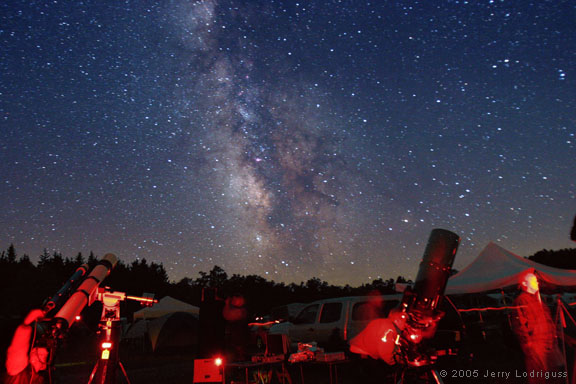
Image credit: Jerry Lodriguss.
On a moonless night, depending on the quality of your darkness, not only is the Milky Way visible, but anywhere from 6,000 up to a maximum of 45,000 naked-eye stars are available to the keenest of observers.
Although, quite possibly, this may be grossly inaccessible to you.
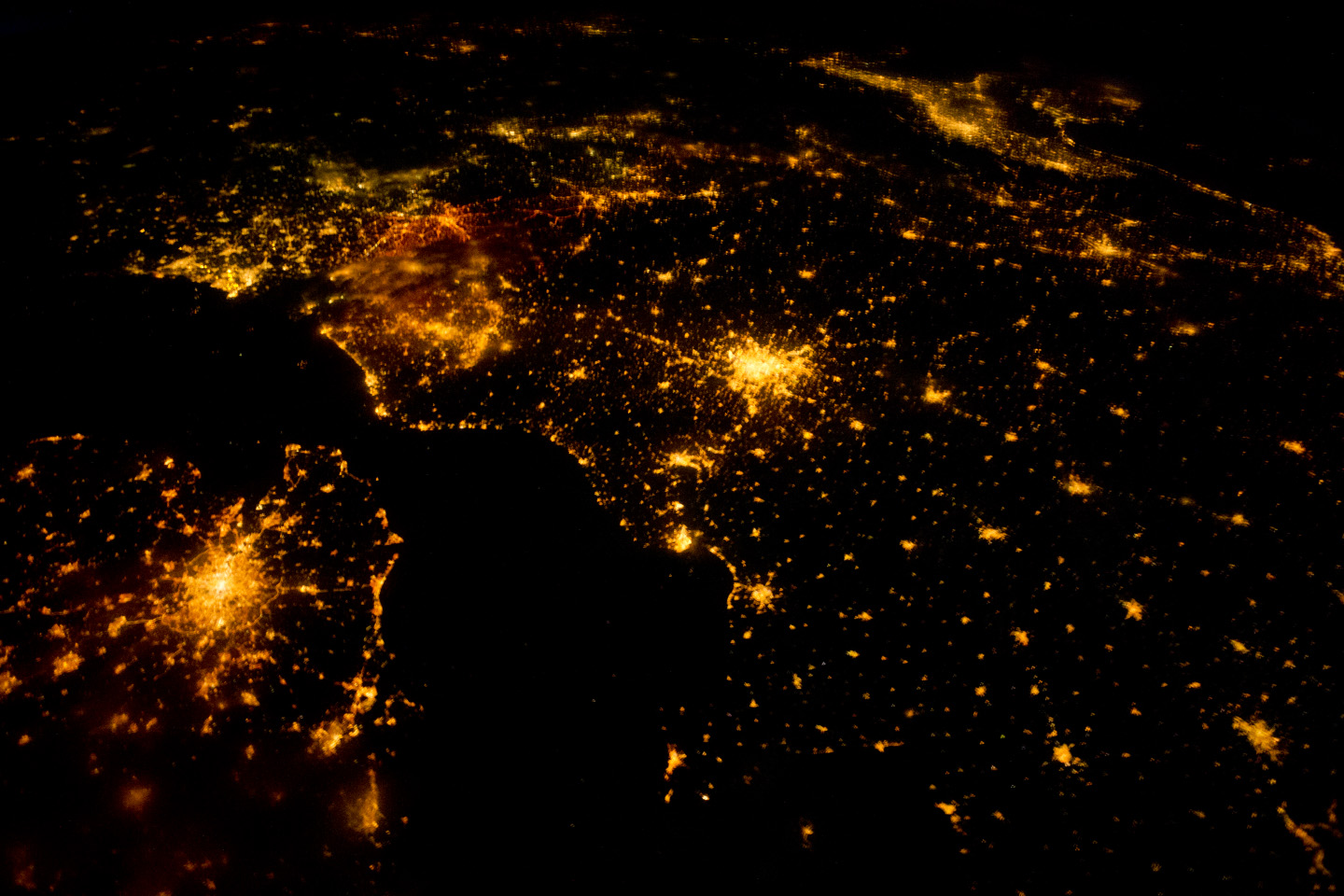
Image credit: NASA / International Space Station.
This picture of Europe at night has been making its rounds this week, and while it may have its own type of beauty to it, all of this light that you see is wasted. This is light that doesn't light up the cities and streets, but that rather heads up, into the atmosphere, and pollutes your view of the night sky.
Want to see the difference that one major light source can make to your view of the night sky?

Image credit: Flickr user Cali Traina.
This picture, from Ontario, Canada, shows the dramatic effects of light pollution on just what you see in the night sky. There are a great many people, in fact, who never have had access to truly dark skies.
And that's really a shame, because take a look at how dramatic the differences are between what you can see in an urban setting to what you can see under "true" darkness on Earth.
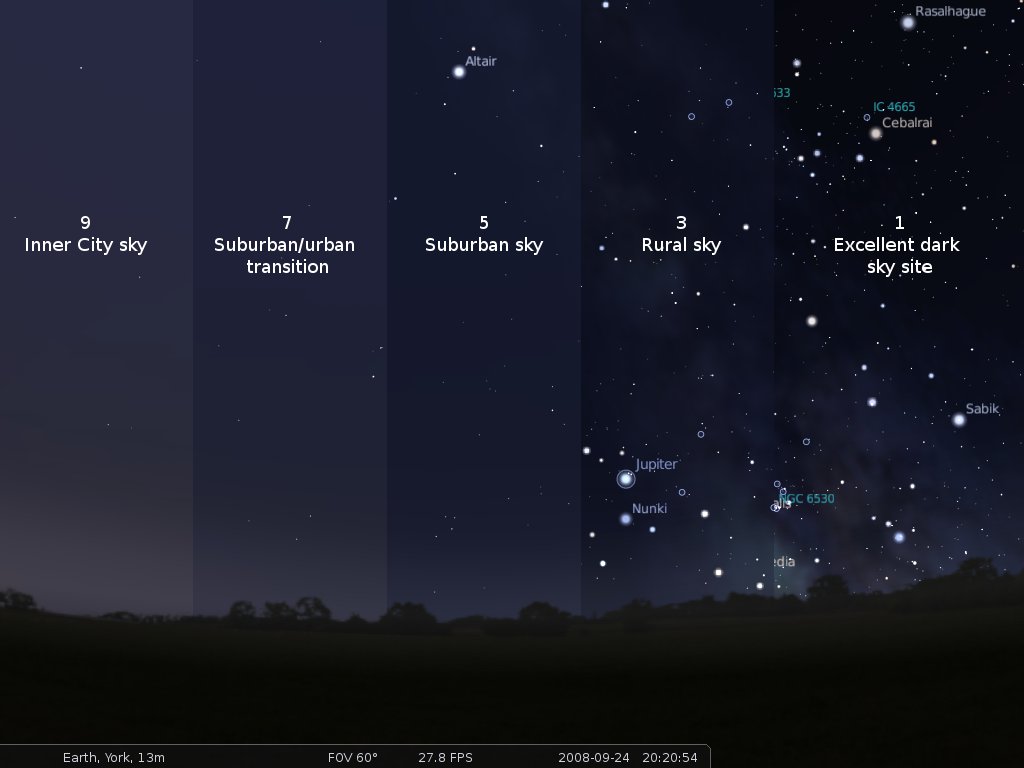
Image credit: Raj Chanian.
The darkest of night skies, for thousands of years, was something available to all humans. If we were more responsible about the way we choose to light our cities, towns, and roads, we could all have that once again. It isn't even that hard.
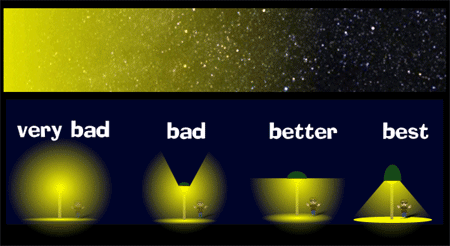
Image credit: Greg's Tech Blog.
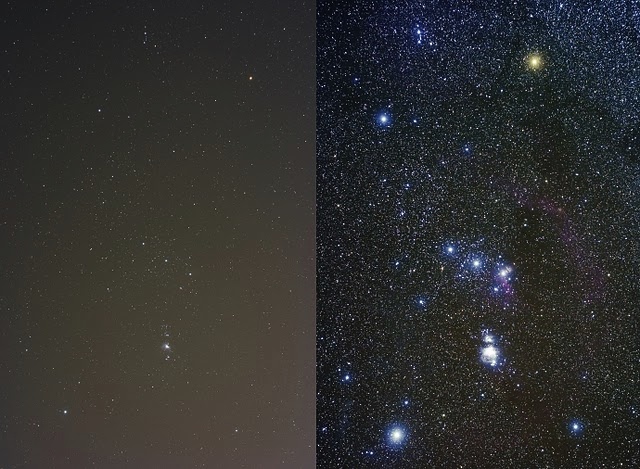
By simply replacing the most common types of street lamps -- the first two -- with the rightmost type, we would not only significantly reduce our cities' use of electricity at night, and we would not only improve visibility (which this also does), but we would get our night skies back. Take a look at the most famous winter constellation in the northern hemisphere, Orion, and what it currently looks like in suburban areas, versus what it would look like under dark sky conditions.
While one normally thinks of the United States as the world leader in energy consumption, Europe has the U.S. beat in terms of light pollution. Take a look at NASA's image of the Earth at night, below.

While less than 50% of the United States has access to skies dark enough to view the Milky Way, true darkness is virtually unattainable almost everywhere on the entire continent of Europe.
And while conservation efforts -- like the much-needed International Dark Sky Association -- are extremely important and would do a world of good, such things are woefully ineffective. The problem has not only gotten much worse over the last 50 years, it's continuing to get worse.

Well, one very beautiful town in New Zealand has decided to do something incredibly positive about it. Take a look at Lake Tekapo, New Zealand, with a population of less than 1,000 people.

Image credit: unknown, retrieved from zastavki.com.
They are trying to get their town designated as a World Heritage Site for their skies, as the very first starlight reserve on Earth! A rarity, Lake Takepo has some of the darkest skies available in electrified areas inhabited by humans, where true darkness can be achieved on a moonless night.
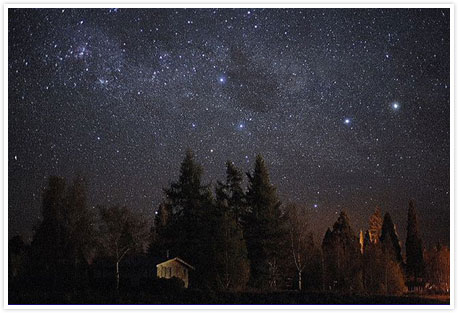
Image credit: Lake Tekapo Scenic Resort.
This needs to happen quickly, because a small town as distant as 50 kilometers away could ruin this darkness for everyone. But I think this is an amazing idea and a beautiful sight that not only needs to be preserved, but it would do the whole world good to give these skies to everyone.
And that's a beautiful thought for the weekend; hope you all enjoy it!
While it is obvious that the "best" lamp would be better than the "very bad" lamp in terms of light pollution, I actually doubt that it would be that much better. I think most of light pollution is from light reflected from the roads, not from light directed straight up, and this light would be unavoidable by definition. (From my personal experience, most lights in Tel Aviv are already the "best" type, but the sky is still completely lacking in stars)
Also, I don't know how much of light pollution is caused by it, but the silliest lights I think, are the ones which shine on skyscrapers, which are also common. Very strong lights, directed almost straight up, so the skyscrapers can be seen at night.
Starlight reserve! A wonderful concept, to be sure
The night sky has always been what inspired a sense of wonder in us, inducing a proper sense of scale and place. As we obscure the night sky we lose that sense of wonder and lose our sense of context. And that leaves us impoverished, more selfish and inward looking.
Great post. I've only seen the milky way twice in my 31 years on the planet, once in the middle of nowhere in Australia and once in the middle of nowhere in Ireland.
I've wondered how dark the night skies are on St. Pierre and Miquelon, tiny French islands off the coast of Newfoundland.
Anyone know?
The picture illustrating the different levels of the Bortle scale is actually from Stellarium's website:
http://www.stellarium.org/features_in_0.10.0.php
One of the things that we lost due to modernization is darkness and we are not realizing its importance in our life ... The dark sky and its beauty ..
We can bless the beauty of the night sky and the wonderment it stirs in us for the very beginnings of cosmology. The first person who wondered "how did all of this come about?" started it all. Thanks for the reminder.
Never been to Tekapo by night, even though I live in NZ. But yes, I walked the Inca Trail in Peru a few years ago, and was struck by how clear the night sky was out in the mountains. Very pleasant...
A friend of mine brought two Japanese exchange students to my house a few years ago. It was light when they came inside to visit, but night had fallen by the time they left. When they were walking out to the car, I heard a lot of talking, so I went outside to see what was going on. It turned out that it was the first time these teenage girls had seen stars! Hard to believe.
This issue is very important to me. I feel humans NEED to see the stars to put their lives in context (and to inspire young people to study astronomy). If I sit outside and gaze into the Milky Way, I realize once more how insignificant my life is. Rather than depressing me, it makes death seem less scary.
The Bruce Peninsula in Ontario, Canada has a dark-skies initiative.
They are currently studying the level of darkness, and there are some by-laws in place for new lighting.
Looking forward to dark skies over Death Valley at the end of this month. Last I had the chance was over a year ago on the beach on the east coast of Zanzibar. I want a telescope, but what's the point in the city?
@Joffemannen: Depends on what you want to do with a telescope. Using a pretty cheap 4" (101 mm) telescope, some dirt-cheap accessories I made, and a common inexpensive camera, I was able to catch photons from quasar 3C 273, magnitude 13, about 2.4 billion light-years away, from the middle of Milwaukee. I could also do pretty well on a reasonable selection of deep-sky objects by eye, and of course sky brightness is nearly irrelevant when you're going for planets, and doesn't matter much for double stars either.
Just don't go all Oliver Wendell Jones on us, and go pointing it at the neighbour's window.
The area of Southwest France-- mostly in the department of the Lot-- where we have our summer home is known as a "dark triangle." It's supposed to be the darkest sky in Western Europe. (Plus, the food here is great and there are hundreds of historic monuments....) I realize this looks like spam, but, honestly, I'm not being paid to write this.
On the topic of telescopes, though, IMO it's better to start out with no tools, except maybe a good pair of glasses. Get to the point where you can identify the North Star, the Summer Triangle asterism, Orion, the Pleiades, and so on at a glance. After you feel at home with the night sky, you'll be able to use a telescope much more quickly.
Just to clarify slightly what hoary puccoon said, when s/he says "glasses", my fellow Americans should read "binoculars". And yes, that's definitely the place to start. A tripod adapter and solar filters for the glasses/binoculars can also be had pretty cheaply, and make for a good experience. Gotta have something to look at those other 12 hours (on average)! But, make sure it's a proper solar filter; you really, REALLY don't want the Sun's light focused on your eyeballs.
The first time I ever got to see the band of the Milky Way with the naked eye was my first visit to North Carolina.
Late one evening in December we're heading from Elizabeth City to Edenton on U.S. 17 and I notice something odd. I look in my side and rear view mirrors and all I see is blackness. So I pull off the road because a little bell went off in my head.
I got out of the car and looked up and was stunned. I'm a city boy, never saw a view like that. The Milky Way band was so detailed and rich it almost looked like you could reach out and touch it.
And of course what did I not have with me? The camera. I now have a phone with a decent camera in it. Just need to stabilize it a bit to get good pix.
And in subsequent trips to NC I've been met with cloudy skies!
Wow, this funny! While you people are complaining of light pollution and the loss of the wonder view of the night skies, we africans are complaining of black out every time and will all warmly welcome and joyfully bear the delight of the plight of the light pollution. Isnt that funny and ironical?
We live in a fairly dark-skies area, which is nice; I can see the Milky Way on any reasonably clear night.
Though sometimes light pollution can be very very local; my neighbor has an incredibly bright garage light on all the time, so viewing conditions aren't great near my house--especially since there are so many trees around that anything with an elevation of less than 45 degrees is blocked. So I have to drive a couple miles to find a good place to use a 'scope.
Randy @15--
Yes, that clarified. I have to *strongly* second your comment about good solar filters. When there was a total solar eclipse in Northern France a few years ago, I saw another American try to use binoculars with solar-filter glasses distributed by a local bank. The glasses made viewing the sun safe when they were properly used, but they had a very strong warning-- unfortunately only in French-- that they were *not* to be used with binoculars.
We did at least get the guy to test, first, by directing sunlight through the binoculars and solar-filter glasses onto a piece of colored paper. There was an immediate, dazzling flash. He dropped the binocs and never tried again. If he had looked at the sun through the glasses and binoculars without checking first, I believe he would have been instantly blinded.
Frankly, after that, I'm more interested in looking at, say, nebulae in the Milky Way, which we can see every clear night. :-)
Your neighbours to the north have been on a mission like this for a few years now. The Royal Astronomical Society of Canada has helped to establish a number of Dark Sky Preserves in various parks across the country. I try to get out to Kejimkujik National Park in my home province of Nova Scotia as often as I can.
@1 Obed's remark about reflected light, seems correct.
It's a great idea to bring back the night sky; but how easy is it really? Did Lake Tekapo just put a curfew on lights or did they install different lights?
I think the only solution will be very light weight night vision glasses (not goggles) and night vision contact lenses. Of course, we'll need 100% compliance or else one car headlight will render us blind.
I suspect that if one adjusted for population density, the US would be worse than Europe for light pollution. Europe doesn't have as many huge overlighted parking lots and wide streets we do in the US.
@Oded I hear you on the vertical lights on skyscrapers! Drives me crazy living in Vegas. Every casino has them. How bout the one, though, that serves no purpose besides serving as an "attraction"?!? A light designed only to direct light straight into the night sky; can even be seen from space. Yea, I'm talking about the one that sits on top of that pyramid shaped casino on the south end of Las Vegas Blvd...not very environmentally friendly as their parent company claims to be eh?
And as for, the light reflecting off of the roadways and other surfaces. LEED green building standards call for higher reflective materials, which would only compound this effect as the standards are gaining momemntum. Essentially, its a giant catch 22.
Great post.
Great post. I've only seen the milky way twice in my 31 years on the planet, once in the middle of nowhere in Australia and once in the middle of nowhere in Ireland.
I had take my family to the middle of nowhere Wisconsin and took my son out to a field to look at the stars in the middle of the night. Just to see the look on his face as his eyes focused on a sky he has never really seen. If these lights could diminish some of the light just in order to see some more of the night sky I'm sure people wouldn't be so pessimistic,
I still remember taking our scout troop to Kokee to work on the astronomy merit badge and there were so many stars we had trouble finding constellations. A truly dark unpolluted night sky is spectacular.