

"Science is facts; just as houses are made of stone, so is science made of facts. But a pile of stones is not a house, and a collection of facts is not necessarily science." -Jules Henri Poincaré
The higher you fall from, the faster you'll be moving when you hit the ground.
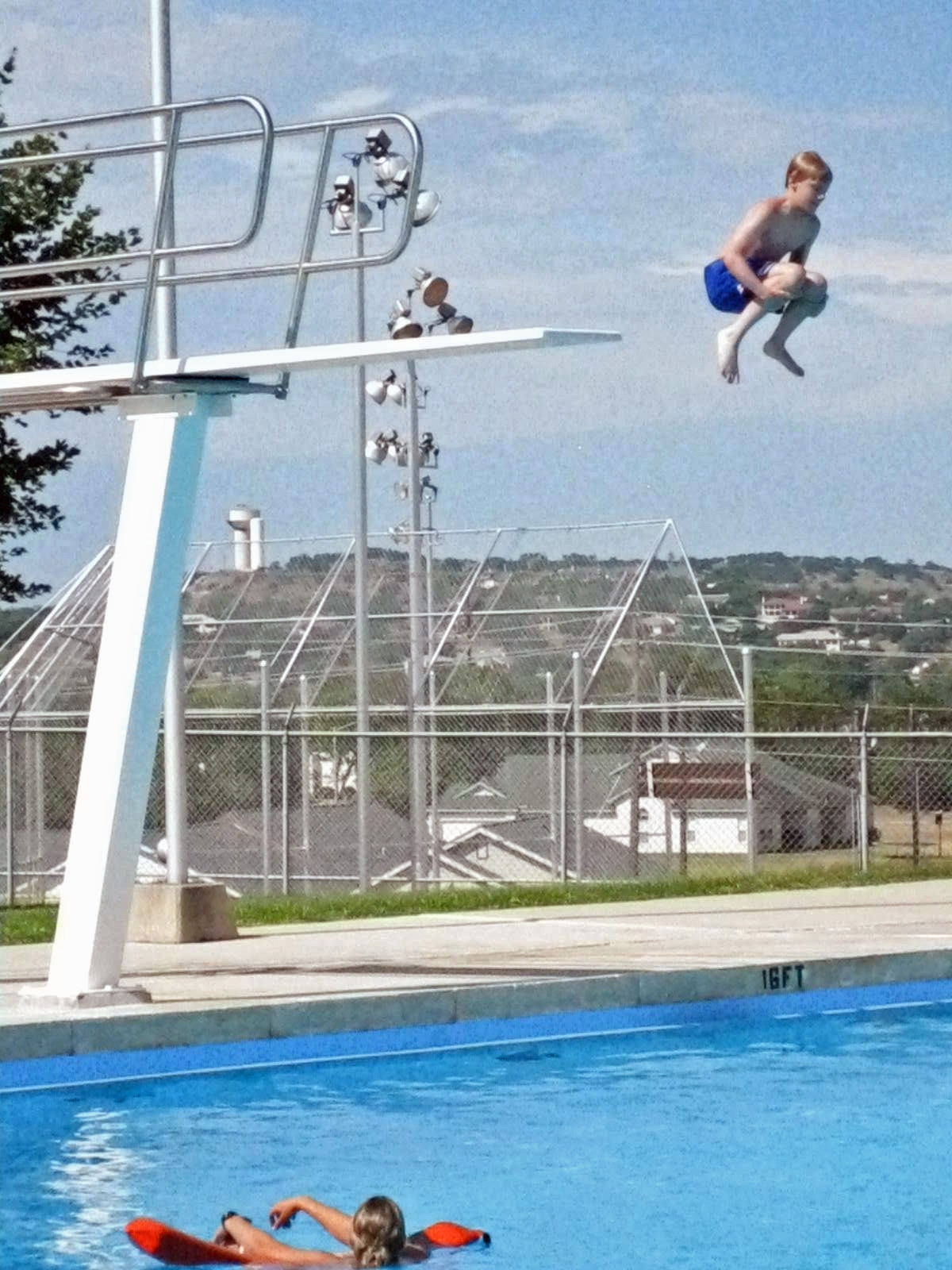
Image credit: Marianne Holland.
Seems like the most obvious thing in the world. You know this intuitively, of course, based on all your experience in the world. Drop an egg from too great a height and it breaks.
While you wouldn't be afraid to jump off of a diving board like the one above, jumping from a greater height might give you cause to worry.

Image credit: s2wghqu at glogster.
Because even though you've never done it, you presume that if you jump from too great a height, you may break when you reach the end of your jump.
So how do you know whether it's safe or not? How do you know whether you're too high to safely jump?
Believe it or not, this is what makes science, and what makes scientists out of us.

Image credit: Hulton Archive/Getty Images.
We're all taught some grand myth about the scientific method, like there's one fixed way to do science.
Stripping away all the pretensions, all that science really is is the way we make sense of this world.
If this thing happens, what's going to happen next? Well, you don't just sit around and talk about it, pontificating on what you think, you go out and investigate it. You make observations and measurements about the different things that happen when you test it out under different conditions.
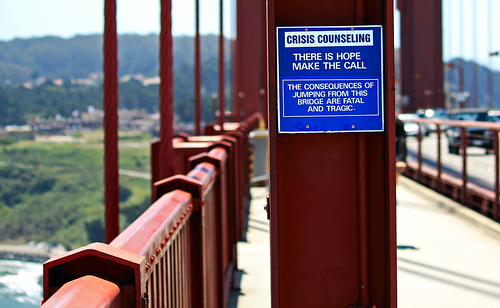
Image credit: flickr user Steve Szyslak.
Perhaps you eventually learn that there are, in fact, some heights that you simply cannot safely jump from, and even, quantitatively what those heights are. And when you're satisfied with what you've found, you can synthesize all your findings together, and say something that sounds profoundly intelligent and informed, like:
The higher you fall from, the faster you'll be moving when you hit the ground.
And this grand statement, that pulls all your investigations, observations, measurements and experience together, describes not only the experiences you've already recorded, but extrapolates to a more general case, and allows you to make predictions about what's going to happen for things you have not yet experienced.
And when you've reached this point, you have the beginnings of what can finally be called a scientific theory. You can start to predict, if you set up a system in a certain way, what it's going to do next! If it does what your theory says, that's evidence confirming your theory. But every theory has its limits, or a point where it breaks down.

Image credit: Skydive Spaceland.
For this particular example, the theory breaks down when an object hits terminal velocity, when the drag force (from air resistance, in this case) cancels out the gravitational force that accelerated you downwards. At this point, it doesn't matter how much higher you fall from, you won't go any faster.
But, of course, science has done better. Rather than a qualitative statement like the one above, we can determine, based on an accurate description of all the forces involved (including gravity, air resistance, wind speed, etc.), exactly how fast and in what direction -- at any given time -- a falling object is moving. Quantitatively.

Figure credit: Timothy John Mallow's excellent article.
And each time we test this theory under novel conditions or circumstances, we either get a great confirmation that our best theory is good in a new way, or we find that there's more to the story than our theory can account for.
And for most of human history, science has progressed incredibly slowly.

Image credit: "Epistola de magnete," from Oxford, Bodleian Library.
Magnetism was first discovered in the 1200s (by Pierre de Maricourt), but it wasn't until the 1800s that its connection with electricity and electric charge was understood, and it wasn't until very recently that the quantum mechanics underlying magnetism were successfully described.
None of the subsequent discoveries made the earlier theories wrong, they simply discovered the limitations of those earlier ideas, and went beyond them.
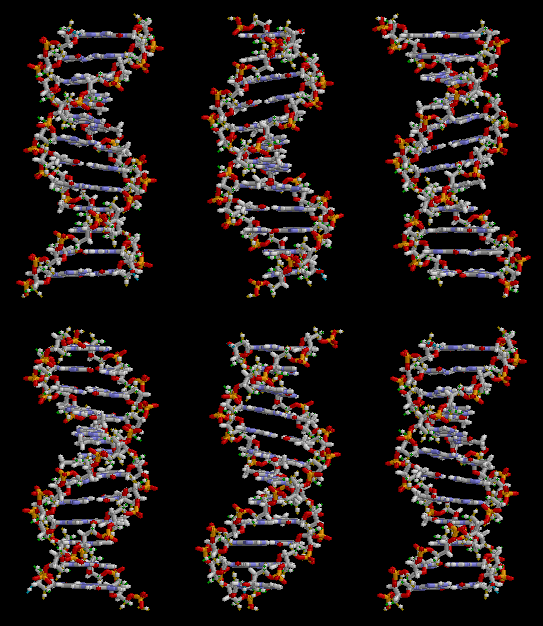
Animation credit: wikimedia user Brian0918.
It isn't like biology started with the discovery of the fundamental source of our genetic code. Before the structure and function of DNA was known, scientists still knew plenty about genetics and inherited traits. If we bred certain living things together with certain traits, we were long able to predict what sorts of traits the population of offspring would have.

Image credit: S. Metzing-Blau.
And before genetics -- the mechanism by which living things inherit traits -- we were still able to determine that the traits of living creatures changed over time, including the major mechanism by which it happens.

Image credit: Benjamin Cummings / Pearson Education.
And even before Darwinian evolution took hold as the leading scientific theory, animal husbandry had been practiced by humans -- breeding animals and selecting for certain desirable traits -- for over 10,000 years!

Image credit: Zenodot Verlagsgesellschaft mbH and The Yorck Project.
Of course, science knows too much these days for any one person to truly be an expert in all of the details in all fields. That's why we have scientific experts, who do know the relevant details in their fields. If there's an alternative theory to evolution, it needs to not only explain the phenomena currently explained by evolution, it needs to accomodate genetics, DNA, and everything else that's been built upon evolution.
The same goes for the Universe.
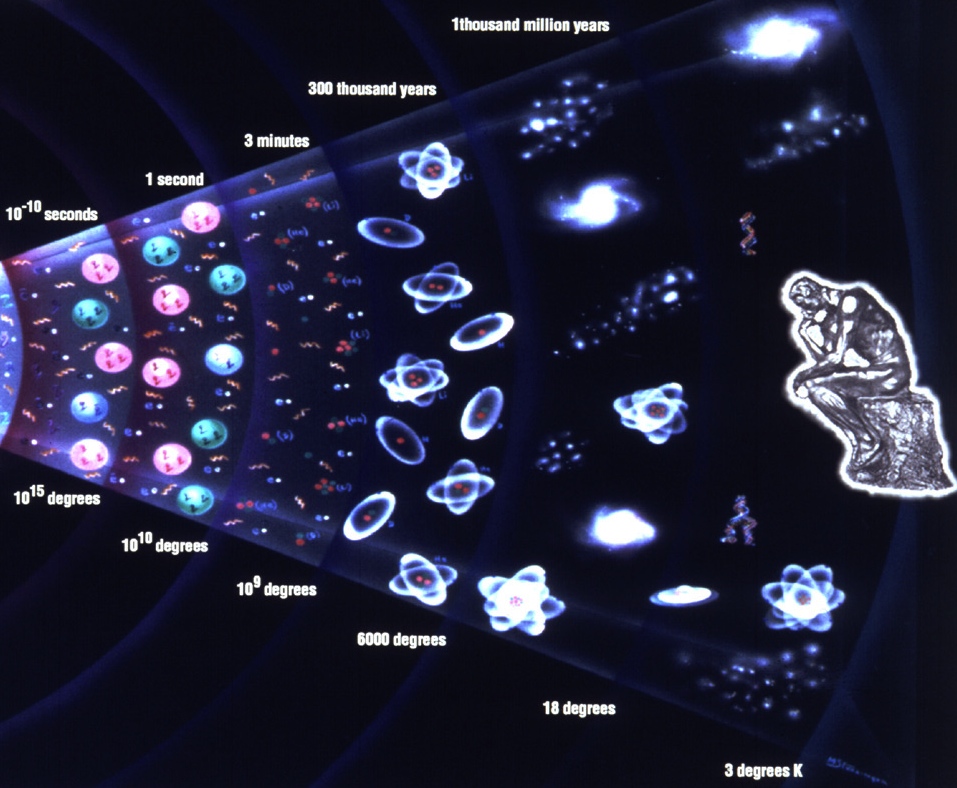
Image credit: edited by me, retrieved from GrandUnificationTheory.com.
At one point in the past, the Big Bang was not even the leading theory of the beginning stages of our Universe. But as observations came in -- of the cosmic microwave background, of galaxy evolution, of the initial abundances of the elements -- the alternatives fell by the wayside, unable to keep up. Today, the Big Bang model predicts all sorts of phenomena -- gravitational lensing, large-scale cosmic structure, fluctuations in the microwave background, etc. -- found to solidly align with observables in a robust way that no alternative does.
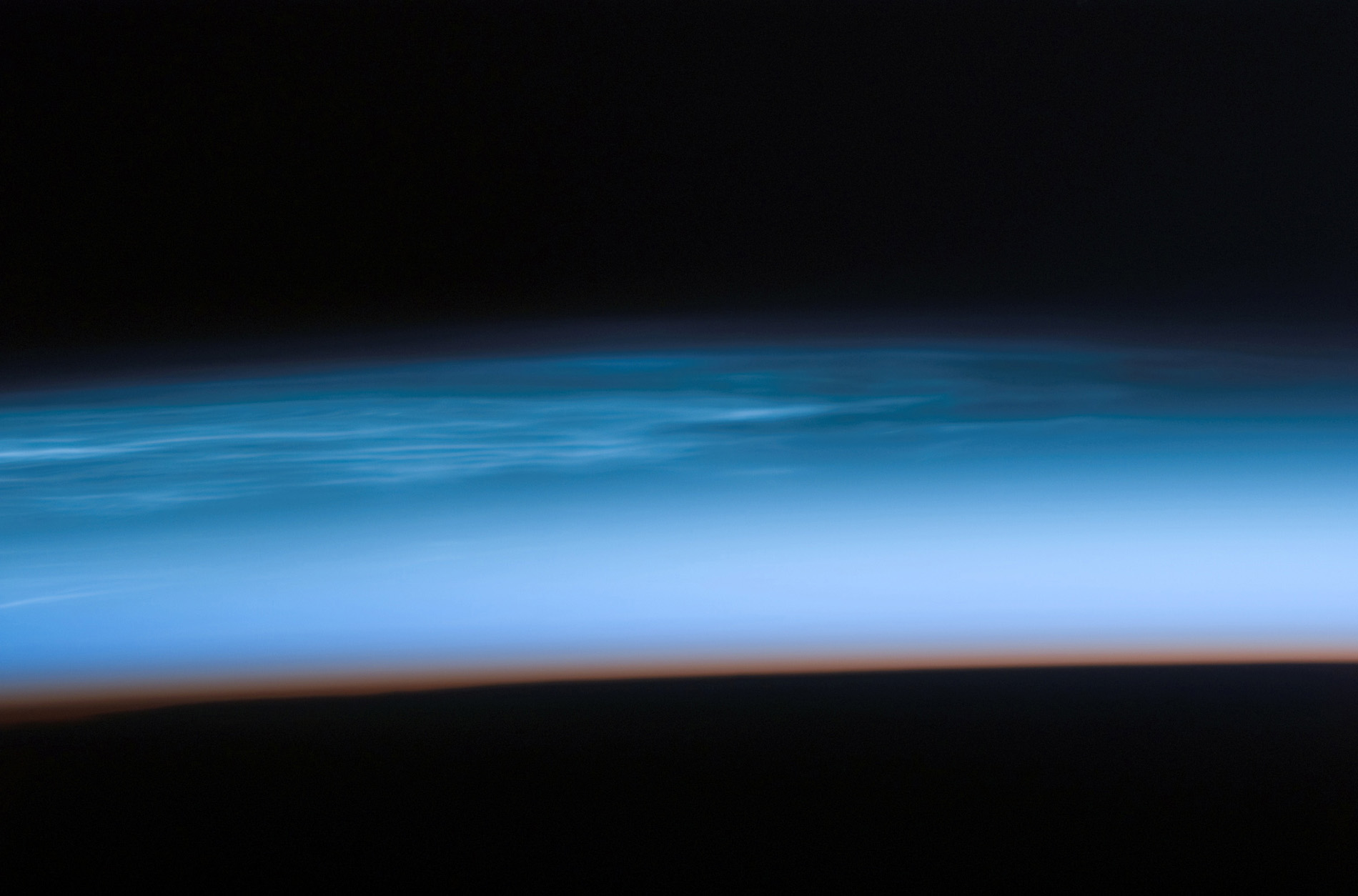
Image credit: Earth from Space, NASA / ISS / STS-117.
Getting a scientific consensus on any issue is incredibly difficult, because the evidence needs to be stunningly overwhelming. If there are multiple reasonable explanations that fit the data even marginally well, you won't get it.
We're skeptical. We don't believe explanations because they sound plausible. We observe. We calculate. We predict. We prod our theories and twist them in novel ways; we probe to the edge of their range of validity and beyond. We demand replications of experiments, and quantitative accuracy for a theory's predictions.
But if all of the alternatives are grossly inferior -- like they are for evolution and the Big Bang -- you'll find that over 95% of scientific experts in that particular field will, in fact, agree. And when those facts pose a danger to public health and safety, it's more important than ever.
Because you may not die if you disbelieve the Big Bang; you'll simply be wrong, and miss out on a deep and profound understanding of your origins and existence. (Which you are free to do as you choose, of course.) But if you decide to taste-test mercury or lead, or smoke a carton of cigarettes a day, or breathe heavily polluted air or ingest microscopic quantities of polonium, the consequences are much more dire. And so it goes with the Earth as well.
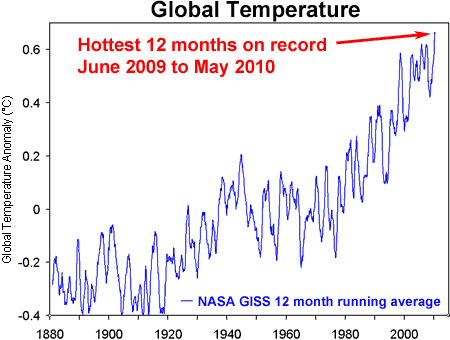
Image credit: NASA GISS, retrieved from skepticalscience.com.
The case for global warming and global climate change has -- among those scientists who study it -- reached that level of consensus. I've encountered a great deal of skepticism over email and on this blog, and although I've been more than happy to write about the details I understand well, I myself am not a climate scientist, so I don't get to be part of the experts who weigh in on its validity. I have to trust the experts, and the consensus they do reach.
And basically, there are four simple components of the consensus:
- The Earth is getting warmer, and the warming is accelerating.
- This warming is primarily due to human emission of greenhouse gases.
- If the emission of greenhouse gases continues unabated, this will continue to force the Earth's average temperature to rise. As a consequence, the icecaps will melt, the sea level will rise, and the climate across many regions of the world will change dramatically.
- And finally, these happenings -- and the ensuing natural disasters that arise from them (flooding, drought, etc.) -- are bad things that we can and should do something about in order to avoid them.
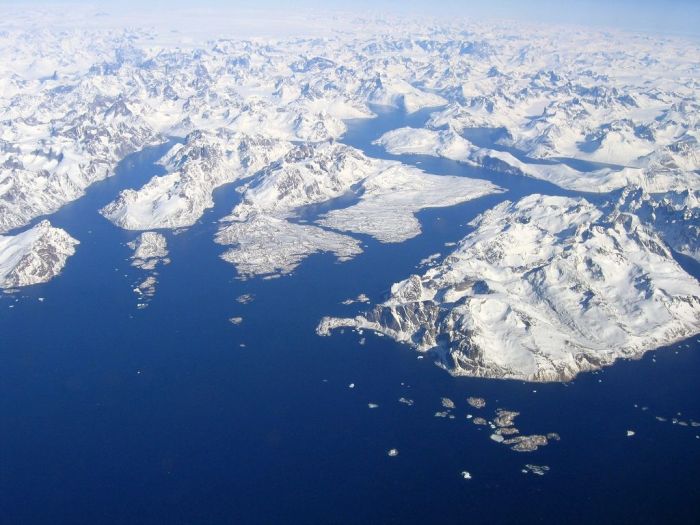
Photo credit: Stig Nygaard.
The consensus is incredibly solid on the first three of these points is extremely solid (at the above 95% level I brought up earlier), and although I haven't heard anyone (notable) contest the fourth point, it is possible that there are those who contend otherwise.
The second and third points are very difficult to contest scientifically as well, because humans have measurably emitted more than a trillion of tonnes of greenhouse gases, which demonstrably cause an increase in temperature in the same fashion that wrapping yourself in blankets causes an increase in your temperature. The physics is so simple and straightforward that -- short of the problem of quantitatively modeling the magnitude of the temperature increase associated with increases in greenhouse gases -- there is no wiggle-room to dispute it and still be scientifically sound.
So those who call themselves climate change skeptics have instead focused on the first point: trying to refute that the Earth's temperature is rising, and that it's rising at an increasing rate. Recently, Richard Mueller, noted climate skeptic, led a project to measure and scrutinize all the previous measurements of global average temperature, and to test just how confident we should be in declarations from NOAA, NASA's GISS, and other sources that the Earth's global temperature has been rising. The results?

Image credit: Berkeley Earth Surface Temperature project, as is the image and video below.
This merged database of temperature data contains 1.6 billion records, all of which are accessible at www.BerkeleyEarth.org. You can also access the full text of their four papers submitted for peer review, and check out their Summary results. As you can see, they confirm with great precision the results of the previous studies, showing a rise over the past 60 years of an average of 1 degree Celsius, with the rise accelerating over the past 30 years.
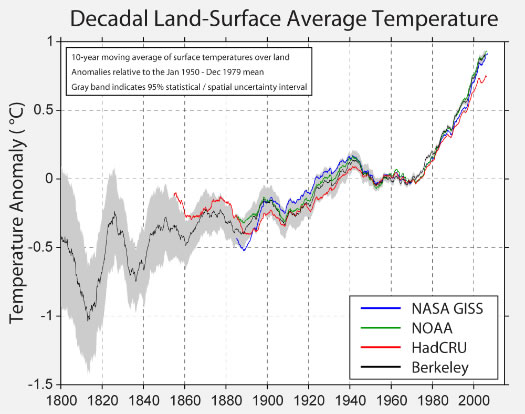
From the summary report itself, Mueller himself had this to say:
Our biggest surprise was that the new results agreed so closely with the warming values published previously by other teams in the U.S. and the U.K. This confirms that these studies were done carefully and that potential biases identified by climate change skeptics did not seriously affect their conclusions.
Many others have reported on this study, and you should check them out if you have a chance. (Keep an eye out for moving goalposts.) You can also see, in incredible video detail, just how the temperature has changed over time across all monitored regions the Earth.
Although there have been many times where scientists are later found to be mistaken, science is the best -- and perhaps the only -- legitimate way to make physical sense of the world and Universe around us. So do something about it; it's your world, too!
You keep trying to reason with them, but deniers gotta deny.
Many (most?) of them seem to be immune to either understanding the science, or they're just good at rationalizing their own disbelief. (e.g. because Al Gore is fat, or something)
Where's the science to show it isn't all part of some Green commie/nazi plot to install a one-World government?
BTW, I notice you used red ink in your graphs - clearly you've been infiltrated by socialists.
I know you realize the complete futility of arguing with these guys. The anti-science prejudice runs very deep in some of them and is not rational. I realized arguing with a neighbor back when I was in high school how a person can decide that rational thinking is just bunk and that's the end of that. You can't win against that.
Ethan, your blog is amazing! This post is just what I've been trying to say for years!
This is what makes you a real scientist. Fakers like PZ Myers have no chance against you. Keep up the good work!
So, granted that global warming is man-made, etc.
Are there any practical measures short of dampening the world economies down past the low point that they're at, at present, that we could take to reduce greenhouse gases, etc.?
If an international political consensus cannot be achieved, to match the scientific consensus, are there real-world measures that might be taken, to address the rise in temperature? Such as placing some sort of artificial obstruction between the Earth and the Sun, etc., if the emergency becomes acute (ice cap melting).
As someone with a mechanical engineering vocation (when I had a vocation), I tend to look for answers first and have a dislike for the blame game. "Deniers" from my point of view come from more places than simple ignorance and hiding-the-head-in-the-sand, (though there are those people out there, God knows).
Once you move beyond science, into the socio/political realm, the implications of the global warming conundrum as stated by its proponents, are simply enormous. And not just for the West. Developing superpowers like China and India get included. Many of those labelled "deniers," from what I've seen, regard the problem as simply too big, with too many explosive ramifications, to attempt to deal with realistically now, with all the other concerns going on in society.
But the question remains: what can be done about global warming, directly and/or indirectly, and how will this effect our quality of life, particularly those areas of the world that have never had much quality of life, and are trying to work their way up to Western levels?
"Are there any practical measures short of dampening the world economies down past the low point that they're at, at present, that we could take to reduce greenhouse gases, etc"
You are assuming that reducing carbon emissions need have a negative effect on the economy.
Granted, coal is awesome, but just look at some cost-modelling for exploitation of energy sources such as wind, solar, or tidal. Notice something? 99% of your cost is up-front: build infrastructure to harvest energy and build infrastructure to deliver it. You do not have the massive on-going and escalating costs associated with constantly having to find more fuel, transport it, (refine it, transport it again), burn it, and deal with the waste products.
This is the main thing the energy companies find so challenging - exploiting renewables means up-front work for the manufacturing and construction sectors, followed by decades of profits only for the banking sector. For society as a whole, this will (eventually) usher in some huge improvements in efficiency and as they've found in Spain, it democratizes the energy sector, which will make it very different from the current energy people who brought you the trillion-dollar war on Iraq.
Just imagine the energy security you'd now have if all *that* money had been spent on building renewables.
And there was no worldwide temperature fluctuation before 1800?
But that's just the trouble. The $1.26 Trillion spent so far in Iraq & Afghanistan was not just found in a dumpster. It was generated by the political will to go halfway around the world & fight wars. Even if everyone accepted the scientific consensus about AGW, there would still be no political will to generate even a tiny fraction of this amount to put a different energy regime in place. Face it, we're screwed.
Nice summary of the Mueller results. The "skeptics" are begging us to await the peer-reviewed version; can't wait to hear what they'll say once it's out.
And, apropos your introductory remarks, I love this quote from the biologist J.B.S. Haldane: "You can drop a mouse down a thousand-yard mine shaft; and, on arriving at the bottom, it gets a slight shock and walks away, provided that the ground is fairly soft. A rat is killed, a man is broken, a horse splashes."
These are pretty charts. But I see 4 obvious problems:
1) Exactly how accurate are these temperature readings? The entire state of California is covered by 3 measuring stations.
2) What is the point of measuring since 1800? 200 years is a blink of an eye in geologic time. How do we know that this wasn't most driven by the exit from the Little Ice Age?
3) Wasn't it warmer in Europe in the Middle Ages?
4) Why were temperatures perfect in 1800? Aren't the benefits of warming better than the problems with warming?
Sadly there is still no proof on anthropomorphic warming....look no scientist is arguing that the data seems to indicate warming, however proof of a link between anthropomorphic actions are speculative.
Additionally the quality of data prior to 1980 can be challenged and the assumptions in the models as well
Bottom line is the earth has a long history of climate change and all of it occurred without any assistance from the Human Race.
Global warming and Global cooling are natural conditions on Planet Earth.
Our pre-civilization ancestors dealt with climate change on a drastic scale during the Eocene era (btw they were not burning coal) and they survived and thrived
I see these kind of articles all the time and as an accomplished scientist I say to myself, "really"? I seldom see the serious skeptics argue that climate change is not happening, I see them question wether the change is varying within normal limits. Supporters seem to be throwing up a straw man argument as far as I can tell. They never address the obvious - such as:
1- Why, historically, temperatures always drop at the end of a cycle while CO2 remains high or continues to rise.
2- Orbital forcing.
But I guess if you have an agenda and want to keep a popular "consensus" you have to pretend consensus is "science". Good thing there are more of us out here who want to continue to study and research even with others have decided for us the case is closed.
Keep slaying that sky dragon Ethan. Who knew it was so easy to take the Earths temperature? Tip of the hat, Comrade. Warmists unite!
"The science doesn't lie. And no scientist should be so arrogant as to believe that they are the only ones capable of making sense of the information; I am a scientist, but I am not the only good scientist. The measurements are good, the evidence is clear, and the underlying physics is straightforward. Unless some new extraordinary evidence comes up, I can conceive of no legitimate reason why the accepted scientific consensus should not be adopted by the world, and used to protect our greatest natural resource: the Earth."
You can add a new skill to your resume....... Propagandist.
"The science dosen't lie."
"...I am not the only good scientist."
"I can conceive of no legitimate reason..."
Your conclusions are laughable and fallacious.
A closing thought:
"....no scientist should be so arrogant...."
Oh yeah, this is some deep shit, man: "humans have measurably emitted more than a trillion of tonnes of greenhouse gases, which demonstrably cause an increase in temperature in the same fashion that wrapping yourself in blankets causes an increase in your temperature."
4. âForbes blog, July 27, 2001 - New NASA Data Blow Gaping Hole In Global Warming Alarmism
In short, the central premise of alarmist global warming theory is that carbon dioxide emissions should be directly and indirectly trapping a certain amount of heat in the earth's atmosphere and preventing it from escaping into space. Real-world measurements, however, show far less heat is being trapped in the earth's atmosphere than the alarmist computer models predict, and far more heat is escaping into space than the alarmist computer models predict.
When objective NASA satellite data, reported in a peer-reviewed scientific journal, show a "huge discrepancy" between alarmist climate models and real-world facts, climate scientists, the media and our elected officials would be wise to take notice. Whether or not they do so will tell us a great deal about how honest the purveyors of global warming alarmism truly are.â
http://news.yahoo.com/nasa-data-blow-gaping-hold-global-warming-alarmis…
The issue isn't whether it's warming, it's why. If you look at effects and hypothesize CO2, it sounds believable, but when you look at stimulus, and anticipate effect, not so much. A world electricity generation rate of 20 trillion kw-hrs/yr equates to one gigawatt plant per 100,000 SQUARE MILES of earth surface. Who would have thought that a state the size of Colorado would not absorb the output of one plant?
Then of course there are all those other observations like:
* that pesky data showing greater warming trends throughout history.
*Times with significantly higher CO2 that weren't stratospherically higher in temperature.
* Correlations with cosmic wind
* The fact that CO2 makes up 0.00038 of the atmosphere but is supposed to dominate the whether when H2O is so much more prevalent and effective of a green house gas.
Yes, for anyone to question this religion is tantamount to questioning Mohammad's divinity.
This wouldn't even be an issue if the left didn't try to politicize the science. Before global warming was even on anyone's radar, they were proposing transferring trillions of dollars of treasure from Western, mostly transparent countries, to Eastern, mostly nontransparent countries.
Kent Sharkey@1:
mrdon@7@7:33am:
JohnBoy@10@8:37am:
GeoSmart@11@8:44am:
deegeejay@12@8:51am:
Titian@13@9:04am:
Dr.Applebreath@14@9:22am:
Joe@15@9:26am:
I would have noted QED, but Kent used the plural "deniers" when its very clear that the aroma of old socks accompanies the comments. Neil Craig, is that you?
So you proceed from a simplistic and morbid consideration of gravity, then crudely depict the history of science placing cosmology, biology, and climate science in a continuum, and voila! Conclude by triple-underscoring "scientific consensus" about AGW. Well done! And...so what?
This article is not very different from Al Gore's movie and most other tendentious-disguised-as-obvious pieces of "popular science". There's not much science in it. It should really be deemed "scientistic". Remember "The Secret"? Or better, "What the Bleep Do We Know?" - movies that used (a few, dodgy) scientists as props to propound incoherent ridiculousness. The Global Warming Crisis as such is much like The Secret, or maybe Tinkerbell - if everyone would just believe, our thoughts would become real. It's magical thinking - Steve Jobs without a profit motive.
I hope rational people retain the voting majority. So far, despite the existence of a "scientific consensus" and an "Al Gore", real-world economics and politics have mostly restrained the apparent urgency to slow or reverse carbon-fueled global industrialization with US products and services playing a dominant role.
"This wouldn't even be an issue if the left didn't try to politicize the science."
It would be an issue -- potentially a huge issue -- but it wouldn't be the political train wreck that it currently is, with a heavy freight of self-superior guilt trips being dispatched far and wide by Global Warming proponents.
It's become such a tangle -- witness the above cavalcade of posts which don't even bother to discuss the issue, but hurl point of views back and forth without acknowledging that the other side may have it's own point -- it's such a tangle that I'm afraid the only solution will happen when Antarctica has dumped its ice into the oceans, the coasts are underwater, etc. And we'll loft some kind of mechanism to cut down solar input -- ie interfering with sunlight.
Which is like closing the barn door after the livestock has run off.
What a bunch of bunk. Your statement "The consensus is incredibly solid on the first three of these points is extremely solid (at the above 95% level I brought up earlier), and although I haven't heard anyone (notable) contest the fourth point, it is possible that there are those who contend otherwise."
What in the world do you mean by "above the 95% level?" That by itself is scientific hogwash and you should know it.
You seemed to want to take the one point that there is agreement on and say that is the point that the skeptics challenge, that is, the earth is warming. It's a strawman argument. Points two through four are the ones that are actually being debated. Is the warming actually due to humans and will it accelerate as the warmists say it will? Have we never had warming before in the history of the planet? If you take a look at the actually temperatures in your annual graph you see a rapid warming in the twenty year period 1980 to 2000. Looking at the current warming you see a flat graph which doesn't support the contention that the warming is accelerating.
I'm an engineer by training and the confidence the warmests have in their "consensus" falls way out of what could normally be expected in a relatively new field involving a chaotic system. Your article is nonsense.
@20. See what I mean? You want to carry on a discussion with THAT?
@6. This is the discussion we need to be having. A practical assessment of resources and investments, independent of political bickering.
Lest I be mistaken for a Left-style warming advocate myself, I'll just say that I blame seventy per cent of the current hoohaw circulating around this subject on Warmists of the Al Gore type, who directly benefit themselves -- both by divesting their involvement in traditional energy (cashing in on coal and oil) and by getting kickbacks for carbon credits that industry feels bullied into purchasing.
The irony is that the most polluted, greenhouse gas emitting, environmentally devastated countries on the planet are located in the former Eastern Block, where Leftism of the revolutionary variety absolutely ran amok for most of the Twentieth Century.
The Left, inasmuch as it still identifies with any kind of political tradition, has nothing to preach to the rest of us about, when it comes to issues like Global Warming, nuclear proliferation, etc.
Welcome, commenters 7, 8, 10, 11, 12, 13 (our old friend Tom C), 14, 15, 16, 18, and 20.
Thank you for proving my point about moving the goalposts. You know, contending that the argument hinges on this one point, and when that point is unequivocally proven, saying "that's a strawman, no one argues that, it hinges on this other point!"
Many of the links I provided -- but here they explicitly are -- point this out:
http://scienceblogs.com/deltoid/2011/10/the_berkeley_earth_surface_tem…
http://news.discovery.com/earth/skeptic-led-study-ends-up-supporting-gl…
http://scienceblogs.com/pharyngula/2011/10/watts_wrote_a_check_he_could…
http://arstechnica.com/science/news/2011/10/climate-skeptics-perform-in…
So curious that you all showed up to comment at just about the same time. I wonder what caused that? You certainly couldn't possibly have an agenda here, could you, that transcends the science?
There is no doubt that we are contributing to it. The fact is world population has grown from under 2 billion in 1880 (the start of all the temperature charts in your article) to almost 7 billion today. We've added over 5 billion people demanding resources that wind up polluting the planet. We need to do a better job of cutting down the pollutants that we produce. That said, it is hard to judge the effect of our pollution on the Earth's temperature. Take a look at http://www.longrangeweather.com/global_temperatures.htm and see that the temperature has fluctuated wildly over the last 4,500 years. During the Exodus it was extremely warm -- warmer than it is today and warmer than the Medieval Warm Period. And there were great plunges in temperature too. I read that the CO2 emissions are not the greatest cause of any global warming that is occurring. it is the carbon emission in the form of Black Soot. This is something we can easily filter on all factories, power plants, smoke stacks, etc. It was stated that if we filtered the Black Soot right now, global temperatures would stabilize and start to fall. We do NOT need to fund global warming studies so much as pass a law to make filtering of Black Soot mandatory. The BIG problem is NOT that we can do it here in the U.S. with a population of 312 Million, but getting it done in China and India with a population total of 2.5 BILLION people. The other unspeakable aspect of my reply is that we have to reduce world population somehow.
To answer your question, I came through Real Science blog.
I am an individual with an interest in climate, but like you am not in that field. I have no agenda,though how to prove that is difficult.
What disappoints me is your indifference to the scientific method. It is the way to be objective and advance knowledge in most circumstances. I would look at oneself carefully for the reason to dismiss scientific methods, before trying to justify doing so.
Yes, your argument is a strawman. Almost all thinking skeptics understand that the earth is warming, about .8 C in the last 150 years. That you focused on point 1 is telling.
The second point is far from being resolved. The only sound argument which is scientifcally tested is radiative physics.
The rest of the anthropogenic global warming hypothesis is far from proven. It does not even reach the level of being called a theory using the scientific method.
The key questions involve sensitivity. There is so much uncertainty in this area, that noone can claim a good enough understanding. The role of clouds is far from understood, for example.
There are competing hypotheses, like the ocean cycles, the role of natural aerosols, even cosmic rays which need to be studied. The IPCC is unwilling to consider these hypothses for it is a political organization. Most of the AGW claims depend on computer models, which have not been verified and are not evidence in any case.
I fear that is the proponents of CAGW who are anti-scientific in not recognizing the limited understanding of the climate, and refusing to consider all the evidence.
The critical flaw in the AGW pseudo-science is that it completely fails to account for past episodes of rapid warming (and cooling). In other words, it is the antithesis of the scientific method elucidated so well in the preamble.
The real intellectual sin is the refusal to consider the possibility that the "settled science" (as the author acknowledges, there's no such thing) is wrong. Specifically, shouldn't we at least be considering the possibility that we might have to learn to live with climate change?
I fear that the blind pygmies may be examining something the elephant left behind rather than the animal itself.
Newtonian physics enjoyed a consensus as well until a dude named Planck showed up.
Just saying.
Perhaps there would have been far less arguement if the NWO/UN crowd did not hijack the issue early on as the perfect way to tax the very air we breathe and control world wide energy and industrial production. Besides, the Chinese have decided that such controls are not in their best interest so "it ain't gonna happen!" regardless of how high the scientific pulpit stands.
I am not a scientist but have been involved in the medical field for over 35 years. If I have learned anything, it is that consensus in science is unbounded arrogance.
Every conference talk seems to start with something like, "We used to think . . ." and then the speaker proceeds to tell us what we "now know to be true." Of course, some conference in the future will correct this current misunderstanding of the truth.
There is much money to be had and much power to be acquired by supporting global warming. Scientists should ask themselves if there is research money available to contradict global warming. If not, why not?
Science should not be swayed by political power. This blog cherry picks facts to reach a conclusion that is debatable. Why else would it only show temperature trends from 1800? You could extract portions of a sinusoidal curve to show trends in any directions you wish. Is that science?
Point #2 does not have consensus - why do you only show graphs from 1800 forward. Any idiot knows the earth warms and cools in a cyclical manner over geologic time and that decades and even centuries are not a large enough sample to show global trends.The earth is currently in an interglacial, and the last glacial period ended about 10,000 years ago - we are warming and have not yet reached the mean average global temperature of the last 2 biliion years (yes, billion with a 'b') and the earth is going to warm for thousands of more years till natural feedback loops reverse the trend and we enter a new ice age - it has been this way for millenia. The earth is warming when viewed from last ice age forward - conclusive proof that this natural warming is being accelerated by man beyond natural feedback boundaries does not have consensus except by the cult of global warming fanatics.
One problem I notice is that while a 'consensus' can be very persuasive, it is, of course, not a proof. Basically, it is just another version of an appeal to authority.
When the identified authority is used not to persuade but to shut down disagreement, you step from science into religion, and that is what has been going on for a long while in the climate change field.
When, as has been done, information is suppressed [Medieval Warming] to strengthen the global warming thesis, then the religion takes on some aspects of the Inquisition.
Set your politics aside, take a little time to look at the issue, and you will see that the 'consensus' falls far short of being complete. It would help if you were a little more agnostic on this issue. You are forcing your conclusion. I suppose your position plays well in the faculty lounge, though.
Have a look at the award-winning wattsupwiththat science blog.
> Are there any practical measures short of dampening the world economies down past the low point that they're at
Yes: reduce energy use, stop using fossil fuels, replace energy generation with renewable sources of power.
Since the dampening of the world economy was caused by rampant speculation of banks and money-men, I fail to see where you were leading with that...
"So curious that you all showed up to comment at just about the same time. I wonder what caused that? You certainly couldn't possibly have an agenda here, could you, that transcends the science?"
No conspiracy...I linked to your article from Real Clear Science.
> Any idiot knows the earth warms and cools in a cyclical manner over geologic time
Yes, the idiot sundog knows this.
INTELLIGENT people know it's wrong.
The earth warms and cools because of the change of energy balances in the earth system.
> The earth is currently in an interglacial
Yup, which means it ought to be cooling, not warming.
> we are warming and have not yet reached the mean average global temperature of the last 2 biliion years
False. PS talk to some other deniers who proclaim that the warming trend is because we're leaving the LIA...
> and the earth is going to warm for thousands of more years till natural feedback loops reverse the trend
Such as what? And what are those feedback loops doing now? Remember, WE are a feedback loop: we're changing the composition of the atmosphere.
Rachelle, if you were to ask me if putting a loaded gun barrel in your mouth and firing a bullet was a bad idea or not, I'd tell you "It is a bad idea".
If you were to ask 1000 people the same question, you'd get the same answer, apart from a few people taking the piss.
So, does this mean that the only way to PROVE it is a bad idea is to suck on a bullet and that you MUST do that?
Or is it, because the gun is in someone else's mouth, you're demanding you be allowed to pull the trigger because there's "no proof" that this is a bad thing to do?
I note that most libertards like you are really against government help for others, but among the first to demand it when the midden hits the windmill for you.
"When the identified authority is used not to persuade but to shut down disagreement"
Nope, taking a contrary position is not disagreement: it's being a contrarian.
Worse, what you're doing is using an identified authority to shut down disagreement with your demand that everyone else has it wrong.
"Have a look at the award-winning wattsupwiththat science blog."
That blog is a blowhard political front. There's no science done there.
"And there was no worldwide temperature fluctuation before 1800?
Posted by: mrdon "
Watts complained that the data Mann used, the procedures and all that stuff he used to produce The Hockey Stick were results of his and others clandestine activities to pull a fast one on the world. He complained that the CURRENT RECORD of temperature data was *really* a cooling trend, but there was no way to prove this because "there was no data and no publishing of the methods" that Watts was willing to admit to.
BEST was done under the accepted auspices of Watts et al for avoiding those complaints.
And so BEST shows that yes, there IS an increasing trend in global temperatures.
The temperatures before 1800 wasn't a complaint Watts had made. If you're unhappy with that, take it up with him.
#24 WWII denialists look at historical patterns of human death (with a notably large peak, for example, during the 14th century) and conclude that the measured rise of human deaths during WWII was not an anomaly caused by humans but part of the "natural cycle" of deaths that we see throughout human history.
#25 so is Newtonian physics taught only as history now? Just askin'
> But I see 4 obvious problems:
> 1) Exactly how accurate are these temperature readings? The entire state of California is covered by 3 measuring stations.
To within half a degree for any one reading. Since random errors cancel out to the square root of the number of readings, that would be, over, say 50 years, an error of 1/400th C.
> 2) What is the point of measuring since 1800?
That was when humans started changing the composition of the earth's atmosphere.
> How do we know that this wasn't most driven by the exit from the Little Ice Age?
Ask sundog.
Oh, and since the LIA ended before 1800, then most of the exit doesn't appear in the record.
> 3) Wasn't it warmer in Europe in the Middle Ages?
No. And Europe isn't the globe.
> 4) Why were temperatures perfect in 1800?
They weren't. They were, however, unaffected by human increasing the CO2 content of the earth's atmosphere.
> Aren't the benefits of warming better than the problems with warming?
No.
I am a chemist. And you, if you are a physicist, ought to know by now that this theory of anthropogenic, catastrophic global warming suffers from scale problems, experimental error, and corrupt data.
One set of scale problems arises due to carbon dioxide's place in the grand scheme of things. There are a number of other factors with an effect, larger than an order of magnitude greater than that of carbon dioxide in our atmosphere, that are capable of producing warming to the extent the earth is now experiencing it.
Another set of scale problems arises from the lack of historical perspective. We don't have reliable, local temperature readings for even 100 years, and yet the earth is millions of years old. The earth has been both hotter and cooler than it is now, and change in weather and climate is the norm.
The experimental error arises, not from the instrumentation, but the system. The system is not homogenized, and therefore the experimental error in temperature readings is far greater than the differences found. This is easily seen in a high-school level experiment: If you take the temperature of a small flask of water as it is being heated, you can get all kinds of funny results, all of which can be smoothed out by adding a stirring rod. The stirring rod causes mixing and an even distribution of the heat load, resulting in a more reliable temperature reading. There is no equivalent to a stirring rod in the earth's atmosphere.
At one time, I thought the global warming people were simply wrong about what the data could show. I've been in scientific meetings where people have tried to wring information out of statistical noise. There are times when people have a theory that might yet be proven useful, but they have not refined the experimental protocol to the point that it delivers information. It turned out that these people adjusted the data (common) and then, threw away the protocol for adjusting the data, as well as the original data (fraud).
As for that alleged consensus, you really haven't been keeping up with the news. That claim of "consensus" has been a lie from the get-go. There is a consensus that the earth is on a warming trend, but the data shows that the trend is so slight that, over the past 10 years, there has been no significant change in global temperatures readings.
> Sadly there is still no proof on anthropomorphic warming.
Yes there is. Go to http://www.ipcc.ch or to skeptical science.
The BEST paper wasn't about the A part. It was to see if there had been any of the GW part or whether, as many denialists including Watts had asserted, just a result of poor analysis of the data.
> Additionally the quality of data prior to 1980 can be challenged
It can. The quality of the data since then can be challenged.
Is there any evidence to support either challenge? No.
> Bottom line is the earth has a long history of climate change and all of it occurred without any assistance from the Human Race.
Really? Where's your proof that the current change that has occurred since 1800 when humans started changing the CO2 concentrations in the atmosphere hasn't had an effect?
A long history of climate change where there weren't any humans of course would not be human caused. But volcanoes pump out CO2, just like humans are doing now. Volcanoes caused climate change in the past. Is your contention that the atmosphere knows where the CO2 comes from and treats it differently if it comes from burning fossil fuels?
PS all those ancestors who survived are now dead. And you wish to emulate them? Go ahead.
> They never address the obvious - such as:
> 1- Why, historically, temperatures always drop at the end of a cycle while CO2 remains high or continues to rise.
If the end of the cycle is at the low ebb of temperatures, temperatures always RISE at the end of a cycle.
Your "obvious" is obviously ill stated.
PS temperatures are still rising. That's what BEST has shown.
> 2- Orbital forcing.
Uh, Milankovich forcing. Which is currently cooling us. And works over thousands of years, not decades.
> Then of course there are all those other observations like:
> * that pesky data showing greater warming trends throughout history.
Really? Where are those observations?
> *Times with significantly higher CO2 that weren't stratospherically higher in temperature.
Yup, hundreds of millions of years ago when the sun was notably cooler.
>* Correlations with cosmic wind
Correlation is not causation. Besides, the correlation with cosmic wind is <20% but the correlation with ln(CO2) is >75%.
> * The fact that CO2 makes up 0.00038 of the atmosphere but is supposed to dominate the whether when H2O is so much more prevalent and effective of a green house gas.
H2O is less than 1%. CO2 .038%. But H2O falls out of the sky as "rain" on planet earth. CO2 rain not so often. Seems this little fact, like the others, are made up.
Jack: "without acknowledging that the other side may have it's own point"
Care to point out where up to your post any denialist here had a point?
Or do you mean "they've got a point: it's worthless, but still *a* point, right?"?
There is no consensus and it is not SCIENCE when the theory and conclusion are based on phony data. When the data is FALSE is is called a HOAX and "Global Warming' is just that. It is made up to promote a political movement not to further science. The real deniers are the people who believe this trash even when it has been proved to be false from the very people who put it together. That is called demagoguery pushing a phony idea. Anyone who reveres Al Gore has questionable judgement.
> Almost all thinking skeptics understand that the earth is warming, about .8 C in the last 150 years.
We have never heard from many thinking skeptics.
Lots of unthinking deniers. E.g. Anthony Watts who in 2007 said that it was cooling and that the temperature record would show it if you used the "raw data".
But now that BEST which used the "raw data" shows that there is a warming trend, suddenly, "nobody disagrees it's been warming"...
> The rest of the anthropogenic global warming hypothesis is far from proven.
Sorry. Wrongo!!!
Doubling CO2 gives a 1.2C warming effect. That's from that radiative physics you accept.
However, we've had a 40% increase and we're not even in equilibrium yet. Yet we've had a 1C warming for that 40% increase in CO2.
Therefore there MUST be a positive feedback. This then is the proof of the rest of the climate science.
Sensitivity MUST be over 2C per doubling of CO2 to arrive at 1C warming after a 40% increase in CO2.
Apparently you can say quite a lot about the sensitivity already.
It's a pity you didn't think of doing anything scientific with what you accepted, isn't it.
> There are competing hypotheses, like the ocean cycles,
Which cannot be an energy source. Cycles get you back to the start, not give you a trend.
> the role of natural aerosols,
Rain out over weeks.
> even cosmic rays which need to be studied
They have been. They don't do the job.
> The IPCC is unwilling to consider these hypothses
Nope. If you'd ever read the IPCC report, you'd read where they attributed to those hypotheses.
They are insufficient to the task.
But you are unwilling to consider the CO2 hypotheses for ideological and greed-driven reasons.
Instead of parroting a denialist screed, consider all the evidence.
> There is no consensus
If 97% agree then if that isn't a consensus, what is?
> and it is not SCIENCE when the theory and conclusion are based on phony data
BEST was started at the behest of denialists who insisted the data was bogus. Apparently even when you get non-bogus data you still see warming...
What you DO see are a lot of desperate people who are in deep denial posting a lot of crap on here.
Ethan, you've essentially put out a sign advertising "free food" to the loons on the denialist side. It takes real arrogance for engineers and the like to state they have better knowledge and understanding than the researchers cited in the studies.
> The critical flaw in the AGW pseudo-science is that it completely fails to account for past episodes of rapid warming (and cooling)
Nope. What a sensitivity of less than 2C per doubling of CO2 that, for example, RPSr adheres to completely fails to account for is the past episodes of rapid warming and cooling.
A sensitivity of 4C per doubling more easily explains those episodes.
> Specifically, shouldn't we at least be considering the possibility that we might have to learn to live with climate change?
Well, if the "settled science" of AGW is wrong, then there's no climate change to learn to live with.
Shouldn't you at least be considering the possibility that you're causing climate change?
Ethan, you seem to be one very stupid man, alot of commenters told you that none dispute that the Earth is getting warmer, everyone skeptic in this thread agreed on it getting warmer, but the skeptic is in WHY it is getting warmer.
And still, in reply to those commenters you STILL claim that the skeptics dispute the warming of the earth.......and link to articles that does really claim that it is CO2 that is the reason for the warming, all your link you post only says that the Earth is getting warmer and none have said otherwise.......try to read and understand what people are saying to you instead of just contantly going on your rant and trying to prove a point that none disputes.......
Geezzzzzz........so why dont you tell us why the icecap that spread all the way down into the middle of Europe in the iceage a couple of thousands years ago vanished? Did they drive huge gasguzzlers thousands of years ago?
Also, if you are stuck on the arrogant line that only real "scientists" can have any credability to why the earth is getting wamer, you will notice that alot of them doesnt blaim man made CO2 for global warming......
Also, man made CO2 emissions is lower than the total CO2 emissions from termites, cows, ands, and all other animals, also alot of animals emit methane that is a way more potent greenhouse gas than CO2 but still, none of your article blaim methane for anything, and what about all the other greenhouse gasses that is more potent than CO2 that you dont mention? In fact, CO2 is one of the least potent greenhousegasses and dont come with this comeback "yeah but we emit so much CO2.......", still add all the methane from animals and other shit and use the factor of X potential of methane compared to CO2 and methane would win hands down...........
But i guess you are just a simpleton that is driven by what media and other non factual media outlets tells you..........
> I am not a scientist but have been involved in the medical field for over 35 years. If I have learned anything, it is that consensus in science is unbounded arrogance.
Yup, there's some unbounded arrogance right there.
You DO know that we used to know that humans couldn't affect the climate, don't you? So why is it that your unbounded arrogance that they were right back in the early 1800's correct?
Nobody now says "We're living on a flat world". Yet, somehow, this "unbounded arrogance" goes unreported and the "HOAX!!!!!!oneoneeleventyone!" of the round-earthers unremarked. Why is that? Oh, aye, that's right: political dogma: government MUST ALWAYS be wrong and corporations MUST ALWAYS be right.
"and link to articles that does really claim that it is CO2 that is the reason for the warming"
obvious correction:
and link to articles that DOESNT really claim that it is CO2 that is the reason for the warming
> but the skeptic is in WHY it is getting warmer.
Nope, the skeptic (Murray) now knows why: mostly human activity.
We have DENIERS who have complained that it's getting cooler, not warmer now DENYING they ever said that.
> so why dont you tell us why the icecap that spread all the way down into the middle of Europe in the iceage a couple of thousands years ago vanished
CO2 buildup because weathering wasn't removing the CO2 sources.
Humans are now building up the CO2 levels even more.
NOTE: that CO2 buildup wouldn't have melted the icecap if sensitivty were less than 2C per doubling of CO2.
> you will notice that alot of them doesnt blaim man made CO2 for global warming......
Count them (and can they spell?)
> Also, man made CO2 emissions is lower than the total CO2 emissions from termites, cows, ands, and all other animals
Nope.
You sea while one ant is emitting CO2 another one is eating carbon-rich food and removing CO2 from the system.
But there's nothing that is converting all that burnt hydrocarbon fuel into carbon again. It's an unaccounted source.
> emit methane that is a way more potent greenhouse gas
But present in parts per MILLION.
Oh, and it combusts or degrades to CO2 and water after a few years naturally. Odd how you know some things really well, but your knowledge in them has some HUGE gaps...
I guess you're just a simpleton.
@deegeejay:
I see these kind of articles all the time and as an accomplished scientist I say to myself, "really"?
Hahahahahahahaha! Oh my God! That's the funniest comment I've seen today and believe me I see a lot of stupid creationist comments. Well done mighty accomplished scientist. You have accomplished to expose global warming to be the commie neo-nazi Darwinian conspiracy theory by virtue of being accomplished. Well done accomplished scientist, or as it is fit to call you, accomplisseur!
> And you, if you are a physicist, ought to know by now that this theory of anthropogenic, catastrophic global warming
Valerie, what is this theory of anthropogenic catastrophic global warming you've come up with?
The IPCC only have climate science and AGW. So you must have some other theory in mind.
> There are a number of other factors with an effect, larger than an order of magnitude greater than that of carbon dioxide in our atmosphere, that are capable of producing warming to the extent the earth is now experiencing it.
Really? What.
> We don't have reliable, local temperature readings for even 100 years, .... The earth has been both hotter and cooler than it is now
If we don't have reliable records for even 100 years, how can you say it's been both hotter and cooler than it is now?
> The system is not homogenized
Really? I seem to be able to breathe quite nicely whereever I am on the surface of this planet.
Seems pretty homogenised to me!
> If you take the temperature of a small flask of water as it is being heated, you can get all kinds of funny results
So take 500 concurrent readings. You know, like we do from thousands of weather stations around the globe.
You'll find that the average doesn't go funny much.
But maybe the problem is you're a chemist, not a climatologist. I'd check up on whether you're competent to speak on the subject, if I were you.
> That claim of "consensus" has been a lie from the get-go.
Really? How have you known? Or is that based on a "consensus" over at WUWT?
On cue, the hivemind clique from WUWT has overflowed from their stinking cesspool in order to drown yet another thread beneath their me-toos.
Not one of you anti-science boardies has the basic human integrity to admit you were wrong, and that your god, your precious teleprompter-led TV weather report reader, has failed you. Nor the integrity to apologize to the innocent and oft-vindicated scientists that your cult has slimed with outrageous conspiracy theories.
Eco-denialists are as dumb, dishonest, lazy, crazy, and cruel as 9/11Truthers, but even worse because they have received a lot of unearned attention and sympathy from fellow travelers and useful idiots in the media, which had the power to completely silence them just as surely as they did to 9/11Truthers but, gosh, for some reason didn't do so. It's some kind of affirmative action program for dumb conspiracy crap.
how about those who doubt the anthropogenicism of climate change look at it this way: even if the massive amounts of green house gases we've pumped into the atmosphere can not be proven to have caused climate change, if you can just acknowledge just the probability, however slight you might find that probability to be, then ask yourself this: would you rather take a gamble on the fact that we are making our planet more hostile to the very conditions which have brought about its startlingly diverse and interconnected ecospheres? what i mean to say is this: as stewards to the earth, shouldn't we err on the side of caution? why is refuting claims of man-made global warming more important than doing anything and everything we can, even if our premise is incorrect, to try neutralize the negative effects we might be inflicting to our planet? in the end, wouldn't it have been better to have tried to do everything we can to halt an obviously deleterious process than to have continued the behaviors which may have been harming the environment, but i think we can all safely agree are in no way helping to aleve our present problems?
This was a substantial write-up, detailed and well illustrated. I enjoyed reading it.
Johnson C. Philip, PhD (Quantum-nuclear Physics)
http://www.Physics4u.info
So far as I know (enlighten me if I'm, out of date on this), none of the models, simulations, analyses etc. which predict future trends of "global warming" and the consequences thereof (see simple component #4 above) have been able to predict the current global temperature and CO2 profile given past estimates of global temperatures and CO2 concentrations as inputs. That tells me that even if the models are correct, with incorrect initial conditions: garbage in, garbage out (GIGO). Alternatively, the inputs could be correct but it is the models themselves which are wrong. Again, GIGO.
Moreover, so far as I know (again correct me if out of date) none of the calculation algorithms which predict future global warming characteristics have been published, peer reviewed or even listed in any of the papers, websites, tweets etc, I've read recently.
I don't mean a simple chemical balance equation, I mean the actual execution (source) code (matlab? C++? Fortran?) which captures the functional and numerical characteristics of the equations specifically listed in the global warming scholarship.
I'd like to run their codes with their data as inputs. We call that "code review"
@Sa9a:
I hope rational people retain the voting majority. So far, despite the existence of a "scientific consensus" and an "Al Gore", real-world economics and politics have mostly restrained the apparent urgency to slow or reverse carbon-fueled global industrialization with US products and services playing a dominant role.
Hahahahah! This thread is a gold mine! Yes, "rational" people have done well!
By the way, why all these morons assume global warming started with Al Gore? It looks like as if they are profoundly ignorant of how the consensus view developed.
Notice the name-calling from the Alarmists, it's their best "fact". Ethan, can you give me the exact temperatures, at depth, in the worlds oceans, (CO2 sinks), and explain the relevance. No? You and your drones should stick to name-calling, the science doesn't work. These AGW models are bogus, assumption riddled, guesswork. It is really bottom of the barrel trickery, not science or scientific "fact". The science is settled? You and your cohorts are dishonest abject morons.
kp:
Do you now? That's cute. The rest of the world would call that "testing". But hey, whatever buzzword you read last week floats your boat.
Hypocrisy, thy name is Titian:
Anyway...
Fair warning, there's no winning with these clowns. Witness the Jonas thread.
@Titian:
Notice the name-calling from the Alarmists, it's their best "fact".
I'm really sorry. I truly am. I would have thrown you some bone if there was not already SHIT LOADS OF SCIENTIFIC BLOGS, LINKS, ARTICLES, CODES, AND SCIENTIFIC PAPERS available. So the thing is, at some point arguing with you retards gets really boring. There is no fun in engaging with a birther, or a 9/11 truther, or a flat-earther. Should I post the same links over and over again about the climate models? No, there is no point. Nothing makes you think.
So right now the fun thing to do is to read your moronic whiny little posts and realize that you ignorant morons never comment on any other scientific post, never read any other scientific blogs or article and just mindlessly swarm the global warming posts.
Just whine on.
For anyone who gets this far down: I should like to draw attention to the following:
Ethan's original post, and his follow-up comment, contain hyperlinks to resources which are:
1- online editions of peer-reviewed literature (or, in the case of the Berkeley papers, literature submitted for peer-review);
2- online resources which review and summarize peer-reviewed literature (or, in the case of the Berkeley papers, literature submitted for peer-review).
These resouces corroborate the conclusions of Ethan's post, to whit:
- Global warming is real
- Global warming is human-caused (anthropogenic)
- Global warming is going to be bad
- We need to take action to counteract global warming
By contrast, the scads of denialists contrarians who have showed up have manifestly failed to offer any similar support for their positions - save, I have been led to understand, for the notorious denialist contrarian site, WattsUpWithThat, purveyors of climate science misinformation and dishonest peculiar takes on the evidence.
Whose opinion to take seriously, I wonder?
Titian,
My "dishonest abject moron cohorts" provided you with a great wealth of information in the comments of this post just four months ago.
Feel free to have another run-through. You're welcome.
For those of you wondering where some of the most enlightening comments are coming from, a little detective work brings us to this lovely source. Hi, everyone!
The issue is far from settled. While there may be some general consensus on "effect", the debate on "causation" is still very active and quite heated.
Any "scientist" who claims that the subject is "closed" is no scientist at all. Never has a scientific subject been "closed". Ever.
Even a scientific foundation, the Theory of Relativity, receives attention and challenge on a regular basis.
Silly man.
@Composer99
Yes that is the point. The denialist crackpots never read any links offered to them. The only things they read are the insults and they really like to whine about them. Put science and credible links in your post and they'll just ignore it. Load up the insults and you'll get their attention.
The blogger makes the claim of predictive and explanatory ability as a key to knowing a theory is beyond dispute, yet:
What would he say about the dramatic failure of the predictions by climate warmists?
What would he say about the fraud that has been exposed?
What would he say about the financial self-interest of the climate scientists? For, if there is no crisis, then there is no need to raise funds to study one.
The blogger is only talking about the Berkely meta-study. For those who study statistics, epidemiology, or other fact-based endeavors of learning, meta-studies are not science, mere editorial endeavors. They are essentially worthless in terms of drawing valid conclusions and adding to the topic of discussion.
"Correlation does not imply causation". That is one of the most important pieces of logic that I learned in college. As an atmospheric and oceanic science student at UCLA, I was groomed everyday to just conveniently forget that 'tried-and-true' piece of scientific logic. I looked at all of the data pouring in that showed a direct link that increased atmospheric CO2 concentration has increased warming (and my professors really drilled that point home every day in both subtle and non-subtle ways). But as I learned more and more in those classes, it became apparent that I would actually be very dopey to oversimplify this global phenomena. Water vapor is the real warming culprit. And obviously, increased global temperatures increases water vapor through evaporation. And increased temperatures decreases ice cover, which decreases the Earth's surface albedo and decreases radiation emission back out to space. These are just a couple of the factors that definitely support a very alarming positive feedback loop leading to exponential warming.
But that's a very small picture...and elementary at best. Earth has had this scenario many times in the past and somehow mother nature has managed to surprise us. If we can't even predict climate accurately in a much smaller scale, even with supercomputers and with our best climate minds, how can we definitively conclude that warming is the direct result of negative human/earth interactions? We have so much to learn and understand about how this planet works, and it would be very scientifically irresponsible to claim that we know anthropogenic global warming to be true.
Let's keep the discussion going.
Thanks a lot Bob, specially for being very specific with your questions.
I also have a few more questions:
What would he say about the recent article that was published and showed everything is bunk?
What would he say about the scientist who made the silly prediction?
What would he say about the other scientist who proved the contra claim?
And finally, what would he say about the most important issue discovered recently?
What a waste of time, bandwidth and mental energy.
No one can argue that getting off of fossil fuel is a good thing...from anyone's perspective.
An equally obvious truth is that nuclear energy is currently the ONLY path to do so. If you think solar, wind and every other Rube Goldberg renewable scheme can replace fossil fuel in providing our base load energy needs, you need to have your head examined.
Just think of how much progress could have been made...could be made, if even half of the political capital expended on AGW were redirected towards nuclear technology and educating the public in the realities of nuclear energy (not the scare propaganda from the anti-nukes).
Once nuclear technology matures to the point where it is providing the bulk of the world's energy, AGW will be a mere footnote in the long list of problems that will be solved.
So, I would say to all you AGW proponents, put up or shut up. Do you want to study this to death and then spend decades in political battles to put into effect policies that will have little to no affect on CO2 but would have a devastating affect on the world's economies? Or do you want to take concrete steps now replace fossil fuels with nuclear and virtually eliminate oil, coal and gas fired power plants?
@67: "Correlation does not equal causation" is too often elided, as you did above, into "NOTHING equals causation." Pull the other one. The impact of greenhouse gases on temperature has been proven in laboratory settings for over 150 years. If the effect of an input has been proven ("more GHGs cause temperature increase"), and more inputs are given ("we're emitting more GHGs now"), and the effect is also given ("the temperature is increasing"), then the causational relationship *which was already established 150 years ago* has been yet again for the umpteenth time re-validated. At this point you're saying that atomic fission is only *correlated* to a mushroom cloud and cannot be assumed to have caused it. Here's a slogan for you: "Paralysis by overanalysis."
36, Huh?
62, Those hyperlinks were all concerning point 1. I have not doubted it was warming.
44, Where is your logic? You say that CO2 has increased and temperature has gone up almost 1C. So? Is it not possible that other factors may have played a role? From 1980, PDO/AMO were in a positive trend, now they are declining. In the last 12-15 years there has been no significant change in temperature or ocean heat content.
I agree oceans cycles cannot directly affect the energy balance. But what if they affected cloud cover?
Cloud forcings are much more powerful than CO2. A 2% change could more than explain all temperature variation.
I agree that CO2 almost certainly has a role, but in your thinking that only CO2 is relevant, you and the IPCC have not been true to the scientific method and fully investigated other possibilities.
If the science is so settled then why do you need a "concensus" of "experts"? The law of gravity does not need a concensus of experts for support. As the blogger noted, it conforms to our experience of the world. Any student could do an experiment and a calculation. A more precise understanding would include corioulus effect, expanding the earth's gravitational potential in spherical harmonics, the distribution of mass within the earth, even relativity, not to mention aerodynamics, distribution of clouds, temp and density of atmosphere. At some point, the problem gets complicated enough that you exhaust our understanding. Then the science becomes a matter of opinion of a few hyperspecialized individuals. This is the state of global warming. To say it is not is denial.
@31: "Are there any practical measures short of dampening the world economies down past the low point that they're at...."
"Since the dampening of the world economy was caused by rampant speculation of banks and money-men, I fail to see where you were leading with that..."
I'm not leading anywhere political with it, that's for sure. The dampening of the world economy, leading to lower levels of CO2 emissions is a simple statistical fluke that will soon be submerged by rising levels of CO2 from the Far East and the Subcontinent.
My underlying point was that it shows ONE WAY by which CO2 levels can be suppressed -- but at the cost of suppressing human enterprise and prosperity. It's the easy way out, but sometimes, with political gerrymandering like Kyoto not to mention cap-and-trade, I wonder if the easy way out is not what the Global Warmists are shooting for.
My underlying conclusion: there has to be a better way, short of this or putting a filter between us and the Sun.
@42
Jack: "without acknowledging that the other side may have it's own point"
Care to point out where up to your post any denialist here had a point?
Or do you mean "they've got a point: it's worthless, but still *a* point, right?"?
Well, maybe. To some extent they have a half-ass point because it's their right to have a half-ass point. One thing I would advise everyone who is concerned about global warming to do is to go back over the bullet points of "deniers," and address their questions at each and every opportunity. And to do it without a sense of superiority, but with gentle kindness.
For example, as Ethan points out, "deniers" have been told that volcanic activity is equal to or exceeds the carbon footprint of the industrial age. He claimed that the effect volcanic activity is actually far less, by a factor of ten at least, than industrial activity.
I went to several websites to doublecheck, and he's right.
In that one stroke, Ethan dealt with an entire range of objections that people who don't want to deal with Global Warming have raised. But there are others.
For instance, the shrinkage of global ice caps on the other planets and moons of planets. Or the pre-1800 solar cycle and its effect on climate at the time, etc.
Most of all, what is the exact connection between climate and solar activity, and climate and man? These are concerns that not only need to be addressed, but the answers iterated and reiterated every time "deniers" raise these issues as being legitimate reasons not to deal with Global Warming.
President Obama's own Energy Information Administration (EIA) projects that in the year 2035, the bulk of world energy needs will still be met by coal and oil:
Coal and oil: 58%
Natural gas: 22%
Nuclear: 6%
Renewables (wind, solar, etc.): 14%
http://www.eia.gov/forecasts/ieo/index.cfm
That's right! 80% of world energy needs in the year 2035 will still be met by burning fossil fuels.
In fact, EIA projects that in the year 2035, the world will be using more coal and oil than it uses now.
So we're not going to stop global warming. We're not going to spend literally hundreds of trillions of dollars to turn the entire global economy upside down into something it isn't, just for that one purpose.
Those who claim this will somehow lead to prosperity are committing Frederick Bastiat's classic fallacy of broken windows. He asked, what is wrong with the following argument? If you want to create prosperity, walk down a street and smash all the windows, then hire people to repair them. They get jobs, they get paid, prosperity!
The fallacy is that this artificial market for repairing windows is taking money and work away from other more productive pursuits.
And that's what is happening with global warming. Sure you can create a green economy if you are willing to spend trillions and trillions of dollars to do that. That is money that could have been used for many other things: National defense. Fighting poverty. Fighting the immediate threats of air and water pollution and infectious and chronic disease. Etc.
You're never going to convince Americans or Chinese to spend those kinds of bucks over decades when we have so many more immediate priorities NOT. GONNA. HAPPEN. Give up that pipe dream.
We should abandon that pipe dream and figure out ways to live with global warming. Just as we've learned to live with traffic congestion, smog, and lots of other side effects of modern industrial civilization.
You are a funny man Don.
So, I would say to all you AGW proponents, put up or shut up. Do you want to study this to death
Dude wake up. AGW was established science three decades ago! Scientists have already moved passed "proving AGW" and on to the study of its effects on the environment, species, human populations and etc.
... and then spend decades in political battles
You know, it would have helped if *some* people could actually keep up with decades old scientific advances.
to put into effect policies that will have little to no affect on CO2 but would have a devastating affect on the world's economies?
Hilarious! You are showing two sides of denial in one post: AGW doesn't exist but if it does then it's already too late!
Global warming is pure fraud. If you are seriously trying to defend global warming, you must address Monckton (Google Monckton) and Lomburg "The Skeptical Environmentalist" and De Blig "Why Geography Matters." The IPCC cooked the data around 1991, hiding the tree ring data and hence eliminating the Medieval Warming Period. It has been degrees C hotter 700 years ago and 140,000 years ago. Earth is at the end of a 12,000 to 20,000 year interglaciation. Warmer is better than another ice age.
Ethan, for some of us, it's not about "moving goalposts." It's about contesting an effort by many to end the world economy as we know it.
So, for me, this issue has moved beyond the realm of physics and climatology and has now entered the realm of economics.
Our response to climate change must addressed using a cost-benefit analysis.
Essentially, do the risks posed by doing nothing outweigh the benefits of doing a specific something? Or, at what point do the risks of doing something outweigh the benefits of doing nothing?
Make no mistake: The economy built on burning fossil fuels has advanced human civilization and quality of life to levels never before witnessed in recorded human history. The advances we have witnessed in medicine, science, agriculture, transportation, accumulation and sharing of knowledge, not to mention creature comforts, such as forced air heat in the winter and air conditioning in the summer, would have been impossible without the burning of coal and oil (or harnessed nuclear fission, which is immaterial to this discussion, but very relevant when dealing with the ideas of many in the "DO SOMETHING ABOUT CLIMATE CHANGE NOW" crowd.)
So, unless you are willing to cease generating and distributing electricity, end air travel, cease industrial farming (and produce mass famine), stop transoceanic shipping, ban the internal combustion engine and collapse the world economy, producing untold suffering as billions die in the resulting famines, wars and epidemics, you must promulgate a realistic alternative.
And therein lies the rub: I know, there are many who will say, as do some of your commenters, that we can easily substitute solar, wind, etc., for the power generated by coal and petroleum. But, as a scientist, I'm sure you are well aware that this is pie-in-the-sky nonsense. We are nowhere near the point where renewables can supply our economy with the energy it needs.
So *what* do we *do* about it.
I don't believe the threat posed by climate change is as dire as those in the alarmist camp would have us believe. Or, at the very least, I don't believe the threat posed by climate change outweighs the benefits to our society produced by the burning of fossil fuels.
I understand that technology continues to advance. And I would love to see the day that my car and my home, and everything in it, can be powered by renewables. But there is so much more that must be addressed, including: how to power large factories and hospitals, trucks and oceangoing vessels that transport our goods, aircraft, etc.
I look forward to that discussion. But I will oppose any efforts that simply say, "The Earth is warming, and now you must suffer."
Here's my challenge to all you scientists and environmentalists and other assorted activists:
For years you have done nothing but pick on the United States to do this or that, or to stop doing this or that. That was fun and feasible because the U.S. had the world's largest economy and we Americans could make a few sacrifices here and there.
Those days are over. In this decade, if present trends continue, China's economy will surpass America's as the world's largest economy. And as things look now, they're going to pass us and keep right on going.
So: Now that China, not the U.S., is the world's largest economy, go pick on them for a change.
If you can get China to take the lead on fighting global warming, then maybe we Americans will tag along.
Otherwise I don't want to hear about it anymore.
Go argue with the Chinese.
Leave us Americans alone this one time.
We're sitting this one out.
Bye.
The GOP doesn't just deny the facts of Global Warming.
They're in denial about their inhuman greed, horrible racism, self-righteous pomposity, etc.
They're not living in reality from the get go.
Thanks,
Rick
What a blessing and a curse a RealClear link. Getting the extra traffic bump is cool (great blog Ethan, you deserve it!), but having a thread cluttered with people like #76 that think Monckton is an intellectual giant has to be considered a downside.
@76: Way to cite a source that disagrees with everything you say. In "The Skeptical Environmentalist" (and everyplace else he's ever spoken), Bjorn Lomborg makes it clear that temperatures are increasing, that humans are causing this, and that it will have an impact on our society.
He believes everything Al Gore believes. He's just cheaper.
You didn't know this, because like the entirety of the LomBorg Collective you have never actually read his work and instead just wave his name around like some sort of voodoo token that you hope will defend you from the evil spirit of environmentalism.
Fail.
@Tom Larkin
Dude you seriously underestimate us. Do you think we don't know Monckton? Are you serious? Monkcton is one of the most unintentionally funny characters around. Deltoid has even a tag dedicated to the all the ridiculous things that he says. He talks funny and he gets pretty much everything wrong. He claims he's a member of house of lords and uses a pink(!) version of their logos even though they wrote him a million times saying that he is not a member. And finally, the guy claims that he has a cure for pretty much any disease including HIV!
Lotharloo : Blah Blah Blah..
Address the subject of the post. Stipulated that AGW exists and we are responsible...what do you want to do about it? A carbon trading scheme? Useless. Eliminate cars? Right.
You spend all this effort bitching and moaning about "deniers" yet you offer nothing but half measures and political positioning as a solution.
Do you want to solve this or not?
@77 You seem to think that scientists have rather more influence over policy decisions than what we really have.
Address the subject of the post. Stipulated that AGW exists and we are responsible...what do you want to do about it?
It's a complex problem so it won't have an easy solution. Furthermore, whatever action we take, it will not have an impact until decades later so essentially what we do is for the later generations. Anyways, there are shit loads of things to do: spread the knowledge and the awareness, reduce the carbon footprint, pressure the policy makers to invest in green energies project including research and development, pressure the policy makers to agree on some form of regulation and so on.
Science is about skepticism, looking to disprove theory- when people say the science is settled, they are not talking about science. When the language of propaganda is employed to attack dissenters its a good sign that the evidence is less than convincing.
Concensus is not evidence, to add at the 95% level is to give it psuedo-scientific credibility.
The physics is not simple at all and in reality is poorly understood. See
http://www.jpands.org/vol12no3/robinson600.pdf
I think the attempts to kill debate rather than engage with it are probably the single biggest cause of the failure to convince the public of the reality of global warming.
Actual evidence is poor - for temps check out
http://junksciencearchive.com/MSU_Temps/Warming_Look.html
and for links to 900+ peer reviewed papers skeptical of G.W.
If its true the evidence will build accordingly, so far it hasn't. Theres no urgency as we cant stop it anyway, can we?
Best wishes
@85: Science IS based on consensus--on mass recognition and acquiescence to evidentiary proof. Anyone who says otherwise knows nothing of either science, consensus, evidence, or proof.
Is ice hot or cold? Is your heart in your chest or in your elbow? Are dinosaur fossils found in dirt or in marshmallows? All of these can be answered by scientific consensus.
Oh, and Junksciencearchive is a 9/11Truther site, run by crackpot 9/11Truther Steven Milloy. So, uh, have fun but include me out.
Ethan, nice summary and thanks for focusing upon global warming again.
Taxing less efficient energy; removing tax breaks for oil and gas and such measures MAY slow down the economy or they may SPUR innovation (even without tax breaks for the energy efficient). But INNOVATION is what grows economies; not tax breaks. So focus on innovation.
If you don't accept the science of climate change; try to accept the security value of going green.
The following are recent quotes about the U.S. Military going green:
"the U.S. Navy now has hybrid ships, and has integrated super-efficient LED lighting on some of its vessels... the Secretary of the Navy announced the Navy and Marine Corps would cut petroleum use in its 50,000 non-tactical commercial fleet in half by phasing in hybrid, flex fuel, and electric vehicles."
"the benefits extend beyond reducing fuel convoy casualties. A fighting force that isn't restricted by the reach of a tanker truck or weighted down by heavy batteries is more nimble.. and more lethal."
"The military says it can cost up to $40-a-gallon to get fuel into the most remote and dangerous places."
"Being energy self sufficient in places like Iraq or Afghanistan isn't just a tree-hugging point of pride. These bases currently use diesel or other fuels to run generators that power everything from air conditioning in tents, to computers running battlefield management software."
"Pentagon strategy papers have identified energy and resource conflicts as a prime driver for future wars."
"there is great hope that some of the renewable energy technology being developed for battle will double back and play a role in civilian life. After all, the military has huge purchasing power, enough to create genuine markets."
"It puts Navy Secretary Mabus in the curious position of being one of clean technology's last defenders in Washington. "To lower carbon emissions, to lower greenhouse gas â that's a good thing to have happen," he says. But those environmental benefits are secondary, Mabus says. "We're doing this to become a better military, to make us better war fighters. We're doing this as a matter of security," he says. Mabus says his goal is that by the year 2020, the Navy and Marine Corps will get at least half their fuel from alternative sources."
So the going green isn't just about a greener planet; it's about a more secure planet. Because there will be less "energy and resource conflicts as a prime driver for future wars" and a green "fighting force.. isn't restricted by the reach of a tanker truck or weighted down by heavy batteries."
So support world security against terrorists and warlords or support a green planet Earth because you love it. But either way, do you have any excuse not to buy green?
When you make a green decision (as a consumer, business person, government official, etc); you help the world be greener AND more secure. Each green decision helps accelerating the learning curve of necessary green innovation. So whether you are a military hawk or a tree hugger; what's your excuse for not acting responsibly green?
Wow, Ethan, I bet you are glad you jumped into this. A couple of points: Anyone who begins by demonizing (calling names) those who they do not agree with, are obviously not offering scientific rebuttal. My largest concern is the lack of scientific support for the very expensive proposed solutions. My second concern is that for the past 7 years, the world temps have been cooling. The overall last 160 years they have been increasing. In the geologic time scale, what is a normal cooling/warming cycle? I don't belive we know the answer to that. Lastly, global warming extremists are just like most other extremists, no sense of humor and a highly inflated sense of being a "Bertha better than you". As always, I enjoy your writing and your opinions. Keep up the good work.
Rick Bowles
Sorry Ethan, your blog is usually quite good but this is a major fail.
First fail- citing NASA GISS data on a graph that goes back to 1880 on the X-axis. Somebody was asleep at the wheel for that one.
Second fail- claiming to have been able to measure global temperature back in 1800. No one did that, because no one could do that. Only a few places on the globe had thermometers capable of measuring accurately to within a few degrees in 1800. Taking a true temperature measurement of accuracy necessary to determine what you are claiming is difficult even with modern equipment.
Even the GISS data is ambiguous, because even though it covers the entire globe it is still a two-dimensional measurement, and our atmosphere is three dimensional.
Therefore I do not believe you have data sufficient to support your claims: 1) that the surface of the earth is warming beyond the normal cyclical changes that have brought us countless ice ages and warm periods in our planet's history and 2)that there is even correlation in the changes we do see, to human activity, never mind causation! In your field of astrophysics, working at a university, speculation and "woo" can be pursued with minimal consequences. Scientists who work in the real world and spend other people's money based on the kind of science you have presented get fired.
@84 "Anyways, there are shit loads of things to do: spread the knowledge and the awareness, reduce the carbon footprint, pressure the policy makers to invest in green energies project including research and development, pressure the policy makers to agree on some form of regulation and so on. "
Platitudes...useless platitudes.
Spreading awareness and knowledge? Green Energy?, Regulations? Useless political posturing. A quagmire of politics, bureaucracy, and boondoggles.
Why can't you just say "yes, we need to embrace nuclear technology and replace the bulk of fossil fuel use"?
Why can't you get behind and advocate the technology which we have now, has a very promising technical future, produces no CO2 directly and minimal collateral CO2?
What's stopping you?
@George:
The article you posted is not peer-reviewed. It's a paper about GW published in journal of "American Physicians and Surgeons" which is NOT a peer-reviewed journal. None of them are climate scientists. Of course that does not make the paper wrong or stupid. The fact that they get things wrong and stupid does ever: http://www.realclimate.org/index.php/archives/2007/10/oregon-institute-of-science-and-malarkey/
Sure we can also use nuclear energy.
Spreading awareness and knowledge?
And what exactly wrong with this? We need to lower our impact on the environment. We can cut our carbon footprint easily in half without any impact on our comfort.
Green Energy?,
We need more research on green energy. I hope you are not allergic to science and research though (you show some symptoms though).
Regulations?
Yes, we need those. Tragedy of commons anyone?
Useless political posturing. A quagmire of politics, bureaucracy, and boondoggles.
Right. It must be useless because you say so and therefore your oppose those measures. How self-fulfilling prophecy of you!
Just a couple last thoughts.
Once the reality that a greener military is a more effective military sinks into political consciousness; the anti-global warming dogma will disappear from the political scene. So ask your politicians whether they support a greener, leaner and meaner military!!!!
Second, Steven Pinker argues in his new book, The Better Angels of Our Nature: The Decline of Violence in History and Its Causes, that "In the 20th century, which included two world wars and the mass killers Stalin and Hitler, the likelihood of a European or American dying a violent death was less than 1%. Pinker shows that, with notable exceptions, the long-term trend for murder and violence has been going down since humans first developed agriculture 10,000 years ago."
Here he is on the Colbert report 6 days ago. Nice video.
http://www.colbertnation.com/the-colbert-report-videos/400079/october-1…
@92 Sure we can also use nuclear energy.
There. Was that so hard? Although your heart doesn't seem in it. Are you an anti-nuke type?
Now, every time you want to post something about deniers or AGW, instead just say we need to move to nuclear energy. It solves everyone's problems with regard to AGW, pollution, etc.
Go ahead and educate all you want, research green energy, whatever. Just know that it's all useless without actually starting to migrate the means used to provide the overwhelming majority of our base power needs from fossil fuel to nuclear energy.
For the science is settled types,
Just answer these easy questions.
What is the net sensitivity of clouds, within .5C?
what is the sensitivity of aerosols, within .5C?
Hint: No reputable climate scientist can say they know with 95% certainty. The modelers you rely on have various figures for aerosols parameters ( depending on what number they need to "fit" their hindcasts)
Oh no! Flooding and drought, and etc. We've never had flooding and drought before global warming. What? We have. Then I guess it's the etc. that we should really be concerned about. Send more money to Al Gore and help prevent etc.
> If you take the temperature of a small flask of water as it is being heated, you can get all kinds of funny results
I can take a drop of water and heat it in a device here in my lab called a differential scanning calorimeter. It will produce incredibly accurate information about what is going on as the water is heated. Nothing "funny" about it.
Wow. I haven't seen so many bots in one place in such a short time. Ethan, rational people are still reading you. Good post. Denialists, I hope y'all are smart enough to actually get paid for this silliness. I'd hate to think that you're selling your own grandchildren down the river without even getting an iPod for it.
Why do so many graphs start at 1800? Because we're sometiems particularly interested in the effect of industrialization, which effectly didn't exist before then. Of course there are many studies going rather farther back. You might want to read some of them.
Natural cycles exist, defnitely. Good thing that they are tending to cool us off right now, even though the effects of AGW are swamping them, or the warming would be even worse. Has it been *this bad before? Sure. Last time was 55 MYA, accompanied by mass extinctions. Are you guys OK with that? 'Cause I'm not - I hear that death for all is bad for business, although it should keep the costs down for the fossil fuel industry.
Some of you suggest that we humans aren't causing this warming. Perhaps you'd care to take a stab at explaining:
1. Why greenhouse gases have reliably shown easily measured GHG behavior in the lab, but they don't in the atmosphere (even though they seem to), and
2. Where the heating (which just so happens to closely match what would be expected from the GHGs) is actually coming from.
Here are just some of the American organizations that support mainstream climate science:
American Association for the Advancement of Science
American Chemical Society
American Geophysical Union
American Institute of Biological Sciences
American Meteorological Society
American Physical Society
American Society of Agronomy
American Society of Plant Biologists
American Statistical Association
Association of Ecosystem Research Centers
Botanical Society of America
Crop Science Society of America
Ecological Society of America
Natural Science Collections Alliance
Organization of Biological Field Stations
Society for Industrial and Applied Mathematics
Society of Systematic Biologists
Soil Science Society of America
University Corporation for Atmospheric Research
For those of you who are "accomplished scientists" perhaps you could expand on your concerns. What is your field, what empirical data do you have that poses a problem, and some links to same would be really awesome.
http://en.wikipedia.org/wiki/Milankovitch_cycles
There's no more point in arguing with an AGW Believer than in arguing with a creationist, a 911-truther, or any other crackpot or crook. Yes, AGW is a hoax. It's far from the first grand-scale scientific hoax, and it won't be the last. But it will go the way of Lysenkoism, N-rays, the Welteislehre, and all the rest.
Carbon dioxide generated by the burning of fossil fuels contributes to the greenhouse effect...but by an insignificant amount. This is no more debatable than is the shape of the Earth. Anyone who says otherwise is either ignorant or a liar.
But arguing with crackpots and crooks is an utter waste of time.
Conley Powell, Ph.D. (Aerospace engineer)
As a theoretical astrophysicist, what do you say to your colleagues who have stated with data that the ongoing solar activity is the cause for the earth âwarming up?â You also failed to address the scandal of data doctoring in England, of course, and instead site a university of questionable reputation given itâs propensity to support an idea just because it serves the agenda. Finally, as a scientist, you accept this as fact instead of being theory. Even evolution only claims to be a theory and not fact. When scientists engage in politics, you only demean yourself.
And thinking that you get through the thick skull of pompous titled blowhards is a fool's quest.
CP@99:
FIFY.
Actual scientist, not a glorified mechanic.
Doesn't take long to get the crackpots foaming at the mouth, does it?
Conley Powell, Ph.D. (Aerospace engineer)
bob: "The blogger makes the claim of predictive and explanatory ability as a key to knowing a theory is beyond dispute,"
Actually, he just pointed out that this offers more supporting evidence for a well-established theory. Perhaps you could offer some evidence pointing to where he said "beyond dispute". Should be easy.
"What would he say about the dramatic failure of the predictions by climate warmists?"
Hard to imagine why anyone would discuss a non-event. Where did this happen? Pics or it didn't happen.
"What would he say about the fraud that has been exposed?"
Perhaps the same as what I say... that there wasn't one. You'd have to ask him, however.
"What would he say about the financial self-interest of the climate scientists?"
You have me here. The wealth and power of climatologists have been legend for centuries. What hope would the penniless fossil fuel industry have against the economic powerhouse that is climatology?
"For, if there is no crisis, then there is no need to raise funds to study one." This succintly explains why there are no working physicists, no chemists, and especially no astronomers. For, without crises, what justification can they have?
Seriously Bob, you reveal a profound lack of understanding of the scientfic community with this comment, as well as your utter lack of curiosity about the world around us. Nobody who loved science or knew scientists would say anything this silly.
I mistakenly posted a comment earlier in this thread, # 55 to be exact, under the false premise that there was some sort of attempt at an exploratory discussion being attempted between "global warming alarmists" and "deniers," as they have so subtly labeled each other. This is no more a dialogue than a presidential debate, where no attempt at convincing arguments are attempted or can even truly be made, each candidate instead beginning with a laundry list of their own over-whemling credentials which then quickly descends into vicious personal attacks upon their opponents. This isn't science, it's some mutant crossbreed of faith and reason which has lost all of the admirable qualities of either. the fact that i, based on reasoned analysis, am convinced of global warming and am reasonably certain that the rapacious consumption of fossil fuels is definitely not helping matters, does not mean i am getting paid by some nefarious eco-corporation or blindly believe everything i hear on the news. talk to biologists, oceanographers, meteorologists, glaciologists, chemists, geologists, ecologists, conservationists, park rangers... hell, talk to anyone who enjoys the outdoors and the beaches and they can tell you what they've seen.
By the way, Onkel Bob and NJ have no idea how their cruel words wound me.
Conley Powell, Ph.D. (Aerospace engineer)
sinz54: "Those days are over. In this decade, if present trends continue, China's economy will surpass America's as the world's largest economy. And as things look now, they're going to pass us and keep right on going."
That's right. China is already ahead of us in wind and solar power generation, and they are working fiercely on smart grid tech. I don't have anything against them myself, but as a Yankee I'd really like to see the USA dominate the technology of the 21st century.
http://thinkprogress.org/?s=china+technology&x=0&y=0
Why do you denialists hate America?
Uh, Conley?
AGW is a hoax.... Carbon dioxide generated by the burning of fossil fuels contributes to the greenhouse effect.
Consistency within one short paragraph FAIL. I hope I never get on a plane you "engineered."
THERE IS NO GLOBAL WARMING THIS IS A MADE UP LIE BY THE SO CALLED SCIENTISTS AND PEOPLE OF LEARNING BUT THE FACT OF THE MATTER IS THAT THE CLIMATE IS CONTROLLED BY JESUS CHRIST OUR SAVIOR THE LORD GOD!!!!!!! WE MUST ALL REPENT OUR SINS! SCIENCE IS NOT THE ANSWERE ONLY JESUS CHRIST OUR SAVIOR IS THE ANSWER! OUR LORD GOD CREATED THE EARTH IN SIX DAYS-6 24 HOUR DAYS-AND THAT IS A FACT I DONT CARE WHAT THE SCIENTIESTS SAY AND THE TEMPERATURE IS WHAT IT IS BECAUSE OF GOD NOT BECAUSE OF GASS PRAISE JESUS CHRIST OUR LORD AND SAVIOR!!!!!!!
TTT, you and your fellow Believers need not respond any further to my little missive. I'm not masochistic enough to enjoy beating my head against stone walls, although I do enjoy poking fun at crackpots every now and then. You're welcome to your delusions. The world would be a less humorous place without folks like you.
Conley Powell, Ph.D. (Aerospace engineer)
You came to us, boy. A bit late to pull the "I'm too cool" card.
Oh, but I am too cool. However, AGW Believers, while good for an occasional laugh, are nowhere near as funny as the 911-Truthers, the creationists, the chemtrailers, the Apollo-was-a-hoax crowd, etc. In other words, you get boring pretty quickly.
Conley Powell, Ph.D. (Aerospace engineer)
DELICIOUS DELICIOUS WINGNUTTERY! Very enjoyable thread - this stuff is fabulous!
Seriously, Conley Powell, praisegod, and Old Vet - you people are AMAZING! Together you're such a fount of idiocy that I feel certain that if only we could harness this deranged energy we could power the world twice over!
Who needs Nuclear when we have foolishness this grand.
I second GregH's comment @116,
Absolutely fabulous thread, the wingnuts are out in force, very enjoyable reading. I'll make sure that I send the displaced masses their way once the sea level rises.
Titian said: "Notice the name-calling from the Alarmists, it's their best "fact"."
I noticed that as well. Even when they have a genuine point to make they tend to tarnish it with name-calling. It really does not strengthen any argument to indulge in that practice, and it implies that there is no real force to their punches.
I have to wonder at their confidence in their faith when real-world predictions have been so hilariously wrong. For the last 3 winters the UK MET office [a big 'yes' organization for global warming] predicted very mild winters and that snow would be a distant memory. Of course they actually had 3 winters of bitter cold, ice and snow and a gullible government was caught off guard when hit with real winters. Several thousand people died of the cold. There may be a consensus on global warming, but don't bet your life on it, or the economy of your nation.
Isn't a good theory supposed to predict events at least some of the time? Even getting close would be interesting, but that is not what has been happening with the oracles of this faith.
Wow. Someone who insists on putting the PhD after their name on a blog and is an engineer. Not a mere normal one, but an aerospace one. There are numerous PhDs on the science blogs, but not many insist on sticking the letters after their name.
Maybe you're not masochistic, but there's certainly no shortage of ego!
Well seeing as you've stated it with such certainty without anything to back it up, I guess I'll have to believe it now won't I?
Let me translate this into aerospace engineer-speak: why is it that on the major aircraft accident record there are numerous accidents where the plane has been destroyed or severely damaged which were traced back to an apparently "insignificant" factor, like for example an iddy-biddy crack in the corner of a window frame or through a couple of rivet holes, or a little teeny weeny locking pin not being engaged? Is it possible that something which appears at first to the outside observer to be insignificant, might not actually be insignificant when you take other factors into consideration?
And what makes it impossible for an apparently intelligent aerospace engineer to understand that on a global planetary scale?
Let's play the game, then. Hypothetically, let's just assume that the AGW scenario I outlined above -- at least the first three steps of it -- were actually true.
You know, that the Earth was getting warmer, that it was primarily getting warmer because of human emissions of greenhouse gases, and that if said emission continues, the temperature will continue to rise.
Since you're such big fans of science, and not of this demagoguery, what science -- again, hypothetically -- would you do to test for this? Or perhaps, more explicitly, to falsify this scenario?
Because surely, if you can do that science, we should immediately go forth and do it, and falsify this corrupt hoax!
"Notice the name-calling from the Alarmists, it's their best "fact". ... You and your cohorts are dishonest abject morons."
And Rachelle, nods along while conveying some poorly reconstructed memories of wrong doing by the MET.
No further comment is necessary.
Some questions I don't see answered in the above:
1) The question isn't whether there is warming, but whether this is a long-term trend.
2) I believe that support for a long-term trend is based on various computer models, which are validated by comparing them with other computer models. This is a good way to form hypotheses, but not conclusions.
3) Reading between the lines, it's obvious that most scientists that argue for global warming deeply want it to be true, since it confirms their opinions about the deleterious effects of a lack of central planning. Scientists often deeply want this or that theory to be true, but they generally acknowledge this and guard against their desire affect e.g. sampling methods, etc. I see no indication that global warming advocates either acknowledge or guard against their desire for it to be true.
4) Global warming proponents use disreputable polemic techniques against skeptics, using the term "deniers" (to associate them with Holocaust deniers), lumping them all together as creationists, etc.
I don't see scientists employing such brass-knuckle polemics in other scientific controversies.
"Waaahhhh, all I ever did to those MEAN OLD SCIENTISTS was accuse them of an international criminal conspiracy to forge all their results, swindle the public, destroy our economy, and kill millions of people--and then THEY SAID I WAS WRONG!!! Waaahhhhh, how can they be so mean!"
Scratch a bully, find a coward.
Some answers:
1) the trend is an unexplained (by any natural mechanisms) and unusual amount of warming clearly shown in the temperature record since the beginning of major industrialisation.
2) Support for that trend is not just computer models, but actual measurement and observation. The observations show the trend. Independent observations by different groups show the same trend. You can't wish it away.
3) Reading between the lines it's obvious.... Huh? What does it matter to a scientist trying to find an explanation for the empirical observations of a warming planet what the cause actually is? Why would it matter whether it's due to greenhouse gases or the warm breath of a giant space duck? Confirmation of either cause is going to get them noticed. Surely the scientists are simply going to converge towards the cause which is most likely (like increasing greenhouse gas concentrations), and diverge away from the causes which are most unlikely (like giant space ducks).
4) Actually most climate scientists tend to stick to arguing against very poor scientific arguments from sceptics - and there are plenty of those to choose from. And if you want to see real "brass-knuckle" stuff, sceptics should take a look in the mirror. Maybe browse Anthony Watts' blog and see the gratuitous insults hurled at climate scientists. Maybe look at the statements of conservative politicians who want climate scientists put on trial and thrown in jail. The sort of vitriol, anger and sheer abuse levelled at climate scientists - who are simply reporting what they're observing and describing what the most likely cause is - is something we haven't seen since the Middle Ages.
As I said. Sceptics should take a look in the mirror.
Sorry Ethan,
Will not accept your hypothetical.
The problem is that the believers in CAGW(which is your 4 points) have not "proved" point 2. They have not even come up with a coherent theory of what is point 2, and what could falsify this hypothesis. The percemtage anthropogenic could be 30%, could be 60.
Skeptics want to discuss the science; believers want to discuss policy. Most do not care for what reasons, but they know we must cut carbon fuels drastically, lower our standard of living and live in a more regulated and more internationally entwined world. They know a warmer world is bad.
For the planet!
@Rachelle:
I noticed that as well. Even when they have a genuine point to make they tend to tarnish it with name-calling. It really does not strengthen any argument to indulge in that practice, and it implies that there is no real force to their punches.
We call you names because it's fun not because our arguments are otherwise lacking. Don't overestimate your confidence that much.
I have to wonder at their confidence in their faith when real-world predictions have been so hilariously wrong. For the last 3 winters the UK MET office [a big 'yes' organization for global warming] predicted very mild winters and that snow would be a distant memory. Of course...
Of course you are talking out of your ass.
Isn't a good theory supposed to predict events at least some of the time? Even getting close would be interesting, but that is not what has been happening with the oracles of this faith.
Aren't you such a cute ignorant troll. Here, since you complain we don't engage you seriously, a link for you: http://www.grist.org/article/series/skeptics
Scroll down through the sea of links and check out the links under "Models don't work". But who am I kidding, you are not actually going to read it.
Lotharlo said:
"Aren't you such a cute ignorant troll. Here, since you complain we don't engage you seriously, a link for you...."
and Loltharlo also said:
"Of course you are talking out of your ass."
I did not complain that you did not engage me seriously. I said that juvenile speech makes you sound juvenile and tends to lessen the impact of your argument if you actually have one. Of course, saying that I am "talking our of [my] ass" only demonstrates, rather nicely, that you are prone to childish commentary. You are right in one respect: I probably will not bother to read anything you link. It is too difficult to take you seriously.
Actually, this style of rabid invective is what one expects when one challenges a religious fanatic. One sees it with people who embrace 'recovered memories' of abuse and, of course, religious fanatics themselves. It's a symptom of something not very healthy I think.
@Rachelle:
You are right in one respect: I probably will not bother to read anything you link. It is too difficult to take you seriously.
Hahahahahahahaha! I don't know why I found it so funny because when I think about it, it is not very surprising that you are not going to read it.
But dear Rachelle, in case you have not noticed, the link that I posted is not written by me and has nothing to do with me. The author has never interacted with me or knows me. And that is why your comment is so amazingly stupid. I wonder what else I can try. Here, this a search engine: www.google.com. Use it to search for information. What's that? You are not going to use google ever again? I'm shocked!
Experiment: Concern trolling works better than regular ignorant blather.
Exhibit A:
----------
"Actually, this style of rabid invective is what one expects when one challenges a religious fanatic."
BZZZZZZZZZT!
NO! I'm so sorry - concern trolls appear just as ignorant and uninformed as regular ignorant trolls. But you wear that self-important puffery so well though!
Thanks for playing!
--
Next week on Spot the Denier, Neil Craig comes back for THE BIG EXPLAINER!! It's ALL A FRAUD!1!! And Every. Last. Scientist. IN THE WORLD Is In On It.
It strikes me that if the "Alarmists" were secure in their alarm, or the "Deniers" were secure in their denial, that this argument would not have descended to the gouging, tearing level it's presently at.
In fact, we don't know 100% for sure about how this Global Crisis -- if it is a crisis -- will pan out. But I think if we are to be honest, both sides give every appearance of being afraid there may be an element of Big-Lie Truth in the opposite side's conclusion.
That "Alarmists" may actually fear, in their cups, that Global Warming, if pushed far enough, will be a Trojan horse for a one-world super-PC Orwellian government.
The "Deniers" may fear, in the backs of their minds, that the Alarmists may be like the broken clock that's right twice a day, and ultimately nail them to the wall when that wall of water from the icecaps melting comes roaring in.
Otherwise, I just can't see this level of vituperation. Hate comes from fear. And fear comes from insecurity. And insecurity comes from sensing you're NOT ALL RIGHT.
Neither bunch of you.
Philip Shaw " I believe that support for a long-term trend is based on various computer models, which are validated by comparing them with other computer models. This is a good way to form hypotheses, but not conclusions."
Go over to realclimate and the latest model update post 2010,
Models are run with different sensitivities and emission scenarios, the model that is currently the closest to reality is the 3degC sensitivity model on BAU emissions path.
a model with a 3.3DegC sensitivity would have been in ideal
agreement, models now cover 20 years of data comparison, hindcast and forecast,
rather then just believing what anyone might tell you about what models do, or do not do, go to realclimate and find out for yourself.
rgds
JB
Really have distaste for the number of trolls on both sides.
99 The temperature increase from 1980-2000 is similar to
that from 1920- 1940 or so. Ghg gives you about 1.2 C per doubling. You need positive feedbacks on net to get to levels worthy of concern. That is where CAGW starts failing. There are no falsifiable theories and conclusive evidence that there is significant net positive feedback.
The argument of the IPCC that they cannot think of another cause is an argument from ignorance. There are many reasonable theories, but the IPCC and research funding do not spend much resources in these areas.
Your list is long but irrelevant. Argument from authority or consensus is just not science.
After 30 years and billions of dollars, climate science is not much further advanced in its basic understanding than at the time of Ahrenius(sp).
I post with some trepidation. I am not a troll or a denier, and don't wish to be mistaken for one. I love science and am generally eager to accept the current consensus on those subjects that interest me (cosmology, quantum physics, complexity theory, evolution, economics). Being merely an interested layperson and not a trained scientist like Ethan or many of those commenting here, I am not equipped to reach independent conclusions or argue against the conclusions of others, even if I wanted to.
That said, what I do have are questions that keep cropping up in regard to global warming. I'm hoping it's okay to voice them here and get some nice polite answers from people who are better informed and better trained than myself. I really don't want to get flamed or yelled at.
Obviously there has been warming. Anyone who denies that at this point has a screw loose. There is some good evidence that greenhouse gases are the cause, and that those produced by mankind are the ones that make the difference, I guess because we're assuming some kind of equilibrium/cycle that we are disturbing with the amount we add. The amount builds up over time and everything accelerates. That's the theory in a nutshell, yes?
But the people on the other side (crazy or not) say, what about the Medieval Warming Period? And I wonder, is there a consensus on that? Did it happen? And if the warming was comparable to what we're seeing now, would it provide evidence that something other than manmade emissions is the cause here (or at least was the cause then)?
I have also heard about a change in the correlation between increased CO2 and increased temperatures. Looking back at the geological record, scientists originally thought the gas increased first and then the temperature, but apparently better measurements now show the reverse, yes? And that too might indicate that maybe the greenhouse gas model is not quite right? Or not?
Is it true that there has not been much recent warming since 1998? If so, what does that mean? How does it fit into the current models?
It's true that I am old enough to remember when the big climate worry was global cooling, not global warming. If you listen to the title song from the Clash album London Calling, they mention it in there. I'm sure if Joe Strummer were alive today he'd be singing about global warming instead. I guess some people think that any science that can flip-flop so quickly can't be right, but I think I can answer this objection myself. Science advances by proposing theories and shooting them down. It is not unusual in the early history of a science to have such flip-flops. They just prove that a healthy debate is going on. Eventually the theory with better evidence prevails. So this isn't even a question but rather an observation. I would be worried if there hadn't been any such flip-flopping.
I suppose there is a follow up question, and that is, are we quite sure the time for flip-flopping is over? Not about warming but maybe about the other parts of the theory -- that it's CO2, manmade, and very threatening to civilization?
I'll admit I was disgusted by Climategate, and I don't think the follow-up on that was very good. Those guys did a real disservice to science and frankly there should have been some consequences for them professionally. The investigations were all whitewash. But from what I can tell it doesn't appear that the underlying science was invalidated. Though the emails do in fact raise some of the same questions (about the Medieval Warming Period, and the lack of recent warming, etc.).
I think it's fair to say that IPCC has been somewhat over-politicized, not the science on the back end but too much of the PR and interpretation on the front end. So far there doesn't seem to be a lot of self-correction happening there, more circling the wagons.
I've been reading a lot about the recent cloud chamber experiment at the LHC. The experimenters are quite clear that they are not deniers, and of course it's only one experiment so far. Nonetheless it is intriguing because one of the scientists thinks that cosmic rays could account for as much as 50 to 100 percent of the recent warming. Even if the truth turns out to be at the low end, that would be a significant change to the debate, yes? And if it were at the high end, what then?
One complaint I keep hearing about the global warming computer climate models is that they don't accurately reflect the role of the sun (changing, not a constant) or water vapor (apparently not well understood yet regarding climate change?). Is this true? Or are these questions uninformed?
The other questions I have are relevant if anthropogenic warming is assumed, but we are looking to estimate the damage to planet earth and human civilization, and looking for viable solutions. One thing that bugs me is that AGW is always presented as a package deal -- all of these assumptions in one -- and I'm not sure it is. Does that make me a denier? Or just ignorant? Please be honest but kind if at all possible.
I have not seen much thoughtful cost-benefit analysis to determine if warming within certain limits would be better or worse for earth and us. It's simply assumed that Armageddon is upon us. Bjorn Lomborg (Cool It, etc.) seems like a voice of reason here. Does anyone else like him? Or is he just a wolf in sheep's clothing?
As for the matter of solutions, the only ones I've seen proposed are draconian, economy-killing cuts in emissions and energy production. The practical problems are both economic and political. How can we afford this? And how can we reach and enforce a global agreement? The second problem seems insurmountable, at least in the near term. What to do as an alternative?
I myself, while not sure if AGW is the end of the world or not, try to seek answers while living as if I were sure about it. I am a vegetarian. And I have arranged so that I live literally right across the street from my workplace. I don't own a house or a yard, I rent a small but comfortable European-sized apartment. So when anyone takes my honest questions as a sign I don't care about the environment, I ask what they are doing about those things. Will you be surprised if I say that I have yet to meet anyone who is doing all three of these things as I am? Such hypocrisy is more common than I would wish. But maybe they are still ahead of me because they don't have any questions.
Here's something I've wondered: instead of letting government try to pick winners and losers between specific companies, why not more basic research on these subjects? For example, if we could discover an affordable room temperature superconductor, wouldn't that change the whole energy problem? Or how about genetically engineering crops and wild vegetation so that they take in more CO2 and put out more oxygen? Stuff like that. Am I making any sense here? Set me straight if not, but again, please be gentle.
@Rachelle
You made an alarmist zealot cry, tears of a lib.....BONUS!
Their radical form of "science" is quite comical. Notice all the fellacious arguments they use, facinating.
Sorry, typo.....fascinating. It's hard dealing with immature "scientists". Hahahahaha
Well, Ethan, you certainly go the denialists stirred up! I am pleased to see that some are now claiming that they never doubted that global warming is taking place (a good change from a month or two ago). It's a bit alarming to see clowns like Monckton being taken seriously, though.
The conventional prediction of global warming comes from a number of observations:
1. CO2 is essentially transparent to incoming radiation from the sun but blocks some of the outgoing radiation (known for 150 years).
2. Therefore, if the amount of atmospheric CO2 were to increase, Earth's temperature would increase, in the absence of any negative feedback mechanism (appreciated for over 100 years).
3. The amount of CO2 in the atmosphere is increasing (known for 50 years).
4. The increase can be attributed to human action, largely through the combustion of fossil fuels (known for 50 years).
5. There is no known negative feedback mechanism that is anywhere close to counteracting the effect of the increased CO2, therefore Earth's temperature is expected to rise (I first heard this prediction in a crop physiology lecture in 1967).
I am curious as to exactly where denialists find fault with this, and their evidence for their views.
Meanwhile, there is evidence of a warming Earth from numerous sources, including weather records, melting glaciers and polar ice, shifting distributions of plants and animals (including pest species), borehole data and records of flowering dates.
To anyone who is not a denialist but is not sure what to think - do not believe what you are told in opinion pieces but go back to the original data if possible. Also check to see if what you are told by any one source is coherent with what you know. Make sure you know the difference between a driving variable and a response variable, and understand that a cycle goes back to where it started.
@Chuck Kaplan
We don't know the sensitivity within a 0.5C margin. But so what? The climate sensitivity to doubling of CO2 is around 1.5 to 4.5 or something and the most likely value is 3.
conclusive evidence that there is significant net positive feedback.
Except that there is. Such as water vapor feedback mechanism:
When surface temperatures change (whether from CO2 or solar forcing or volcanos etc.), you can therefore expect water vapour to adjust quickly to reflect that. To first approximation, the water vapour adjusts to maintain constant relative humidity. Itâs important to point out that this is a result of the models, not a built-in assumption. Since approximately constant relative humidity implies an increase in specific humidity for an increase in air temperatures, the total amount of water vapour will increase adding to the greenhouse trapping of long-wave radiation. This is the famed âwater vapour feedbackâ. A closer look reveals that for a warming (in the GISS model at least) relative humidity increases slightly in the tropics, and decreases at mid latitudes.
How do we know that the magnitude of this feedback is correctly simulated? A good test case is the response to the Pinatubo eruption. This caused cooling for up to 3 years after the eruption â plenty of time for water vapour to equilibriate to the cooler sea surface temperatures. Thus if models can simulate the observed decrease of water vapour at this time, it would be a good sign that they are basically correct. A good paper that demonstrated this was Soden et al (2002) (and the accompanying comment by Tony DelGenio). They found that using the observed volcanic aerosols as forcing the model produced very similar cooling to that observed. Moreover, the water vapour in the total column and in the upper troposphere decreased in line with satellite observations, and helped to increase the cooling by about 60% â in line with projections for increasing greenhouse gases.
Philip Shaw @122:
To answer your questions:
(1) quoth Philip: The question isn't whether there is warming, but whether this is a long-term trend.
Try resources such as Real Climate, Skeptical Science, and Spencer Weart's A History of Global Warming. These resources amply document that there has been a long-term warming trend in which an anthropogenic signal has been visible (even dominant) since the 1970s. I will not provide hyperlinks as more than 2 puts a comment into moderation; however a Google search will easily find them.
(2) quoth Philip: I believe that support for a long-term trend is based on various computer models, which are validated by comparing them with other computer models. This is a good way to form hypotheses, but not conclusions.
Your belief, unfortunately, is false. The evidence for long-term anthropogenic warming comes from empirically-derived evidence, from surface and satellite temperature records, cryosphere melt, the isotope signature of carbon dioxide in the atmosphere, and the simple fact of massive human carbon dioxide emissions.
(3) quoth Philip: Reading between the lines, it's obvious that most scientists that argue for global warming deeply want it to be true, since it confirms their opinions about the deleterious effects of a lack of central planning. Scientists often deeply want this or that theory to be true, but they generally acknowledge this and guard against their desire affect e.g. sampling methods, etc. I see no indication that global warming advocates either acknowledge or guard against their desire for it to be true.
Unless you have some evidence to back up this unsusbtantiated word salad, there really is no reasonable conclusion save that it is false.
(4) quoth Philip: Global warming proponents use disreputable polemic techniques against skeptics, using the term "deniers" (to associate them with Holocaust deniers), lumping them all together as creationists, etc.
I don't see scientists employing such brass-knuckle polemics in other scientific controversies.
My response is two-fold:
First, go and read some of the debates between scientists and creationists.
Second, denier and even denialist are perfectly apt descriptions of many who argue against the conclusions of mainstream climatology.
Deniers deny AGW is real, or that it is anthropogenic, or that it is, on balance, harmful to humans and other species, or that we can (or ought) to do anything about it. For the most part, they do this without any supporting evidence (exhibit A: this thread), and in the face of the massive amounts of theoretical, experimental, and empirical evidence showing AGW is real (see the resources I mentioned above).
Climate science denialists (such as Christopher Monckton or Anthony Watts) not only deny the evidence, but they do so using predictable techniques, techniques which upon analysis are found to be in common with other denialists such as HIV/AIDS deniers, germ theory deniers, anti-vaccine cranks, Truthers, Birthers, and, yes, even Holocaust deniers. These techniques include cherry-picking, allegations of conspiracy (AGW == hoax and similar BS), fake experts (Monckton, Fred Singer, and the like), moving goalposts (e.g. 'I never said it wasn't warming, just whether it was man-made warming'), asserting without evidence, projection (exhibit - Conley Powell), and general logical fallacies (most notably the straw man, the ad hominem, and the false dichotomy).
Dude, I've got your fellacious argument right here.
The fact that our current troll bukkake shot was orchestrated from the Dan Simmons boards makes it pertinent to point out that there's a definite bent among some sci-fi authors to be obnoxious anti-science clods who love whipping their fanboys up into paranoid frenzies.
Michael Crichton was very well known for his trendy "politically incorrect and proud!" anti-environmentalism. Less well known was that he also considered the germ theory of disease to likewise be a global hoax by evil scientists, and that in his estimation the true cause of disease had never been documented. Crichton also believed in astral auras, psychic spoonbending, and demonic possession and exorcism.
Then there was Orson Scott Card, who ruined his own "Ender" series forever among fans when he turned out to be a swinish gaybasher and gleeful "WTC-deserved-it" type a la Bobby Fischer.
Less well known but no less irritating is Jerry Pournelle, who is known to derail his sci-fi convention appearances and book signings into Monckton-style lectures about how climate science is a foot in the door for tyranny and eugenics. I once witnessed Pournelle dismiss the claims of an actual scientist in his audience by citing his own experience in "creating" the atmospheres and ecologies of the fictional worlds in his books. Really.
Loltharlo,
I never imagined that your link was to something you wrote. I just assumed it would not be worth my time.
I looked. It wasn't.
Your authority describes himself as "a former musician, turned tree planter, turned software engineer."
Well that is certainly a list of credentials to rely upon for predicting the climate in the next 100 years.
Actually, he seems a little unsteady on the value of models in this field. One thing I noticed was that he does, appropriately, say that the value of models should be measured against how reliable their predictions are. That brings me back to the supercomputer models relied upon by the UK MET office and others. They predicted three mild winters in a row. They got three bitterly harsh winters in a row. By almost any standard, that is failure...unless, of course, you use the same faith-based logic for climate that Creationists use in their arguments. You really do not differ from them so very much.
By the way, if you persist in ad hominem attacks on everyone who has a different view from yours it should hardly surprise you that you have deluded yourself into believing there is a universal consensus on anything.
For a little while you should at least try pretending that you are not so juvenile. It could become a habit and people may begin to believe you actually have something worthwhile to say.
Positive feedbacks so far,
4% increase in atmospheric water vapor,
Mid level ocean heating being transported to the Western Antarctic ice shelf and melting it from below.
second lowest arctic minimum sea ice extent but lowest volume for 8000 years, albedo change, not even part of short term feedback models
evidence that methane emissions due Arctic ocean warming has already commenced, feedbacks become forcings.
If climate sensitivity was low then the climate would never change,
The current 3.3DegC climate sensitivity only takes into account short term feedbacks both positive and negative,
One of the known negatives whereby the tropical hot spot allows some heat to escape to space is claimed by the sceptics as not occurring, they see this as good news, well no it would be bad news as the models would underestiming the surface temperature rise.
Rachelle confuses weather predicting models with GCM's
here are a few correct predictions from GCMs
That the globe would warm, and about how fast, and about how much.
That the troposphere would warm and the stratosphere would cool.
That nighttime temperatures would increase more than daytime temperatures.
That winter temperatures would increase more than summer temperatures.
Polar amplification (greater temperature increase as you move toward the poles).
That the Arctic would warm faster than the Antarctic.
The magnitude (0.3 K) and duration (two years) of the cooling from the Mt. Pinatubo eruption.
They made a retrodiction for Last Glacial Maximum sea surface temperatures which was inconsistent with the paleo evidence, and better paleo evidence showed the models were right.
They predicted a trend significantly different and differently signed from UAH satellite temperatures, and then a bug was found in the satellite data.
The amount of water vapor feedback due to ENSO.
The response of southern ocean winds to the ozone hole.
The expansion of the Hadley cells.
The poleward movement of storm tracks.
The rising of the tropopause and the effective radiating altitude.
The clear sky super greenhouse effect from increased water vapor in the tropics.
The near constancy of relative humidity on global average.
That coastal upwelling of ocean water would increase.
Philip Shaw @122,
For answers to your points 1 and 2, there is a whole wealth of scientific literature by -- you guessed it -- climate scientists that you'll have to refer to. Realclimate.org contains pretty much all the information you could ask for. But your third point is one that was brand new to me.
As a scientist who argues for global warming, I cannot necessarily speak for all scientists who do so, but I can certainly speak for myself.
And let me tell you, I would love for it to be true that global warming wasn't happening.
Industrialization -- and our copious generation and use of electrical energy on demand -- has been absolutely wonderful for our standards of living, quality of life, and economic prosperity. How great would it be if, once we took care of air and water pollution, there were no further negative effects on our world from it?
I'm using that electricity right now, as I write this comment, on my laptop, connected to the internet wirelessly, in my warm house.
Oh yeah, at night.
And you think I don't want to be able to have more energy? If there were no negative effects to burning coal, oil, natural gas, etc., I'd be all for it! The more the merrier! How great is it -- in the USA -- to be able to get into my car, take $200 in gas money, even today, and drive 2,000 miles across the country, anywhere and anytime I want?
But if me -- and a million (or a billion) other people -- doing so, you know, contributes to messing up the entire planet, and messing it up in irreparable ways for hundreds-to-thousands of years, we should figure that out before we ruin it.
Because that's what being a responsible human being is: taking responsibility for the consequences of your actions, both the intended and the unintended ones.
So -- to summarize -- I'd love it if these luxuries I enjoy came without consequence. But if there are consequences, we need to know what they are and how to avoid and/or mitigate them. And if we're causing these problems, how are we going to find that out?
Through science. And that's why -- if a scientific consensus has been reached, responsibly, like it has -- you listen. Because we're responsible human beings.
Right?
Chuck Kaplan:
I'm very, very sorry that the total sensitivity is only known with a lower bound of 1C below expectation but Annan and Hargreaves shows how it is determined WITHOUT CLIMATE MODELS.
Annan is a reputable climate scientist and he says he knows total climate sensitivity is 2-4.5C with 95% certainty, WITHOUT USING CLIMATE MODELS.
I'm not relying on modelers. What are you relying on?
140
Bayes Theorem? That's the proof? lol
Ethan Siegel notes:
"Because we're responsible human beings.
Right?"
Evidently you haven't had much exposure to the judicial system. The actual answer [in contrast to the 'modeled' answer] is that we are not particularly responsible.
Assuming that you are right in attributing recent warming to human activity, is it sensible to sacrifice the lives of many by putting the brakes on our present economy without first working through alternatives? The energy failures in the UK [because of the push to 'green' energy] have already cost several thousand lives in the last few winters. The push to use ethanol for fuel has diverted food harvests to fuel production raising prices for basic food in the Third World, but maybe they don't count for much in the 'green' world.
By pressing so hard and so fast on the global warming issue, including using deliberate [and now admitted] exaggeration of the immediate dangers, the political will to pursue 'green' alternatives is evaporating rapidly. Possibly turning away from global warming concerns would not be very responsible, but only in your dreams and, maybe, the faculty lounge are people responsible as you would use the term.
In the meantime, it is going to be difficult to convince people that industrialization is the cause of the present warming since we still--in this cycle--have not gotten as warm as were were in Roman times or in the Medieval warm period. What caused warming then? What's the consensus on that? One response by those who make their living off global warming was to try to erase the evidence of warming in non-industrial times. But, that doesn't really make it go away. It just makes the 'consensus' less bumpy.
In any event, you have probably seen the reports that the recent cooling has been caused by pollution generated in China. So, can we counter global warming by emitting more pollution?
You should always be suspicious of a 'consensus' when trillions of dollars are riding on the conclusion.
No, we are not a particularly responsible species.
All the same, I enjoy your blog. Thanks for putting the effort into it.
145
I give Annan credit for trying to use reality,ie. real observations, rather than the usual models. First of all, he is trying to ascertain total sensitivity, not the important pieces. But volcanoes and ice core samples have much too high error range.
I guess I am just not a fan of using subjective methods,Bayes Theorom, to prove anything important. It can suggest relationships, but not prove. YTMV.
On your question, I am not relying on anyone. I just do not know what the sensitivity or the doubling relationship is, though my worthless guess would be .7 for sensitivity and 1.0 - 2.0.
Models are useful for understanding processes, but not for predictions and are definitely not evidence.At best, they are theories. My complaint with climate science, besides general sloppiness, is that too much work centers on models.
The energy failures in the UK [because of the push to 'green' energy] have already cost several thousand lives in the last few winters.
Wait a second ... are you channeling Monckton? (because if so it's hilarious). Where's your evidence for this?
Rachelle, :
" we still--in this cycle--have not gotten as warm as were were in Roman times or in the Medieval warm period."
Got any actual evidence for that statement?
Because the actual scientists who publish actual science to inform us on these issues will tell you that you are flat out wrong.
And yes, trillions of $$$ does ride on this - which is why there is so much disinformation and lies being spread by the polluters whose trillions of $$$ are at stake. Disinformation and lies which you have apparently lapped up.
I'd just like to thank you Ethan for this well composed lay-oriented discussion of the sceintific framework attending this branch of science. People such as you are of enormous value to humanity.
It was inevitable that you would draw hordes of flying monkeys from WUWT and denier central. Sadly, what motivates them has nothing to do with the integrity of the science and everything to do with their estimation that unless the science is rendered tainted by claims of fraud, incompetence, conspiracy or other malfeasance that policy aimed at reducing anthropogenic emissions of CO2 will become unstoppable.
This offends a number of important constituencies -- those who profit directly or indirectly from the right to dump industrial waste into the biosphere for free, those who believe that only such a world can grant them the lifestyle they have now, rightwing libertarians who see mitigattion as regulation and regulation as coercive and as imposing on their personal space, and of course those who see the whole thing in purely tribal terms -- in which the victory of this issue will lead to a weakening of conservative politics.
For these people, reasoned argument is worse than beside the point because for them every instantiation of the science is simply another attempt to deploy a weapon against their side of a culture war. Their attempt to respond has been aptly dubbed "agnotology" a kind of culturally-induced anti-knowledge -- or as Oreskes has it "culturally produced ignorance". Arguing against scientific reality is hard going, because for a long time, conservatives -- their primary base -- used to claim primary interest in facts and well-established ideas and would snort derisively at the idea that everyone was entitled to have their own facts. The unhinging one sees above shows that this attachment to data salience and measurable reality was, for conservatives substantially conditional -- that when reality failed to serve their cultural needs, they began to abandon it, and to sneer at those holding onto it as members of "the reality-based community" by contrast with those who were inventing "new realities" for others to come up with. This was how the Bush-era folks did politics and one sees that in pretty much every place where AGW-denial rears its ugly head.
So AGW-denial has no good alternative but to rain down abuse on scientific discourse. Unable to have science serve their side of the culture war, they have determined to wreck the joint by traditional political means -- calumny, abuse, fantasy, focusing on their own hate figures like Al Gore and, ludicrously, Reagan-appointee James Hansen and so forth. So crazed are they that having decided they can tell/recycle any lie and hurl any abuse (in a recent forum in Australia a denier held a noose up at a prominent visiting German scientist) and then, more absurdly, pretend they are victims of attempts to "silence" them, "shut down debate" and of "ad hom".
Deep in their hearts, the least unhinged of them surely know that their cause cannot be won. At most, they can put off the day of reckoning to a point where disasters are unavoidable and hope to run the defence of business-as-usual on the basis that it's now clearly too late to act. By that time, most of those responsible for such a human tragedy will have died or be past the capacity to campaign. But they will have sucked out every last piece of privilege and left a huge biospheric deficit -- a ruined world -- as a legacy to future generations.
That is what this is really all about. We all ought to have a serious think about how we'd like to be recalled by the people who are our age in 2050 or 2075 when most cheap fossil fuels will almost certainly be exhausted and when it really will have been decades too late to prevent a catastrophe, should that now be in train. There can be no doubt that my grandparents' generation, who were my age in the late 1960s dropped the ball in the 1950s. They allowed the mess we now see to be authored. They could however, claim with some plausibility not to know what they were doing. Yes Gilbert Plass had warned them but most people didn't know. They didn't know about tobacco either. Still, they should have acted because mitigating pollution made sense in its own right, even then. So did not running down the world's resources. But they have a half-credible excuse for their recklessness.
We however, do not. We know full well what we are doing and what effect it will have on the life chances of our children and theirs. We know that it will prejudice the life chances of people in the poorest parts of the world especially greatly and that in effect, we are eating their future. The people who become adults in 2030 may come too late to act. Accordingly if we fail to act early and robustly, our generation will deserve to be looked on as the people most responsible of all for every tragedy connected with AGW befalling them. Let us hope that we don't live long enough to listen to those rightly cursing our sreckless and self-serving indifference, or our excessive toleration of the special pleading of the conservative flying monkeys in evidence above.
There is no point in wasting time debating the denialati, for whom intellectual honesty is a foreign concept. Pick any of their posts here and it is packed with lies and stupidity. Just to take the latest example, some fool named Chuck Kaplan has a "complaint" against an entire branch of science -- the output of thousands of trained researchers from numerous institutions -- charging this scientific field of study with "sloppiness" ... the intellectual ineptitude of such a category mistake boggles the mind. And this grossly dishonest and ignorant Mr. Kaplan charges this science with having "too much" of its work centered on models ... an absurd falsehood that, even if it were true, would not negate the massive amount of direct observation that supports the scientific theory of climate change ... namely, anthrogenic global warming.
Liars and buffoons all, these "skeptics" who gullibly accept anything that comports with their biases and preferences while ignoring masses of evidence that go against them.
Well, I guess there is little use to be here. I am not in climate science , but a somwaht related field. AGW is not a scientific theory. It does not have falsifiable hypotheses. There are no major objective predictions which have come to pass. Indeed the failure rate of predictions is uniquely high.
As for the charge of sloppiness. The lack of knowledge of statistics is appalling. Check McIntyre's destruction of the Antartica study. Consider M Mann's upside down Tiljander. Well, the whole "hockey stick" fiasco. The dishonesty of "hide the decline".
The skeptical scienticists are not immune from this charge either. Both sides of the cloud/ENSO forcing or feedback debate use woefully inadequate statistics.
Lost data sets, total opaqueness of data sets and models in peer review.
The standards for climatology do not approach those for physics,chemistry, even my lowly biology.
Well, it really does not matter. The alarmism is going nowhere, but billions more will be wasted before it is all over.
Rachelle, meet Titian:
Oh, wait, you did:
I suppose that it would be "name-calling" to point out that you are a pathetic hypocrite and a loathsome sack of dishonest garbage, but nonetheless it is true.
Regardless of what field you are in, you are ignorant, dishonest, and arrogant. If you were not, then you would know how thoroughly your stock denialist talking points like 'the dishonesty of "hide the decline"' have been refuted and how much they reveal your ignorance.
It's always the same with the denialist garbage, whether it's Titian or Rachelle or Chuck ... its all about politics and economics for them, not seeking the scientific truth.
Ethan - do you get paid per troll? :)
Best denialist links award so far goes to George @86 - who links to JPANDS which is a right wing, creationist, racist, christian fundamentalist, anti-vaccinationist, crank medical journal. This journal has actual published a paper arguing that shaken baby syndrome is actually "vaccine injury".
Wow - Do you have any evidence that Milloy is really a 9/11 "Truther" - that sounds too good to be true.
Charles Bogle, allow me an attempt to answer some of your questions. Not so good at all the html stuff, so excuse the layout:
1. "Obviously there has been warming. Anyone who denies that at this point has a screw loose. There is some good evidence that greenhouse gases are the cause, and that those produced by mankind are the ones that make the difference, I guess because we're assuming some kind of equilibrium/cycle that we are disturbing with the amount we add. The amount builds up over time and everything accelerates. That's the theory in a nutshell, yes?"
"accelerates" is probably not right. The most simplistic description would be that greenhouse gases reduce the rate with which incoming radiation is dissipated back into space. Increase the amount of greenhouse gases, and that rate reduces further. If everything were to remain constant, there will be an equilibrium between incoming and outgoing radiation, and a 'constant' temperature of the earth's surface. Adding greenhouse gases (or removing them) changes the equilibrium resulting in establishment of a new equilibrium with higher (or lower) surface temperature.
2. "But the people on the other side (crazy or not) say, what about the Medieval Warming Period? And I wonder, is there a consensus on that? Did it happen? And if the warming was comparable to what we're seeing now, would it provide evidence that something other than manmade emissions is the cause here (or at least was the cause then)?"
There's little consensus on the MWP, or at least on the magnitude and spatial coherence of the MWP. You can find papers that state "see, there was a MWP here, too!", which have the MWP 200 or 300 years later than another region (often Europe). Your part in parenthesis also is important: yes, it is very well possible something else was the cause then (although CO2 levels were a bit higher). There are many things that will affect the equilibrium between incoming and outgoing radiation.
3."I have also heard about a change in the correlation between increased CO2 and increased temperatures. Looking back at the geological record, scientists originally thought the gas increased first and then the temperature, but apparently better measurements now show the reverse, yes? And that too might indicate that maybe the greenhouse gas model is not quite right? Or not?"
Look up Milankovitch cycles. One common problem with pseudoskeptic arguments that use the "T rises before CO2!" is that for the most part the T rises concomittant with CO2 (more than 80% of the time). In the Milankovitch theory, the chain of events is as follows: small changes in the earth's orbit alter the spatial distribution of sunlight on earth. This by itself perturbs the in/out equilibrium of radiation and thus the earth's surface temperature will change. Let's say it increases: this results in outgassing of CO2 from the oceans. That further perturbs the equilibrium and thus provides a further heating, etc. However, this feedback is not an accelerating feedback, e.g., the effect of greenhouse gases is logarithmic, so other 'negative' feedbacks will slowly take over. It's important to realise that the orbital wobbles are small and 'short-lived'.
4."Is it true that there has not been much recent warming since 1998? If so, what does that mean? How does it fit into the current models?"
The problem here is a cherry-picking of the starting point. Take 1997 or 1999 as the start year, and the warming trend is much higher than since 1998. These short periods are simply not very useful to do a proper trend analysis, in particular with a strange year like 1998 included so close to the start-point. And it fits with no problem in the current models, as long as those include all potential forcings. Many of the models ignore an ocean-'cyle' called ENSO to free up capacity to do long-term projections. But that also means they easily show deviations from the observed short-term trend. Anyway, see also:
http://www.realclimate.org/index.php/archives/2011/01/2010-updates-to-m…
(which also shows the oddity of 1998 versus the rest).
5. "It's true that I am old enough to remember when the big climate worry was global cooling, not global warming. If you listen to the title song from the Clash album London Calling, they mention it in there. I'm sure if Joe Strummer were alive today he'd be singing about global warming instead. I guess some people think that any science that can flip-flop so quickly can't be right, but I think I can answer this objection myself. Science advances by proposing theories and shooting them down. It is not unusual in the early history of a science to have such flip-flops. They just prove that a healthy debate is going on. Eventually the theory with better evidence prevails. So this isn't even a question but rather an observation. I would be worried if there hadn't been any such flip-flopping."
Biggest problem, however, is that the "cooling" worry was mainly media manufactured. There were some "old" geologists who were sure it would be cooling, simply based on known glacial-interglacial cycles and their disbelief that CO2 could have any effect. There were some concerns over the rapid increase in particulate matter in the atmosphere (aerosols, also google for "nuclear winter"). But by the time Newsweek screamed "OMG, we're going to freeze to death!", most scientists already projected warming due to vast release of greenhouse gases (of which the projections were even underestimated).
6. "I suppose there is a follow up question, and that is, are we quite sure the time for flip-flopping is over? Not about warming but maybe about the other parts of the theory -- that it's CO2, manmade, and very threatening to civilization?"
Very unlikely in my book, apart perhaps from the last option. The "flip-flop" sometimes happens in the early days of a theory developing, but I have yet to see a theory that builds on so much different lines of investigation that has totally changed. It's like evolution in that sense. There was a brief period where lamarckism was the prevailing description of evolution, and for some time was considered equivalent to Darwin's theory (somewhat dependent on where you lived, France vs UK for example). With the current knowledge of genetics we know Darwin was mostly right, but there are some minor sections where lamarckism (soft inheritance) does work better than Darwin's theory.
A problem with the "threatening to civilization" is that it depends on moral and ethical evaluations on what constitutes "threatening" and "civilization". I know a few people who are not to worried about a reduction in the world's population, even by 90%. "Just natural in the course of earth's history"...
7. I've been reading a lot about the recent cloud chamber experiment at the LHC. The experimenters are quite clear that they are not deniers, and of course it's only one experiment so far. Nonetheless it is intriguing because one of the scientists thinks that cosmic rays could account for as much as 50 to 100 percent of the recent warming. Even if the truth turns out to be at the low end, that would be a significant change to the debate, yes? And if it were at the high end, what then?
Could you mention that one scientist? Jasper Kirkby once thought so, but actually has had to admit that the CLOUD experiments don't really show what he had thought they would. Moreover, there's been no upward or downward trend of cosmic rays over the last 30-40 years or so, so that can't explain the warming at all. If you were referring to Henrik Svensmark: he's got a fun paper in which he removed a 2 degree warming trend (now, where did that come from?)and then got a good correlation with cosmic rays (but that correlation is equally good with solar cycles, if I remember correctly).
8. One complaint I keep hearing about the global warming computer climate models is that they don't accurately reflect the role of the sun (changing, not a constant) or water vapor (apparently not well understood yet regarding climate change?). Is this true? Or are these questions uninformed?
A bit of both. There are no models that describe what the solar variance will be over the next 100-200 years, although this will have an impact on the climate projections. Thus, by necessity one has to make projections, usually by assuming a constant solar output. We know that on the really long-term solar output will increase (thousands of years), so taken a constant solar output isn't really that bad a guess. The role of water vapor is understand quite well, but detractors like to claim it is not. Of course, there are discussions on the exact magnitude amongst climate scientists. But that's at a level of the sixth decimal of the speed of light. Very important to some physicists and certain experiments, completely meaningless for the vast majority of applications.
9. The other questions I have are relevant if anthropogenic warming is assumed, but we are looking to estimate the damage to planet earth and human civilization, and looking for viable solutions. One thing that bugs me is that AGW is always presented as a package deal -- all of these assumptions in one -- and I'm not sure it is. Does that make me a denier? Or just ignorant? Please be honest but kind if at all possible.
I'll be honest: there are many who think like you. Problem is, quite a few of those hide their unhappiness about e.g. the proposed solutions by attacking the science. It is also important to note that there is an important element of moral and ethical issues in terms of impact and solutions, and honesty there is also of importance. For example, it may well be you rate the potential impact on your economical situation higher than that on the people in e.g. Bangladesh. So, if you stand to gain from AGW (less heating in winter, your crops grow better, etc.), while some Bangladeshi's loose their agricultural land because of sea level rise, it would be honest to openly state that you care about your situation more, and that you do not feel any moral responsibility (note, please do not take this too personal). However, it appears to me that many who deny AGW because they don't like the solution actually inherently are torn by this type of moral argument: AGW must be wrong, or otherwise they may have a moral responsibility, but that would require personal sacrifices.
10. "I have not seen much thoughtful cost-benefit analysis to determine if warming within certain limits would be better or worse for earth and us. It's simply assumed that Armageddon is upon us. Bjorn Lomborg (Cool It, etc.) seems like a voice of reason here. Does anyone else like him? Or is he just a wolf in sheep's clothing?"
Lomborg is very good at taking the high end projections of the cost for AGW mitigation, and the low end projections of the impact of AGW. And he misconstrues the science. In his first book (the Skeptical Environmentalist) he attacked environmental organisations of only looking at the high end, and then frequently presented the low end projections from scientific papers as the realistic projections. Hmmm...hypocritical much, Bjørn?
11. "As for the matter of solutions, the only ones I've seen proposed are draconian, economy-killing cuts in emissions and energy production. The practical problems are both economic and political. How can we afford this? And how can we reach and enforce a global agreement? The second problem seems insurmountable, at least in the near term. What to do as an alternative?"
I've not seen those economy-killing cuts. In most cases, money would just be flowing away from fossil fuel companies to other energy providers. And yes, us regular civilians will be paying more for our energy, but (especially in the US) there is still a lot to gain in energy preservation (nobody HAS to have a 15 mpg car, nobody HAS to drive the car to the shop that's less than half a mile away, etc.).
A global solution is difficult, but that still is no reason to deny the science or the impacts of AGW.
12. "I myself, while not sure if AGW is the end of the world or not, try to seek answers while living as if I were sure about it. I am a vegetarian. And I have arranged so that I live literally right across the street from my workplace. I don't own a house or a yard, I rent a small but comfortable European-sized apartment. So when anyone takes my honest questions as a sign I don't care about the environment, I ask what they are doing about those things. Will you be surprised if I say that I have yet to meet anyone who is doing all three of these things as I am? Such hypocrisy is more common than I would wish. But maybe they are still ahead of me because they don't have any questions."
Asking questions is one matter, asking vicious questions another. I did not see your questions as anything but honest. Read some of the other questions in this comment section, and ask yourself if those are from someone who is open-minded (and honest). Many claim to have honest questions, and then come with a question that contains an implicit claim that all those scientists are a bunch of lunatics and only Spencer, Lindzen, Watts, etc know "Da Truth".
13. "Here's something I've wondered: instead of letting government try to pick winners and losers between specific companies, why not more basic research on these subjects? For example, if we could discover an affordable room temperature superconductor, wouldn't that change the whole energy problem? Or how about genetically engineering crops and wild vegetation so that they take in more CO2 and put out more oxygen? Stuff like that. Am I making any sense here? Set me straight if not, but again, please be gentle."
Already being done. just not enough investment yet. That's the wrath of much economic thinking: yes, might be necessary in 20 years, but costs too much now, so let's just wait.
Complete and utter lies, the product of human garbage.
BWAHAHAHA! See again #156. So-called Skeptics" (i.e., lying garbage) like Chuck are ENTIRELY motivated by non-scientific concerns. This is reflected in the pejorative terms they use -- "alarmists" and "CAGW". They accuse the world's scientists of perpetrating a hoax for the money just for reporting facts that they don't want to accept. The denialati are liars and scum, fundamentally bad people.
"most scientists that argue for global warming" are 98% of all climate scientists and a whole lot of others. What's obvious is that anyone making the claim you make about them is a blithering idiot and a crank. Hey, but Chuck Kaplan says that you just want to talk about science! Can't you cranks get it straight?
There is no end to the ignorance of cranks.
Great post, parts of it reminded me of Asimov's classic essay on scepticism, The relativity of wrong.
One must be mightily impressed by the quality and consistency of the arguments from the "skeptics" and their intellectual honesty.
The Carbon dioxide greenhouse effect is the theory,
that humans are increasing the atmospheric levels of CO2 is not theory it is fact
anyway here is the history of the theory
http://www.aip.org/history/climate/co2.htm
> So far as I know (enlighten me if I'm, out of date on this), none of the models, simulations, analyses etc. which predict future trends of "global warming"
Yes, KP, you're wrong. Not even out of date (unless your last look into this was in the 70's or earlier).
> so far as I know (again correct me if out of date) none of the calculation algorithms which predict future global warming characteristics have been published,
Again you're wrong.
You can even download your own GCM: http://www.giss.nasa.gov/tools/modele/
> Any "scientist" who claims that the subject is "closed" is no scientist at all. Never has a scientific subject been "closed". Ever
The earth is round?
The Earth orbits the sun?
That things fall down in a gravitational field (Newton's apple)?
That things fall at the same rate in a gravitational field absent any impeding force (Gallileo)?
That light acts like a wave and a particle?
PS what scientist has said that the science is closed? And what "science" were you talking about?
CERN results are interesting but have no impact of global warming
http://www.realclimate.org/index.php/archives/2011/08/the-cerncloud-res…
>What would he say about the dramatic failure of the predictions by climate warmists?
Well, according to the records, the recent warming despite a cooler sun has been 0.17C per decade. Pretty close to the IPCC prediction of 1.8C per decade.
> What would he say about the fraud that has been exposed?
You mean the Wegman fraud? I'd say it's about time someone investigated his fraud.
> What would he say about the financial self-interest of the climate scientists? For, if there is no crisis, then there is no need to raise funds to study one.
If there's no crisis, then there's no need to stop buying oil.
That's what us warmists would say, bob.
> Water vapor is the real warming culprit.
Yes. However, since it rains daily, the water vapour cannot drive climate change, only increase the sensitivity of climate to other forcings.
Hence that 1.2C per doubling of CO2 warming is increased to something like 3.5C per doubling.
You're very nearly there, wow is right. Just a couple more baby steps needed.
> 44, Where is your logic? You say that CO2 has increased and temperature has gone up almost 1C. So? Is it not possible that other factors may have played a role?
Others have. Sun is cooler, so the warming from other sources is higher than 1C.
Denialists like you insist that the clouds will cause cooling, so the warming from other sources is higher than 1C.
Milankovich is on a cooling trend, so the warming from other sources is higher than 1C.
What do we have left?
CO2.
> From 1980, PDO/AMO were in a positive trend, now they are declining.
Not a source of energy. Oscillation means "return to the earlier state". So why is there a TREND there? CO2 is trending higher...
> In the last 12-15 years there has been no significant change in temperature or ocean heat content.
Nope, there has been: http://www.skepticalscience.com/The-Earth-continues-to-build-up-heat.ht…
Quite significant.
> I agree oceans cycles cannot directly affect the energy balance. But what if they affected cloud cover?
The ocean doesn't reach the sky.
> Cloud forcings are much more powerful than CO2. A 2% change could more than explain all temperature variation.
Nope. Cloud cover can be a warming or cooling factor. Current best guess is slightly warming.
And how do clouds change? The water vapour is used up already to produce the clouds we already have. So there would have to be MORE water vapour for more clouds. But what could make more water vapour? Warmer air. What is warming the air?
CO2 greenhouse warming.
> I agree that CO2 almost certainly has a role, but in your thinking that only CO2 is relevant,
Nope, that's YOUR thinking.
Pop along to the IPCC web page given to you and download the reports. You'll see that there's an attribution to all your effects.
You, however, have never read and prefer to pretend what the thoughts of others and the science is so you can make up vacuuous arguments.
Chuck Kaplan:
You must have gone blind when you got to post #143 above, some of which I have repeated in case you open your eyes:
That the troposphere would warm and the stratosphere would cool.
That nighttime temperatures would increase more than daytime temperatures.
That winter temperatures would increase more than summer temperatures.
Polar amplification (greater temperature increase as you move toward the poles).
That the Arctic would warm faster than the Antarctic.
The magnitude (0.3 K) and duration (two years) of the cooling from the Mt. Pinatubo eruption.
They made a retrodiction for Last Glacial Maximum sea surface temperatures which was inconsistent with the paleo evidence, and better paleo evidence showed the models were right.
They predicted a trend significantly different and differently signed from UAH satellite temperatures, and then a bug was found in the satellite data.
The amount of water vapor feedback due to ENSO.
The response of southern ocean winds to the ozone hole.
The expansion of the Hadley cells.
The poleward movement of storm tracks.
The rising of the tropopause and the effective radiating altitude.
The clear sky super greenhouse effect from increased water vapor in the tropics.
The near constancy of relative humidity on global average.
That coastal upwelling of ocean water would increase.
> My underlying point was that it shows ONE WAY by which CO2 levels can be suppressed -- but at the cost of suppressing human enterprise and prosperity
And there are other ways.
I.e. VOLUNTARILY reducing energy use.
> My largest concern is the lack of scientific support for the very expensive proposed solutions.
Since solutions are either political or economic, you'd need some economist to support a solution.
And, by the way, you seem to know enough support to call them "very expensive proposed solutions".
Go have a look at the Stern Report.
> Second fail- claiming to have been able to measure global temperature back in 1800. No one did that, because no one could do that.
So how come we "know" it's been warmer in the past, then?
If we ignore all the temperature data before 1900, then we still have a match between theory and experiment that proves AGW.
And we can do it, by the way, because we're not measuring global temperature, but how much WARMER every place we have a record on the globe has gotten.
> Just answer these easy questions.
> What is the net sensitivity of clouds, within .5C?
0.0C
> what is the sensitivity of aerosols, within .5C?
0.0C
Both are silly questions.
What is the sensitivity of climate to cloud change or aerosol concentration changes.
But you'll find scientists answering these questions in the IPCC report.
> Oh no! Flooding and drought, and etc. We've never had flooding and drought before global warming
We've had species extinctions before. But that doesn't mean humans didn't kill off the Dodo.
We've had forest fires before, but that doesn't mean we don't have arsonists.
> Carbon dioxide generated by the burning of fossil fuels contributes to the greenhouse effect...but by an insignificant amount.
> Posted by: Conley Powell
Really? Where's your evidence? Where's your proof?
> I noticed that as well. Even when they have a genuine point to make they tend to tarnish it with name-calling.
I notice that you don't actually have a complaint except the manufactured one of calling an accurate label on you "name-calling".
Someone who denies any evidence presented to them is a denier.
> It really does not strengthen any argument to indulge in that practice
It doesn't remove the counterpoint either. But rather than deal with the counterpoint to your diatribes, you'd prefer to tone troll.
> For the last 3 winters the UK MET office [a big 'yes' organization for global warming] predicted very mild winters and that snow would be a distant memory.
Nope, they never did.
Someone said that our children would come to never know what snow was. Future tense, remember.
And it predicted the heavy snow last year two months before it happened.
It seems like the Met Office predictions are far more accurate than your pontifications.
> Some questions I don't see answered in the above:
> 1) The question isn't whether there is warming, but whether this is a long-term trend.
Since it's human production of CO2e at the moment, it's long term until after we stop.
> 2) I believe that support for a long-term trend is based on various computer models, which are validated by comparing them with other computer models. This is a good way to form hypotheses, but not conclusions.
But the evidence of the temperature trend is the proof of the conclusion.
> 3) Reading between the lines, it's obvious that most scientists that argue for global warming deeply want it to be true,
Ah, I take it "reading between the lines" means "making up what I want to read".
> 4) Global warming proponents use disreputable polemic techniques against skeptics, using the term "deniers" (to associate them with Holocaust deniers)
Nope, denial is a term that was in use in the early 1600's (1654 IIRC) to denote someone who denies.
This was a long time before Hitler.
But reading between the lines, you want to pretend you're being set upon. And willing to make anything up to make it so.
> In fact, we don't know 100% for sure about how this Global Crisis -- if it is a crisis -- will pan out.
You never know whether you'll live to retirement.
Doesn't stop you saving for it, Jack.
You're "pretending" to be moderate. But what you knowingly ignore is that on one side there's 97% of the practicing experts saying one thing, and 1% on the other side, THEN TREATING THEM AS IF THEY'RE EQUALLY REPRESENTED.
> The argument of the IPCC that they cannot think of another cause is an argument from ignorance.
That argument is because of your ignorance of what the scientists whose reports are in the IPCC report have done.
> After 30 years and billions of dollars, climate science is not much further advanced in its basic understanding than at the time of Ahrenius(sp).
That's true.
So why is it suddenly wrong? If it's withstood testing for 150 years, it's pretty damn solid.
Oh, hang on, I know why: you're greedy and hate environmentalists.
> But the people on the other side (crazy or not) say, what about the Medieval Warming Period?
They also say that we can't measure the global temperature.
But it's already warmer than the MWP. What's causing TODAY'S warming? We don't care about what did the MWP warming.
Plus that's already been answered. Go along to skeptical science and look for the "Zombie arguments".
Since you so quickly segued into a zombie argument, I assume the rest of it is the same. Look at SkS and check their arguments list.
> AGW is not a scientific theory. It does not have falsifiable hypotheses.
Yes it does.
If CO2 doesn't trap IR radiation but not Visible light, then AGW is wrong.
> As for the charge of sloppiness. The lack of knowledge of statistics is appalling.
Yes, check that failure of McIntyre when he used an incorrect PCA which didn't correct for auto-correlation, or Wegman's hockey stick analysis that used a method NOBODY ELSE USED to "prove" that Mann's method was wrong.
Or the denialerati here who INSIST that we can't measure global temeprature or that the trend is not proven.
Or did you miss them?
> Lost data sets, total opaqueness of data sets and models in peer review.
What lost data sets? And you can get the datasets from NASA from their site for years. Along with their model. And as to peer review, there is 80 years of peer reviewed paper behind the IPCC.
> The standards for climatology do not approach those for physics,chemistry, even my lowly biology.
Really? So where is the information about ALL the drug trials GSK did? How about the documentation and peer review for Monsato's business?
> The alarmism is going nowhere, but billions more will be wasted before it is all over.
Quoted FTW: You just used alarmism there!
Crackpots are really funny when they realize that they've lost...invariably long after this has become obvious to rational people. So rant and rave as much as you like, losers. We rational people are enjoying it...those of us who bother to read your fulminations. I, for one, am not going to waste much more time on you.
#77 #77 #77
My post way up there was flippant, but #77 (which no AGW defender bothered to respond to, because it is absolutely damning of their cause) was a more precisely put version of THE OTHER SIDE.
Someone wanted to know why Al Gore should be mentioned in this context. It is because he took the AGW show on the road, and has exemplified the quasi-religious - "eschatological" - reading of climate science. Words that keep appearing: arrogance, hubris. Why? Because science really doesn't work that way. Scientists are a protected, influential class in the same way that kings and elected representatives and priests and children are a protected class - not nearly as important as they think they are.
> My post way up there was flippant, but #77 (which no AGW defender bothered to respond to,
...because it doesn't make any responsive claims.
Maybe it isn't #77 any more. Of course, your only post under the name Sa9e before that one was post #18...
Either you're highly confused or you're a sockpuppet.
Thanks for that. #77 was by JB, I should have mentioned the author's handle. And yes, it does make "responsive claims".
Did you read it?
> So rant and rave as much as you like, losers.
Is it now rational to maintain several itentities with multiple mutually exclusive claims, Con?
Thankfully you've decided not to waste our time with you, so that's OK.
> And yes, it does make "responsive claims".
Which are?
> Did you read it?
Did you?
And I only read the beginning because it immediately turned into a pointless rant, not worth the effort of trawling through to see if there was anything actually worth reading in it.
But if you can get the pertinent bit (or the bit you've asserted hasn't been answered, which frankly isn't likely since there have been scores of "I've never seen this answered" which have been answered for decades, just never acknowledged by the deniers), then that will save me trawling through the miasma of idiocy of post 77.
Marco, thank you for taking the time to answer my questions in the spirit in which they were asked! You have made the subject clearer to me and I do appreciate it. I feel much more comfortable that the overall AGW theory does not have any major holes at this time. I had not realized there were sound answers to all of these questions and concerns. Most of the skeptics looked pretty nutty to me but I wondered if their talking points had any validity.
In particular I was not aware of how Lomborg had stacked the deck in his analyses, and I tended to be less critical of him because he accepts AGW but doesn't think it's a big threat. Many thanks for the info.
One follow-up: I had asked about basic research that would help change the game with global warming/energy issues, specifically "an affordable room temperature superconductor" and "genetically engineering crops and wild vegetation so that they take in more CO2 and put out more oxygen." You said: "Already being done. Just not enough investment yet."
You mean both these lines of inquiry are being pursued? How much money and attention is being put into them? Why don't they ever make it into popular press discussions of this subject? And what about other big ideas that have been floated, like space shields and such? Anything promising there? It's hard for me to sort what is science fiction or science fact or just plain nuts. But I wonder if some of these less discussed ideas might be where most of the hope lies, because political solutions seem so elusive right now.
For example, inSa9e, the claim: "So, unless you are willing to cease generating and distributing electricity, end air travel, cease industrial farming... blah blah blah" is NOT a responsive claim.
It's a statement of what they have been told to say. A claim unsubstantiated and therefore NWOR.
> I had not realized there were sound answers to all of these questions and concerns.
And answering it 100,000 times again and again and again to everyone who has found "questions" but never even bothered to LOOK for "answers" is why you get deservedly short shrift.
I mean, did you even bother to look? It's not like you couldn't find the name of the IPCC and google for the damn answers, is it.
> You mean both these lines of inquiry are being pursued?
Yes.
Not as a solution to AGW.
> How much money and attention is being put into them?
As much as Monsato et al wants to put into research on GMOs for that purpose.
As much as the science council can afford to put into pure superconductor research given that the companies want a product NOW, not three years down the line.
> Why don't they ever make it into popular press discussions of this subject?
Because you never looked. Because they're not driven by a desire to combat AGW.
> And what about other big ideas that have been floated, like space shields and such? Anything promising there?
Space shields are Dan Dare science. How big a shield would you need and how would plants cope with less sunlight so suddenly? And you have to pay a LOT per kilo to get something into orbit.
> It's hard for me to sort what is science fiction or science fact or just plain nuts.
Then stop listening to the nuts.
For crying out loud, you're a tool.
Just to deal with your citation: "So, unless you are willing to cease generating and distributing electricity..."
What's the answer? Well, no one is willing to cease generating and distributing electricity. No one is willing to abandon carbon based energy.
That's not only responsive on the part of JB, it's a provocation. Because no matter how apoplectically alarmist the pro-AGW thread commenter and/or Al Gore get, they will never wrest control of world industrial production on a scale necessary to stop the carbon emission trends that frighten them.
There is no answer because the solution to AGW isn't to cease generating and distributing energy, you mind numbingly ignorant tool.
This is where Wow supplies us with "the solution"...
A solution to what? Something not in post 77, right enough.
Making my point for me: nothing in post #77 said anything that can be answered because there's nothing to answer. JB merely CLAIMS that the two only options are: stop industry entirely or put up with AGW.
Fallacy of the excluded possibilities.
So, what FROM POST #77 DO YOU WANT TO SEE ANSWERED.
That was a lot less tool-ish. Just sayin'.
Your responses indicate - and the heightened pejorative rhetoric that acoompanies AGW discussion indicates - the base political warfare at the heart of this. The author of the article is arguing that science is unequivocal and therefore those that stand in the way of whatever imagined robust responsed to Climate Change are idiots. And your complete misunderstanding of JB's post #77 replicates Ethan's straw man dismissal. It's not bad science, it's bad faith.
I guess to distill it: AGW-truthers need to just be honest about the political aims. Pretending that China and India (and Brazil...) are not central to the discussion, and not afterthoughts, would be a start. And there the discussion ends, because the West doesn't have a vote. In the real world (Copenhagen and Kyoto both proved this) everyone knows that the world is not yet rich enough or technologically advanced to unilaterally disarm from internal combustion of fossil fuels - ENERGY WHICH REMAINS IN ABUNDANCE.
When I was in elementary school in Florida the textbooks suggested that major production regions would be out of oil by now. Peak oil? Only because we insist on it, only because it's black and smells bad.
What you miss in #77 is what the environmental movement always missed, and what the AGW political warfare movement misses everyday - that your side wants deprive people of income. That your side needs us to buy a car we can't afford, to vote for politicians that want to raise our taxes. It's leftism run amok, and the fact is, enough Global Warming Scare ideologues have been exposed at this point that the reflexive dismissals of "skeptics" doesn't have the force it once did. Al Gore is largely to blame. He represents the clownishness of hard-left politicians trying to represent themselves as "reality-based" when their solutions fly in the face of economic inconvenient truths.
No, you want to see political debate because there's no science in your corner.
> And your complete misunderstanding of JB's post #77
Since you haven't managed to say what JB said in post #77 that needs answering, what proof do you have that I've misunderstood it?
Hope again?
> What you miss in #77 is what the environmental movement always missed... that your side wants deprive people of income.
Nope, that's what YOU have always maintained. However, this is projection based on your bigotry and hatred.
Go on, find somewhere where an environmental movement said "We want to deprive people of income".
> That your side needs us to buy a car we can't afford
No, that would be the marketeers for Ford, GM et al.
But you still haven't managed to say what it was in post 77 that needed answering.
If there MUST be answers, then the answers are all:
No, those aren't the only solutions.
> ENERGY WHICH REMAINS IN ABUNDANCE.
Yup, from the sun. It'll last several billion years.
We've moved on in the real world and we have things called "Wind turbines", "Solar Power Plants" and so on that don't rely on fossil fuels.
Keep with your 19th century technology and complain that YOU aren't technologically advanced enough.
I mean, what a pair of pointless wankers you and JB are.
"WE CANNOT STOP!!!". Yeah, the cry of the piteous cocaine junkie. Cry me a river, you moron.
If you want a cost-benefit analysis you need more than "I don't believe the threat posed by climate change is as dire...".
There's the Stern report which goes into the cost of the two scenarios.
But, no, you DEMAND that environmental issue MUST be all wrong because you're full of loathing. Or paid shills.
Australia have a plan to get to 100% Carbon Free industry by 2050.
Are you so very far behind the Australians? What country are you from that is so far behind there's not even a possibility of even reducing carbon footprint without shutting down the economy.
I'd like to run their codes with their data as inputs. We call that "code review"
Do you now? That's cute. The rest of the world would call that "testing".
------------------------------------
Calling it "testing" demonstrates that you are out of your area of expertise. You might know PhD level physics, but not algorithms nor their implementation to the same extent.
As I stated before, the underlying "global warming" algorithms have not been verified nor validated. They are not available for public review let alone "peer" review. Historical data as initial conditions have not replicated current conditions.
The last is most important. If one can't actually replicate current conditions, how can we extrapolate future trends?
> Calling it "testing" demonstrates that you are out of your area of expertise.
Saying that shows you have no clue what you're talking about.
But if you wan the code, go get it:
http://www.giss.nasa.gov/tools/modele/
> As I stated before, the underlying "global warming" algorithms have not been verified nor validated.
As I stated before, you're wrong.
Of course, there is always room for skepticism about any scientific theory. For example, Albert Einstein started as a skeptic and ended as a skeptic. But he stayed very close to the facts in his speculations. Thus he imagined great theories which have withstood a great many tests. And when he was incorrect(as in quantum mechanics) his scientific imagination did not fail him; rather his objections were profound insights which helped others (e.g. from Bohr to Bell) to better understand and explore the strange meaning suggested by quantum mechanical observations and experiments and to better frame theory.
As I read the objections to climate change; I hear no profound or even mediocre scientific insight. Yes, even a mediocre scientific insight would be nice. But all I hear is political rant and dogma.
Wow: I think I understand your anger and impatience, and sorry if I inadvertently contributed to them. Believe it or not, there are people like me -- I'm not sure how many -- who are not scientists but try to follow as much of it as they can. Climate change is not even one of my main subjects of personal interest but I try to understand it because it affects all of us and I want to be an informed, responsible voter.
My post here was actually motivated by watching a GOP debate in which only one candidate -- the guy with the lowest poll numbers of course -- said he believed what science had to say about evolution and climate change. On the other side of the aisle we have a Luddite president who thinks automation and technological advance are enemies of the people. Not much to choose from there. But choose I must.
Anyway, yes, I have googled lots of things and read lots of information, including one whole IPCC report and one whole refutation of same, both mostly Greek to me, but hey, I tried! As I explained, I am not really equipped to sort through all of this myself. Perhaps in your eyes that makes me not worth trying to educate. Okay, I guess. My point is, I have goodwill on this issue. I have not been quite sure AGW was a major threat, but I have been living as if it is, which frankly is more than most of the people who say they are sure of it are doing. I want to be helpful and prudent, not a tool or a troll.
I think there may be a lot of people like me out there in the electorate who want to believe the right thing and do the right but there is so much arrogance and anger on both sides of this controversy that it is hard to drill down to objective statements that depend just on facts and good science. Climategate did damage to the cause, but even more damage in my opinion was done by the lack of a thoroughgoing response to the underlying bad faith displayed by some of the scientists in question. A missed opportunity I think.
I'm a layman. I do care about science. I'm reading Roger Penrose's new book Cycles of Time right now, even though it might as well be written in Martian as far as I'm concerned (I get his conclusions, just don't have the math to comprehend how he got them).
I will try to stop listening to the nuts. I could use a little help sometimes in figuring out who the nuts are. And for that I thank Marco, and you too, even if I did irritate you without meaning to.
Of course, there are additional ironies that #77 does not highlight (although of all the posts, I stand by it being the definitive answer to Ethan's article).
For instance, it would be interesting to pose the question: what is the scientific consensus on the net carbon emissions release including both production and end-user lifecycle (per watt, per dollar, etc.) of solar panels, electrical vehicles, and so on - and make the comparisons. Dial out the subsidies for a keener view. Such analyses are done but are buried. No one wants to be TOUTING an explicitly "anti-green" agenda, for chrissakes!
Anyway, as far as I know, we have not yet discovered a more efficient energy production process than simple internal combustion, given the emissions. Nuclear might be, but there are huge carbon emission costs that we tend to ignore because of the sheer megawattage and also the embarassment of talking about waste products. Certainly no green techs, from hydroelectric to solar, so far, is provably cleaner in terms of carbon emissions vs. overall resource efficiency when the production factors are included.
To answer my own question: there is no scientific consensus on the question of whether green techs are or are are not actually costlier, dirtier and more dangerous than coal. So when you say - no one is trying to deprive people of income - and then slyly mention GM - I am reminded of #OccupyWallStreet. The politics and the corporatism are closely linked - as are the subsidies and the populist politicians that promote them.
Still, you keep insisting that there's nothing substantive in #77. Trying to hide something obvious by saying don't look! So I'll try one more time: #77 countermands the would-be force of scientific consensus that Ethan laments to be lacking from the body politic, by pointing out, that it is not a matter of science that the world cannot take too seriously AGW for the forseeable future. So all the angry handwaving by promoters is nonsense, and increasingly transparently so.
To the few rational people posting here:
Everyone to his own idea of fun, but you might consider following my example, and just poke fun at the AGW nuts, without trying to reason with them. Trying to reason with them is entirely pointless, for the same reason that it's pointless to talk to a Mormon about pre-Columbian North and South America.
In any case, the nuts have done about as much harm as they're going to do. It could have been much worse.
sa9e:
It would help if you had any, you know, evidence to back up your assertions.
If you're going to suggest that everyone who is arguing AGW is real and needs to be dealt with is a card-carrying EarthFirst-er, you're the one arguing in bad faith.
Kindly explain how cutting emissions is more damaging, than, say, the combined economic and human costs of the 2010 Pakistan floods, the 2010 Moscow heat wave, the two once-in-a-century Amazon basin droughts of 2005 and 2010, the drought & wildfires in Texas this year.
Kindly explain how cutting emissions will be more damaging then, say, the expected human and economic costs of the current best estimates of sea level rise (75-190 cm) by 2100. You can start by adding up numbers for Miami, New Orleans, the Netherlands, and Bangladesh.
Kindly explain how cutting emissions will be more damaging then, say, the human and economic costs when glacier meltwater is no longer powering the Indus river system sufficiently for large-scale agriculture.
If you think climatologists and their supporters want to deprive people of income, you are wrong. It is as simple as that.
@179 " In fact, we don't know 100% for sure about how this Global Crisis -- if it is a crisis -- will pan out.
You never know whether you'll live to retirement.
Doesn't stop you saving for it, Jack.
You're "pretending" to be moderate. But what you knowingly ignore is that on one side there's 97% of the practicing experts saying one thing,"
Actually, you have no idea whether I'm pretending to be moderate or serving as a stalking horse for deniers. Suspicion is the one great thing 20th Century politics brought us, and the evidence I see, from all the above posts with the exception of mine and maybe five others, is that suspicion will increase exponentially into the 21st Century, until one side or the other gains totalitarian power and tracks down all posters who weren't on their side, and provides them with up-against-the-wall therapy.
WHERE I'M COMING FROM is a position of SKEPTICISM, which is supposed to be the scientific method. Gradually, through accumulation of evidence, I've become convinced that there is a problem with Global Warming. Instead of screaming at each other about the nature and extent of the problem, we should be discussing what REALISTICALLY to do about it, GIVEN A WORSE CASE SCENARIO. Because worse-case-scenarios have a way of coming true.
That said, the Human Race faces many OTHER challenges in the 21st century above and beyond that of Global Warming, including nuclear war, totalitarianism emerging from global catastrophes, the singularity, Hugo de Garis' Artilect Conundrum, and to my mind not least the distinct possibility that "outside entities," overhearing shit like the arguments on this page, will throw up their hands (or tentacles) at the malfeasance of Humanity, and take care of the problem quickly and cheaply with a bombardment of relativistic kill vehicles.
Which would solve the climate problem instantly, once and for all.
> Actually, you have no idea whether I'm pretending to be moderate or serving as a stalking horse for deniers.
Actually I have an idea. I have no proof it's right, but I still have it.
> WHERE I'M COMING FROM is a position of SKEPTICISM
No, because you have to be skeptical of what you know too. Did you check your assertions? Or take then as truth?
> That said, the Human Race faces many OTHER challenges in the 21st century above and beyond that of Global Warming
Are you skeptical of that?
No.
I thought you weren't going to waste our time any more, Con?
Obviously you're not all that rational, isn't it, really.
> Of course, there are additional ironies that #77 does not highlight
So still nothing from post #77 like you proclaimed could and needed but hadn't been answered, inSa9e. No surprises there.
> For instance, it would be interesting to pose the question: ... the net carbon emissions release ... of solar panels, electrical vehicles, and so on
Cut out the useless wordsalad. It would be more interesting to find the answer, surely?
So how come you haven't bothered?
Solar panels, for example, have a EROI of 5-7 years for carbon and wind turbines even more.
An interesting question is: what does that question have to do with AGW?
Care to answer? As far as I can tell "bugger all" is the answer.
> we have not yet discovered a more efficient energy production process than simple internal combustion
Yes we have: Wind and solar power is cheaper than oil and gas. Oil, coal and gas is running out and getting more expensive to extract.
So what does your statement have to do with AGW? Bugger all again.
> Certainly no green techs, from hydroelectric to solar, so far, is provably cleaner in terms of carbon emissions vs. overall resource efficiency when the production factors are included.
You already said you didn't know the full lifetime costs. So how do you know this is true?
You don't.
> there is no scientific consensus on the question of whether green techs are or are are not actually costlier, dirtier and more dangerous than coal.
This would be why you UNSCIENTIFICALLY said it was actually dirtier?
> So I'll try one more time: #77 countermands the would-be force of scientific consensus that Ethan laments to be lacking from the body politic
That isn't a statement that has an answer other than "that doesn't make any sense".
> that it is not a matter of science that the world cannot take too seriously AGW for the forseeable future.
If this statement is made as plain there, what answer is possible other than "you're wrong"?
> Believe it or not, there are people like me -- I'm not sure how many -- who are not scientists but try to follow as much of it as they can.
Except you haven't quite obviously followed "as much of it as [you] can" since you never even bloody looked at the IPCC website.
You've looked for QUESTIONS that deny AGW all right, but you've never bothered to look. This is patently obvious.
If you didn't know but wanted to find out, you WOULD NOT have come on here saying stuff like "What about the MWP?". You'd be asking "Where can I find out what the AGW science is?".
No, you've patently NOT followed as much as you can, just followed as much as you wanted.
Some people just don't f--king listen. This is my own last comment, then I have to go live my life.
All of us innately have to be skeptical about all the risks and threats that loom over us personally and our civilization, or we'd either go nuts or be unable to move.
So yeah, I'm skeptical about ALL of it.
Nuclear war (we've gotten through sixty years of the Bomb and no nuclear war, right?),
Global Warming (little ol' us, effect the climate? Come on, now),
The Great silence (life everywhere, but intelligent life only on earth? Sounds Okay to me),
The Singularity/Artilect Conundrum (how would a machine ever achieve consciousness when we ourselves {a la Becket} don't even know if we've got it?),
So yeah, I'm skeptical. You have to be, to get on with your life without drinking yourself to death or becoming paralyzed.
But that doesn't mean I can't listen, and take appropriate action when appropriate action is called for.
Increasingly the time for doing something about Global Warming is upon us. You can deny the hell out of it, or use it to beat the hell out of everyone else in order validate your own shaky place on this globe, but it is what it is and about that I retain very little skepticism whatsoever.
> As I explained, I am not really equipped to sort through all of this myself.
Did you ask where you could get a layman's version?
Well, RealClimate or SkepticalScience will do you for that.
But how come you didn't ask all the deniers on here about problems with THEIR theories you've "really tried" to read?
Here is something that will help you Ask Questions The Smart Way:
http://catb.org/~esr/faqs/smart-questions.html
or
http://www.wikihow.com/Ask-a-Question-Intelligently
> Some people just don't f--king listen
Yep. Try it some time.
> So yeah, I'm skeptical about ALL of it.
No, you're pissing about to avoid doing anything. You're in denial, and blithering is one mechanism to avoid facing facts.
> Global Warming (little ol' us, effect the climate? Come on, now)
See?
Really. Do you know how much CO2 we've added to the atmosphere? We've increased concentrations of atmospheric CO2 by 40%.
You think that has NO EFFECT??? Really? Come on, now. Given that we're 33C warmer from the 100% GHG concentration we have, and 1/4 of that is from CO2, then adding 40% will add nothing???
I'm listening. The problem is I'm listening to what you're DOING, not what you're PROCLAIMING.
Composer99,
>Kindly explain how cutting emissions is more damaging, than, say, the combined economic and human costs of the 2010 Pakistan floods, the 2010 Moscow heat wave, the two once-in-a-century Amazon basin droughts of 2005 and 2010, the drought & wildfires in Texas this year.
I couldn't make that leap, so I can't explain that. Cutting carbon emissions has been done routinely for decades in the West, more agressively over the years, and there isn't anything we could have done to prevent unexpected extreme weather events, which have always occurred. There's no evidence that we can suppress weather by legislating carbon controls, which deprive people of income.
>Kindly explain how cutting emissions will be more damaging then, say, the expected human and economic costs of the current best estimates of sea level rise (75-190 cm) by 2100. You can start by adding up numbers for Miami, New Orleans, the Netherlands, and Bangladesh.
I live in New Orleans. Also, the Netherlands is below sea level. Your challenge is ridiculous for the same reason as above, but it is worth saying that while emissions cutting cannot preclude natural disaster, civil engineering can reduce costs. But it is expensive, and has to compete for funding with subsidies for technologies that end up releasing more emissions in their production then they could possibly save down the line.
>Kindly explain how cutting emissions will be more damaging then, say, the human and economic costs when glacier meltwater is no longer powering the Indus river system sufficiently for large-scale agriculture.
Again, there is no connection. We can't save the Indus River Valley by voting for Democrats in the US. That is the bullshit that your side proposes, and it is tired.
For those who say "Nobody who has any sort of credibility has ever said it's not warming", are you including Anthony Watts in the "nutcase" section?
In his 2009 Heartland Institute talk:
http://scienceandpublicpolicy.org/images/stories/papers/other/watts_is_…
âThe findings and recommendations of these highly respected and influential scientific and political organizations are now in doubt. The data currently used to claim that the twentieth century witnessed a statistically significant warming trend are unreliable. The truth of that claim can be established only with new and more-reliable data. Since the U.S. temperature record is widely regarded as being the most reliable of the international databases, it follows that data used to estimate the
change in global temperatures over the past century must also be revisited.â
> I couldn't make that leap, so I can't explain that.
I guess this is because it is absolutely damning of your cause, yes?
> I live in New Orleans. Also, the Netherlands is below sea level.
So how much was lost in NO when it flooded? How much do the Levees cost to keep watertight each year? Don't you even know where your taxes are going to?!?!?!
> We can't save the Indus River Valley by voting for Democrats in the US.
Ah, so FINALLY, you ADMIT that AGW isn't political and can't be solved by voting.
Rather contrary to your earlier assertions...
Amazing, jaw-dropping display of political polemical denial in evidence here, and, having waded through it all, I'm left with the following impression : there was not one scientific backing for any one of the assertions and beliefs from any of those who want to disbelieve in AGW. That, and the repetition of so many zombie 'arguments', is proof that science, facts and evidence are of no importance to these people.
(By the way, in the headline post, the link under "climate change sceptics" leads to http://www.skepticalscience.com/, which is a site which actually REBUTS climate change skeptics. Anyone who actually seeks evidence and the facts, should head over there and find the answers to all the zombie arguments of denial found above)
Philip Shaw @122
Not met many scientists, have you? Attend any scientific conference and it will quickly become obvious that most scientists are willing to cooperate but strongly resent enforced central planning.
kp @200
A program developed in research is quite different from one used commercially, in that it is continually being modified as new information comes to light or as new ideas need to be incorporated. Rather than have a duplicate group checking the work (and possibly not noticing the mistakes) it is more effective to have multiple groups working largely independently to achieve the same ends. When these come up with essentially the same answers, it suggests that they are probably correct. Where they differ, such as in the changes in rainfall pattern, it suggests that more work needs to be done.
Charles Bogle @133
The speed of photosynthesis rarely limits the amount of standing plant material in the long term, but just increases the rate at which new material appears and old plant material dies, decays and returns the CO2, so the whole system cycles faster (this can be useful in annual crops in short-season areas). In addition, the plant chemical composition changes, there tending to be more carbohydrate and less protein and minerals. To maintain their own protein intake, herbivores therefore need to take in more plant material. There can also be changes in the levels of chemicals that are protective against insects, diseases, etc. This is why increasing atmospheric CO2 is not expected to have much of a positive effect on yields or natural standing biomass.
Back atcha, Crank... Or should we say Dr. Crank?For we all recognize, you are immune to both reason and insults.
Wow - your trollish posts are the best argument I've seen so far for not doing a goddam thing about anything.
I am a registered Democrat, and have voted more or less accordance with my party affiliation all my life. But if it leads to minds like yours, that won't take "yes" for an answer but absolutely have to grind all differing POVs into the dirt, then I'll take whatever the other side has to offer. If you're the future, then I think we better flush the future ASAP.
Now why don't you peel yourself away from that shitboard you call a computer and run out and play in traffic -
Really, anon? So you'll let the people die a horrible death in the billions just because YOU consider me a troll..?
Not a very nice person, are you. You prefer your sensibilities over the future of our civilisation.
> but absolutely have to grind all differing POVs into the dirt
Try and tell a mathematician that pi is NOT 3.14....etc and EVERY SINGLE POV of what Pi "really" is will be ground into the dirt.
Why?
BECAUSE THOSE POV's ARE WRONG.
Now, peel your latest sockpuppet away from the internet and think about how you'd be accepting of a POV different from your take on your hidden activities: that you're murdering children.
PS, anon, why is it that you think that AGW can only be accepted by Democrats?
Science doesn't care who you vote for.
Neither does the planet.
So why is your voting or otherwise for Democrat or Monster Raving Loony Party have to do with AGW?
Or is it that you think EVERYONE ALWAYS votes "party line" and that you (pretending to be a democrat, but actually a republican voter who follows the party whip that AGW is false) merely project that on to everyone else in error?
JSmith, very few people disbelieve that a large number of ethical scientists are very concerned about the climate and believe that current understanding leads them to conclude various things, call it the consensus if you like. Somewhat more controversial is the idea that dreadful disaster scenarios follow necessarily from Global Warming, whether Anthropogenic or not. Quite a bit more controversial is the idea that regardless of popular sentiment, given the actual economic and political facts-on-the-ground, we can rapidly "heal the fever" that this population of experts has identified. There is a progressive evasion from science when we start talking about solutions to AGW.
As has been repeatedly stated by others, the issue is really not whether the consensus is well-justified or whether there is an unfair attack on science or evidence-based assertions going on. Granted, it is the favorite red herring of the left.
Live by the troll, die by the troll.
Use the troll to promote your belief system, the troll will turn around and bite you where it hurts.
You have been warned.
Ah, "I've been warned" that some anonymous coward on the interwebs is so cheesed off that they'll let children die rather than allow someone to say things he doesn't like.
I'm quaking.
Most humans aren't as misanthropic as you, you moron. They actually quite like humans and would like to see them survive and be happy.
> Somewhat more controversial is the idea that dreadful disaster scenarios follow necessarily from Global Warming
So ice never melts in inSa9e world?
You see, if it warms, ice melts here on Planet Earth.
Now, given that the oceans WERE 60m higher when there were no permanent ice caps, at some point if it warms up, the sea level will again be 60m above current level.
But, to you, this is a "scare scenario"?
Only possible if you believe that ice doesn't melt and that saying it will is a scare tactic...
> As has been repeatedly stated by others, the issue is really not whether the consensus is well-justified or whether there is an unfair attack on science or evidence-based assertions going on
First time that's been said.
But I notice that you don't say what "the issue is really". You only say what it is not. Base, I may say, purely on your own revisionist mind.
Wow-Take your lithium and shut up.
Excellent, Wow. You have taken your lithium and shut your mouth.
We have an oustanding program, here at the AGW Institute, for ridding you of your irrational fear of global high temperatures. We put you in a steam room with an ECT Delivery System attached to your temples, crank up the heat, and hit you with enough jolts to floor a Percheron horse.
It's an AGW-approved therapy, and I highly recommend it. If you'll just shut your foaming mouth long enough to sign this release form, here at the bottom, on the dotted line ....
Trolls are bad enough... are we actually going to entertain the clinically insane now?
Apparently Anonymous is one of those troll who just got to troll. Sad really.
@Anonymuys
Quite funny and fully human, scientifically illiterate but politically sincere.
@Wow
Humorless and righteous hubris, politically ignorant; but scientifically accurate.
These two alternatives are in gridlock on global warming. A tie breaker alternative is needed.
"To lower carbon emissions, to lower greenhouse gas â that's a good thing to have happen," says Navy Secretary Mabus. But those environmental benefits are secondary, Mabus says. "We're doing this to become a better military, to make us better war fighters. We're doing this as a matter of security." Mabus says his goal is that by the year 2020, the Navy and Marine Corps will get at least half their fuel from alternative sources... "We looked at vulnerabilities for the Navy and Marine Corps, and one of the ones that rose right to the top was our dependence on fossil fuels."
Oops, the politics of global warming just changed.
If you are for a leaner, meaner military; then you're green.
See @88 above
Wow: Sweet Baby Jesus, can you give a guy a break? I did go to the IPCC site. I found a lot of material there but the IPCC has had some PR problems (and rightly so I think) that make me question at least their presentation and interpretation, if not the data behind it. I believe their science is good, but as I said, the whole report was a bit over my head. Which is exactly why I like to hear from other posters who are better informed than I am.
I am a regular reader of this blog because it is the most informative and entertaining on one of my main interests, cosmology. So when Ethan posted on AGW, not a normal topic of his, I took the opportunity to ask some questions. Again, climate issues are secondary to me as a reader but of more importance to me as a voter. I follow as much as I can, or want, whatever, I'm not going to go all semantic on you. Nobody can do everything.
Really, I was just hoping that the nice, sane, reasonable science people who post here might be able to offer this layman better instruction and guidance than on the climate-related sites I've visited, where everybody on both sides just assumes you're a troll if you ask anything and there's so much anger and arrogance flying around. I have questioned deniers on those sites and got myself good and flamed for it.
Would it be too much to ask for some assumption of goodwill? Not everybody gets where they're going in exactly the same way as you. Doesn't mean I'm not honing in on the truth. I do appreciate the links you provided and will check them out, thank you.
Richard Simons: Thanks much for the additional info about the issues with genetically engineering plant life to take up more CO2. Very useful.
Sa9e:
Your dishonesty, presumptuousness, and ignorance are on perfect display in this reply.
If you bother to review suggested resources such as Skeptical Science, Real Climate, and Spencer Weart's (freely-available) online book A History of Global Warming, you will see that:
(1) AGW, predicted by Svante Arhennius in the late 19th/early 20th century as a consequence of human fossil fuel emissions, follows from the discoveries of Tyndall in the mid-19th century.
(2) Further reinforcement of the theoretical/experimental/empirical basis behind AGW was provided by Gilbert Plass and his colleagues, studying atmospheric physics for the Air Force in the 1950s - with additional predictions of its consequences (such as sea level rise and cryosphere melt).
(3) From the 1970s on, the signal of AGW has been increasingly visible in the available evidence.
(4) The warming produced by AGW is occuring at a rate that is unprecedented in the current climate regime.
Such consequences as sea level rise, glacier melt, ocean acidification and increases in extreme warm-weather events follow from the fact of warming. None of these consequences, in and of themselves, are desireable in the slightest. Taken together, they are an aggregate of outcomes that are best avoided.
A major step in this process is the reduction of aggregate human emissions of fossil fuels, whether undertaken on the basis of individuals, communities/municipalities, regions, or national states. That cutting emissions is a rational (indeed required) response to AGW follows from the fact of human emissions causing it in the first place, and from the predicted outcomes.
I cannot speak for Real Climate, but Skeptical Science has provided resources showing that mitigation efforts (cutting emissions), thus diminishing the resulting consequences of AGW over time, is less expensive than simply allowing the consequences to come as they may and attempting to adapt to them.
Your response?
As I said: dishonest, presumptuous, ignorant.
Arctic sea ice, the Greenland ice sheet, the Antarctic ice sheets, and glaciers (such as those feeding the Indus) don't care who you vote for. They just respond to warming by melting.
Ocean chemistry does not care who you vote for. It just responds to the known chemical properties of ocean-atmospheric interaction as atmospheric CO2 increases, and takes up CO2 and becomes more acidic - and at the rate this is occuring, there are serious knock-on effects to ocean ecosystems providing food resources to large numbers of humans (and aquaculture/ocean tourism $$ as well).
Droughts don't care about party affiliations. They just ruin farmers' livelihoods or cause large-scale tree die-backs in tropical rainforests.
I don't think it takes much thought to realize that the costs of bearing the consequences or attempting to adapt to them are far greater than the costs of diminishing them.
I don't care who you vote for, and I don't care which party is in power in the US (I'm not an American). All I care about is that policy-makers realize the scope of the problem and the imperative to undertake its solution - and if they don't (or won't), that they be replaced by those who do (with an ideal opportunity for this occuring just next year).
If you are going to spout garbage to the effect of your comment #226, then I put it to you that the problem is not the evidence, climate scientists, leftists, 'greenies', or Al Gore. The problem is you, and you are fully deserving of the moniker 'denialist'.
@Charles Bogle:
Both for complete beginners and those with some knowledge:
http://www.realclimate.org/index.php/archives/2007/05/start-here/
It links to documents on NASA, National Academy of Science, as well as links provided by other countries such as UK, Germany, IPCC, a booklet from multiple agancies, NOAA, NSF, AAAS and so on.
Seriously, are you going to trust a stupid weatherman (WUWT) over the huge collection of scientists from multiple agencies and different counties? Or are you going to trust some idiotic trolls on this thread who sign their names with "PhD" or sound pompous and fake confidence of knowledge on areas that they have no expertise in?
These threads are always interesting from a sociological point of view, primarily because they tend to be extremely predictable. Those against the AGW principle tend to say the same things over and over: the temp info is inaccurate, they will say something about Methane, they will likely mention Al Gore and/or some other "leftist" group, the less rational will delve into full blown conspiracy theories. If they are very educated on the subject, they might avoid all of the typical nonsense and focus on climate sensitivity to CO2 increases or the effects of cloud cover, there is at least some room for disagreement there, even though the data we have tends to point towards the numbers Greg alluded to.
It is all well and good to try and explain why these sorts of "objections" or "issues" have already been examined many times and point to good sources that discuss them, but it misses a larger point: there is in fact some level of uncertainty about AGW, just as there is with all science, and there always will be. The question is not whether there is uncertainty, but what should we do in the face of varying degrees of uncertainty.
For those that question AGW, consider this: if the temp readings are inaccurate (which they don't seem to be but let's assume they are), they are still the only data we have, we are not going to get better historical temp readings. If the warming is a function of some natural cycle we don't yet understand that is on very long (read thousands of years) cycle, we won't know that until many, many years into the future. If the cloud cover increase from additional CO2 will eventually force a negative feedback, we also won't know that until many years into the future. We can imagine other possibilities that require many more years of information gathering, but the point is made.
So given some uncertainty, what should we do, if anything? One answer is to do nothing except sit back and wait for more data, data that might come, if ever, many decades into the future. This approach has the benefit that if AGW is not a reality, we have saved the time, money and energy of trying to chase a phantom. However, if it turns out that AGW is a reality, and it should be noted again that the only data we have, suspect as some may believe it to be, points in that direction, then we have sat on our hands and done nothing and it will be too late.
Imagine you are at your business, its the biggest sale day of the year and a large part of your income is made this day. You begin to hear reports, anecdotes only, that a tornado is heading your way. You get multiple reports, but they are conflicting on the direction, the class of tornado, etc. You live in an area where tornadoes occur regularly, so it is plausible, but the data you have is just not firm enough to make a definitive conclusion. What should you do? Close the business to be on the safe side, risking your entire yearly income? Keep the business open and hope for the best, putting your own and your customers lives at risk? By the time you get the data, it will be too late, the tornado will be on top of you. The answer to the AGW question is simple to state but complex to answer: what should we do given several bad choices and incomplete data?
If everyone is now in agreement that the planet is warming, which seems to be a universal claim now, should we assume its not man-made and sit back and do nothing because its beyond our control, or should we reach the tentative conclusion that it might very well be man-made and take appropriate steps? Saying we should wait for more data is just a red herring, it is extremely unlikely we will have more definitive data in time to alter whatever decisions we arrive at. Arguing over the data at this point in the game is moot, we have the data we are going to have, its decision point time and we have to make that decision with the data we have. The cost of action may be high, but the cost of inaction will be higher.
Lotharloo: Thanks for the link. I didn't reference WUWT. Just had to google it to find out what it was. I am learning to spot the trolls by distinguishing those who provide useful info (like yourself) from those who merely vaporize or attack blindly.
One problem that sane people have to face is the extreme amount of money and propaganda that is being poured into the AGW debate. There are not that many players though and if you spend some time you'll know mos of them. There is WUWT. There is Heartland Institute which a free market/libertarian die hard and an extremely ideology driver organization whose members don't like AGW and they don't believe in it because it goes against their economical or political ideology. Yeah, they are that blind. Then there is "research" founded by various oil companies. There is junkscience website which hosts another ideological freak who thinks cigarettes are harmless, DDT is fine, AGW is bunk. And the reason is because regulations are bad! Yes, for those idiots science is settled by looking at the political spectrum of its implications.
If others know more players on the denier side, please share them.
Oh, and then there is Lord Christopher Monkton, who is an entirely different category for himself. He's extremely funny (unintentionally), very eloquent and someone who can convince you what he says actually makes sense. He probably is my favorite denier. He's the kind of person who can take a paper that actually supports AGW and quote is somehow to make it look as if it was against AGW.
If you are more interested in the history of AGW denial, search for Naomi Oreskes a historian of science.
@ Charles Bogle:
In addition to the link supplied by Lotharloo, Spencer Weart's text, which I can't recommend enough, is here.
It can get a little dry, but it traces our current understanding of the Earth climate system from the first glimmerings of the atmospheric greenhouse effect as uncovered by Fourier & Tyndall, through Arhennius' predictions of AGW, through to Plass' breakthroughs in the 50s, and down to the present day.
Lotharloo: Thanks for those further links and leads. I did know about the Heartland Institute. I'm a libertarian too but I don't see that as a guide to determining good science (maybe influencing policy once you're sure of the science).
I will have to look up Lord Monkton as I always enjoy a good laugh. In my other life I am a comedy guy and was raised on the English stuff.
A more credible libertarian outlet, for me, is Reason magazine. Their science correspondent Ronald Bailey was apparently something of a latecomer to AGW (2005). The main thing, though, is that in the end the magazine lived up to its name and was open to being convinced by the evidence. Here's his coming out piece:
http://reason.com/archives/2005/08/11/were-all-global-warmers-now
Composer99: Thank you so much for that link. Never heard of Spencer Weart but will definitely give him a tumble. I have received more useful information by commenting on this blog than on any other. Go SWAB!
Good lord, Ethan. Whenever you write about Dark Matter or Global Warming, you get bombarded wit name-calling. And you ften get.the " you're not a real scientist" line. Typical.
Calling it "testing" demonstrates that you are out of your area of expertise.
Saying that shows you have no clue what you're talking about.
But if you wan the code, go get it:
http://www.giss.nasa.gov/tools/modele/
> As I stated before, the underlying "global warming" algorithms have not been verified nor validated.
As I stated before, you're wrong.
------------------------------------------------
Went http://www.giss.nasa.gov/tools/modele/ as you suggested & read the abstracts there.
None of the abstracts imply or state present conditions are modeled correctly using historical data. If they the modelling was correct, then the authors would have stated so.
The authors variously imply that some or most of the conditions are correctly modeled. That is not the same as my critique above. I have selectively quoted from the abstracts.
[1] Schmidt, G.A., R. Ruedy, J.E. Hansen, et al 2006
"This version is a complete rewrite of previous models incorporating numerous improvements...Overall, significant improvements over previous models are seen, particularly in upper atmosphere temperatures and winds, cloud heights, precipitation, and sea level pressure. Data-model comparisons continue however to highlight ****persistent problems**** in the marine stratocumulus regions.
(Thus, it's better than it was)
[2] Koch, D., G.A. Schmidt, et al 2005
"Although the 222Rn emissions appear to be approximately the right order of magnitude, model 210Pb is ***too large***. Conversely, our 7 Be source is ***too small***..."
(A few inconsistencies and they are honest about it)
[3] Miller, R.L., R.V. Cakmur, et al 2006
"The agreement with observations is improved compared to previous distributions ..."
(Improved agreement - its better than it was.)
[4] Shindell, D.T., G. Faluvegi, et al 2006
"The model is able to capture many features of the observed magnitude, distribution, and seasonal cycle of trace species..."
(Many features - not all features)
From the documentation (http://www.giss.nasa.gov/tools/modele/FAQ.html)
[1] ...The code will correspond to modelE1 - the frozen version for 2004. (Huh 2004????)
[2] ...D: How to use parameters to control numerical instabilities (woah, numerical instabilities?)
[3] ...use an ISTART that is not compatible with the AIC, GIC or OIC files in the rundeck, the model is not guaranteed to crash nicely. In fact, the opposite is likely. Strange crashes on start up are very often related to this. (Crash???? Nice Crash vs not nice crash???)
[4] ...The wonderland model is a sector version of the GCM that is used for very fast or very long runs that do not have to be as true to the real climate as normal. (aptly named I guess)
And my favorite:
[5] ...Nobody's code is perfect (least of all ours)... (at the bottom of the page http://www.giss.nasa.gov/tools/modele/HOWTO.html#part0)
This is what you are defending? As I stated, not your area of expertise.
An an addendum to my last post which I forgot to mention.
Examining the code documentation (thank you for the link - http://www.giss.nasa.gov/tools/modele/), this code suite might qualify as SEI level II code if the review committee was very lenient.
Its clearly level I, but maybe level II.
Add this to my last comment.
Another decent blog sadly infested by denialist idiocy.
I've said this before but it's worth saying again: Guys, if reality is all too much for you, how about you get yourselves an Xbox or a Playstation and stop wasting everyone's time?
The grownups have things to do and you're just getting in the way.
I would like to see a cross-plot of some form of mean surface temperature vs. mean atomospheric CO2 concentration going back 200 years. I understand that the data for both of these parameters over time has been established. But I have never seen anyone plot T vs. [CO2] nor attempt to establish a statistical correlation between these two parameters. It seems to me that there are different levels of scepticism. There are many who concur that Earth's temperature is rising, but who doubt that man-made CO2 is the culprit. Thus, a plot of T vs. [CO2] demonstrating a statistically meaningful correlation would be a picture worth a 1000 words.
Is global warming/global climate change a theory or a religion (or belief system)?
By that I mean is global warming/change falsifiable?
I've not read that it can be falsified.
Your thoughts?
Six months ago 90% of the denialists who've shown up here would've been lauding Múller's for his honorable intention of showing that supposed warming is an artifact of garbage algorithms written by corrupt commie pseudo-scientsts.
Parroting Watts, RPSr, McI, and the rest.
But now that Múller's team confirms what has been known for a decade or more ...
Listen to them! The howls! The screams! The accusations of BEST being fraudulent!
It's rather silly,
Even if their presence has ruined your blog, Ethan.
The data are readily available for you to do it yourself, which I am sure you would find more convincing than if someone did it for you. Bear in mind that CO2 is not the only thing affecting global temperatures and the effect is not instantaneous.
Of course it is, but it depends on what you mean by 'global warming'. If it could be shown that the currently accepted absorption spectrum of CO2 is seriously wrong, or that atmospheric CO2 is not increasing, then a new explanation for the warming trend of the last few decades would need to be found. The chances of either of these is essentially zero.
On the other hand, if it could be shown that the temperature records for the last 50 years are faulty, and also that polar ice is not melting, that glaciers are not shrinking, that sea level is not rising, that various species of birds, mammals, insects, etc are not shifting poleward and to higher elevations, that flowering time is not becoming earlier in the spring, that plant hardiness zones are not shifting northward (in N America) and that bore-hole temperatures are wrong, then there would be reason to think that temperatures are not increasing. Note that each of these seperately is evidence that Earth's temperature is increasing.
A significant drop in global temperature might cast doubt on the idea that global warming is taking place (but remember that a statistically significant result can occur purely by chance). If there were no obvious cause for a drop in temperature (e.g. major volcanic eruption) that would suggest that current ideas need to be reconsidered.
Composer99 and/or JSmith,
You call me a denialist, that's fine with me. I do deny that current understanding of climate science warrants the emission-reduction efforts already underway, and certainly deny that mad attempts at extending these efforts domestically is a good thing for the recovery of our economy. And I suppose I deny that implementing efficacious controls on carbon emission (equal to the task that the AGW nutters demand) is anything close to feasible when the majority of the world's population is barely waking up to modernity.
Your criticism was lengthy, but its central notion is found here:
"I don't think it takes much thought to realize that the costs of bearing the consequences or attempting to adapt to them are far greater than the costs of diminishing them.
No, it doesn't take much thought to assume a conclusion in advance of proving it. If you did bother to brood a bit on that, you would risk grokking that this is THE crucial question and it is nowhere close to being settled by a scientific consensus.
You speak of my breathtaking ignorance, and appeal to my sense of shame about various ice sheets and glaciers. Fine! Thank you! I am ignorant of what is obvious to you. If I believed that humanity was guilty of destroying the planet, flooding the Indus valley because of blithe, greedy use of carbon fuels, then maybe your indignation would have force. But let's be honest: the Indus River Valley has been flooding since time immemorial (and hundreds of thousands being wiped out by coastal or flood events is absolutely not a new phenomenon). I weep openly at carnage - but if unnecessary mortality rates are the problem, then addressing "climate change" ought to be a low priority.
And here I thought we were doing so well, Sa9e.
Try this out for size:
(1) What happens to all that Greenland & Antarctic land ice when it melts? Where does it go? What, as a result, can we infer?
(2) In point of fact, I was not referring to flooding along the Indus River. Perhaps I should have been more explicit on that account. What do you think will happen to the agriculture, industries, etc that depend on Indus River water when the glaciers feeding no small part of it are melted away?
Finally, I and others have encouraged you to review other resources (such as this one) you might see that I am not pre-supposing that mitigating/diminishing AGW is less costly than letting it unfold in full force. Only you presume as much.
You also presume that scientific consensus is some empty concept. Not so. As Ethan points out in the OP, it is usually based on a consensus of evidence. Richard Simons has a run-down of just that evidence in #251 (namely, by documenting just what would have to be shown to be false in order to "disprove" global warming).
If you refuse to engage the actual evidence being presented, by Ethan or anyone else, and continue to rehash your preconceptions, presumptions, and misrepresentations without substantiating them with evidence of your own, then I am sorry to say I stand by describing you as a denialist.
MichaelBrost - anthropogenic global warming explains stratospheric cooling. Other theories don't. Falsify stratospheric cooling and you've falsified AGW.
You are not a scientist but a big asshole man like all others of your sort unable to understand that so-called "big bang" (so far only theory) is not a fact but only delirium originated from the bible creation myth and orthodox indoctrination. Actually, the global warming, if it takes place, is caused by scientific crowd (like you) with destructive mindset. Here is a cartoon illustrated disastrous speculations of so calles science exercising technical destruction on our planet: http://www.toonpool.com/cartoons/The%20nature%20of%20science_116839
Interesting reading. My thoughts. I have always been a skeptic, not of the warming, but possibly the amount, and not the human contribution, but again of the amount. It may be tiresome to the AGW crowd to have to keep proving these points, but it is necessary due to the extreme costs of doing something about it. It may also be tiresome to have to keep debunking the same "zombie" arguments, but again that is your role to educate others as you discover facts and confirm them. Being condescending and arrogant doesn't help your side. People are always resistant to changing their positions. Hence our distrust of flip flopping politicians.
I'm not a scientist, but have an engineering background, specifically power generation. First, the single worst thing for the environment is poverty. You are not going to change human nature, so you must figure out how to harness it. People want their children and they want a good life style. So you cannot seriously propose reducing world population or stopping or slowing the advances in the developing world.
The environuts must stop opposing building power plants downtown. Every 100 miles electricty is transmitted half the energy is lost. By building power plants in the cities, which now hold more than half the worlds population, the greater profits achieved by the higher efficiencies will justify the cost of the better and more expensive scrubbers.
Renewable energy just isn't competitive or reliable enough. This will change. As new technologies is developed and as the rest of the world industrializes and increases energy consumption faster than the supply of fossil fuels can be expanded and energy prices rise. If government is going to pour money into this then in should be into pure research and not into start up companies like Solyndra.
Nuclear power should be expanded. But instead of trying to figure out where to store all the waste we should have our reactors built with an area that spent and processed long term waste can be loaded and exposed to the reactors neutron flux to change it to stable elements and isotopes.
I could continue but it is late.
> Wow: Sweet Baby Jesus, can you give a guy a break?
If that guy deserves a break, yes.
You, however are not honest and do not deserve a break.
You started with some zombie arguments.
They were answered. What did you do then?
Oh, that's right, wasted more time asking more questions. It seems like you only want to waste someone's time by asking "serious questions".
Tell me, since you state you really tried to read the IPCC report why you didn't make a peep when people here complained that the effects of cloud cover on climate were not addressed when a fairly simple graphic in the IPCC report you CLAIM to have read has just those things in it?
Is it because you didn't actually read the IPCC report?
Or is it because you don't believe it, but want to make out that there's still "controversy" that needs to be "cleared up"?
Or both?
THIS is why you don't get a break: you're dishonest.
skeptical: "but it misses a larger point: there is in fact some level of uncertainty about AGW"
But that's not what the IPCC report misses. It categorically states the uncertainties.
It's the denialists who are CERTAIN 100% no room for error. CERTAIN that CO2 isn't it.
You need to work on your study methods if you're going to tread AGW discussion as a sociological experiment: you're not observing, you're partisan. Because you aren't actually checking your "observations" (which are actually your beliefs unobserved) against the system you're observing (the actual facts).
And that means you're not approaching this as a scientist.
"Went http://www.giss.nasa.gov/tools/modele/ as you suggested & read the abstracts there."
Buffoon.
The code is there. The model. Your DEMAND was to see their code. There is the code, right there.
But now you've been given what you DEMANDED, you're now changing what you demanded. Typical shabby denier trick.
Please tell us where the peer reviewed papers on the code used for protein folding exists.
Oh, it doesn't?
> 248
> I would like to see a cross-plot of some form of mean surface temperature vs. mean atomospheric CO2 concentration going back 200 years
Go to:
http://bartonpaullevenson.com/Correlation.html
Or Tamino's place over at wordpress.
> But I have never seen anyone plot T vs. [CO2] nor attempt to establish a statistical correlation between these two parameters.
Have you ever tried to look?
> By that I mean is global warming/change falsifiable?
> I've not read that it can be falsified.
If CO2 isn't a GHG or if humans aren't adding to the GHG concentrations in the atmosphere, then AGW is falsified.
"But let's be honest: the Indus River Valley has been flooding since time immemorial "
And fires have been raging around the world since time immemorial.
So I guess that inSa9e will be lobbying to have the laws of arson removed.
Yes?
> I have always been a skeptic, not of the warming, but possibly the amount, and not the human contribution, but again of the amount.
Well, since BEST was set up to specifically check the amount of warming in the record, you'll stop being skeptical of the warming amount, yes?
Or will you deny even this evidence?
> but it is necessary due to the extreme costs of doing something about it
What about the extreme costs of NOT doing something about it?
Go look at the Stern Report. There you'll find the cost of mitigation is much cheaper than adaption.
And remember: an ounce of prevention beats a pound of cure. There's a reason why aphorisms exist, you know.
> but again that is your role to educate others as you discover facts and confirm them.
Nope. It's not our role to repeat again and again the zombie argument rebuttals. After all, you did some search to FIND those zombie arguments. Why didn't you do some search to FIND the answers?
> I'm not a scientist, but have an engineering background
OK, prove to me that your bridge you built is safe and prove what load it can carry before breaking.
Of course, to do so, you'll have to load the bridge to breaking point. At which point, the bridge is now unsafe and you have to build a new one. Which needs the same testing...
And now, rather than getting on with your damn job, you're having to prove to every little pissant that your bridge is safe, never actually able to finish the bridge and move on to build more.
Feels good, does it?
> First, the single worst thing for the environment is poverty.
False.
The poorest countries do the least amount of environmental damage. The USA is a very rich country but is destroying its environment.
In fact, the single worst thing for the environment are people with lots of money: it's never enough.
> You are not going to change human nature,
In a recent poll, 73% of respondents wanted more done to combat AGW. We're not going to change the nature of the endemically greedy and misanthropic. But they're a minority.
> Renewable energy just isn't competitive or reliable enough
France lost their nuclear power two years ago and had to import from Germany's RENEWABLE sources because the rivers used for the cooling water were too warm to manage.
Sellafield has been unavailable for over 6 months.
Chernobyl has been out of action for how many years now?
As an engineer your livelihood depends on big expensive projects, so your denial of the facts of power generation are understandable enough.
> Nuclear power should be expanded
Nope. It's estimated to take 14 years for the Finnish power station to be built, and the estimate keeps increasing as they find more problems with the design.
The first wind turbine in a windfarm can produce power on the second day of building.
Renewables should be expanded. China's eating your lunch because they realise it.
> an area that spent and processed long term waste can be loaded and exposed to the reactors neutron flux to change it to stable elements and isotopes.
Do you know what happens to those waste products as they absorb MeV neutrons and alpha particles? They heat up. If they heat up too much, your container melts and that goop gets out. I would have thought an ENGINEER would have understood that we don't have many materials that will withstand 1000C temperatures, never mind that of overactive radioactive waste.
Yes it is late.
It's about 20 years late to be exact. But knobheads like you have wailed "it's not warming!" "it's a conspiracy!" "It's not us!!!" for 20 plus years after the evidence was solid enough to make us certain that there was a problem.
And you want another 20 years while we build more nukes???
Mark Chu-Carroll over at Scientopia's Good Math/Bad Math often points out that the worst math is no math at all.
I think there are some applicable corollaries pertaining to this topic:
- the worst kind of science is no science at all;
- the worst kind of economics is no economics at all.
If you're going to come onto a thread like this and argue any one or more of:
(1) it's not warming
(2) it's not us
(3) it's not bad
(4) we can't/shouldn't do anything about it
(5) everyone claiming the opposite of (1)-(4) is a greenie/pinko/commie/socialist/Democrat/boogeyman-of-your choice
then come and argue using science & economics. Bald, unsupported assertion coupled to logical fallacies simply won't cut it.
If you can't be bothered to support your positions with scientific or economic evidence, don't be surprised that you or your arguments get characterized as denier/denialist. Because that is what they are.
If you think Ethan & other defenders of mainstream climatology are doing the same, go read Skeptical Science and think again.
Some commenter always challenges the Climate Change skeptic to produce their own evidence, or grapple with some citation provided. What utter bullshit - save it for professional conferences! This is not a debate among experts, and appeal to the authority of peer-reviewed articles can't help much. Concerned citizens have no business joining a mob of scientists to bully the rest of the public into economically painful CHOICES. That's fascism.
What you guys don't get is that you expose the weakness of your case by ignoring the PRAGMATICS of the problem, a position which is completely askance of "the science". In other words, bracket the IPCC and NASA, focus on the economics. I know it's hard, but try it for the sake of argument. If AGW worriers had a knock-down solution to the problem they identify, something that was cheap and sexy - the ground would shift quickly. Noting the absence of knock-down solutions - what do we do? Well, preferably - we count on the exercise of rational agency in free people in an economy based on scarcity, supply and demand, to brute force a solution. Much less ideal is an outright carbon-takeover of the industrial base - but that's what we've been up to since the 1970s.
Technophiles are fond of Moore's Law. The consistency of the economics and manufacturing lifecycles of IC miniaturization has been THE major generator of innovation and economic rejuvenation for some time - Silicon Valley high tech has essentially created biotech, green tech, modern hyper-telecommunications, industrial and transportation expansion generally, and a consumer market that employs most of us. Moore's Law is good example of an island of relative industrial-economic stability. This is the sort of prospect that the energy industry needs in order to solve the resource distribution and waste (i.e. carbon) problems.
Why do AGW greenies not understand that their problem-space is not essentially different from any other technological obstacle? Why is it that free citizens in a nominally free-speech society have to accept that certain problems are so special that the only possible solutions are those that a partisan minority seek to impose?
To conclude - why I responded to Ethan's article is because I think it is emblematic of the Al Gore method. It is absolute irrealism - maybe even surrealism. Magical thinking buttressed with good science. Take serious ecologic concerns, ignore everything else, and then act as if the world was on the verge of ragnorok. Sorry, NO. Scientists cannot rush society to solutions to global problems. That is anti-Enlightenment.
> Some commenter always challenges the Climate Change skeptic to produce their own evidence, or grapple with some citation provided. What utter bullshit
Yes, how DARE someone require the inSa9e posters here to produce EVIDENCE of their position! They are making no claims, except the claim that it's all a conspiracy, that CO2 can't be doing it, that it would ruin the economy, that the IPCC are corrupt, that it's politicians making a power grab, that it's a enviromental plot to take over the world and so on.
So, apart from ALL THOSE CLAIMS, they're not making any claims at all! So why should they show evidence to support claims, when they claim they've made no claim whatsoever!!!
> This is not a debate among experts
You got that right: you're an incompetent.
> Concerned citizens have no business joining a mob of scientists to bully the rest of the public into economically painful CHOICES. That's fascism
No, that's being responsible.
But you don't like being a responsible adult. You're like the angry teen who is OPPRESSED I TELLS YA by mom demanding that he HAS to take out the trash once a week.
> What you guys don't get is that you expose the weakness of your case by ignoring the PRAGMATICS of the problem
What's so hard about not wasting energy?
What's so hard about building renewable energy sources?
The only thing that's hard about them is your incessant whining.
> In other words, bracket the IPCC and NASA, focus on the economics
That's been done:
http://en.wikipedia.org/wiki/Stern_Review
Turns out it's much cheaper to mitigate than adapt.
Feeling enlightened yet? Or are you still deep in denial?
MichaelBrost @ 249.
Global warming due to CO2 and other greenhouse gases can certainly be falsified. Specific predictions include a) stratospheric cooling, as IR radiation is reduced, b) increased temperature at the poles more than the tropics, c) greater warming at night and in winter, due to reduced heat loss. You can also check IR backscatter from the sky, or measure it from satellites.
These predictions are all opposite to warming coming from the sun, and all have been confirmed. Please share that information with your sources.
I'm sorry. I do not understand why you think that the atmosphere cares how difficult it might be for people to cut back on CO2 generation.
No. A skeptic would grapple with the citations and look for contrary evidence (which, in this case, they will not find). What you are describing is typical behaviour of denialists, people who refuse to look at the evidence but who know that everyone who has studied the subject in depth is wrong. I am curious as to which references here you find to be too difficult as I have not noticed any that really get into the details.
BTW, the IPCC reports are what virtually all participants could agree on and are generally considered to be too cautious, a view that is backed up by, for example, their predictions of Arctic ice loss versus actuality.
Red alert. Red alert. Wow has escaped from his cell at the AGW Institute and has commandeered the PA system in an attempt to beat us all into submission.
Approach with caution. Scorched ears and danger of hydrophobic mania transmission acute. DO NOT SPEAK TO THE SUBJECT. You will only be hammered down by violent, taken-out-of-context sophist counter-arguments, whether you agree with him on the subject under discussion or not.
Instead, transmit calming hypnosis waves through your computers to sedate the subject. Orderlies will move in once his mouth stops moving.
That is all.
If only that was all from you, anon. But it never is, is it.
Am I still supposed to be scared or something, that you'll let your wounded pride make you decide to disbelieve evidence and condemn our civilisation?
Hey, I wonder if, since anon here is so mean and rude and on the side of denial of AGW, whether this would constitute something that will bite him back and make him/it decide to support the IPCC to show those mean old deniers that they shouldn't be so rude and mean..?
Easy, easy. You men there with the butterfly net, back off. He'll tear right through that mesh with his false analogy talons.
We need animal tranquilizer -- fast. Orderly, run back to the lab and get a full hypo of angel du -- I mean, PCP. Bring it back here on the double.
OF COURSE WE'RE LISTENING TO YOU, and with the utmost respect, Mr. Wow. AND YOU'RE RIGHT. You always are, you always have been. OF COURSE there's nothing malicious or domineering about your posts. You're a reasonable man. We're all reasonable men, here.
NO. CERTAINLY I DON'T MEAN THOSE PESKY DENIERS. They're the scum of the earth, true villains walking and we REALLY APPRECIATE YOU pointing that out to us.
Is that hypo ready? Alright, men. Steady, steady --
GET HIM!!!
Oh dear, our latest idiot troll seems to have fallen off the sanity cliff.
Five minutes silence would seem to be in order.
(PS I thought you'd said you'd finished? Can't you say anything truthful?)
OW! Stop that biting! Stop that biting!
Back up, back up. Get me some disinfectant.
It's no good. That acid tongue is just too much. I'm afraid we've... failed, men. We're just going to have to allow him to have the PA system until he runs out of steam, or falls asleep...
But when he does, then, I think we're all looking forward to wiping that cracked, leering grin off Mister Wow's face, are we not? Harhar. Cattle prods and double strength Tasers eh wot?
Alright, then. Back to work. It's a defeat, but the war continues. The battle of the relatively sane against the bipolarly oppressive. It's a worthy cause ...
Lock that door, on your way out, Orderly. And it wouldn't be a bad idea to pile some furniture up on the other side, just in case he figures out a way to get by the lock.
These latent totalitarians are damned clever, you know.
@Anonymous:
Instead, transmit calming hypnosis waves through your computers to sedate the subject.
Oh no! I'm so scared! Please don't spend the whole day concentrating on transmitting your hypno waves at us. Please don't do that! Have some mercy!
sa9e Says: Some commenter always challenges the Climate Change skeptic to produce their own evidence, or grapple with some citation provided. What utter bullshit - save it for professional conferences
Shorter Sa9e: We don't need no stinking evidence.
Rachelle:
I must be living in a different UK to you, then. In my UK, there has been one wet warm winter, one cold winter, and one more severe winter. For the first time in 25 years, we've had snow that laid for more than a day. When I was a child, we had laying snow every winter without fail, and the temperature regularly went down to -10C. I haven't seen those temps for the last 30 years; even in last year's 'severe' winter, -5C was the coldest it got. Besides, this is all 'weather', not climate.
Sa9e engages in more denialism:
Since this is a weblog on Scienceblogs and the topic under discussion is climate science, this claptrap can be safely dismissed as self-serving nonsense. If you can't be bothered to come to grips with the scientific evidence, why should your opinion be taken seriously? If you are arguing solely from ignorance, presumption, and assertion, then your argument is garbage.
In addition, see Richard Simons' rebuttal to this point.
There is this phenomenon known as "democracy", which you might have heard of, in which an executive or legislative governing body can be given a mandate to undertake policy by a large body of humans who are often called "voters" in this context. The inclinations of the governing bodies and the nature of the policies they set out are usually decided by either a majority of voters or by a plurality. Typically, with some adjustments made to account for self-imposed limitations on the governing bodies' freedom of action, the policies enacted can require the entire citizenry to make painful economic choices. Is there anything particularly "fascist" about this phenomenon?
Considering that denialist scientist Fred Singer is still claiming AGW isn't real, and given a casual scroll-through of posts at, say, WattsUpWithThat, or even scrolling through comments on this very thread shows denialism of the science is still going strong, I find the suggestion to shelve the science foolish.
In addition, if you weren't so busy pooh-poohing evidence, you might have noticed that Skeptical Science has links to various publications discussing the proposed solutions in terms of cutting emissions, reducing fossil fuel use, and their cost-benefit analyses.
Complex problems do not have simple, knock-down solutions. The end goal - reducing CO2 emissions to near zero - may be simple. However, since fossil fuel use permeates almost every aspect of modern society, getting from here to there will require some treasure and toil - although as, say, the Stern Report suggests (link found on Skeptical Science - in an article I linked to upthread), this may cost no more than 1% of global GDP to undertake. A lot of money, to be sure, but nothing near what ignorant, presumptious denialists claim about "ruining the economy".
That's one of the reasons why a price on carbon (whether implemented as a carbon tax, cap & trade, fee & dividend, or some other possibility which I am not aware of) is so important, as this assists market mechanisms. Right now most of the costs of carbon dioxide emissions are externalized, so emitters and consumers of their products/services aren't paying for the damage caused, either upfront (because no price is set on carbon) or as compensation to those harmed. If a convention of industrial associations came up with a reasonable carbon price which members agreed to adhere to, that would be a very good start. However, the free-rider/collective action problems inherent in voluntary action may prove insuperable, requiring a state-enacted mechanism (e.g. carbon tax).
This is a pile of word salad that adds nothing to what you are trying to say.
Why do denialists not understand that atmospheric physics, ocean chemistry, and ecosystem responses to disruption do not care about humans or their desires?
Why is it that free citizens in a nominally free-speech society have to accept that policy appears to be made to cater to fossil-fuel interests and their apologists instead of in the rationally-considered interests of the citizenry?
Why does a partisan minority of denialists hijack all attempts to come to grips with the problem with cries of "it's not real, it's a hoax, it's not us, it's not bad, we can't or shouldn't do anything?"?
A bullshit argument from ignorance. Ethan would not even need to post articles such as this if the serious discussion on solutions to climate change were not being constantly interrupted or undermined by denialism and if denialist fellow-travellers such as yourself weren't so keen on ignoring that there is a conversation about solutions (and presuming that everyone pointing out there's a problem is an unreconstructed caricature of a 1960s countercultural activist).
As has been established, this is far from the reality of the situtation. That you insist this is so is the result of your own ignorance and presumptiousness.
Wow and Anonymous have been going at it for fifteen rounds. Their endurance is amazing.
As unofficial judge:
Anonymous gets the most points for humor.
Wow gets the most points for science.
This is a science blog.
Thus for the most scientific credibility in every round; Wow is the undisputed winner; Wow has defended the global warming hypothesis with relentless scientific rigor. Anonymous's humor is no match for Wow's scientific rigor.
Wow's humor is much inferior to Anonymous's; but Wow does have humor potential and I would not rule out his possibilities on the comedy circuit.
On personal sarcasm and abuse; Wow has a serious advantage over Anonymous. Some might be inclined to call Wow an asshole. Well, everyone is an asshole on somedays.
Today, Wow is the scientific communities asshole. We are proud that Wow had enough reason and scientific knowledge and tenacity to street fight the dogmatic anti-science, anti-global warming disinformation flunkies.
By scientific knockout, Wow is unanimously declared the street fighter that best represents near unanimous scientific views on global warming.
Good job Wow!!
That is humor to you? Yikes.
The funny thing is, I agree with Wow on the scientific basis for global warming.
I just don't like the way he goes about contending with those who don't agree with him. You win more people over with sugar than vinegar -- let alone acid being hurled in the face.
There's no avoiding a tendency toward authoritarianism on both sides of the issue, but it needs to be kept down. That's all I was getting at: if you're not going to allow a debate (because you think the debate's over), at least try to present your points cogently without metaphorically slaughtering the either side and taking a dump on their grave.
And I'd be saying the same thing if I thought the "deniers" were right, and being abusive. (Which I don't, on either count).
Anon said:
Concern/tone troll 101. This is virtually a textbook exemplar.
The substantive claim {win more people over with sugar than vinegar} is either moot or misleading in its application here. This question is not a matter of winning people over, like getting someone to dance with you or selling them home cladding, or cajoling reluctant teenagers into cleaning their rooms.
This is about what constittues observable reality and to what extent it ought tobe relied upon to found public policy. Whether people are civil to those uttering cant is neither here nor there. Anyone who opts to side with nonsense against human wellbeing merely because someone spoke harshly is someone not worth having as an ally.
Speaking for myself, I'd strongly prefer such people to be on the other side, with their fellow fools and misanthropes where they properly belong. Having someone like that on our side opens us up[ to potential embarrassment and sandbagging.
One thing that's worth pointing out is that in 2006, 79% of Americans believed that the Earth was getting warmer. That is, that global warming was happening.
The most recent poll done showed that over the last five years, that number has dropped to 59%, even though the science has gotten stronger in that time. (Remember, the hottest 12 months on record happened from 2009-2010.)
So if you're contending that no one is denying that the earth is getting warmer, I think you should be out there educating that 41% on what the science actually shows. Namely, that the Earth is getting warmer.
"Speaking for myself, I'd strongly prefer such people to be on the other side, with their fellow fools and misanthropes where they properly belong. Having someone like that on our side opens us up[ to potential embarrassment and sandbagging."
@282 -- I'm sorry, you get into these realms and you're dealing with politics. You want to be a scientist, go be a scientist. You want to talk about the future of the world economy, which dealing with global warming will definitely impact, you're in the realms of politics and have to expect to present a political argument as such.
In the 1960s, the Viet Nam War Protestors were "right" about the War. But their resistance was so acid, their protests so small-minded, venal, and full of cheap shots, that they alienated large portions of the populace, who preferred to see the War go on for another five years, at the cost of thirty thousand plus more American dead, and billions of more dollars wasted.
Similarly, approaches such as Wow's threaten to snatch defeat from the jaws of victory, by instituting a crude kind of triumphalism over those who were formerly deniers, and alienating the hell out of everybody not on "your side" of the fence.
You don't want me on "your side?" I AM NOT ON YOUR SIDE, not if your side entails the trashing of everyone who doesn't hew to the party line. This is nothing more than another kind of fascism rearing its head, and once you have tyranny it doesn't matter whether you're right or wrong, whether your ideology might save the world or not, you're on the road to Hell taking everybody within your purview of power along with you.
Wow: I'm sorry you don't wish to have a civil discussion. I thought that's what I was trying to have.
I was not aware my questions were "zombie arguments." I thought they were honest questions. Okay, I'll take the critique, even if I'm not sure what it means besides being a gratuitous insult.
So having other questions or follow-up questions is necessarily a deliberate attempt to waste someone's time? Hey, if you don't want to take the time to answer, that's okay.
I didn't try to read the IPCC report (the most recent one). I did read it. The whole thing. True, my eyes glazed over. And no, I don't have photographic recall of every minute detail. What I TRIED to do was comprehend it. I was able to get the front matter -- i.e., the summaries written from a more political, policy-making angle. Some of the science at the back end was over my head. I'm not generally regarded as a dope but I am not a trained scientist, and unlike some who post here I won't pretend to have that ability when I don't.
I also read an equally lengthy attempt to rebut that report, which was also somewhat above my pay grade scientifically speaking. For what it's worth, I tend to believe the science in the IPCC report, as far as I could understand it. Admittedly, as I clearly stated, I am not in a position to judge. I did still have some questions, so sue me.
I honestly did not know if there was still a controversy about some of these points. That's precisely why I was asking questions. Again, not trolling, not sandbagging, and not dishonest to my knowledge except insofar as apparently I did not follow whatever arcane script of yours I was supposed to follow for airing my questions. It seems I am hopeless merely for having questions. Okay, I'll take that too.
Nonetheless, I am grateful to other readers of this blog who responded to my questions in a civil and helpful way. Thanks to their kindness and patience and goodwill I know more about this subject than I did a few days ago. Even you provided some useful information in your cantankerous way, and I have thanked you for that.
Personally I think it's a good thing that someone like me -- a layman with a healthy interest in science -- wants to know more and is willing to learn. Unlike some posters here, I don't think I already know it all. Don't you want more people on your side of the argument? Or only if they perform the purification rituals as you have ordained from on high?
I am not going to go into the mud with you on all this name calling and assuming bad faith. I prefer to believe my fellow humans are decent until they have given me ample reason to believe otherwise. In your case I will simply assume you got up on the wrong side of the bed, maybe for several days running. I'm not here to argue or demean, just to learn. Peace out.
Ethan said:
"One thing that's worth pointing out is that in 2006, 79% of Americans believed that the Earth was getting warmer. That is, that global warming was happening.
The most recent poll done showed that over the last five years, that number has dropped to 59%, even though the science has gotten stronger in that time. (Remember, the hottest 12 months on record happened from 2009-2010.)"
Ethan, this reflects what I said earlier. The more aggressively measures are pushed to correct global warming the more the political will to address it will decline as people begin to feel the impact of those measures.
And I have to say that those pushing global warming have given a lot of ammunition to those who oppose them. The emails and computer memoranda released in the 'Climategate' scandal hurt their reputations badly even if they can be explained. The fact that Hansen is fighting tooth and nail against the State of Virginia [and others] to avoid releasing documents and emails generated in part with public funds and public facilities smells bad even if there is nothing damaging in them. It hurts, too, that the emails released show that some of the scientists in this field shut out opposing voices and tended to favor pal review over peer review of their articles. I could go on, but I think you get the point.
Also, too, one should accept that there are many who agree that there is some global warming [we are, after all, recovering from a Little Ice Age] but are not convinced that the change is strongly caused by human activity. After all, the planet has been much warmer in the past, millions of years before human beings existed--and colder too.
I expect that as more people suffer fuel deprivation in winter, higher gas prices, electricity shortages, and food shortages, the public will to accept anthropogenic global warming will diminish.
Meanwhile, you probably saw the recent effort to explain short-term global cooling on increases in pollution from China. Perhaps the solution to global warming is more pollution.
Someone asked earlier what evidence there was that there was a Medieval warm period.
NOAA didn't keep records then, but there are other clues. There are records showing that wine grapes were harvested in central England and English wine was beginning to compete with French products much to the annoyance of the French. Apparently viniculture is not on for England now because of the cooler climate. Also, too, there is the record of the Viking settlements in Greenland. The Vikings pulled out when it got too cold, and it does not appear that temperatures have yet risen to the level that could support the Medieval Viking economy. There are other proxies for actual measurements of temperature.
If I remember correctly, there are great burrows and stone structures for a people who once lived on the islands of Northern Scotland, but they, too, pulled out when the weather turned harsher. That last few documentaries I have seen of the ruins don't suggest that the climate is even yet as friendly as it once was. If we get to choose between cold and war [and I am not convinced we can], choose warm.
No you didn't. You were being disingenuous. No person familiar with the area could believe the things you were saying were "genuine questions" because all of them have been asked and answered many times. You may not like the answers, but your challenge is to move on, by acknowledging the responses and showing why they aren't satisfactory.
That's why these arguments get the title "zombie". They have been metaphorically resurrected from the grave and pressed into the service of a misanthropic cause. Those of us who have made it our business to keep up with the science of the matter are more than a little bit tired of deniers treating discussion as if we're doing groundhog day. That seems a transparent attempt to waste everyone's time and confuse large numbers of the not quite as well-informed into thinking that matters that have been long settled are not.
Fran Barlow: Okay, now I've been called a liar by two people here. I'm still scratching my head and trying to understand why.
Hello! If I was totally "familiar with the area" I wouldn't be asking questions. They may have been asked and answered many times, but not by me. I haven't been part of all your previous conversations. Not everybody posting here is at the same place in their knowledge of this subject as you. I got some good answers to my questions from people here with more patience and better manners than you, and I have indeed moved on. I'm not trying to prove why the answers aren't satisfactory. They are satisfactory. Are you so intent on projecting your hate that you can't tell when someone is sincere?
Once again, I don't have any axes to grind here. I'm trying to learn. Mainly what I'm learning is how nasty and ill tempered so many people are out there in the blogosphere.
I'm not a denier. Not trying to waste anyone's time. Not trying to confuse the not quite as well informed. Where do you come up with these accusations?
Why are you so quick to assume the worst about others who don't happen to automatically be at your level of understanding? It's a good thing you have the science and the facts on your side, because if these issues were decided on the basis of simple basic civility and decency, you would lose big time.
Rachelle @286:
The Little Ice Age was not a global illness. What do you think caused it and why do you think temperatures increased again?
Rachelle @287, as claimed evidence for the existence of a Medieval Warm Period
"At the last official count, the Wine Standards Board reported that there were just over 350 vineyards producing wine throughout England." (Wikipedia) There were also producing vinyards in England in the 17th and 18th centuries, in the middle of the so-called 'Little Ice Age' so do not regard the presence of vinyards as definitive evidence of a warm climate.
The MWP seems to have been a primarily North Atlantic phenomenon, with non-synchronous warm periods in other parts of the world. All the global temperature reconstructions I have seen recently show it to have been less warm than conditions today.
Richard Simmons makes a couple of good points regarding my comment on the Medieval Warm period. I said that I thought that there were vineyards for wine production in central England during the Medieval Warm period and he correctly noted that there are vineyards in England even now. However, it appears that most of those are in the southern part of the country. http://www.english-wine.com/content.html
In any event, that was only one of several possible proxies for the climate then. As for all of the global temperature reconstructions seen recently show the MWP to be less warm than conditions today, possibly that is true. I don't know what he has seen. The issue is sufficiently complex to make one skeptical of anyone who embraces a view one way or the other with the conviction of a recent religious convert. It is always worth remembering that for most of the planet's history there were no ice caps at all.
I'll make a last comment, then sign off as Anonymous the same way I earlier signed off as ....someone else.
There have always been climate fluctuations, but they previously fell within an oscillating range of normality.
Two things give the Global Warming scenario a weight of undeniable menace that simply hasn't been in play before.
One is the fact that uncoming climate change has a high statistical possibility of being irreversible. Once CO2 is liberated from its entombment in the planet, (not to mention methane), then more of it will be released, raising the heat, and on and on, until the Greenhouse mechanism runs out of control and throttles civilization and/or the human race.
Far scarier, to my mind, is the vulnerability of our civilization to changes far less massive in scale than those posited above. We're having trouble right now keeping our heads above water, economically, culturally -- and spiritually, if I dare mention the "s" word -- in conditions that, while stressful, are almost ideal compared to previous times of trial the human race has endured.
We're having trouble even now, but it looks like things are going to get much worse -- including, perhaps worst of all, on the climate front.
The area I'm living in is reverting to Dustbowl conditions. There's been a sustained drought lasting several years, culminating this past year in our getting less than a foot of moisture. It impacts my lungs, which are in none too good a condition to begin with. It impacts the aquifer and brings the American Southwest that much closer to being a true inland desert. There is a foreboding in the air, Out West, that I haven't seen in my lifetime -- though I catch eerie resonances with it, reading about the Great Depression and the Dust Bowl calamity of the 'Thirties -- another manmade climate disaster.
When the storm is upon us, I see a likelihood of negative political change accompanying the collapse of the environment. I already see it here, on this comments page. Because if the "Warmists" are nasty now, when only the science and not the politics are on their side -- what are they going to be like when the politics goes over to them?
Extremists don't need to be vindicated -- that's how you get eliminationism and the total ruination that comes with it. But, like it or not, I think it's highly likely that in the next couple of decades, some of the worst people on this comments page are going to be proved right.
That prospect should scare "deniers" into giving up their own project of foisting the blame on the messenger. By doing so, I'm telling you, youe cede almost the entirety of future politics to those whose only virtue is that they were "right" on this issue, but who -- in their impatience, their vengefulness, and their underlying contempt both for human individuality, communal life, and common-sense values -- are the last ones who should ever be put in charge of any society.
"Deniers" need to wake up and realize they're not losing the argument to "Warmists." They're losing it to an environment on its way down with no end in sight. And it will be the worst, most fanatical of the environmental extremists who inherits this ruined world, if ordinary decent human beings don't start living at least a few minutes a day with an eye out to what tomorrow may bring.
"Wow: I'm sorry you don't wish to have a civil discussion."
I am.
But not with a timewaster like you who PRETENDS to be "just asking questions" when you're parroting a party line.
I'm sorry you're not here to learn but to obscure.
Tell me, you came here with questions. They were answered. You are still here WHY?
"I was not aware my questions were "zombie arguments.""
Then where did you get the idea from?
Oh, that#s right: from the echo chamber.
Did you ever try to look for the answers?
No. You came here and repeated them.
When they were answered, did you realise that you had been led a bum steer and decide that you were seriously misled and go away to remove your ignorance and bad information?
No. You continued wasting people's time.
"Someone asked earlier what evidence there was that there was a Medieval warm period."
That was someone who denied that we have records for the past 100 years.
"NOAA didn't keep records then, but there are other clues."
Really? So we DO have records beyond the last 100 years? You'd better get on to the poster who insisted that AGW was false because we don't have the records.
"There are records showing that wine grapes were harvested in central England"
We're growing wine that competes with French, Italian and even Australian imports much further north now.
This would be a clue that it is warmer now than it was in the MWP.
"Apparently viniculture is not on for England now "
WRONG: http://www.guardian.co.uk/travel/2010/may/21/english-wines-vineyard-sta…
Maybe you need more clues and fewer assumptions.
PS on the "However, it appears that most of those are in the southern part of the country"
But not all, which is what you ignore: there are more north than there were in the past. And unlike in the Mdeieval England where Roman Catholocism required EVERY DAY a communion wine and there was no local Threshers store to get a nice cheap French import.
"Also, too, there is the record of the Viking settlements in Greenland."
Ah, another zombie argument. They died. It wasn't a settlement: it died.
"If I remember correctly, there are great burrows and stone structures for a people who once lived on the islands of Northern Scotland, but they, too, pulled out when the weather turned harsher"
Ah, how little you know.
They left because the forests that they needed were all removed by their activities.
No wood: no houses. No wood: no fires. No home and no fire: no life.
"That last few documentaries I have seen of the ruins don't suggest that the climate is even yet as friendly as it once was."
There are people who investigate historical climate. Michael Mann is one. Go ask a specialist who knows how to do this work what the data suggests, don't ask Rush Limbaugh.
"In any event, that was only one of several possible proxies for the climate then."
And using other proxies, ones rather more accurate than "did you grow wine?" when you don't ask the quality of it is this:
http://en.wikipedia.org/wiki/File:1000_Year_Temperature_Comparison.png
"As for all of the global temperature reconstructions seen recently show the MWP to be less warm than conditions today, possibly that is true"
Well a "clue" was enough for you to proclaim that the weather today is colder than the MWP.
It appears your level of required proof varies depending on the answer that proof gives: if it denies AGW, then the bar is nonexistent. If it proves AGW, then the bar is never met.
"Looking back at the geological record, scientists originally thought the gas increased first and then the temperature"
Saw this one, and it's another SkS zombie, but rephrased.
NO, the scientists DIDN'T think the gas increased first. And if they'd thought that, then this would have been them agreeing "looking back at the geological record" that AGW was correct.
What happened was they noticed that there was a feedback. In fact waaaay back with Arrhenius they already knew that the changes in solar radiation was NOT enough to make the Milankovich cycle caused changes get us out of a glacial. CO2 was one way to explain it.
The idea was that the milaknovich forcing warmed the planet a little. CO2 was released from a warmer ocean. That CO2 caused a temperature rise and made a warmer ocean and less ice. A warmer ocean released more CO2 and less ice meant more absorption of sunlight, making for even more warming.
A positive feedback cycle, though many deniers insist that no such thing exists in nature.
So, Fake Neophyte, when you were reading about the MWP and heard one side say that it was warmer and were reading the IPCC report on the temperature reconstruction, why did you not see the temperature graph where the 2004 temperature was higher than the MWP?
If you had, that would have answered your question of "Was the MWP warmer than today"?, wouldn't it?
I mean, you DID read the IPCC stuff, didn't you. You said you had, and if you'd been lying about that, then you could be lying about you not being a denialist.
So why did the idea that "The MWP was warmer than today" come into your investigations on one side when the idea that "Today is warmer than the MWP and here's a graph" didn't happen?
Charles Bogle:
No, this is the exact opposite of the truth. Lorius et al predicted in 1990 BEFORE it was observed in the ice-cores:
So, the orbital forcing came first, THEN it was AMPLIFIED by the consequential CO2, CH4 and Northern Hemisphere ice sheet changes.
So you have either:
(1) made up the idea that scientists originally thought the gas increased first and then the temperature or,
(2) copied the idea from someone who was pursuing a scientific disinformation campaign.
Presuming it's the latter, you should be very embarrassed that you have helped propagate a scientific disinformation campaign, if you're honest that is.
Fran, Wow:
Based on the content of his comments, I do not think you can compare Charles Bogle to, say, Sa9e or Conway.
Not knowing something is not a crime; nor is being misinformed if you don't (yet) have cause to doubt your sources.
Wow: Done trying to explain myself. The only reason for my last few posts was to try to respond to mistaken assumptions about my motives and some gratuitous name calling and character assassination. I can see that was a fool's errand. So I will fulfill your fondest wish and disappear. Final word to those who kindly answered my questions and left me better informed than when I came into the conversation: thank you.
Final word to Ethan who runs this excellent blog: You lament that acceptance of AGW has fallen off considerably in the last few years. After getting my own thinking straightened out here I can understand why this is so troubling.
I think there are several reasons why acceptance has declined. One is a very active -- I guess you call it denialist -- machine, emanating mostly from the right. Apparently it comes out a lot in mainstream publications like Forbes and WSJ, which business people like me read for their business content. These are the main "echo chambers" where I picked up my "zombie arguments" without having any idea that's what they were.
Another factor is the perception that dealing with AGW would cripple the economy. Whether that perception is correct or incorrect is one issue, but it is a widely held perception.
However, I must concur with one other poster here who cites Climategate as a major reason why acceptance of AGW. Here's where I think the proponents of AGW (among whom I now count myself, thank you) made a major miscalculation. They thought that their only duty in responding to Climategate was to make sure the public knew the science was intact. They did a pretty good job of that.
What I believe they underestimated was the depth of disgust with the bad behavior of some of the scientists in question. When everybody saw that there were basically no consequences whatsoever for ethical and scientific lapses admitted by these scientists in their own words, that really shook public confidence in the soundness of the AGW establishment. It would have really helped if the investigations had been more objective and candid and if there had been consequences. Just one man's opinion.
Finally, as the back and forth on your own blog makes clear, while there are trolls and other nasties on both sides of this issue, it is very hard for someone like myself to enter the discussion and be taken at face value for long enough to get their head screwed on straight. The amount of contempt, ill will and sheer cussedness coming from the pro-AGW side does no service to the cause. Some of your better mannered readers helped to make me a convert, but that would not have happened if I had taken the bait of the haters and slunk off or allowed myself to be provoked.
My counsel, whatever it might be worth, is that patience and perseverance and kindness will do more good and win more minds that knee-jerk hating. I haven't seen any hate from you and I am grateful to those of your readers who follow your example. I began following your blog when you made an interesting post on your religious views (or lack thereof) a month or two ago. I even commented on your post, and managed not to draw down any trolls upon myself. I guess AGW is even more contentious than religion! Who knew?
Anyway, I intend to keep reading but will probably not comment further as life is too short to be caught up in a feedback loop of negativity. Keep up the good work.
Is global warming/change falsifiable?
Of course it is, but it depends on what you mean by 'global warming'.
------------------------------------------
So reading all the comments above it boils down to:
"worldwide temperatures as measured by (sensor set + proxies) shows average global temperatures are increasing"
vs
"worldwide temperatures as measured by (sensor set + proxies) does not show this"
So to falsify global warming/change it would be sufficient to show the later holds?
Is that about right?
Rachelle:
I certainly get the point that there has been a huge smear campaign against climate scientists.
And what, pray tell, is causing this "recovery"? Climate doesn't change without a change in forcing.
Yes and CO2 was higher then too so what is your point?
Yes and CO2 was lower during the ice-ages recorded in ice-cores so again, what is your point?
Rather ironic that food shortages, partly caused by global warming, would motivate reduced acceptance of the science. But not surprising considering this is just a huge exercise in blame-shifting, a human characteristic with a long history.
Yes, just like the solution to the problems in a pyramid scheme is to make the scheme bigger. As the climatic forcing from CO2 gets bigger, you just burn fossil fuels faster and faster to get more negative forcing from the sulphate aerosols. This works fine until the whole scheme inevitably collapses because fossil fuels must run out sooner or later. But then, as well as the fossil fuels running out, humanity has to deal with a global warming disaster at the same time.
Yes, that's a great solution to global warming, Rachelle.
There were no scientific lapses, admitted or otherwise. There was one ethically dubious suggestion made, which AFAIK wasn't acted on, and had no bearing whatsoever on the science anyway.
Not only that, what kind of "recovery" goes past the original value and [i]accelerates[/i]?
Rachelle @291:
Could you point me to any reconstruction that shows otherwise?
Where was the most northerly Roman vinyard in the UK? Where is the most northerly one now? Are these commercial or hobby vinyards? What was the relative price of imported wine versus domestic two millenia ago? What is it now? Remember that a Roman soldier would have been happy with even poor quality wine.
MichaelBrost @301:
Essentially, yes. Bear in mind that this would have to be a result of some so-far unforeseen event such as a major eruption to rival the largest in history. Even then, I doubt whether the effect would persist long enough for the rate of increase to be significantly less than that over the past four decades.
I hope you are not going to respond with 'but temperatures have not increased since 1998' as that, apart from being wrong, would show a woeful lack of statistical understanding.
""worldwide temperatures as measured by (sensor set + proxies) does not show this"
So to falsify global warming/change it would be sufficient to show the later holds?"
No, you'd have to show that the climate science is wrong and that it is wrong in such a way as to disprove human introduction of an an increase of 40% in CO2 in the earth's atmosphere is not causing warming.
This could be finding that the temperature change is positive but that we have a mechanism that both proves CO2 increases are having no effect AND another mechanism that isn't sourced from human activities that is causing a warming trend.
E.g. if someone PROVED that cosmic rays could cause the trend AND someone had PROVED that CO2's effects were negated by some other proportionate effect, then AGW would be disproven.
Short version: you have to show that current climate science is wrong before you can even start to disprove AGW.
"There was one ethically dubious suggestion made"
Not even that.
Saying "this paper sucks donkey balls, it should never pass review it's so bad" is not ethically dubious, even if it's not very nice (heck, even if it's not even correct!).
Furthermore, saying "If this paper does pass review, then we need to change peer review" is also not ethically dubious unless process improvement is ethically dubious.
And in that case, you're basically saying that stopping GIGO is ethically wrong.
I just noticed that Rachelle was talking about Medieval vinyards in central England, not Roman ones. However, my main points still hold. There are now commercial vinyards in northern England, and in Medieval times wine was a very important part of regular church practice. They would have been content with anything that had not turned to vinegar.
PS Do not confuse me with that other guy :-(
"The only reason for my last few posts was to try to respond to mistaken assumptions about my motives "
You misspelt "accurate" there. Accurate begins with an A not an m, for a start.
My post was to show you WHY you're treated as mendacious.
That you haven't got an explanation for your "investigations" turning up zombie arguments yet NOT turning up the responses is proof positive that you have not been acting in good faith.
"Not knowing something is not a crime; nor is being misinformed if you don't (yet) have cause to doubt your sources."
Composer, you forget Boggle said that they'd looked at the IPCC reports.
If you have read two sources and doubt one, why not say why you doubt the other? Why repeat the statements of the source you have been misinformed by on a blog like this? Surely a very different question would be asked by someone who has seen WUWT statements about climate change and read the IPCC reports and didn't know which one was right.
Neither myself nor anyone else is putting Boggle in the same category as Rachel or inSa9e. But neither is inSa9e in the same category as Boggle.
They all three are deniers, however.
I see that Wow disagrees with me on whether static temperatures would disprove global warming. I think this boils down to 'what do you mean by global warming?' Static temperatures would indeed suggest that temperatures are not increasing, but would do nothing to disprove the theories behind the concept of global warming.
To me, asking 'what if global temperatures decreased over the next 20 years' is rather like asking 'what if a man fell off the top of the Empire State Building, bounced twice then walked away.' It's so unlikely that there is little point in considering it.
Boggle in post 205: "Anyway, yes, I have googled lots of things and read lots of information, including one whole IPCC report and one whole refutation of same, both mostly Greek to me, but hey, I tried!"
Composer, can you explain how someone could start off with the questions they did when they state they've googled lots of things, read lots of information including one whole IPCC report and still asks "Was the MWP warmer than today?"? How about "Is it true that there has not been much recent warming since 1998?"? Or "all of these assumptions in one -- and I'm not sure it is."? These are not queries about the science, they're assertions of what Boggle wants to be true.
How about "The investigations were all whitewash."? That doesn't sound like there's any doubt to me. This one "the only ones I've seen proposed are draconian, economy-killing cuts" seems completely devoid of doubt even though there's no proof they would be draconian, never mind "economy-killing".
A denier pretending to be "just asking questions" fits the boot perfectly. That's not to say that there cannot be another explanation, but that such an explanation would require a lot of special pleading.
I agree. I was referring to the suggested deletion of emails - which, IIRC, never actually took place. Small pickings, given the size of the smear campaign.
"I see that Wow disagrees with me on whether static temperatures would disprove global warming."
That would be right. :-)
If, for example, some internal process of the sun (which would be visible to us only in its effect) meant a 0.3% reduction in output, we could easily see a cooling overall for at least a couple of decades.
This wouldn't disprove AGW because AGW is the result of the state of climate knowledge and the sun is part of that knowledge. Climatologists can't predict the sun's output since a global model doesn't run that far out of our atmosphere.
But if the temperatures stayed static and the climate science could find no reason for it, this would be proof of (at least to begin with) that the science is wrong and therefore the conclusion of human produced increase in CO2 isn't going to cause the predicted outcome.
Of course, AGW could be wrong the other way: the output could be far worse than climate science predicts.
It's not a happy wrong, though.
AGW is the result of the known processes that climate science includes to predict climate. It's not a model of AGW, it's a model of climate processes.
You have to start with disproving climate processes.
"I was referring to the suggested deletion of emails "
There's nothing wrong with deleting emails. It wasn't even a suggestion. IIRC, it was "I'd prefer to delete the stuff than let him get hold of it".
I'd prefer to gouge my eyes out with a blunt spoon than go to goatse.cx, but this isn't a suggestion I will gouge my eyes out.
And a data deletion policy is not only normal, a massive introduction of DRM in MS Office, MS Exchange and Adobe Acrobat ensures an email deletion policy. This is not only pushed as a BENEFIT for companies, but is considered NECESSARY for security and probity in companies.
If deleting emails is ethically dubious, there's not a corporation that isn't due some time in the sin bin...
Richard, the point is that it isn't a temperature decline or stasis that disproves AGW. There are many many ways of disproving it.
What is needed isn't a particular temperature trend, but a trend that current climate science can't explain with the processes currently included.
Whether that's a rising, static or cooling trend (which has to be statistically significantly different from the trend that climate processes we know about would predict) is irrelevant.
A trend that is different from the expected is all.
@Annonymous and @Wow and others
This is a science blog run by a scientist, Ethan Siegel, to discuss and educate on science. Yes the posts do touch upon political issues (e.g scientific funding, global warming); but the bulk of his words and ideas are the science. Read Ethan's words in today's post, line by line-graph-and-image; you will find 98% science and maybe 2% politics. But Ethan is 100% civil. We are guests on his blog and he sets a high standard of scientific knowledge, scientific civility and general civility which few of us can emulate. It doesn't matter to Ethan or us regulars if you are scientifically ignorant; if you are here to learn and are scientifically inquisative.
But it you aren't here to be scientifically civil (i.e. to learn, inquire, question and share about science); then please take your scientific uncivility elsewhere.
@Anonymous, I submit your comments today are all about dogmatic politics; and definitely not about understanding scientific theory, reasonable scientific skepticism or scientific dialogue. To you a dogmatic agenda is decided first; then you cherry pick an occasional science sound bite. But basically you have no respect for science and are scientifically illiterate. You are scientifically uncivilized and are here for a political brawl (yes with some humor).
@Wow, I submit reads and writes so fast; that he sometimes confuses scientific skepticism for anti-science dogmatism. Then he over-zealously attacks a reasoned viewpoint; and yes that is an annoying scratch on the face. But @Wow respects science and is scientifically literate. @Wow frames his arguments in reference to scientific work. @Wow is here to learn and to share science. @Wow is scientifically civil. But @Wow is not politically civil.
Not many of us are here to defend science; but @Wow is. So when an anti-science, disinformation dogmatists descend upon Starts With A Bang blog; @Wow springs into action. @Wow is a pit bull, who can leave an anti-science, disinformation dogmatists without his testicles (metaphorically speaking).
@Anonymous, your sugar coated words do not hide your scientific contempt. You are a disinformation dogmatist that uses scientific soundbytes as political slogan, not for scientific dialogue. It's time to call it a day while you still have a sense of humor.
@Wow, it's not my kind of dialogue but I still can say, "Good job."
Thanks.
(though I hate to say that, 'cos it sounds like circle jerking; but you used so many letters I felt something had to be said)
I've seen far too many people abused by someone coming on with the "I'm just asking..." and as Boggle shows, answering them goes nowhere but more questions.
On the occasions when someone really doesn't know, and it's something they really couldn't expect to know, you'll see I'm at most curt, but as accurate as I can get with a soundbyte in informing them.
Even when the other stuff they spout is garbage, some of it is just a common mistake and it's not that hard to spot a genuine one.
It's not easy to read Boggle's first post and go "Yeah, denier in ship's clothing" because people don't LIKE to be rude. But I've seen so many people who REALLY know what they're doing, REALLY trying to help and REALLY getting jerked around by someone who, just before they go off in a huff, finally demonstrate that they've been a denier all along.
These nice people don't like to kick these pieces of trash in the nuts. I don't like doing it either, but I like even less these better people getting jerked around.
If Boggle had asked "I've heard things like 'Was there a MWP', but don't understand the IPCC report on it, where can I go to find out a layman's version?" this would be fine. Several including me would have asked for what sort of info and what level to decide whether RC, Spencer Weart, Crock of the Week or SkS would be a better site.
But no, it was 100% standard denier cannon that's been done to death before. Even the MO has been done many many times.
And what's worse: when someone comes along asking a genuine question, they'll get short shrift because someone has been pretending ignorance before.
The MO here is so unvaried from other denialists "just asking", there's no doubt.
Charles Bogle:
You agree that you have been misled by misinformation campaigns about the science. How do you know that you and others have not also been mislead by misinformation campaigns about the scientists' behaviour? Considering how successful the campaign against science has been, it's hardly surprising that the perpetrators are even more successful at character assassination, given that science is usually not the greatest strength of persuasive advocates.
You're just repeating part of the misinformation campaign about the culpability of what the scientists actually did. It's already been pointed out to you above that you repeated the misinformation campaign about the science. It's clear that a lot of people including yourself have to be dragged kicking and screaming to the realization that you have been taken in in many ways by a massive organized disinformation campaign that extends to every part of the global warming issue.
You see you're still being taken in by a massive disinformation campaign. Are these people who tell you the investigations were not objective and candid the same ones who fed you the disinformation about the science?
"You're just repeating part of the misinformation campaign"
Nope, he's lying too: "admitted by these scientists in their own words".
Of course, no quote or link given to these "own words".
Of course, it could be that he's been shown a quote out of context and just believe it, in which case this would not be a lie, but which would he prefer: liar or idiot? Personally, I'd prefer liar: at least there's some inference of directed animation.
"Anonymous, your sugar coated words do not hide your scientific contempt. You are a disinformation dogmatist that uses scientific soundbytes as political slogan, not for scientific dialogue. It's time to call it a day while you still have a sense of humor."
I do still have a sense of humor -- I get to laugh at that.
Go back and read some of Jack Dawe's posts on the number of galaxies in the universe, the status of dark matter, Stephen Hawkings' view on aliens, etc., and tell me he has have no scientific acumen.
I, of course, am Jack Dawe. I post largely on screenwriting blogs, and I am a writer, so when things get rough -- as they did yesterday, with Wow -- I don't want my name to come up in that regard, when a prospective producer googles it. That's why I posted as "Anonymous."
Beyond which, as I pointed out to "Fran," when you raise scientific arguments that have big political or religious connotations, you better forget about science and batten down the politico-religious hatches.
I'll keep saying it until I'm blue in the face: I AM NOT A DENIER. I AM SUFFERING PERSONALLY BECAUSE OF GLOBAL WARMING AND I'D LIKE TO SEE SOMETHING DONE ABOUT IT.
But I have enough life and historical experience to know that being right in a political or scientific sense does not translate into a good social result. The Communists, in Russia, in 1917, were "right." Look what they got twenty years later, and what it did to their country. The Viet Nam-era Left was "right," and look what their tactics did to politics in this country for the next thirty years.
Adapting scorched-mind attack modes for dealing with deniers is discrediting the environmental movement. As Ethan -- if I can call on him in this regard -- posted, belief in Global Warming HAS GONE DOWN BY 20% in four or five years, despite the fact that it has been manifestly proven to be happening, and is more and more impinging on the lives of people in climate-sensitive zones (like the American SouthWest).
What's needed now, on the part of the environmental movement, is to reflect deeply upon goals and the means to achieve them. If you really want to save the planet, you'll stop with the throat-slashing personal attacks not just on fools and dupes, like you think I am, but on people who really are duplicitously manipulating the argument against you.
Because you're being baited, and you're falling for it. And that's discrediting what you claim to believe.
Ethan:
Excellent article; thanks for posting it.
And the comments take me back to those "thrilling days of yesteryear" before the OISM petition became a laughing-stock and Naomi Oreskes pwned Benny Peiser. It's not often these days that I see such a torrential flood of illogic, except on a denier blog.
Jack Dawe wrote: "Adapting scorched-mind attack modes for dealing with deniers is discrediting the environmental movement. As Ethan — if I can call on him in this regard — posted, belief in Global Warming HAS GONE DOWN BY 20% in four or five years, despite the fact that it has been manifestly proven to be happening, and is more and more impinging on the lives of people in climate-sensitive zones (like the American Southwest).
This is true, but even now more people accept the fact of AGW than don't.
One reason it's true is the slumping economy in the U.S., because even if (as the Stern Report says) dealing with AGW after the fact (adaptation) will cost 5 times as much as dealing with it proactively (mitigation), the latter will still be expensive. Who wants to think about another money sink when they're struggling to put food on their family's table?
But I think another factor is the ongoing organized campaign by those I call the Denialists. You allude to this yourself, and there's plenty of documentation of it.
In my view, blasting foolish comments on blogs like this one plays a very small part.
Kala, #43: "There is no consensus and it is not SCIENCE when the theory and conclusion are based on phony data. When the data is FALSE is is called a HOAX and "Global Warming' is just that. It is made up to promote a political movement not to further science. The real deniers are the people who believe this trash even when it has been proved to be false from the very people who put it together. That is called demagoguery pushing a phony idea. Anyone who reveres Al Gore has questionable judgement."
Where is the PROOF of your angry ASSERTIONS ??? (See; I can do the CAPS trick too...)
And anyone who still thinks dissing Al Gore will disprove climate change has no judgment at all.
Titian wrote (#134 & 135): "You made an alarmist zealot cry, tears of a lib.....BONUS!
Their radical form of "science" is quite comical. Notice all the fellacious arguments they use, facinating.
Sorry, typo.....fascinating. It's hard dealing with immature "scientists". Hahahahaha"
Uh, no. We wouldn't use "fellacious" arguments on Rachelle. We'd use our "cunning linguist" arguments.
(Sorry, guys â couldn't resist.)
mrdon wrote (#7): "And there was no worldwide temperature fluctuation before 1800?"
Leaving aside the crucial difference between "temperature fluctuation" and a generally rising temperature trend that we've measured over the past thirty years or so, your question implies that one temperature change is no worse than another.
Try a thought experiment. Suppose the planet reached an average temperature of 100° (Fahrenheit, not Celsius). Would that matter? Would it make a difference?
It certainly would to us. Most airplanes could not fly, at least with normal loads. Most power plants would shut down because they couldn't shed waste heat. Refrigerators and air conditioners would not work too well, even if they had power. Agriculture would be severely curtailed. Worst of all, many humans would not live for long in such an environment. The same is true of many other species.
Consider also the level of competition for environments where human survival was possible.
The planet would survive, of course. It's been far hotter in the past. Molten, even.
Life would survive: Arthropods, bacteria, many plants, much sea life. Mammals, not so much.
I hope you see the point. Rising temperatures are a concern because they threaten human civilization â a collection of billions of people, half of whom live on or near the sea, and all of whom are supported by a fragile infrastructure designed for a set of conditions that would no longer exist.
Chuck Kaplan wrote (#125): "Sorry Ethan,
Will not accept your hypothetical.
The problem is that the believers in CAGW (which is your 4 points) have not "proved" point 2. They have not even come up with a coherent theory of what is point 2, and what could falsify this hypothesis."
"Believers" certainly have. Given that the world is warming, there are only a few things that can cause it to warm.
* It could be sunlight getting stronger. But sunlight has been measured by satellite since 1978, and it is known to be constant, or to have fallen slightly. so that's out.
* It could be Earth getting closer to the Sun â or tilting the Northern Hemisphere, which has most of the land surface, more directly toward the Sun (the Milankovich cycles, already pointed out above.) But we understand those well enough to know that we're now in a cooling phase.
* It could be heat from Earth's molten core ‐ except that it isn't. Also, there's no known way for that source to suddenly increase its output, while (as noted above) temperature is increasing faster these days.
* It could be carbon dioxide, but from natural sources like volcanoes. But studies show that, year to year, human activities release more than one hundred times as much as volcanoes. Also, volcano eruptions produce lots of sulfate particles, which cause cooling â like Mount Pinatubo in 1991.
* It could be ocean waters releasing carbon dioxide â except that they're getting less alkaline, which means they're absorbing it.
And the isotopic signature of atmospheric carbon dioxide is changing in a way that shows most of the extra carbon dioxide to be old, which means it comes from underground â that is, from fossil fuels.
Other causes (solar ultraviolet, cosmic rays) have been proposed, but there is no evidence they're responsible.
So the bottom line is that until there is better evidence, the way to bet is that we are. Which means we can do something about it.
Charles Bogle wrote (#133): "I post with some trepidation. I am not a troll or a denier, and don't wish to be mistaken for one. I love science and am generally eager to accept the current consensus on those subjects that interest me (cosmology, quantum physics, complexity theory, evolution, economics). Being merely an interested layperson and not a trained scientist like Ethan or many of those commenting here, I am not equipped to reach independent conclusions or argue against the conclusions of others, even if I wanted to."
"That said, what I do have are questions that keep cropping up in regard to global warming. I'm hoping it's okay to voice them here and get some nice polite answers from people who are better informed and better trained than myself. I really don't want to get flamed or yelled at."
"Obviously there has been warming. Anyone who denies that at this point has a screw loose. There is some good evidence that greenhouse gases are the cause, and that those produced by mankind are the ones that make the difference, I guess because we're assuming some kind of equilibrium/cycle that we are disturbing with the amount we add. The amount builds up over time and everything accelerates. That's the theory in a nutshell, yes?"
Yes, with the proviso that you didn't explicitly mention feedbacks. There's good evidence that greenhouse gases are responsible, and that the greenhouse gases which are making a difference come from human activities. See my response to Chuck Kaplan for more detail.
Also, it's generally worth doing some research on you own before posting a list of questions at a blog like this. There are Web sites dedicated to providing answers. Skeptical Science is probably the best one for you; it sorts its answers into basic, intermediate, and advanced levels. RealClimate is good for deeper discussions of the science, and ClimateProgress for news and policy questions.
I'd also recommend reading a book or two. A good place to start is The Climate Crisis by David Archer and Stefan Rahmstorf (Cambridge University Press, 2010). Both are climate scientists, and the book is very readable.
Charles Bogle: "One thing that bugs me is that AGW is always presented as a package deal -- all of these assumptions in one -- and I'm not sure it is. Does that make me a denier? Or just ignorant? Please be honest but kind if at all possible."
I'm not sure what you mean here by "all these assumptions." But, knowing the upward trend of temperature is real, if we assume it continues as it has, very unpleasant conditions will arrive at some point. These conditions include stronger storms, drought in places that now get plenty of rain, seas encroaching on low-lying areas, the spread of tropical diseases, and reduced productivity for many food crops. The main area for dispute is just how soon we'll reach that point.
"I have not seen much thoughtful cost-benefit analysis to determine if warming within certain limits would be better or worse for earth and us. It's simply assumed that Armageddon is upon us. Bjorn Lomborg (Cool It, etc.) seems like a voice of reason here. Does anyone else like him? Or is he just a wolf in sheep's clothing?"
Lomborg's basic argument is that solutions to climate change will be developed in the normal course of things, and we don't need governments involved in providing those solutions. Google for the Web site "Lomborg errors."
"As for the matter of solutions, the only ones I've seen proposed are draconian, economy-killing cuts in emissions and energy production. The practical problems are both economic and political. How can we afford this? And how can we reach and enforce a global agreement? The second problem seems insurmountable, at least in the near term. What to do as an alternative?"
Recent history shows us that industry calls any measure that will force it to clean up its act economically ruinous. It was that way with the Clean Air Act, removing lead from gasoline, and the Montreal Protocol. All those things turned out to be far more affordable that the warnings claimed. So will action against global warming â that is, if we ever take any.
"I myself, while not sure if AGW is the end of the world or not, try to seek answers while living as if I were sure about it. I am a vegetarian. And I have arranged so that I live literally right across the street from my workplace. I don't own a house or a yard, I rent a small but comfortable European-sized apartment. So when anyone takes my honest questions as a sign I don't care about the environment, I ask what they are doing about those things. Will you be surprised if I say that I have yet to meet anyone who is doing all three of these things as I am? Such hypocrisy is more common than I would wish. But maybe they are still ahead of me because they don't have any questions."
Good for you. But don't make the mistake of deciding, as so many do, that hypocrisy negates the scientific evidence.
Composer99: Thank you for your generous comments. For what it's worth, I would much rather be thought an idiot, uninformed or misinformed than a liar.
Chris O'Neill: You're right, based on what I have learned here I should be more dubious of what I have read about the Climategate investigations. I did not read the actual reports but only various popular press accounts of them. I did read a lot of the original emails and found those disturbing. Perhaps I did not have enough context to interpret them correctly. It does seem to me that for whatever reason the AGW establishment was not able to counter the widely held impression that the scientists involved had bullied journal editors, tried to rig the peer review process, purposely disobeyed the FOI act, etc. That may not be their fault. Thanks for your critique. Also thanks for your info about the past history of CO2 and temperature increases. Yes, apparently I was unknowingly parroting a discredited argument. My mistake was dumb but not intentional. I appreciate the correction.
Chris Winter: Thanks for the critique and the additional leads. I accept the charge that I initially commented here without being sufficiently thoughtful and prepared. Again, it was an honest mistake but still an avoidable one and I think I now understand why others have been so unforgiving of it. You are spot on that hypocrisy is not a refutation of science. If it were then AGW would already be disproved. I will never again be deflected by the dichotomies exemplified by Al Gore, etc. I will follow up on the information you have provided and continue to try to better educate myself on these issues. Ignorance is curable and I'm working on it.
@321 Jack Dawe
You say, "I AM NOT A DENIER. I AM SUFFERING PERSONALLY BECAUSE OF GLOBAL WARMING AND I'D LIKE TO SEE SOMETHING DONE ABOUT IT."
But then I read @130 Jack Dawe (above), "In fact, we don't know 100% for sure about how this Global Crisis -- if it is a crisis -- will pan out."
These two comments are scientific and politically ambiguous in the Presidential sense of "I did not have sexual relations with that woman" and "It depends on what the meaning of the word is is."
Bring some science to the table!
@331: You say, "I AM NOT A DENIER. I AM SUFFERING PERSONALLY BECAUSE OF GLOBAL WARMING AND I'D LIKE TO SEE SOMETHING DONE ABOUT IT."
But then I read @130 Jack Dawe (above), "In fact, we don't know 100% for sure about how this Global Crisis -- if it is a crisis -- will pan out."
These two comments are scientific and politically ambiguous in the Presidential sense of "I did not have sexual relations with that woman" and "It depends on what the meaning of the word is is."
Bring some science to the table!
Jack Dawe re's: THANK GOD, I don't have to be consistent to post on these boards.
Suffice it to say that it took some reflecting on my silicosis symptoms, which I previously assumed were picked up working in a toolroom for twenty years, and current conditions in the Southwest, before I began to reflect a bit more personally on the subject of Global Warming.
But I still don't know for sure whether my own history or the climate is to blame.
And I still can't say exactly how the Global Warming crisis -- if it is (today) a crisis -- will pan out, though increasingly it doesn't look good.
There are spin artists on the Deniers' Side who say that Global Warming arrives just in time for the new Ice Age, and so we'll muddle through balancing off one against the other. But I don't think we're muddling through too well as a society, as is, let alone playing a thermostat balancing act between Warming the planet and icing it down.
My attitudes have actually changed, from my first posting on this comment page. God forbid. I know you're supposed to arrive at the subject matter fully informed and with a set of beliefs ready to open fire like the guns on a battleship's deck. But I really hadn't, and haven't, worked it out 100% one way or the other.
The fact that I'm leaning toward supporting those who want to do something about Global Warming -- the rational ones anyway -- has transpired with thanks to Ethan and no one else.
As for science, for the hundredth time, both sides of this argument had better wake up to the fact that the question of Global Warming is 95% political/sociological and 5% science. Because if the science is right, you can nail it to the door like Luther's Theses and forget about it. What remains is what actions to take, and that's entirely in the realm of politics and philosophy.
Where you science specialists appear to be totally out of your depth.
No, they are distinct questions:
1. Is climate change happening ("the question of global warming")
2. What do we do about it. ("the question of what to do about global warming")
(1) is 100% scientific, (2) is political (with scientific backup on efficacy of remedies). This kind of conflation is a common denialist tactic to attempt to (pardon my mixed metaphor) poison the well with red herrings.
Which it is.
We wish. It's been done for decades. The problem is fighting the guys doodling on it because of their vested interests in preserving the status quo, who attempt to enlist those who seek any quarter from having to face the reality that we're affecting the climate, and not for the better.
Again, mostly-but not all. If I propose we all need to drink Dos Equis exclusively to stop climate change, that would be political and philosophically defensible. A little scientifically done research would come in handy though, don't you think?
Like the Stern report.
Really? What a quaint, unfounded and childish assertion. If you would like to simply concede the scientific issues and move on to political ramifications, go right ahead an pose a cogent argument. The repetitive JAQing off you have done so far in this thread does not qualify as one.
Since most of the commenters on this page have agreed that Global Warming is happening, and represents a threat to the future of the Earth, the cogent question would be, how do we "do something" about Global Warming without either slowing the growth of the world economy to the stall level or instituting a world totalitarian state?
That was basically the question I asked back at comment #5, and to which the best answer remains comment #6.
Everything between that and the acrid bit that you dropped, above, has been so much shouting and bullshitting. But keep on jacking your jaw. I want to see these comments reach #350.
Chris Winter:
More accurately, the extra Carbon comes from an organic source rather than (say) the ocean. Organic sources of carbon are poorer in Carbon 13 than inorganic sources because the Carbon uptake process transfers Carbon 12 more efficiently than Carbon 13. Ferdinand Engelbeen has a very neat description of the research on this issue.
More accurately, it comes from an organic source
This means of course that anyone who thinks the extra atmospheric CO2 is coming from the oceans (which some denialists do) is deluding themselves.
Jack Dawe:
Unfortunately, there is no shortage of such people as we saw during the GFC. Two common types of people who combine to produce disastrous results are the dishonest manipulators (the dishonest loan salesman in the prelude to the GFC) and the gullible ignorants (who took out loans beyond their means before the GFC).
As with the GFC, most people don't understand the details or the science but are easily manipulated by dishonest advocates into living beyond their means. In the case of global warming, they are being manipulated into living beyond their environmental means. Perhaps as with the GFC, most people won't realize there's a problem until there's a GWC.
And to reflect on the fact that they are up against a tough, determined, and profoundly dishonest enemy who will use any means possible to achieve their selfish ends. Science has a hard enough time when there is no such enemy. What are the chances when there is such an enemy?
@337 Within the next couple of decades, there will be an opening -- probably more than one opening -- for those who know the truth about the climate to get their point across. Because the climate is going to continue to deteriorate until the problem becomes undeniable.
Study how the Roosevelt administration dealt with their own deniers -- the very people who'd stripped the High Plains bare of grassland, and had created the Dust Bowl. Review how, with infinite patience, point by point, they built a case for reform and environmental recovery. Read Timothy Egan's THE WORST HARD TIME -- and you can get it in audiobooks if you don't have time to read it.
The scientists, land managers, politicians, and bureaucrats agitating for change, back then, were not angry, not impatient, not frustrated at the very idea that someone would oppose them. They worked around, past, and through such people. They stated their case calmly, and took action -- and gave the American Southwest a seventy-year lease on life.
Those with scientific training, of all professionals, should be able to review the situation, decide what can and what may be done, and approach the powers-that-be, when the time is right, with a plan of recovery both local and global. They should be able to do it without speaking through clenched teeth, and without giving the impression that they regard those who disagree with them as being less than human.
You should not continue to argue with and berate the Deniers if you can't rationally convince them -- because by the time the Deniers have their denial crammed back in faces, it's going to be too late for everybody.
Jack Dawe:
That is indeed what the scientists have done, and we can all see the results of that.
I've had a, er, delightful time going through the comments above. I've found that the number of denialists who respond to any particular climate-related blog post is directly proportional to how profoundly that post calls out and/or challenges their anti-scientific beliefs. And it's clear the denialist bat signal was sent out far and wide over this one: the overabundance of "Al Gore" references, the over-reliance on the same tired denialist tropes, the equating of care for our planet with socialism, etc., each of them a dead giveaway that Ethan hit a deep nerve.
Excellent work!
It's a tough time to be a denialist--but it's only going to get tougher on them from here forward.
@ Jack Dawe
I've reread your comment @5. If you had kept on that tack I wouldn't have called you out from the multiple comments of others that needed to be called out. Your comment @338 also has thoughtful merit. I'm calling it a day. Be well and keep your sense of humor.
Remember that strange case of the rabbit swimming aggressively towards Jimmy Carter's canoe (as if he was a grizzle bear ready for a kill). Fortunately, the Secret Service protected our President. And hopefully, Jack Dawe never becomes an anonymous rabid rabbit again.
Yes first line @5, Jack Dawe said, "So, granted that global warming is man-made, etc." I too at times have found myself arguing with the position that I support. I call it the rabid rabbit syndrome.
@OKThen - Thanks. I think we can all agree on the main matter of importance, and I guess let our ideas about solving the problem simmer until an opportunity to do something about it arises.
Everybody who reads the above comments should realize that, barring some sort of revolutionary development, the final onus for future catastrophe lies not with the vehement "Warmists" I complained about -- who at this point seem to be more frustrated than anything else -- but with Know-nothings from Rush Limbaugh on up. Sometimes the ignorant really are malignantly wrong.
@Fran Barlow: "Concern/tone troll 101. This is virtually a textbook exemplar.
The substantive claim {win more people over with sugar than vinegar} is either moot or misleading in its application here. This question is not a matter of winning people over, like getting someone to dance with you or selling them home cladding, or cajoling reluctant teenagers into cleaning their rooms.
This is about what constittues observable reality and to what extent it ought tobe relied upon to found public policy. Whether people are civil to those uttering cant is neither here nor there. Anyone who opts to side with nonsense against human wellbeing merely because someone spoke harshly is someone not worth having as an ally.
Speaking for myself, I'd strongly prefer such people to be on the other side, with their fellow fools and misanthropes where they properly belong. Having someone like that on our side opens us up[ to potential embarrassment and sandbagging. "
I sure hope this doesn't mean you're claiming that anyone who refuses to use insults and other petty techniques to defend Reason should go and side with Unreason instead! If it does, then I'll never agree with you on it -- I'm always going to side with science but I'll never stoop to such techniques (at least insofar as the highest restraint a fallible human can give, that is).
Thought everyone following this thread would find the link below to be of interest (esp. inasmuch as it falls in with the growing belief of most of us here that Global Warming is going to be a big, big problem):
http://news.yahoo.com/skeptic-finds-now-agrees-global-warming-real-1426…
Re Medieval Warm Period:
http://www.sciencemag.org/content/291/5508/1497.short
No-one is trying to write the effect of the MWP on global temperature out of existence. But another observation you might consider is that as well as the MWP being not as warm as this decade, the transition into the MWP from the Dark Ages was FAR slower than the transistion we've seen over the past 100 years.
FWIW, Rachelle's link is to a paper by Wallace Broecker, the climate scientist who coined the term global warming, and who made predictions of the temperature rise we were likely to see through 2010.
In 1975.
http://www.skepticalscience.com/lessons-from-past-climate-predictions-b…
Even in the abstract of the piece that you link to (bold emphasis mine):
Although it isn't the point of this paper, it states that whether the MWP was global or not, it doesn't negate the effects of burned fossil fuels on the Earth's global average temperature. At best, it exists, and accounts for a fraction -- but not the entirety -- of the increases in the Earth's temperature.
Rachelle: You originally claimed @147: "we still--in this cycle--have not gotten as warm as were were in Roman times or in the Medieval warm period." When asked to justify that, you brought up a red herring about vinyards and you've now brought up a 10 year old paper in which the author speculates that it wa a global phenomenon. However, you have still not presented any supporting evidence for your original claim. I gather this means that you have none.
347 said: "FWIW, Rachelle's link is to a paper by Wallace Broecker, the climate scientist who coined the term global warming, and who made predictions of the temperature rise we were likely to see through 2010."
You have it right. I thought that a opinion on the MWP by a scientist who seems to share your opinion on global warming would be more creditable to you. I can still respect the views of someone whose opinion differs from my own.
Considering many people on this site claim to admire science and yet adopt a rigid view that the science is settled on such a complex issue is strange, and not very scientific.
Do you recall when, years ago, claims were made that cold fusion had been achieved. Scientists were skeptical and were open with their skepticism. But they did not engage in the rude, political and ad hominenm attacks that are now so common in climate studies. Instead they went to their benches to see if they could replicate the reported phenomena.
'Settled' science is religion. Think for a moment, the emotion and hostility mounted against the 'heretics' [excuse me, 'deniers'] in climate studies has very much of the tone of religious condemnation. It's shameful, and it has already led to multiple embarrassments--climate gate, loss of public support, pal review instead of peer review, data destroyed, and efforts to 'hide the decline'. On the other hand, I am not in the least uncomfortable citing a publication by someone who believes we are experiencing global warming.
"'Settled' science is religion."
Really? So the sun being the center of the solar system is a religion???
Buffoon.
"Think for a moment, the emotion and hostility mounted against the 'heretics'"
Anything like "You're all Nazi sympathisers" Monkton? How about "Not enough knives to commit hari kari" Beck? Or the eternal witchunt of Puchinelli?
"I sure hope this doesn't mean you're claiming that anyone who refuses to use insults and other petty techniques to defend Reason"
Concern trolling isn't refusing to use insults.
In fact, it is using the denunciation of unimportant tone to disregard the all important content that is the modus operandi of the concern troll.
You will also note that such denunciations only grudgingly, if ever, get pointed to the denialists. See, for example, Rachel's "ignorance" of the death threats against climate scientists and the nearly constant stream of invective and vituperation from the likes of Glenn Beck, Hannity and O'Reilley.
I guess Lenin's deathbed denunciation of Stalin's rudeness was a "concern troll" of its kind. Too bad other responsible people in positions of authority didn't listen.
Unless you plan on seizing overnight control of all the world's governments, you're going to have to convince the greater part of the world's population that doing something about Global Warming -- something that may be self-limiting, difficult, and painful -- is worth it. You're not going to do it by painting the other side with a black brush -- not, that is, until climate change has reached a catastrophe point, and the black brush finally seems appropriate.
"Climategate" not only set back Warmists' political agenda, it also set back doing anything about the approaching disaster for another critical half-decade. The latter, IMO, was by far the greater tragedy.
Between the lines, though -- if I can join Wow in reading motive and intent into the somewhat obscure points of alot of these comments -- I sense that vindication of that sort, granted finally by a world going over the precipice into population crash and an unlivable environment, MIGHT NOT BE AN UNWELCOME OUTCOME for him and his kind. As darkness closed in, he and/or the inheritors of his approach would at last have their hands on the control switch of civilization. Which is what (reading between the lines, again) they seem to be angling for to begin with.
As for the rest of us -- but especially those "deniers" who still have ears to hear - as in an automobile accident, you can be right in the eyes of the law, and carry it right with you to the graveyard. Don't use the freedoms currently granted by our civilization to dig a hole for the rest of us to be buried in -- whether by Wow or the climate itself.
What does Lenin have to do with this?
Nothing.
Too bad people are so willing to find reasons not to listen, isn't it, Jackie boy.
"you're going to have to convince the greater part of the world's population that doing something about Global Warming"
In a recent poll 73% of the people responded wanted more done to combat AGW.
What's happening is that your intransigence and the oceans of money from the utra-wealthy who are terrified by change because they are unlikely to have quite as much money after a change as they have now is making the worlds governments in the main refuse to do anything about it.
See also the voting for the Greens in Australia.
The people want more done.
But denialists like yourself insist that you speak for the people.
""Climategate" not only set back Warmists' political agenda,"
Because it was a manufactured controversy. Smear campaigns always set back the political agenda of someone being smeared. It doesn't have to be true to do that.
But you don't even know what the contents of the emails were, do you. You just repeat the mantras you've been inculcated with from other deniers.
It's funny how the rich people will be last and least affected by climate change, but you insist that I'd be happy with it. That sort of insanity is a common result of the overwhelming self-deception that a denier has to manage to manufacture in themselves: when they're believing 100 impossible things, it's pretty easy to believe in 101 impossible things.
But you deniers just gotta deny. After all, with any luck, YOU'LL be dead before you get bit in the bum. Why the hell should YOU care enough about some foreign kids who may not yet be born yet to change your profligate lifestyle that proves to your neighbours and yourself that you've "made it"?
@Wow You're spitting all over your computer screen again. Clean it up before you post your inevitable snarling, misread rebuttal to this comment.
Ah, projecting again, Jackie-Boy?
Tell me how you come to the conclusion that complaining about how we ought to do something about AGW makes you "read between the lines" that I'd like everyone to die?
Or was that just a load of bollocks you were saying?
Oh, hang on, I know the answer to that.
Not to belabor a point already made, but I'm honestly beginning to wonder if this guy (Wow) isn't a agent provocateur, a denialist posting as a Warmist fanatic, to sow the seeds of discord and rejectionism amongst borderline deniers and lukewarm Warmists.
I suppose he's well known in the scientific community in Britain at least. Still, a pound note doesn't mind whose hand it's exchanged to, and we all know who has the financial resources in this debate (and it ain't the Warmists).
There's no proving a negative, and seldom a positive. But his behavior, to my mind, goes a long way to convict him. Alot of political pitbulls turn out to have been playing both sides against the other, destroying consensus, to pave the way for their own future power and influence....
Or is it wrong, to be like him and be suspicious of motive...?
Ah, a lot of statement with absolutely no evidence.
What, couldn't you answer a question about your own thoughts? You had to waffle on about conspiracy theories and how everyone else is a bad ol meanie but you're just sweetness and light?
Answer the question.
Go on.
Double dare you.
'course Anonymous has already let out that they "said goodbye" under another alias.
Could be jackie here is the same dude trying to derail the actual thread.
Again.
You see, part of science is using evidence to build your conclusion.
Yet almost everything you've said has been personal conjecture based on nothing evidenced. The only common thread is that it allows you to deny a problem in AGW.
This guy (Wow) is either stupid, to respond to these posts the way he has, or sinister. And I don't think he's stupid.
But he could larn a thing or two about polemic, as in the following:
So denialist dollars and guineas line Wow's pockets: he lives the Anglo-Saxon high-life while he dares accuse me, a meager SSDI recipient of Celtic and AmerIndian stock, of cashing in my chips on the backs of the future.
Meanwhile, I live in a glorified pueblo in New Mexico and cough my life away thanks to the dust of that very Global Warming that Wow false-heartedly propounds. In the end, all I can hope for is that my Apache/Aztec brethren do not kill and eat my dogs once I'm laid to rest.
Oh, life! What sting could be more bitter than the one that kills the afflicted, misunderstood and alone, for naught!
See how it works? None of the above is in fact untrue, not even the assertions made about Wow's character are "disprovable." Even though it's largely a tissue of exaggeration and melodrama, reading the above paragraphs you'd be willing to canonize Jack Dawe (not my real name) and hang Wow from the nearest tree.
When the fact is, there's nothing but human beings posting here and no one is either fit for canonization or 100% right or wrong.
Besides which, I already said that I'm "Anonymous." Wow. You ought to learn to read as fast as you talk.
"he lives the Anglo-Saxon high-life while he dares accuse me, a meager SSDI recipient of Celtic and AmerIndian stock, of cashing in my chips on the backs of the future."
Yup.
Your greed means you don't want to pay to clean up. Or, worse, you don't want anyone RICH to pay to clean up (libertarian mode denialist).
Just look at the other teabaggers who were screaming holy murder about healthcare: working against their own interests because they are CONVINCED that rich people (which they will be one day, if it weren't for the gubment and liberal commies ruining it all) shouldn't have to pay for their mess.
You making a sob story doesn't prove squat.
"and cough my life away thanks to the dust of that very Global Warming that Wow false-heartedly propounds"
Really? Now how is saying that AGW is real causing your problems?
Ah, it's not.
Now I note you are still unable to explain what evidence leads you to your proclamations.
No evidence but still pounding out the polemic.
Rather unscientific of you.
But I suppose it's better than having to pay to clean up, isn't it, denier.
What were Steve Jobs' last words? "Oh, wow."
Think he was trying to tell us, maybe, about who really nipped his middle-aged genius in the bud? Some sort of Satanic denier trying to appear on the side of the Warmist Angels, eh Wow? Want to man up to your crime, Wow? Speaking of which --
Wow. When was the last time you beat your wife?
"Shut up and speak to the issue. I called you a denier, you denier."
No. But really. When did you last beat your wife, wife beater?
"Denier denier."
Wife beater wife beater.
(Ethan produces a sidearm and a) shoots Wow and Jack Dawe b) shoots his blog. To put it out of its misery).
Meanwhile, I'm looking to be the four hundredth comment on this page. I'm having more fun than a weekend drunk, and have nothing to stop me but a denier in warmist's clothing!
Richard Simmons said:
"I just noticed that Rachelle was talking about Medieval vinyards in central England, not Roman ones. However, my main points still hold. There are now commercial vinyards in northern England, and in Medieval times wine was a very important part of regular church practice. They would have been content with anything that had not turned to vinegar.
PS Do not confuse me with that other guy :-("
I think you should be more worried about being confused with 'Wow' than the other R. Simmons.
The use of wine in church practice in Medieval England is not proof that it was produced there. In fact, they got a lot of their wine from France, and the increased harvests and wine production during the WMP led to recorded complaints by French wine producers. It apparently seemed a new source of competition to them.
No proxy is going to be fully satisfactory, and I imagine that some that seem very good now will later be suspect. It is this very uncertainty that makes many reluctant to carve the global warming story in tablets of granite.
I noticed that some speaking of settled science referred to the settled science that Copernicus was right and the Earth goes round the Sun. Yes, he was more or less right, as was Aristarchus from whom he borrowed, but the issue was far from settled. Copernicus and Galileo both relied on perfectly circular orbits that required epicycles to get their math to conform to observation. Then, of course, Kepler introduced elliptical cycles and cleaned up the problem with the orbit of Mars. It wasn't until Einstein that the orbit of Mercury was explained. I think I read about yet another orbital anomaly some while back that still requires some explanation, but I am not sure.
The point is, even science that everyone here declares is so settled that even a fool should grasp it is subject to refinement and re-interpretation. Even Ptolemy was settled science for more than a millennium.
There are many people who recognize that the Earth has been in a warming trend for some decades. What is less clear--and far from settled--is whether it is continuing to warm [or if it has stalled, for how long and why] and what factors are driving climate change. Even if, as seems likely, human activity is a factor it may be relatively insignificant compared to other causes.
There is a great deal to be learned about this and it seems far too soon to declare the case closed and begin ridiculing those who still have questions.
Rachelle @362:
Read my name!
So are you saying that really, not much wine was produced there or that it is not a good proxy and you shouldn't have brought it up?
Why do you not accept that CO2 is causing warming? What factors do you think are being ignored or not being given appropriate credit? What are the reasons for your belief?
Is this based on anything more than wishful thinking?
Richard Simmons said (inter alia):
[Quoting me]: Even if, as seems likely, human activity is a factor it may be relatively insignificant compared to other causes.
"Is this based on anything more than wishful thinking?"
Okay, I am now beginning to confuse you with 'Wow'. When I say human activity 'may' be relatively insignificant ...etc., I am not making a statement one way or the other much less indulging in 'wishful thinking'. I am also allowing that human activity may, in fact, be significant. It is a statement that allows for either possibility. Am I wishing that both possibilities be true? Hmmmmm?
One recurring problem I see in these posts is that many people seem unable to read clearly and are incapable of thinking at all without stumbling over their prejudices. You appear to be one of those. Excuse me for thinking more of you at one point.
If you aren't 'Wow' maybe you could link to one of your exercise videos...that should be entertaining and well within your level of competence.
"When I say human activity 'may' be relatively insignificant ...etc., I am not making a statement one way or the other"
Yes you are.
You're saying that it may be that something else is there, despite all the fingerprints of it being Greenhouse Gasses, the greenhouse gas we produce being an absolute fact and the temperature change being concordant with the current known forces.
What you're doing is no more and no less than saying "It could be little green men from Venus trying to make our planet hotter so they can invade us".
"No. But really. When did you last beat your wife, wife beater?"
I've never beat my wife.
Epic Fail.
So you can't say how you achieved your position, all you know is that it's true.
This is truly a belief system you have, not a reasoned one, not a scientific one. So why were you appearing here, if you have only faith that AGW is wrong?
Denier.
@366 No. I'm sorry. I'm really starting to change my mind about "where you're coming from."
I thought you were only an evil little British stuffed shirt, seeking to catch up with your Kraut-ish cousins in the number of "useless eaters" you could slaughter, but I'm also beginning to realize --
You're stupid as well. Profoundly, world-shakingly STOOPID. Stupid, as in village-idiot out-to-lunch. Stupid as in, wandering in the dark and loving it dunced-out.
And more than a little bipolarly INSANE.
I'm fairly dumb myself, but not crazy enough to continue with this spitting match.
Go f--- yourself and have a good day.
Got any proof, or only assertion, jack-ass?
When did you stop beating your wife?
(note: that's how that question was supposed to go. Talk about stoopid)
So tell us how my posts are causing global warming that's creating the dust you're choking on, idiot?
Care to substantiate your denier claim: "Global Warming (little ol' us, effect the climate? Come on, now)"?
Or are you hoping that your denialism is ignored?
such as people who are unable to read names, even when they are pointed out to them.
I am trying to find out why you brought up the issue of grapes being grown in England during Roman and Medieval times. As best as I can determine, you mentioned them because at the time you thought it demonstrated that conditions globally were warmer at the time, but now find you are unable to justify it or to admit that you were mistaken.
One recurring problem I see in these posts is that many people seem unable to read clearly and are incapable of thinking at all without stumbling over their prejudices.
This is probably a waste of time, but:
WOW said: "What you're doing is no more and no less than saying "It could be little green men from Venus trying to make our planet hotter so they can invade us".
I was thinking more along the lines of things like the Sun or, possibly, cloud formation from cosmic rays, etc. You are more of the 'little green men' type, I think.
Have you ever noticed that it is cooler in the shade? Maybe the Sun has some impact on global temperature.
"I was thinking more along the lines of things like the Sun"
Well, since TSI is down:
http://en.wikipedia.org/wiki/File:Solar-cycle-data.png
No. It's not that.
"cloud formation from cosmic rays"
Since we can see clouds and cloud cover hasn't described enough change, nope, it's not that either.
http://www.skepticalscience.com/ConCERN-Trolling-on-Cosmic-Rays-Clouds-…
So, no to those two.
Got anything else?
Now, given that CO2 explains it well enough, why might it be something else?
Whatever else it might be would have to:
1) remove CO2's effects from the climate
2) parallel (please give reasons why) the increase of log(CO2)
3) not already be included in the climate models
Now, whether this has been a waste of time depends on whether you wanted to continue to sow doubt or whether you wanted to find answers.
WOW says: Now, whether this has been a waste of time depends on whether you wanted to continue to sow doubt or whether you wanted to find answers."
I have no doubts about you...the Moon is relevant.
What about the moon is relevant?
Does a full moon make it hotter?
Goes a full moon mean that CO2 doesn't absorb and radiate in the IR and not visible wavelengths of light?
What, in short, is relevant about the moon.
So, the moon was irrelevant, then.
You weren't here to hear answers after all.
You were here to proclaim that doubt was "skepticism" not denialism.
Except the sources for your doubt have been answered and you've had to deny the existence of those facts.
WOW asks:
"What about the moon is relevant?"
Answer: Lunacy
Rachelle: it seems to me that you are following the classic denialist pattern:
1. Throw out a few things that you've heard somewhere that might suggest that global warming is non-existent/trivial.
2. When unable to justify these, claim that the warming might be due to something other than CO2, interspersed with claims that non-denialists have closed minds.
3. When called on this, fling out a few long-refuted claims about the sun, cosmic rays, etc (do CO2 release from oceans and undersea volcanoes come next?).
4. When it is pointed out that there is little to no evidence to support these contentions, either resort to insults or go off in a huff.
Your views as expressed on this blog are far from clear. Ask yourself: Why is that? What exactly are my views? Do I think that global warming is not taking place or that it is trivial? What are my reasons for adopting the views that I have? If you honestly answer these questions, you will be less likely to embarrass yourself when you enter discussions on blogs.
Richard Simmons--Are you sure you aren't the exercise guru?
No? Guess not. He is more rational. I haven't confused you with him and I got the name thing first time around. It isn't much of a joke and I imagine you have used it far too many times. I imagine your friends, if you have any, are tired of it.
I have not said global warming is non-existent, but I doubt it is unprecedented. What do you imagine the planet was like during the Carboniferous?
Consider this: http://www.spiegel.de/international/world/0,1518,662092,00.html
The whole concept of complexity began to mature with relatively simple weather systems, do you imagine that the complexity of the entire globe can actually be settled? If so, why are so many of those convinced of anthropogenic warming now confused by the apparent showing of warming?
To make my position clear: I do not doubt that recent global warming has occurred; I do not doubt that carbon dioxide levels have increased because of human activity; I do doubt that the relationship between human activity and observed warming has been settled. Is that hard to understand?
If it is truly 'settled' why is there confusion over the cause of the current pause in warming? If it is settled, where are all of the hurricanes we were told would increase in strength and intensity? If it is settled, why have so many other models failed to correspond to actual observations. The polar ice cap that was supposed to have vanished by about now is still there and, by the way, the endangered polar bear population has actually been increasing. When you folks actually get something right you might be taken seriously.
Anthropogenic warming might be occurring, but it has been oversold and the issue is far from 'settled'.
Rachelle @ 378:
Who says it's been settled? Not I, although my knowledge of physics and the data on emissions, concentrations, global temperatures, etc convince me that there is a strong relationship.
Because people have an abysmal understanding of statistics. No-one has shown that there is currently a pause in warming. To do that, you would need to show that the current temperatures are unlikely to have occurred just by chance if the warming trend was continuing. In fact they are quite likely to have occurred by chance.
As I understand it, there never has been any agreement that hurricanes will increase in strength or frequency but that while more energy in the system will tend to increase hurricanes, higher jetstream speeds will tend to reduce their formation.
Citation, please.
Citation, please. According to Polar Bears International, at the 2009 meeting of the IUCN Polar Bear Specialist Group, scientists reported that of the 19 subpopulations of polar bears, 8 are declining, 3 are stable, 1 is increasing and there is insufficient data on the other 7 population.
Comments like this do nothing to enhance your apparent level of maturity.
"Answer: Lunacy"
Ah, so you're a lunatic, and that's why you posted "it could be something else"!
Fair enough. The first step on the path to cure that is recognising the problem.
Given your other answers that weren't "etc", therefore nonexistent for what's causing the warming trend were wrong, do you think maybe you're wrong about AGW now?
"I have not said global warming is non-existent"
We haven't said you said that. Why do you tell us something we already know???
"but I doubt it is unprecedented"
Why do you doubt that? When were you born? Before 1800?
Why doubt the evidence of people who produce the data you get to consider what the temperature was before you were born?
"What do you imagine the planet was like during the Carboniferous?"
What do you imagine the sun was like during the Carboniferous? What temperature rise in degrees per decade put us into the CArboniferous? And how does that compare to the 0.2C/decade that we see at the moment?
"do you imagine that the complexity of the entire globe can actually be settled"
Do you imagine that someone has said that the complexity of the entire globe is settled? Why do you believe that has been done? Any evidence of someone saying that?
Do you believe that the entire complex problem must be known before you can act on a problem?
If you do, you don't get much done, do you.
"I do doubt that the relationship between human activity and observed warming has been settled. Is that hard to understand?"
What's hard to understand is why you doubt that.
You have no evidence that it's wrong in any meaningful sense and your wibblings about what else it could be have proven wrong fairly trivially.
You accept paleoclimate when it says that the carboniferous was hotter, but deny paleoclimate when it says that the current warming is anthropogenic.
Your doubts are hard to understand because they have only dogma behind them.
What we want is the evidence you have for your doubts. Is that so hard to understand?
"why is there confusion over the cause of the current pause in warming?"
There isn't any confusion. Except on your part. There is no pause in warming currently going on. What are your error bars? Does your estimation in the current trend exclude 0.2C per decade trend to the 95% confidence limit? If not, then there's no pause.
"where are all of the hurricanes we were told would increase in strength and intensity?"
Where were you told that you'd have them by now? Where have you looked to see if you have had them?
http://www.guardian.co.uk/world/natural-disasters
"why have so many other models failed to correspond to actual observations"
What models? The ones that include human effects on the climate correspond quite well to the actual observations. Plimer's model with a much lower sensitivity is wrong, but his model denies AGW is having an effect.
"The polar ice cap that was supposed to have vanished by about now"
You seem to have a whole bushel of wrong ideas, don't you. When were you told that the polar ice cap was supposed to have vanished? Are you misrepresenting an ice free north pole which HAS happened as predicted?
"the endangered polar bear population has actually been increasing"
No, they've been declinding. Reports of sightings are increasing because there's no ice for them to hunt on so they have to find food in human habitation.
When you folks actually get something right you might be taken seriously.
WOW said: "No, they've [polar bear] been declinding. Reports of sightings are increasing because there's no ice for them to hunt on so they have to find food in human habitation."
Have a look at the satellite images of the pole:
http://arctic.atmos.uiuc.edu/cryosphere/
The bear have enough ice essentially to cover all of Europe. They have plenty of ice to walk and hunt on.
It is easy to find links to studies on increasing polar bear populations. I'm not going to trouble to do it for you.
In 1998, Gore gave a speech in Berlin in which he said the polar ice cap would be completely gone within 5 years. If you look at the satellite photo you will see that is not even a remote possibility. As for there being open water at the north pole, that is not unusual. Leads open in the polar seas regularly because of currents and winds. There is an old photo from the 1950s of the USS Nautilus surfaced in open water at the north pole.
You do not hesitate to lie or mis-state information and you regularly set up straw man arguments to thrash. More than once I have wondered if your computer is in the recreation room of an asylum. I have noticed that I am not alone in that speculation.
Yes. I looked at that picture.
"The bear have enough ice essentially to cover all of Europe."
They have very little ice. Look at the picture ten years ago.
The bears have less ice and it disappears quicker and the bear, being a heavy animal, needs thick ice.
It is easy to find links to studies on decreasing polar bear populations. I'm not going to trouble to do it for you.
"In 1998, Gore gave a speech in Berlin in which he said the polar ice cap would be completely gone within 5 years"
Really? Got the transcript of that speech, 'cos all I can find are people saying he said it, not him saying it.
At this link:
http://www.youtube.com/watch?v=MsioIw4bvzI
"entire north polar ice cap, during some of the summer months, could be completely ice-free within the next five to seven years"
But for some reason, everyone quoting him in WTFUWT puts an elipsis in the middle...
And is from 2009, not 1998.
So those five to seven years haven't ended yet...
And try something a little more accurate in analysis:
http://tamino.wordpress.com/2011/10/04/arctic-sea-ice-2011-2012/
Hmmm?
You seem to be quite willing to pick any cherry, commit any fabrication to deny the evidence because you don't like the consequences.
Foolish girl.
PS what happened to "it's the sun that done it"? Or doesn't sunlight cause ice melt? Maybe you think ice doesn't melt?
(the other alternative to your insistence there's plenty of ice and it's all fine is that you deny that the temperature trend is warming)
Hey, just thought you'd like to know I read the first couple of paragraphs, and was REALLY expecting some pseudo-science nonsense to pop in. However, I was wrong, this was a really interesting article. Thanks!
Jake.
On polar bears (in case anyone is still harbouring thoughts that denialists like rachel are right):
http://www.skepticalscience.com/polar-bears-global-warming.htm
In regarding to a lot of comments about shooting down the warming argument all together:
I think there is an approach in thinking similar to that of Human-centered Biology. Just as the Heliocentric Theory was viewed around the time of Copernicus's time.
Unless this view is broken there will always be people who cannot accept their actions having profound effects because people are typically seen as "good" or "better" than the natural world and just disregarding that this COULD BE A POSSIBILITY. :l Time to take off the rose-tinted glasses.
Plus the lack of data that is extensive and useful is limited which makes it harder to show results as well as one would in different subjects among the science world as far as historical data is concerned.
When I first heard about Global Warming what I initially thought was as follows:
Global Warming = Colder Winters and Wet Autumns.
I have lived in the Northern part of the US for most of my life and temperature has been pretty predictable. However now that I have lived through one Major Flood it's interesting to note that in the Northern Midwest around the Dakotas there has been more issues of farmland vs dike/levee/flood-able farm land as solution of what can be down when a city is built on a river, to relieve the people in the cities during the Spring when the snow and ice thaw out in the ground.
Part of the problem is that the ground does not thaw fast enough before the snow melts which causes the flooding because the water has no where to go but to the nearest tributaries and then to the river. :\
P.S.
Genetic Determinism is a "Straw Man" Argument. :l This has yet to determined as correct.
Come on, we can get to 400 comments and still not decide anything. Just got to feed a little more fuel to the fire.
Jack Dawe, you f---ing denialist, come out and fight like the hired hand you are!
Wow -- you subhuman enviro-Nazi, stop hiding behind your British passport and show your face!
Fight, team, fight: #400 is only -- 10 posts away!
Looks like someone with multiple personality disorder is posting under the name of another.
There's no such thing as Multiple Personality Disorder. The original Sybil has revealed it all to be a hoax.
Why, I was arguing with myself just the other day, and I said to myself, Wow, ("Wow" being the negative component of my well-integrated single personality), why don't you post another inane, inflammatory comment taking another poster's words out of context and making it appear that they think exactly what they don't, so that you may thereby verify your own feeble hold on reality?
And, Wow, that's exactly what I did.
(#392! 7 to go!)
Of course not.
It's just that the medicine is nice, not that you have to take it.
I'm a writer, not a scientist (though sometimes I wish I were).
I have access to a fairly large range of literary and rhetorical "voices" which I deploy according to the demands of circumstance and readership.
So can anyone say, with absolute assurance, that I haven't been using "Wow" as a sockpuppet to generate comments on this thread, for my own devious reasons --
Only Ethan knows for sure who really lives in Britain and who in New Mexico -- and he's not talking --
Oh dear.
Posted by: Jack Dawe | November 3, 2011 11:41 AM:
> Jack Dawe, you f---ing denialist, come out and fight like the hired hand you are!
Evidence of multiple personality disorder, joe jobbing or stupidity.
Silly me for thinking it might have been a joe jobbing...
I could also be random spam generated by a monkey at a keyboard. And so could Wow.
I'll have to look in a mirror and ask him....
Science denialists never decide anything. I can can almost guarantee you that Rachelle will show up at some other blog and say
"how do we know it's not the Sun wot dunnit?
and
"how do we know it's not the Cosmic Rays wot dunnit?"
You certainly could be random spam.
Unless you're in a dilbert cartoon and are either Dogbert or Bob the Dinosaur, nobody uses themselves in the third person unless they're confused about who they are or who they're logged in as.
Speaking seriously, for a change. While we dither and yuk it up the human race creeps closer to catastrophe on almost every front.
Doing something about Global Warming would seem to be the least we could do for the coming generations. What once seemed clouded and uncertain now appears next-to-inevitable -- like the ground rushing up at a skydiver whose parachute has failed.
Speaking seriously. Rachell and other "deniers" remind me of someone working three jobs to pay for a million-dollar mortgage they never could afford to begin with. Their efforts are heroic, their reasons and excuses endless, and their plight ultimately tragic.
On the other hand -- if I can still speak seriously of "Wow" and not a few of the other "Warmists" -- these guys remind me of the bank manager hammering at the door to get the next installment on the loan paid off -- or else.
Technically, they're 100% in the right. People shouldn't be living beyond their means. The "Deniers" have definitely run up a debt and it doesn't look like it's going to get paid off. The rest of us, who didn't gamble with the future, are going to be stuck in the lurch.
But it's difficult, speaking as a human being, not to have a degree of sympathy for someone whose main flaw was wanting to get all they could out of their lives -- up to and including, granted, trashing the environment.
And it's hard to be entirely sympathetic to those who have caught them in arrears, and are screaming for them either to pay up or get the hell out.
"Warmist"? That's a denier dogwhistle.
Talking seriously requires more than saying "talking seriously".
You have already said you don't think it's likely that we're able to change the climate with our CO2 output, so in what way can you then expect us to do anything about Global Warming?
You're a denier, Jack.
And you're an idiot who can't read. But it's all right. They have classes in remedial education for such as you.
Long as you don't break your neck climbing off your high horse....
#401?!
Have a look at this:
http://wattsupwiththat.files.wordpress.com/2011/11/ridley_rsa.pdf
... and that is the sound of Rachelle moving her goalposts.
You've been posting here about how other factors besides CO2 could be responsible for most of the recent warming, or how it's not yet as warm as during the MWP, Rachelle.
Now you're throwing a text at us from someone who agrees it's real and it's humans. He just happens to have some disagreements with whether it's bad or worth doing anything about.
So the question is Rachelle: what evidence does he have to back that up? And is it better than the evidence showing AGW is bad and worth taking action to prevent/mitigate? And can he make his case without engaging in logical fallacies, cherry-picking, or other hallmarks of denialism?
2 402 (Rachelle) I read the article, and have some points I drew from it ticked off below:
"Debunking is water off a duck's back when it comes to psuedoscience." Unfortunately, it's the Deniers who appear to be shedding water when scientists demonstrate that Global Warming is going on: deniers appear to be seeking any way out, whether it makes sense or not, to show that something other than Global Warming is happening, right here, right now.
"Heretics are sometimes right." And they're sometimes wrong. And sometimes one person's heretic is another's enforcer of the orthodox. This has little relevance to the Global Warming debate because of societal splitting: certain sectors of our society -- embodied in the academy, news media, and the political Left -- have an interest in Global Warming being "true"; others -- corporations, mainstream religions, and the Libertarian and political Right -- have an interest in it not being "true."
Thus Al Gore -- a reprehensible figure in all ways but one: he just happens to be correct about Global Warming -- can at once be an enforcer of "Orthodox" Belief as set forth by his political cronies, and an "Heretic" according to Constitutional or religious Believers. (The big danger of guys like Gore is that, once they're proven right on this score, they'll gain so much credibility you'll never be able to prove them wrong, in the eyes of the public, on any other subject).
"Keep a sharp eye out for confirmation bias in yourself and others." Both sides are about equally guilty of confirmation bias. Reading the comments on this monstrous page is like watching a tennis match of "A-HA!" going back and forth, each side confirming itself while slamming the other. And sometimes not even reading the posts from those they consider their opposite numbers before responding (see Wow's repeated labelling of me as a "denier," "denialist," etc., when I am anything but. {I think the real antagonizing agent here is my conservative disposition, which conflicts with Wow's radical authoritarianism}).
"Never rely on the consensus of experts about the future." This is maybe the dodgiest point made in the essay. For myself, Global Warming is less "proved" by consensus than it is by my own life experience and the experiences of others: here in the Southwest, we're seeing a minor-d dustbowl despite all the lessons learned in the "Big One" and the use of the waters of the Ogalala Acquifer. In times past, areas like the Southwest -- environmentally fragile to begin with -- served as the "canaries in the coal mine" of the the world, harbingers of future disaster. Add to that the "consensus" of the greater majority of climatologists that something bad is going on, and you begin to approach a basis for believing this to be the case.
Beyond these points, Ridley gets into his reasons for being a Global Warming Skeptic where once he was a believer. Alot of this stuff is suspect for the very reason he finds "Warmist's" data suspect: it's dependent on statistics and graphs, and you can use statistics and graphs to prove anything.
He draws from this the conclusion that to take major steps to contain or reverse Global Warming would be like "applying a tourniquet (hangman's noose) for a nosebleed."
Other commenters on this page have pointed out that NOT TO DO SOMETHING about Global Warming -- if it's anything beyond the nosebleed level -- will ultimately cost five to ten times what doing something about it now will cost. So Ridley's objections on this basis are so much, excuse me, piss in the wind.
Lastly, I'll say something about comment 214, which Wow has constantly quoted out of context. Or better yet, I'll let it speak for itself:
"So yeah, I'm skeptical about ALL of it.
"Nuclear war (we've gotten through sixty years of the Bomb and no nuclear war, right?),
"Global Warming (little ol' us, effect the climate? Come on, now),
"The Great silence (life everywhere, but intelligent life only on earth? Sounds Okay to me),
"The Singularity/Artilect Conundrum (how would a machine ever achieve consciousness when we ourselves {a la Becket} don't even know if we've got it?),
"So yeah, I'm skeptical. You have to be, to get on with your life without drinking yourself to death or becoming paralyzed."
I think it's pretty obvious that I was not dismissing any of these threats to the human future, but rather saying that to be obsessed by any or all of them would make it impossible to live your life. Wow, as is his tactic, has constantly repeated the comment above Global Warming (see above) as proof that I'm a Denialist. When in fact I was mocking or undercutting the Denialist position, a fact that should be apparent at even a passing glance at the text.
One last word on the validity of continuing to be in denial about Global Warming:
If you're made acutely uncomfortable -- fearful of some kind of loss -- by a set of projected circumstances, you need to study fairly closely your own reasons for rejecting that projected set. And if your reasons don't hold up, you should begin to suspect that it's your discomfort that's causing you to reject the circumstances being described, and not your rational mind.
Like it or not (and I don't really like it because alot of Global Warmists are oppressive if not fascist in this debate) Global Warming is happening, is a problem, and needs to be dealt with. Deny it at your own peril: when assholes are proven right, they don't suddenly cease to be assholes. Let alone when they gain political power.
Rachelle:
No, that is common in blogs, not in what might loosely be called climate "studies". There are no political and ad hominenm attacks in scientific papers.
You mean blogs.
Yes, climategate is indeed a political and ad hominenm attack against scientists, and the perpetrators of the attack are indeed shameful. But you seem to think the criminal actions of climategate were motivated by the emotion and hostility on blogs.
Yes, the personal smear campaign against scientists has been quite successful in causing loss of public support for climate scientists who never mount political and ad hominenm attacks in scientific papers and very rarely, if ever, do it anywhere else on public display.
Once again, you yourself engage in a smear attack against scientists. Yet you hypocritically complain about political and ad hominenm attacks by others. When you lack scientific argument, this is what you do.
Original data was not destroyed.
Hide the decline of what? There is no evidence of a decline in global temperature.
No, the Nautilus did not surface at the north pole. The first ship to do so was the USS Skate. But since you're a science denialist I'm not surprised you don't bother getting your facts right.
You complain about mis-stating information after what you did above. What amazing hypocrisy.
Yet more amazing hypocrisy.
These science denialists make it so easy to know that they're wrong with all their misinformation, strawmen and hypocrisy.
Chris O'Neill said:
"No, the Nautilus did not surface at the north pole. The first ship to do so was the USS Skate. But since you're a science denialist I'm not surprised you don't bother getting your facts right."
You are right. It was the USS Skate that surfaced at the North Pole [March of 1959] and not the USS Nautilus. The Nautilus was the first to reach the North Pole but did not surface there.
Of course the point that I was making was that a submarine could surface at the North Pole in the 1950's rather than being blocked by sea ice. I don't think that point is much diminished by the fact that it was the Skate and not the Nautilus. Do you?
As for the rest of your points, you are getting into WOW territory so they do not merit a response.
I'd pay real money to embed pictures on Scienceblogs comment threads.
Then Rachelle's post #405 could get the image it deserves: the Waaaambulance (Google it, I don't want to go over 2 links).
Perhaps the Wikipedia article on the USS Skate.
In point of fact, Rachelle, the Skate surfaced through the ice on each of her Arctic tours.
Composer 99:
"In point of fact, Rachelle, the Skate surfaced through the ice on each of her Arctic tours."
Yes, and the ice was thin enough for it to do it. That is not always possible.
Notice this brief summary:
http://www.telegraph.co.uk/earth/environment/globalwarming/6636563/Univ…
Infamously: ""I've just completed Mike's Nature [the science journal] trick of adding in the real temps to each series for the last 20 years (ie, from 1981 onwards) and from 1961 for Keith's to hide the decline."
And: "Can you delete any emails you may have had with Keith re AR4? Keith will do likewise."
Does not seem particularly forthcoming, does it? There is room for skepticism.
Rachelle:
Hardly much point in you telling someone who just corrected you for a lack of research.
Just because a submarine can surface doesn't mean there's no ice. It just means it's thin enough to allow surfacing.
I thought your term was "open water". It appears we have someone who likes playing with words.
Typical denialist tactic. You can't deal with the issues so you just resort to smearing and ad hom, just as you do with climate scientists when you can't deal with the message they're delivering.
Rachelle:
Again, to hide the decline of what?
There is room for asking what they were talking about. It doesn't give an excuse for making up defamatory stories about what actually declined.
Global warming hoax? I'm not an expert on global temperatures/warming/cooling as aren't most of the people here.
But I'd like to think I'm a logical person.
Man-made climate change 'deniers' claim there is a hoax, whilst 'agree-ers' may believe oil/coal companies, etc. are behind the 'deniers.'
When someone lies to you to sell something, they are going to make a gain. Who is going to make the huge gain out of a shift away from fossil-fuel power? No-one really, as after construction of plants, etc., there is basically just maintenance, as 'environment-friendly' sources of power such as solar, wind, geo-thermal, etc. are basically free. So I cant really see the motivation for creating a global-warming hoax. Who wins?
However, there will be some big losers if we shift away from fossil-fuel sources of energy, say, oil companies for a start.
So, logically, for the observer of this debate/argument, it is much more likely that big companies, etc., may be funding & fighting the idea of global warming, rather than some entity/ies making up the idea that humans are warming the planet for some unknown reason.
Dunno about you guys but, in life, when someone starts making a lot of noise about something, it's worth thinking: "ok, but what's your angle?"
Maybe the deniers will be proven right, there's some possibility, as deniers would have to admit there's some chance humans are responsible for global warming, but should we just argue, fiddling away as Nero did as Rome burned?
Prepare for the worst-case scenario; who wants to leave future generations with problems much bigger than we are facing at present.
The other problem with the conspiracy theory from deniers is that it has to be 150 years old and entered into WITH ABSOLUTELY NO PROOF WHATSOEVER released over that time of such collusion. Not only within climate science, but within biological sciences, weather reporting, gardners, and astronomers among others.
But not one message with "If you follow suit, you'll get a wodge of wonga", even after 15 (17?) years of stolen data from one of the major sources of climatology data, the CRU, available for all these deniers to trawl through.
Whereas for the oil industry to be behind much of the denial industry, only a few need to be coerced or bribed and
a) we have evidence of such bribery
b) we have companies offering services to create a fake set of identities for blogging comments.
"Again, to hide the decline of what?"
Hide Rachels' decline in intelligence. Unfortunately, it backfired.
@404 "it's dependent on statistics and graphs, and you can use statistics and graphs to prove anything." - that is a fatuous canard, in extremis of bad framing perhaps true, but we have enough graphs and the latest affirmation to be reasonably sure something is going on with warming. Some simple points:
1. A process doesn't have to be certain to be dangerous, that's the whole idea of "risk."
2. CO2 input to the atmosphere is a stimulus/driver, even if other things are too/affect/feedback in various ways. That in itself makes it a risk factor.
(2b - there are other drivers of change, hence merely pointing out that it was warm back in yadda doesn't count against CO2 as a driver!)
3. As Tom Friedman well put, taking #1 into account first: most of what we should do to alleviate CO2 production is good to do for other reasons anyway, like saying on fuel costs, less pollution, independence from foreign sources, speculators, etc. since renewables mostly use free inputs.
4. CO2 also is dangerously acidifying the oceans, aside from climate effects.
"Fine minds make fine distinctions."
@ 416 You may have a fine mind, but it appears to be a fine mind incapable of reading. What I was saying in the post was exactly what you said in your post, with some political stuff thrown in along with a response to complaints from an earlier commenter.
My post was made after reading the lecture given by Matt Ridley (Phd?) to the Royal Society of the Arts, in Edinburgh, on October 31, 2011. Ridley, a one-time proponent of Global Warming, has seen fit to vacate his former convictions in favor of Global Warming being a "hoax," with a number of graphs and statistical choices being his main justification for doing so.
As I said in a somewhat dismissive way, graphs and statistics can be used to prove anything. So can semantics. So can someone setting out to prove a pre-judged point. If you work in the field of statistics and are offended by that, sorry. You may have to find work elsewhere if you expect to live with your conscience.
At the risk of repeating myself, once again, in final conclusion: "Global Warming is happening, is a problem, and needs to be dealt with. Deny it at your own peril --"
"@ 416 You may have a fine mind, but it appears to be a fine mind incapable of reading"
Posted by: Jack Dawe | November 4, 2011 10:32 AM
Quoting the beginning of #416:
@404 "it's dependent ...
Looking at #406:
Posted by: Rachelle | November 3, 2011 9:20 PM
Ridley's trying to prove Global Warming isn't happening, using graphs and statistics. The use of graphs and statistics, as stand-alone proof of anything, is suspect. For myself, I place it far below lived experience. And FROM ALL I'VE SEEN, Global Warming IS happening.
But that's just me I guess.
And the cause is, (for the lion's share of that warming)..?
An unfortunate confluence of industrial and traffic discharge of CO2 gasses (manmade) and the growing release of methane entombed in the interior of the planet and under the oceans, generated by the elevation of temperature caused by the increase in CO2 emissions. In one binary word: man-made.
So AGW is correct. It IS little ol us.
It's what I said all along. Only you wouldn't take time to read each of my comments in its own full context, but had to relate it to what someone else said, or how my comments came across to you (the tone).
I haven't been convinced AT ALL by the arguments on this page -- though Ethan's initial post did reinforce my own growing conviction that 1) global warming is real 2)largely manmade 3) something needs to be done about it 3a) WHAT?
I was already convinced man-made Global Warming is happening. That said --
The arguments have revealed not only a savage proto-totalitarian strain amongst SOME Believers in Global Warming, but a jaw-dropping Know-Nothing-ism and self-aggrandizing stupidity on the part of almost ALL Deniers. I would hope to fit into neither of those categories, but that doesn't make me a Denier. It makes me someone who counts QUALITY of future life on Earth to be at least equal to sustaining QUANTITY: a conservative-minded Warmist.
And that's my last comment, at last (a week after I last bowed out). Make of it what you will.
423
It's what I said all along.
+++
Compare and contrast:
+++
214
Global Warming (little ol' us, effect the climate? Come on, now),
Posted by: Jack Dawe | October 26, 2011 11:19 AM
+++
This is why I wonder if you're running multiple user accounts and occasionally forgetting which one you're posting under, among other evidence of such.
This is why I wanted to nail down what you believe.
It is quite interesting that there seems to be a fairly widespread blackout on the results of ice core analysis of Antarctic ice which consistently show that CO2 levels rise from between 200 to 1000 years FOLLOWING temperature increases.
Also the fact that there were very many considerably warmer periods in the earth's past always gets completely left out by those who seek to convince us that those of us who bring up such facts are "deluded deniers".
I guess then that the fact that temperatures on the other planets in the solar system are increasing, as well as the disappearance of Mars polar ice caps are also due to our technological activities here on earth and paying more taxes (unconvincingly called "carbon taxes")to AL Gore or the World Bank will stop all that.
Robert Leclaire:
How about some interest in the fact that Lorius et al predicted in 1990 BEFORE observing in the ice-cores that:
So, the orbital forcing came first, THEN it was AMPLIFIED by the consequential CO2, CH4 and Northern Hemisphere ice sheet changes.
There is no blackout on this information so you have either:
(1) made up the idea that there is yourself or,
(2) copied the idea from someone who was pursuing a scientific disinformation campaign.
Presuming it's the latter, you should be very embarrassed that you have helped propagate a scientific disinformation campaign, if you're honest that is.
All you have achieved is cause another groundhog day. I've already dealt with this issue in this very thread.
http://www.dailymail.co.uk/sciencetech/article-2055191/Scientists-said-…
As I said: Room for doubt.
Only if you either don't understand basic statistics or are willing to play fast and loose with it, as seems to be the case for Judith Curry.
Richard Simmons [not the exercise genius] said in response to my previous post [428] saying there was room for doubt:
"Only if you either don't understand basic statistics or are willing to play fast and loose with it, as seems to be the case for Judith Curry."
Richard, you seem to have lost the point altogether. Ethan's main argument was that the science is settled and that there is a consensus on global warming.
When two scientists working on the same project are locked in a bitter and public fight over the conclusion to be drawn from their work, I take it as a given that one or the other is wrong to some degree.
The point [focus really hard here, Richard] is that that type of public fight suggests that the 'consensus' may not exist and the 'science' is not settled.
Do you finally get it?
If not, explain to me how there is a consensus and settled science when the two scientists on a project bicker over the result?
Whether anthropogenic global warming is true or not, it is not true that there is a consensus on the claim and it is not true that the science is settled. This is not an isolated case, by the way.
Richard Simmons, you do understand, don't you?, that whether anthropogenic global warming is happening and whether there is a scientific consensus on anthropogenic global warming are actually two different issues.
For example, Copernicus was essentially correct but there was not an immediate consensus on his views.
Rachelle: What proportion of climate scientists need to agree for there to be a consensus?
Richard Simmons [not the dance master] asks:
"Rachelle: What proportion of climate scientists need to agree for there to be a consensus?"
Stupid question, Richard. What proportion agree that the Earth goes round the Sun? What proportion agree that atoms exist? Does scientific 'truth' now depend on a majority vote?
Evidently you don't get it and I doubt that you ever will.
"What proportion agree that the Earth goes round the Sun?"
Not 100%. Not 100% for dinosaurs to have been extinct millions of years before mankind walked. Not 100% for a spherical earth.
"Does scientific 'truth' now depend on a majority vote?"
That wasn't the question asked. What was asked was what proportion must agree for there to be a consensus.
Nothing more. Nothing less.
Can't you answer the question?
What room for doubt?
There's no proof that the future hasn't happened yet. There's no proof that there's NO teapot orbiting jupiter.
But there's NO CASE that warming has stopped.
There's room for sophistry. There's room for talking bollocks.
But the accusation isn't proof.
What evidence is there that the warming has stopped?
"Ethan's main argument was that the science is settled and that there is a consensus on global warming."
Really? I looked for "science is settled" and see only deniers using it.
And there is a consensus on AGW.
"I take it as a given that one or the other is wrong to some degree."
This would be the one without evidence for their statement. Curry.
"that that type of public fight suggests that the 'consensus' may not exist and the 'science' is not settled."
No, you can have a complete nutter complain and throw accusations around and this doesn't affect the science.
If some data has been "hidden", then where is it? Wasn't Curry on that team too? Where is her evidence?
Nonexistent.
"If not, explain to me how there is a consensus and settled science when the two scientists on a project bicker over the result?"
Because Curry is an attention whore, playing to the crowd paying her attention she craves.
Explain to me how you believe Curry's statements when there is no evidence?
"it is not true that there is a consensus on the claim"
How many would have to agree? 97% agreement, 1% disagreement seems like a consensus to me.
"and it is not true that the science is settled"
What science are you talking about? You've already admitted that the heliocentric solar system science is settled.
PS did you look at the data, or just the graph? Because you're already saying a graph lied once. How do you know you're not being lied on this one of Currys?
http://www.skepticalscience.com/baked-curry-the-best-way-to-hide-the-in…
Rachelle @429:
Rachelle @430:
Rachelle @432:
Then why are you obsessed with whether there is or is not a consensus?
For myself, I would say that it is reasonable to consider there to be consensus on an issue when over 90% take a similar view. In the case of AGW, it is something like 97%. Now, instead of your usual tactics of being smarmy and avoiding the question, please could you tell me what proportion do you consider is required to constitute a consensus?
Richard Simmons [not the weight loss expert-he says] asks me:
"Then why are you obsessed with whether there is or is not a consensus?"
Weeellll, I suggested you focus. You didn't.
The reason I am 'obsessed' with whether there is or is not a consensus in this thread is because that is THE THEME of Ethan's article above. That, presumably, is what we are discussing. Would you prefer a critique of your video "Sweatin to the Oldies"? Do you have a new diet you would like to recommend? Or maybe, on this thread, we can stick to the original point of Ethan's article.
As a side note, Ethan's suggestion that we bow to his imagined consensus is nothing but an exercise of a well-known logical fallacy, an appeal to authority. If you had read the pdf of the speech I posted above you would know that that is an approach held in contempt by people like Feynman and others who have actually accomplished something in science.
Go back to dancing and don't bother me anymore.
"Weeellll, I suggested you focus. You didn't."
Yes, this would be why he asked you why you seem so obsessed with the existence or not of a consensus. If he'd suggested it, he would know why HE was so obsessed, hence wouldn't have to ask.
"is because that is THE THEME of Ethan's article above."
You earlier said it was "the science is settled". Will you please make up your mind or at least say that you don't know.
THE THEME of Ethan's article is that you do science every day. You don't jump out of tall buildings because the science consensus is that you'll die. You have no need to test this personally, and tales of airline stewardesses falling two miles and surviving will not make you take the risk.
"we bow to his imagined consensus is nothing but an exercise of a well-known logical fallacy"
Nope, it's a well known way the world works. See above.
Plus, it's not an imagined consensus. It's a real consensus.
Appeal to authority is NOT a logical fallacy. Why else do you go to the doctor to find out what that discoloured discharge means?
Appeal to a false authority is a fallacy.
And you fall for that one time and time again. See Curry.
WOW says: "Appeal to authority is NOT a logical fallacy."
Idiot. See:
http://www.logicalfallacies.info/relevance/appeals/appeal-to-authority/
http://en.wikipedia.org/wiki/Appeal_to_authority
http://www.fallacyfiles.org/authorit.html
http://grammar.about.com/od/ab/g/appealauthterm.htm
"Appeal to authority is NOT a logical fallacy."
Hold on there. Yes it is a logical fallacy, but you need to examine the structure of the argument to see if the fallacy is actually being employed or not. Global warming is not real because climatologists say it is, vaccines aren't safe because the CDC support them etc. It's the data that tell us this.
Now, if you lack the background to evaluate the data, it is a reasonable heuristic to look at the opinions of the majority of experts in a given field. That is a perfectly rational use of your time. But if this was the sole argument, it would indeed be a logical fallacy.
Of course, the experts are happy to explain the science- at length, repeatedly, to general and more specialized audiences, in the literature, on blogs, in op-eds and letters.
"The reason I am 'obsessed' with whether there is or is not a consensus in this thread is because that is THE THEME of Ethan's article above."
So then you were just throwing out a red herring when you asked "Does scientific 'truth' now depend on a majority vote?"
For about a millennium and a half one could say:
"There is a learned consensus that the Ptolemaic description of the heavens, with Earth at the center, was true.
A learned consensus is proof of the truth of a proposition.
Therefore Ptolemy is true."
That is why an appeal to a authority [or consensus] does not prove anything.
What is important is WHY authority has concluded as it has.
Wriggled out of it again, I see, Rachelle.
"Ethan's suggestion that we bow to his imagined consensus is nothing but an exercise of a well-known logical fallacy, an appeal to authority."
So if you believe the consensus to be imagined, what would you consider to be enough to reach a consensus?
BTW: Making fun of a misspelling of my name is OK the first time. Repeating it on every opportunity is something I associate with six-year-olds. Does Mummy know you are using her computer?
"What is important is WHY authority has concluded as it has."
Agreed. Do you know why the consensus is that AGW is taking place and will become a serious problem?
Simmons: Wriggled out of it again, I see, Rachelle.
Wriggled out of nothing. It is clear from your statements that you would have unquestioningly accepted that the Earth is the center of the universe because that was the expert 'consensus' for about 1,500 years. I'm glad we are not relying on you for advances in science.
Interestingly, it is expert consensus that still satisfies millions that their particular god(s) rule the universe. No need to think about it--the experts have already agreed.
In any event, when two climate research scientists working together on a project get into a bitter fight as to whether their data shows increased warming, cooling, or no change, I think it is safe to say that not all of the experts have reached a consensus on these issues.
As for the use of your name, scroll up--it was you who put the ridiculous joke about your name in play. So do you Sweat to the Oldies?
"Wriggled out of nothing."
You are simultaneously arguing that 1) there is no consensus, 2) besides consensus doesn't matter. When asked for clarification on what would define consensus you switch to #2. When someone wants to talk about the science behind apparent scientific arguments you jump back to #1. Wriggle wriggle Rachelle.
"In any event, when two climate research scientists working together on a project get into a bitter fight as to whether their data shows increased warming, cooling, or no change, I think it is safe to say that not all of the experts have reached a consensus on these issues."
This is a bitter fight that can be understood and resolved by anyone who has taken an introductory statistics class. (hint there is no evidence for a decrease in the warming trend) This tells me that the "fight" is not about the science and thus does not call into question any of the areas of widespread agreement - cue another Rachelle wriggle.
Rachelle:
Dailymail? Bwahahahahahahahahahaha. Is that where you get climate science from?
Regarding Curry, from her list of refereed papers, you can see that she hasn't been actively doing her own work in climate science for more than 10 years. But the main thing is you can see that she has become somewhat deranged on the subject of statistical analysis of global temperature series. Pay particular attention to figures 6 and 7 on that page if you have any interest at all in understanding the subject.
By the way, have you found out what it is that declined yet? Like all good trolls you probably have no interest in the truth but in the unlikely event that you do, Peter Sinclair has produced a description of what it is that actually declined and the subject area.
Rachelle:
Muller is not a professional climate scientist. Curry hasn't published much of her own work on climate science for more than ten years.
Those two are not active "experts" on climate science. Of the active experts on climate science, only a tiny minority (3%) disagree with the concensus view and those couple of individuals have a long history of being either intellectually dishonest or politically motivated or both.
That is certainly one way to achieve a 100% consensus.
As soon as someone reaches a conclusion you do not agree with he is no longer a 'climate scientist'.
The Church used to get 100% consensus the same way.
That's been happening a lot in Climate Religion {"Science"}; differing opinions are immediately declared heretical.
Incidentally, by your standards Ethan is not a climate scientist, either, so he should not be permitted to have an opinion on the subject...nor any of you, I suspect.
Just for historical interest--in the early 70s MIT published a study on possible anthropogenic climate changed entitled "Inadvertent Climate Modification".
Multiple possible ways of nudging climate in different directions were discussed but I was particularly fascinated by a proposal being kicked around in the Soviet Union for some years. The Soviets were talking about spreading fine carbon on the arctic sea ice to lower the albedo and increase the rate of melting. The hope was that they could get rid of the polar ice and convert Siberia into a garden spot and economic dynamo. For some reason nobody plans big like that anymore.
Rachelle:
So you're denying Curry is not an actively publishing climate scientist. And you wonder why you're called a denialist.
Where did I say no-one other than active climate scientists is allowed to have an opinion on climate science? The point was that when it comes to so called doubt, the opinions of active climate scientists are worth far more than anyone else's.
By the way, have you found out what it was that actually declined yet or do you just prefer to wallow in ignorance?
re: 439
So going to a solicitor about legal matters is a fallacy?
YOU are the idiot, foolish girl.
Using Curry's claims as proof of malfeasance IS a fallacy. Using the Daily Mail as a reliable source is a fallacy.
However, you like the answers they give, so you fall for it.
"Yes it is a logical fallacy, but you need to examine the structure of the argument to see if the fallacy is actually being employed or not."
No, not in the sense Rachel the bimbo uses it.
There IS a logical fallacy called "Appeal to authority", but
a) these are Authorities (note plural)
b) we aren't just saying "they're right 'cos they got PhD's"
c) they've been right all the way along the line so far
is why we accept their authority.
Neither you nor Rachel apparently read the question: is going to your doctor about the discoloured discharge an appeal to authority fallacy?
"That is why an appeal to a authority [or consensus] does not prove anything."
Hang on, how do you know Plato was wrong? How do you know that the sun is the center of our solar system?
Authorities told you.
So is your statement an appeal to authority logical fallacy too?
Chris: "Of the active experts on climate science, only a tiny minority (3%) disagree with the concensus view"
The minority is only 1%. 97% agree, 2% ambivalent. Ambivalent isn't disagreeing.
> As soon as someone reaches a conclusion you do not agree with he is no longer a 'climate scientist'.
Indeed. Denialists used that on Muller when his work didn't go the way they wanted it to. Before then, it was all "This will finally prove the data shows no warming trend!!! I'm willing to stand by the results!". Then, when the results show no scam, "He was NEVER skeptical", "He was bought out!!!".
You see, what you do to find a working climate scientist is find a scientist who's actually working in climate science.
Rather like you finding a professional plumber as opposed to some DIY handyman who happened to fix his sink once.
"No, not in the sense Rachel the bimbo uses it."
Ok, fair enough. Your previous statement was much more general and I read it as a flat statement that appeal to authority isn't a fallacy. I was just pointing out that although it is a fallacy, Rachelle wasn't using the term properly.
"Neither you nor Rachel apparently read the question: is going to your doctor about the discoloured discharge an appeal to authority fallacy?"
You should be able to tell from my previous response. No its a rational decision. *If* you go home and tell your wife that the Dr. said its nothing to worry about, so stop bugging me then you are using the fallacy. To avoid that, you would relate the explanation that the Doctor gave you, not just the direction.
Again, climatologists are happy to provide that explanation, in depth. Most of us who follow the science are happy to refer people to those explanations.
> Ok, fair enough. Your previous statement was much more general
Well, it is somewhat more general than that: though there is a fallacy of appeal to authority, an appeal to authority isn't a fallacy. Just like all answers are replies, a reply isn't an answer.
"He has a PhD (in chemistry), therefore he's right about his economic theory" is a logical fallacy using the appeal to authority.
"He has a PhD (in chemistry), therefore he's right about combustion of hydrocarbons" is an appeal to his authority, but not a fallacious one.
In the case of denialists, they use the authority SOLELY as their reasoning. Like you say, the evidence is made availalbe, but you can tell that denialists don't look because they whine about things like "they don't put error bars on!!!", which is false if you read the report. They're just relying on someone else not bothering to look and taking their word for it (which is again a logical fallacy of appeal to authority, making the assumption that the denier complaining actually looked).
Rachelle @445
Rachelle @449
If you understood anything about statistics, you would realise that JC's statements demonstrate that her knowledge in this area is far, far less than is expected from a climatologist (in a set of courses for undergraduate science students, it would be covered near the end of the first course or the beginning of the second). Either that, or she is being knowingly dishonest. That you have not noticed this is revealing of your own lack of awareness. Even if your ability with statistics is not up to it, you should have read criticism of her comments and thought "By golly! They are right! She is not a person to trust." Her mistakes are not obscure.
"Well, it is somewhat more general than that: though there is a fallacy of appeal to authority, an appeal to authority isn't a fallacy. Just like all answers are replies, a reply isn't an answer."
I think we're basically in violent agreement. If you haven't seen it, I think you'll enjoy http://plover.net/~bonds/adhominem.html .
Last line,"He is not countering A's argument by saying A is an idiot; on the contrary, having logically countered A's argument, and having seen A's reaction, he is arguing that A is an idiot. "
Rachelle @118
Davem @277
Rachelle @147
Lotharloo @149
Rachelle @147
Vince Whirlwind @150
Rachelle @286
Chris O'Neill @302
MartinM @304
Rachelle @287
Richard Simons @290
Rachelle @287
Wow @295
Rachelle @349
Chris O'Neill @405
Rachelle @349
Wow @350
Rachelle @370
Wow @371
Rachelle @378
Wow @382
Rachel @378
Richard Simons @379
Rachelle @383
Wow @384
Rachelle @383
Chris O'Neill @406
Rachelle @406
Composer99 @408
If I were so consistently wrong in my facts as Rachelle has been, I'd retreat in total embarrassment.
WOW said "So going to a solicitor about legal matters is a fallacy?"
Nice example...we all know lawyers never disagree about anything.
Richard: if I were so stubbornly insistent on sophomorically misspelling someone's name dozens of times, I wouldn't be surprised if people ceased to take me seriously at all.
"Nice example..."
Indeed it is a nice example.
So, is it?
You're not even able to say "most legal experts" and therefore remove the outliers, but still you go to a solicitor and ask their advice, not to, say, your newspaper delivery boy.
Or do you?
blueshift, it's similar for many other "logical fallacies". Those who don't understand them bring them out to discard the points against them (which is a sort of meta-fallacy, I guess).
I.e. "I don't understand how it could happen" isn't a logical fallacy by personal incredulity. "It can't happen, and your information is wrong because I don't understand how it could happen" is.
@Wow #464,
Exactly.
Re deaths from rising heating costs in the UK because of 'green' energy projects:
"The government-commissioned report found that over 2,700 people die every winter from not being able to heat their homes due to rising energy costs."
And: "Andrew Cooper, Green Party energy spokesperson, said "It should be a basic human right to be able to live in a warm home with affordable fuel bills..."
Odd that these people see 'affordable fuel bills' as a 'basic human right' even as their policies [like those of Obama] make energy costs skyrocket.
You can't sell a gallon of gas if you only produce a half gallon and all the yapping about 'social justice' and 'basic human rights' isn't going to convert a half gallon to a gallon. That simple reality is turning people against the big green projects.
http://www.greenparty.org.uk/news/greens-appalled-by-report-revealing-f…
Note that that is from the 'green' party. Less ideological sources are even harsher.
I suppose this goes into the 'it's only weather' bin or, perhaps, the 'colder proves it is getting warmer' can.
WOW, this site is run by lawyers, by the way, but their information is linked to weather/climate sources.
http://www.powerlineblog.com/archives/2011/11/united-states-is-getting-…
Oh, you're going to prove that the two are related? I mean, you're not just asserting this out of irrational hatred for anything and anyone who is environmentally conscious, right?
No...
No...
[Citation seriously frigging needed]
Powerline? Are you serious? You're seriously grasping at straws now.
Oh, and WattsUpWithThat is not a "weather/climate source", but you knew that already and are flailing like a toddler, desperately throwing poo at the wall and hoping something sticks.
Rachelle, why does that graph include 2010, and not 2000?
Stu said:
"Oh, and WattsUpWithThat is not a "weather/climate source", but you knew that already and are flailing like a toddler, desperately throwing poo at the wall and hoping something sticks."
Stu(pid), You probably don't know that WattsUpWithThat was voted best science blog, but the principal 'weather/climate source' given in the link was to NOAA National Climatic Data Center: "US Climate at a Glance". I assume that the US agency charged with studying weather and climate qualifies as a 'weather/climate source'. Stu(pid), you look stupid when you respond to something without actually looking at it. Or do you really believe that NOAA's National Climatic Data Center has nothing to do with weather and climate?
http://www.ncdc.noaa.gov/oa/climate/research/cag3/cag3.html
"I suppose this goes into the 'it's only weather' bin or, perhaps, the 'colder proves it is getting warmer' can."
Actually, I think it goes in the "too ignorant to understand the meaning of statistical significance" bin.
Stu[?] 'seriously needed' a citation to my comment that people suffered because of rising fuel costs in the UK.
Stu[?] no more looked at my link to the Green Party's page than he looked at the link to NOAA for which I mocked him in the preceding note.
If he had looked before typing he would have seen a citation to the following BBC report which included a further citation to the UK Dept. of Energy & Climate Change report.
Rising fuel costs are causing suffering in the UK.
What Stu[?] needs is brains, not citations.
http://www.bbc.co.uk/news/business-15359312
http://www.decc.gov.uk/en/content/cms/funding/Fuel_poverty/Hills_Review…
Blueshift said: ""I suppose this goes into the 'it's only weather' bin or, perhaps, the 'colder proves it is getting warmer' can."
Actually, I think it goes in the "too ignorant to understand the meaning of statistical significance" bin."
I have your number. It is only 'statistically significant' when it agrees with your preset conclusion. Colder is colder. Warmer is warmer. If I am cold, prating about 'statistical significance' isn't going to make me feel warmer. It isn't going to lower fuel bills either.
Holy crow, Rachelle! Did you come up with that one all by yourself, or did you have help? Your rapier wit really makes it impossible to ignore your substantive arguments!
Argumentum ad anonymous Internet populum. Sorry if I look for credentials other than Bloggies for a college dropout radio weatherman. Especially one that cherry-picks data, makes spectacularly wrong predictions and then lies about them.
Nice job dodging the question though. Why did Powerline go to Watts? Why not look at the data itself? Why did Watts pick the exact range he did, instead of, say, 2000-2009? Do you think you're bringing forth a novel argument here? Do you think we've never seen Watts's cherry-picking tripe before? Do you think this has never been addressed? Why are you in love with zombie arguments?
My name is now in question? Are you off your meds, Rachelle?
That not just a lie, but an obvious and stupid one. I'd like a citation for "their policies [like those of Obama] make energy costs skyrocket", which you damned well know because it was mind-bogglingly obvious.
Why do you try these silly, childish avoidance tactics, Rachelle? Do you feel backed into a corner? Are you around people on whom these tired old ploys, canards and evasions work?
Stu[pid],
You want a citation for Obama's policies and increasing energy costs:
How about Obama himself?:
OBAMA:
"Under my plan of a cap and trade system electricity rates would necessarily skyrocket."
at about the 0:39 mark
http://www.youtube.com/watch?v=HlTxGHn4sH4
Now all you need to do is link US plans for cap-and-trade regulation to UK heating costs.
Stu[pid]:
I noticed that you failed to catch that the relevant citation regarding weather and climate and continental cooling above was NOAA.
No, your name isn't in question to me. I am quite comfortable thinking of you as Stu[pid]. Even more so after your latest rant.
"It is only 'statistically significant' when it agrees with your preset conclusion."
Nope, because I don't use Humpty Dumpty games. Words have meaning Rachelle.
Hmm, maybe you don't understand why I mentioned statistical significance? If that's the case, I'll lend you a hand. It was your link that was relying on the lack of statistical significance over short periods of time to dupe its readers. This means you are one of three things:
1) A dupe
2) Dishonest
3) Too intellectually lazy to have examined the argument since it appeared to support you.
UK anti-global warming policies, high energy costs--thousands dying.
Green taxes designed to meet a £200billion bill to switch to wind, wave, solar and nuclear power currently add around £100 to annual bills.
Read more: http://www.dailymail.co.uk/news/article-2050961/Thousands-dying-afford-…
Rachelle, bullpuckey. You know Watts cherry-picked his date range. Why are you pretending this is news to you?
By the way, it is frightening to see how thin your veneer of high-minded "skeptic" was, and how quickly the petulant child underneath came out. I'm sure a licensed therapist could help you with that anger.
Bluesh i t said:
"This means you are one of three things:
1) A dupe
2) Dishonest
3) Too intellectually lazy to have examined the argument since it appeared to support you."
Why only three things? Three possibilities are not statistically significant.
4) Convinced that you would continue to shout 'global warming' even if your apartment was being crushed by an advancing glacier.
Why would I look for data around 1998? It is generally agreed that we were warming up to about that time...not much to dispute there. The question is whether we are still warming or whether warming is slowing down or stalled or backing up. I don't know the answer, but several years of cold winters and summers across most of a continent don't make a strong 'statistical' argument for continued warming. Even if I accepted present, ongoing global warming without question, I don't think I would be stupid enough to reference a decade of cold and cooling as proof of it. I think you would argue that snowmen on Miami Beach don't matter because they are not 'statistically significant'. It would still be cold though.
Next time you step out and into a sub-zero blizzard, don't bother to wear a jacket--it's just weather and not statistically significant.
"Three possibilities are not statistically significant."
If I were a nicer person I would let this thread die, but I'm just having too much fun watching you wave your ignorance around. You have proven that you have no idea what the words you use actually mean.
"The question is whether we are still warming or whether warming is slowing down or stalled or backing up."
Here's a thought: let's see what the data say.
http://www.woodfortrees.org/plot/wti/from:1999/to/plot/wti/from:1999/tr…
Oh look, a positive slope. Probably not statistically significant since you are "asking" about such a short period of time. However, we can see that there is certainly no evidence for a cooling trend post 1998 or even an end to warming.
"I think you would argue snowmen on Miami Beach don't matter because they are not 'statistically significant'"
Again, I mentioned statistical significance because *your link* used the lack of it to make a misleading argument. The piece that *you* put forward to reinforce *your* point, brought this up and apparently you didn't know this.
So you are clearly both #1 and #3.
I'll take "non-sequitur of the week" for $200, Alex.
Does someone have an idea on how to gently explain the difference between weather and climate to Rachelle without her having another fit?
Stu,
"Watts cherry-picked his date range."
So what range should he have used?
Rachelle, please don't start playing dumb. It's very, very tedious.
"So what range should he have used?"
That's actually a good question. The basic idea is that you need to know how much warming is expected, and what the normal year to year fluctuation is. Then you can work out how frequently those annual fluctuations will hide the warming signal for any given length of time. This has been done in several ways, including in a recent publication by Santer et al.
"Because of the pronounced effect of interannual noise on decadal trends, a multi-model ensemble of anthropogenically-forced simulations displays many 10-year periods with little warming. A single decade of observational TLT data is therefore inadequate for identifying a slowly evolving anthropogenic warming signal. Our results show that temperature records of at least 17 years in length are required for identifying human effects on global-mean tropospheric temperature."
http://www.agu.org/pubs/crossref/pip/2011JD016263.shtml
Rachelle:
And they don't make a strong statistical argument that warming has stopped either. But since you are so strongly in denial you will probably never get the point that several years data on their own do not mean anything. But surprise, surprise, we have more than several years data.
She won't of course because she's absolutely shameless. She's gone from accusing others of being juvenile to being juvenile herself. Shameless hypocrisy is part of her makeup.
By the way Rachelle, have you found out yet what it is that declined? You're taking a long time.
"By the way Rachelle, have you found out yet what it is that declined? You're taking a long time.
Posted by: Chris O'Neil"
Chris, the expression in the email was to the effect of using "Mike's nature trick to hide the decline."
Can you tell me why any scientist receiving public money would be trying to hide anything?
Can you tell me why any scientist receiving public money would be purging emails to avoid FOIA requests?
Can you tell me why any scientist receiving public money would go to court to fight the release of documents paid for, in part, with public money?
The 'decline' element of that email worries me much less than the 'hide' part and it should concern you as well.
Blueshift responds to my question: ""So what range should [Watts} have used?"
By citing a journal that says, inter alia,:
"our results show that temperature records of at least 17 years in length are required for identifying human effects on global-mean tropospheric temperature."
Setting aside, for the moment that they are working with models that have proven to be notoriously unreliable, if he had simply read a little further down in Watt's original article he would have seen:
"So when you run the NCDC âclimate at a glanceâ plotter from 1996 for the USA on Annual mean temperature data for the contiguous United States for 15 years of data, you get this, flatness:"
Fifteen years is not the same as the 17 years Blueshift's article favors, but it is pretty darn close. Also, it has the advantage of being based on actual past measurements rather than computer models clumsily trying to poke into the future. Watts didn't use 2011 because it isn't over yet, but I suspect it will follow the trend of the decades and give us 16 years. This is hardly 'cherry picking' on the part of Watts.
By the way, he includes a graph and the observed trend from 1998 back in time is clearly downward so that if we were to include 1994 and 1995 in Watts' data set even the requirements of Blueshift's article are satisfied.
Rachelle:
You don't even have the courtesy to put ... between "trick" and "to" in your quotation out of context. Michael Mann never tried to hide anything.
I'll believe you're really interested in the answer to this question once you've watched Peter Sinclair and can describe what the issue actually is.
Of course it concerns me, but unlike you, I have an interest in the actual issue and have found out what it was.
Chris O'Neill said:
"Of course it [hiding data] concerns me, but unlike you, I have an interest in the actual issue and have found out what it was.
"Michael Mann never tried to hide anything."
Mann is engaged in litigation to avoid disclosing documents related to his publicly-funded climate research to the Attorney General of the State of Virginia. [See link for a little information on this].
Here is the issue. Mann has used public money, including money from the State of Virginia, to do climate research. His conclusions are well known, but the 'Climategate' emails alerted law enforcement to the possibility that researchers were deliberately sabotaging FOIA requests. With that came the possibility that the research was less than fully legitimate.
If it is legitimate, and it may well be, Mann should be perfectly willing to provide the information the AG has requested. Instead, he has lawyered-up and fought the release.
I am sure that you agree with me that if the public pays for research, the public should have access to it unless it is defense related.
There is an additional issue. If progressive funding was disbursed on the basis of researchers' conclusions and those conclusions are not truly supported by the underlying work, then the False Claims Act comes into play. I am not informed of the particulars of Virginia's False Claims Act, but the Federal False Claims Act provides for treble damages plus costs. It can also be maintained by a qui tam suit, meaning that any citizen can file the suit on behalf of the government and share in the final judgment.
As for your 'actual issue', perhaps that can be resolved when the problem of researchers' refusing to release all of their information is settled.
They took the public money; the public has a right to get the product.
http://www.foxnews.com/scitech/2010/04/30/virginia-attorney-general-glo…
Chris,
I responded to your last note and touched lightly on some legal issues but it is being held up for review.
"So what range should he have used?"
One appropriate for climate trending. You also didn't complain about the lack of error bars, either. Naughty.
He also shouldn't have used an extreme outlier 1998.
And you should have been more intelligent.
"They took the public money; the public has a right to get the product."
They HAVE the access to the product. Not one of you deniers ever bothered to get it, or even acknowledge it, mind.
What they want is a fishing expedition. The Virginia AG has no more right to private emails than I have a right to your telephone records.
"The government-commissioned report found that over 2,700 people die every winter from not being able to heat their homes due to rising energy costs."
So, the increasing poverty has nothing to do with it, hmm?
"UK anti-global warming policies, high energy costs--thousands dying."
30,000 died in Europe in 2008 from heatstroke.
Anti-Green, Money-led, idiotic teabaggers killing thousands.
"The question is whether we are still warming or whether warming is slowing down or stalled or backing up."
Indeed it is.
Now, given that the sun is at a very deep low and we STILL aren't dropping in temperature, what do you think will happen next? Are you hoping that the solar cycles stop the sun gets dimmer and dimmer (rather like you)?
Have you actually calculated the trend and included the error of that trend, foolish girl?
In the last year wholesale prices put about £170 on gas bills alone, while support for renewables added £20 to combined bills.
http://www.guardian.co.uk/environment/damian-carrington-blog/2011/nov/0…
What did Rachel the denier fool blame cost rises on?
Rachelle:
How do you know that's the only exception. Mann did not hide the results of his paleoclimatic research.
The "actual issue" has already been resolved. You are just in denial that it already has been.
Foxnews. Bwahahahahahahahahahahahahahahahahahahahahahaha.
Rachelle:
OK they were deliberately sabotaging requests from vexatious politically motivated cranks who had no interest in using the information for research. Who can blame them for doing that.
By the way, I note that you now do not dispute that your email quotation out of context doesn't mean that Michael Mann hid anything. You're just moving your goalposts (as usual).
There are also several reasons why you can legitimately refuse a FOIA request.
Of course, deniers deny there are any such reasons.
WOW:
"The Virginia AG has no more right to private emails than I have a right to your telephone records."
When your emails are generated while you are working, and particularly when using an employer's computers and equipment, the emails are not private as to the employer. That issue has been litigated many times.
"When your emails are generated while you are working"
Nope, not even then.
"That issue has been litigated many times."
You have the litigation response wrong. You do not employ them. The AG doesn't employ them. Their department employs them, you just pay for it.
And you have no more right to call yourself their employer than the fact that General Electric has your money to pay their employees when you buy their stuff makes you the employer of GE employees.
Plus, like I said, you have no right to a fishing expedition.
Do you pay Michael Mann to write emails or to do science?