

"The pages are still blank, but there is a miraculous feeling of the words being there, written in invisible ink and clamoring to become visible." -Vladimir Nabokov
The wonderful images we take of deep space -- from distant galaxies to all the stars, clusters, and nebulae within our own galaxy -- all have something in common.
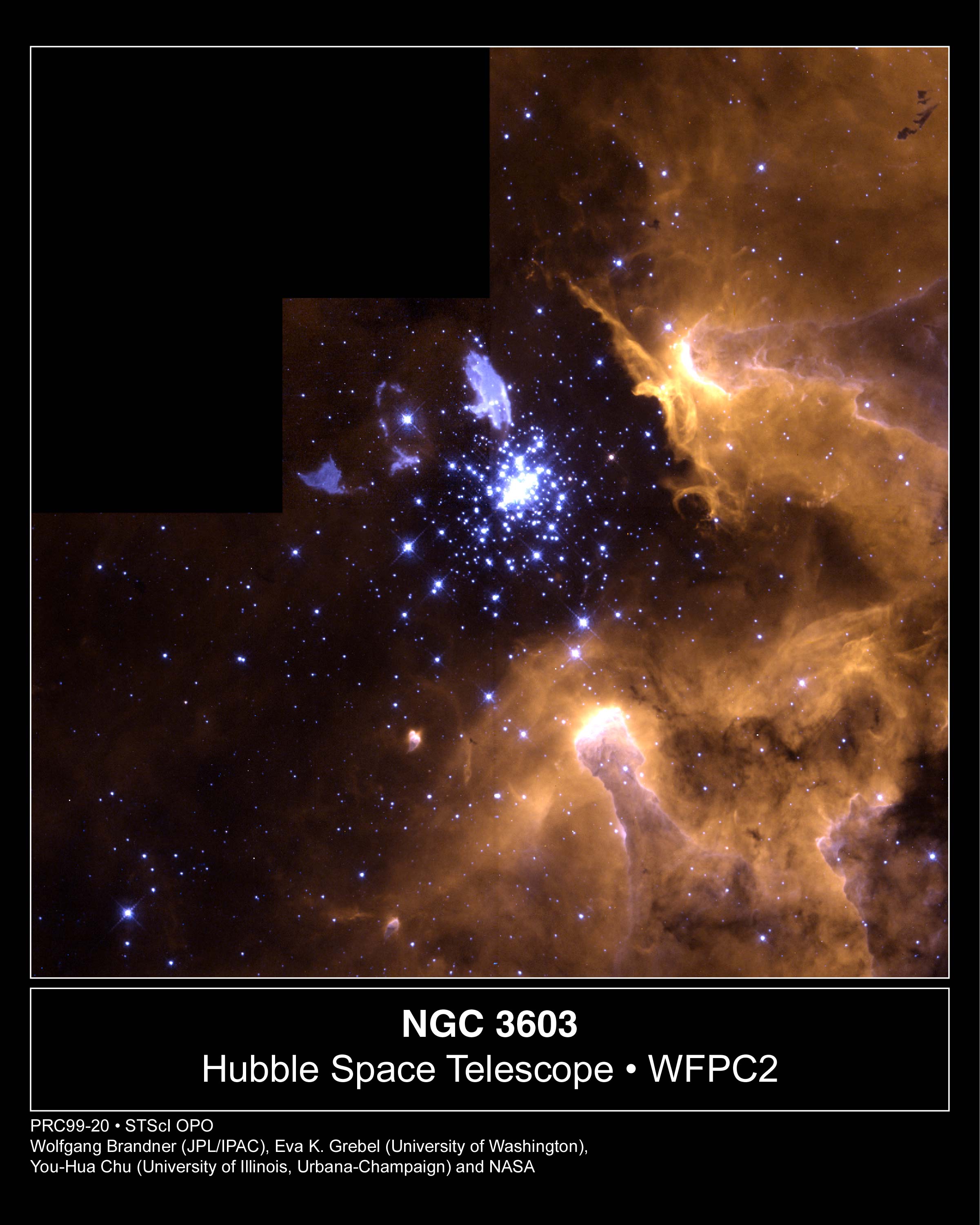
Image credit: Wolfgang Brandner, Eva K. Grebel, You-Hua Chu, and NASA.
Light! More specifically, electromagnetic radiation. While this light isn't always in the visible portion of the spectrum, that's certainly the type of radiation we're most accustomed to. And that's unsurprising: the greatest source of energy for us is the very same as the greatest source of energy for the above cluster, NGC 3603.
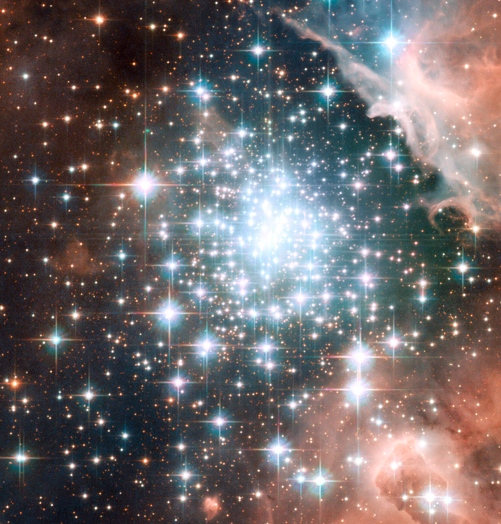
Image credit: NASA, ESA, and the Hubble Heritage (STScI/AURA)-ESA/Hubble Collaboration.
The type of light that comes from these stars -- like the light that comes from all stars -- is highly dependent on the temperature of the star in question. The hotter a star is, the more blue, or even ultraviolet its light will be, while the cooler it is, the redder -- often well into the infrared -- will its light be.
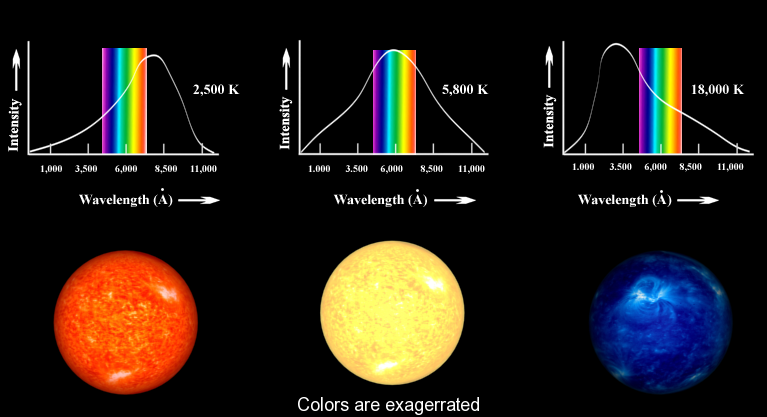
Image credit: Jasem Mutlaq.
But not every star is like our Sun, nor just a bit hotter, nor just a bit cooler. Some stars are literally hundreds of times more massive, while others are just a minuscule fraction of our Sun's mass.
And hence there is a tremendous variety among the fates of the various types of stars.
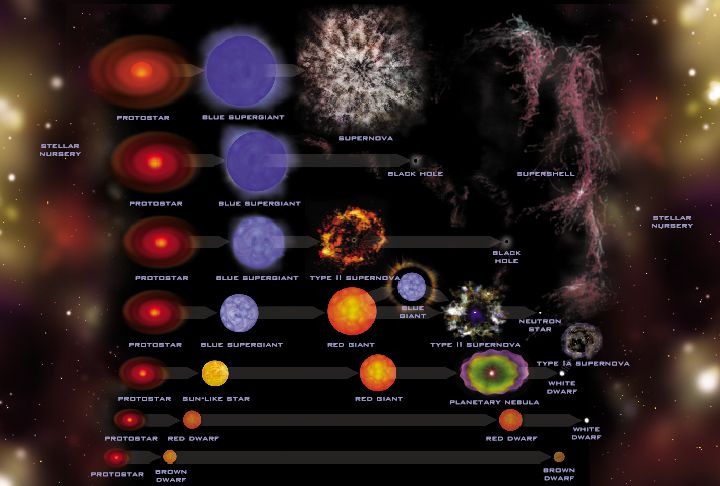
Image credit: Melissa Weiss, CXC, NASA.
And while nearly all of the stars we are familiar with get their energy source from the same place as our Sun -- nuclear fusion -- this is not the only energy source for the stars in our Universe.
Because in addition to nuclear reactions that give off energy, there's also a tremendous amount of energy stored in gravitation.
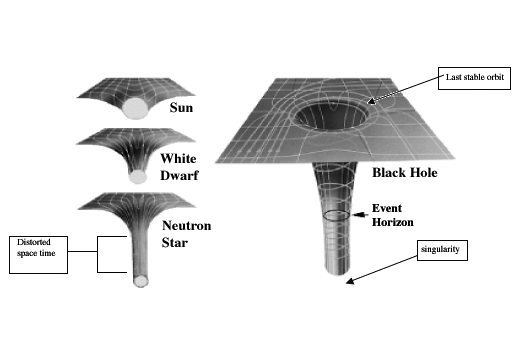
Image credit: NASA.
As a large mass collapses or contracts, there are a couple of interesting things that do and do not happen. The spacetime outside the mass -- the stuff that was outside of the initial, pre-collapse/contraction star -- does not change. The energy in it doesn't change, the curvature doesn't change, the gravitational potential doesn't change, and so on.
But where the spacetime, initially, was enclosed by the initial object, but isn't after the contraction/collapse, there's more, negative, gravitational potential energy. And that energy's got to go somewhere.
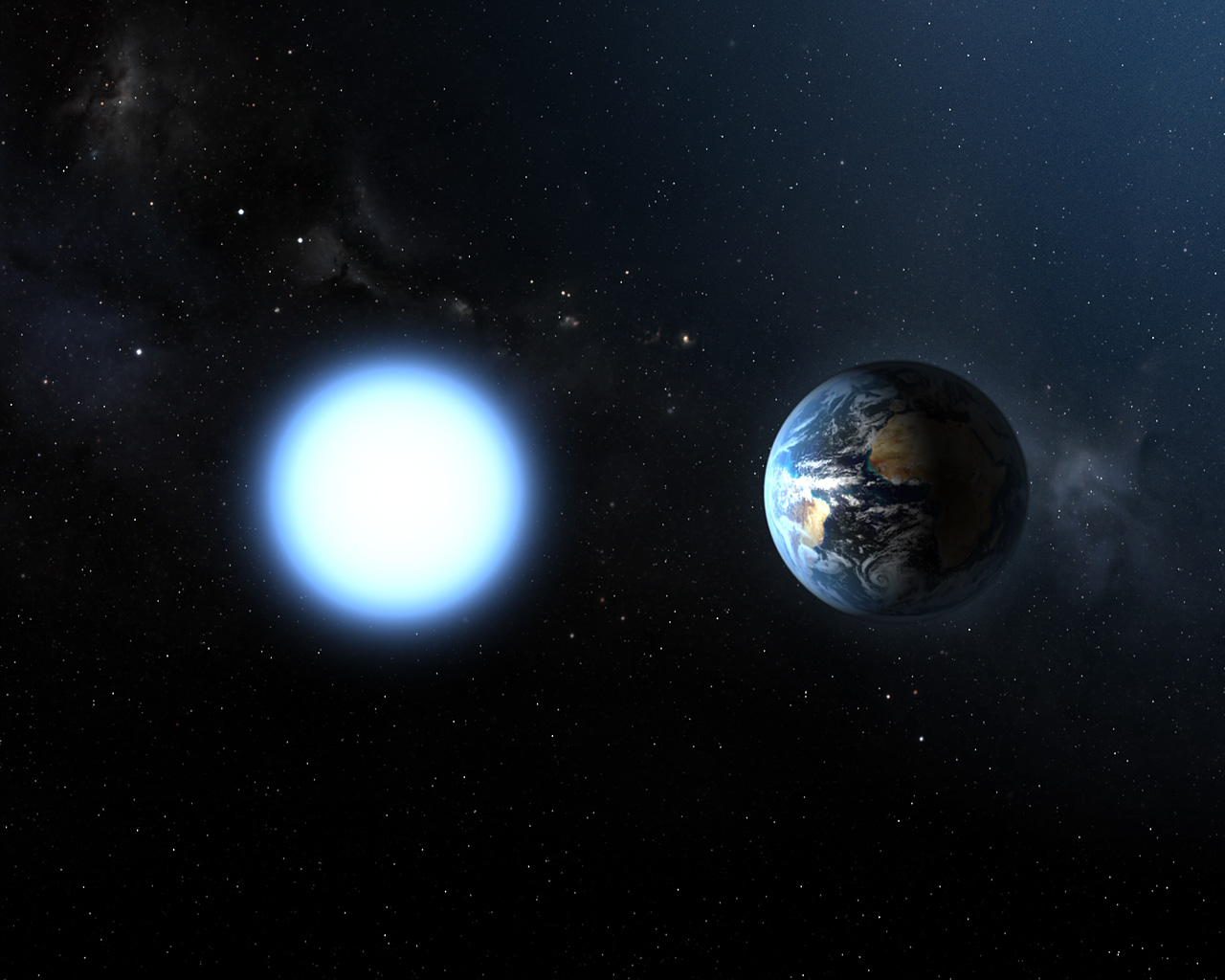
Image credit: ESA and NASA.
One place it can go, in particular, is into light, which is exactly what happens for White Dwarf stars. Comparable in mass to the Sun but in size to the Earth, these stars give off large amounts of light, powered only by gravitational contraction.
For example, if the Sun were replaced with a White Dwarf star, it would still appear 400 times brighter than our Full Moon currently does!
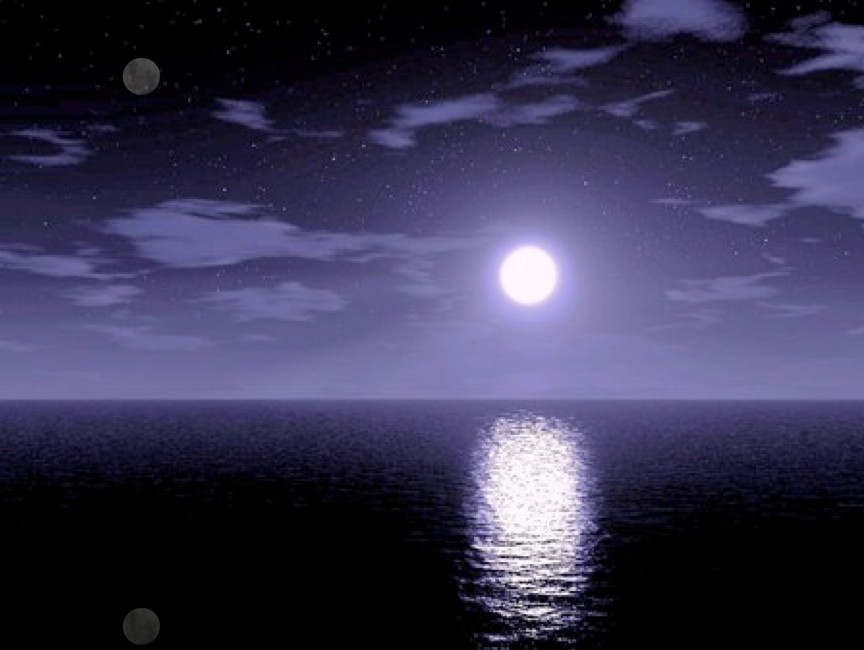
Image credit: Taken and modified from abstract.desktopnexus.com.
But not every collapsed/contracted object is the only star in its Solar System; many, like our night sky's brightest star, are in binary star systems. A binary star system is one where two stars -- or star-like object -- orbit one another. Over time, these orbits aren't simply stable, they decay due to gravity, and start to inspiral in towards one another.
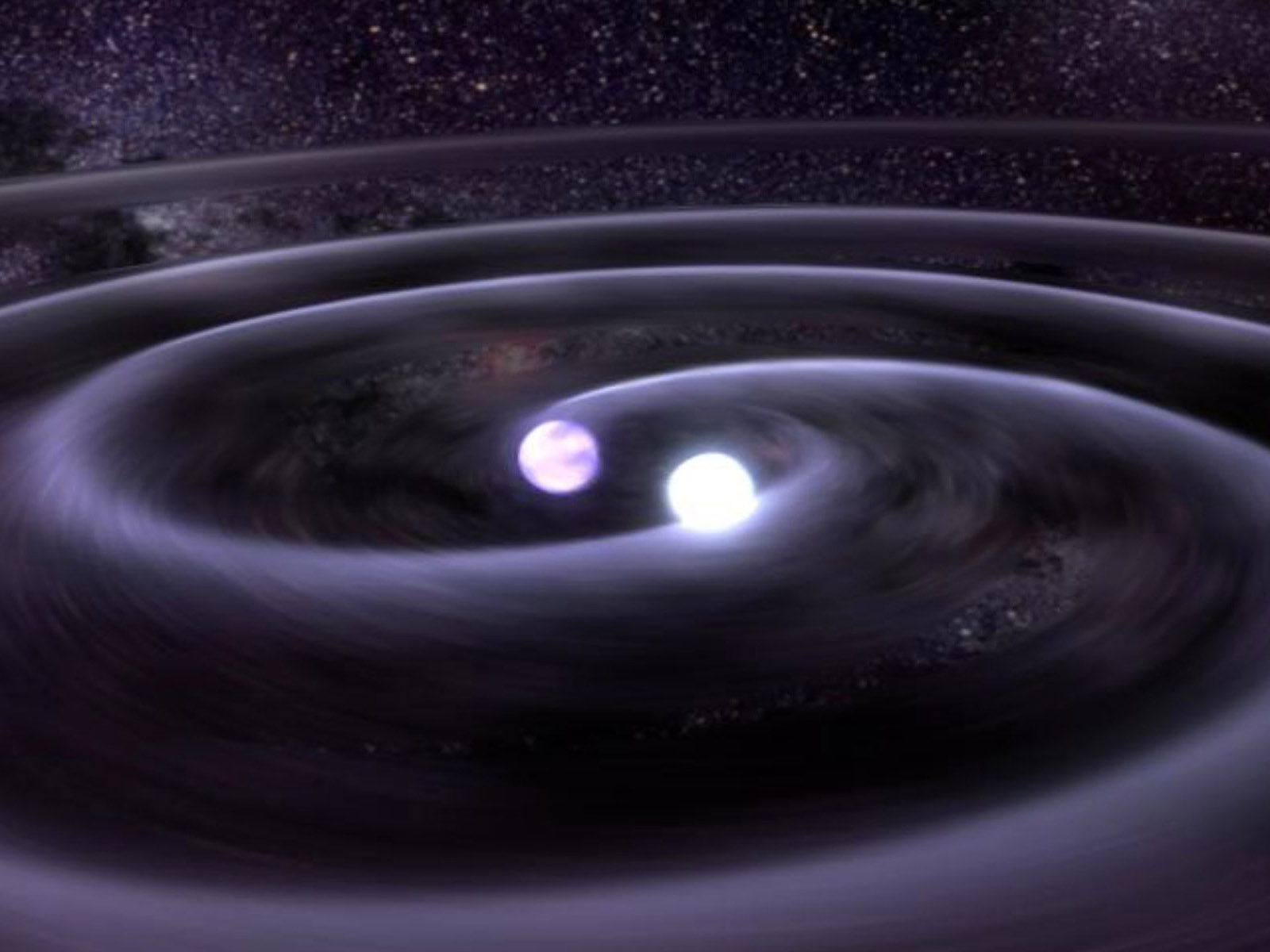
Image credit: NASA/Tod Strohmayer (GSFC)/Dana Berry (Chandra X-Ray Observatory).
Only this time, as the gravitational energy decreases, it isn't light that comes out. And I don't mean visible light; I mean any form of light. Not X-rays, not infrared, not radio waves, nothing.
What type of radiation should come out of a system like that?
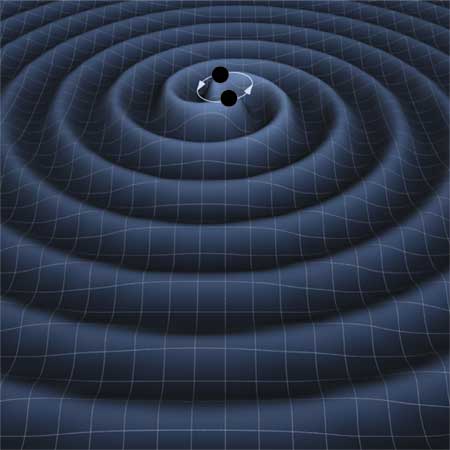
Image credit: LIGO Scientific Collaboration (LSC) / NASA.
Gravitational radiation, also known as gravitational waves! These ripples should propagate through spacetime, and rather than being detectable as light, they should deform the dimensions of objects as the gravitational waves pass through them!
There should be a steadily accelerating emission of waves as two objects spiral in towards one another; the closer they get to each other, the shorter the period becomes. Then, during the merger phase, there should be a catastrophic emission of both light (as it's very likely, especially if it's two white dwarfs, to create a supernova) and gravitational waves, followed by a "ringdown" phase of ripples, right in the aftermath of the merger.
It's a bold prediction by Einstein's general relativity, to be certain. But we've already observed -- indirectly -- one important aspect of this!
By taking a look at two pulsars (collapsed neutron stars) that orbit one another, we should be able to make predictions as to how the orbital period of these two stars should decay over time! Over the past 30+ years, since the discovery of the first binary pulsar, we've done exactly that.
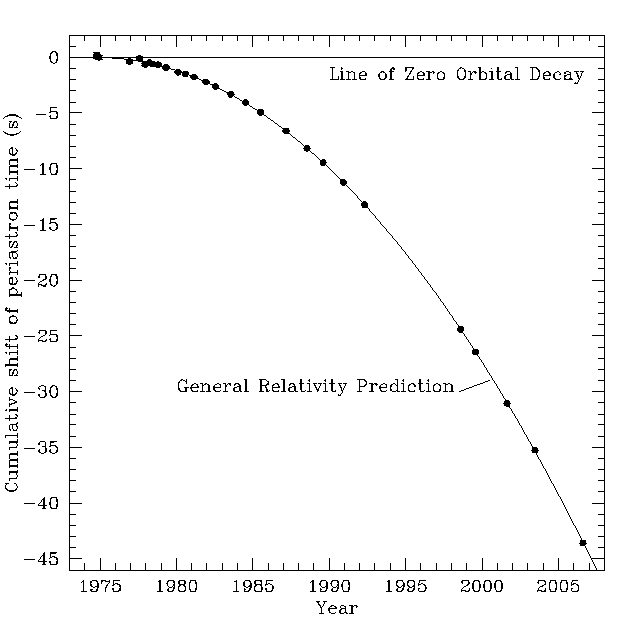
Image credit: J.M. Weisberg, D.J. Nice, and J.H. Taylor.
But we've love to be able to detect these waves directly! So what can we do to try to detect this invisible radiation in the Universe? Well, you can shoot precise lasers -- of very well known wavelength -- over huge distances in multiple directions. You can bounce that light off of mirrors, and send it back, where you put the light from both directions back together, and you see an interference pattern from those two directions.

Image credit: LIGO/LSC, retrieved from albert.phys.uwm.edu.
Because these gravitational waves are so weak, you need an incredibly long baseline (to give you a huge number of wavelengths: you need to detect a change of about 1 part in 1028) to detect even a tiny shift in one of these distances.
We've got a project on Earth currently attempting to do just this: the Laser Interferometry Gravitational-wave Observatory, or LIGO.
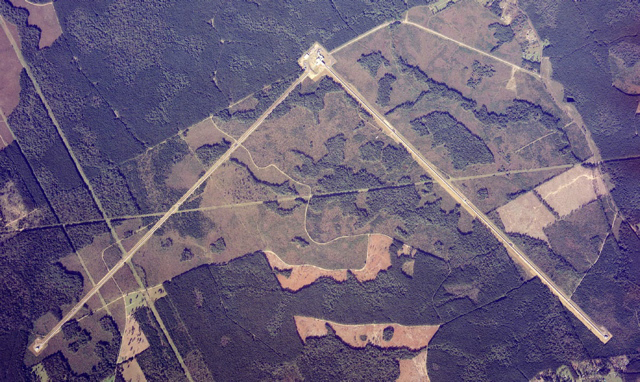
Image credit: Ricky Geautreaux, Aero-Data Inc., Baton Rouge, LA.
But LIGO is stuck here on Earth, where you're not only limited by your ability to send lasers from one location to another on Earth, you're also limited by how well you can shield yourself from terrestrial vibrations.
If we were really serious about detecting these gravitational waves, there's only one place to go to look: space!
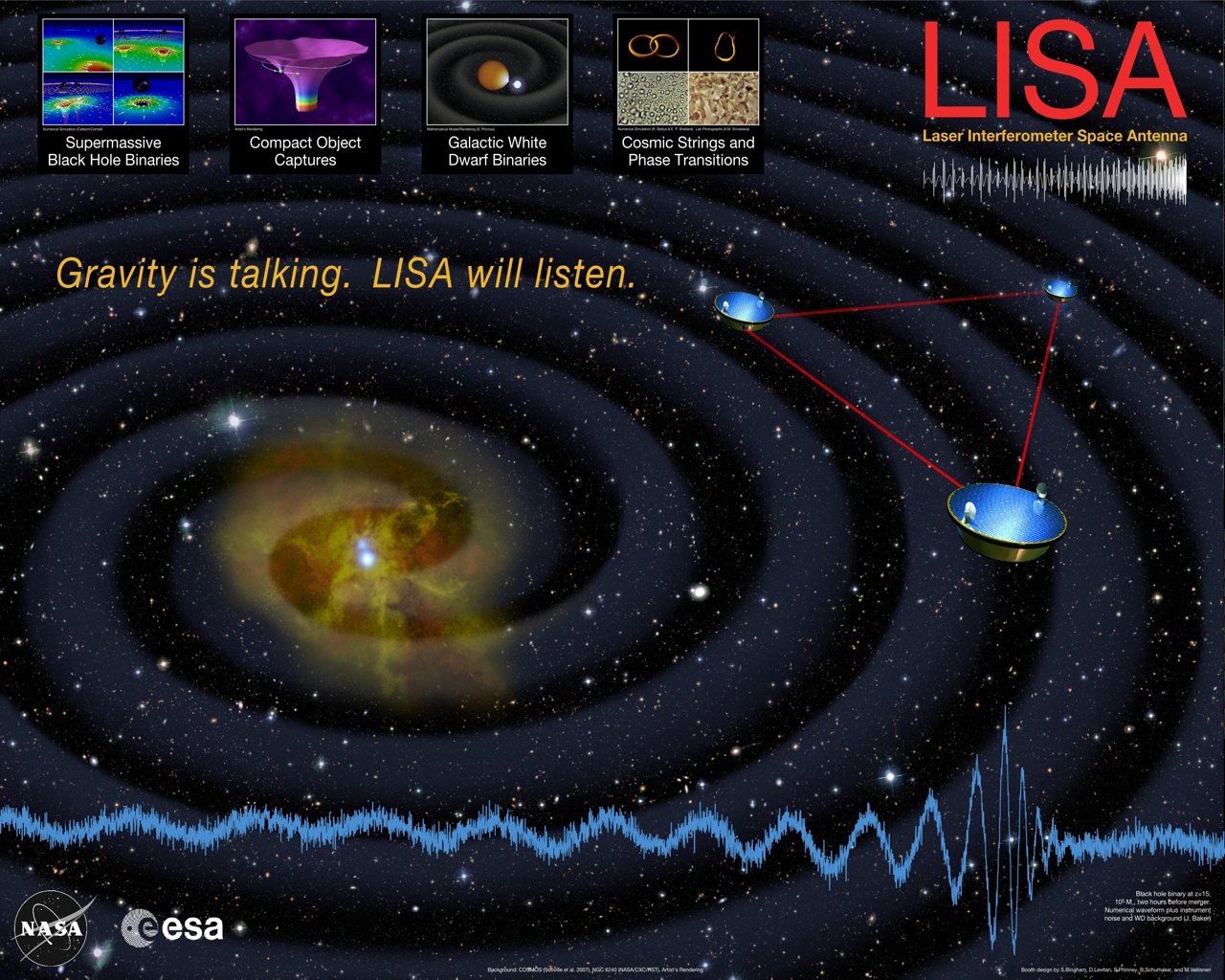
Image credit: LISA media gallery.
And that's exactly what the Laser Interferometer Space Antenna, or LISA, is designed to do! Unfortunately, doing anything in space is expensive, and with NASA's budget gutted and the ESA unable to afford it on its own, this set of three spacecraft designed to orbit behind the Earth -- with distances between them of five million kilometers apiece -- is at least a decade away now. From the official site:
ESA has ended the study of LISA and the other concepts as partnerships at the scale proposed in the New Worlds New Horizons decadal survey (NWNH). ESA has begun a rapid definition effort that includes the formation of a new science team (to be announced shortly). That effort will identify science goals and a mission concept that can be implemented as part of an ESA-led mission launching in the early 2020's. Revised mission concepts from the three science areas will be considered in a selection process commencing in February 2012.
The Universe is speaking -- all the time -- in a language we've never heard before. And yet, as soon as we hear it, we're in a place where we are confident that we'll immediately understand it!
So what's it saying? How many -- and where -- are white dwarfs inspiraling? How many black hole mergers are there in distant galaxies? What does a catastrophic gravitational wave emission from a merger look like? The Universe is telling us, right now. We just need to listen to one of the last great untested predictions of general relativity, and we'll be able to see, for the first time, the invisible radiation of the Universe: gravitational waves!
Hey Ethan! I love your blog. Been reading it for a while now. I wanted to suggest that this post serve as the basis of a follow up post on the other theory that this device was supposed to inform us about. The one about our reality actually being played out or whatever as a holograph displayed on the event horizon of the universe... Or something like that? This device was supposed to be able to detect the "fuzziness" of the holographic instantiations of plank lengths I think.
Or not. Maybe it's a quack theory. But it was a neat idea.
So Logan, er, Ethan (sorry, not sure where that came from), I'm curious about one thing. I'm sure I'm misunderstanding something, but it kinda seems like gravity is infinite energy. That is, it never seems like something is ever in danger of running out of gravity. Where am I going wrong here?
Man, I was so bummed when I heard the then-current LISA plan was canceled. More so than if JWST is canceled. This isn't just a newer, better telescope. It's a fundamentally new method of viewing the universe!
Dark Jaguar:
Forgive me for talking about gravity in classical, non-relativistic terms, but I believe it still works as far as answering your question.
The gravitational force field created by an object never fades, but the amount of energy that can be extracted from a gravitational field does. An object held up high in a gravitational field of a much more massive object will have a lot of potential energy, and that energy will be converted into kinetic energy as it falls, and when it hits the surface of the bigger object that energy will convert into other forms... But then you're done. You're not getting any more energy out of the gravity between the two objects.
The only way to get more energy out of it is to expend energy lifting the object back up so that it can be dropped again.
So that in brief is how you can have a perpetual, never-fading force without having it result in infinite energy.
Don't forget about the third type of radiation, neutrinos! More numerous than the light! ;) I suppose one could even call dark matter radiation too, if it exists.
@Dark Jaguar: The concept of energy in gravity is somewhat ill-defined. As CB points out, you can measure energy differences of falling objects in a particular frame of reference, but you can't measure or even define the "energy of the gravitational field". For that we use a different quantity with the same dimension as energy, "curvature", which describes the strength of a gravitational field. (In fact one can define an "energy" of the gravitational field, but then one can show that you can increase the energy arbitrarily without changing the curvature, and therefore without changing any gravitational effects) This is one of the reasons gravity is fundamentally different than the other forces, and one reason it has been so difficult to make a quantum theory of gravity. There are many ways to formulate this problem, perhaps one of the most intuitive is: if the cosmological constant is an energy density per volume of space, and space is expanding, isn't the total gravitational energy increasing with time? ...and the answer is a rather unsatisfying "we can't actually define the energy of gravity".
Most physicists sweep the energy in gravity issue under the rug, but I think it is very fundamental. Gravity clearly does carry energy. Solving this may lead to a sensible theory of quantum gravity.
That pic with the sun being replaced by a white dwarf and outshining the moon is incorrect. The moon in that position would be somewhat of a half moon and not the full. The full moon appears in the sky opposite the sun, which in this case was replaced by a white dwarf. Now I understand that it is just artistic license to convey the differing brightness, but still, hey now.
Aside from gravitational waves, are there any other predictions of GR that we haven't yet directly observed? (Now that we've observed frame-dragging. Woo!) If not, is the next step trying to test some of these zany unified GR/QFT theories (string, LQG, etc)? How far away are we from the tech to do that?
Suppose spiraling white dwarves turn out to be very common. What are the implications of numerous gravity waves on our obervations of other objects? Would the gravity waves bend other forms of radiation--light for example and cause us to overestimate distances?
How fast do gravitational waves travel?
Hi Ethan! Love the blog.
I just had a question about gravitational radiation. As I understand it, LIGO has been in operation for quite a while, to no avail. I know general relativity is fiendishly complicated, but I just was wondering if that was the only reason theorists haven't been able to predict the wavelength and frequency of the radiation. Do we think we're close? Is it a lot smaller than we imagined? Why does this not indicate clear problems with the idea of gravitational radiation?
@Chris: c.
Evan @1, you are likely talking about Craig Hogan's work on fundamental "noise" that should show up in some interferometry due to extra dimensions. Although I wrote about it a few years ago, that explanation is highly speculative, and if I remember correctly, Sabine Hossenfelder took a very good skeptical look at it, and found that the "signal" indicating this effect was due to a much more mundane explanation.
Dark Jaguar @2, there isn't an infinite amount of energy to be gained by gravitational collapse (or equivalently, as Bob @4 correctly notes, by the curvature it causes). The energy, in fact, can be calculated for the overall effect of gravitational collapse throughout the entire Universe. And has been. By me, among others.
Waydude @5, I meant to show that "incorrectly" as you note. This is meant to compare our full moon as it is now with the Sun if it were a white dwarf. The Moon -- if the Sun were a white dwarf -- would not only appear in a different phase, but would appear about a factor of 1,000 less bright, due to the reduction in luminosity of the star sourcing its photons.
Benhead @6, there are others, but they seem to be even farther off. For example, GR predicts that gravity is a purely (rank-2) tensorial theory of gravity, and therefore the graviton should exist with spin +/- 2 only. But if TeVeS is correct, there should be -- at the very least -- other particles and/or couplings that the standard GR graviton should not have. One of the maddening things about GR is how difficult things are to calculate, and therefore how difficult it is to make predictions. Once we solve the self-force problem, for example, we should be able to tease out a new observable prediction. Give the GR theorists some more time on that one; the problem is really difficult!
Jim @7, the magnitude of the effect we're talking about is somewhere on the scale of the size of an atomic nucleus for every light year of space. So it's very unlikely to bias astronomical distance measurements.
Chris @8 and djlactin @10, it is c: see here for much more information on that.
Michael @9, LIGO is looking in an interesting frequency range where gravitational waves are predicted. Unfortunately -- and it was designed knowing this -- it is not sensitive to merging white dwarfs, binary neutrons stars or black holes, or other "common" occurrences, due to the small magnitude of the waves created from those events. Realistically, this version of LIGO would need to operate for centuries in order to have a legitimate shot at seeing something. Which is fine; this LIGO is widely recognized as a proof-of-concept prototype. Advanced LIGO, when complete and operational, should start to see a few major events (maybe 1-10 things per year), but this is edging very close to its design sensitivity. Moreover, it only gets the very "high frequency" objects, or the very last moments of an inspiraling binary pair.
LISA is the one we really want, as it is designed to probe a frequency range -- with great sensitivity -- that is much more interesting for the purposes of gravitational waves. See here for a comparison; while LIGO will only see systems with orbital periods much smaller than one second (!), LISA should be able to see systems with periods on the order of an hour, which are thought to be far more plentiful.
I seem to recall, rather vaguely, somebody suggesting that Jupiter isn't a planet but actually a star that just didn't have the mass (and, thus, gravity) to ignite properly, thus making the Solar system a binary system.
For evidence, this individual -- who is not a scientist -- claimed that we know how much light should be reflecting off of Jupiter and how much of that we should be able to see and we're seeing more than that.
This evidence seems to me, at best, to be poorly summarized. I've long had this nagging wonder if this guy was, in fact, right or just a goofball with an idea.
Enough background; my questions are thus: given what we know about astrophysics today, is this idea even worth investigating? If it is, has it been? And if it has been, what are the results?
Could make a decent post someday.
Great post as always.
I have a dumb question: you say gravitational waves should "deform the dimensions of objects", and I understand how LIGO would detect that. But isn't LISA looking at deformation of the space in between the detectors?
So is there a difference between measuring the deformation of an object and deformation of the space between objects? Do gravitational waves act the same on both objects and empty space?
ShadowWalkyr--
I think your question comes down to "how do we define a star?" Yes, Jupiter is a net energy source; however, it's not producing that energy by fusing hydrogen (or anything else) at the core. Rather, the energy is coming from gravitational collapse.
FWIW, Wikipedia tells me that Saturn is also a net energy source, for the same reason. So if someone wants to count Jupiter as a star, they have to count Saturn as well.
Where are the 10^28 wavelengths coming from? 5*10^9m even in x-ray wavelengths comes up several orders of magnitude short.
100 Hz for LIGO - so we could hear the Universe hummmm?
@13 - yes, space and what's in it is being deformed by these gravitational waves
@15 - I didn't do the math but I'm assuming the resolution is better than wavelength, my understanding is that they are detecting phase shifts.
Orbital delay: I expect that acceleration happens to each of the binary component masses due to the speed of gravitation v_G=c between them.
qbsmd,
Sorry, and nice catch! We need to be able to detect a change of one part in 1028 over the whole baseline, or a change of some tiny fraction of a single wavelength.
I only wish we could get 1028 wavelengths in there!
"One place it can go, in particular, is into light, which is exactly what happens for White Dwarf stars. Comparable in mass to the Sun but in size to the Earth, these stars give off large amounts of light, powered only by gravitational contraction."
Uhm, that's wrong. White Dwarf stars do NOT contract significantly, that's the entire point of the whole 'degeneracy pressure' business.
They simply take long time to cool - their surface area is small and their mass is large. And radiative cooling is rather slow.
Alex,
Why would you say such a thing? White dwarf stars do contract significantly; you simply need to wait long enough! For a white dwarf star, given the energy it puts out, one can calculate the amount of time one must wait for it to contract and cool to extremely low temperatures. Depending on what you qualify as "extremely low", it takes anywhere from a few trillion up to a quadrillion years, a time much longer than the age of the Universe. And the amount of energy released in this contraction -- over this extremely long time period -- is tremendous. (Afterwards, of course, when the object becomes a "black dwarf", degeneracy pressure prevents any further contraction, and there is no further energy source.)
But why wouldn't you call it gravitational contraction; that's exactly what's going on: you are converting gravitational potential energy into light! That's what the Kelvin-Helmholtz mechanism (also called Kelvin-Helmholtz contraction) is! Do you object to it because the radius of the white dwarf doesn't change all that much over time, i.e., that the rate of contraction is minuscule? The luminosity of a white dwarf is small by the standards of our Sun, sure, but it still gives off a tremendous amount of light: maybe 1/1000th of the Sun's light!
Your comments here have normally been very well-informed, and so I do not understand your objection to calling it contraction. Contraction is generally what astronomers use to talk about a slow, small change in an object's size over a long amount of time, as opposed to collapse, which is rapid and more catastrophic.
Outer shell of the white dwarf may indeed collapse further but it doesn't produce much energy compared to the simple stored thermal energy. The temperature in the white dwarf's core is thought to be 5-25 million K, the surface temperature is mostly determined by greenhouse-like effect of the outer layer.
Degenerate matter in the star's core just doesn't compress much with cooling (conversely, it doesn't expand much with heating). It also doesn't compress much with increased pressure - it behaves almost like ideal incompressible fluid.
And that's the reason for the Ia type supernovae - degenerate matter conducts heat very well and doesn't expand with heating. So once conditions for the carbon burning are established in the dwarf's core it goes downhill pretty fast. Normal matter would just expand until a new equilibrium is established but degenerate matter _can not_ expand so it all blows apart in a space of a few seconds.
Alex, I think I see. You're not disputing that the gravitational contraction of the (red giant) predecessor down to a white dwarf is the source of the white dwarf's energy, but that it the white dwarf itself isn't powered by further contraction into some more-dense state.
Your note that the core of the dwarf is very hot, but its tiny surface area at a much lower temperature is the reason why it takes so long to cool and go black is, of course, correct. Thanks for clarifying what you meant, and also for letting me know that I need to be more clear about that in the future!
Ah yes, so we're in agreement then.
Alex and Ethan nice discussion on white dwarfs.
Since white dwarfs supposedly live so long, is there some kind of spectral signature that differentiates an young white dwarf from a very old white dwarf?
Is there any telescope, current or planned, that will be particular good at finding white dwarfs and giving enough data to analyze their age? They seem to be pretty important objects; but quite hard to find.
They'll be optically dense so therefore they will be pretty close to an ideal black body radiation curve.
Since it's cooling, the age will show up as a drop in temperature, but since the variation in the temperature of the white dwarf would be pretty large compared to the change in temperature from cooling for, say, 10 billion years, it'd be hard to make any guesses to age.
Add to that that they have very little surface area, and there's not a lot of radiation to see, and that makes only nearby white dwarfs possible to discern, and you've got pretty much the definitional busy-work job...
@26 Wow
Thanks. Makes sense. But there's other opinions.
"APRIL 24, 2002: Pushing the limits of its powerful vision, NASA's Hubble Space Telescope has uncovered the oldest burned-out stars in our Milky Way Galaxy. These extremely old, dim stars provide a completely independent reading of the universe's age without relying on measurements of the universe's expansion. The ancient white dwarf stars, as seen by Hubble, turn out to be 12 to 13 billion years old. Because earlier Hubble observations show that the first stars formed less than 1 billion years after the universe's birth in the big bang, finding the oldest stars puts astronomers well within arm's reach of calculating the absolute age of the universe."
So the "completely independent reading of the universe's age" is what interests me. But I can't track down how it works or if it is completely independent or theoretically accepted interpretation.
For some confusion NASA says, "It may take 10 billion years, but our Sun will someday reach the end of the line and quietly become a black dwarf. White dwarfs can tell us about the age of the Universe. If we can estimate the time it takes for a white dwarf to cool into a black dwarf, that would give us a lower limit on the age of the Universe and our galaxy." Sounds good but...
@21 Ethan "For a white dwarf star... it takes anywhere from a few trillion up to a quadrillion years... when the object becomes a "black dwarf." I know I deleted a lot but Ethan seems to say that it takes much longer than NASA's estimate for a white dwarf to become a black dwarf.
So are White dwarfs good cosmic clocks or not?
And will we be able to see these clocks in distant galaxies with the planned JWST?
OK those are my questions, can anyone shed some insight upon my area of concern, thanks.
Hi Ethan,
what do you think about this:
Imagine a binary system consisting of just two stars with equal masses orbiting each other.
Due to the distance of star m from its partner star M, gravitation from M needs some time to reach m, due to finite speed v_G=c.
Thus star m actually "sees" M in a slightly deviated "old" direction, and m has to accelerate.
Hi Ethan,
it would be very nice to get an answer to my question (28)?
May be from any body else?
Thanks a lot in advance.
Schwar_a,
That is exactly right, and not only is that right, from the fact that gravitational radiation is occurring, we expect the orbits of those two stars -- since energy is being carried away -- to decay!
We have measured this, of course, as stated above, but we have measured it so precisely that we can use the predictions of gravitational radiation and the measurements of orbital decay to indirectly measure the speed of gravity. The results?
http://www.desy.de/user/projects/Physics/Relativity/GR/grav_speed.html
To within < 1%, gravity moves at the speed of light. So this is a very nice thought on your part, and in excellent agreement with our best observations as well.
Cheers!
Last I'd heard, they hadn't managed to get their error bars down low enough to make a claim on that.
Nice to hear progress!
Hi Ethan,
"...since energy is being carried away..."
What I mean is that this is not the reason for the decay (or better, not the only one).
_My_ picture was driven only by the slightly different direction of the acceleration towards the old position of the partner star M - very classically calculated, without any loss of energy by radiation. This should lead to the shortening of the actual radius r of star m to the actual Barycenter by Îr = r·z_G = r·(1/â(1-2GM/(c²r)) - 1).
As a layperson, gravity has always seemed like a great unknown to me. It seemed in school the explanation was "it works because it works" and that never satisfied me. I hope we can come to some understanding of it in my lifetime.