

"Change, like sunshine, can be a friend or a foe, a blessing or a curse, a dawn or a dusk." -William Arthur Ward
Few things are as essential to our world as we know it as the primary source of our light, heat, and all the life that flourishes on Earth as the Sun itself.
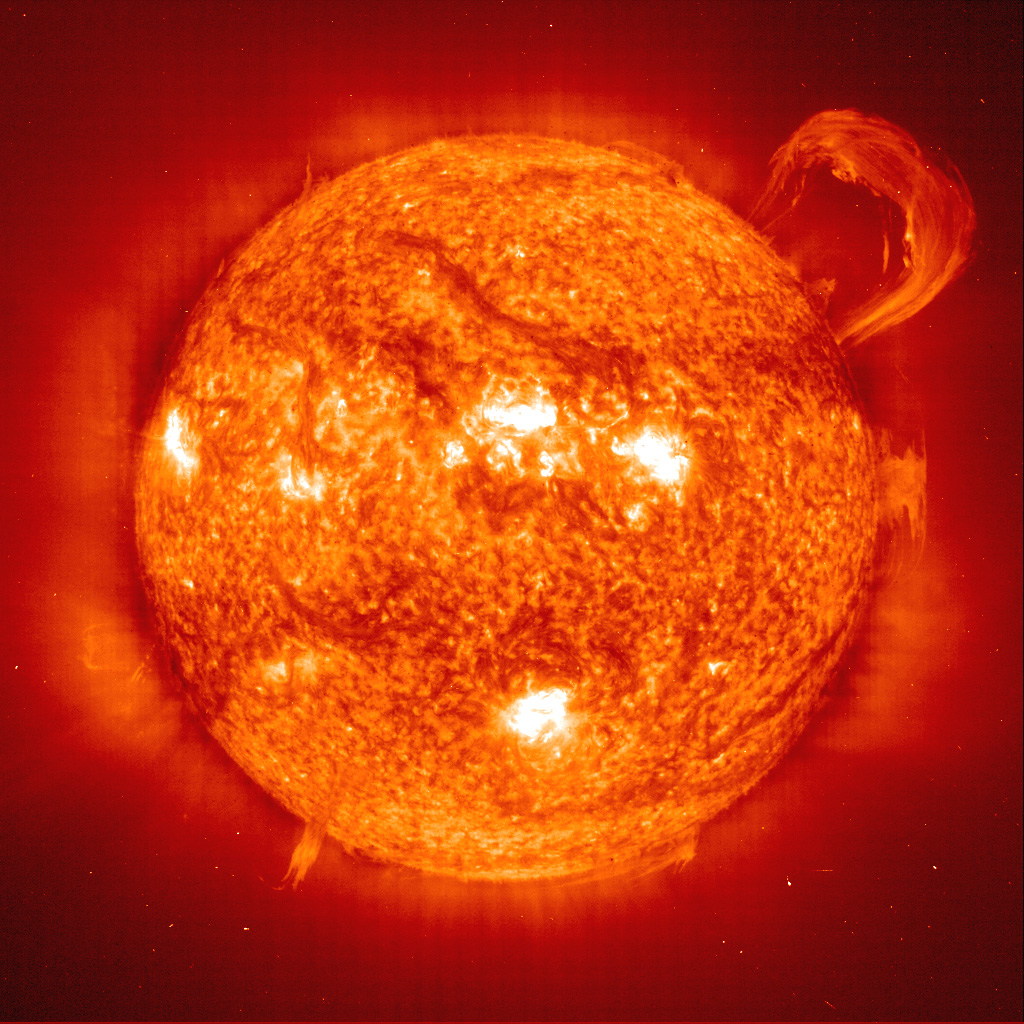
Image credit: NASA / ESA / SOHO-EIT Consortium, retrieved from legacy.spitzer.caltech.edu.
And yet, there are two things that may strike you as very important when it comes to our Sun. One may be the fact that, at 150 million kilometers (93 million miles) distant, the Sun is so much closer to us than even the next closest star: Proxima Centauri.
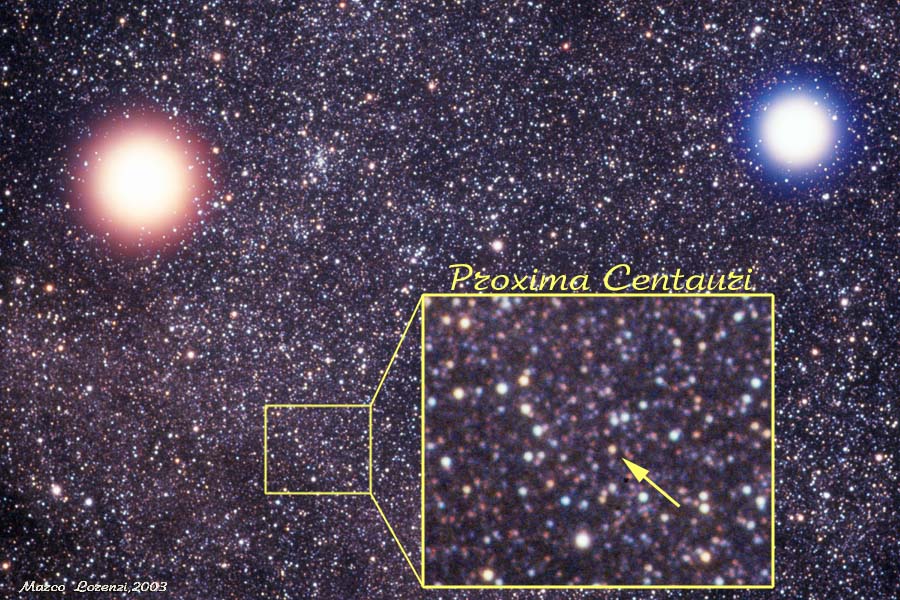
Image credit: Marco Lorenzi.
At forty trillion kilometers distant, Proxima Centauri is over 200,000 times farther away than our Sun, giving you an idea of the great distances between the stars in our sky, and how fortunate the Earth is to be bound to our Sun.
The other thing that's striking, once you learn a bit about the timeline of the Universe, is that even though the Sun has been around for billions of years, the Universe existed for over nine billion years before the Sun came into existence! So where, then, did our Sun come from?
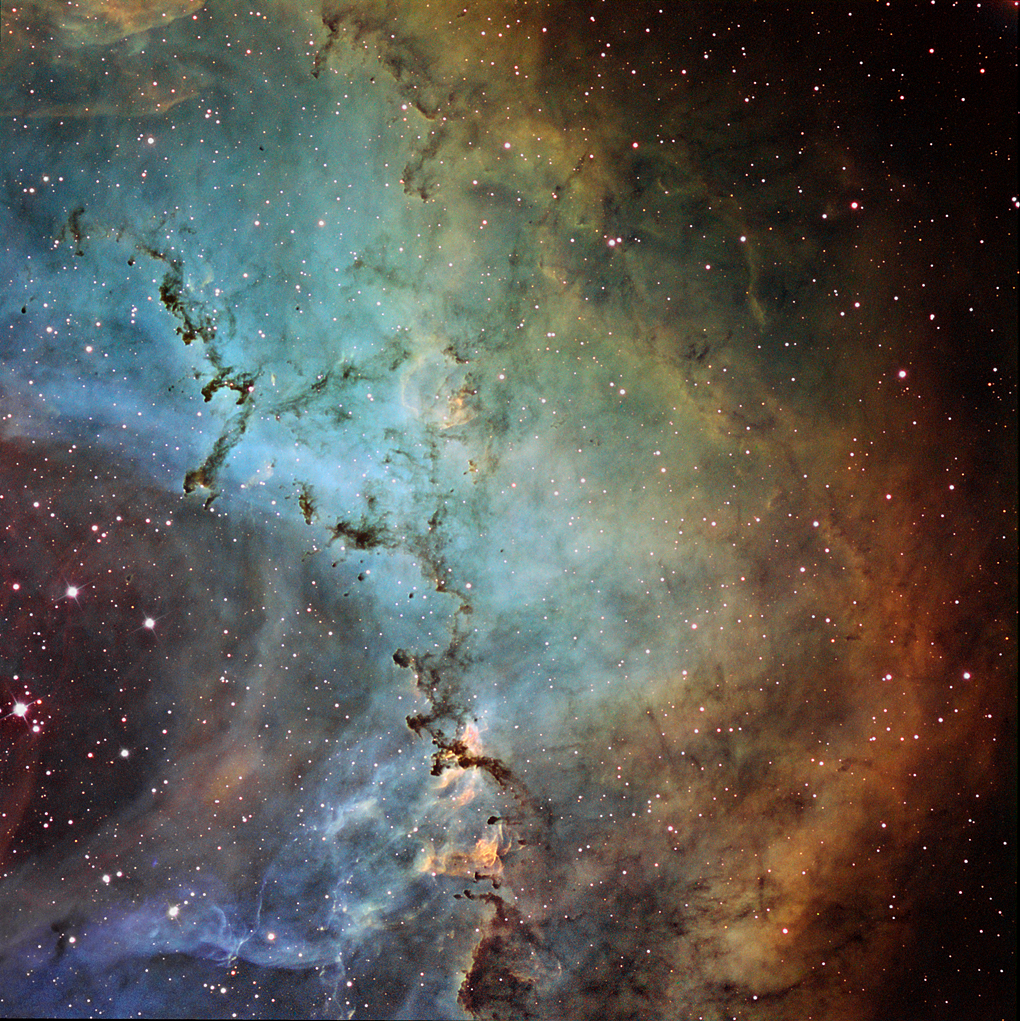
Image credit: John Ebersole, retrieved from APOD.
The Sun, like all stars, didn't simply pop into existence. And what's more: the environment it formed in is dramatically different from the environment we live in now.
In order to form any sort of collapsed object, you need to start with a more diffuse set of matter that will contract down to a more compact configuration. All throughout the galaxy, we find molecular clouds that are doing exactly that.
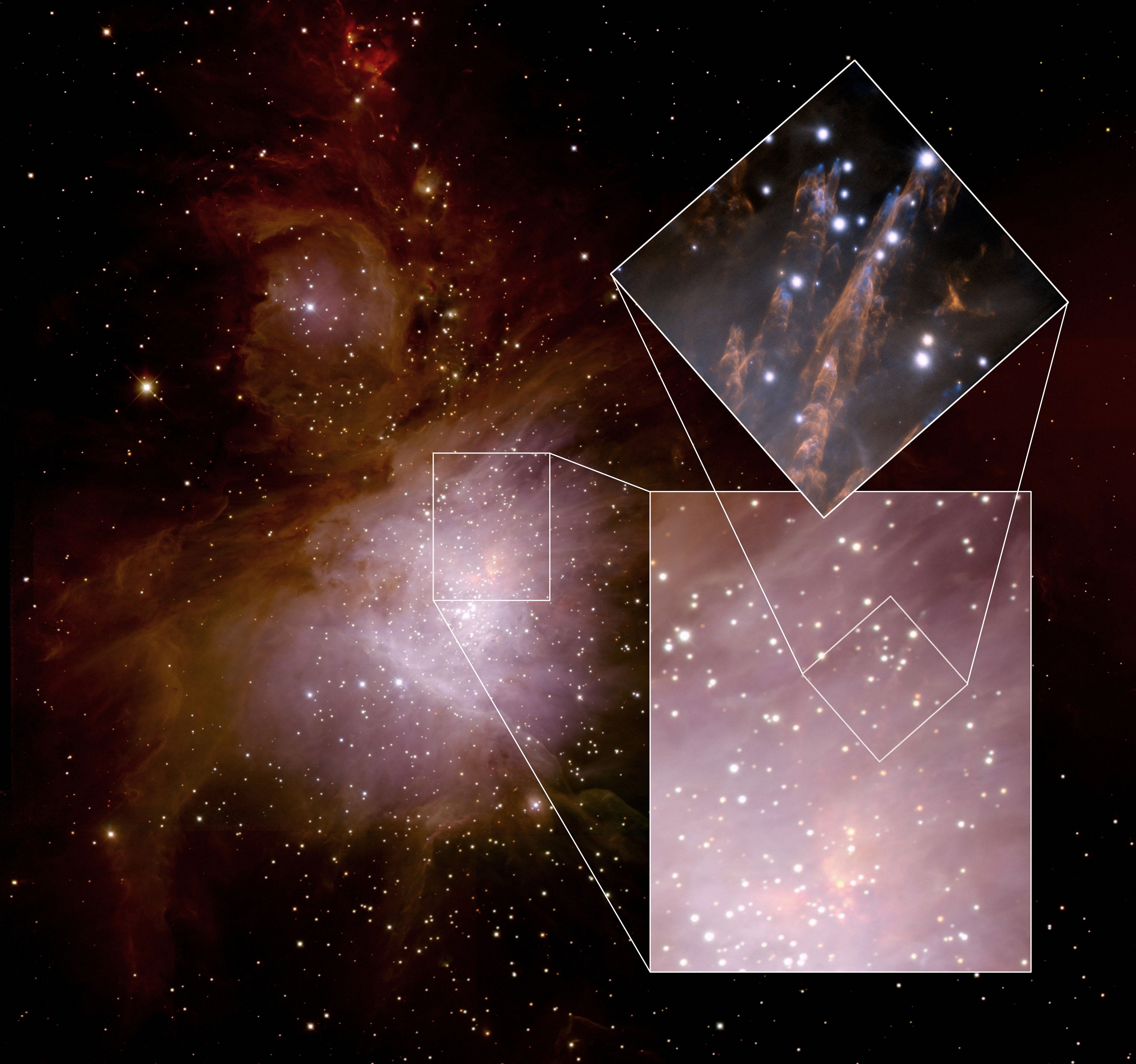
Image credit: M. Robberto / STScI and NOAO / AURA / NSF / Gemini Observatory.
This is what's going on inside the Great Orion Nebula, above. Molecular gas clouds, composed of a combination of pristine gas untouched since the Big Bang as well as recycled material expelled from previous generations of stars, contract down under the relentless force of gravity.
In order to do so, these clouds must be huge: much more massive than the material required to form a single star. And when you accumulate enough of this diffuse matter in one location, and it begins to contract, there are inevitably some regions that become densest the fastest. And -- because that's how gravity works -- these places that become denser pull progressively more matter in atop themselves, limited only by how quickly they can dissipate the energy associated with this gravitational contraction. If we peer deeply into the dark depths of these clouds -- like the Horsehead Nebula -- what is it that we find?
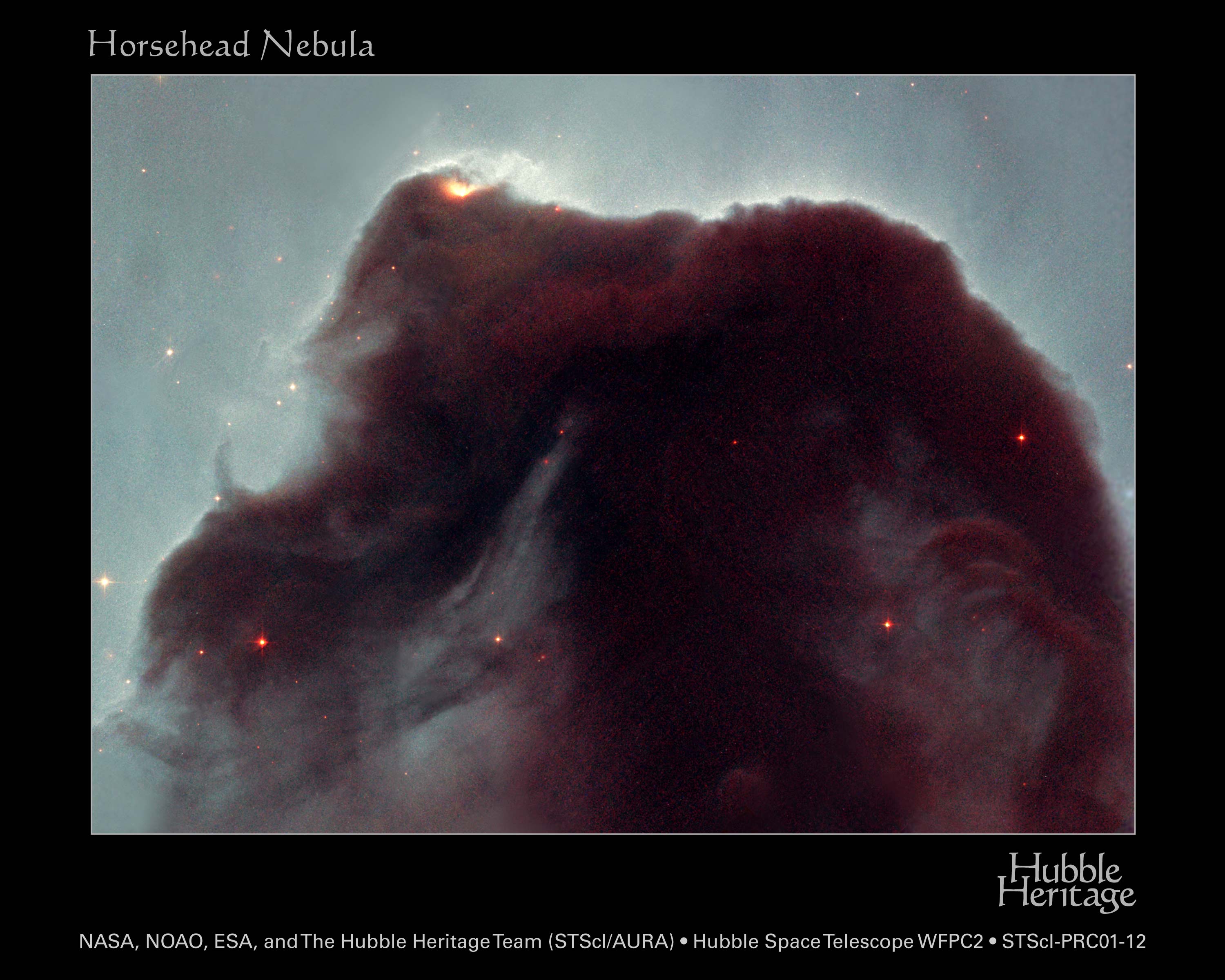
Image credit: NASA, NOAO, ESA and The Hubble Heritage Team (STScI/AURA).
There are stars forming in there! In fact, this is how stars form throughout not only our own galaxy, but all galaxies in which new stars are observed to form: in clusters. Typically containing thousands of stars separated only by maybe twenty light years, this is what these dusty, contracting nebulae will turn into as the effects of gravity run its course.
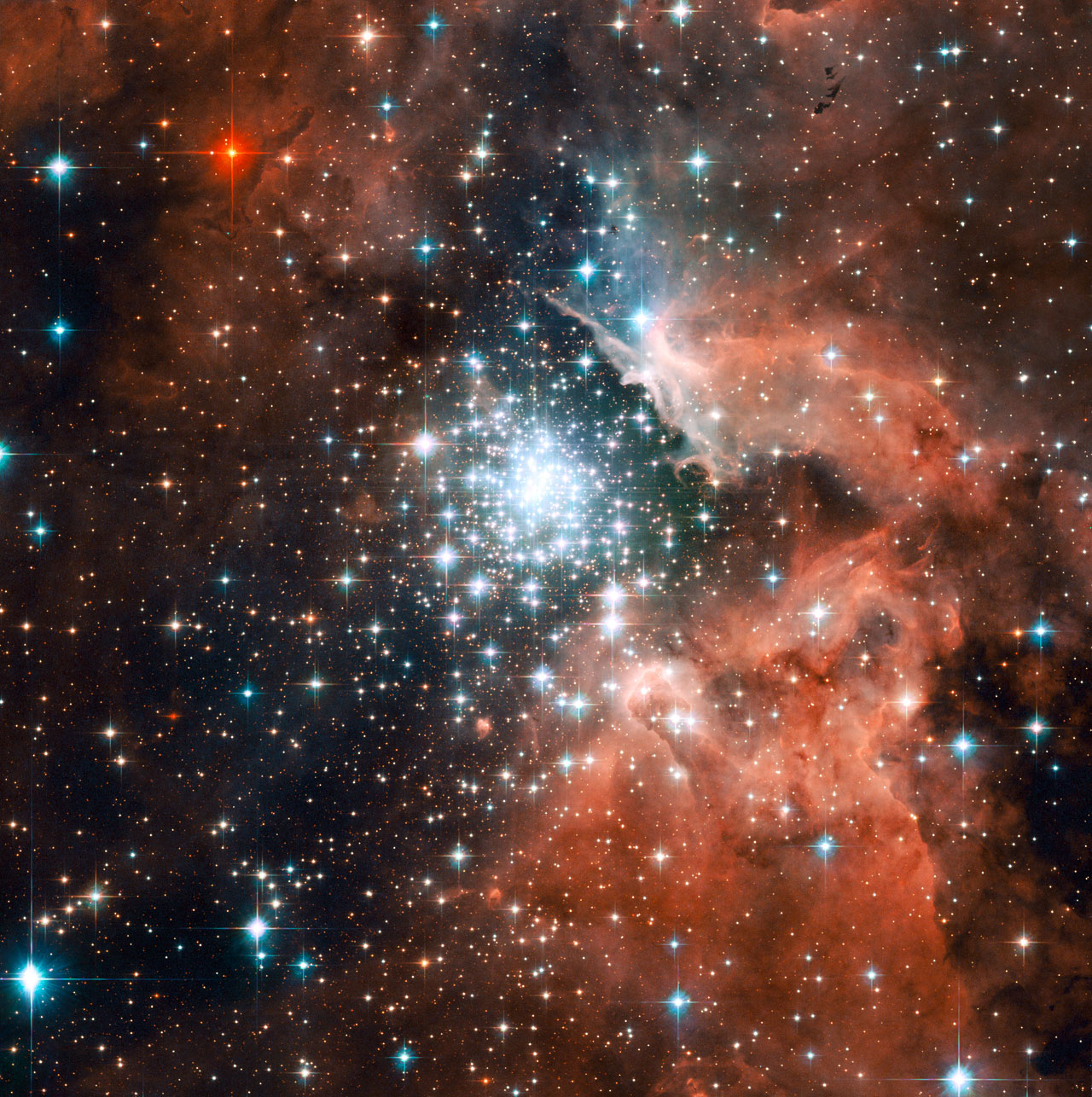
Image credit: NASA, ESA and the Hubble Heritage (STScI/AURA)-ESA/Hubble Collaboration.
And over enough time, all of the gas will either form stars or be stripped away from heat, pressure, or interactions with other galactic material in relatively short order. Stars are still actively forming in NGC 3603 above, making it one of the places we're optimistically hoping will soon bring us a supernova within our own galaxy. But when the dust is all gone, no new stars form, and all we can do is watch as the heaviest, most massive stars die off. What's left behind is known as an open star cluster, like the Wild Duck Cluster (Messier 11), below.
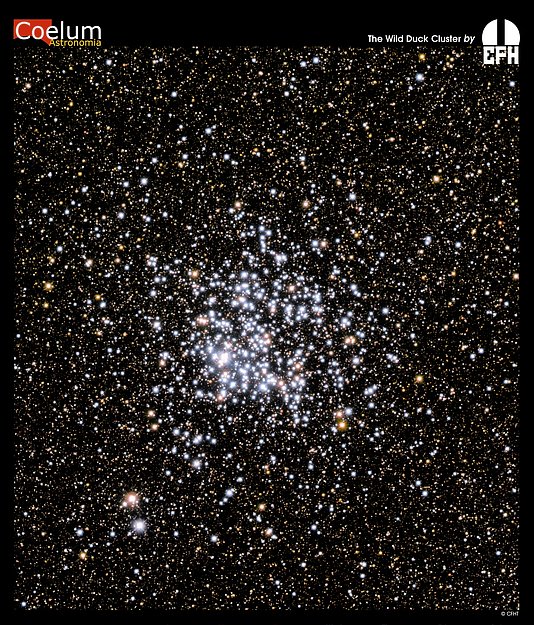
Image credit: Jean-Charles Cuillandre (CFHT), Hawaiian Starlight, CFHT.
Messier 11 is 220 million years old: less than 5% the age of our Sun. Yet it is not young for an open cluster; all of the brightest, most massive O-stars (and most of the B-stars) have already died, spending all of their fuel. Although in extremely rare instances, open star clusters can hold together for billions of years, most star clusters get ripped apart by the gravitational influence of our galaxy!
In fact, the closest star cluster to us, the Hyades, is a premier example of this.
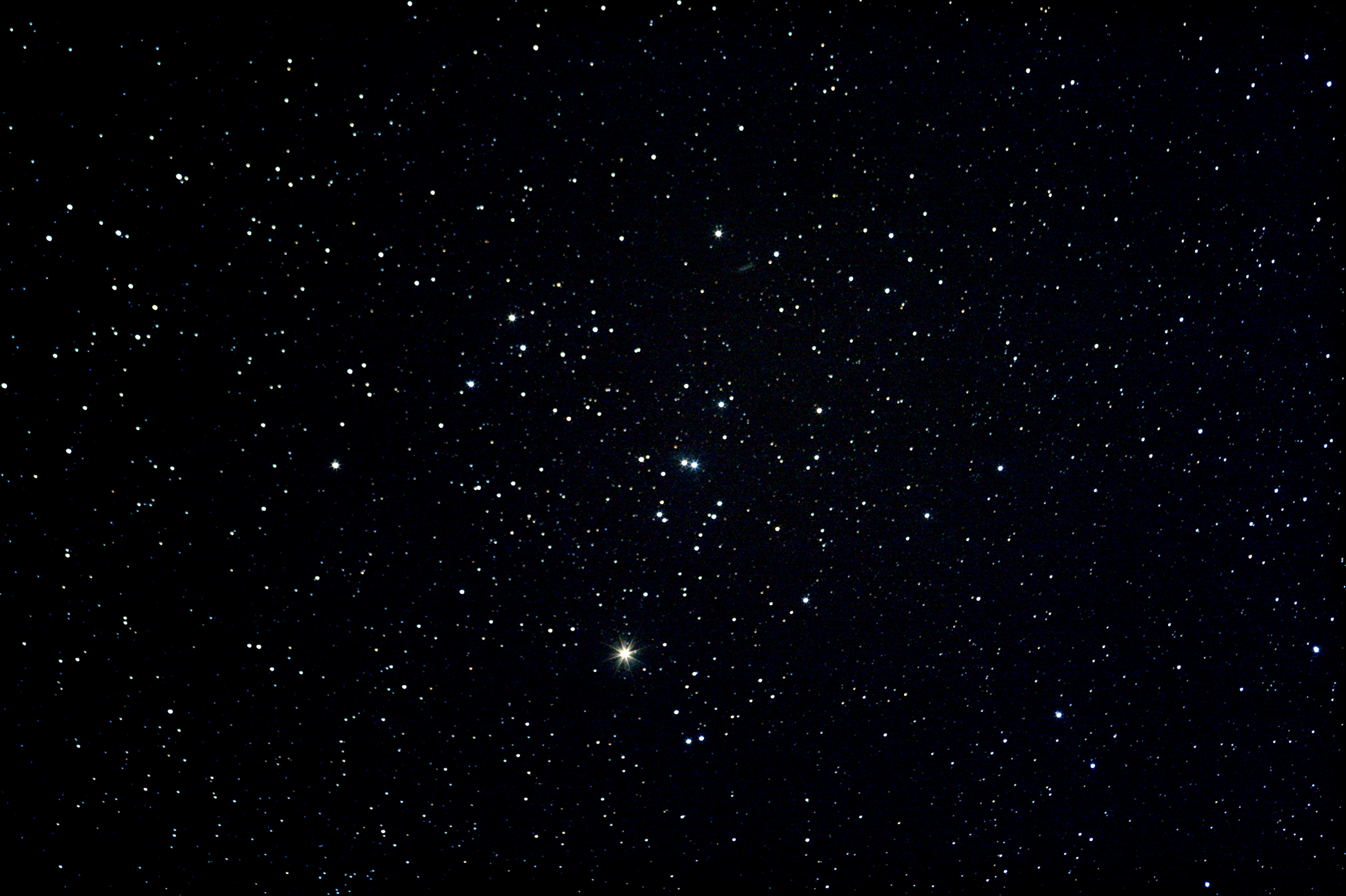
Image credit: Todd Vance.
Nearly three times the age of the Wild Duck Cluster, the Hyades is down to maybe 200-400 stars, about a third of which are in the process of gravitational escape from the cluster. We can also see a number of stars that have just finished escaping from the Hyades: there's a star stream that's at least partially left behind by the cluster!
In fact, based on the velocities of the stars, we can extrapolate back in time and find that the Hyades was a more massive, tightly-bound cluster in the past!
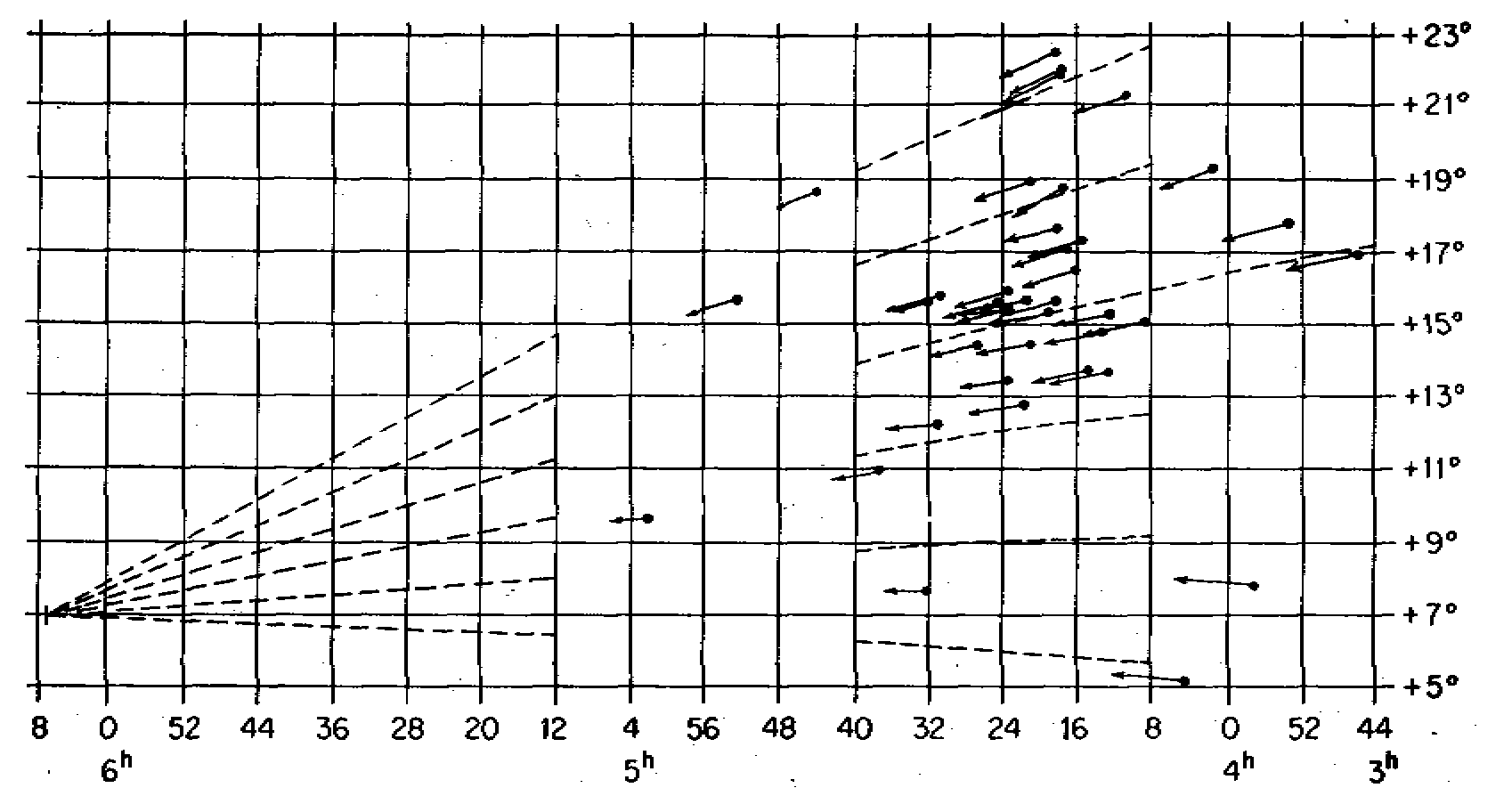
Image credit: University of Durham.
Over the 4.5 billion years since our Sun formed in an open cluster, all of the stars that formed along with it were scattered throughout the galaxy, and unlike the stars in, say the Big Dipper, there is no star stream or moving group that we appear to be associated with; our history -- like that of all old field stars -- is lost to the ages.
But don't let our forgotten ancestry get you down; our skies are filled with a huge number of easily visible, young star clusters, including this beauty: The Double Cluster in Perseus!
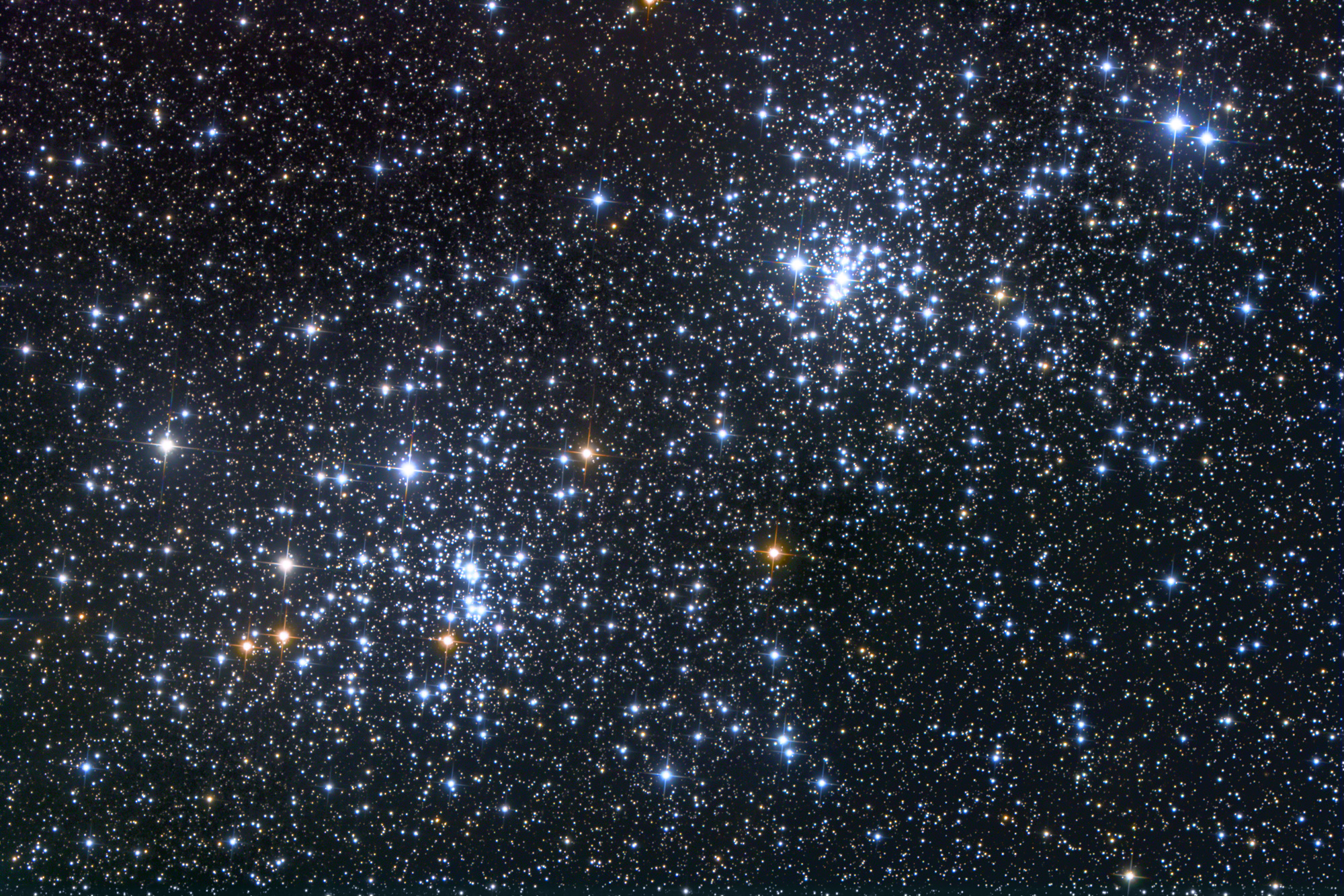
Image credit: Roth Ritter / Dark Atmospheres.
With more than 300 B-type stars in each of these young clusters, dated at 5.8 and 3.2 million years old, respectively, even these two infants are too old to have those extremely short-lived O-stars in them! Find the double cluster on a dark night with your naked eye, just between the constellations of Perseus and Cassiopeia, or grab a pair of binoculars (or a small telescope) and see that it is, in fact, two separate clusters!
What you'll see is a glimpse of where all our galaxy's stars once lived: in a stellar nursery. And that's where the Sun comes from!
Ethan -
Thanks for a very nice posting, as always. I had never really thought about our own star's stellar nursery. This brings to mind a few questions:
1) Does the makeup of the Oort cloud indicate anything about the nature of the stellar nursery? I would imagine that it would set limits as to the initial density of stars.
2) Is there any evidence that we could find in very ancient solar system bodies (Hello, Vesta!) that would indicate whether there were any O or B-type stars in the immediate vicinity during the formation of the solar system? It would seem possible that we might be able to identify atypical ratios of metals or isotopes that could be tied back to one or more neighbors becoming a supernova.
3) Do the stars in a cluster have an initial proper motion from the gas cloud that provides energy to break up the cluster, or does it require some external force? A look at the graph of the Hyades cluster give the distinct impression that some form of shock wave passed through the gas cloud to form the stars and that this shock wave provided an initial kick to the individual stars.
4) Finally, has anyone ever published a statistical breakdown on the type and classes of stars in the Milky Way? I have always wondered, for example, as to the ratio of, say, GV mainstream stars to AVII white dwarfs.
Amazing website. Enjoyed reading about light pollution and preserving our night skies, then browsed around. Great work! Not flirting, just stating a fact: You are SO cute.
M11 is one of my favorite objects for viewing. Pictures just can't do it justice.
It seems to me that once a star reached sufficient mass to initiate fusion, it would stop growing in size. Clearly, I am wrong.
Can you explain the process that causes one star to be the size of our sun, and another star to be the size of VY Canis Majoris?
I read the title and thought oh no, here comes a boring post about dust and gas, mixed with with some over-used photos of our sun. Quite the contrary. I expected to stay close to the sun, but you took us all over the universe! Keep up the excellent work sir. Also makes me wonder what the ratio is of pristine gas left over from big bang vs the rest of the matter in space.
Man, how didn't you link to a cluster formation simulation? The best I find is the following: www.youtube.com/watch?v=YbdwTwB8jtc. The downloadable, hi-res video, and commentaries can be found at www.ukaff.ac.uk/starcluster/
Horsehead Nebula looks like a scary monster with long arms on either side. XD
What's your take on the sun having a binary companion star? It's something I've read about recently but I'm not sure if I buy into it.
Uhh, that sun looks more like Betlegues, the supergaint star, thats all orange and red like XD
this is my favorite article yet
Hi question for you. I am a total novice but love science. How do we know so much about distant galaxies but so little, relatively, about our own oceans, weather and stuff like that?
Where did the sun come from and how did it get its name
A: From the mommy sun, and from its Birth certificate.
Billions of years ago the sun came to existance by itself??? Just popped out??Seriously,are people this stupid to believe this? You can tell this tale to your kids maybe they will believe you
Yeah, by itself. No mummy star or daddy star. No midwife star either.
Seriously, you xtian nutters are stupid to ask that sort of shit. That's why you have to have sunday school to indoctrinate the kids while they still believe in fairies, santa and invisible friends who do things.
Hi you all,
So who created the dust and clouds and such to create the stars? no answer right science, because God did. Have a great day. I mean I respect scientist line of work, the study of things that already exist but you cant say it all came together by itself. Even if they did form as you say (though thats not my belief) WHO made the clouds in which the stars form? God did thats who.
God is not the right answer because there is no god.
The gas clouds were created the same wan dust clouds are created, 0% god content.
Sorry, this is NOT the idiot corner, if you want the idiot corner, please find another channel.
TIA.
Oh STFU Ya Retard, Look what ya just posted:
"The gas clouds were created the same wan dust clouds are created, 0% god content."
WAN? WTF The N is two levels below on the keyboard you MORON. You have a brain all be it pea sized and yet miss that?
And yet you call out GOD daily as though you are some genius to be listened too that is the voice of reason.
What a laughing stock of humanity you are.
Stupid Person..
"Oh STFU Ya Retard, Look what ya just posted:
“The gas clouds were created the same wan dust clouds are created, 0% god content.”"
Yeah, you moron, what's wrong with it? 0% god involved in the formation of dust clouds. Or lightning. Despite thousands of years of people believing it was, no god is making lightning.
Sorry, like I told the other godbothering idiot, this isn't the idiot's corner, if you want to be a retard, please find your normal channels.
THIS channel is for the rational people.
( I think Tex was pointing out a spelling error in the word 'wan' instead of 'way' in that extract ).
And once again for the gb's, if your god is everywhere, its brain could not function. Even at the speed of light, across 40 odd billion lightyears, the information would still be travelling for one single decision. With the expansion of space, any thought will take longer over time.
:)
Not to mention that their god, if it did exist, would be so psychotically insane that it would be better classed as a demon.
But as to teabaggie, is he saying that I mistyped, therefore god???? And why did he design the keyboard on netbooks to be so small that your fingers at "home" position cross over to many different keyes very easily...? Is he that big a dickhead???
Pretty damn weaksauce proof.