

"Every year I teach dozens of students at the University of Birmingham. Most of the students on the gender and sexuality courses are women. I guess this is because the boys don't think that gender applies to them: that it's a subject for girls."
-Louise Brown
You know the stereotype, perpetrated throughout the United States (and well beyond) for generations: girls aren't as good at math as boys are. For a long time, people pointed towards the long list of (almost exclusively male) mathematicians and scientists as support for this idea.

Image credit: Image Source/Getty Images, retrieved from news.sciencemag.org.
Never mind the fact that women had been disenfranchised from these careers for centuries. From Barbie dolls to Harvard presidents, the gender disparity in mathematics and the sciences is often attributed to a hypothesized difference in intrinsic aptitude, even today.
Over the past generation, however, standardized tests in the United States have seen that gender gap completely disappear. First among elementary and middle schoolers, then among high schoolers, and today, male and female students achieve identical average math scores on the SATs.

Image credit: Tim Pannell / Corbis, retrieved from time.com.
Despite the fact that there are known social, institutional and economic gender inequities, even while the gender disparity has been progressively disappearing for older girls and boys over time, there is still a marked gender inequality at the highest career levels. Regardless of how much the inequality has lessened over time, the idea that this is somehow due to an inherent female inferiority persists. There are still people, even today, who steadfastly believe that there are more male mathematicians and physics professors (among other fields) not because women are being treated and judged differently or unfairly, but because men are naturally superior to women at this.
(Don't think that's true? Go read the comments on my last article on gender in science, from a mere eight months ago.)
But you know how prejudices and confirmation biases work: if you think things are a certain way for a certain reason, then when your reasoning is shown to be incorrect because your premise is flawed, what do you do? Do you question your conclusions, or do you just find a new explanation that brings you to that same conclusion? Most recently, the argument goes something like, "even though men and women are equal on average in math ability, men have a greater variance in their abilities. So there are more very dumb men, but also more very smart men, and those are the ones who become scientists, etc." And then a statistic like this gets thrown up.
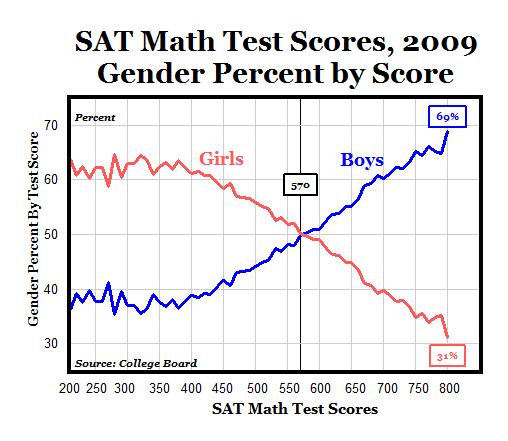
Image credit: College Board.
"A-HA," you hear, "69% of the perfect SAT Math scores were achieved by boys, more than twice as many as the girls!" Never mind that in the 1970s, the disparity was 93%-7%, and that girls' performances have been steadily rising. Clearly, girls just can't possibly be as inherently gifted or talented at math as boys, and that's why there are more male physics and math professors. (And feel free to apply this flawless logic to whatever field you feel like.)
Now, I can tell you all about my personal experience at all the different levels of education. From the elite math students in elementary and middle school to the best math students in the nation at the high school level, to math and physics majors at elite universities, at the undergraduate and graduate levels, onto the faculties at those same colleges and universities, I have lots of stories about achievement, adversity, and gender-specific obstacles that only women face. But this isn't that story of the anecdotes I've accumulated over a lifetime in that environment; this is about something far larger than my accumulated experience. This is science!
Last month, a new study came out, spanning 31 countries and measuring the mathematical performance of well over 100,000 students, on the standardized TIMSS exam. Here are the results.
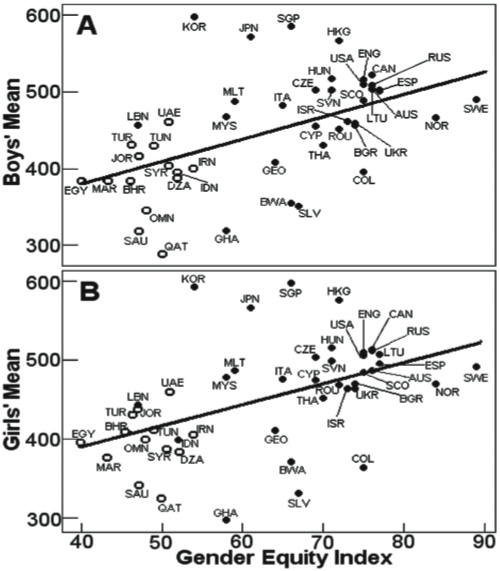
(This and all subsequent images from Kane & Mertz, 2011. If you don't like fooling around with someone else's interpretation, I've uploaded the full paper, by Jonathan M. Kane and Janet E. Mertz, here.)
As you can see, between each country, there's practically no substantial difference between the mean scores of male/female students. In some countries, boys do better on average, in some countries girls do better on average, but across all countries, there's no statistically significant difference in the average scores of girls and boys.
But you'll also notice there's something called the "Gender Equity Index" on the x-axis. What's that? It's a weighted measure of the gap between men and women when it comes to things like economic equality, education, and political/economic empowerment. Sweden is highest, with a score of 89, while Yemen is lowest, with a score of 31. (The U.S. comes in 24th, at 74.) 100 would be actual gender equality; no country in the world has it yet.
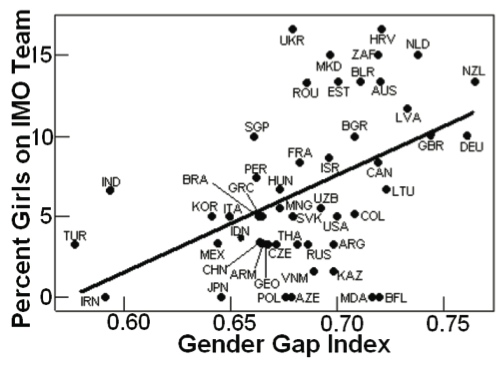
The gender gap index is almost the same, but also includes health and survival (the U.S. does slightly worse here), and is on a scale from 0-1 instead of 0-100. As you may well have guessed, countries that have higher levels of equality do, in general, see things like greater female representation on the International Mathematical Olympiad teams.
But the hypothesis, remember, was that males have a greater variance than females when it comes to math ability, and that's why there are so few females at the high end of the career spectrum in math and science. Is this true, that males have a greater variance than females in their math ability, and if so, is the variance significant enough that it could account for this gender disparity? Well, let's see what the data has to say about that.
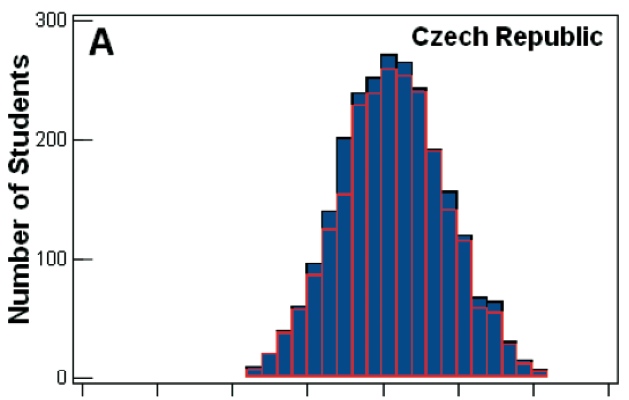
Well, there are some countries, like the Czech Republic, that show absolutely no difference between boys (blue) and girls (red), not in average and not in variance. So if males do have an inherent variance greater than females, it isn't exhibited everywhere.
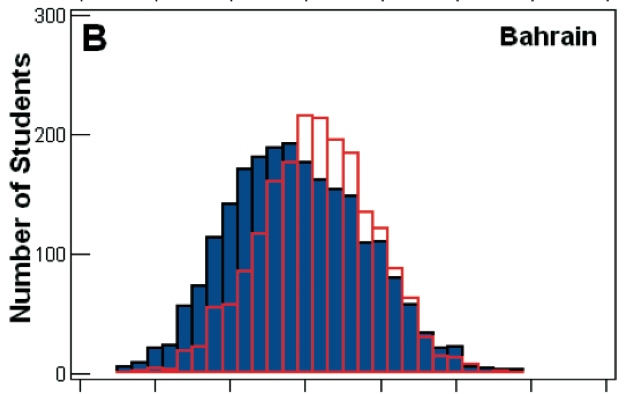
There are some countries, like Bahrain, where boys do in fact have a larger variance in their math achievement than girls do, but also have a lower average. In the case of Bahrain, the variance only makes up the boys' failings at the high end; there are the same percent of girls achieving top scores as there are boys at the high end. So even where boys do show a greater variance in their scores, it doesn't always translate into greater achievement at the high end.

There are even a few countries, like Tunisia, where the inverse of this hypothesis is true! In Tunisia girls' math scores are lower on average than the boys, but exhibit a larger variance! Here, too, at the high end, there are more girls than boys. If there is something going on where boys have an intrinsically higher variance than girls, and this results in more top male achievers at the highest scores, we aren't seeing it across the board.
But the point was not to hand-pick countries; I could have just as easily chosen individual countries where the data supports the stated hypothesis. The point is to look at all the available data, complete with gender inequities and all, and draw the best conclusions we can based on that. So, what are the overall findings?
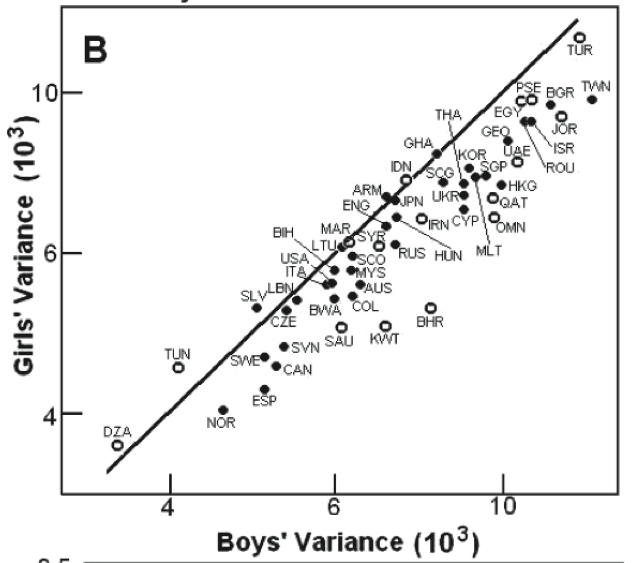
Overall, although there are many countries where there is virtually no difference in variance between boys and girls, boys actually do show a slightly greater (by a few percent) variance than girls in performance. (For example, the U.S. shows an 8% greater variance for boys.) But these differences in variance between countries are much greater than the difference in variance between boys and girls in any individual country! The question, then, becomes whether that difference in variance could explain the gender gap in math and science among men and women?
The authors tried to control for many different factors, and did their best to separate out what effects on test scores these different factors could possibly have. What did they find? In their own words,
None of our findings suggest that an innate biological difference between the sexes is the primary reason for a gender gap in math performance at any level. Rather, these major international studies strongly suggest that the math-gender gap, where it occurs, is due to sociocultural factors that differ among countries, and that these factors can be changed.
In fact, if there's one thing that really drives this point home, it's the graph of achievement in each country, regardless of gender, as a function of gender equity.
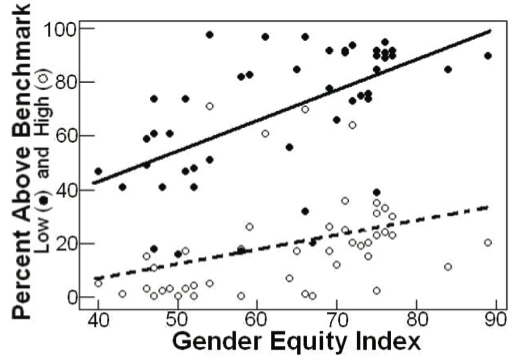
Wow! The percent of students scoring above 400 (low) and above 550 (high) rise dramatically, among both genders, when there's greater equity among men and women! In other words, every step forward that a country takes towards eliminating the gender disparity in the economic, political, and educational realms leads to greater math achievement for both genders.
But I'll give you the conclusions of the authors themselves:
In summary, we conclude that gender equity and other sociocultural factors, not national income, school type, or religion per se, are the primary determinants of mathematics performance at all levels for both boys and girls. Our findings are consistent with the gender stratified hypothesis, but not with the greater male variability, gap due to inequity, single-gender classroom, or Muslim culture hypotheses. At the individual level, this conclusion suggests that well-educated women who earn a good income are much better positioned than are poorly educated women who earn little or no money to ensure that the educational needs of their children of either gender with regard to learning mathematics are well met.
io9 also has a great writeup of this story, for those of you who want some further reading. I hope that if there's one thing you take away from this, it's the lesson of this last graph: the closer we get to gender equality, the more everyone benefits. Go read the paper yourself, and convince yourself that there are demonstrably far more significant factors than gender in determining math ability; the data is all in there, along with other "inherent-gender-ability" hypotheses that are also discredited. It's time to put this sexist hypothesis for the achievement gap where it belongs, buried in shame in our past.
Because we all benefit from equality, and now you've seen the science that proves it.
Here's an exotic idea: perhaps you should wait for other experts on the topic to respond before you, a physicist, declare the debate over and call others discredited sexists.
Ethan,
Your post is soooo dumb, it takes someone to concoct a bogus "Gender Equalty Index" in order to try and "level the playing field".
There is a very good reason why women are on average not as good at Math or other Visual-Spatial intensive tasks as men, it's called testosterone, which reorganizes the male brain in utero and long afterwards to optimize for Mathematical, Strategic and Creative Thinking, and funny enough women have much less testosterone on average then men.
There's no escaping biology!
I am reminded of xkcd: http://xkcd.com/385/
pconroy, I find your whole premise ridiculous.
Pconroy, two things, firstly there is nothing bogus about the gender equalty index, acutauly it is called the gender inequality index and is a report released annually by the UN, you can look it up and secondly, I am highly skeptical of all hypothesis that there are biological reasons for the discrepancies in abilities, based on the fact that these are mainly tested using test scores taken as the children are in middle or high school, and as Ethan linked in the article, gender stereotypes and societal expectations exist from a very young age.
Personally I believe that these sterotypes, espeically from a young age are a huge part of the reasons why there is such a difference, girls at 12 a are a lot more concerned with fitting in, than they are thinking about future careers options, and thus are far more likely to work harder and do more advanced english classes, than be the only girl in an advanced science class, so even if we do move to increase gender equality, which we must do, we really need to do is stop these perceptions, of giving girls dolls and cooking sets, more simplistic toys, preparing them for motherhood and becoming a house wife (not that there is anything wrong with that, if that is what the woman wants to do, and chooses) and we give boys model planes, lego, things that encorage them to build, to create and to think about the world around them, which do you think is more conducive to becoming a scientist?
It didn't take long for the cupcakes to show up.
@ pconroy - How do you cupcakes explain the shrinking (and even disappearing gap). Is the testosterone difference decreasing? Must be due to cell phones/vaccines/fluoridation sapping our vital bodily fluids.
@Shine - Your whine is almost identical to that of an AGW denialist.
Very interesting; I only have a quibble with this part near the end:
Surely the study -- at least from your summary! -- implies no such thing? It shows a correlation, but we know what that doesn't imply. I know that studies have shown (and replicated and confirmed) that women who are reminded of the stereotype that women are poor at maths before being tested, subsequently perform worse than women who are not thus demotivated, so there's a mechanism for a putative causational relationship there -- but what about boys' better performance?
I find it tempting to think that gender equality may be one variable in an array of dependent sociocultural variables, some of which have the effect of boosting math performance across the gender lines; but while it could be right, it seems premature to conclude that equality itself is causative.
Still, that doesn't alter the main theses that (1) mathematical ability seems gender blind, (2) there's good reason (IMO) to think that gender equality does directly help girls in maths, and (3) regardless of its causative relationship to maths scores, gender equality is a good thing to strive for!
From my experience, it's the same in software development. It's overwhelmingly a male-dominated profession (*), but those few women who do enter the field tend to be just as competent as their male counterparts.
(*) although oddly enough, about two-thirds of recent job applicants I've interviewed have been women, so perhaps that's changing.
â¢Un chômeur fait partie de la population active inoccupée.
⢠Une femme au foyer fait partie de la population inactive occupée.
Quâest-ce qui cloche dans ce texte et où se cache lâindice ? Comment ce phénomène a été legiferée et comment changer ces données ? Sont les mauvais résultats des chiffres de chômage féminin provoqué par les mentalités qui nâévoluent pas ? Est-ce la musculature de lâhomme qui prenne le dessus dans les rapports entre les deux sexes ! Et si ce nâétait pas ça, si câétait la force juridique attribué à lâhomme qui joue un mauvais tour à la femme. Les lois faites peuvent être défaites. Cet article fait mention des féministes qui se sont laissé bernées par un législateur (malveillant ?). Cet article développe aussi des conseils et des instructions comment sortir de cet impasse. Les femmes appartiennent à toute classe sociale. Câest la raison pourquoi cette histoire dépasse les différences politiques entre la droite et la gauche.
La publication des chiffres du chômage est régulièrement commentée dans les médias. Mais qui parle du chômage des femmes ? Il est pourtant plus fort que celui des hommes. En toute Europe, les femmes sont les premières concernées par l'insécurité et la précarité croissantes de l'emploi et par les bas salaires comme l'ont analysé plusieurs rapports internationaux. En outre les femmes sont moins couvertes par les systèmes de protection sociale. Les femmes sont en moyenne plus diplômées que les hommes et moins souvent employé.
Lâorigine des inégalités entre les femmes et les hommes ne se trouvent probablement pas sur ce marché de lâemploi. Ni la droite, ni la gauche, ni d'ailleurs les acteurs syndicaux ne mettent le problème de la gratuité de la femme pour son travail à la maison à l'ordre du jour. Le sujet ici n'est pas de dépeindre les femmes en victimes mais de déplorer que la question de leur gratuité soit ignorée, occultée, absente de la scène politique.
Lâabsence de statut pour les femmes pour le travail à la maison a des répercussions sur leur présence au marché du travail. On pourrait dire que le travail à la maison, pourtant indispensable au sein de la société, est exclus de tout droit. Le droit au salaire ou un statut actif ne sont pas reconnu pour le travail à la maison principalement fait par la femme. Les bénéficiaires de son travail domestique est à premier abord le conjoint, suivi par lâemployeur. Les deux profitent lâun et lâautre du travail gratuit de la femme. Sans le travail de la femme, câest lâhomme lui-même qui doit organiser le ménage. Sans le travail de la femme à la maison, lâemployeur ne pouvait pas compter sur un employé concentré sur son travail. Sans la femme la société était privée de la possibilité de la continuer (la reproduction des travailleurs, (remarquons le mot REproduction au lieu de production.))
Les heures du travail pour accompagner la progéniture, la futur population active et inactive, les nourrir etc. demandent un grand effort. Une fois adulte les enfants feront partie de la population active et ils contribueront aux caisses de retraite. Les retraites profiteront à tout le monde, qui a travaillé et contribué, en exception des femmes, qui les ont mis au monde. La population active en totalité profite donc du travail non-statuaire de la femme.
Les femmes torchent un double bagage sur leurs épaules : Le boulot mal-rémunéré et le boulot sans statut (les taches et les rôles), qui demandent beaucoup dâheures : ensemble, tout travail confondu, 7j/7j à 24 h par jour. Mêmes si elles se reposent, elles restent joignables pour résoudre tout problème concernant les enfants. Normalement la présence comme par exemple le garde de la nuit dans une maison de retraite est payé. Il a le droit de se reposer et il devient actif en cas de problèmes. Aussi une capitaine dâun bâtiment à la mer reste responsable et vigilant pendant quâil dorme. Il est payé pour ça.
Cette double contrainte de la femme, qui est le ménage et le travail sous-payé, devient aujourd'hui d'autant plus intolérable que la crise et l'austérité frappent plus durement les femmes. Ce nâest pas une surprise considérant que cette moitié de la population nâest pas équipé avec une indépendance juridique. Le double charge des deux activités en intérieur et à extérieur du couple pourrait expliquer leur faible disponibilité pour des engagements dans le domaine de la vie politique par exemple. Tout cela a des conséquences néfastes sur le regard de la femme sur elle-même et le regard des autres sur des valeurs féminins en général. La dévalorisation des qualités féminines a un effet sur lâinconscience collective. Pour valoriser les qualités féminines il suffira dâattribuer un prix, une étiquette sur la valeur économique du travail domestique au sein du couple. Pour traduire cette valeur symbolique en valeur monétaire je pars de précepte que la valeur du travail de lâintérieur du couple équivaut la valeur du travail en extérieur du couple.
La loi du mariage est une plaque tournante de notre société. Câest comparable avec un carrefour des rails du train qui a son incidence sur toutes les voies ferroviaires qui se dispersent de tout cotés. Si on étude la législation qui règle ce trafic de ce carrefour on découvre que les signaux verts ont une préférence pour le sexe masculin et les feux rouges préfère le sexe féminin.
La loi du mariage est un instrument de lâEtat pour différencier les citoyens en deux types juridiques différents. Les femmes perdent là leur statut de citoyenne libre. Elles deviennent: femme de..., femme au foyer de... (terme ancienne), vassal de... (terme juridique). L'administration commence toujours son questionnaire en demandant si vous êtes homme ou femme, si vous êtes marié, si vous êtes veuf/veuve, si vous êtes divorcé, etc. Parce que cela a des conséquences juridiques différentes. Sur cette plaque tournante du mariage (PACS et concubinage inclus) la femme change du train. Elle perd ses droits individuels et dès lors elle dépend de ses faveurs. Les deux sexes et les plusieurs disciplines de la science se sont mis à inventer des mots, à inventer dâautres définitions pour le concept de travail pour masquer cette situation inégalitaire. Les responsabilités familiales, les taches et les rôles ne représentent rien dâautre que le travail au sein du couple. En langage économique ce travail appartient au secteur tertiaire. Les soi-disant inactivités des femmes au sein du couple cachent des activités économiques en service de son partenaire et son employeur et en service de toute la société, notamment de la population active. La terminologie de la science économie a réduit les ménages en unités de consommation pour les opposés aux entreprises, qui sont étalées comme des producteurs. Ni lâun ni lâautre nâest avéré. Les deux sphères produisent et consomment au même temps. La distinction entre le marché du travail et « le marché du couple » fut construite à lâaide des lois, concentré dans la loi du mariage.
Sur cette plaque tournante, qui est la loi du mariage, sur le perron où arrivent et partent les trains se trouve deux guichets. Le premier avec la notation: « pour la population active, recettes et dépenses ». Un escalier caché descendant vers un perron souterrain mène à un deuxième guichet destiné aux femmes au foyer avec ou sans salaire dâappointe (et les enfants et la jeunesse), uniquement pour les dépenses. Les trains fiscaux sâarrêtent et partent. Aussi le wagon du droit social et de lâéconomie dépend de sa répartition de cette plaque tournante et poursuit les voies pour des destinations différentes.
Dans le droit fiscal en France la notion de foyer fiscal suppose implicitement que l'ensemble des postes de recettes et de dépenses des ménages soient mis en commun. Or, les études statistiques dâINSEE montrent que cette pratique est plutôt une exception. Lâhomme reste propriétaire de son salaire avant et après imposition. Il est tout seul propriétaire des avantages mêmes pour les avantages financiers que le fisc lui attribut pour avoir une femme. Il reste propriétaire même si cet argent est donné à disposition à la femme pour faire des courses du ménage, par exemple. Supposons quâelle achète un lot gagnant avec cet argent, câest lui, lâhomme que est le ayant-droit, qui puisse réclamer la totalité de la somme. Bien sûr, une situation pareille se joue uniquement si un divorce est en route. Il faut que lâhomme saisisse le tribunal pour effectuer ce droit de propriété, mais il aura le prix, à coup sur. Ceci est une histoire vraie. Un tribunal inférieur aux Pays-Bas est venu à ce verdict dans les années â90. Dans ce cas échéant il nây agissait pas dâune somme dâargent, mais un piano. Le revenu de l'époux est un droit très personnel. Lâhomme peut en disposer à sa propre discrétion. La même chose sâapplique au droit de retraite. Celui qui cotise, est le propriétaire de la retraite. Avec la pension de réversion lâEtat a partiellement reconnu le droit sur une pension pour les veuves/veufs. Pourquoi lâEtat ne met pas en place une réversion au sein du chaque couple, dès le début ?
Cette notion dâinactivité est le résultat dâune vision patriarcal de la coopération entre deux adultes qui forment un couple. Le but ciblé de ce mot dissimule la subordination de la femme vis-à -vis lâhomme. Pas uniquement la femme dans le couple, mais toute femme ici en France et partout dans le monde. (Le monde occidental avec sa culture de guerre a exporté son système patriarcal, dans presque le monde entier. Le travail inactif est nécessaire pour soutenir le travail actif. Le travail inactif est subordonné au travail actif. Le travail actif est tributaire du travail inactif. Lâun nâexiste pas sans lâautre. Câest yin et yang, mais le + ou le - est maniéré par les juristes en service dâun gouvernement patriarcal.
Comment réaliser une égalité au sein du couple ? En fait, il faut arrêter à faire la distinction entre le travail et le travail. On peut coopérer, mais le travail ne se laisse pas partager. Quâon puisse partager sont les fruits de ce travail. Ces fruits que Napoléon Bonaparte a destinés au propriétaire de verger : le jardinier en présentant la femme comme lâarbre fruitier. Le code civil de Napoléon plaçait la femme sous la tutelle financière et administrative de son mari. Depuis le mariage a été adapté sans pourtant toucher au pouvoir financier de lâhomme sur sa femme.
Les effets de cette omnipuissance financière de lâhomme sont élargis vers toutes les variantes des couples (PACS et le concubinage) et ne se limite plus au mariage. De coup il nâexiste plus le libre choix pour la femme. Avant le droit matrimonial nécessite le consentement de la mariée pour se soumettre au régime matrimonial. En revanche aujourdâhui elle ne peut plus se plier par sa propre volonté à la puissance financière de son partenaire. La puissance financière dâune partenaire vers lâautre est coercitive. On ne peut plus échapper à cette évidence, si ce nâétait pas en restant célibataire.
La femme est tellement en désarroi, quâelle cherche la solution de ce système dans son choix de partenaire, le prince charmant sur son cheval blanc. Elle croît que son prince lui protégera contre tout malheur, qui en réalité fait une partie intégrant du système judiciaire. Cette situation de subordination de la femme existe autant que le droit matrimonial existe, quelque forme quâil soit, civil ou religieux, peu importe. Donc au moins 3000 ans jusqu'à 5000 ans. Assez longtemps pour effacer le mémoire à un autre système, la société matriarcale, basée sur le concept de partage du pouvoir entre tous les membres. Un système tellement juste et proche de la nature, que lâécriture ne sâimposait pas. Quand les hommes (quelques uns, le fameux 1% du mouvement de » Occupy Wallstreet ») ont pris le pouvoir sur toutes les femmes et dâautres hommes, ils avaient impérativement besoin de lâécriture pour justifier cette déviance et rupture avec lâharmonie de la nature. Câétait peut-être la plus grande révolution mondiale que nous nâayons connu . Les effets désastreux de cette nouvelle société, basée sur la guerre, le vol et le viol, sont encore en rigueur, plus que jamais.
Olympe de Gouges, auteur de Déclaration du droit de la femme et de la citoyenne en 1791 avait très bien compris quâil fallait un contrat entre homme et femme basé sur le partage du pouvoir (= argent). Un contrat basé sur la coopération entre les conjoints, autrement dit un partenariat associé aux parts égales, un compagnonnage entre les deux conjoints du couple qui reconnaît la productivité de la femme, comme source de droit individualisée. Le concept initial dâégalité des sexes devant la loi dâOlympe de Gouges nâa pas pu trouver une suite. Apparemment lâidée de lâégalité des sexes fut inconcevable pour les révolutionnaires. Ses idées lui amènent à la prison et à la mort. Ses idées furent guillotinées avec elle en 1792.
Dans la première moitié du XXe siècle les féministes ont obtenues une grande victoire, celle du droit de vote. Le premier pas dâune lutte pour lâémancipation consiste toujours à la réclamation du droit de vote. Hélas, à ce jour le droit de vote nâest pas utilisé pour supprimer notre statut de vassalité. Rétrospectivement la deuxième vague du féminisme autour de â70 est restée sans résultats. Les dirigeants nâayant plus le droit de guillotiner les femmes dissidentes, recourent à lâarme des lois écrites. Ce quâils ont fait était génial au niveau stratégique, mais sâavérait désastreux pour les femmes. Pour que le but de la loi du mariage reste patriarcal et intact, le législateur se débarrassait de tous les signes renvoyant au genre. Pourtant sans toucher à la base du rencontre juridique de deux sexes qui reste inégalitaire. Très vite le gouvernement a su détourner les idées des féministes. Des petits changements insignifiants furent établis dans le code civil. Il sâagit surtout du camouflage et le maquillage des textes de lois frisant à la tromperie et à la trahison. La loi du mariage fut sexe-neutre sans se débarrasser de la discrimination envers la femme. Elle nâobtient pas le statut dâune personne active. Implicitement elle reste objet de droit, alors que lâhomme est sujet de droit. Toutes les différences au sein du couple restent en vigueur. Il nây a aucun doute sur la sincérité des féministes de la première heure, mais le but : instauration de nouveaux rapports entre les sexes, ne sâest pas produite. Le début de cette deuxième vague féministe était peut-être naïf, mais franc. Toutefois les premières féministes ont très vite été infiltrées par les gens disposé à accepter des compromis temporaires qui après soient perpétuellement menacés.
Les juristes du gouvernement font des heures supplémentaires pour trouver des solutions pour créer une égalité artificielle des sexes. Artificielle, parce que le cÅur même de notre subordination légiféré est resté intact. Le résultat est une danse des mots pour sublimer le vrai visage du droit civil. Les textes des lois sont désormais sexe-neutre. La notion de chef de famille est supprimée sans toucher à la puissance financière de lâhomme. Sâil sâagit dâun seul revenu du ménage ou le ménage à double revenu, le pouvoir financier est dans les mains de celui qui gagne le plus, souvent lâhomme. Les deux figurants du mariage (couple) resteront pareil : le privilégié (lâhomme) et le dupé (la femme). Dorénavant, causé par le sexe-neutralité des textes des lois, les hommes eux aussi peuvent tomber dans le trappe de vassalité (= ensemble des règles de vassalité, qui règlent les relations entre le seigneur et son vassal). Cela est également une injustice. Cependant, être un homme au foyer reste une exception souvent de courte durée et nâest pas soutenue par une société comblée des hommes au foyer (dépendants de leur femme). En outre la société patriarcale est prête à renverser cette situation inconfortable à « lâordre naturelle » quand lâopportunité juridique se présente.
Après cette opération gouvernementale du nettoyage de la code civil, la soi-disant égalité des sexes dans les codes était proclamer et saluer avec joie par les féministes. Le gouvernement à su exorciser le danger et a déplacer lâattention des femmes sur une autre source dâinjustice : les mentalités du peuple. Câest maintenant le peuple qui doit changer ses idées sexistes. Le gouvernement a su détourner lâattention des féministes vers la lutte pour changer des mentalités, qui dès lors seront vues comme lâobstacle principale sur le chemin dâégalité. Le pouvoir public a fait accroire aux femmes que lâindépendance économique se trouvait sur le marché du travail. Les femmes ont anticipé sur ce concept de lâEtat par inventer la politique de la répartition du travail rémunéré et non rémunéré entre homme et femme sans mettre en question la gratuité elle-même. Cette politique est restée infructueuse. Cette analyse fausse a mené à la combinaison du travail domestique et de lâactivité rémunérée par une personne, la femme, tandis que les finances sont toujours un dé jeté par les mains de lâhomme. On parle désormais de la conciliation famille-travail plus égalitaire (pour la femme).
Pour négocier avec son partenaire la femme a besoin dâun statut juridique indépendant, quâelle nâa pas. Et voilà que le serpent mord à son propre queue, un cercle vicieux. Le système judiciaire est justement construit sur le non-statut de la femme, concentré dans la loi du mariage. La loi du mariage forme les fondations du notre système judiciaire. Des autres fondations sont possibles. La législation pour réaliser cela existe déjà : la société avec ses lois dâimposition. Selon l'article 1832 du code civil français, « la société est instituée par deux ou plusieurs personnes qui conviennent par un contrat d'affecter à une entreprise commune des biens ou leur industrie en vue de partager le bénéfice ou de profiter de l'économie qui pourra en résulter. » Lâhomme et la femme deviennent alors associés. Nâest-ce pas beau comme formule dâune coopération entre homme et femme ? Pour que cette porte sâouvre pour les couples, il faut fermer un autre : celui du mariage. Lâexistence même de la loi du mariage bloque lâaccès vers les lois sur les sociétés, donc sur lâégalité des sexes.
Lâinégalité prescrite du couple a des incidences outre le couple. Lâemployeur sait très bien, que le portable dâune mère responsable nâéteint pas pendant les heures de son boulot. Elle continue à organiser le ménage, au cas où⦠Lâemployeur sait très bien que le travail de sa salariée ne sâarrête pas à la fin de la journée. Câest le ménage qui lâattend. Chaque loi visant dâimposer le même salaire pour le même boulot est vouée à lâéchec. En outre il y a encore une autre raison. Rien de surprenant que les mêmes salaires homme/femme restent utopique. Pourquoi payer une femme autant que lâhomme tandis quâelle prête à faire la majeure partie de son travail sans aucune récompense monétaire. Câest une raison psychologique et ce nâest pas le moindre. Les inégalités entre les femmes et les hommes ne sont pas contraintes par la politique de droite et du gauche. Il nâexiste pas une partie politique qui ne veuille vraiment supprimer lâinégalité juridique femme/homme. Cela reste dans la sphère des bonnes intentions. Ce nâest plus bien vu dâêtre contre lâégalité de sexes, mais les paroles restent vides, sans conséquence politique.
Maternité est souvent perçue comme la cause de la pauvreté des femmes. Cela est une erreur. La cause est les lois discriminatoires qui sont en vigueur quand la femme se met en couple. Pour l'homme la cohabitation apporte des avantages purement juridiques. Il obtient tout d'un coup une femme au foyer, qui amène souvent son propre argent avec son salaire appointe. C'est une situation embarrassante et humiliante, non seulement pour les femmes elles-mêmes, mais aussi pour les hommes avec un sens aigu de la Justice, qui respectent leur épouse. L'un et l'autre n'est aucune raison de panique. Il faut faire face à cette situation et demander l'autonomie juridique-économique au pouvoir politique. Le Patriarcat a démontré dans le passé, qu'il est réceptif aux exigences raisonnables, pourvu que les arguments corrects soient utilisés.
Quoi quâils disent, la femme nâest pas une charge financière pour lâhomme. En réduisant les coûts de ménage, elle fait accroître le pouvoir dâachat de lâhomme. Les femmes sont un facteur de réduction des coûts pour l'homme. Sans son travail domestique, le coût de la vie ait été beaucoup plus élevé. Ce travail au sein du couple ne se limite pas uniquement au travail domestique, mais puisse aussi englober le travail de lâentreprise de lâhomme. La fermière donne un coup de main à son mari, qui est le chef dâentreprise agricole. Elle participe au travail de lâentreprise sans aucune récompense. Aujourdâhui lâentrepreneur peut associer son conjoint à l'exploitation ou à la gestion de l'entreprise, si les deux époux souhaitent se placer sur un pied d'égalité. Ils pourront, dans cette situation envisager la création d'une société et seront ainsi "conjoints associés à 50/50". Toutefois la femme doit prouver aux impôts, quâelle soit entrepreneur au même titre que lui. Un boulot en plein temps de la femme est considéré par le fisc comme incompatible avec une société à 50/50%. La même restriction ne compte pas pour lâhomme.
Cette idée dâêtre des associées dans une société mène uniquement à lâégalité si le travail familial entre dans les colons statistiques du travail actif. Et pour cela, il faut supprimer la loi du mariage avec toutes ces lois dérivées pour que la société à part égales puisse prendre sa place central au sein de la société. Nous, femme et homme, serons ainsi « dans le même bateau », pour le pire et le meilleur. En faisant ainsi, la France peut se mettre à nouveau sur le devant pour les droits de lâhomme, cette fois-ci élargi avec les femmes et les enfants.
Sources :
â¢Vous avez dit chômage des femmes ? Point de vue | LEMONDE.FR | 29.12.11 par Christiane Marty.
â¢Code civil.
â¢Droit général des sociétés
â¢''Lâargent du « ménage », qui paie quoi ?'], Travail, genre et sociétés n°15; Delphine Roy avril 2006 La répartition des charges et des ressources est en fait dépendante du rôle attribué à chacun dans le couple http://terrain.revues.org/document3530.html
â¢''Tout ce qui est à moi est à toi ?''], Terrain n°15; Delphine Roy septembre 2005
â¢Annie Fouquet « L'invention de l'inactivité », Travail, genre et sociétés 1/2004 (N° 11), p. 47-62.
As teachers we learn (based on studies) that a teacher's expectations influence students' performance. It doesn't seem far-fetched to me that this would extend to a society's expectations.
I use to tentatively accept the "males have greater variance" hypothesis. Now I don't.
I think the so perceived difference between the number of Maths (and Physics) researchers between boys and girls can also be explained by aptitude.
Normally what I have seen is that girls have more aptitude for biology like subjects, while boys' aptitude leans towards Physics and Maths subjects.
But of course, the girls who are doing maths and physics can do them as well as any boy.
@primeval
But "aptitude" is kind of a vague concept, and it's not clear that it's free from effects of gender inequality. If girls are told from the day they are born, whether explicitly or implicitly via toy selections &c., that girls are worse at maths than boys but better at "softer" sciences like biology or "softer" subjects still, like English or history -- is it then any wonder if girls show less "aptitude" at maths by the time they're taking standardised tests?
It is great to see some statistics debunking the gender myth.  As parents, we have alot of work to avoid perpetuating the gender stereotypes of excellence in science in math.  I agree with Emily, the play options we give boys are "more conducive to becoming a scientist".  At young ages, we encourage girls more in creative play while we encourage boys to build and follow sports (always helps in building math skills).  We must actively, consciously counteract this cultural norm by encouraging girls in differnt play -- such as legos, fantasy sports teams, model building, science experiments kits, etc. It is happening, we are changing as a society. By the time my daughter gets to high school, there will be more than three other girls in her calculus class.
Another very interesting article, thanks for posting it. It seems to me that one of the pervasive problems with this topic is the near impossibility of disentangling all the natural and environmental factors that go into determining one's intelligence or aptitude (however they may be defined) for a particular subject. We can't do designed experiments in child-rearing, with controls on every possible variable, so at some level it's hard to really say how the effects of nature and nurture interact. The fact that test scores among the sexes are converging (presumably in response to increasing emphasis on providing better opportunities and encouragement for girls and women to learn math and science) suggests that nurture plays a huge role in determining mahtematica aptitude. I also don't really buy the argument made earlier about the effects of hormones on brain development. This particular argument is underlain by a series of assumptions; i.e. 1) only one developmental factor controls a person's ability to perform certain tasks, 2) for Math\science aptitude, that factor is analytical\spatial reasoning ability, and 3) these are enhanced by in utero exposure to testosterone. Even if we accept that the latter two are true (which they may or may not be, I don't really know) it still doesn't meant that the first assumption holds. For example, it may well be correct to say that males are inherently better able to understand spatial problems, but if (for the sake of argument) we accept this stereotype as true, then we might also accept the stereotype that females have better intuitive skills. In my experience, math and science rely heavily on intuition, especially as one reaches higher and more abstract levels of thinking and reasoning. So maybe the male and female brains are both well-suited for mathematical and scientific thinking, just in different ways? Or, maybe there's just no difference? Regardless of how it works, I value my female scientific colleagues highly, and I am forever grateful to a (female) tutor that helped me understand my undergraduate PDE course.
Great post, thanks for sharing.
Exactly right, about "aptitude" being a rather vague attribute, that is. Turns out that a big driver for the disparity in math scores turns out to be not innate mathematical talent, but rather spatial aptitude:
And to show just how tricky this stuff is (in case anyone wants to argue that spacial aptitude is an important component of mathematical ability), it turns out (check the date on that quoted bit) that women aren't necessarily less innately endowed then men when it comes to this particular "aptitude" either:
So there's a whole lot of attributes or sub-attributes, or sub-sub-attributes which are arguably part of that vague thing "mathematical ability", some of which women are "innately" better at than men. For example, they also tend to do better when it comes to tasks involving perceptual speed, that is, the ability to pick out like items from a collection of similar objects that differ by one or two small details. In fact, when it comes to your basic computation, symbol shuffling, what have you (a hugely underrated component of mathematical ability imho, simply because you have to do so much of it as a matter of course during the working day) women do better than men.
I'd have to say the theory that women "just aren't good at math" has been debunked to my satisfaction :-)
Or rather, since I have a small quibble with Ethan's last few points, let me say what I mean more formally and observe that there doesn't seem to be a lot of evidence for the theory that men are just better at math than women by virtue of their intrinsic manliness. I have to say that, because Ethan also said, "I hope that if there's one thing you take away from this, it's the lesson of this last graph: the closer we get to gender equality, the more everyone benefits." I don't disagree, mind you, but the complexity of the subject being what it is along with our almost total ignorance as to how neural structures go about their mysterious business of "cognition", well, I'm very leery of any sort of positive claim. The correlation bit I'll go along with :-) Again - since I've grown increasingly concerned that the general public doesn't understand this point - it's not that I take the opposing position to Ethan's contention that there's a casual relationship between gender equality and gender differences in mathematical ability. And I'm not saying he's wrong while refraining from suggesting a competing hypothesis either. In fact, I strongly suspect he's right. What I am saying, the crucial distinction, is that this claim hasn't been verified. I'm being properly skeptical when my scientist hat is on iow, and that shouldn't be confused with disagreeing with the conclusion. As I said, a very important distinction, and whose muddling is responsible for a lot of the poor public discourse we see these days.
"Over the past generation, however, standardized tests in the United States have seen that gender gap completely disappear. First among elementary and middle schoolers, then among high schoolers, and today, male and female students achieve identical average math scores on the SATs."
At least the last part seems patently false, unless changes in the previous three years have been very dramatic: http://www.britannica.com/blogs/2009/07/more-on-the-male-female-sat-mat… Moreover, the study by Janet Hyde you cite as your only reference in this paragraph was based on some standardized tests for school kids which the authors themselves noted contained "no complex problems". However, complex problems and fluid mathematical intelligence is what the whole thing is actually about, especially when discussing the higher variance hypothesis.
Some years ago (I do not know if it is still true), I also looked into the OECD's PISA study and didn't find a single country where boys didn't outperform girls at math and girls outperformed boys at reading. (Gender inequality doesn't mean that one gender is "better" than the other, just that they are different.)
As far as TIMSS is concerned, it would be interesting to see if a) we actually have the crucial "complex problems" in this test and b) the effect that girls mature earlier than boys works in favor of them here. (Both are honest questions, I am not sure about the answer.)
Also, at least two of the three countries you mentioned are rather poor, so the average quality of education need not be very high. This might mean that even if the test contained a substantial amount of math problem solving tasks, very few people did actually do them. Hence, we could effectively just see the result of a test on standard application of middle or high school level mathematical techniques.
Last, but not least, you only seem to see the debate under the "nature vs nurture" aspect. But if there are significant differences in mathematical aptitude, aren't they important for an evaluation of possible discrimination against women in current academia regardless of their causes and possible disappearence in a later generation?
Hi Ethan, Interesting article, but the data .... well mark me down as underwhelmed! All the plots with "Gender Equity (or Gap) Index" on the x-axis look more like shotgun targets than nice linear correlations as the "fit" lines suggest.
This actually fits in nicely with one of your earlier posts on how our eyes can be deceived. Simply putting a straight line fit with trend through the data makes a big impression on the mind - take it away and I think the correlations would look a lot less impressive.
Take the last one for example, and look at the open circles - 550+ scores. We are told the scores rise "dramatically" with gender equity index. Do they? The four highest scores (which are really "dramatically" higher than all the others) lie in the middle of the distribution - the ten equity scores that are higher than them have performance score a fraction of theirs! The two highest equity scores have average to low performance scores!
Take out the trend line and get rid of the confusing black dots and no clear correletaion at all emerges.
As you discussed at the start of your post Ethan, as scientists we must be so careful to avoid over selling results that pander to our own personal predjudices.
Here's an exotic idea: read the paper and show that it's wrong.
Here's another exotic idea: read the paper and show our host has misunderstood it.
Aren't you ashamed to make an argumentum ad hominem? You act as if physicists were automatically incapable of understanding statistics!
Here's an exotic idea: show us some evidence for this claim!
And those four capital letters... are they ornamental somehow?
To the people saying this isn't "proof", and that they want more data, better studies and the like.
For what?
To change the status quo against discriminating against women and girls? Huh?
Why was the default position the idea that women and girls are not as good at math as men and boys in the first place? It is not like in the distant past there was some society that was totally egalitarian between men and women, and they did a series of studies that showed beyond a reasonable doubt that society would get even better if women were discriminated against.
ohh really? its good.thanks for this details.i love this blog!
"To the people saying this isn't "proof", and that they want more data, better studies and the like.
For what?
To change the status quo against discriminating against women and girls? Huh?"
The primary question should not be if a scientific statement serves some political purpose, but if it is actually true.
As to the question why it's important: If there are actual performance differences between the sexes, then some part of the gender gap in math, science or engineering professions can NOT be attributed to discrimination. Quite the contrary, measures based on opposite assumptions will be discriminatory in nature when taken beyond a certain point. So your claim that anyone who doubts your preconceived beliefs just wants to justify artificial privileges is rather unfair.
Here's something that's not a bit scientific. It's anecdotal. The first two posts to disagree provide no logic but rather go for the visceral, emotional shot. In short hystrionics by a couple of dudes who are afraid those cute little girls who turned 'em down in high school might just be as smart as they are...I guess if it's not p.c. to call 'em lesbians you can call 'em stupid and call it science.
Saskia, your article in Le Monde is fairly political and, even bearing in mind the different approach to women in Gallic culture, there are a few glaring omissions:
Just how much "travail dans la maison" are women not being paid for? Not stated! You can't have a an entire article basing itself around this key concept without quantifying it.
Why is "boulot sans statut" a female problem only? It isn't. Both sexes are responsible for and carry out unpaid as well as paid work.
Why does the author imply that "rester joignable" (without remuneration) is a female problem? It isn't. Not even remotely true.
Sadly, this article is a feminist manifesto, not accurate and objective, as with so much else from the feminists these days.
The fact is that women have less unemployment, are less likely to be victims of crime, less likely to be in jail, less likely to be homeless, enjoy twice as much use of the healthcare system, and have a significantly higher life expectancy. These facts are not indicative of a society with a structural bias against one sex (or "gender" as the monoglots like to call it).
Where I live, girls achieve much higher average school results, and - as admitted in your article - they take a much higher share of tertiary education than do men.
Feminism would benefit enormously if it would back away from dishonest polemics and deal instead with facts. If the poor performance of girls at school prior to the 1990s was such a huge problem then, why is the opposite problem now affecting men not admitted as being a problem now?
pconroy, I had to LOL at your post. Here's the thing. I like mathematics. I do it for fun. It's a good way to relax and when I'm not doing it I find that I'm doing arithmetics with numbers around me. I don't like statistics, not because it's hard (it's not at all, probably the easiest form of math out there) but I just don't like the theory behind it even though I know that it's fairly sound. I don't have testosterone, and I'm not a transman. How do I fit in with your well thought out study?
Speaking of biology, I had a minor in it and took some graduate courses in it. I was always doing the math and the guys were doing the gross stuff. There was one lecture where the professor had a big long equation which essentially contained a sequence where we were supposed to take the derivative of the integral of a natural log. I don't know where he got that from but if he had any real math skills that would have jumped out at him. He's Italian and has kids, I think that he has an adequate amount of testosterone, and so did the 20 or so guys in the class. When I see stuff like you posted I'm just amazed that there are still guys like you who don't seem to have progressed past the stone age.
I don't know how anyone could think that the reproductive organs would help you in mathematics! LOL!
In physics, the gender disparity is not just professors. It is also a 9 - 1 or so disparity in grad students and even undergrad majors (at least at many of the most competitive schools). So it will be a very long time before the equity in native ability starts showing through in the faculty.
I have a daughter working on a PhD in physics at a highly respected school, and I know girls can do as well as boys in math and hard science. But in middle schools in the US, it is still considered "cool" for girls to be stupid in math. The cultural barrier is right there for anyone to see.
To paraphrase a global warming cartoon:
Would it be such a bad thing if we ensured women had the same educational opportunities and training as men, and then it turned out there was a biological difference?
Ethan
Very nice summary. Thanks.
Now, if only we knew how to productively use all of skills of so many talented people. Economics despite its mathematics remains in much need of insight.
The world cannot accept another lost generation of talented people young/old men/women. How to we use the best talents of people?
I have thoughts but mostly frustration; and frustration is not a theory much less a working solution. Perhaps some brilliant woman will grasp some economic truth that the mostly male mathematical economists have somehow missed all these centuries.
I welcome the increasing education of women. There is no shortage of intelligence in this world. We as a world are wasting so much skill and talent; it is our great failure that we are not better than we are. We must somehow as individuals and as peoples be better than we are.
That's enough, I'll be quiet.
I am beginning to think there is no new-age,feminist, lgbt, global warming, etc., etc., rubbish that you won't try to dress up in frills of nonsense and peddle as settled fact.
Men and women are different. Even their brains are anatomically different. Evolution crafted them for different tasks. Yet you try to convince yourself that the differences do not exist.
With different brain structures one would expect different intellectual abilities when performing different tasks.
I am really beginning to wonder what is wrong with you.
@30 Rachelle (nice female pseudonym for a guy)
Yes women and men are different. But no woman that I know is stupid enough to argue that there isn't still gender discrimination and prejudice: only men are stupid enough to argue that. Ethan simply presented the evidence to refute your bias and prejudice. So why don't you show your true colors and tell us your real prejudices instead of pretending to be reasonable.
As a guy, I hear stupid locker room jokes and mostly don't laugh because bias, prejudice and bigotry aren't funny. But I suspect you laugh loud and repeat the misogynistic humor.
Also Mr. Rachelle, please tell; do you cross dress in public or just online??
OKThen said:
"no woman that I know is stupid enough to argue that there isn't still gender discrimination and prejudice: only men are stupid enough to argue that"
I take it you haven't learned to read yet.
Put your finger on the screen and trace every word I wrote. Where did I say there isn't gender discrimination?
Saying that the brains of men and women are different because nature has assigned them different challenges does not mean that men are better in everything. In fact, just the opposite. Women would necessarily be superior to men in many areas. One easy example is language acquisition. Women generally learn language much faster than male children and often have larger vocabularies throughout life. Clearly, by your particular example of stupidity it is evident we are better at reading as well.
At lot of quasi-illiterates seem to hang out on these so-called science blogs.
@32
Rachelle you are still avoiding the topic of Ethan's post. So let me specifically ask, do you agree that women are roughly equal to men in mathematical ability? Your silence and your general bashing suggests that you do not agree. Please address the topic of discussion.
Also, please clarify your gender. Your ambiguous reference to "we" did not clarify; it seems ironic.
pconroy: for someone who apparently recognizes the importance of a biological perspective for understanding many aspects of human behavior, you provide a disappointingly lazy substitute for an actual biological explanation for the sex-difference in math ability (which, as already noted by Militant Agnostic, appears to be disappearing, whereas the sex-difference in testosterone is not, so...?). First, where's the evidence that men and women actually differ in the domains you mention (e.g., creativity)? Second, why would a sex-difference in math ability (and these other domains) evolve in the first place? (Math ability is very different from certain visuospatial abilities that do appear to reliably differ between the sexes, perhaps due to evolutionary factors). Third, where's the evidence that testosterone "reorganizes the male brain in utero and long afterwards to optimize for Mathematical, Strategic and Creative Thinking"? You conclude that "There's no escaping biology." More like there's no escaping pseudo-biological post hoc explanations for sex-differences. As an evolutionary behavioral researcher myself, I am embarrassed by your comment, which contributes to inaccurate and unflattering stereotypes about the evolutionary behavioral sciences.
OKThen: Just curious, what's the relevance of Rachelle's gender? If the idea is that only men can be sexists, I beg to differ. Sexism isn't about men vs. women. It's a pervasive problem, and both genders are exposed to (and come to internalize, whether they know it or not) negative messages about women's math ability.
@Anonymous:
What pconroy mentioned, even if her or his choice of words may be overly confident, is a serious theory that has been put forward and discussed by serious researchers: http://en.wikipedia.org/wiki/Empathizing%E2%80%93systemizing_theory
Moreover, there are also peer-reviewed papers discussing a relationship between mathematical and spatial abilities: http://psycnet.apa.org/journals/edu/91/4/684/
OKThen's comment left me thinking.
When I said that men and women are different with anatomically different brains [corpus callosum is larger in women, for example] why did he automatically assume that 'different from men' must only mean inferior to men?
He could not conceive that some differences may lead to women's superiority in some areas.
Sorry, OKthen, but your deeply founded sexism just revealed itself. You are sexist to the core and are trying to hide it, but you outed yourself.
I have to say, I am not surprised. A number of male 'champions' of women have turned out to be pigs. You are in plentiful, though not good, company.
Rachelle,
You say like it is a fact that men and women's brains are anatomically different, yet this is actually rather controversial -- and not for reasons of political correctness. The thing is, individual variation appears to be quite a bit larger than the supposed differences between the sexes -- and the averages determined in various studies do not typically vary by much at all. So if individuals of either sex differ from one another more dramatically than the average male differs from the average female, how relevant are the average differences anyway? How can you say that women are evolved to particular roles and men to particular other roles when individuals show such dramatic variation, exceeding the differences between any gender averages?
In other words, I am unconvinced that gender has any predictive value whatsoever when it comes to aptitude. Except for those tasks requiring the actual sexual characteristics (I don't expect men to be good at breastfeeding, nor women to be good at inseminating people), once you give equal opportunities, the aptitude differences vanish.
Furthermore, since you appear to have read about this sort of thing, surely you have read that brain development is still poorly understood but clearly involves a great deal of environmental influence. Genes are important, hormones are important, prenatal exposures to exogenous hormones (i.e. those of the mother) are important -- and so are nutrition, trauma, life experiences..... Based on that alone, we cannot exclude the hypothesis that the differences in aptitude between the sexes, as measured on standardized tests, may be significantly influence by upbringing and not evolution.
Now, I appreciate what you're saying about how "differences" shouldn't be taken to mean "inferiorities". But I have two things to say that. 1) When you call OKthen deeply sexist, are you sure you are not projecting? You object to him/her assuming that you meant women are inferior, but this was not an unreasonable assumption of your meaning, since this article is about combating the assumption that women are not as good at math. Do not blame him for you not clarifying that you were speaking more generally than was the blog post. 2) Historically, people who promote the idea that women are good at some things and men are good at others have been a) wrong and b) very bad for women's rights. You maybe shouldn't be surprised when people get suspicious, therefore, when someone comes out saying that men and women are fundamentally different and good at different things and have evolutionarily different roles.
@ Calli Arcale:
The statement that "individuals of either sex differ from one another more dramatically than the average male differs from the average female" is not really wrong, but it does not change the fact that significant differences between the sexes exist.
You ask what predictive value gender has for mathematical ability, given this argument. That's actually easy to answer: If the only thing you know about two persons is that one is female, one male, the odds for the latter being the one with more mathematical problem solving ability is higher than for the former. This is just a statistical statement, not a statement about "all women", and it goes the other way for many other cognitive tasks. But I don't think this is irrelevant for judging the situation in the math and science professions.
Also, your point does not adress the higher variance among men. As pointed out above, I do not see this conclusively refuted in this blog post, and it's also hard to see how this can be sociologically explained by a cultural bias against women's math competency. (Just as it's hard to imagine by what mechanism gender equality could directly improve math performance of everyone, BTW.)
Reindeer, your #39....good post!
As for anatomical differences between male and female brains, it is only 'controversial' for people whose prejudices make it emotionally necessary to be controversial. I have spent a lot of time with medical students who take gross anatomy. It isn't controversial among people who actually dissect brains.
Speaking of, not all of the differences are distinctly intellectual. Female physicians can visually spot early stage jaundice in infants much soon than their male counterparts can.
@37 Rachelle
"why did he automatically assume that 'different from men' must only mean inferior to men?"
I didn't. e.g @29 I said, "Perhaps some brilliant woman will grasp some economic truth that the mostly male mathematical economists have somehow missed all these centuries."
As to whether I am "sexist to the core", have anything to "hide" or am a "pig"; that depends upon what you mean by "sexist", "hide" and "pig". Only my shrinks really know; my first shrink of over 10 years was a black woman (I'm a white guy). She died and is irreplaceable; my current shrink is a white man.
Now can you stop bashing and name calling long enough to address the topic of Ethan's post, "do you agree that women are roughly equal to men in mathematical ability? Your silence... suggests that you do not agree." @33
@38 Calli Arcale
Very well reasoned and well said.
And thank you.
OKThen at #42 said:
:my first shrink of over 10 years was...my current shrink is..."
Well, that explains a lot about your posts.
Well, there goes the reputation of the distaff.
Well done Rachelle for helping misogynists everywhere.
reindeer:
Your statement is nothing more than circular logic -- if women are, on average, worse at math* than men, then odds are in favor of a particular woman being worse than a particular man. That's trivially true.
But you miss the point. The difference touted by some studies (and refuted by others -- this by no means settled science) is generally quite small. Perhaps even within the error of margin. Does this have any *practical* predictive value when looking at a man and a woman? I do not believe the data supports that contention. If individual variation makes more difference than gender, what use is the gender difference in gauging the fitness of a particular candidate? Little to none.
It also doesn't address the question of whether such differences are inherent, which was rather the point of the thread. Rachelle spoke of differences visible in gross anatomy. I am not aware of any such differences besides size, and size is pretty well explained by overall differences in body size -- it's also not been shown to correlate to any differences in neurological capabilities. In the absence of gross physical defect (and often even in the *presence* of gross physical defect), I would greatly question the ability of anyone dissecting a brain to predict the capabilities of its former owner/occupant. I would also question the relevance of a handful of medical students' opinions based on a few dissected brains at the start of their careers. They do not yet have the experience to know whether the differences they observed between their specimens was meaningful or just normal variation.
(They may well have the hubris to *think* they know, of course. But that's what we need science.)
Of course, even if brains are different, this still does not address inherence. We know brains can develop differently based on environmental input. Untangling cause and effect is more difficult than you make it appear, though I admit if you are looking for evidence to support your argument, it may not appear necessary to look further. ("These brains are different, therefore differences in ability are inherent in one's gender, therefore this is how it is evolutionarily meant to be.") But again, that's what why we need science.
* Remembering, of course, that there isn't really a realistic "good at math" measurement. Math is a much bigger field than the average man on the street thinks.
Ethan,
Great post, but I would question whether these data actually justify the conclusion that increasing gender equality necessarily leads to increased mathematical achievement. It's possible that there is a hidden variable in play that correlates with both gender equality and mathematical achievement, and that is the reason for the correlation. I'm not sure exactly what that variable is, but factors like overall economic prosperity or levels of individual liberty in a society could play that role. I don't doubt the data or the correlation between gender equality and math performance, but there might be more to it than just increasing gender equality.
Cali Arcale said"
"I am not aware of any such differences besides size, and size is pretty well explained by overall differences in body size -- it's also not been shown to correlate to any differences in neurological capabilities."
Cali, check on 'corpus callosum'. It tends to be larger in females than in males. I just read [moments ago] of some research that claims that that is reversed in individuals with gender dysphoria--larger in males who perceive themselves as female and smaller in females who perceive themselves as male--interesting if later research proves it to be true.
As for size correlating to capabilities, the weight of the evidence now says it does, although, of course, other factors are in play. Heredity also plays a role, as has been seen with identical twin studies. Jews of European origin have undergone some fairly recent evolutionary changes that seem to have resulted in superior intellectual ability, and that is manifest wherever in the world they live. Africans, on the other hand, perform poorly on every test for mental aptitude given them and that appears to be reflected by day-to-day performance in places as widely separated as Zimbabwe, Haiti, and Detroit.
Strange, isn't it, that so many people are intimidated by the fact that there are differences between men and women?
Calli Arcale,
well, indeed, my bad for not explaining my point clearly enough: What I actually wanted to say is that the difference in mathematical abilities can not be characterized as "small" based only on a comparison with "internal" variation of the genders. The expectation value of math test scores for, e.g., female candidates may still be significantly lower than for men (or vice versa for other cognitive tasks). This certainly is trivially true.
You claim that mathematical test scores of men and women only differ insignificantly and add that some studies even deny there is any such difference. I am primarily aware of the study of Janet Hyde cited in the blog post above, but, as I wrote before, this study only investigated standardized school tests which the authors themselves admitted on the last page contained "no complex problems". The same is probably true for the TIMSS study, as far as I can judge from the 8th grade questions I have read: Mostly reproductive questions asking the kids to apply mathematical techniques they (should have) learned. The other issue with many such studies is that several researchers have claimed that cognitive differences between the sexes only become really pronounced at the end of puberty. Especially, you may have to take into account that girls normally mature earlier than boys.
Now, is your basic contention that, even if there are gender differences, they are always tiny and irrelevant, true? Apparently not, at least when you look at US SAT scores: The difference is at the 1% level of significance. (see http://mjperry.blogspot.com/2009/06/both-mean-and-variance-of-sat-math-…)
As for the question if the difference is biological: There certainly still is prejudice and gender discrimination (although today it does not only go one way). However, doesn't it strike you that the difference has shrunk very little in the previous two decades? In fact, it hasn't shrunk from 2000 to 2009. (compare http://www.infoplease.com/ipa/A0883611.html and http://mjperry.blogspot.com/2009/11/800-sat-math-scores-male-female-rat…) In this time, there have doubtless been numerous initiatives to advance girls and women in mathematics, and it's implausible to claim that society is more biased and sexist today than in 1990. This is one piece of evidence that biology at least plays a role.
As noted above, there is a serious theory put forward by serious researchers like Simon Baron-Cohen that cognitive differences are influenced by diverging fetal testosterone levels. He has also linked this to mathematical achievement.
"Remembering, of course, that there isn't really a realistic "good at math" measurement. Math is a much bigger field than the average man on the street thinks."
The last sentence is certainly true, but not only do most tests adress a variety of areas, but achievement in these areas should normally be highly correlated.
Last, allow me to repeat that sex differences in mathematical ability are relevant for assessing discrimination issues in current society regardless of their social or biological cause.
Reindeer #48.
Once again you have written an excellent post. I particularly like your point about the relationship of actual differences [insofar as they can be determined] and the social and legal issues that are driven in ignorance of those differences. How do we justify Draconian 'remedies' to remove a guessed-at discrimination that does not exist?
It may be true that many of the cognitive differences between men and women show up at puberty, but not all of them. Anyone who has raised boys and girls knows they are very different almost out of the womb. As I mentioned before, girls acquire language sooner and better than boys everywhere. Also, girl infants too young to speak can be seen to focus on and track human faces more than boys do. Boys, on the other hand, track some mechanical, moving toys more than girls do. It seems that both sexes have weaknesses and advantages and as a species we work better together.
Rachelle,
thank you. However, just to be fair to the feminists among us: While we obviously agree on many points (particularly your last sentence), I believe it's an overstatement that discrimination against women has ceased to exist. I believe there are studies showing that women in top academic positions in math and physics on average scored higher on SATs or GREs than their male counterparts. This can pretty much only be explained if women in modern academia do not have the same chances as men of equal ability. (Or at least I can't think of another explanation.)
Nevertheless, it seems a significant part of the gender gap can not be accounted for by sociology, discrimination or prejudice. Hence, we haven't achieved "equality" in the sense of equal chances for equally able people when the percentages of men and women are 50-50 for any given occupation. Depending on the skills the job demands, this may mean that either sex was discriminated against.
This means one should be careful to design anti-discrimination measures in a way that they don't become discriminatory themselves at some point. I believe this may already have happened in some areas.
Reindeer said:
"I believe it's an overstatement that discrimination against women has ceased to exist."
I never said that discrimination against women doesn't exist.
I also never said that discrimination against men doesn't exist.
I also never said that discrimination against blacks doesn't exist.
I also never said that discrimination against whites and Asians doesn't exist.
I also never said that discrimination against midgets doesn't exist.
However, we may have passed the point where our attempts to eliminate all discrimination have created remedies that are more destructive than the problem itself.
People being what they are, some discrimination against just about anyone will always exist somewhere.
Here is Wikipedia's list of women mathematicians.
http://en.wikipedia.org/wiki/List_of_female_mathematicians
The mathematics of these women has contributed to mathematics and science since Hypatia of Alexandria (c. 370-415). These are the exceptionally brilliant women mathematicians, so far.
@38 and @45 Calli Arcale has proved to be the most reasoned commentor on this post.
Rachelle has proved to be the most prejudiced pretender on this post. @47 Rachelle said, "Africans, on the other hand, perform poorly on every test for mental aptitude given them." And Rachelle continues to refuse to state his opinion of whether he agrees that "women in general are roughly equal to men in mathematical ability?" Rachelle's discussion is full of half-truth, insult and prejudice.
@Rachelle:
In some cases, discrimination against some group may be tiny enough to ignore/hope that it completely vanishes anyway at some point. However, if it happens on a large scale (which I believe happens to women in some areas of modern society, but also to men in others, such as the school system), it's an injustice and should be tried to correct.
Only that a) it must be clearly investigated to what extent it really happens, e.g. by comparing people of equal ability as measured by standardized tests, b) measures should have clear goals and a finite time horizon, rather than lasting for an indefinite amount of time. Also, one should try to determine the precise cause of discrimination. For example, if you believe women have undeserved disadvantages in some area due to lower self-esteem, why do something for "gender equality" rather than help people with low self-esteem in general?
@OKThen:
Yes, there have been brillant female mathematicians throughout history. Without the many barriers society erected for them, there would have been more. That's not actually controversial.
Nevertheless, this still is a small minority of (more or less) famous mathematicians who have lived throughout history: http://en.wikipedia.org/wiki/List_of_mathematicians While women have been underprivileged for centuries, this somehow doesn't show as much in other areas. For one example, look at this far longer list of accomplished women: http://en.wikipedia.org/wiki/List_of_female_writers (In fact, it has about 10 times as many entries.) Another (albeit small) piece of evidence that there might be something biological going on here.
You seem to believe that statements like: "On average, men are better mathematical problem solvers than women.", or: "Men outnumber women among mathematical top performers." are equivalent to denying the existence of brillant female mathematicians, ore somehow devalue their contributions. In fact, quite the contrary is the case: People of high math ability are never "average", they are extraordinary. And this is even more true if they are women.
Also, did it ever occur to you that you might be just as prejudiced as some of the people you disagree with? You have a "moral view" of promoting equality of all people and refuse to take seriously any evidence that might be at odds with it. It may be a noble motive, but the facts of the real world are still under no obligation to adapt to your wishes.
@53 Reindeer
You say, "People of high math ability are never "average", they are extraordinary. And this is even more true if they are women." But the question is why?
Before answering that question why; may I suggest rereading Ethan's post and follow some of the important links to the research that he is discussing.
You say, "the facts of the real world are still under no obligation to adapt to your wishes." that is correct so start with yourself and read the new paper that Ethan pointed to and look at the charts starting with the Gender Equality Index and stick to the "facts of the real world."
OKThen,
I have already stated why Ethan's post didn't convince me, but let me elaborate (fair warning: this has to be long):
1) I doubted that the tests he (ultimately) based his claims on were really testing the ability to solve complex new mathematical problems, as opposed to routine apllication of learned mathematical techniques. There are certainly tasks that fall somewhere between these two extremes. Nevertheless, it would be no surprise to see girls perform better in the latter kind of tasks, considering their better overall school grades (which, like the gender gap in mathematical academia, I believe to be caused by a combination of discrimination and real, possibly innate, cognitive differences).
If you look closely, the claim that women = men in math is based on
a) a 2008 study by Hyde et al that found no difference between boys and girls on standardized school tests. The link given by our host can be found here: http://news.sciencemag.org/sciencenow/2008/07/24-01.html However, here is the actual paper: http://dericbownds.net/uploaded_images/hyde.pdf Allow me to quote from it:
"Today, with the gender gap erased in taking advanced math courses, does the gender gap remain in complex problem-solving? To answer this question, we coded test items from all states where tests were available, using a four-level depth of knowledge framework (15). Level 1 (recall) includes recall of facts and performing simple algorithms. Level 2 (skill/concept) items require students to make decisions about how to approach a problem and typically ask students to estimate or compare information. Level 3 (strategic thinking) includes complex cognitive demands that require students to reason, plan, and use evidence. Level 4 (extended thinking) items require complex reasoning over an extended period of time and require students to connect ideas within or across content areas as they develop one among alternate approaches. We computed the percentage of items at levels 3 or 4 for each state for each grade, as an index of the extent to which the test tapped complex problem-solving. The results were disappointing. For most states and most grade levels, none of the items were at levels 3 or 4. Therefore, it was impossible to determine whether there was a gender difference in performance at levels 3 and 4." (Emphasis mine.)
I have to give the authors some credit for considering the problem and admitting it in the paper, though this somehow didn't materialize in the press reports.
b) The TIMSS study (on which the new paper is based). Contrary to my first impression when skimming several questions the situation seems to be better here: According to http://www.simce.cl/fileadmin/Documentos_y_archivos_SIMCE/timss/TIMSS_2…, 25% of the math questions for grade 8 and 20% for grade 4 belong to the domain "reasoning" and therefore could be classified as "complex problems". However, this leaves us with 75 to 80% of questions that aren't. As indicated above, one might expect girls to do very well at the other questions: For whatever reason (women score higher on many verbal problem solving and reading tasks, but I believe there is also evidence for some discrimination against boys going on in some Western countries) they tend to do very well in a school environment that primarily confronts them with this kind of tasks. It would be interesting to see if the results would remain similar when looking ONLY at the reasoning exercises.
This point becomes particularly important when you remember that besides the statistical mean, there is the even more important aspect of variance: According to the higher variance hypothesis, the advantage for men is greatest among the highest performers and hence for the most complex tasks.
2) There is the problem of maturity: In the early teenage years, you have an effect of girls maturing earlier than boys, of which, e.g., this study made a point: http://www.rediff.com/news/2006/sep/08iq.htm For this and other reasons, gender differences may not become really pronounced before the end of puberty.
Of course, you might see this as an attempt to explain these studies away (although I believe these are important and real issues). However, there is evidence for an - on average - better math problem solving ability of men, or at least for them being the vast majority of top performers. You must either find an explanation for this evidence while maintaining that the sexes are roughly equal. Or you must try to find an explanation for studies like TIMSS and Hyde, as I just tried. In my opinion, the latter is the more convincing approach. Consider this:
A: The OECD's PISA study which, like TIMSS, is designed to assess quality of educational systems in various countries. Like TIMSS, it seems to be somewhere between a routine school test and a mathematical problem solving test. And like TIMSS, it doesn't show significant gender differences for all countries, nor do all of them go in the same direction. But you may convince yourself here: http://www.oecd.org/document/2/0,3343,en_32252351_32236191_39718850_1_1… that there still are significant differences in favour of boys in more than 66% of the participating countries. Only six countries had the difference going in favor of girls, and only one (Qatar) had girls significantly ahead of boys. (Incidentally, it had one of the worst overall performances, which suggests that at least in this country, girls really are better than boys at the simpler tasks of the test.) This might convince you that not "all math tests are equal" (it was much more balanced in TIMSS).
Across all OECD countries, we have a statistically significant difference of 11 points in favor of boys.
B: I have already linked above to a blog discussing the higher male math SAT scores in the US. The difference of more than 30 points has not shrunk in the first decade of our century, and it's at the 1% level of statistical significance. This is only one country, but when you discuss gender dsicrimination in US academia, these tests are taken by precisely the relevant group of people. Janet Hyde, when introducing the study discussed in 1) a), offered the alternative explanation that more women then men take the test and so you are "dipping farther down into the distribution of female talent". For a discussion of that, see here: http://mjperry.blogspot.com/2010/12/perfect-sat-math-scores-males-outnu…
Most importantly, it doesn't explain away that men outnumber women at the top scores. As I wrote above, this is relevant for current discrimination issues even if it is completely culturally caused (and it seems hard to even explain the higher variance that way).
C: Boys also seem to have better average performance than girls on mathematical olympiads (see here, under "statistics": http://amc.maa.org/sitedirectory/dir-r-z.shtml - haven't calculated levels of statistical significance, though). Now, this is a very special sample of people. so who's in it? It will be kids who are good at mathematics and have developed enough confidence in their abilities to participate in a competition. According to people like you, society systematically discourages girls and women from doing mathematics, so we would expect the girls who do participate to be vastly better than their male counterparts. Except they aren't. Even in a country like Sweden with its nearly perfect gender equality index of 89, you will only find one female member of last years team for the International Mathematical Olympiad: http://official.imo2011.nl/team_r.aspx?code=SWE&year=2011 So, how do you explain that purely environmentally?
OKThen:
"Rachelle's discussion is full of half-truth, insult and prejudice."
You have already admitted being a psych case. Why keep trying to prove it?
Enough debate.
I have my opinion and you have yours.
But you and I will keep watching the same trends.
Here is the US data:
Women now account for 50% of all new PhD's in general.
Women now account for 33% of all new PhD's in Physical and Earth sciences
Women now account for 27% of all new PhD's in Math and Computer science
Women now account for 22% of all new PhD's in Engineering
"The female percentages are likely to go up, if trends of the last 10 years continue. During that time, the average annual rate of increase in doctorates earned by women was 5.5 percent, more than twice the male percentage of 2.1 percent. While the size of that gap varies by discipline, it is present even in disciplines where the vast majority of doctorates today go to men."
source http://www.insidehighered.com/news/2010/09/14/doctorates#ixzz1jSa7TXvV
OKThen,
"But you and I will keep watching the same trends. [...] The female percentages are likely to go up, if trends of the last 10 years continue."
"In the space of one hundred and seventy-six years the Lower Mississippi has shortened itself two hundred and forty-two miles. That is an average of a trifle over one mile and a third per year. Therefore, any calm person, who is not blind or idiotic, can see that in the Old Oolitic Silurian Period, just a million years ago next November, the Lower Mississippi River was upwards of one million three hundred thousand miles long, and stuck out over the Gulf of Mexico like a fishing-rod. And by the same token any person can see that seven hundred and forty-two years from now the Lower Mississippi will be only a mile and three-quarters long, and Cairo and New Orleans will have joined their streets together, and be plodding comfortably along under a single mayor and a mutual board of aldermen." (Mark Twain)
However, given the fact that programmes to advance women in math and science will probably continue beyond the point where there is any detectable discrimination against them, and possible discrimination against boys in some Western school systems, you may be right. Only for other reasons than you think you are.
Poor Reindeer tries to appear reasonable while expressing prejudice against women.
First he "pseudo-reasonably" asserts, "People of high math ability are never "average", they are extraordinary. And this is even more true if they are women... the advantage for men is greatest among the highest performers and hence for the most complex tasks."
Then when he sees the trends in women with PhD's; his tune changes and he whines about, "possible discrimination against boys in some Western school systems."
OKThen,
1) Before talking about "reasonable" or not, perhaps you would care to read all of your posts and count the number of actual facts and rational arguments in them. Then try to do the same with mine - or even some people closer to your own opinion. Perhaps this will tell you something about who's reasonable here.
2) There is no contradiction between the statements you quoted, and I stand by both of them. In fact, I have said explicitly that, like the gender gap in math, I believe girls doing better in most Western school systems results from a combination of inborn cognitive differences and discrimination.
3) Girls get better grades at school, earn a majority of Master degrees and so on, and you obviously expect their percentage of PhDs to rise well above 50%. So someone who is so obsessed with saying (I could say: "arguing", but that would be a vast overstatement - see 1) that men and women have roughly equal cognitive ability would have to interpret that as the result of social factors and discrimination entirely. Therefore, one could expect you to speak out against this discrimination against boys.
I am not holding my breath , though.
Boys are no better than girls at math and science. Society has a lot to do with how we behave and act, and that filters through our gender. Saying that girls are better at literature than boys is equally wrong, and unfairly stereotypes half the population!
I think you are a noble man!
I've encountered a new explanation to support the "boys better than girls at maths" argument. They admit that girls have equal or even higher scores than boys, but they say the reason is that the education system and evaluation criterion is contrary to what boys are good at, that the system is too narrow and feminine.
It seems that when it comes to prejudice, people become so creative. The possibilities are endless... :(
"“A-HA,” you hear, “69% of the perfect SAT Math scores were achieved by boys, more than twice as many as the girls!” Never mind that in the 1970s, the disparity was 93%-7%, and that girls’ performances have been steadily rising. "
Look at the asian countries mean(and also their gender-equity index), then consider the proportion of asians in US taking the SAT.
In the late 1980s 52% of the girls scoring 700 or higher on SAT-M at age<13 were asians.
Asians currently score almost a SD over the SAT-M mean.
"Wow! The percent of students scoring above 400 (low) and above 550 (high) rise dramatically, among both genders, when there’s greater equity among men and women!"
correlation not causation...
look up la griffe du lion for more.
The real question is...
Why is it so offensive and politically incorrect to point out the fact that Men are better than Women at Math?
There are millions of studies and debates over a fact! It's a fact. Not an opinion.
Math SAT Scores from 1972-2012
http://www.aei-ideas.org/2012/09/2012-sat-test-results-a-huge-gender-ma…
And Surprise! The same ~33 point gap remains and has not gone anywhere! Why?! Men are better at math.
Instead of living in a fantasy world where everyone's the same, let's celebrate the FACT that we are not the same. Women are better than men in a great number of areas including English, Reading, Spelling, Grammar, and most Social Sciences.
Notice nobody cares when women outperform men? See any studies trying to explain away gender gaps when Women are superior? No. Of course not! So why is it a huge problem when men outperform women? It shouldn't be.
A novel thought I know, but could it be that men and women have different strengths. Can it be ok that men are somewhat better at math in general, and women in other ways? Saves all this feminazi nonsense trying to prove the world isn't round.
Can you use topology and set theory to categorize the sexes?
I came across an interesting dissertation that does just that; but is there any precedence for this, or can I write off such a study as humanities-scholar-gone-wacko?
https://www.academia.edu/5984726/Sexuated_Topology_and_the_Suspension_o…
any response would be welcome
"Boys are no better than girls at math and science. "
Actually, looks to be pretty correct on some evidence
Mind you, girls are no better than boys and empathy or compassion. Based on evidence.
It's usually taken as meaning girls are BAD at them, though. Weird thing, innit.
You say, “People of high math ability are never “average”, they are extraordinary. And this is even more true if they are women.” But the question is why?
Before answering that question why; may I suggest rereading Ethan’s post and follow some of the important links to the research that he is discussing.
You say, “the facts of the real world are still under no obligation to adapt to your wishes.” that is correct so start with yourself and read the new paper that Ethan pointed to and look at the charts starting with the Gender Equality Index and stick to the “facts of the real world.”
www.arcon.pk
"And this is even more true if they are women.” But the question is why?"
Because genetics would prefer one thing over another:
Men's superior strength vs Women's superior hardiness.
Then again. many things overlap so far that there's no statistical difference between them. Which isn't uncommon: it even exists in the claimed pay gap. IQ may well be that proposition. I've certainly seen claims that the average male IQ is no higher than the average female IQ, but the variation in men's IQ is quite notably bigger. So much dumber and much smarter men then women. It could be that you cannot get the top without accepting the bottom. It's not something to root to get. As long as you're honest and fair.