

"It took less than an hour to make the atoms, a few hundred million years to make the stars and planets, but five billion years to make man!" -George Gamow
Let's pretend that, for all of our history on Earth, we had never once bothered to look up with any instruments beyond what our own eyes could offer. Imagine that all the technology we'd have would be the same -- telescopes, electronics, GPS, etc. -- as would our fundamental scientific knowledge -- Einstein's General Relativity, the Standard Model of Particle Physics, etc. -- but we had just never bothered to turn our attentions toward the Universe beyond our sphere of Earthly concern. (I know, I know, you can't even imagine. But imagine!)
What would we find, today, if we turned our attention upwards for the first time ever?
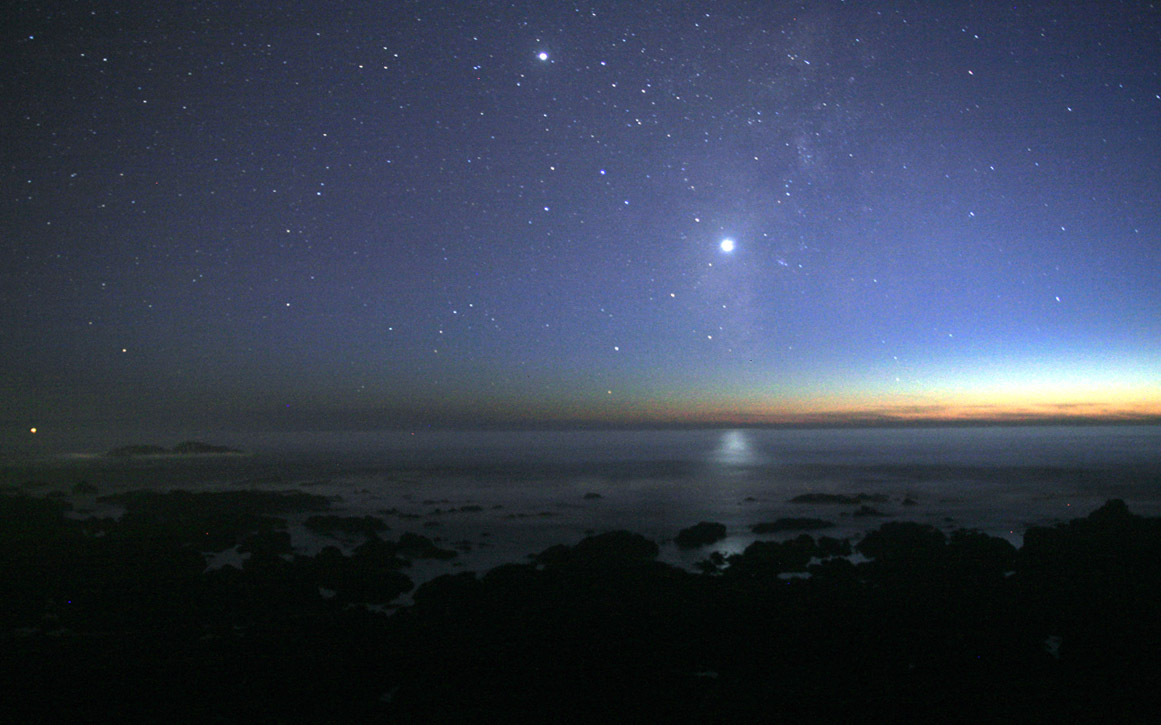
Image credit: Mila Zinkova.
Up in the night sky, we'd find some different classes of objects. Some wouldn't twinkle, ever, under any atmospheric conditions. These objects -- the Moon, satellites, and the planets -- we could easily see, with a telescope, had large angular sizes and big, identifiable parallaxes, allowing us to determine their actual size and their distance from us. These would be the objects within our own Solar System.
There would also be stars, in a variety of colors, temperatures, sizes, and distances. We would quickly discover the relationship between the distance to a star and its apparent brightness, and how that was related to its intrinsic brightness.
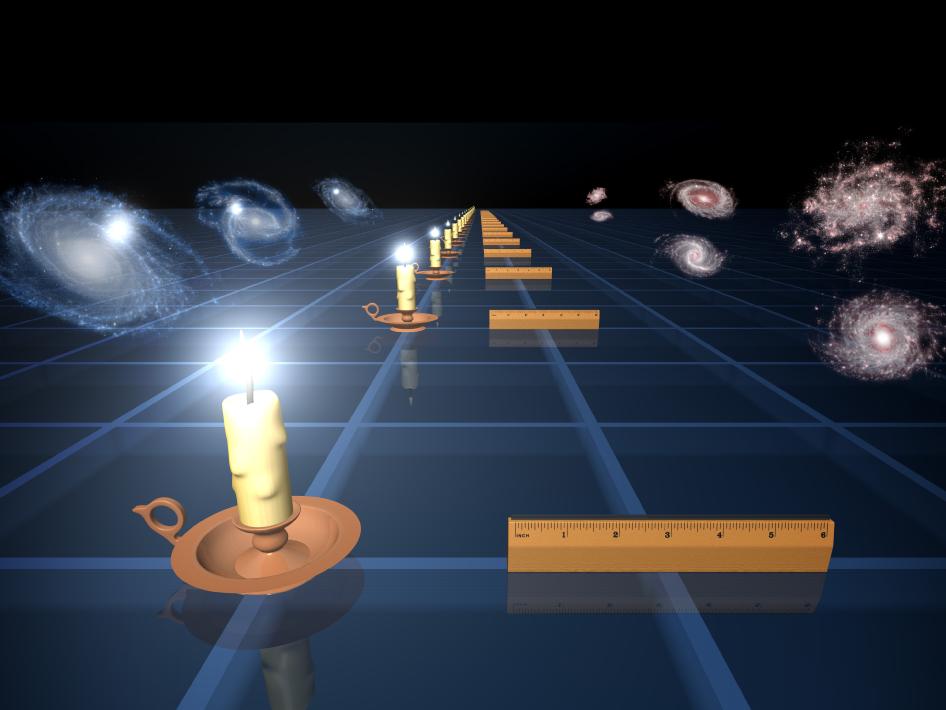
Image credit: NASA / JPL - Caltech.
We'd slowly start to -- with lots of observing targets and time -- learn the science of astronomy. We'd learn about different star types, including main-sequence stars, red giants, variable stars like Cepheids and RR Lyrae stars, and stars that went nova or even supernova!
Armed with the knowledge of what's in our Solar System and of the stars that lie beyond it, we'd have a strong base for peering beyond, into the rest of the Universe. So that finally, when we looked up at the third type of object in the night sky -- the extended nebulae -- we'd be ready to learn lots of interesting things about them.
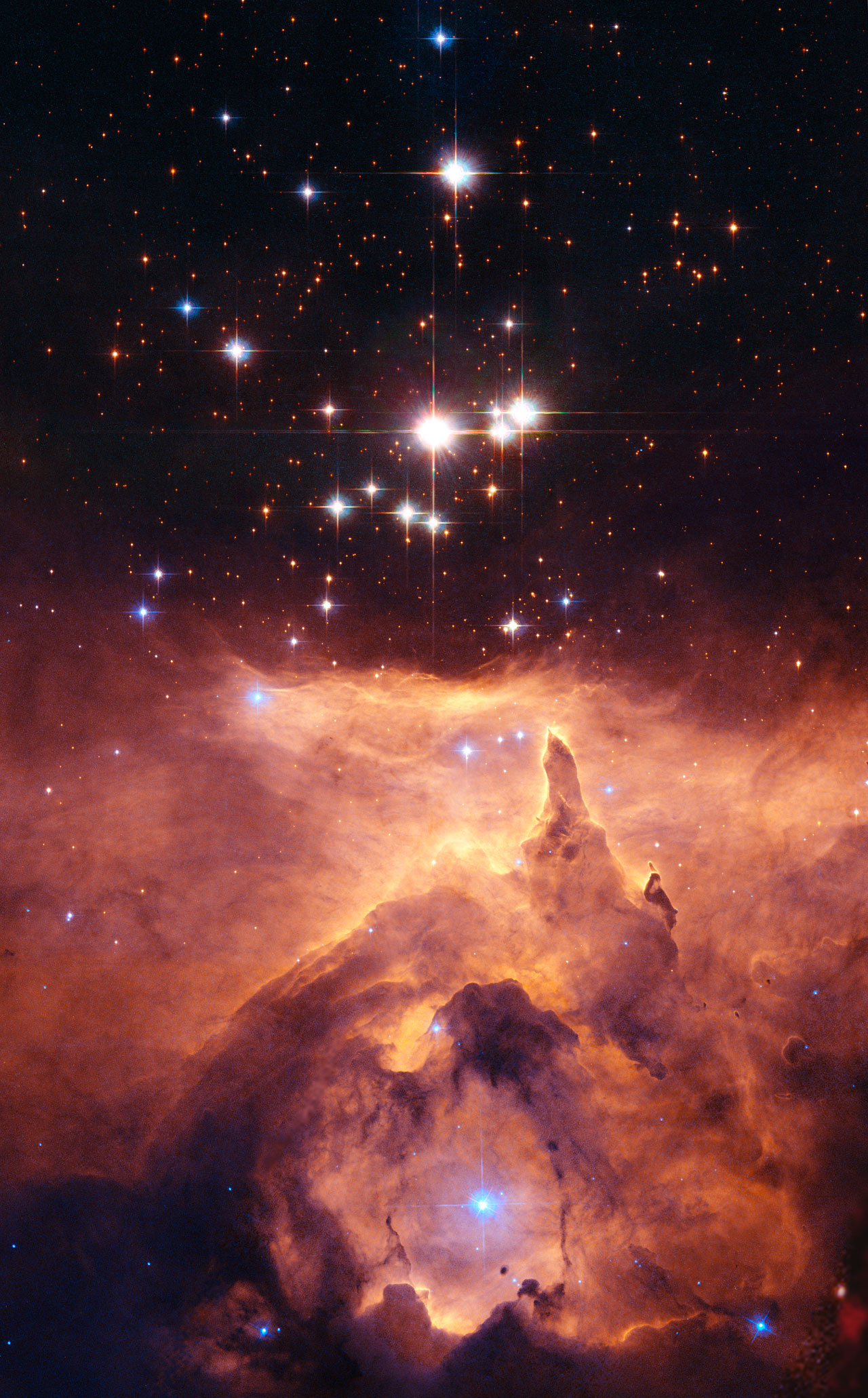
Image credit: NASA, ESA and Jesús Maíz Apellániz.
How old are these young star clusters? With an understanding of stars, we can tell you. How far away are these nebulae and supernova remnants? By understanding individual stars and the distance/brightness relationship, we can tell you. And finally, what about these faint, fuzzy blobs and spirals in the sky? Just what are they?

Image credit: ESA/Hubble, NASA and H. Ebeling.
At this point in time, we can resolve individual stars inside many of them, and find that unlike the stars in our own galaxy -- which are hundreds, thousands, or even tens of thousands of light years away -- these objects are millions of light-years distant. In other words, they are island Universes, or galaxies entirely separate from our own!
This might seem like the most obvious thing in the world today, but consider that this was not known until less than a century ago. And while you were making these measurements of distances to these galaxies, you might have noticed something else.
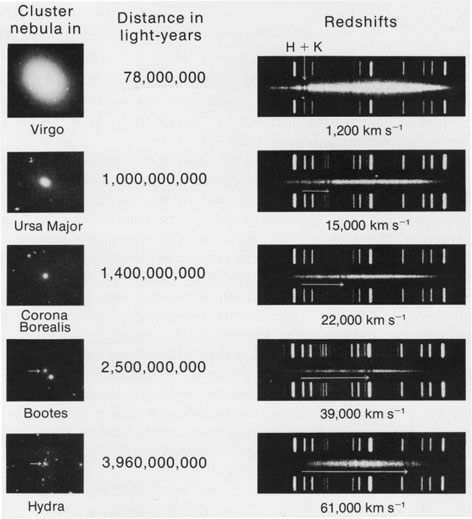
Image credit: retrieved from Western Kentucky University.
These galaxies were not just very distant, but the light coming from them was also redshifted. When objects move towards or away from you, the frequency of the light gets shifted towards the blue or red end (respectively) of the spectrum, with the faster motions corresponding to a swifter velocity. According to general relativity, the expansion (or contraction) of spacetime could cause the same type of red (or blue) shift of the light.
What you'd find, when you looked out at all of the galaxies you could see, would've been something remarkable.

Image credit: R. P. Kirshner, 2003.
You'd find that the more distant a galaxy was from you, on average, the more redshifted its light was! You'd notice that this was virtually independent of direction on the sky, and that -- excepting the fact that there was a "scatter" of a few hundred to maybe a thousand km/s -- this was a Universal relation, extending for not just millions but billions of light years!
From this alone, you could draw a few different conclusions depending on how you interpreted your data, such as:
- the Universe was such that we were at the center, at rest, and that objects were moving away from us, with further objects moving away faster,
- light was getting tired, and that the further away a light-emitting object was, the more energy it lost, shifting further into the red end of the spectrum, or
- the Universe was expanding under the rules of General Relativity, and that the galaxies' light shifted deep into the red because of the Universe's expansion.
If this last option were true, we'd have a very interesting picture of the Universe's history.

Image credit: NASA / CXC / M. Weiss.
We'd have a Universe that was expanding, that was smaller, denser, and (because of how wavelengths/frequencies work) hotter in the past. Which means we'd have a Universe that was expanding, diluting, and cooling today.
This "model" of the Universe is one you might recognize: this is the Big Bang picture of the Universe! If this were true, you'd ask yourself, what else would we expect to be the case?

Image credit: 2dF Galaxy Redshift Survey.
If we looked into the past, we'd expect that the Universe would have been more uniform, with fewer large galaxies and fewer giant clusters of galaxies. After all, if the Universe has been around for a finite amount of time, and gravity attracts things over time, the structure that existed billions and billions of years in the past should consist of smaller galaxies that are less clumped together than the ones that exist today.
In other words, the Universe should have been more homogeneous in the past. We also said that the Universe should have been hotter in the past! What does that mean?
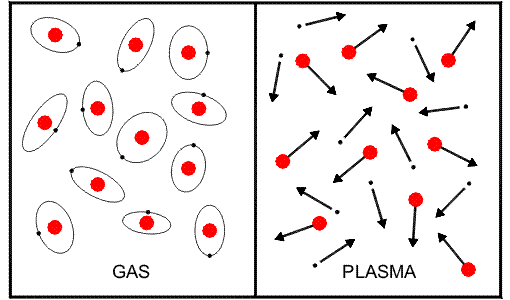
Image credit: retrieved from the Ministry of Science and Technology in Brazil.
It means, at some point, the average temperature/energy of a photon in the Universe should have been so high that neutral atoms -- the stuff that makes up everything we know on Earth -- would not have been able to form! A hot, ionized plasma is all that should have been around, as every time an atomic nucleus tried to capture an electron, a photon should have come along and blasted it apart. So at some point, the Universe should have been filled with a hot, dense plasma. (Which we know -- by the way -- is opaque, or not transparent, to light! Remember this!!!)
But we can go back even further! Imagine a time that was even hotter and denser than when this plasma existed, to a time where it was so hot that even protons and neutrons -- the constituents of atomic nuclei -- would be blasted apart by the scorching hot radiation of the Universe!

Image credit: me, modified from Lawrence Berkeley Labs.
At some point, the lightest elements in the Universe would have been unable to form. These are some of the consequences of this Big Bang model of the Universe, and these are theoretical predictions that we can test!
How's that?
Each of these events will leave observable signatures behind. If we start out in a hot, dense, roughly uniform state and come forward in time, we can predict what we should see today based on the Big Bang model of the Universe! Let's start at the beginning and come forward.
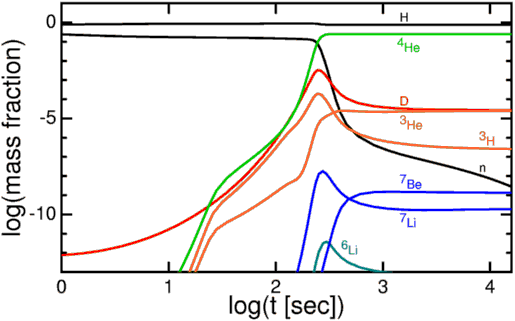
Image credit: Ned Wright.
The light elements: as the Universe expands and cools from an incredibly hot, dense state, eventually it will cool enough that the protons and neutrons, left over from an even hotter, denser state, will fuse together into the light elements deuterium, tritium, helium-3, helium-4, lithium-6, lithium-7, and beryllium-7. The only parameters that determine how much of these light elements get created are the ratio of photons to protons+neutrons. Because we know the particle physics behind it, we can know how much helium-4, helium-3, deuterium, lithium, etc., should be left over from the Big Bang, dependent only on that one, measurable parameter. If we can find some pristine gas from the early Universe, all of these elements should exist in those predicted abundances.
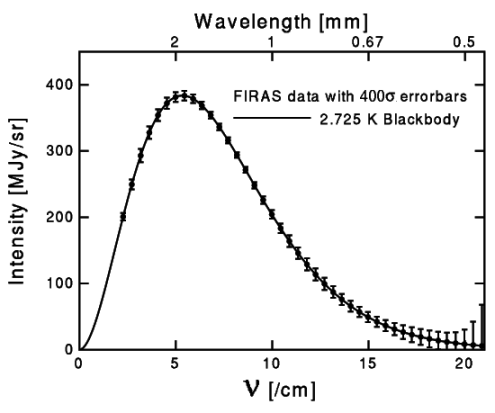
Image credit: COBE / FIRAS, retrieved from Fermilab.
The leftover radiation from the Big Bang: better known as the Cosmic Microwave Background! Because the hot plasma was opaque to light, we can't see all this radiation from the Big Bang until these neutral atoms form. But once these neutral atoms form, that leftover radiation from the Big Bang should not only stream directly to us, it should come to us practically uniformly in all directions, with a predictable, blackbody spectrum stretched by the expansion of the Universe. (Note that the other, above explanations for redshift -- including tired light -- do not give the proper spectrum!)
The discovery of this leftover radiation and the accurate measurement of its spectrum led, historically, to the acceptance of the Big Bang, as no other model of the Universe explains this observation, the abundance of the light elements, and the redshifts of the distant galaxies simultaneously. But there is one more great observation we can make.

Image credit: V. Springel at Max-Planck-Institute at Garching.
The Large-Scale Structure of the Universe: from the earliest stars and galaxies to modern times, from isolated dwarf galaxies to humongous clusters and superclusters, some of which have behemoth galaxies maybe 100 times the mass of the Milky Way inside of them, we should find larger, clumpier structure in the Universe today and more sparse, uniform structure in the past.
And we do! To all of it: WE DO!
And that's what the Big Bang is. That's how we'd figure it out today, and that's how we figured it out historically. And -- this is important, detractors and skeptics -- it isn't everything.
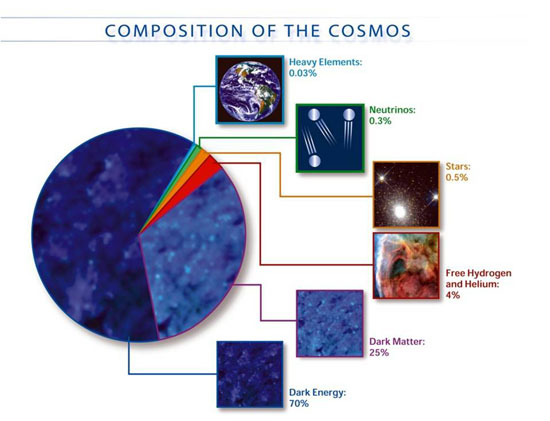
Image credit: Composition of the Cosmos, retrieved from the LSST.
It doesn't tell you exactly how much structure you have in the Universe and on what scales; you need a set of initial fluctuations for that, and that's what inflation gives you. It doesn't tell you exactly how the Universe has expanded over its history; you need to know how much total matter and dark energy are in the Universe for that, which is something the Big Bang doesn't predict for you. (You might assume that there isn't any dark energy, and that all the matter is normal -- protons, neutrons, and electrons -- but that would be awfully presumptive of you!) It doesn't tell you how the structure the Universe contains evolves over time; you need dark matter in addition to normal matter to get that right. And it doesn't tell you about the pattern of fluctuations you should see in the nearly-perfectly-uniform microwave background: you need inflation, dark matter, and dark energy for that. (Incidentally, the same amounts and types that the other measurements told you that you'd need, but that's a story for another time!)
But you mustn't deny the Big Bang because it couldn't predict those things. Those things went beyond the scope of the Big Bang. The Big Bang knows what to do with them if you put them in, but just like any theory, it can't do everything by itself. But that's what the Big Bang is, that's how it works, and that's how we know it's right.
Any questions?
Is it possible to distinguish between a push (i.e. Big Bang) and a pull, or a mixture of the two causing inflation? I have no idea how to make a prediction from that which is testable.
Stated another way: If you look at soap bubbles in the sink, some of the bubbles expand because their neighbors contract. If our universe is one of many, could inflation be due to a analogous phenomena? How would be know?
Maybe that would eliminate the need for dark matter and dark energy to explain structure and inflation.
I want to make sure I understand this "left over" radiation bit...
With a light bulb, some atoms are energetic, and their motion produces electromagnetic radiation. But if I switch the light off, it stops producing the radiation (light).
However, the light is was making while it was on continues to expand outward.
Is this analogous to the Cosmic Microwave Background radiation produced by the plasma? It's switched off, but continues to expand outward from its original source(s) in all directions?
P.S. Too bad Science Blogs comments section doesn't have a subscribe feature!
My brain can't cope with all the mathematics of the Big Bang, but I plod on reading all your lovely and intriguing posts in the hope that enlightenment may dawn on me one day.
Can you answer a silly question please?
Is there anything that explains what triggered the Bang?
P.S.
I LOVE the pretty pictures, I sortta understand a few of them and they just blow my mind.
Daniel @2: No, a turned-off lightbulb is not a good analogy for the CMB. The effect is black body radiation. Anything that has a finite temperature will emit a spectrum of photons, and in the limit of a perfectly absorbing body in thermal equilibrium this spectrum has a particular shape, with a characteristic frequency proportional to the temperature of the body. Many things have spectra which are well approximated by a black body spectrum, including the Sun (T ~ 6000 K), the Universe (T ~ 2.7 K), and even the Earth (T ~ 300 K).
This, by the way, is also the reason adding CO2 to the Earth's atmosphere tends to warm the planet. CO2 has absorption bands at wavelengths a black body of the Earth's average temperature would admit. If you reduce the amount of energy the Earth can radiate away and keep the energy input from the Sun fixed, then the amount of energy in the Earth system must increase (energy is conserved), so the Earth will get warmer until it can reestablish an equilibrium (the intensity of black body radiation is proportional to T^4).
"Is there anything that explains what triggered the Bang?"
There are many explanations. Which one would you like to read?
http://en.wikipedia.org/wiki/Big_Bang
Thanks, Eric. Unfortunately, that puts me back to "I don't get it." What I don't understand is, where is this radiation coming from today? Why is it still here billions of years later?
"What I don't understand is, where is this radiation coming from today?"
It didn't come from today.
It takes time for radiation to come FROM somewhere TO here.
For the MWB, that distance is about 15 billion light years away. Which means it didn't come from anywhere *today*, it came from somewhere 15 billion years ago.
1.) The traditional lay understanding of the Big Bang describes it as the beginning of time and space, but I've heard that Quantum Mechanics changed that traditional understanding just a few years after the original Big Bang theory was popularized.
Why/Is the Big Bang is considered the beginning of time rather than "merely" an event ~13.7 billion years ago when all matter was compressed down to a point.
2.) What can we scientifically say about what existed immediately prior to the Big Bang? There's a lot of talk about "getting something from nothing" and the quantum uncertainty of instability of nothing and the Casimir effect, but this surely depends on a background spacetime with some type of dimensional structure for particles/anti-particle pairs to appear within, right? If we are to posit a quantum fluctuation as the origin of the Big Bang, then we must admit some type of structure pre-existing to cause this.
3.) I know the detection of the acceleration of universal expansion has mostly killed the idea of a cyclical universe of expansion followed by contraction and re-expansion (except for Roger Penrose...) but when we talk about the Big Bang as the origin of spacetime does that kill the idea of the cyclical universe? If so why have so many people spent time researching cyclical universe models?
4.) Does a cyclical universe model have issues with the 2nd law of thermodynamics where entropy must tend to increase over time? If the universe has been expanding and re-contracting forever wouldn't entropy be maximized?
5.) How do we know that the Big Bang was the origin of space and not just an explosion of matter within space?
"It didn't come from today. It takes time for radiation to come FROM somewhere TO here."
Kind of like the light from a light bulb, after it is turned off. It keeps travelling further from its source of creation, even after the source is no longer creating new light.
Or how the light from a very DISTANT "lightbulb" (e.g. star) can get to you long after it exploded and disappeared.
So the light is coming from the big bang. We're only seeing it today because it took a long time to get here.
"but I've heard that Quantum Mechanics changed that traditional understanding"
The time and space that we exist in didn't change in understanding with QM.
"2.) What can we scientifically say about what existed immediately prior to the Big Bang?"
Nothing. Since time started then, there is no more "before" then than there's a North from the North Pole.
Or an infinity plus one.
"If so why have so many people spent time researching cyclical universe models?"
Because those models may still be right. They're having a look.
"Does a cyclical universe model have issues with the 2nd law of thermodynamics where entropy must tend to increase over time?"
No.
:-)
"5.) How do we know that the Big Bang was the origin of space and not just an explosion of matter within space?"
Because there was no space before then. How do we know that there's no monster hiding under the bed without actually looking? We reason it out.
It's possible we're wrong, but then you have an infinity of wrong answers to choose from. Reasoning is the only method we have of cutting that number down.
I didn't see any of this in genesis. Are you sure this is correct?
Wow, I'm pretty sure you failed to address any of the issues I was bringing up.
1.)
"The quantum theory of gravity has opened up a new possibility, in which there would be no boundary to space-time and so there would be no need to specify the behavior at the boundary. There would be no singularities at which the laws of science broke down and no edge of space-time at which one would have to appeal to God or some new law to set the boundary conditions for space-time. One could say: 'The boundary condition of the universe is that it has no boundary.' The universe would be completely self-contained and not affected by anything outside itself. It would neither be created nor destroyed. It would just BE. [Stephen Hawking, A Brief History of Time (New York: Bantam, 1988), p. 136.]
2.) Based on your answer you can say something, namely that nothing existed prior to the Big Bang, or that there is no before. I'm well aware that's the traditional wisdom but I'm hoping for a more authoritative answer for what the scientific theory actually demands.
3.) If a previous universe was the origin source for our universe's big bang, then in any normal sense that universe's time was before our time, and there was both space and matter before our Big Bang. Now, if theoretical physics wishes to use strict definitions to say that our spacetime began at the Big Bang that's fine, but you have to have some new terminology (such as Imaginary Time ala Hawking and Fenyman) to refer to the other concept of time which is naturally implied by a cyclical universe model.
4.) Care to elaborate why not? I don't think the idea that there would be a problem with this is naive, but I also don't know that it's necessarily true. It's probably okay to say that our physics can't transcend a singularity and therefore we can't say whether the 2nd law continues to operate throughout that event. What I'm wondering is whether we're able to actually say that there is no problem, or merely able to say that we don't know due to the singularity, presumably we can't say that there is a problem since lots of smart physicists have worked on cyclical models being well aware of the 2nd law.
5.) Begging the question? I'm not opposed to "reasoning it out," I'm asking you (or someone) to do so and educate me rather that just state that it's true. In a cyclical universe model if gravity pulled all the matter back to a single point, presumably it wouldn't _also_ do so for the spacetime, right? So cyclical universe models assume that if a universe's worth of matter was crunched back down to a singularity a big bang would occur (and not just a black hole), but if it were to do so it would occur within the confines of existing space, right? Or is the theory that it would spawn a new spacetime "bubble universe" isolated from the empty spacetime of the previous universe?
1) it's true that quantum theory changed the way we think about things on a really small level, but it doesn't change anything about how we understand the big bang. It just offers a way to explain WHY the mathematics of General Relativity break down at certain boundary points. generally that explanation is that general relativity doesn't account for the unpredictable undulations in the quantum foam.
2) The idea behind why there was no "before the big bang" is a result of general relativity called time dilation. As you know, the more massive something is, the more gravity it produces and the more gravity it produces, the more it slows times. So if you were to have an infinitely massive point particle as the big bang theory suggests, you would essentially infinitely slow down time. That is, everything WITHIN that infinitely massive point particle would experience no change in time, while (assuming a multiverse) things outside of it would exist OUTSIDE of the spacetime of the singularity and would still experience time as they normally would. remember, time dilation in this case is the result of gravity which is transmitted through spacetime.
3) The idea of the cyclical universe has pretty much nothing supporting it to begin with. The idea that the big bang marked the beginning of our space-time doesn't necessarily rule out the possibility of a cyclical universe (as I mentioned above to some degree), but without any evidence of a mechanism for these cycles to repeat, we can't possible make any assertions.
4) I can't answer this question as things regarding entropy usually aren't very intuitive, but I'm sure someone with more insight can explain. I don't put much thought in cyclical universes because of the reason listed above.
5) The reason we know that the big bang wasn't an explosion of matter within space is because the expansion would have had to have happened at speeds much higher than the speed of light. That is, space can expand faster than the speed of light, but nothing can travel faster than light within that space. So the only way to explain this ridiculously rapid initial expansion is to invoke the idea that space itself was what was initially expanding. There's more to the reasoning justifying it, but that's the jest of it.
"I didn't see any of this in genesis. Are you sure this is correct?"
You don't remember the famous passage:
"And the Lord said 'Let there be light of a temperature of 2.7K' and there was light."
;)
In response to the one who asked what caused "The Big Bang"--the "First Cause" caused the "Big Bang".
why does all this make for an "in the beginning" story? the universe has a lot in common with a campfire at the end of an evening. a pile of glow with sparks popping out. next time you look up at the sky on a dark night, consider that what you see is the result of something that came to its end. all that's left are these embers we call stars. question we'd like answered is: what was the something all about?
5) Ethan did this post Why we think there's a Multiverse. According to which if I read it right, the Big Bang was an explosion of weirdness in Multiverse-space. I guess "explosion" is a legitimate stand-in for hyperinflation.
"what was the something all about?"
My guess is God just got bored of doing nuffin'
"what was the something all about?"
Why does it have to be about something?
Hi Ethan,
love when your articles deal with broad and awesome topics, such as BB in this case.
Ran across this paper not long ago: http://www.newtonphysics.on.ca/hubble/index.html
and am really interested if something like this is valid. This would probably then fall under 2nd category of how you can interpret the data, but the author above is making a compelling case. Only a tiny ammount of interstellar gas would be enough to cause the light to redshift. Has this been debunked since then?
Thank you.
Sinisa @21,
The short answer is, "no." That is a tired-light cosmology, which was actually initially proposed a very long time ago. The reason we know it's wrong is that, while we can get the same temperature for the background radiation, we will get the wrong spectrum if this is the mechanism.
Want details?
http://scienceblogs.com/startswithabang/2010/10/big_bang_alternatives_c…
Cheers!
Marshall,
Based on the illustration shown in:
http://scienceblogs.com/startswithabang/upload/2011/10/why_we_think_the…
Our entire universe is one of those red X's in which inflation stopped? And I would assume that we have no way of knowing how far to the right we are in that chain of eternal inflation? And can we say whether the chain is eternal only in the direction to the right or whether it is eternal in the direction to the left?
From one of the links in the multiverse article:
"The basic workings of inflationary models are summarized, along with the arguments that strongly suggest that our universe is the product of inflation. It is argued that essentially all inflationary models lead to (future-)eternal inflation, which implies that an infinite number of pocket universes are produced. Although the other pocket universes are unobservable, their existence nonetheless has consequences for the way that we evaluate theories and extract consequences from them. The question of whether the universe had a beginning is discussed but not definitively answered. It appears likely, however, that eternally inflating universes do require a beginning."
Hi Ethan,
thank you for the reply and link. Explains a lot. I see the article about why tired light theory doesn't work is from 2010, didn't know about this blog back then ;) Great follow-up read.
Thank you very much again.
Awesome post! My favourite thing about this blog is how Ethan shows the chain of discovery; why and how certain theories have fallen by the wayside because of observations.
When a theory breaks more than it fixes, it ain't no good.
(Still reckon we're in a mote of dust under a giant's fingernail, though...)
The other thing to realize, Sinisa, is that www.newtonphysics.on.ca is a complete crackpot site.
Sr. Sharon,
Wrong.
1. The "First Cause" is rendered mute, because in order for there to BE a "cause", it presumes that space-time ALREADY existed prior to the Big Bang, and you don't know that. In a black hole, (and at the Singularity of the Big Bang), there IS NO TIME, (yet), and thus no "opportunity" for the "cause" to occur in. The First Cause argument has been rendered obsolete by Cosmology. There is no continuum of time in which to place a "cause".
2. If a "creator" "existed" prior to space-time, there is no human linguistic element, (word), for a being which "exists", "loves", "thinks", is "cognizant", "aware", which DOES NOT require time for it to have meaning. The MOST you can say, is that you can say nothing meaningful.
3. The very "act of creation", would have to have a "beginning", a "mid point", and an "end". THAT requires TIME to exist ALREADY. Therefore your First Cause cannot be THE "first" cause. It requires space-time to exist at least concurrently along with, (and at every point), WITH your god. Therefore your god cannot be THE creator of EVERYTHING.
jason.dhaviland.firestone1@gmail.com
BTW,
The total energy of the universe is zero, ("0"). Gravity can have a negative energy. Therefore there is no need to posit a "cause" if there is, in the end, "nothing".
I have studied cosmology as an interested layman for years and have often wondered why the Universe began in a singularity. Why couldn't it have been in a 1 centimeter sphere? -Al
3/29/14
What a tremendous and succinct presentation Ethan! I loved it all.
It is profusely illustrated.
Maybe this blog is dead. It's been 2 years?
@al #29, #30, #31: No, the blog is not dead. You are just reading a post that was made two years ago. Why don't you click on the main title at the top of the page (just above the green line), and see all the recent stuff?
@Jason Firestone
God was from the beginning, is now, and will be forever. God has always been--He himself was not created ...He was...therefore there is a beginning....It does not have to be seven literal days like in the book in Genesis. So God existed before space time...You don't know that he didn't exist before that.....He has always been....Humans have great difficulty understanding forever....eternity....especially before time began....That is why God is God.