

"They call it a great wonder
That the Sun would not
though the sky was cloudless
Shine warm upon the men." -Sighvald, Icelandic poet
A couple of times a year, during the New Moon, the Sun, Moon, and Earth all line up in the same plane. As seen from Earth, the Sun's disc appears blocked, either in whole or in part, by the Moon. As The Beta Band would have told you, this creates an

Image credit: Total Solar Eclipse in Russia.
Back in 1994, I was living in New York; this was the last time an annular eclipse happened anyplace close to where I was living. From where I was, about 87% of the Sun's disk was blocked by the Moon, and there were two very interesting (and obvious) things that happened:
- The Sun remained incredibly, blindingly bright to look at, but gave off virtually no warmth, and
- shadows looked, well, really weird.

Image credit: Philippe Haake, retrieved from APOD.
I didn't have the fun kitchen skimmer that Philippe Haake had, above, but I discovered that, with my back towards the Sun, if I held my fingers, crossed together, over my head, the shadows produced by the tiny spaces in between my fingers would produce miniature eclipses Suns.
But if I had been in a more fortuitous location, where there actually was a full annular eclipse, those tiny little apertures would have produced images of the ringed annulus, such as the rings Steve G.S. saw shining through the tree leaves in 2005.

Image credit: Steve G.S., from the 2005 annular eclipse in Spain.
Well, I live on the West Coast of the United States now, and I'm finally getting another chance to see an annular eclipse! This May 21st/May 20th, depending on which side of the international date line you're on, is our planet's next eclipse. Those of you in Hong Kong, Taipei, Tokyo and other areas will get to see the annular eclipse shortly after sunrise on the 21st, but those of you in the west/southwest United States are in for an extra special treat.
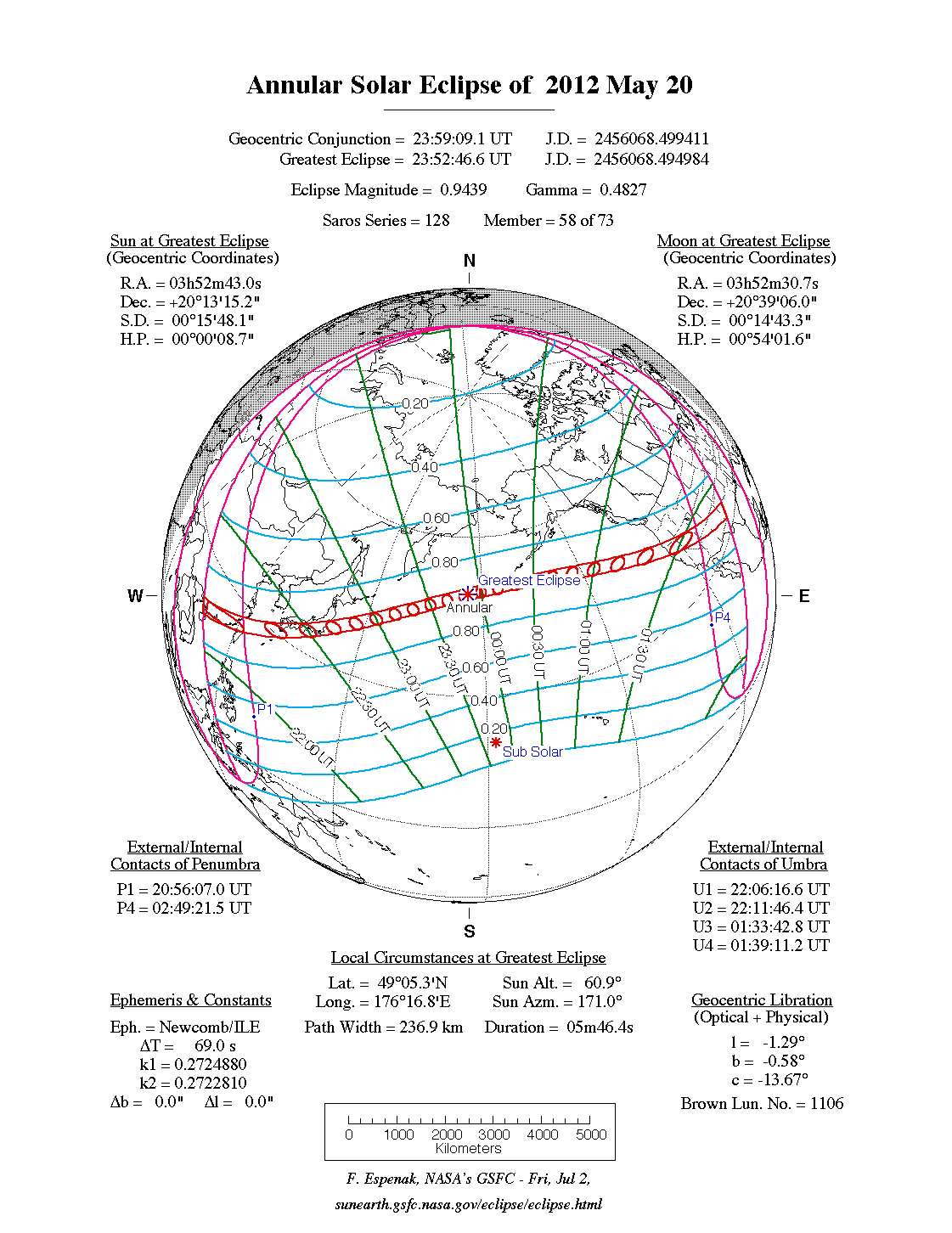

Image credit: Google Maps / NASA.
In the waning hours of the day on May 20th, as Sun descends in the west, the Moon will pass in front of it, creating the first annular eclipse in the United States since 1994!
This time, I'm going to be prepared.

Image credit: Frisius Gemma's Camera Obscura, 1544, retrieved from artist-how-to.com.
First off, I'm going to make sure I have a pinhole camera with me. A pinhole camera is as simple as having a piece of cardboard with a pinhole poked in it and a white screen behind it. As the sunlight passes through the pinhole, the (inverted) image of the Sun's disk gets displayed on the screen in the back.
If the Sun's disk is partially blocked, then what shows up on the display screen is the eclipsed Sun, completely safe for viewing. There are a number of quality, ultra-low-tech options readily available for your display screen.

Image credit: Shree Nayar of BigShotCamera.org.
Because the eclipse is happening late in the day -- in the Pacific Time Zone, it starts at about 5:10 PM and ends at around 7:30 PM -- I'll want to make sure I have a clear view to the west, where the Sun will be descending. I am taking no chances, and will be staking out a spot along the coast. With over 200 miles of prime viewing coastline available, I'm even hoping for a little solitude while it happens.

Image credit: Craig Wolf Photography.
The ocean is sure to provide me with very little in the way of obstacles that will obscure the Sun's view. The only possible interference will come from the astronomer's nemesis: clouds.
I also plan on photographing the Sun, directly, during the eclipse! Although I'm not a skilled photographer by any stretch, anything from a pair of welder's goggles to the interior of a 3.5" floppy disk, placed over the lens of your camera, will allow you to successfully photograph the Sun during an eclipse!

Image credit: Chin-Yu Hsu, who was in high school with me during the 1994 eclipse, of the 2009 solar eclipse, from Taiwan, using a 3.5" floppy filter.
I won't, however, be looking at the Sun through the 3.5" floppy disk; welder's goggles are okay (as are some other types of protective eyewear), but be careful! You won't feel the damage the Sun can do to your eyes until it's too late; make sure if you're going to look at the Sun directly that you get the proper equipment to protect your eyes.
I'm hoping to get some images as good as the ones taken by Steve G.S. with his solar filter in 2005. (Yeah, right!)

Image credit: Steve G.S.
The United States will get a shot at a total solar eclipse -- perhaps the only sight more spectacular than an annular eclipse -- on August 21, 2017. But for those of you with a chance to go out and view this one, including those of you just crazy enough to be eclipse chasers (which may include me, now), start planning for it now.
You won't get another chance at an annular eclipse in the USA until 2023, so don't miss it!
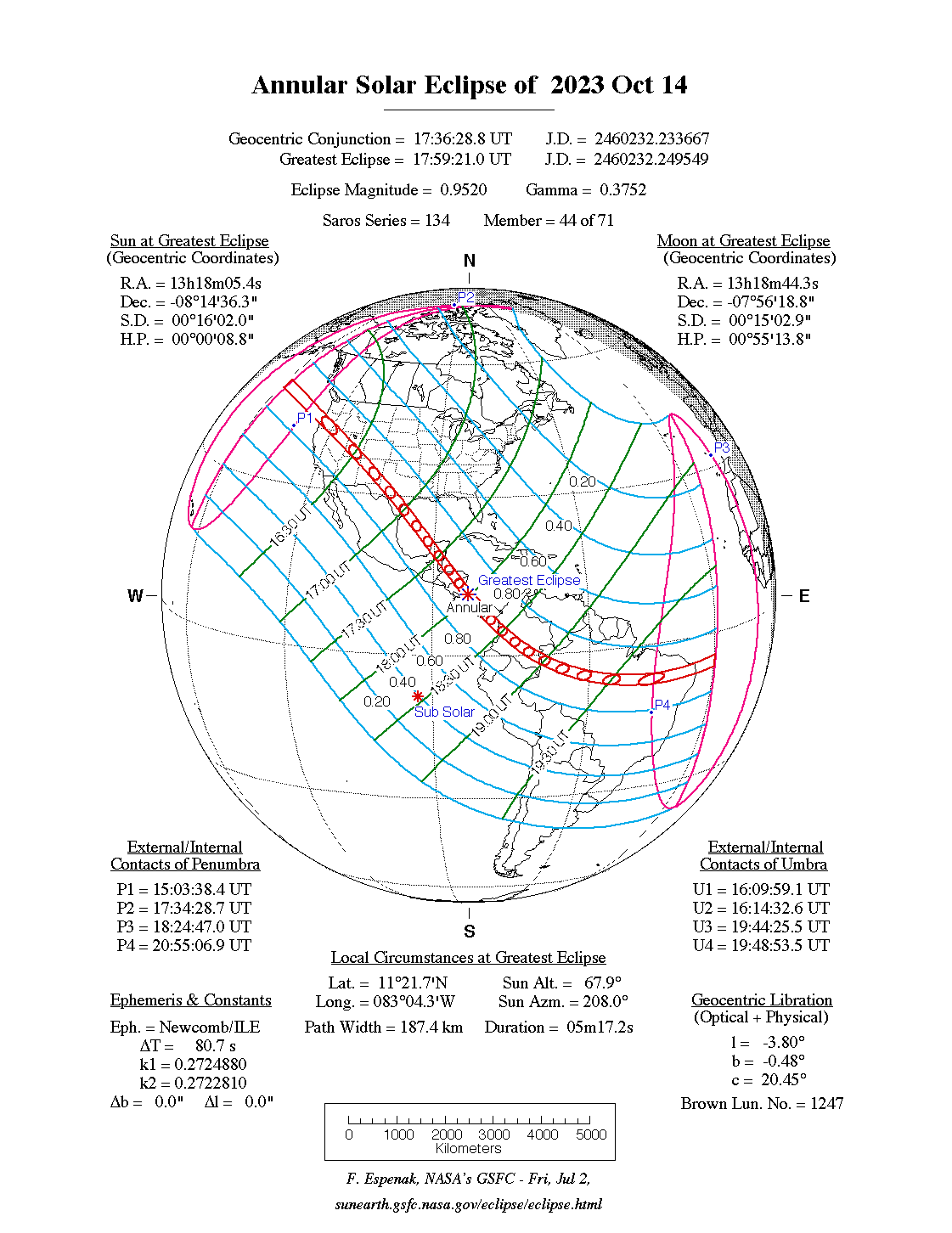
I live in the partial zone (Tucson), but I plan to make a trip up north (relatively speaking) to see it as an annular from somewhere near the Four Corners region.
Back at the last Venus transit (June 2004, I think it was?), I happened to live in an ideal location, Milwaukee, from which I could watch the Sun rise over Lake Michigan while the transit was already in progress. And there was just enough thin haze that, for maybe five minutes or so after it rose, you could still look at it, even through binoculars. So, I'm probably one of an elite few that has seen a Venus transit with the completely naked eye (and not gone blind from it), now. But, of course, I would not recommend this to ANYONE, and do not try this at home!
In 1994 I was living in an ideal spot for seeing the annular eclipse. I got to see it from the roof of the building where I worked at the time.
I just missed seeing the August 1999 total eclipse. I happened to be in the Munich area, which was in the totality zone, but from where I was watching a cloud passed over the sun during totality and only moved off just after totality ended.
hi
can help me to see this annular eclipse because i am residing in southern part part of india. is it visible in india?.
Sorry, Ashoka @3,
The eclipse will not be visible to you in India; it will still be an hour or two before dawn when the eclipse would have reached you. You may be able to see a partial eclipse phase right at dawn, depending on your longitude.
You can check where the eclipse falls on Earth here:
http://eclipse.gsfc.nasa.gov/SEgoogle/SEgoogle2001/SE2012May20Agoogle.h…
I guess I'm going to have to miss this one, but Hopkinsville, KY is only a few hours from Memphis. see you there in 2017.
I drove to Bisbee, AZ for the 1994 one, lots of fun with the pinholes. But the most amazing thing I found was the drop in temperature at full eclipse. Looks like we're going to get lucky here in Albuquerque, pretty much center line.
I live near Brisbane, Australia, and I plan on making the trip of about 1500 kilometers north to Cairns to see the total eclipse in November. I've never seen an eclipse of the sun before. It better be good or I'll have a bone to pick with Mother Nature!
Please know that the Oregon coast thick marine air is notorious for dowsing what would be beautiful sunsets. The worst part is how deceptive the fog bank can be. It may push out to sea many miles throughout the day, revealing blue skys, but as soon as the sun starts to drop the fog creeps back in, and the sun is lost in a crewel ribbon of grey. I highly recommend you get to the beach early, if you watched the fog push back off the beach in the morning, then it will probably be back fog-blocking the horizon during sunset. It would be a shame if you missed the eclipse, you should definitely have a back up spot should the ocean be socked in. Here is a link that has some useful fog prediction data.
http://www.oregonhanggliding.com/predictingfog.pdf
Can't wait to see your photos, best of luck.
I'm not as familiar with the stubbornness of the fog in northern California, hopefully the link will still help you set up for the perfect shot.
I'll be traveling to Albuquerque to see the annular eclipse...but I don't know WHERE in the city would be good to go to share the experience with others and to get an unobstructed view of the eclipse. Would people living in Albuquerque please make some suggestions? Thank you.
The Albuquerque Astronomical Society (TASS) is part of a coalition of organizations working to provide ecellent public and private eclpise viewing locations. The primary location for amatuer astronomers will be at Mesa del Sol Pavilion (a few miles south of the Albuquerque Airport).
There will be areas cordoned off only for amatuer astronomers with telescopes. Another area will be open to the general public. The closest lodging to this site is Isleta Pueblo Hardrock Casino and Hotel. The Albuquerque Balloon Museum will also host public viewing. Contact TAAS via the website taas.org for more information.