

"Deep into that darkness peering,
long I stood there, wondering, fearing,
doubting, dreaming dreams no mortal
ever dared to dream before." -Edgar Allen Poe
When you look out into the darkness of a moonless, unpolluted night sky, you'll of course notice that it's full of stars, planets, and the occasional extended object.

Image credit: Bob King at AstroBob.
But you'll also notice that there are plenty of regions that -- other than a few stars -- don't really have very much going on. One such region, visible in the southern skies pretty much year-round, is the constellation of Sextans.

Images credit: Jim Kaler.
A region of space where there isn't very much going on -- no bright stars, no planets, no close, extended galaxies or nebulae -- is ideal for looking out, deeply, into the Universe.
You may remember, very famously, that the Hubble Space Telescope has done that a number of times, producing images such as the magnificent Hubble Ultra-Deep Field, an image which contains around 10,000 galaxies!
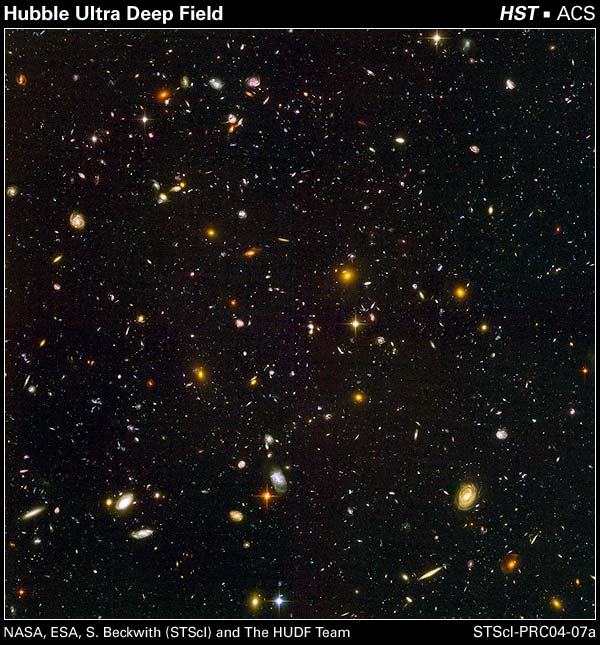
Image credit: NASA / ESA / S. Beckwith (STScI) and the HUDF team.
And that, well, that's a lot. But is that the record?
If it was, it certainly isn't anymore! Because that region of space I showed you, above, in the constellation of Sextans? The European Southern Observatory has -- with their VISTA telescope -- created the deepest wide-field image of all-time, containing over 200,000 galaxies!

Image credit: ESO/UltraVISTA team. Acknowledgement: TERAPIX/CNRS/INSU/CASU.
The ESO has released a couple of videos, where you can see exactly where on the sky this region is, and zoom in a bit on some of these 200,000+ galaxies. In the video below, the full region of the survey -- known as UltraVISTA, of the COSMOS field -- is visible at about 0:31 into the clip.
Zooming even deeper into the field and panning around, the video below showcases some of the highlights of this survey.
Of course, they've also created an interactive, zoomable version of this survey. I've taken the liberty of creating for you a sample of what it's like to zoom in, by a factor of 4, on a given region of the original, full wide-field survey.
To remind you, here's the original image.

Now, let's zoom in to the upper-left quarter of this field.

Now, let's take another quarter (lower right) of that, for 1/16th of the original image.
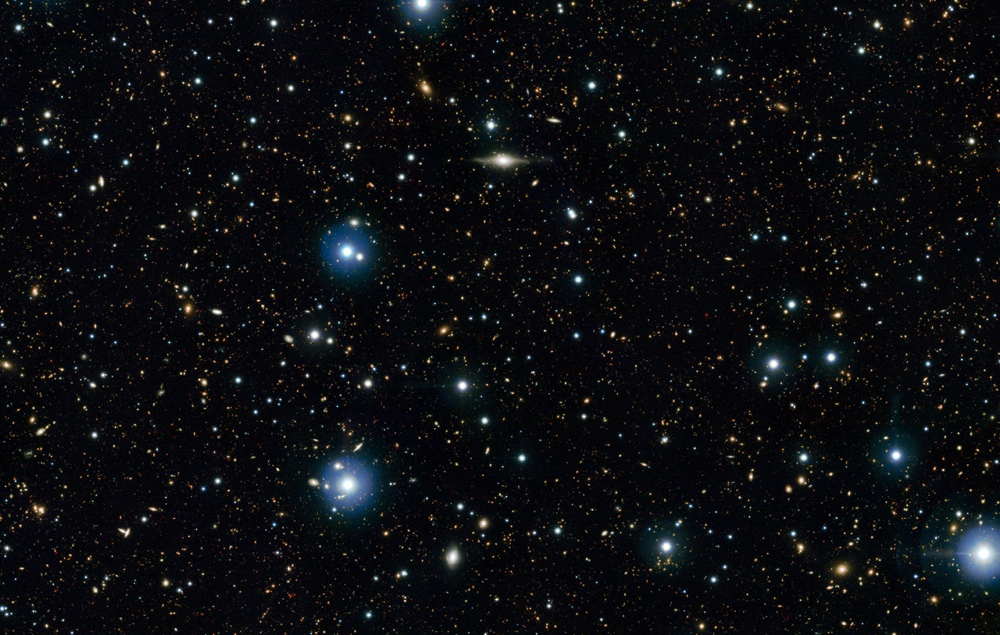
And another quarter (lower right) of that, giving us just 1/64th of the original field-of-view...

And another quarter, bringing us to 1/256th the original...
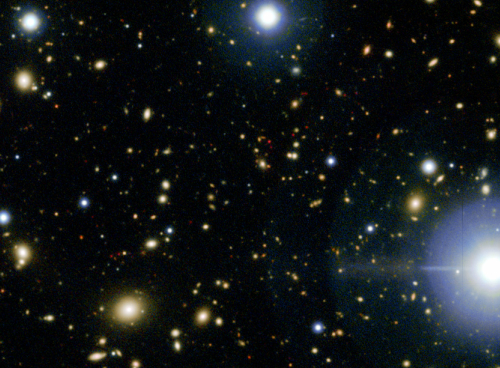
And finally, down to the maximum resolution, just 1/1,024th of the original image!

And that's what your Universe looks like! I'll be away at MidSouthCon until next week; hope you have a great one until then!
You say your zooms are upper left, lower left, lower left, but it looks like the images match up better if your zooms were actually upper left, lower right, lower right.
Does some poor soul have to count the galaxies by hand or can a computer do that?
Thanks Flavin; fixing now!
How does this image match up regarding galaxy density, vs. the hubble ultra deep field? Are the avg densities the same? Does this image change our figures for the total estimated number of galaxies in our universe, or does it agree with our current model? And if it does, say for instance, give us a larger figure for avg galaxy density, how would it change other ideas? Would it make the ratios of dark matter, normal matter, dark energy different than we currently believe them to be??
These types of images always just absolutely blow my mind. Makes you realize how insignificant we really are...
One thing with those deep field images that always fascinated/baffled me is: If we keep looking back ever further in time for the early galaxies, does it come to a point where it doesn't matter which direction we're looking, we're seeing the same galaxies because the field of view is larger than the size of the universe that early on?
I think it's zoom factor 5, not 4.
And when you say "with the exception of 2 or 3 faint stars", you're talking about the last image of your zoom sequence, right? Am I correct in thinking there are at least 30 stars from our galaxy in the full-sized image, and for example 9 (I think) in the third image of your sequence?
Here's a related question I somethimes think about: how many stars in our local part of the galaxy have we mapped, out of how big a total? And are we getting close to having enough stars for a virtual 3D image of our region of the galaxy that we could navigate through and get a sense of our surroundings?
Every time I try to wrap my mind around these scenarios, I just sigh. Nothing we are taught prepares us for this reality. Nothing. Really, who are we as a reality in the universe? I would venture to say nothing, but this does not work. Physics dictates flow of motion. I really would like to know where this us,we are going!!!!!!!
It is inconceivable just how inconceivable this is.
What the deep field images tell me is that we're not the center of the universe.
Some years ago I got a little 4" ETX, that blew me away. Of course being the western consumer that I am, I was soon drooling over catalogues that promised bigger and better views - I figured I would only be happy with some huge monster light bucket permenantly set up in the garden.
However, as my knowledge of astronomy grew, and my mind realised just what an insignificant mote of dust it is we sit on, whatever I see in this little scope becomes inreasingly more amazing. In fact after reading this, I pop out and spy Venus with the naked eye - and knowing were even this brilliant Jewel sits, in the truly grand scheme of things just adds more.
The more we see - the more there is to see - and so ad infinitum.
If this is the work of a god - its having a laugh.
Answer to "5 & 10 & 11":
I agree to: "Insignificant we look like to the displayed greatness and findings."
But what does it mean, we are not the center of the Universe? Insignificant we are?
Each living creature, including us, has his personal "Big Bang" and center of the Universe.
That's why we are able to look around us and see, discover and feel.
Time, space and everything is moving, expanding.
Life is the trigger.
Enjoy!
I think you are the center off the universe and its always expanding name it "God".You are in the middle of it and sharing this neverending proces.