

"Well you run and you run to catch up with the Sun but it's sinking,
racing around to come up behind you again.
The Sun is the same in a relative way but you're older,
shorter of breath and one day closer to death." -Pink Floyd
For the last four-and-a-half billion years, the Earth has spun on its axis, orbiting its parent star: our Sun. Today, our home planet looks something like this.

Image credit: Reto Stöckli, Nazmi El Saleous, and Marit Jentoft-Nilsen, NASA GSFC.
Looking at our world, even from outer space, you see some very familiar features that we think of as essential parts of our world. The vast, watery oceans. Our substantial (but not too thick) cloud-filled atmosphere. And the great land masses: our continents. These continents are, perhaps, the most striking feature to a traveler looking down on our rock from space, as the land on our world is not merely the color of the rock that composes it or the ice frozen upon it.
No; huge swaths of our Earth's land is transformed by the color of the life that dwells upon it.

Image credit: Juan Manuel, a.k.a. Van Pelt on flickr.
The way we got here is a remarkable story in its own right. What we commonly think of as complex life -- the plants and animals visible to our naked eyes -- has existed on Earth for only around 600 million years.
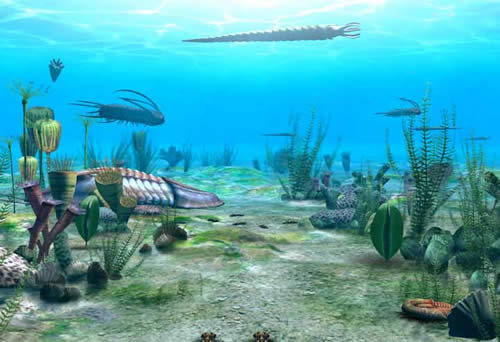
Image credit: Planet Dinosaur.
Prior to that, life was mostly colonies of single-celled organisms, engaging in relatively simple life processes, like turning sunlight into energy, or somewhat more complex lifeforms feeding off of that abundant biomass. It makes you wonder what took so long; what took the Earth around four billion years to bring about the large plants and animals that have dominated the planet?
We've gone from fish to insects to reptiles and dinosaurs to (eventually) birds and mammals. We've gone from the seas up onto the land and into nearly every possible location on the planet. And yet, what science tells us is that for nearly 90% of the Earth's history, we didn't have anything like what we have today. It turns out we've actually been incredibly fortunate to go down the path that we did.

Image credit: Joel Cayford.
The atmosphere that we take for granted is a relatively recent thing. In particular, it took billions of years of organisms turning sunlight, carbon dioxide and water into carbohydrates -- an energy source that could be used even in the absence of sunlight -- which produced oxygen as a by-product. At first, this trace amount of oxygen was absorbed by the oceans or by the seabed rock. Once the oxygen began to make its way out of the oceans, it was absorbed by the land surface. Finally, the oxygen accumulated in the atmosphere, paving the way for life as we know it.

Image credit: Christian Jégou.
It took more than four billion years for life to make it onto land on our planet, and we've got maybe another 500 million to one billion years left.
What, that's it?
Yes, that's it. Why such a short time?

Image credit: Wikipedia/wikimedia commons user Tablizer.
Because the Sun, like all stars, burns more luminously as it gets further and further along in its life cycle. By the time its energy output increases by another 10-20%, the oceans will boil, and terrestrial life as we know it will cease to exist.
If we had a cooler, lower-mass star, it would burn its fuel more slowly, and increases in such a star's energy output would give us more than this narrow, 1-1.5 billion year window for land-based life.

Image: Morgan-Keenan Spectral Classification.
That's not so hard; while our Sun certainly isn't the biggest, hottest, or brightest star out there, being a G-type star, only 5% of the stars in existence are brighter and hotter than our Sun! Most stars -- meaning around 90% -- are either K or M-type stars, which not only live longer than our Sun, but burn cooler and in a more stable fashion than our Sun does.
So while our Sun and Earth have been around for 4.5 billion years, the Universe has been around for 13.7 billion, or more than three times as long. If you were to condense the entire history of the Universe into one calendar year, the gas cloud that collapsed, forming the Sun and Earth, wouldn't have done so until early September of that year.

Image credit: NASA / JPL-Caltech / T. Pyle (SSC).
That's good, because back on January 1st, there was no carbon for our sugars, nitrogen for our DNA, oxygen for our lungs, calcium for our bones, iron (or copper) for our blood, or phosphorous for our body's (ATP) energy system. There was no silicon for the "rocky" part of our rocky planets.
It took generations of stars to live and die, fusing their primordial hydrogen and helium into the heavier elements that make us up, spitting that spent fuel out into the Universe once those earlier stars reached the end of their life cycles.

Image composite created by J-P Metsävainio of AstroAnarchy.
But did we really need 9+ billion years of previous generations of stars to have the type of planet we have today? What if these generations came and went quickly in some places in the Universe, and gave rise to rocky planets many billions of years before Earth was a twinkle in its grandfather-star's belly?
What if, instead of in September of the Universe's history, there were rocky planets in the Universe's early days, some of which might still be around today?
If this possibility sounds exciting, have I got news for you.

Image credit: NASA, retrieved from Discovery News.
375 light-years away, here in our own galaxy, lies an old, non-descript star, just a little less massive than our own Sun. If our Sun formed in the Universe's "early September", this star, HIP 11952, was formed in late January/early February, an estimated 12.8 billion years ago.
What's remarkable about this star? It's the oldest, most ancient star ever confirmed to have planets orbiting it!

Image credit: Timotheos Samartzidis.
So far, they have confirmed two gas giants planets orbiting it, with the smaller one just a bit less massive than Jupiter, while the more massive one nearly is three times as heavy as our Jovian giant. The star itself has fewer heavy elements than any other star ever found with planets around it, but, compared to most other stars its age, is extremely enriched with these elements essential to all we hold dear.
We've long known that there are regions of space that burn through generations of stars much more quickly than, say, our corner of the Milky Way does. A prime example is any actively star-forming region, such as the center of our own galaxy.

Image credit: NASA / JPL-Catech / S. Stolovy / Spitzer Space Telescope / IRAC.
With the oldest confirmed gas giant planets around it (according to this research, published last month), could this star also have rocky planets around it, too? With a longer lifetime than the Sun, if there are rocky planets here, could they have harbored complex, macroscopic life for not just half-a-billion years, but for many billions of years?
If so, what would that look like? And if they were technologically savvy, what could they accomplish?

Image credit: Jeffy Kun at DeviantArt.
And if not, we've got literally billions of old, cool stars -- stars that may be rich enough in heavy elements to have rocky planets -- to sift through and search. We've found solar systems with Earth-sized (or smaller) planets, we've found solar systems with rocky planets in their star's habitable zones, we've found cool stars, sun-like stars and hotter stars with rocky planets, and now we've found very old stars with planets around them, too.
We normally think of Earth -- and the complex life on it -- as the epitome of what the Universe can create with its building blocks. But there's a whole Universe out there just waiting to be discovered, and what's out there may be more fantastic than anyone has ever imagined.
(My apologies for the unusually long time between posts. I thought a few times about cranking out something short and light, but you've grown accustomed to things being of a certain quality here, and I wouldn't dare disappoint you. Hope it was worth the wait!)
Great post!
I've been reading this book I stumbled across a couple years ago and it's explaining the origin of the universe, god, science and philosophy to me. It talks about our solar system, local universe, other universes and grand universes.
You may be intersted in looking through it!
Best of luck and keep up your great posts!
http://www.urantia.org/urantia-book/read-urantia-book-online
As you said, "It took more than four billion years for life to make it onto land on our planet". Yet life on Earth has been changing at an incredibly rapid pace due to the domination of humans. Human history as a time period is very small when compared to the entire existence of the universe and the Earth. However so much has happened in that very small amount of time. It is fascinating, and somewhat scary, to think about what may happen in the 1/2 - 1 billion years left in the lifespan of the planet.
Your posts are always worth the wait, thank you.
Great article. As there are millions of planets like ours, there must eventually evolve humanoids on each of those earthish planets. And many of them must be in the same position as we are, standing on the crossroads between carefully preserving and cherish what we have here, or continue to march forward with brute force on a path that may lead to global destruction with as terminal the ignition of our own star, that explodes like a supernova. In a way we could be part of the bigger plan that makes it all work. This may sound funny, but haven't we already reached the level where we can get atoms to fuse and split generating tremendous amount of energy, what would be the next level, releasing the energy that keeps these elementary particles together? Some stars do grow old, others don't.
Cool article Ethan. Like they say... good things come to those who wait :)
@Chelle
"there must eventually evolve humanoids on each of those earthish planets."
What in the world makes you say that?? Life probably, intelligent life maybe. But humanoids, highly unlikely! Have you forgot how we came to be here?! Monkeys weren't always on the top of the food chain. And it wasn't some grand plan that made dinosaurs extinct. If it weren't for that cataclism that made them extinct we wouldn't be here today and life on this planet would be very different. Secondly, there is no definite reason that inteligent life would go with technological development. Just look at dolphins.
The evolution of an organism is highly dependent on the outside factors. Forget little green men and 2 legs, two feet, 2 eyes etc.. that's just hollywood sci-fi.
@3 - Sinisa Lazerek
At first glance you seem to be correct, but you have to taken into consideration that our atmosphere has settled itself into a certain setting that is very beneficial to our kind of species. You might want to check the book "Oxygen: The Molecule that Made the World". And I don't see the relevance to Dinosaurs as to why we wouldn't exist. Birds are like dinosaurs and they are still around. As for Dolphins they are limited to the medium in which they live, bad luck for them.
"Secondly, there is no definite reason that intelligent life would go with technological development."
Why wouldn't it? The monkeys that learned to use a stick to knock of others and got all the females ... it is this way of using tools that developed us into who we are, don't see no reason why it should be any different on all the other planets ... survival of the fittest is a law of nature.
Great article!
And it was certainly worth the wait. I found this part the most fascinating though:
It took more than four billion years for life to make it onto land on our planet, and we've got maybe another 500 million to one billion years left.
Whether or not intelligent life forms exist somewhere in the universe is a popular topic in the blogsphere but this is the first time I see the above point being brought up. It's quite fascinating to think that life on earth could be entirely made of single-celled organisms, from its beginning to the end. It really shows how difficult it is for an intelligent life form to evolve.
@Chelle
I'm not talking about our atmosphere, and our planet. My comment was to your comment about other planets. Life doesn't need oxygen. Life doesn't need 78% Nitrogen. Life doesn't need gravity of 9.81 m/s*s. Life doesn't need -10'C - +40 'C temperatures. Even on earth there are bacteria that use i.e. cianyde for instance, and others that exist perfectly in conditions where no humanoid would survive for more than 10 seconds. To think that only what is here is valid for the entire universe or even galaxy is very narrow minded and homocentric. And further there is no reason why it should be so. You said "must" and this is what I object to.
You also say that dolphins are limited to their medium. And we are not? Come on!
Another asteroid can come and wipe us out and give some other species it's 5 minutes on earth. Earth shaped the life on it, just as some other planet (if possible) will shape the life on it.
Yes, it was worth the wait. Hot perspective, cool images.
But with all due respect, I don't think the state of atmospheres ages gone by are all that certain. Presumably that is why you don't see those kind of definitive graphs as Cayford "Google hunted" data for.
One thing that graph hides, and the text doesn't mention, is that the pathway to the modern atmosphere may have been less than secular. In fact, there may have been two environmental catastrophes of the biosphere's own doing, ushering in the first likely but as of yet undocumented mass extinctions. But also ushering in the modern atmosphere.
- Photosynthesis of cyanobacteria happened to release enough oxygen that reducing environments, if spread outside hydrothermal vents et cetera, disappeared and the highly poisonous oxygen was established as an environmental factor.
That happened some ~ 2.5 - 2 Ga bp [billion years before present].
- The first calciferous sponges happened to bind enough organics that organic filled environments disappeared and a rich oxygen atmosphere was established.
That happened some 0.8 - 0.5 Ga bp.
Note that I'm not sure about the state of this recent find of the oldest complex animals to date. They are numerous, the paper looks good, but aside from some positive blogging by paleontologists early on I haven't seen anything since.
And of course the organics model is a hypothesis, albeit it looks like a good one to me. It concur with the model of Kasting ("When Methane Made Climate", 2004). On p83 Kasting has a similar graph as Cayford, where the disappearance of the still relatively high methane concentration ushers in a period of atmospheric instability and global ice ages.
[I also note that he has the emergence of methane correlated with the emergence of life, a detail absent from Cayford's graph.*]
So ironically monocellular life happened to usher in the conditions allowing for small complex multicellular, and these in turn may have happened to usher in the conditions allowing for large complex multicellulars. By wrecking and poisoning the previous pristine planet beyond its easy to live of state of course, making us eke out a much harder existence in their garbage... But I digress.
It _is_ a small but bad coincidence that our biosphere lifetime is constrained by the lifetime of our star. If we had existed on a planet among the more numerous and long lived M stars, the biosphere lifetime, give or take crustal life, would have been constrained by the lifetime of our atmosphere. For superEarths I believe I have seen model results of ~ 20 Ga, while M stars may have ~ 100 Ga or more.
---------------
* His claim on existence and methane production of early methanogen metabolism however is, or should be, controversial. Phylogenetically it likely derives from an aerobic methanotroph metabolism, it is enzymatically complicated, so would likely evolved after the Great Oxidation Event. It is googleable.
Methane would derive from the organic soup that oxygen and monocellulars didn't make much of a dint in, evidently.
#4:
Traits are living in a combinatorial space (number of legs, eyes, et cetera), so any one combination is a priori exceedingly rare even if a posteriori evolutionary families of them isn't. So yes, biologists think brains capable of language and some other specific human traits are exceedingly rare.
However, tool use and tool use culture isn't rare at all. The dolphins you mention, they haz it, cultural transmission of tool use. (Here, "sponging", using sponges to scoop up food without wear on your own skin.)
Whether this constitutes technology as ape stone tool factories is arguable. But technology is "the making, usage, and knowledge of tools," et cetera in Wikipedia. "The use of basic technology is also a feature of other animal species apart from humans. These include primates such as chimpanzees, some dolphin communities,[54][55] and crows."
#5:
Intelligent life has deep ancestry in animals, the same structures that makes up our cortex can be found in mushroom bodies of invertebrates.
And a cortex is a self organizing symbol handling device, which is why intelligent animals can learn patterns (organized as symbols) without the over-training that hampers simple neuronal nets. This was found out ~ 2004 IIRC, when they made a neuronal net model of a cortex: it was the first stable learning neuronal net that learned without specific training setups. (It is googeable.)
What is difficult is to evolve large complex multicellulars in the first place. (Here it took a) a rare endosymbiosis resulting in mitochondria, combined with an b) oxygenated and c) organic free atmosphere.)
#6:
Life doesn't need oxygen, but large complex multicellulars need it. Excitingly they found some complex animals that doesn't need oxygen at all last year, but use hydrogenosomes instead of aerobic metabolism. But they are less than a centimeter in length IIRC. (I don't have the energy, but: it is googeable. =D)
And there will likely be no more "wipe out" asteroids. That first mass extinction asteroid took billions of years until it happened, and it happened to hit a localized garbage heap that organisms had made (a common theme =D) of calciferous and sulfurous sediments. Considering that the biosphere has only 0.5 - 1.5 Ga left, the odds are minute.
And that they will wipe "us" out? A mammal species lifetime is a few million years on average. I think H. erectus with his 2 Ma was the odd man out, most ape species are short lived. And humans are evolving faster than most species. I would give "us" another 0.8 Ma at most, then there will be something else. Faster if we split in many species in a migration to the stars.
The odds for another impact on "us" - oh, forget it.
"- The first calciferous sponges happened to bind enough organics that organic filled environments disappeared".
Oops, that looks odd as stated. They bound organics into sediments over time of course, most organics were still recycled by monocellular life and there was no way these early animals would have been able to capture enough of the cycle I think. Instead they diverted some into sediments over long enough times, and here we are.
Unless AGW reinstates the organics filled or even carbon dioxide atmosphere of old. :-/
Terrific post.
@6 -Sinisa Lazarek
"Another asteroid can come and wipe us out and give some other species it's 5 minutes on earth."
Like that's what I'm talking about, humans only need their 5 minutes to blow the whole joint up, supernova style.
It's strange to think that a billion years ago a civilization could have been more, settled their solar system and die before Earth life ever colonized land.
My personal opinion is that life is probably quite common on planets that can support it, but as for intelligent life thatâs another matter if you look at the Earth itâs only a very recent addition, however given the vast numbers of planets in the universe it seems highly unlikely that intelligent life has not occurred many times, and if the universe is indeed infinite then it must be an infinite amount of them.
All doze alienz r comming heer to steelz de internetz paketz 4 soor! Akkordin 2 @mashable: Your Internet (and Mashable) not loading? It's not your wi-fi. Avg packet loss is 23% in North America; 35% in Asia. Story to come... https://twitter.com/#!/mashabletech/status/187976924881104896
Posted by: Chelle
"This may sound funny, but haven't we already reached the level where we can get atoms to fuse and split generating tremendous amount of energy, what would be the next level, releasing the energy that keeps these elementary particles together? Some stars do grow old, others don't."
Here's an excerpt from a conversation I was having on The Oil Drum earlier today: http://www.theoildrum.com/node/9104#comment-885940
FMagyar on April 8, 2012 - 8:15am Permalink | Subthread | Parent | Parent subthread | Comments top
Hey Eric, thanks for that cheerful tidbit!
Think about that for a minute⦠No food... water...gasoline...radio...internet...
In short: almost nothing will be left... Hundreds of millions in Europe and the US would surely die. But this is not all... All nuclear reactors will melt down... because the cooling of the reactors fails.... Thus, a Super Solar storm has the potential to cause a Fukushima type accident at every nuclear power plant in the world! And worse... The fuel assemblies in the spent fuel pool will melt... Catch fire, and radioactive fission products will be released into the atmosphere... Because there is at least 10 times more spent fuel then in the reactors... The world will be confronted with the equivalent of thousands nuclear reactors melting down...! Will this be the end of human life on earth...?
Damn Mayans! At least I won't have to worry about paying my bills >;^)
Seriously though, harnessing Nuclear Energy, has got to be the stupidest idea humans ever came up with!
@15 - Fred Magyar
As it turns out the Fukushima accident hasn't brought that much harm to the world. A nuclear disaster or war could have some devastating effects for mankind but it won't be something that we could not survive. I believe that high-energy-particle-collisions and our search for what's inside matter, is the only thing that could cause a chain-reaction where matter at elementary particle level could starts to combust, and such a process would be unstoppable. This is not an issue for now as energy & frequency levels are still within relative reach of cosmic-rays but, but within a few decades or hundred years from now we might reach a level that surpasses what could be considered a safety zone. I believe that some might be tempted to cross that line out of curiosity to see how hard we can push the machine, 'cause such type of behavior is in our genes.
@4 chelle: The monkeys that learned to use a stick to knock of others and got all the females ...
Not sure whether I'm more bothered by the sexism, the biology failure or the limping syntax.
Oh, who am I kidding? of course what bothers me most is of/off. The connection between sexism and inability/lack of interest in proper spelling is one of those mysteries that never fail to fascinate me.
@17 - damigiana
Regarding the biology failure you might want to check biologist Edward O. Wilson's article in the most recent Newsweek:
http://www.thedailybeast.com/newsweek/2012/04/01/wilson-s-war-sociobiol…
But then again he is a controversial figure ...
Sorry for the bad spelling.
Posted by: Chelle
"As it turns out the Fukushima accident hasn't brought that much harm to the world. ."
I'm not quite so sanguine about that for a number of reasons.
http://www.theoildrum.com/node/9104#comment-886012
http://enenews.com/ambassador-murata-writes-secretary-general-exaggerat…
Excerpt from one of my comments in the discussion on TOD
Reality Check:
As of February 2, 2012 in 31 countries 435 nuclear power plant units with an installed electric net capacity of about 368 GW are in operation and 63 plants with an installed capacity of 61 GW are in 15 countries under construction.
http://www.euronuclear.org/info/encyclopedia/n/nuclear-power-plant-worl…
I'm sure they are all 100% safe with zero possibility of anything like 'FUK D' happening anywhere else.
However, given the very real possibility of the collapse of industrial societies, on which the continued safety of such plants depends... due to things such as hitting resource limits, climate change, social unrest, wars, famine, etc... etc... Not to mention that many of these nuclear power plants currently operate in flood zones, near major fault lines and might be subject to the consequences of myriad natural disasters such as powerful hurricanes, earthquakes, floods, and maybe even a black swan or two. What could possibly go wrong?
May I recommend Collapse of Complex Societies by Dr. Joseph Tainter (1 of 7)
http://www.youtube.com/watch?v=ddmQhIiVM48
Regarding what the consequences of A CME at the end of the year might be, that I really don't know but it might be the perfect storm (no pun intended)
Perhaps this is a gross exaggeration?
Think about that for a minute⦠No food... water...gasoline...radio...internet...
In short: almost nothing will be left... Hundreds of millions in Europe and the US would surely die. But this is not all... All nuclear reactors will melt down... because the cooling of the reactors fails.... Thus, a Super Solar storm has the potential to cause a Fukushima type accident at every nuclear power plant in the world! And worse... The fuel assemblies in the spent fuel pool will melt... Catch fire, and radioactive fission products will be released into the atmosphere... Because there is at least 10 times more spent fuel then in the reactors... The world will be confronted with the equivalent of thousands nuclear reactors melting down...! Will this be the end of human life on earth...?
In any case I'm not convinced that we humans really have a handle on how to deal with multiple possible nuclear meltdowns across the globe happening simultaneously.
If you have concrete evidence to the contrary then please provide it.
Fred, are you a campaigner from greenpeace?
Phil Plait (who he?) in his boof "Death from the Skies" suggests that we can extend the habitable phase of our planet by sling shotting asteroids around the planet and slowly widening its orbit over millions of years. We have plenty of time to develope the technology to do that before it is needed.
@Austen & Fred
You guys might want to check this PopSci article:
How it Would Work: Destroying an Incoming Killer Asteroid With a Nuclear Blast
"By the time [the Sun's] energy output increases by another 10-20%, the oceans will boil, and terrestrial life as we know it will cease to exist."
That sounds like the least of our worries. A giant sun shade in space (or some other fix) would take or the excess energy output.
Posted by: "Chelle Fred, are you a campaigner from greenpeace?"
LOL! No, sorry to disappoint you if that's what you were hoping.
I'm just playing devil's advocate. I do believe Tainter has something serious to say in His Collapse of complex societies.
I think we are already at the beginning stages of that collapse as far as our Industrial civilization is concerned.
I don't have any reason to believe that an economic model that depends on growth on a planet of finite resources has a snowball's chance in hell of continuing.
As far as I can tell the continued safety of Nuclear Power plants depends on maintaining infrastructure and a stable functioning civilization.
If civilization collapses due to any number of possible tipping points such as Peak Fossil fuels, climate change, social unrest due to famine, pestilence, drought, wars or any number of other possibilities then there is the very real possibility that there will be multiple nuclear meltdowns.
Perhaps humans will find ways to continue outsmarting nature and her pesky natural laws and limits but seeing what I have seen around the globe up close and personal I don't find much reason for optimism.
Perhaps you can convince me otherwise?
About the sun heating too much in a billion years, if there is still a civilization left with our levels of technology or better, wouldn't it be feasible to wrap the earth in an artificial winter with clouds of ashes or particles ? (ie, a nuclear explosion in a volcano or on the moon).
About alien technological civilizations, we don't know how many technological civilizations there are in the universe, though I wouldn't be surprised if it's a big number. But if technological science keeps progressing once it happens, then all those civilizations had the time to reach levels far more advanced than our own.
@24 - Fred
Perhaps you can convince me otherwise?
The collapse of complex societies is an interesting topic, and a nuclear incident (meltdowns/war) would have devastating effects for the most of us, but I doubt that it would mean the end of humanity, look at cancer and how much radiation is thrown on those cells to kill'm, and in many cases they just keep going on.
What interests me more is what part we play in the bigger scheme of things, if you look at evolution we learned to manage fire, electricity, chemistry and nuclear power by always zooming in at things. What's next, either we have reached the maximum level or there is still one more powerful energy source to discover. In that case it would be at a subatomic level and all matter on this planet is made of atoms, even stars.
Boldly stated I believe that we could set-off a supernova, but perhaps you can convince me otherwise?
damigiana @ 17 writes:
And the incessant need of Officer O.G. Crymore of I.R. Internet Police to swoop in and make it a point to correct the grammar and spelling of anyone who's blown wind up his or her skirt the wrong way such that his or her pet hobby horse now has a frowny face while *also* demonstrating a failure of grammar never *fails* to fascinate me.
*note, you should have written, "is one of those . . . never fails . . ." As a member of the internet grammar police (Sexual Victims Unit), you should by now have learned that one is the subject while 'of those mysteries ' is a prepositional phrase on which the verb 'fails' does not act. Anyway, this lesson in grammar is brought to you courtesy of O.G. Redmor'nyou from infernal affairs. Carry on. Carry on.
The "our kind of species" that a rich oxygen atmosphere is beneficial to includes every thing of every form from a mushroom to a human.
It most certainly does not favor "humanoid" forms above others.
If the dinosaurs had not died out, the niche that allowed for the evolution of the earliest primates would not have been opened (it was occupied by a dinosaur). Primates would never have evolved. The human form is completely contingent on having descended from primates (which are completely contingent of having descended from mammals, and so on). Tool using, communicating, social generalized intelligence would not necessarily have been likely to evolve in such a world. If it did evolve, it would have been very unlikely to have ended in a "humanoid" form.
@28 - amphiox
If the dinosaurs had not died out, the niche that allowed for the evolution of the earliest primates would not have been opened (it was occupied by a dinosaur). Primates would never have evolved.
There is a 10-15 million years gap between the extinction of dinosaurs and the first primates. Don't think that the opening of a niche was the decisive factor, rather the natural change of climate, atmosphere and environment. Btw if you look at the oceans there are still some pretty old sharks swimming around along all kinds of sea creatures.
Chelle @26 "Boldly stated I believe that we could set-off a supernova, but perhaps you can convince me otherwise?"
Sure! Or create baby universes with the help of the LHC and I'm not being facetous either. Unfortunately we seem to need a functioning industrial civilization with everything that implies to be able to build and maintain things like the LHC.
In any case, whatever our future holds, I strongly suspect we are due for some major paradigm changes...
Cheers!
Fred
"My apologies for the unusually long time between posts."
Ethan, for you, we'll wait. And thanks for the best science blog on science blogs!
Well thank you very much for throwing me into a panic. I had no idea we had so little time left before the sun cooks us. Only half a billion years left? So little time and so much to do! Obviously, we will perish before we have had the necessary time to explore the galaxy, never mind the universe. I am so depressed!
"That sounds like the least of our worries. A giant sun shade in space (or some other fix) would take or the excess energy output."
The earth may survive the red giant stage of our sun. It will lose mass and the conservation of angular momentum of the earth in its orbit would mean it would have to orbit further out.
However, it's possibly moot: the solar system is due to lose a planet in a few hundred million years. Most likely either us or Venus, IIRC.
As for:
"As it turns out the Fukushima accident hasn't brought that much harm to the world."
The permian extinction wiped out 99% of species but hasn't brought that much harm to the world.
All you have to do is define "harm" loosely enough.
Here's a question for you: has the harm Fukishima done exceeded its benefit to the Japanese taxpayers?
Answer: yes, already. And the cost is only going to go up.