

"And what I wanted to do was, I wanted to explore problems and areas where we didn't have answers. In fact, where we didn't even know the right questions to ask." -Donald Johanson
You can learn an awful lot about the Universe by asking it different questions than you asked about it previously. If all you ever used were your own senses, there would be an awful lot to learn, but you would be severely limited.

Image credit: Kerri Rankin Thoreson.
Even from the highest mountaintops, for example, you'd never be able to distinguish whether the Earth was round like a sphere or flat as a pancake, if all you used were your eyes. But by looking at the Earth on a larger scale than you could achieve otherwise, its roundness becomes both apparent and indisputable.

Image credit: NASA / Johnson Space Center.
The same thing applies to the Universe, both on large scales and small. If you want to know what the overall structure is of the Universe, you have to look at it on the largest scales. Looking at individual galaxies or even large clusters of galaxies won't get you there at all; if you want to know what your Universe looks like, you need to look at it on the largest and grandest of all scales, spanning billions of light years in all directions.
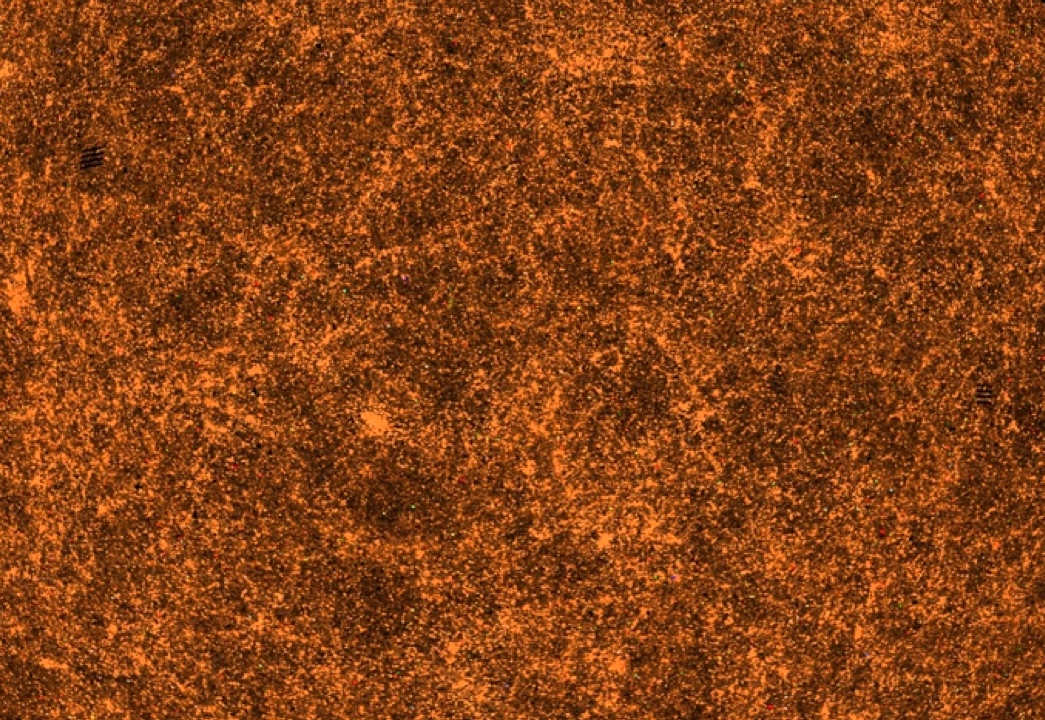
Image credit: Sloan Digital Sky Survey - III / Data Release 8.
In the above image, still showing just a fraction of the Universe scanned and measured by the Sloan Digital Sky Survey, each pixel represents an entire galaxy. By measuring how galaxies cluster and clump together -- how they are distributed throughout the Universe -- we can determine what it takes to create a Universe that looks like ours.
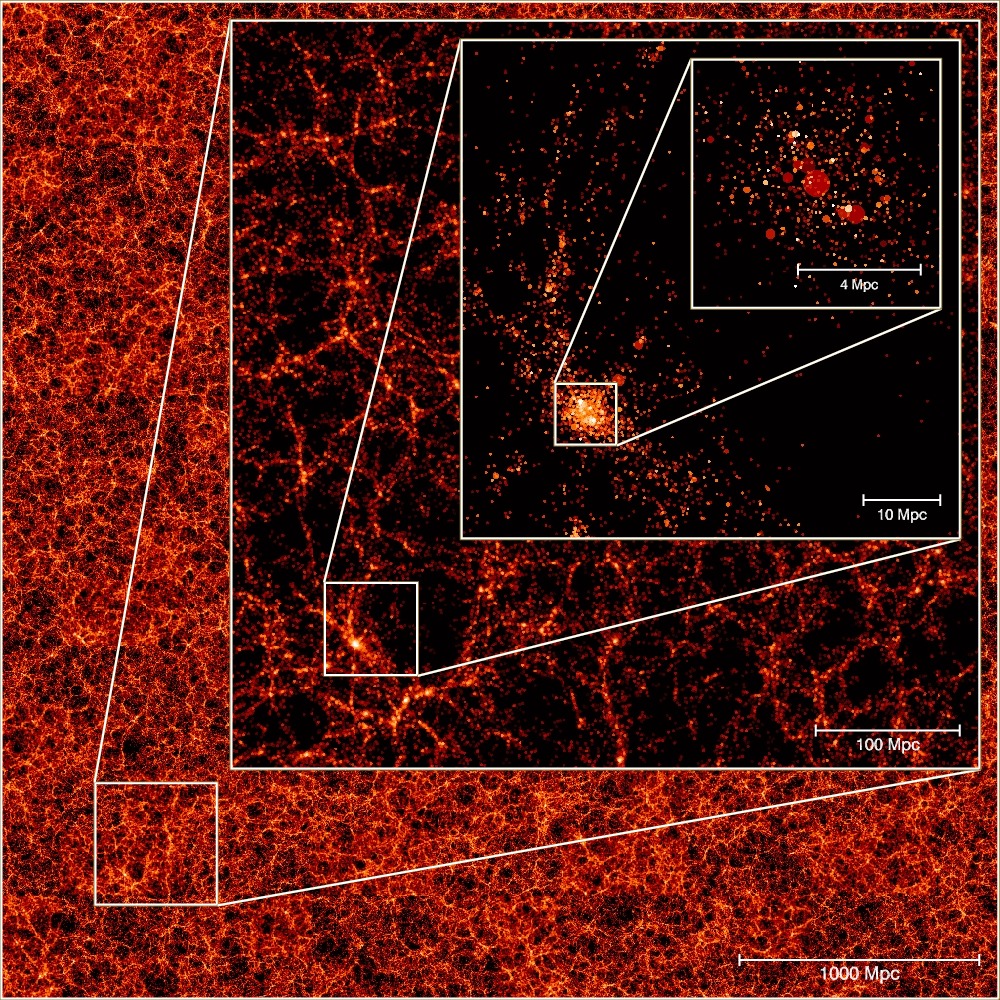
Image credit: Millennium-XXL / Raul Angulo & Simon White / MPA-Garching.
What we learn, as you can go through in detail, is that the structure of the Universe requires that there be a type of matter in it that does not collide with either normal matter or with photons, that outnumbers our (normal) matter by a factor of five- or six-to-one, that don't respond to either electric or magnetic fields, and that... frustratingly, can not be any of the known particles in the Universe!

Image credit: Contemporary Physics Education Project.
This would be a very, very big problem under one condition:
If the known particles and laws of physics explained all of the observed phenomena in the Universe.
In other words, if there's no new physics out there (beyond the standard model), then there's no need for any new particles out there, and so, why would there be any dark matter? There simply wouldn't be a strong motivation, not from an elementary physics standpoint.

Image credit: retrieved from io9.
And yet the opposite of that is also true: if there is physics out there that isn't explained by the standard model, then there must be new types of particles out there! And if there are new particles out there, there are good candidates for this dark matter. You've probably heard of some of the speculations that abound:

Image credit: retrieved from Ecole Polytechnique Federale de Lausanne.
For example, if there's a symmetry of nature known as Supersymmetry (or SUSY, for short), then there ought to be twice as many fundamental particles as the ones we currently know about. Moreover, the lightest one is a perfect candidate for dark matter! Until we know what this particle's properties are, however, we don't know exactly what predictions to make as far as particle-particle interactions go.
While dark matter may or may not be supersymmetric in nature (many argue that SUSY may not even exist), this last part -- that until we know what dark matter's particle properties are, we don't know what predictions to make for dark matter's interactions -- is generally true. But there are plenty of other ideas. Two more speculative ones, first, and then two definitive ones.

Image credit: Kamioka Observatory, ICRR, Univ. of Tokyo.
The electromagnetic, weak, and strong nuclear forces could all unify at some high energy, in what's called a Grand Unified Theory, or GUT. One of the universal consequences of GUTs is that they all predict that protons will decay, and so that's one of the things we look for. In many variants of GUTs, there are candidates for dark matter that emerge naturally.

Image credit: Brian Greene / Columbia University.
Same case for extra dimensions; they may or may not exist, but if they do, then there are plenty of new particles and interactions that certainly exist, and one (or some) of them may make excellent dark matter candidates.
But those -- supersymmetry, grand unification, and extra dimensions -- are speculative ideas, and may not describe our Universe. But there are two observations that we have already made in the Standard Model that already cannot be explained by the particles and interactions we know today. This means there are new particles out there, yet undiscovered, that could easily solve the dark matter problem.

Image credit: Hiroshi Nunokawa.
For one, neutrinos have mass! According to the Standard Model, there should only be one type of neutrino -- a left-handed one -- and they should have zero mass. But this is not the case!
They are observed to have non-zero mass. In fact, all three types of neutrinos have non-zero mass, meaning there is new physics and there are new particles out there! Right-handed (or sterile) neutrinos could very easily make up the dark matter; we are searching for them as you read this! But perhaps the new physics that explains neutrinos isn't also what explains dark matter. There's another problem.

Image credit: Normal Rockwell, retrieved from mcgarnagle.com.
There are a couple of fundamental symmetries of nature that, at least in everyday life, seem pretty obvious. One is that the laws of physics in a mirror -- where left and right are reversed -- are the same as our normal laws of physics. (We call that Parity, or P-symmetry.) Another is that matter and anti-matter obey the same laws of physics. (We call that Charge Conjugation, or C-symmetry.) Most laws of physics that you know, like gravity and electromagnetism, always obey these symmetries.
According to the standard model, they have to; it's coded into the physics. But these symmetries don't exist for the nuclear (weak and strong) forces in the standard model. If I took something like a muon, reflected it in the mirror (applying P-symmetry), and replaced that image with an anti-muon (applying C-symmetry), I'd be testing whether the combination of CP-symmetry was a good one or not.

Image credit: James Schombert at University of Oregon.
If it were a good symmetry, then if all the muons decayed with one orientation, all the anti-muons would decay with that specific, mirrored orientation. But they don't, and so that CP-symmetry is violated. This is good for the Universe, because CP-violation is one of the necessary things to make more matter than anti-matter. But if it happens for an interaction like this -- the Weak nuclear interaction -- then it stands to reason that it should also happen for the strong nuclear force.
But it doesn't! Why wouldn't it?

Image credit: Playmobil Circus Tightrope Artists Performers.
The same reason this unicycle toy doesn't tip over: there must be some sort of extra, hidden weight that provides extra balance, or in the particle's case, crushes the amount of strong CP violation. Theoretically, the standard model allows you to violate both C and P together here, but we've looked, and to something like one part in a billion, we don't see any. So something -- and this means there's new physics -- has got to be forbidding it!
This outstanding problem, known as the Strong CP problem, is the second hint of new physics that must go beyond the standard model. And at least one class of solutions to it produces an outstanding dark matter candidate, known as the axion.
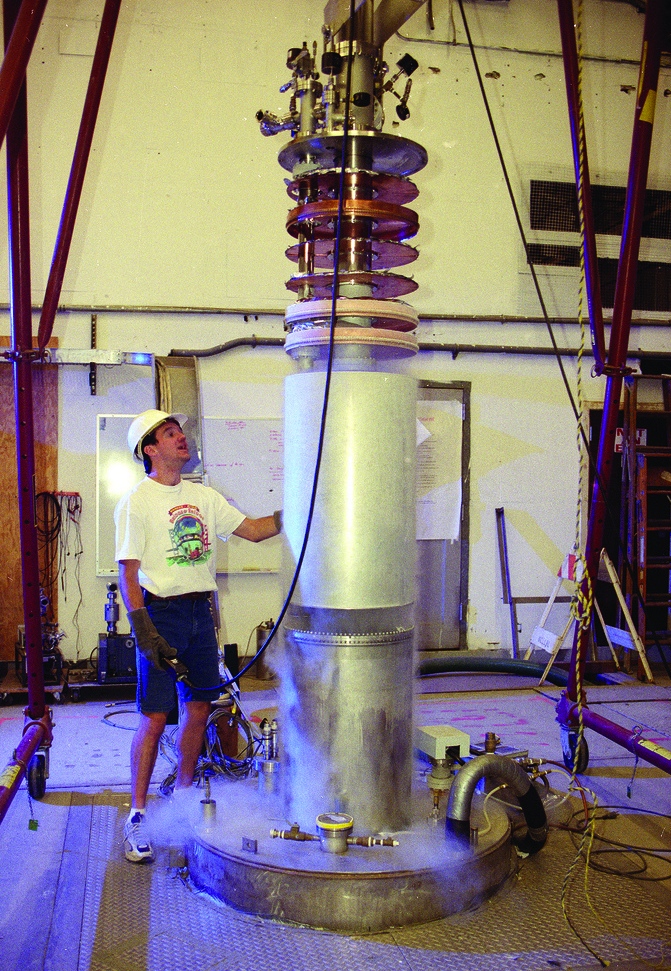
Image credit: Axion Dark Matter Experiment (ADMX), LLNL's flickr.
There's definitely physics in this world that's beyond the standard model, there's definitely more to neutrinos than we know, and there's definitely something stopping CP violation from occurring in the strong interactions. There may also be extra dimensions, grand unification, supersymmetry, or something even more exotic or surprising. But all of these possibilities require new particles, many of which make good dark matter candidates, and all of which have unknown particle parameters.
When you combine this information with our astrophysical knowledge of dark matter, you can see why I prefer the approach of using the astrophysics to try and reconstruct/determine some of the particle properties of dark matter, and try to guide us as to what we should look for. (No, really, I sometimes research that!)
We've got lots of options and lots of searches going, but there's so much we don't know about it at this point! Cross-sections, masses, reaction rates, lifetimes, etc., they're all mysteries at this point. We may not know what dark matter is, exactly, but we've got lots of strong possibilities for what it could be, and some hints that simply can't be ignored. We're desperately trying to be able to detect it directly, and solve this mystery once and for all. Welcome to the cutting edge!
Particle physicists seem unanimous that the CERN LHC should detect some new particles. I can wait a year or dozen for the next new fundamental particles. Whatever they are; they should clear away a lot of speculation; because right now particle physics is suffering from an abundance of speculation and not enough new experimental data.
Let's hope that whatever is found helps explain the dark matter observations. The various dark matter theories are nice; but without a particle or a process, all we've got is something analogous to Newton's action at a distance; the best dish in town but not a satisfying meal.
I bet for supersymmetry, but I am not a physicist.
I confess to wanting SUSY to be true because, though I'm not a physicist, it sounds so PRETTY.
I don't think there is dark matter, at least not in the way you are describing it. There, I said it. There is no compelling reason I've heard as to why non-baryonic particles should collect into halos around galaxies.
I fully respect the holes that dark matter fills in the large scale structures of the universe, but I don't think that hole is going to be filled with the types of particles you describe. If I had to make a wild guess as to what is really going on, I'd bet that dark matter and dark energy are both a manifestation of Zero Point Energy. We know from Hawking radiation that particle-antiparticle condensate is gravitationally active. Zero Point Energy does surround all galaxies because space surrounds all galaxies.
There are are the known knowns and there are the known unknowns but there also are the unknown unknowns.
We need a unified theory of politics and physics. :)
Minor quibble with your opening thought: I think that if you were standing on a high mountaintop watching a ship come over the horizon, you would have good reason to surmise that the earth is spherical (or at least curved).
@Denier (4):
For this (Zero Point Energy) to be true you have to show that the forces between the two plates in the "Casimir effect" experiment are caused by gravity...
@anybody:
Is there anybody who can help?
The following text is entirely quoted from the following page:
http://www.newscientist.com/blog/lastword/2007/03/fooled-in-blackpool.h…
While camped at 6000 metres altitude in Peru in 1962, I and some colleagues asked ourselves this question about the Pacific horizon. We actually only saw the curvature by comparing the horizon (about 277 kilometres away) with a nylon thread stretched tight and level between two ice axes.
While standing atop Blackpool Tower, if you sight the seaward horizon over a level, 1-metre straight edge, which is held 1 metre in front of you, trigonometry shows that the ideal horizon would appear to be almost a millimetre higher at the centre of the straight edge than at the ends. This is a much smaller effect than typical atmospheric distortion which, in effect, means there is no visible curvature.
From our camp in Peru, the difference was almost 6 millimetres - easily visible when compared with a straight edge. Even so, the curvature was not apparent when simply looking at the horizon.
Charles Sawyer, Byron Bay, New South Wales, Australia
@4 - Denier
We don't know. It is still hypothetical.
Nice presentation,
although that image from Millennium-XXL is not a very usefull picture imo.
There cannot be a physical representation of a followed path from a photon, displaying -multiple- histories.
It would be like -> Hey, I can see the history of a particle [currently] of my own body in the past!
A photon represents [with a lot of other photons together] a picture of the physical circumstances at the moment of creation.
Showing a picture of the mass distribution at the time of its creation. It carries no information about the conditions of a later period.
This simulation implies that you can see multiple histories of a particle at the same time.
As a consequence that would imply that you can follow the entire history of a photon during its travel into the future, looking back from the past. But one can observe only the followed PATH it travelled.
There cannot be any physical connection between the baryonic particles emitting that radiation and the distribution of mass in the present.
CMB radiation therefore cannot represent any information about our present state of mass distribution.
Although it can display some information about mass distribution at a later time, because of the dynamic SZ-effect. I admit that.
@SCHWAR_A - I'm not following your logic on that one but am willing to hear you out. Please expand on your thought of the Casimir effect needing to be gravity based in order for particle-antiparticle Zero Point Field (ZPF) condensate to be responsible for the effects attributed to dark matter.
For the record, I believe that Casimir force is caused by the gap between two plates being small enough that some wavelengths cannot exist between the plates but can exist outside the plates, and that causes an overpressure which drives the plates together. I don't see how that concept makes the other concept of gravitationally active condensate impossible. Please explain.
@Denier (11&4):
One possible solution may be the following:
The Casimir effect is known to get its energy from the zero-point energy:
"...it is best described and ... easily calculated in terms of the zero-point energy of a quantized field in the intervening space between the objects." [Wiki]
With this knowledge we must assume that the attractive force is caused by the integer multiples of standing half-waves with minimum-possible wavelength, between both plates. This is the sum of all such waves between all particle-pairs between both plates.
The energy for or of these waves is the zero-point energy.
You claimed in (4) that ZPE could be the reason for the additional gravity, called "DM".
This means to have the same situation as in the Casimir-experiment: at least two particles distributed to two sites with one standing minimum-wavelengthed half-wave, sourced from ZPE, in between.
And this would mean that ZPE is responsible for gravity, at least for the additional gravity "DM".
Greetings.
very nice survey. surely the reason i keep coming to your blog.
Neither Ethan nor anyone else in the comments mentioned this, and seems to me it hasn't been covered.
So here's my question.
What astronomical/astrophysical observations/experiments are due in the near future that could give more data in order to shrink the amount of theories floating out there.
LHC as far as SUSY and some exotic particles is nice and fine, but I'm more interested in astronomical observations. From what I can see both DM/DE side and f(R) gravity side by now have many similar models. Not just galaxy rotations but many other phenomena.
Seems like there's too many theories and not enough data at the moment. So any news about future couple of years as far as possible experiments that could lead to more insight?
@SCHWAR_A(12) - I can see where the confusion comes from. Please let me clarify. In the same way that matter and energy are two sides of the same coin, I believe the effects attributed to both dark matter AND dark energy stem from ZPF. The Casimir force is on the dark energy side of the coin, is not gravity based, and at the same time does not preclude the 'gravitationally active particle-antiparticle pairs as dark matter' concept.
Speaking specifically to the relationship between the Casimir force and dark energy, there have been some attempts to mathematically tie them together.[1]
[1]- http://arxiv.org/pdf/1102.5572v3.pdf
@Denier (15):
"The Casimir force is on the dark energy side of the coin, is not gravity based, and at the same time does not preclude the 'gravitationally active particle-antiparticle pairs as dark matter' concept."
Is this Your speculation, or physically based?
Could You please explain the reasons?
Thanks a lot,
Greetings.
"As a consequence that would imply that you can follow the entire history of a photon during its travel into the future, looking back from the past"
To the photon, time doesn't pass and there is no distance between its origin and its destination.
@Wow(17) & Hannes (10):
To me its not clear, what Hannes claims:
A) The simulation changes the photon-properties of creation-time on their way.
B) The actual photon changes its properties while travelling.
For me is very clear that the entire history of the travel is imprinted to the photon: it changes its direction due to gravity, it changes its wavelength due to expansion and passed masses, it changes spectrum and its lines due to passed electron-configurations, it suffers from polarization changes, from interferences...
But there is no way to find out, when/where what was imprinted to the original photon, just by scrutinizing the received and thus changed photon.
Greetings.
@SCHWAR_A(16) - I would say both. As with modified gravity theory or nonbaryonic dark matter theory, there is undeniably speculation involved. There is also a proposed physical model where virtual photons exist at all frequencies but there is a Ginzburg-Landau type phase transition at 1.7 THz, and the photons below that are gravitationally active while above it they are not.[1]
The paper linked below goes into greater detail on exactly how the proposed Ginzburg-Landau-like model is fully consistent with QED Casimir force.
[1] http://arxiv.org/pdf/astro-ph/0703364v2.pdf
"it changes its direction due to gravity... etc..."
These are all how it changes to our perception. Consider the centrifugal force.
Doesn't exist.
But to turn a rotating frame of reference into an inertial one (so we can use all the idioms we found so useful in our practically inertial day-to-day life), we "see" a force that keeps the water in the bucket that would otherwise fall out due to gravity.
This may be a clearer explanation of why, as you say, we can't find out where this photon was morphed in its history.
But if we look back at where, from our POV, this photon came from, we can see the dust cloud that scattered the photon's brethren, the star whose gravitational field stretched the photon and made it "bend" from its straight path and so on.
It is therefore entirely possible to say what happened to the photon in its history.
You just can't ask the photon. It has no voice, no memory.
Does a regular muon ever decay the 'wrong way', or is it just the anti-muon?
In fact, does ANY other particle do this?
@Wow (20):
"It is therefore entirely possible to say what happened to the photon in its history."
Consider the photon was influenced a bit by objects that we cannot see or detect anyhow - such encounters are also contained in the history...
So it actually "is" not possible, because the computer to calculate this, would be something like our universe itself (built on "Magrathea"? - see Douglas Adams ;-)
Greetings.
"Consider the photon was influenced a bit by objects that we cannot see or detect anyhow"
And suppose there's an invisible monster made of spaghetti and meatballs pulling on strings that are also invisible and indetectable?
Really.
WHAT can interact with a photon and not be visible (light is made up of photons)? Leprechauns?
@Denier (19):
...actually a very interesting paper, thanks a lot!
Following this, wavelengths below 0.15mm are gravitationally active while those above are not.
The largest measured Casimir-distances are about 6µm and thus in the gravitationally active range...
Greetings.
@Wow (23):
???
SHWAR (25)
!!!
(obviously you cannot actually answer the question, else you would have)
@Wow (26):
sorry, may be I do not understand your intention...
"WHAT can interact with a photon and not be visible (light is made up of photons)?"
Is that the question you mean?
OK:
Imagine a per se detectable, but for our sensors unmeasurable mass passing your photon somewhere on its way to our detector. This mass had an effect to our photon.
Without permanently waching "all" masses in the universe simultaneously, we cannot reverse-calculate the history of our photon.
Greetings.
@SCHWAR_A(24) - I'm not understanding what you are saying. Per the model outlined in the linked paper, lower frequency, longer wavelength photons are gravitationally active. Higher frequency, shorter wavelength photons are not. A wavelength of 6µm is a higher frequency, shorter wavelength than 0.15mm and thus in the inactive range. Am I missing something obvious or did you get tangled up in frequency versus wavelength?
Quoted directly from the paper:
---------------------------------------------
Note that in our model virtual photons exist (in the
usual quantum field theoretical sense) for both ν < νc
and ν ⥠νc, hence there is no change either to quantum
electrodynamics (QED) nor to measurable QED effects
such as the Casimir effect at high frequencies. The only
thing that changes at νc is the gravitational behavior of
virtual photons.
---------------------------------------------
"Is that the question you mean?"
Yes. See how much easier it is when you say something?
"but for our sensors unmeasurable mass passing your photon somewhere on its way to our detector"
This would require a large mass an EXTREMELY long way away, and without any nearby neighbours for us to find its effects.
And this is only "current sensors". 150 years ago, we couldn't detect galaxies as being made up of stars. 80 years ago, we couldn't get enough light in to detect the redshift.
Today, we can't get the resolution to detect an atmosphere on a planet. But in 10 years time, there will be several detectors able to do so (if we spend the money to make them).
And this hypothetical case still is begging the question. You have to presume such an object exists to prove the contention that we can't tell the history of a photon if it interacts with it.
But a large mass of a galaxy can cause more distant galaxies to move or appear several times (gravitational lensing).
Even at billions of light years distance, we can still tell what's been fiddling with the photons we see.
"Per the model outlined in the linked paper, lower frequency, longer wavelength photons are gravitationally active. Higher frequency, shorter wavelength photons are not."
Why?
They are all affected by gravity. There's no apparent reason why not. An electron still exerts gravitational attraction on its neighbours, so why does it not work for high frequency (therefore more massive) photons?
@Denier (28):
You are right, I toggled both with fatal result!
May be because the DeBroglie mass-wavelength relation shows the vice-versa behaviour: smaller wavelength is higher mass.
To me its nevertheless unclear:
- Why about 151µm shall be the wavelength threshold between attractive interaction and no interaction.
- Is this threshold a hard boundary or smooth?
- How does the large-wavelength photon act gravitationally at all?
- What is it doing different that that with smaller wavelength?
- Is there something, which counteracts the more with the photon the less energy it has, like damping? Something like an ether?
Greetings.
One answer: A neutrino "can interact with a photon and not be (electromagnetically) visible". The neutrino interacts with the photon via the gravitational force.
Thus so the "dark matter observations" need some particle-like-thing (e.g. a neutrino or a geon)that is gravitationally active (all matter and energy is gravitationally active); but that does not interact with photons electromagnetically (or else we could astronomically directly observe the cause of the "dark matter observations".)
But neutrino hypothesis has not explained the dark matter observations in the detail (nor has any other hypothesis yet). And physicists and astronomers understand a lot of detail that needs to be consistently part of any dark matter explanation. So until the physical insights, mathematics and observations all work together in the detail; we got nothing.
The problem isn't "waching "all" masses in the universe simultaneously". Astronomers, accurately enough, do take account of all relevant mass. From a galaxy time point of view, light passes through a galaxy in the blink of an eye (10-100 thousand years) versus galaxy rotation (10-100 million years) or galaxy collision (AndromedaâMilky Way collision predicted in 3 to 5 billion years). Light moves fast, galaxies move slow.
"One answer: A neutrino "can interact with a photon and not be (electromagnetically) visible". The neutrino interacts with the photon via the gravitational force."
And the mass of a neutrino is what?
So, now, how BIG a change will that have made to the redshift of a photon?
Go on.
Give it a quick calculation.
"but that does not interact with photons electromagnetically"
The electrically neutral mass of the Moon interacts with photons, but not elecromagnetically.
It isn't Dark Matter, however. So this isn't enough to discern the uniqueness of Dark Matter from Ordinary Matter.
But I agree that we NEED more than just the placeholder "Dark Matter" to get it any further than "isn't it just a fudge factor?".
@Wow(30) - Phase transitions like this are not unique to this theory. The Higgs Mechanism in the Standard Model has all elementary particles as massless above the Electro-Weak Symmetry Breaking point.
This particular theoretical model is based heavily on the Ginzburg-Laudau theory of superconductivity. The authors propose an analogue to Cooper pair condensation is responsible for the observed effects.
Simple answer: there SHOULDN'T be dark matter... IF gravitational theories were SUFFICIENT to account for actual observations based on the OBSERVABLE gravitating masses. That gravitational theories require reified mathematical fairy dust to prop them up is basically a failure of science to adapt to changing realities and find a better answer. Kind of sad, really. ;)
C'est la vie. Ya' go with what you've got, sometimes...
Personally, I really think that SOMEone needs to go back down the garden path to the fork in the road and see what lies down the other path.
(Evolution of the Plasma Universe: I & II)
http://plasmauniverse.info/downloadsCosmo/Peratt86TPS-I.pdf
http://plasmauniverse.info/downloadsCosmo/Peratt86TPS-II.pdf
Easy enough to pick up & read for a potential new starting place using fully electrodynamic models, rather than old-school gravitational models. Again, just for shits and giggles... Seems like the possibility needs exploration, though. Yeah? We know a lot more today about the universe (it's mostly plasma! not just 'neutral' matter) than we did when gravitational theories somehow stole the show and never gave it back. Up until that point, there was something of an enthusiasm for explaining things electrically (comets, solar surface action, etc.)... It's too bad the gravitational theorists were louder. =o\ Methinks it set up back about a century of theory...
Read up on Kristian Birkeland, C.E.R. Bruce, Eric Crew, Alfvén, Ralph Juergens, Wal Thornhill, Anthony Peratt, Eric Lerner. There's a whole other vista of cosmology yet little explored... But offering such great promise, if only someone were brave enough to set aside their engrained opinions and explore it.
But, we go with what we've got it seem, even if it's full of mathematical fairy dust that's been refuted 5 ways from Sunday...
https://plus.google.com/112680512627015845391/posts/Aa1HJ5jBZEe
How does the idea that there is a cut-off wavelength for photons participating in gravitational attraction mesh with reference-frame-dependent red shift? How does it mesh in general with General Relativity, where energy affects the geometry of space-time? Now it's only some energy?
@SCHWAR_A(31) - All great questions. Sadly this particular theoretical model is phenomenological. Although I do like this one, please keep in mind there are dozens of ZPF dark energy/dark matter models. Another, far more microscopic model[1] that also eliminates the shorter wavelength energies is linked below.
[1] - http://arxiv.org/pdf/1010.1339.pdf
@CB(35) - The cutoff is not for photons, it is for virtual particles in the zero point field. The way it fits into general relativity is to create a cosmological constant that expands the universe in an ever accelerating manner, and create the additional mass attributed to dark matter.
I have a question. Sounds stupid but my search-fu was weak this time. The pics from the Sloan survey has distances listed as Mpc. Now i found that 1 Mpc = 3.08568025 Ã 10/22 meters (couldnt make the 10 to the 22 power small). Antwhay my question is what the hel does Mpc stand for? Mega parcects? Million Parcets? or something completely diffrent?
Thanks
@Hermit(37) - Mpc = megaParsec
Thank You! Thats what I thought but wasnt sure.
I suspect dark matter is going to turn out to be ordinary dust and the reason it exists is because nature abhors a vacuum.
@SCHWAR_A
I can't see how an entire history of a photon can be inprinted on it.
Because we look back tracking its followed path we deduce from its surroundings what might have happened to it.
If we leave away all this circumstantial evidence all what is left is a single photon with certain characteristics. And we can measure those one_time_only.
The CMB photons that are polarized do [afaik] not show up in WMAP's images at the cold spot since they must have higher energetic levels also, due to inverse Compton scattering.
The CMB photons detected are the ones that are believed to be undisturbed and untouched. They show up as a cold spot because we detect less of them.
If the photons were gravitationally bend they would be far away from the cold spot also.
All the other stuff:
"it changes its wavelength due to expansion and passed masses,
it changes spectrum and its lines due to passed electron-configurations"
..are not real changes to the photon imo. If you look at a bigger holographic screen there is no actual change to the photon itself.
The energy-total is the same and a telescope can restore the original spectrum.
A single photon can also not interfere with itself.
"I can't see how an entire history of a photon can be inprinted on it."
I can't see how this is required.
"And we can measure those one_time_only."
Any event is one time only. I can't see how this is a problem.
"A single photon can also not interfere with itself."
Though mostly true, if they can self-gravitate (i.e. the produce a gravitational field as well as react to it), then they do.
Though this again has a very similar problem to shwar's "a neutrino could affect a photon!".
"That gravitational theories require reified mathematical fairy dust to prop them up is basically a failure of science to adapt"
Except that this entire discussion shows science trying to adapt.
I guess when you see an athlete running the mile really fast, if they haven't actually finished yet, this "proves" that the athlete cannot run the mile, hmm?
@Hannes (42):
"...what might have happened to it."
...with accented "might". Additionally, all these "happenings" are more or less in the past. Thus "imprinting" is not literally as a list; it is somehow gathered, the non-reversable sequential sum of all influences.
"...there is no actual change to the photon itself. "
Changing the vector is not a change?
Holography lives from "phases", thus the photon with changed polarization, wavelength, direction "is" changed.
"A single photon can also not interfere with itself."
Interference in my list was from external sources, like all other influences...
Greetings.
@Wow (43):
"...self-gravitate..."
This is an interesting aspect!
Do you know severe papers dealing with this?
What would that mean to the various wavelengths?
Greetings.
"What would that mean to the various wavelengths?"
Not much, since the gravitating mass of the photons is tiny compared to the baryonic mass of the universe.
It does change how the universe may be shaped somewhat, though, and would have had a vastly different effect in the early universe. That's where I find the idea interesting.
But the effect that would have today, not much.
@ Denier:
Okay, how do we reconcile different properties for virtual and real photons? Doesn't a gravitational cut-off for virtual photons imply that an energy-carrying electromagnetic field would cause changes in potential energy of other objects based on that field's gravity if the virtual photons are above or below the threshold wavelength?
By the way, I just want to mention what a new and pleasant experience it is to discuss this issue with someone who is against Dark Matter theories but isn't all "Scientists are dogmatic and refuse to admit they're obviously wrong!"
This is especially poignant with the arrival of the usual Plasma Cosmology "Dark matter is fairy dust, but I'm going to shove the electric force into everything even if unnecessary" type.
@CB(48) - The concept of virtual and real photons having different properties is well established. For example the virtual photon is thought to be the carrier of the electromagnetic force[1], while real photons do no such thing.
The Zero Point Energy causing changes in the potential energy of other objects is the basis for the Casimir effect[2], however the gravitationally active component does not come into play because the distances involved are shorter than the wavelength phase transition point. That was the nature of the discussion I was having with SCHWAR_A earlier in this thread. Over longer distances, there would be a gravitational influence which could fill the roll of dark matter.
Thanks for the compliment CB. It is good to have a place with knowledgeable contributors where I can bounce some of these ideas around.
[1] http://www.physics.ox.ac.uk/documents/PUS/dis/virtual_photon.htm
[2] http://en.wikipedia.org/wiki/Casimir_effect
"The Zero Point Energy causing changes in the potential energy of other objects is the basis for the Casimir effect"
That is incorrect.
Quantisation of photons is the prime cause of the Casmir effect.
@Wow(50) - The theory feels pretty solid on this one. I think you would be hard pressed to find a paper or even internet page describing the Casimir effect that didn't mention zero point energy(ZPE), vacuum energy, zero point field (ZPF), vacuum fluctuations, etc. Experimental observations are also consistant with the theory.[1] That being said, I'm always game for something new.
Just to be sure I understand your proposed theory on Casimir effect, you are saying the Casimir effect is dependent on quantization of real photons. If the experiment to measure the Casimir effect were conducted in a shielded vacuum chamber where no photons were allowed to enter, there would be no measurable force acting on the plates. The Casimir effect works only in the presence of photons. Is that right? Please expand on that.
[1] http://arxiv.org/pdf/quant-ph/0106045.pdf
"The theory feels pretty solid on this one."
Maybe, but your understanding of it is wrong.
"Just to be sure I understand your proposed theory on Casimir effect, you are saying the Casimir effect is dependent on quantization of real photons."
No. Read again: "Quantisation of photons is the prime cause of the Casmir effect."
PS this:
"If the experiment to measure the Casimir effect were conducted in a shielded vacuum chamber where no photons were allowed to enter, there would be no measurable force acting on the plates."
Is impossible. It's like the "if a tree falls in the woods" conjured conundrum (or, as I recently told someone else, the "which came first").
Part of your problem may stem from what you don't know about the "virtual" part of science.
An electron/positron virtual particle pair consist of two actual real things: an electron and positron.
They just annihilate before their existence violates two requirements:
1) No energy in the region
2) Heisenberg's Uncertainty Principle as relates to #1 above
"For example the virtual photon is thought to be the carrier of the electromagnetic force[1], while real photons do no such thing."
What? I thought virtual photons were only used to explain electrostatic forces where you can't detect photons, but all photons are electromagnetic force carriers.
@Wow(52) - That's better, but by including the previously omitted word 'virtual' you are only part of the way back.
A point where I'm still unclear is on virtual particles versus zero point energy(ZPE), vacuum energy, zero point field (ZPF), vacuum fluctuations, etc. In post 50 you objected to the idea of zero point energy being the basis for the Casimir effect, but are now touting virtual particles. Please expand on your idea of how virtual particles are unrelated to zero point energy(ZPE), vacuum energy, zero point field (ZPF), vacuum fluctuations, etc. Bonus points if you can do the same for Heisenberg's Uncertainty Principle as you are using it.
@CB(53) - The force-carriers are virtual particles. The virtual photon carries the electromagnetic force. The gluon is the force-carrier for the strong nuclear force. W and Z bosons handle the weak nuclear force. Real particles as force-carriers violate energy and momentum conservation.
If you just wanted to see that real and virtual photons have different properties, the link [1] in post 49 speaks plainly.
If force-carriers needing to be virtual is unclear, this explains it better than I could:
-----------------------------------
http://electron6.phys.utk.edu/phys250/modules/module%206/standard_model…
Force carriers
In quantum field theory, fields are associated with particles which transmit the forces. The particles of the electromagnetic field are the photons. In quantum electrodynamics all electromagnetic fields are associated with photons, and the interaction between the charged particles occurs when one charged particle emits a virtual photon that is then absorbed by another charged particle. The photon has to be a virtual photon, because emission of a real photon would violate energy and momentum conservation. If, for example, an electron initially at rest emitted a photon, the final state would consist of an electron and a photon moving off in opposite directions, a configuration which necessarily has more energy than the initial at-rest electron.
-----------------------------------
Sorry, still not clear. That example only covers the electrostatic case which I already understood to use virtual photons. In any circumstance where the electron would lose energy as a result of emitting the photon, such as emitting in the direction of its motion, I don't understand why it would be required that the photon be virtual.
Also, the only difference between a virtual and real photon the link suggests is that a virtual photon is one that we can't observe because it must be reabsorbed in an amount of time that satisfies the uncertainty principle. It says that's what "virtual" means. So, where does the virtual photon become something actually different? I don't get it.
@CB(56) - Virtual particles exist out of borrowed vacuum energy. This is why they can spring up out of empty space without violating conservation laws. There is an upper limit to the amount of energy that can be borrowed. The energy of the virtual particle multiplied by the amount of time it exists cannot exceed the Plank Constant. The less energetic particle, the longer it can exist. The more energetic, the less time it has before it has to give the energy back and wink out of existence. Real particles have their own energy.
It is possible to turn virtual particles into real particles that are not limited by the Plank Constant, but that is a can of worms that can opened later.
With the exchanges of electromagnetic,weak, and strong nuclear forces, the particles that emit these forces are not diminished by emitting them. For instance, the electron has an electromagnetic charge that can be detected over a distance until the end of time without ever using itself up. No energy is going into the transmission of that electromagnetic force. It can not be a real particle transmitting the force because a real particle requires energy to create it and get it moving. On the other hand, a virtual particle does not require energy from the emitting entity because it borrows its energy from the vacuum. It just can't transmit the force very far because its existence is limited.
Does that help, or did I make it worse?
"Virtual particles exist out of borrowed vacuum energy."
Nope, they exist out of borrowed energy.
You're making (again) a distinction that doesn't exist and only clouds the issue.
This is why CB is having problems with your explanations. You're making stuff up as being somehow special and different when they aren't.
"but by including the previously omitted word 'virtual' you are only part of the way back."
Nope, I'm already at the right place.
You keep putting "virtual" as some sort of magic pixie dust that makes it all so very different.
It isn't and your insistence that it is shows you haven't really understood it at all.
@Denier:
(55) "The virtual photon carries the electromagnetic force."
(57) "...the electron has an electromagnetic charge that can be detected over a distance until the end of time without ever using itself up."
(57) "...a virtual particle does not require energy from the emitting entity because it borrows its energy from the vacuum. It just can't transmit the force very far because its existence is limited."
Isn't there a contradiction:
end-of-time range for force caused by charge
vs.
limited range, because it is "virtual".
Greetings.
Am sorry to interrupt the discussion about ZPE and Casimir ef., but am unclear to how this could ever be tied to DM or DE.
Namely if DE is indeed Lambda then yes, somehow ZPE can maybe be an explanation. But again, I think that the theorized and measured values will be extremely non-compatible.
But my main confusion in Denier's argument comes from Casimir effect and DM. It is well known that Casimir effect only makes sense on very small scales (atomic, quantum scale). By what mechanism is it working on galactic scales? And what are the parallels to the uncharged plates? Galaxies? Again back to the first question, what about distance? How does it propagate to such large scales? Virtual particles are virtual because they "exist" in a extremely tiny time fraction, by what mechanism do they span galactic distances? Thanx!
"but am unclear to how this could ever be tied to DM or DE."
Denier has some whacko theory that photons above a certain energy don't get modified by gravity and that the Casmir effect shows this phenomenon.
Or, in short: nobody is clear how this could ever be tied to DM or DE.
@ Wow
Is he talking about gamma ray types of energy or even higher? Gamma ray's we can detect. And how much photons. That's what I don't understand. Am I understanding correctly, his theory about the cause behind DM would be highly energetic gamma ray bursts from all around the universe??
@SCHWAR_A(60) - Often my explanations aren't great and I can see how that one is particularly confusing even right after I wrote it. My apologies. Let me try to clarify.
There are 4 things to keep track of:
1 - The source entity (electron)
2 - The force-carrier (virtual photon)
3 - The electromagnetic charge (negative)
4 - Information of the charge's existence
In the example, the electron is the source entity. It has a negative charge. The negative charge the electron has isn't ever diminished. If you measure its charge now, or a thousand years from now, the charge will be the same.
The second entity is the transmission agent, or force-carrier. In the example, that is the virtual photon. The force-carrier never has the electron's negative charge, only the information that the charge exists. The force-carrier can transmit that information, but only over short distances because its existence is limited.
The point of bringing that up was because I was contrasting the property differences between virtual photons versus real photons in highlighting that light can travel across the universe but magnetic force is only felt locally despite both being transmitted by photons.
The two lines at the bottom of your post aren't a contradiction because they are descriptions of different actors.
@Sinisa Lazarek(61) - Forget about the Casimir effect. It was brought up by SCHWAR_A when seeking a clarification, and it has led to numerous tangents ever since.
In a nutshell, the theory is that some virtual particles are gravitationally active while others are not. Those gravitationally active virtual particles are what make up the missing mass that is currently called dark matter.
@Wow(58,59) - I had hoped that in working through what I had asked in post(54) that you would see your error, but it appears you've skipped it. I suppose it is true about being able to lead a horse to water.
Despite my attempts that have included links reputable sources, I can see that you disagree with my view that ordinary photons and virtual photons have different properties. I'll leave debating this point with words from the Department of Physics at Oxford.
"...the virtual photon has different properties to ordinary photons."
http://www.physics.ox.ac.uk/documents/PUS/dis/virtual_photon.htm
If you'd like to continue to debate the point, I'm sure you can find an email address on their site.
@65 (Denier)
Ok, even if that was the case, then something else is bothering me. How do you fit that to observational facts?
If you have virtual particles popping in and out of existance all the time, thus having a net gain to "missing mass" of the universe, that process should be uniform...all over the vacuum of space without any form or structure.
How would that explain the rotation of galaxies, galaxy mergers, structure formation, gravitational lensing etc. What prediction would such a theory make? Seems like it's just changing the words.. not dark matter anymore, but a virtual particle that is just a gravity force manifestation in the real world. We can't detect it since it's virtual, but it's gravity contirbution and probability distribution is just such as we need.
@Sinisa Lazarek(67)
With regards to the rotation of galaxies, this theory fits observations far better than WIMPs or other Dark Matter (DM) particles. That theory has particles that do not interact electromagnetically, or via the weak, or strong nuclear force. As such, DM particles can not collide with anything. In a collision of galaxies, the regular matter does interact and slows down to form a new cluster. DM would keep right on going. I'm sure you've seen the bullet cluster overlaid with lensing data to demonstrate exactly what I am talking about.
The problem with that is the dark matter has no reason to come back to the new cluster. Remember that the ejected DM has 5 times the mass of the visible matter. It might be possible the DM cloud doesn't get away and two separated masses start orbiting around a common central point. That would be interesting from our perspective because we could only see the visible matter.
The amount of dark matter in a galaxy would also vary depending on how many collisions the galaxy had gone through. Lots of collisions would lead to a lot of ejection of DM.
While all of this should happen if this type of DM exists, it has never been observed in the rotational patterns of galaxies. All galaxies rotate around their own central point. The missing mass needed to account for the rotation is always spread evenly around perimeter. Regardless of the history, age, luminosity, or anything else, it is always the same ~140 solar masses per square parsec of DM needed to get the rotation to work out right.[1]
This observation is one of the major weak spots of Dark Matter theory, and a strength of the rival theory of MOND, or as some guy once said:
"MOND is far superior to all models of dark matter in predicting the observed rotation curves of galaxies."
-Ethan Siegel [2]
MOND has a lot of other problems that I won't go into in the interests of staying on point. The reason I bring it up is to highlight a major observational problem DM theory has. If dark matter is made of virtual particles, they can't be ejected because they can only travel as far as allowed by the Plank Constant. Space is always around the outside of a galaxy, and so would be the soup of virtual particles.
[1] http://iopscience.iop.org/2041-8205/717/2/L87/fulltext/apjl_717_2_87.te…
[2] http://scienceblogs.com/startswithabang/2008/01/mond-vs-dark-matter.php
@Denier (64):
"...but magnetic force is only felt locally..."
Do you mean that the magnetic field is only short-ranged?
Or do you mean that there, where the interaction happens, after even long travelling of "real" photons, a "virtual" short-ranged photon finally provides the force?
Greetings.
@Denier (68)
Am sorry, but you haven't seemed to answer my question. Instead you wrote about what DM does and doesn't and what other theories have problems with. Thanx for the reply, but wasn't asking that. Already know the limitations of other theories. Was asking about your theory. And you haven't seemed to answer. It's not only about galaxy rotation. MOND and f(r) gravity models do that great.
But how does your theory explain the bullet cluster? In your theory virtual particles are popping all over the place inside and outside of galaxies. Yet in bullet cluster we can clearly see the mass distribution. How does your model explain that. Likewise how does your model explain gravitational lensing in what seems to be empty space? Your process is uniform and not localised. So how does lensing appear?
Thanx
@SCHWAR_A(69)
The magnetic field is short ranged because the magnetic field is made up of a stream of virtual photons.
Light is long ranged because light is made up of a stream of ordinary photons.
@Sinisa Lazarek(70)
In post(67) you asked multiple questions including "How would that explain the rotation of galaxies, galaxy mergers, structure formation, gravitational lensing etc". You have to understand that answering that question is a massive undertaking ill suited to a single reply in a thread. I picked 'rotation of galaxies' first because you mentioned it first.
In short, the model is phenomenological. It works great with observations because it uses observations as the starting point to determine the phase transition point of what is and what is not gravitationally active. Where the model is weak is on the microscopic level where no specific mechanism is proposed for making wavelengths longer than 1.7 THz gravitationally active while those shorter are not.
I realize that is not a very satisfying answer, and will try to address the mergers, large scale structures, lensing, etc., aspects of your question in future posts.
We measure DM through additional gravitation at places, where we do not expect it.
We now stay looking at DM gravitationally:
We assume two masses not too far away from each other.
Each mass has its own gravitational field, inclusive its increasing factors as function of distance, the DM as f(r).
Why are we astonished that between both clusters of "Bullet" no evident gravitational distortion could be measured? It is a vector field and should mainly cancel out...
Greetings.
@Denier (71):
For me was new that magnetic fields are short ranged!
Are there any substantiations for this?
Greetings.
@SCHWAR_A (73)
I'm currently working on reconciling the Bullet Cluster lensing data with the theory for the question Sinisa Lazarek asked. I will post it when it is ready.
@SCHWAR_A (74)
Let's put aside the word 'short' as it is a relative term, but substantiations for range can be found in the form of an 'r' in Coulomb's law. If you were looking for something less mathematical, I'd say that we can see starlight from objects several thousands of light years distant, but can not feel the magnetic influence of those same objects is easy enough.
@Denier (75):
...now my world is in order again!
Magnetic fields range as far as "real" photons do, but we cannot detect them over a large distance, because their energy density is so tiny then.
Thus you marked them "short"-ranging.
And the "virtual" photon is the "force" applied by the field to a test particle locally, and thus is seen to be "short"-ranged, within its Heisenberg-range.
Correct?
Greetings.
Yeah sorry that just makes things worse. And what's this about Coulomb's Law? The electric force follows the inverse square law, yeah, but so does emission of light. One is just a much greater effect because most objects are electrically neutral. As your link http://electron6.phys.utk.edu/phys250/modules/module%206/standard_model… said:
"A virtual photon can exist for a time Ît ~ Ñ/ÎE. Since for a photon the wavelength can be arbitrarily large and therefore the energy arbitrarily small, we can have ÎE --> 0, Ît --> infinity. The virtual photon can have an infinite range."
I'd like more than a throw-away line in a brief link about how virtual photons have different properties that then proceeds to not explain this. This other link that explains in much more detail says (like some others I looked at like WP) that the only difference is that we observe one and can't observe the other because it is always re-absorbed.
@CB (77):
""...The virtual photon can have an infinite range.""
In fact they say that "no" virtual photon has "infinite" range, because a virtual photon with E = 0 is not a virtual photon anymore - it does simply not exist...
What actually is said is that virtual photons have a range, depending on their energy, like
r = K·λ.
Fitting this with the Ginzburg-Landau-type model I guess that
K â 3·10^34,
because the lightest stable mass particle ist the electron and its wavelength λ_C would give about 7·10^22m ~ 2Mpc, the maximum range for gravitationally bound objects...
(And 1/K would be in the numerical range of h...)
Greetings.
It says that the photon can have arbitrarily long wavelength, thus arbitrarily low energy, and thus arbitrarily long range. It's a limit. And it's valid to say (and what that page actually does say, like I quoted) that this limit signifies "infinite range" because for any finite separation, the virtual photon can have a range longer than that. It can be arbitrarily large.
Are you arguing that there is in fact a specific finite range beyond which a virtual photon can't reach? I don't see what the mass of an electron has to do with that, please explain.
I mean, as I understand it the weak and strong forces have a finite range because their gauge bosons have mass. But what prevents a massless photon from having arbitrarily low energy?
@CB
Let me try to describe the difference between a virtual photon and an ordinary photon on a more microscopic level. When an ordinary photon is emitted by something, it travels across space. In one second, that photon will be about 300,000 km from where it was emitted. An ordinary photon is a wave-particle with a certain wavelength.
A virtual photon is nothing like that. There is nothing particle-like about it at all. It is a standing wave. There is no little particle packet that travels between an electron and proton. The virtual photon electromagnetic-force carrier that facilitates the attraction between the two oppositely charged particles is a standing wave that exists between proton and the electron. If the electron is half angstrom distant from the proton, the wavelength of the virtual photon standing wave will be exactly half an angstrom. The standing wave doesn't travel at the speed of light because it doesn't travel anywhere. It exists, and then it doesn't exist.
Virtual photons can transmit the information of spin between 2 particles, but they cannot communicate information about electromagnetic field disturbance because their wavelength is always equivalent to the distance between the two objects in communication.
Ordinary photons can communicate the information of electromagnetic field disturbance but they cannot communicate the information of spin between 2 particles because they are bound by energy and momentum conservation.
@Denier (81):
"If the electron is half angstrom distant from the proton, the wavelength of the virtual photon standing wave will be exactly half an angstrom."
- This standing wave should be a standing HALF-wave and thus its wavelength should be according to twice the distance.
- The docking points of this standing half-wave are the "surfaces" of both particles and not their centres. Thus the wavelength should be a bit shorter than that related to the centre-to-centre distance.
- What is the energy source for this standing half-wave? It must be driven somehow by both particles. There is energy conservation because sent energy returns within the standing half-wave at the same time.
Greetings.
@CB (79):
"I don't see what the mass of an electron has to do with that, please explain."
The electron as the lightest mass which builds up our world has the largest wavelength and thus with the Ginzburg-Landau-like model the largest range following the above mentioned r=K·λ.
And, yes, I argue that there is a limit to all photon radiation, "real" and "virtual".
Following this model electrons have the largest range and thus are gravitationally active far beyond protons/neutrons.
Greetings.
"But what prevents a massless photon from having arbitrarily low energy?"
Nothing.
That's why you get the square law and infinite range. If there were any mass to the photon, the range would HAVE to be limited, since the total energy of the photon would be
m(0)c^2 + e
where e is the energy the photon carries in its motion.
Since to last to infinity requires infinite time from the frame of reference of the observer, the uncertainty principle requires that the total energy of the photon approaches the limit of zero as it approaches infinite distance.
Not possible if m(0) is nonzero.
"We can't detect it since it's virtual, but it's gravity contirbution and probability distribution is just such as we need."
In fact this illustrates Denier's confusion over the whole issue of what he's talking about.
Virtual particles exist for too short a time for the universe to notice them without that universe interfering with it (black holes, for example).
Therefore there would be no gravitational effect since before the graviton could be emitted, the source is gone.
He at once thinks that virtual particles are different from real ones inherently AND that they are the same as ordinary particles. Changing which view based on what keeps their hypothesis alive.
@Wow (85):
"He [Denier] at once thinks that virtual particles are different from real ones inherently AND that they are the same as ordinary particles."
That's not true: Denier told us roughly:
"The virtual photon ... that facilitates the attraction between ... particles is a standing wave ..."
For me this sounds OK, I even would remove all dots from my citation above. A standing wave as a piece of shared, common energy between two particles - a good idea! It would linearly shrink with distance instead of 1/r². Exactly what we need for modified gravitation...
Greetings.
For the last hundred years or so I think we have lost much of our reasoning and logic in physics. We stopped asking the "why" questions and now consider many of these questions in the domain of philosophy or religion. We stopped looking for the simple answers since it is now excepted that reality is very complicated.
A perfect example, I think, is the supposed characteristics of space such as expanding space(BB model), warped space(GR), curved space (GR), just to give the explanations concerning space as a simple example. Space may instead be flat and Euclidean if reality could be otherwise explained without any of these supposed characteristics.
Why do we need dark matter? Because otherwise our present gravity models would not work. Why else? because a dark matter particle might help explain problems seen in the standard particle theory. Why else? Because dark matter could slow down the acceleration of the universe after the initial Inflation? etc.
Dark matter of different sorts could be a fix for many of our present theories and hypothesis.
A simpler answer might simply be that our present models of gravity and particle theory are generally wrong and that gravity works differently, particles might be otherwise explained.
After all, reality could be simpler without any of them if observations could be otherwise explained.
For all these reasons I do not think any of today's theories in physics should be accepted as fact without continuously evaluation their foundations by looking for simpler answers.
A conservative approach might be to consider dark matter, dark energy, dark flow, etc. as being placeholders for observations/ explanations that we may not understand.
In the next few decades I expect most of today's theories in physics and cosmology will be drastically changed or replaced by far simpler models.
"For all these reasons I do not think any of today's theories in physics should be accepted as fact"
They aren't.
But when discussing your personal theories, it's much SIMPLER language to use "it is this way" than "it seems this way, with some caveats, a few provisos and a long screed of where error may have crept in".
To someone *wanting* to be picky, they will interpret this language as "proof" that scientists all use faith and presume fact when there is none.
"That's not true: Denier told us roughly:"
In one post.
In another, he tells differently. Hence: Changing which view based on what keeps their hypothesis alive.
For the last hundred years or so I think we have lost much of our reasoning and logic in physics. We stopped asking the "why" questions and now consider many of these questions in the domain of philosophy or religion. We stopped looking for the simple answers since it is now excepted that reality is very complicated.
Ha! That's a laugh.
Yeah, science in the last hundred years has stopped looking for simple, elegant answers. That's why they didn't try to unify the electromagnetic and weak nuclear forces, and haven't been desperately trying to find a way to unify the rest. That's why they accepted the "particle zoo" of hundreds of discovered particles, and didn't pursue Quantum Chromodynamics despite being a simpler explanation.
Hey, here's an idea: Maybe accepting that space-time is Gaussian as a direct consequence of the assumptions of General Relativity is actually the simpler explanation for the behavior of the universe than assuming it's a Euclidean geometry and then coming up with all the mechanisms needed to make it look Gaussian in accordance with the verified predictions of GR.
Circles are simpler than ellipses but by the time you get done trying to explain the motion of heavenly bodies with circles, the simple math of the ellipse suddenly looks a lot more elegant. It may be naively counter-intuitive, but sometimes going towards slightly more complex in one way results in everything else being a lot simpler.
@CB (90):
If you would like to tell us that science should "also" publish for non-physicists, then I agree with you.
But I also see that this would cost a lot of time, which physicists usually do not have...
Perhaps you have time left - try to start "translating".
But please, with good examples, not only phrases...
Greetings.
I am not a scientist, but consider this... Can you find dark matter with prime numbers?
Let us take size into matter. A baseball field comes to mind. The inside area of the four bases, the infield, is an atom, say a hydrogen atom. Take the standard model of particles and you can easily fit them all in to this infield, and probably have room to show interactions. Say the smallest of all particles, neutrinos, is the baseball the pitcher would throw.
Now we know there is dark matter out there, and wether it is small or large or the same size it has the ablity to interact with all the particles we know of and can see. But we cannot see dark matter. It must be like the bactiera on the baseball. - The pitcher picks up a clean ball and puts bacteria onto before he throws. - Every tool we have cannot see that small, and thus it is dark.
We are fishing in a pond of sand for a trout. It is our expectation that one day we will catch a trout. And one day we will. This dark matter is seen not in reflection, not within the logic of sight but intuition. To find dark matter would be like finding a trout swimming in sand, yet like standing in a fog bank, the fog is dark matter. We litterally swim in dark matter or perhaps dark energy.
Scaling of size? It is probably if not absolute that there is a smallest measureable amount, the Planck constant . It would be pointless to measure anything smaller than a planck except that this may be the sizes in the range of dark matter. Size matters, and size changes things, it gives mass to the massless. It becomes a perspective, which can be illusions, if photons were the most soild things in the universe, and could reflect off of anything then where are the reflections of dark matter? Is dark matter so small as to be unable to be struck by the most soild thing?
Or even better, those eleven dimensions string theory brings to bay. We know pi has no end as does prime numbers, well we are pretty certian on that. And just maybe our solid reflecting photons, cannot interact with all eleven dimensions. In fact perhaps they only interact with four of the eleven. So pi and prime numbers can go past four dimensions perhaps into eight of the dimensions. -If I were composed of dark matter and trying to find the universe of light what tools could I use that are common to both? - This is ofcouse suppsition but one must find the right tool for the right job, and if there is any SUSY or symmetry would it not have to be in a equal number of dimensions?
Eleven is a prime number, and is not equally dividable except by itself or one.
If we get into a rabbit hole and decide that our universe of light is four dimensions, and dark matter is four dimensions, that is eight. What are the other three dimensions? Well I am going to name all the dimensions, Harry, Frieda,, no ... The X, Y, Z and add Time this is our lighted universe, then X -, Y-, Z-, and add Space (what no anti time or negative time, try being late to work, or better find a real paradox in the universe. And if protons are immortal and protons decay, one is in time and the other is not). Now we have three left, Prime Numbers, Pi, and Constant Symmetry & Asymmetry (it is really called Constant or sometimes Logic, but most of all Love as love is real and it comes from somewhere). Well if someone has not alreay named them all then I have done it first. Though I doubt I am first, someone has already named them in a math formula.
So if my ramblings are correct, a tool is needed, we have tools, observation and math ect. so we probably need new tools or old tools reinvented. And we need a commn point, something that is in or on in both sides or eleven sides.
Here are my startling predictions, if I am right. 1: Prime numbers exist in all dimensions, Pi is correct and a never ending number in all dimensions. 2: Love exists in all dimensions and all particles can love, and hate; matter, antimatter and love seprates and attracts. 3: The best tools to find dark matter is a fractile generated map for a lens and the trajectory of photons after they interact with the fractile generated map projected onto a portion of the universe. 5. Space and Time are seperate dimensions and they can overlap alot and form black holes. 6. Space and Time say on Earth do not touch each other but osculate as a speed in excess of lightspeed squared. And the speed of this osculation can change but must remain on a prime number above the speed of light squared. 7. The universe can be described as an Analog Fractile Algorithm that is finite and repeatable in any and every segment in a chaotic manner and thus appears infinite.
"Well Rejoice if you know I am wrong, then think you are right. And if I am right, then think you are wrong. And all is disproved." Wyley
OK, what's with it with the wordsalad bullshit?