

"A journey is a person in itself; no two are alike. And all plans, safeguards, policing, and coercion are fruitless. We find that after years of struggle that we do not take a trip; a trip takes us." -John Steinbeck
Here on Earth, we all get to enjoy the delight of being located in an extremely fortuitous place in our Solar System. Not just today, mind you, but billions of years ago, when the Solar System's planets were first forming!
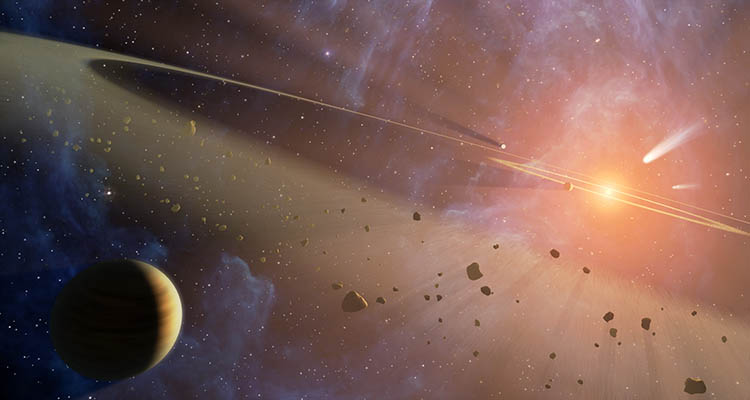
Image credit: NASA / JPL-Caltech, retrieved from Jodrell Bank CfA.
Located close enough to our Sun, when the Earth first formed, like our neighbors Mercury, Venus and Mars, we were chock full of heavy elements. Not just the carbons, nitrogens and oxygens that abound on all the known worlds, but important ones much higher up on the periodic table, including silicon, sulphur, iron, nickel, tin, lead, and even the radioactive uranium!
This might not sound so special to you, but our world would be a lot more boring if we had formed farther from the Sun. See for yourself:
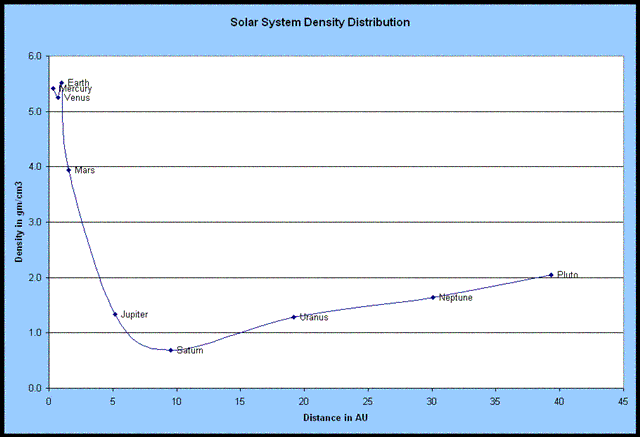
Image credit: Russ Meyer, using data from NASA.
Jupiter and Saturn aren't simply less dense than Earth is because they retained all that excess hydrogen that our wimpy gravitational field couldn't hold. Although that's true, they're also made out of elements that are intrinsically less dense!
We can identify where an object found anywhere in the Solar System -- including meteorites that fall to Earth -- simply by examining what they're made out of.
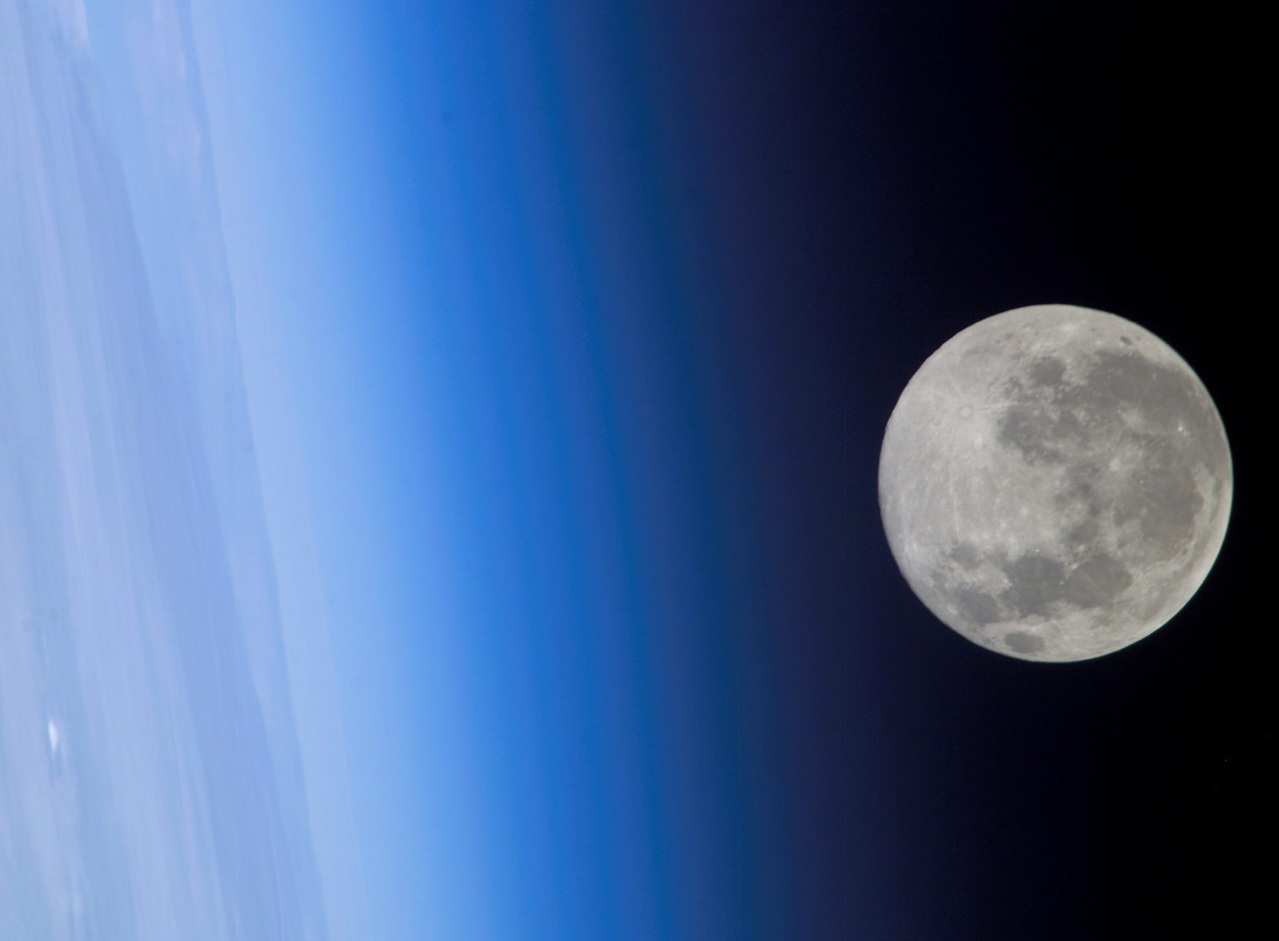
Image credit: NASA, retrieved from National Geographic.
One of the most spectacular applications of this knowledge came when we first journeyed to the Moon. For the first time, we'd be able to analyze rocks from the Moon and their chemical composition! What we found was simultaneously profound and the most boring thing imaginable.

Image credit: NASA / Apollo 11, retrieved from panoramas.dk/moon/mission-apollo.html.
Because the Moon is made out of the same stuff that the Earth is!
Before you start saying, "Duhhhhh," as some of you are wont to do, let's remember that it didn't have to be this way. We need only look at our nearest moon-ed neighbor.
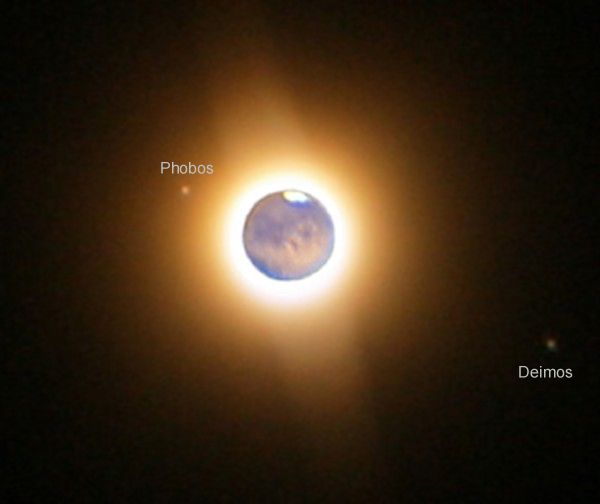
Image credit: Johannes Schedler / Panther Observatory.
Because Mars' two moons, Phobos and Deimos, are not made out of the same stuff Mars is! They formed significantly farther out in the Solar System, originating in the asteroid belt. Only a chance encounter with another body (probably Jupiter) flung them in to the inner Solar System, where they were gravitationally captured by the red planet!
If it happens for Mars from the asteroid belt, you may be wondering about that other, even bigger belt in our Solar System, and what the possibilities might be from there.
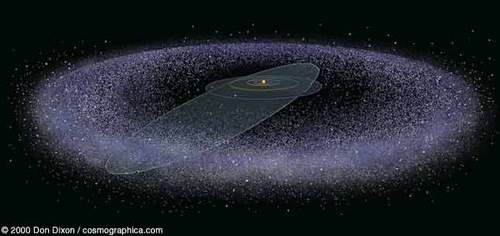
Image credit: Don Dixon / Cosmographica.
I refer, of course, to the Kuiper Belt, the band of leftover proto-planetesimals from the formation of our Solar System. These small, icy objects are only about a third the density of Earth, but are more dense than the gas giants that lie interior to them.
If the asteroids could be flung towards the inner, rocky worlds due to the gravitational influence from Jupiter, it stands to reason that these Kuiper Belt objects could similarly be flung inwards thanks to Neptune.
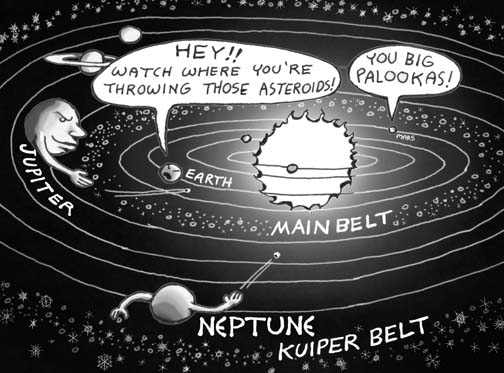
Image credit: source unknown, retrieved from clowder.net.
There are some dead giveaways that your object isn't from the same part of the Solar System as its initial planet is. There's the elemental composition / density argument, of course, but simply via random chance, 50% of these objects that get captured will wind up revolving around their planet the wrong way. One obvious guy like this is Neptune's largest moon, Triton.
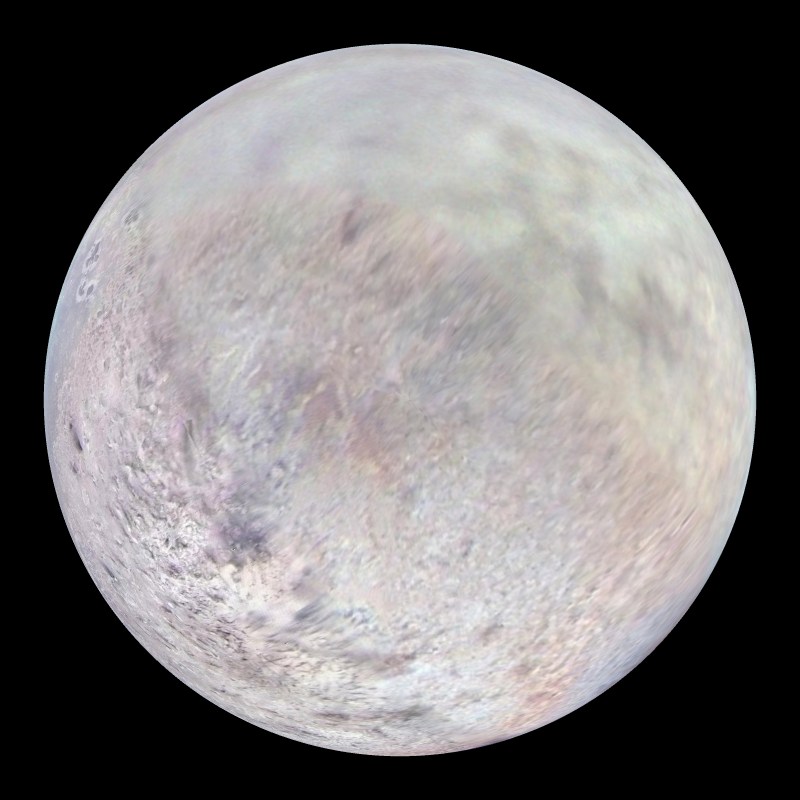
Image credit: Voyager Spacecraft, S. Albers / NOAA / GSD.
Triton is maybe the easiest one; he's so large that if he were still in the Kuiper belt, he'd be the largest object there, dwarfing (burn!) both Pluto and Eris!
But there are others, elsewhere, that don't quite look like they belong. And a Saturnian mystery may, in fact, be on the cusp of being solved thanks to this idea.
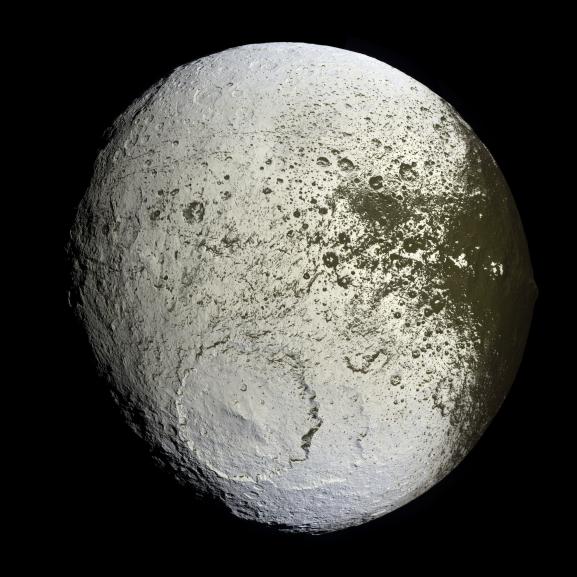
Image credit: Cassini / NASA / JPL-Caltech.
This is Iapetus, one of Saturn's moons, looking like it always does: like it came out on the wrong side of a trip through the mud. Iapetus does all the moon-like things correctly: it revolves the right way around Saturn, it's got the right density for its spot in the Solar System, its surface is even made of the same elements -- as far as we can tell -- as it ought to be.
Except for that muddy mess that discolors one of its face. What's going on here? It turns out Iapetus isn't alone.

Illustration credit: AP / NASA, retrieved from abcnyheter.no.
A giant, diffuse outer ring, well beyond the Saturnian rings you're used to, pollutes Iapetus' orbit. As the tidally-locked moon speeds around Saturn, these grains from the ring smack into Iapetus, discoloring it like billions of bugs on a windshield.
The question, of course, is where did this ring come from? Because it isn't Saturn. The answer is much more fun than that!
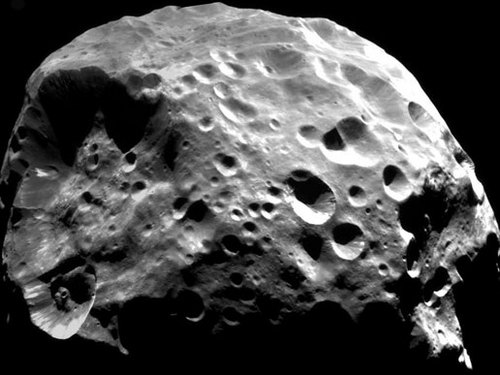
Image credit: Cassini / NASA / JPL-Caltech.
Say hello to Phoebe, Saturn's very suspicious moon, located in the same vicinity as both this outermost ring and Iapetus. Phoebe is full of craters, a different color and elemental composition than the other moons, and -- this is a big and -- it revolves around Saturn the wrong way!
In other words, this outsider came all the way from the Kuiper Belt to become a moon of Saturn! And the journey was no picnic for Phoebe, either.
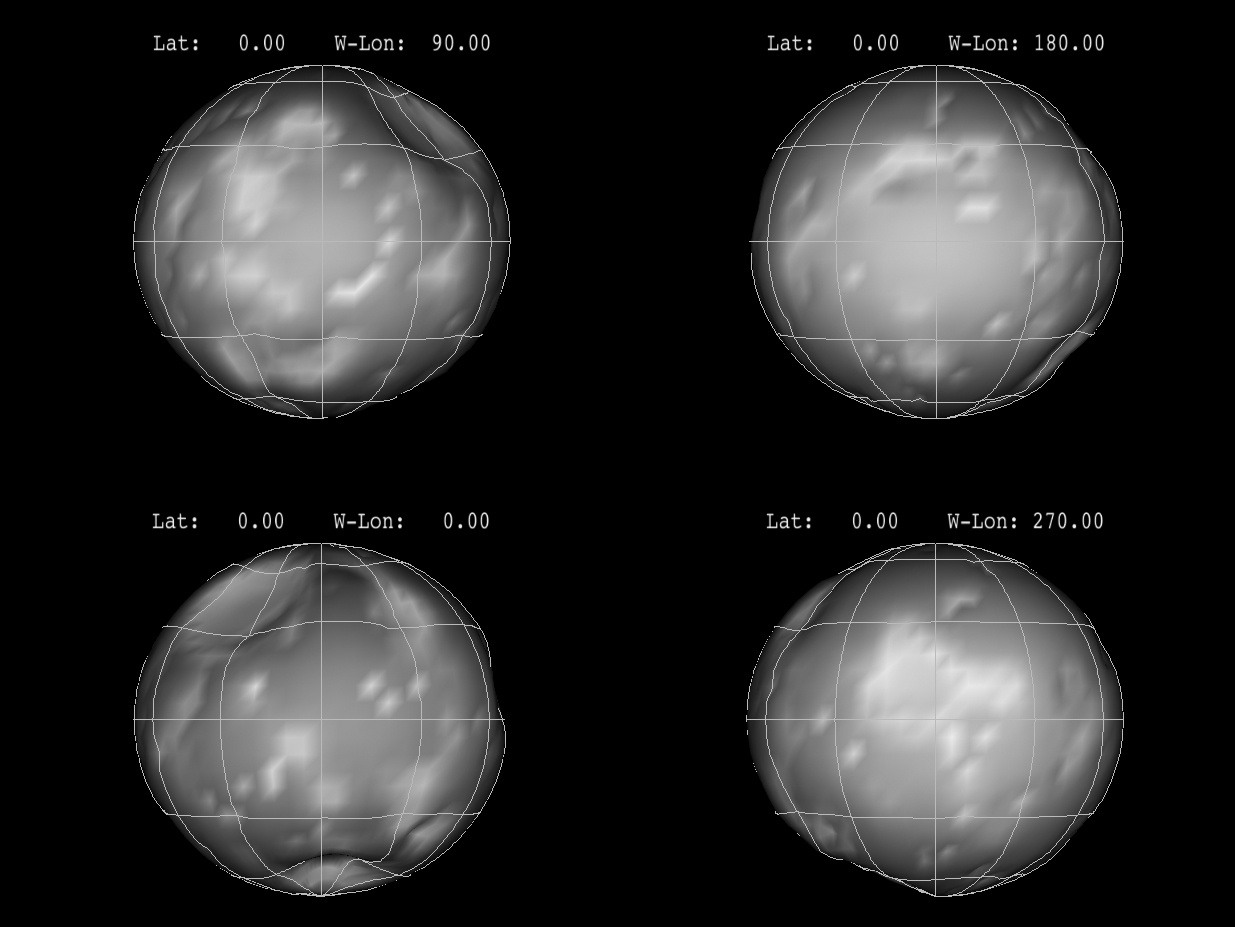
Image credit: NASA / Cassini / Caroline Porco / CICLOPS.
Those craters on its surface are from a lifetime of bombardment! The once-spherical Phoebe has lost a lot of its mass, and that's almost certainly where the material that makes up both the outermost ring and the diffuse discoloring of Iapetus comes from!
Let this be a lesson to all of you: if you want to be adopted by another planet, make sure you orbit the same direction as everything else! In the meantime, know that objects from the asteroid belt or Kuiper Belt could come in at any time, and could even become our planet's next additional moon!
Loved this article, thanks! I didn't know about the decreasing density with distance from the Sun. I knew the gas giants weren't as dense as the inner planets, of course, but didn't realize the same was true of the moons.
Question: Doesn't this argue against there being life in Europa's presumptive ocean, there perhaps not being enough of the heavier elements to support it?
It's not got much to do with the lack of heavier elements.
It's about how the lighter ones can't hang on to a hot planet as easy (Helium is rare on earth because its velocity at the earth's orbital temperature is close to its escape velocity).
The inner planets didn't grow fast enough to keep hold on the lighter elements when the sun started burning, so they never retained the ones they got.
Further out, its cooler, therefore the thermal velocity lower. Therefore you don't need to be as big to keep hold on it.
But that means you can gain a lot more mass because there is so much Hydrogen and helium compared to the other stuff.
Which means you can keep hold of more.
Which means you can gain yet more mass.
Etc.
Therefore they#re light not because they're missing, for example, silicon, but that 99% of the mass of the gas cloud we formed from was Hydrogen and Helium.
We've been sieved.
"I refer, of course, to the Kuiper Belt"
That Ooort to be the last of it.
(sorry, I couldn't help myself...)
@ Wow
But Ethan specifically said it was not entirely due to that reason, and that they did inherently lack the heavier elements in addition to retaining more of the light ones. What's up?
That is arguable. The prograde, circular and equatorial orbits of these moons have them & some very elliptical equatorial craters put up for the same process that begat us our Moon. (Except they never coalesced into one body, and most moonlets deorbited, the only way those impact scars could have formed.)
"Despite many efforts an adequate theory describing the origin of Phobos and Deimos has not been realized. In recent years a number of separate observations suggest the possibility that the martian satellites may have been the result of giant impact. Similar to the EarthâMoon system, Mars has too much angular momentum. ... The low mass of Phobos and Deimos is explained by the possibility that they are composed of loosely aggregated material from the accretion disk, which also implies that they do not contain any volatile elements. Their orbital eccentricity and inclination, which are the most difficult parameters to explain easily with the various capture scenarios, are the natural result of accretion from a circum-planetary disk."
@ CB:
The protoplanetary disk was very turbulent as witnessed by asteroid samples. So you had ferrous minerals and silicates everywhere, while volatiles froze out according to their solidification temperatures (especially "the ice line" for water). Also, there seem to be a gradual densification depending on collisional history (from rubble piles and comets with perhaps 40 % pore space towards denser bodies).
That leaves Europa with plenty of minerals in the core, and plenty supplied by impactors. The problem would be if neither would reach the water due to top and bottom ice. (Yes, bottom ice, since the ocean is _deep_!)
But the ice movements we now know about would drag impactors down if they didn't make it by themselves. And there is likely hydrothermal vents piercing from below due to the tidal heating that established the ocean in the first place.
"with perhaps 40 % pore space" - or if it was 60 % or even 80 %? It could be a lot, IIRC.
"But Ethan specifically said it was not entirely due to that reason"
And I specifically DID NOT SAY it was entirely due to one reason either.
"and that they did inherently lack the heavier elements in addition to retaining more of the light ones"
If that is what Ethan meant, then I say he's entirely wrong.
This is entirely allowed since people, humans, can be wrong and this is not a sin either to be wrong or to say someone else is wrong.
And I specifically DID NOT SAY it was entirely due to one reason either.
Okay but you strongly suggested it was due to the effect you described and said nothing about the other effect, while Ethan talked about both.
If that is what Ethan meant, then I say he's entirely wrong.
In other words you *were* saying that it's not due to the other effect Ethan mentioned. So why bother pointing out you specifically did not say it if you were in effect saying it?
This is entirely allowed since people, humans, can be wrong and this is not a sin either to be wrong or to say someone else is wrong.
*giant eye-roll* Yeah, and I specifically did not say anything to the contrary, nor did I imply it, nor am I revealing after the fact that it is what I meant anyway.
I was asking for clarification. Can you give some? Here let me quote the part of Ethan's post that I'm talking about, and let me know if you know what it means and if it's wrong, and why:
"Jupiter and Saturn aren't simply less dense than Earth is because they retained all that excess hydrogen that our wimpy gravitational field couldn't hold. Although that's true, they're also made out of elements that are intrinsically less dense! "
I specifically said that this mechanism existed.
Beyond that was your assumption, CB.
"In other words you *were* saying that it's not due to the other effect Ethan mentioned."
In other words, my words mean what YOU mean them to mean?
No, there is vastly more available Hydrogen. As a percentage of available matter you will have little rocky stuff on large planets and the inner planets will be much lighter due to having lost the mass in their orbit by the star either eating it or blowing it away.
A SMALLER effect is "they're also made out of elements that are intrinsically less dense!"
The core of Jupiter is how dense?
Any response to the critique by van Flandern that they only way for orbital capture (of small moons like Phobos&Deimos) to work is to simultaneously increase the mass of the planet, aka his "Exploding Planet" hypothesis? Also describes Iapetus discoloration...