

"Without a wish, without a will,
I stood upon that silent hill
And stared into the sky until
My eyes were blind with stars and still
I stared into the sky." -Ralph Hodgson
The next month -- from May 5th to June 5th -- brings three of the most spectacular astronomy sights possible on Earth back-to-back-to-back for skywatchers of all types, without telescopes, binoculars, or any special equipment. Tonight, May 5th, marks what's come to be known as a Supermoon, or the largest, brightest full Moon of the year.

Image credit: Chris Kotsiopoulos at Earth Science Picture of the Day.
Not that you'll notice, mind you, unless you've got both an incredible eye and an incredible memory. The full Moon is, by far, the brightest thing in the night sky, outshining the brightest star in the sky by a factor of around 40,000.
A supermoon, on the other hand, is only about 30% brighter than a normal full Moon.
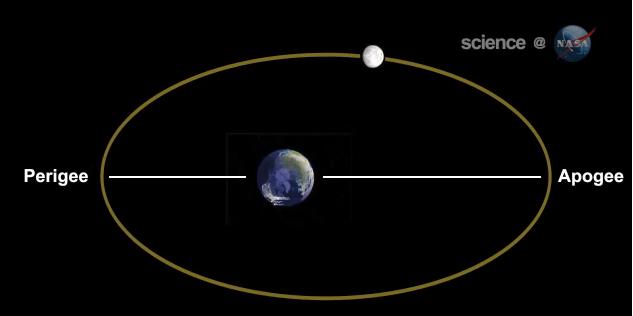
Image credit: science @ NASA, retrieved from Tara Hastings at WDTN.
The Moon, of course, orbits the Earth in an ellipse, rather than in a perfect circle. When the Moon is farther away from Earth in its orbit -- or closer to apogee -- it appears smaller in the sky, while when it's closer to Earth -- near perigee -- it appears larger. The supermoon is the one full Moon out of the year that occurs when the Moon is at its minimum distance from the Earth, and hence appears the brightest.

Image credit: Essay Web's astronomy site.
These differences, however, are relatively small. The full Moon at apogee is only 20% smaller than the full Moon at perigee, a difference completely un-noticeable to even a trained observer, unless you put these two images right next to one another.

Image credit: Marco Langbroek, the Netherlands, retrieved from surfersvillage.com.
Having the closest, brightest full Moon of the year is a great excuse to go out and look at it, attempt to photograph it, or if you're far away enough from streetlights, enjoy the shadows cast by the moonlight.
There's nothing you can't do with a supermoon that you couldn't do with any, ordinary full Moon, but it is fun to think about why this happens.
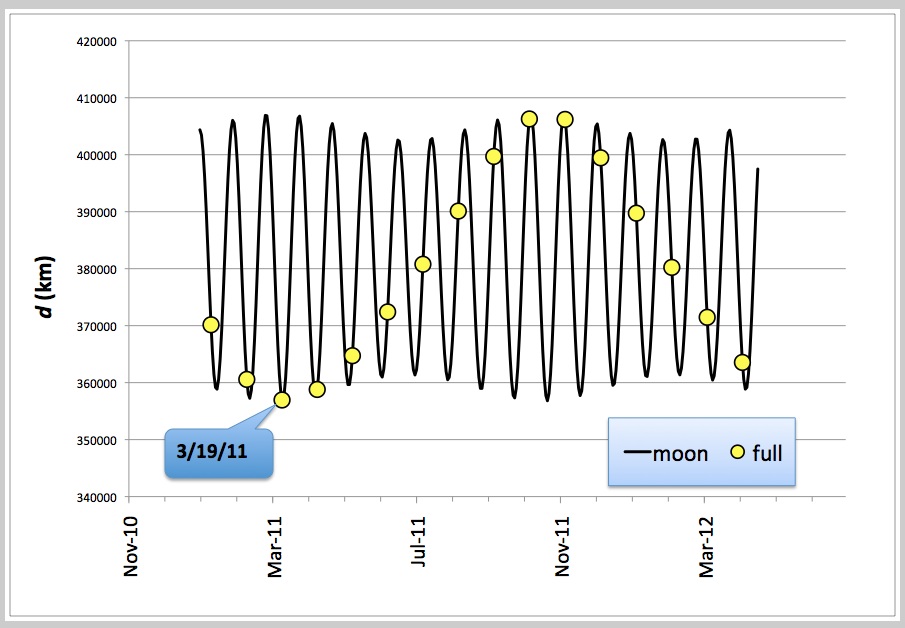
Image credit: Ryan, footnote #3 on Carrie Fitzgerald's site.
The Moon makes an ellipse around the Earth, which in turn makes an ellipse around the Sun. Right now, the Moon's perigee is in the opposite direction of the Earth from the Sun, so full Moons appear as large as they're ever going to. New Moons and crescents, on the other hand, will appear somewhat smaller, as they occur closer to apogee.
But six months from now, the Earth (and Moon) will be on the other side of the Sun, so the Moon's apogee will occur close to the full phase, resulting in somewhat smaller full Moons, while new Moons and crescents will be larger. You can see NASA's apogee and perigee calculator for more information, but I think the diagram below illustrates things pretty clearly.
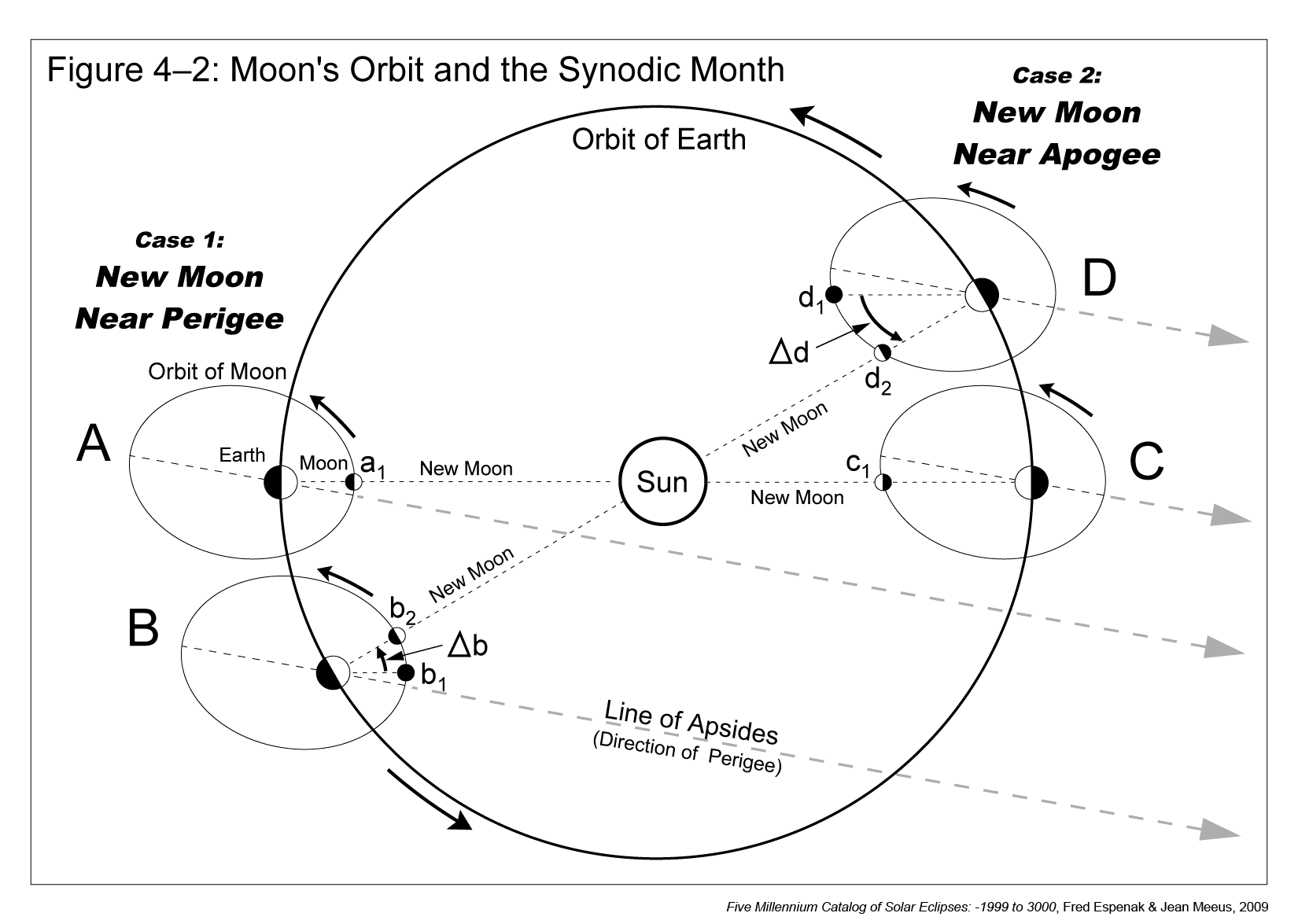
Image credit: NASA, Fred Espenak and Jean Meeus.
Right now, we're extremely close to position "C" in the diagram above, where the Moon's apogee (farthest from Earth) occurs close to the Sun, and the Moon's perigee (closest to Earth) occurs away from the Sun. This gives us the supermoon that you can see tonight, but fifteen days from now, it's going to give us something far more rare and special.
The Moon's apogee occurs on May 19th, and the very next day, at nearly its most distant from Earth, the Moon, Earth, and Sun will all line up, producing the spectacular and rare sight of an annular Solar Eclipse!
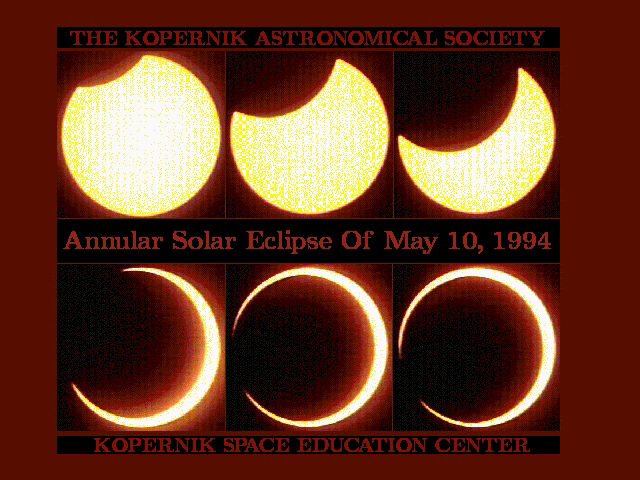
Image credit: Kopernik Observatory and Science Center.
On the evening of May 20th in North America, close to Sunset, the Moon will pass in front of the Sun. But because the Moon is so close to apogee, it will actually appear ever so slightly smaller than the Sun in the sky, and thus will not be sufficiently large to block it completely!
Astute skywatchers who plan their trip right and are blessed with clear skies will get to observe the elusive "Ring of Fire" shown above. I've already written my eclipse guide for those of you preparing to join me in watching this, but there is one cheap piece of equipment I'll recommend that everyone pick up for looking at the Sun: a pair of Welder's Goggles.

But there's another reason to get welder's goggles that's even more rare and spectacular than the upcoming solar eclipse. Those of you who've had clear skies in the west for the past month or two may have noticed an extremely bright object there just after sunset.
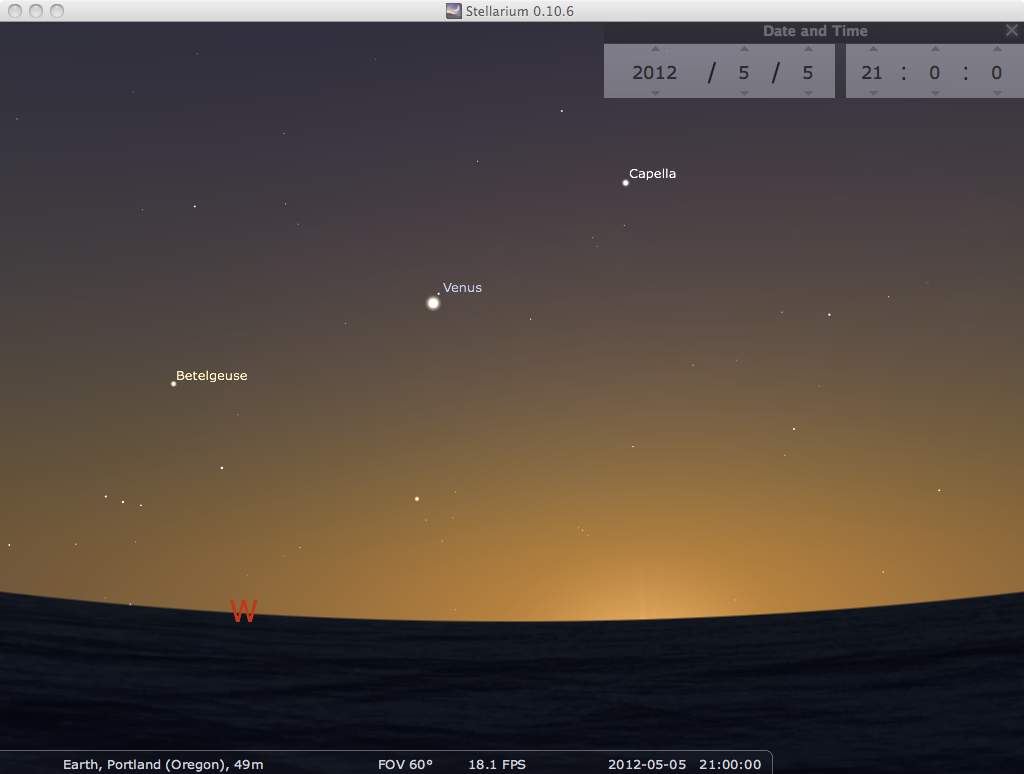
Image made with stellarium.
This is what the night sky will look like at 9 PM at 45 degrees latitude (where I live) tonight. That bright object, fifteen times brighter than Sirius, is the planet Venus, which just achieved its greatest apparent brightness in the sky. (And appears as a gorgeous crescent with binoculars if you can focus properly!)
Venus, being an interior planet to Earth, appears brightest not when it is closest to us, nor when it's in its full phase, but rather when it's a crescent, where the combination of proximity to us and the amount it's illuminated is maximized.
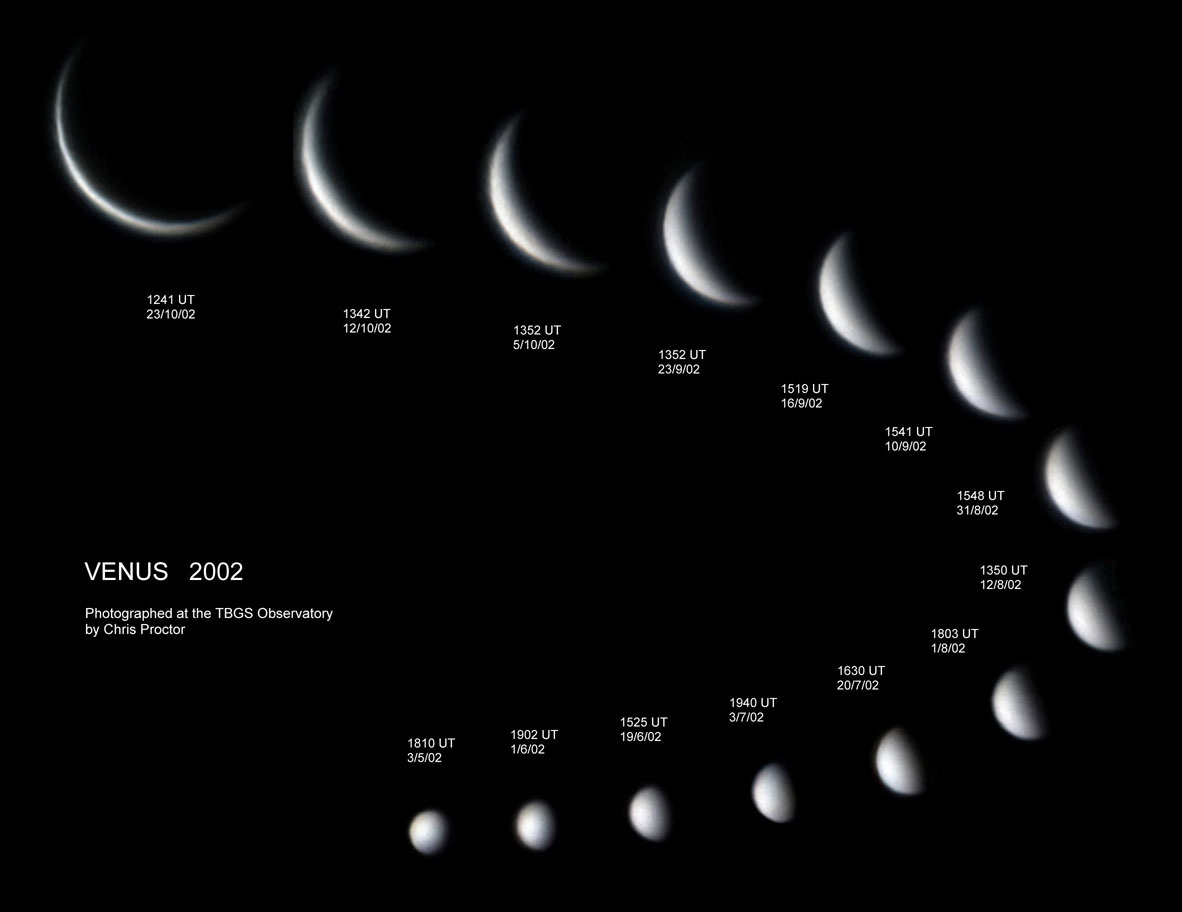
Image credit: Torquay Boy's Grammar School's Observatory.
Over the coming month, Venus will descend in the sky, with progressively less and less of the planet becoming illuminated to our eyes, percentage-wise. However, Venus' angular size will increase, as the apparent diameter of the planet will increase in the sky due to it physically getting closer and closer to us.
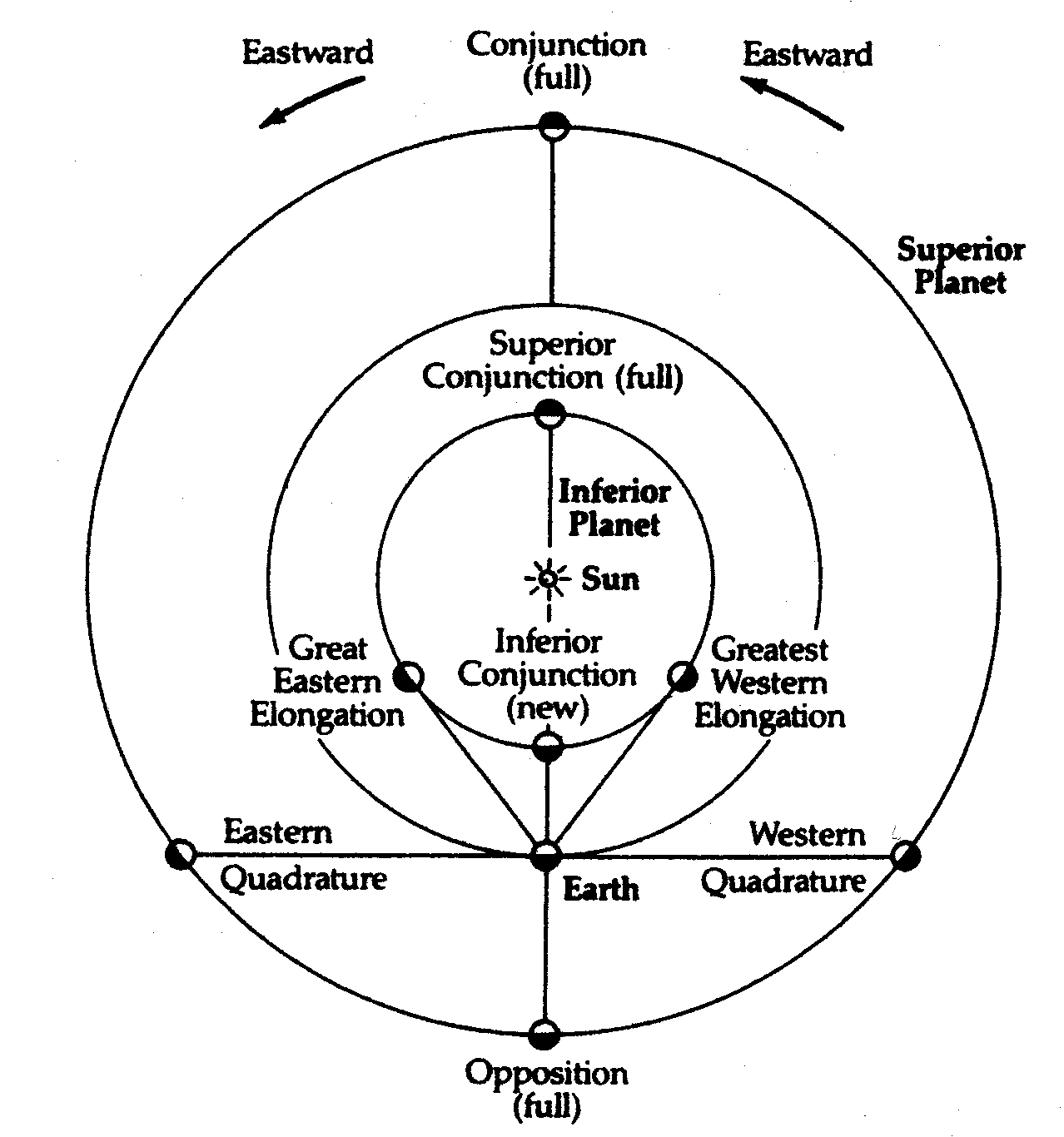
Image credit: Shamefully retrieved from victoriastaffordapsychicinvestigation.wordpress.com.
Eight years ago, Venus didn't just pass interior to Earth, missing the Sun by just a degree or two; in 2004, Venus actually transited across the disc of the Sun, blocking a small fraction of the Sun's light. These transits are incredibly rare; you and I will get two in our lifetimes.
The last Venus transit before the 2004 one took place in 1882, and the next one won't be until 2117. Unless, that is, you're ready on June 5th of this year.

Image credit: Tonk at CloudyNights.
It is perfectly safe to look directly at the Sun for brief periods of time with a good pair of Welder's goggles, and I've already got mine.
Where should you be to see it? That depends on where you live.
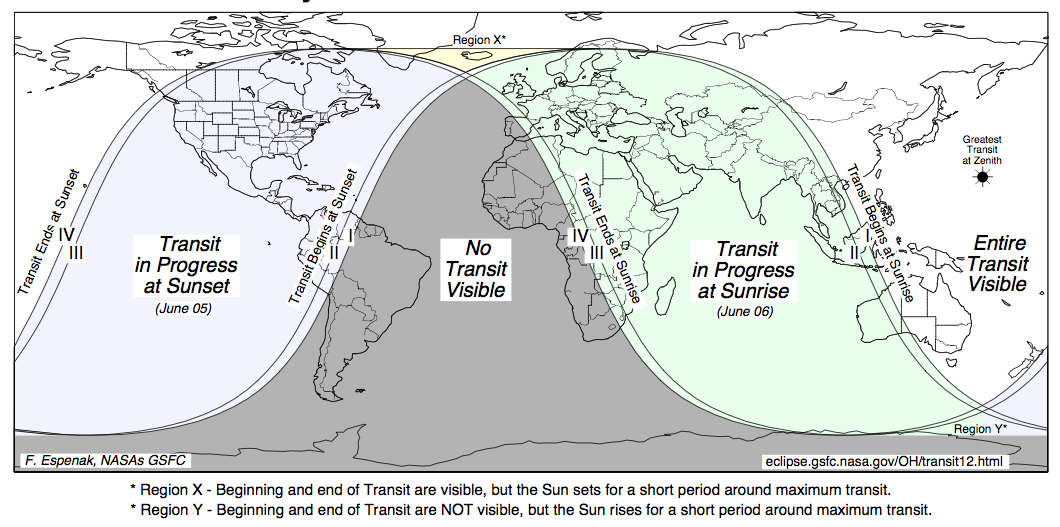
Image credit: Fred Espenak / NASA, retrieved from eclipse.gsfc.nasa.gov.
Where I am in North America, the Venus transit will start at about 3:00 PM on June 5th and will continue through sunset. The entire transit won't be visible in North America, as it takes many hours to complete, but this is your one chance to witness an event like this with your own eyes.
In Europe, parts of Africa, and most of Asia, of course, you'll be able to see the transit in the morning of June 6th instead. But those of you living in Iceland get the most special treat of all: a transit that spans both sunset and sunrise!
Three major astronomical events -- the supermoon, tonight, the annular solar eclipse, on May 20th/21st, and the transit of Venus, on June 5th/6th -- all occurring within a month of one another! There's never been a better time to purchase a pair of welder's goggles, that's for sure!
> There's never been a better time to purchase a pair of welder's goggles, that's for sure!
Yeah, and a super fast jet to whisk around the world so as not to miss anything ;-)
Might a pinhole camera suffice? (S. Korea here, so the event will conflict with increasing illumination.)
The effect of the Moon's elliptical orbit is actually pretty obvious to the naked eye - one just has to look for oneself instead of trusting countless astronomy bloggers who claim it's not ...
I'm confused as to why the "supermoon" would be 30% brighter when it is only 14% larger. How's that work?
Waitaminute - in the third diagram, the Moon's orbit around the Sun as indicated by the green trace is alternately concave and convex. Isn't the Moon's orbit always "concave up" wrt to the Sun? Or am I misremembering?
I'm with Ori here. I can see why the moon is 14% bigger (27,000 km closer out of an average 384,000), but then why isn't the brightness difference approximately the same as the size difference? How do we get the much bigger effect of 30%? P.S if you want to see a classic example of total rubbish in astronomy reporting have a look at this article at IBN: http://ibnlive.in.com/news/see-supermoon-of-the-century-this-weekend/25… - The picture isn't even our moon! I think its Enceladus one of the moons of Saturn!
@waitaminute: Two things to remember re that diagram:
Firstly it is completely not to scale, the orbit of the earth is so much bigger than that of the moon that the "wiggles" are tiny if put to scale.
Secondly, the above means that the variation of the moon's orbital speed relative to the sun due to it orbiting the earth is tiny - average speed of moon = 2.6 million km/day, variation due to orbiting the earth = 86 thousand km/day, so the wiggles are pretty symmetrical on both sides of the orbit.
Thinking about it a little, brightness follows an inverse square law. Wikipedia says the moon is .0027 AUs at apogee and .0024 AUs at perigee. The ratio of the distances is 1.125, and the square of that is 1.266. Does that imply that the moon at perigee is 26.6% brighter?
@Waterbergs: I didn't mean to be nitpicky[1], though I can certainly see how I came across that way. It's just that I'm in the teaching trade (math) and a firm believer in the maxim that a picture is worth a thousand words. I'm also of the opinion that whatever the disappointments some of us older people suffer over the futures that never were, it's a great time to be alive if you're an educator and wanting to make your own pictures!
[1]The convexity issue was something Asimov pointed out in his essay on the "double planet" system, Earth and Moon. Somebody should erect a statue to that man as an educator par excellence.
"The entire transit won't be visible in North America"
Speak for yourself! Now I just need to hope the weather cooperates...
--In Anchorage, AK
Ethan, can you explain why we don't observe a transit of Venus every time Venus passes between us and the sun? Put another way, why are these transits so rare?
@ Kongming
I don't know for certain, but I'm betting it's because of earth and venus' orbital inclination -- 7 degrees for earth and 3ish for Venus. So only at certain parts of our respective orbits would Venus appear within the sun's apparent half-a-degree disk.
If both orbits were exactly in the plane of the ecliptic, then we'd see Venus transit the sun much more frequently.
@CB
That seems logical. I didn't realize that Earth and Venus don't orbit in the same orbital plane. I guess I always heard the term "plane of the ecliptic" and took that to be an actual plane.
@ Kongming
It is a plane! Just not every object is in that plane. Btw, sorry, I messed up my numbers and terminology. The ecliptic is the plane defined by the apparent path of the sun in the sky so the earth's inclination with respect to this is by definition 0. The numbers I gave were relative to the sun's equator. And the number I *wanted* to give was relative to the invariable plane, which is the plane of the total angular momentum of the solar system.
Hi Ethan,
Just someone with an amateur interest in astronomy and physics here. In school we learn that everything that passes within the event horizon of the black hole is devoured (spaghettified) and disappears to some yet to be definitively determined location. Based on what you've said here, that standard, albeit oversimplified lesson is not entirely accurate. Is the accretion disk comprised of matter that has entered the event horizon and has been jettisoned back out, or is it matter that is orbiting ever closer and has not yet reached the threshold of no return? Should I be thinking of the event horizon as the mouth of a messy child who crumbles his food, doesn't eat it all, and stuffs some of it in his pockets? I just want to get a grasp on what is devoured, and why some matter is and some is not.
I accidentally posted this comment on the wrong thread...apologies. I meant to post on the black holes don't eat as much as they accrete article.
While welder's goggles (No. 14) will enable you to look at the sun SAFELY, they aren't designed for their optical qualities and, more important, you'll be seeing the sun its actual size. Maybe OK for the annular eclipse (if you're on that path) but a somewhat disappointing way to view your one and only transit, I think. Venus will be a pinpoint, near the limit of visibility. Even inexpensive binoculars can easily give you magnifications of 10 or more. But it's crucial those binoculars have proper solar filters over both front lenses, not the eyepieces. You can buy commercially made ones sized to fit or, if you're handy, buy a sheet of solar-filter film from an astronomy store (about $30) and make your own. Simplest of all, look for live webcasts of both the eclipse and the transit.
I never thought that we could see Venus pass across the sun, and it's amazing that these events are happening within a month of each other. Time to get some welder's goggles!
Your best option (if you don't have CHEAP binoculars that you can afford to have break) is to make a pinhole camera with a box and a bit of thin white paper. Stick it on a tripod head with some temporary glue/bluetack and have a blanket nearby to help shade the image.
If you have a pair of binoculars you can risk breaking, use it to project an image on to white card. It'll be much brighter, but the heat concentrated at the eyepiece may crack the glass.
Given my luck, it'll be raining hard.
I'm almost hoping for cloud and rain to cut down the number of people who'll show up in ERs the next day with damaged retinas. One problem is that a lot of even experienced starwatchers will be trying to view the sun for the first time. Virtually all will know to cover their objective lenses with a filter made of AstroSolar film, which blocks all but one-100,000th of the sun's light (and heat). But many will forget to cover or remove their finder scopes. Out of habit, some will look through to align the sun. Instant eye damage. At a minimum, they'll burn out crosshairs, crack a lens, set fire to hair or clothing. Still, it's better than losing a retina.
My question is if wormholes exist at sub atomic levels so small
That the particles can't fit through can time and space go through being pulled through pulling objects toward each other?
Is this what gravity really is?? Lol
I also could apply same concept to black holes that the magnetic fields and gravity pull the matter so tight around dead star that the wormholes combine being held together by the intense magnetic field at center !???? Lol