

"They say 'A flat ocean is an ocean of trouble. And an ocean of waves... can also be trouble.' So, it's like, that balance. You know, it's that great Oriental way of thinking, you know, they think they've tricked you, and then, they have." -Nigel Tufnel
Black holes* are some of the most perplexing objects in the entire Universe. Objects so dense, where gravitation is so strong, that nothing, not even light, can escape from it.
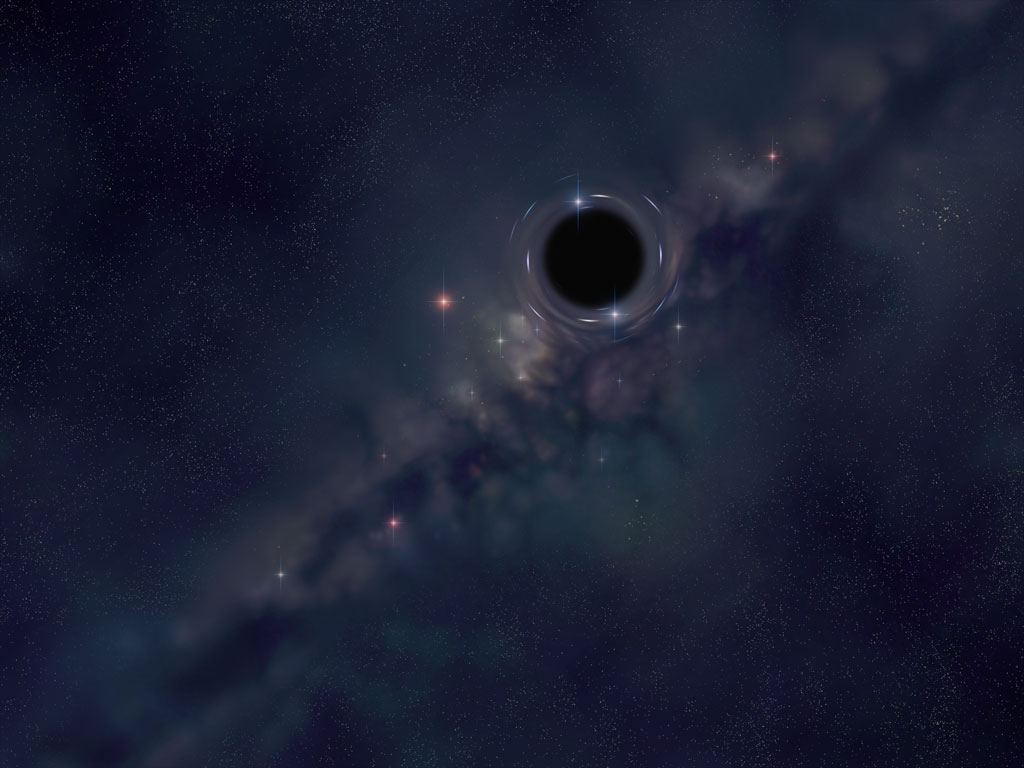
Image credit: Artist's Impression from MIT.
But there are a number of very counterintuitive things that happen as you get near a black hole's event horizon, and a very, very good reason why once you cross it, you can never get out! No matter what type of black hole you had, not even if you had a spaceship capable of accelerating in any direction at an arbitrarily large rate.
It turns out that General Relativity is a very harsh mistress, particularly when it comes to black holes. It goes even deeper than that, mind you, and it's all because of how a black hole bends spacetime.
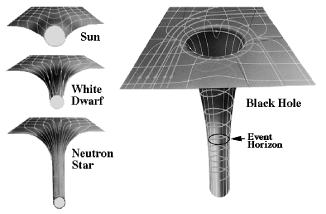
Image credit: Adam Apollo.
When you're very far away from a black hole, spacetime is less curved. In fact, when you're very far away from a black hole, its gravity is indistinguishable from any other mass, whether it's a neutron star, a regular star, or just a diffuse cloud of gas.
The only difference is that instead of a gas cloud, star or neutron star, there will be a completely black sphere in the center, from which no light will be visible. (Hence the "black" in the moniker "black holes.")

Image credit: Astronomy/Roen Kelly, retrieved from David Darling.
This sphere, known as the event horizon, is not a physical entity, but rather a region of space -- of a certain size -- from which no light can escape. From very far away, it appears to be the size that it actually is, as you'd expect.
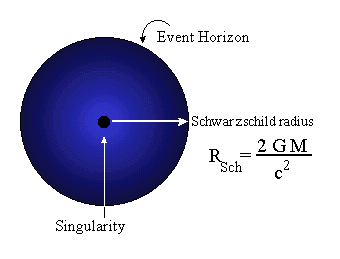
Image credit: Cornell University.
For a black hole the mass of the Earth, it'd be a sphere about 1 cm in radius, while for a black hole the mass of the Sun, the sphere would be closer to 3 km in radius, all the way up to a supermassive black hole -- like the one at our galaxy's center -- that would be more like the size of a planetary orbit!
From a great distance away, geometry works just like you'd expect. But as you travel, in your perfectly equipped, indestructible spacecraft, you start noticing something strange as you approach this black hole. Unlike all the other objects you're used to, where they appear to get visually larger in proportion to the distance you are away from them, this black hole appears to grow much more quickly than you were expecting.
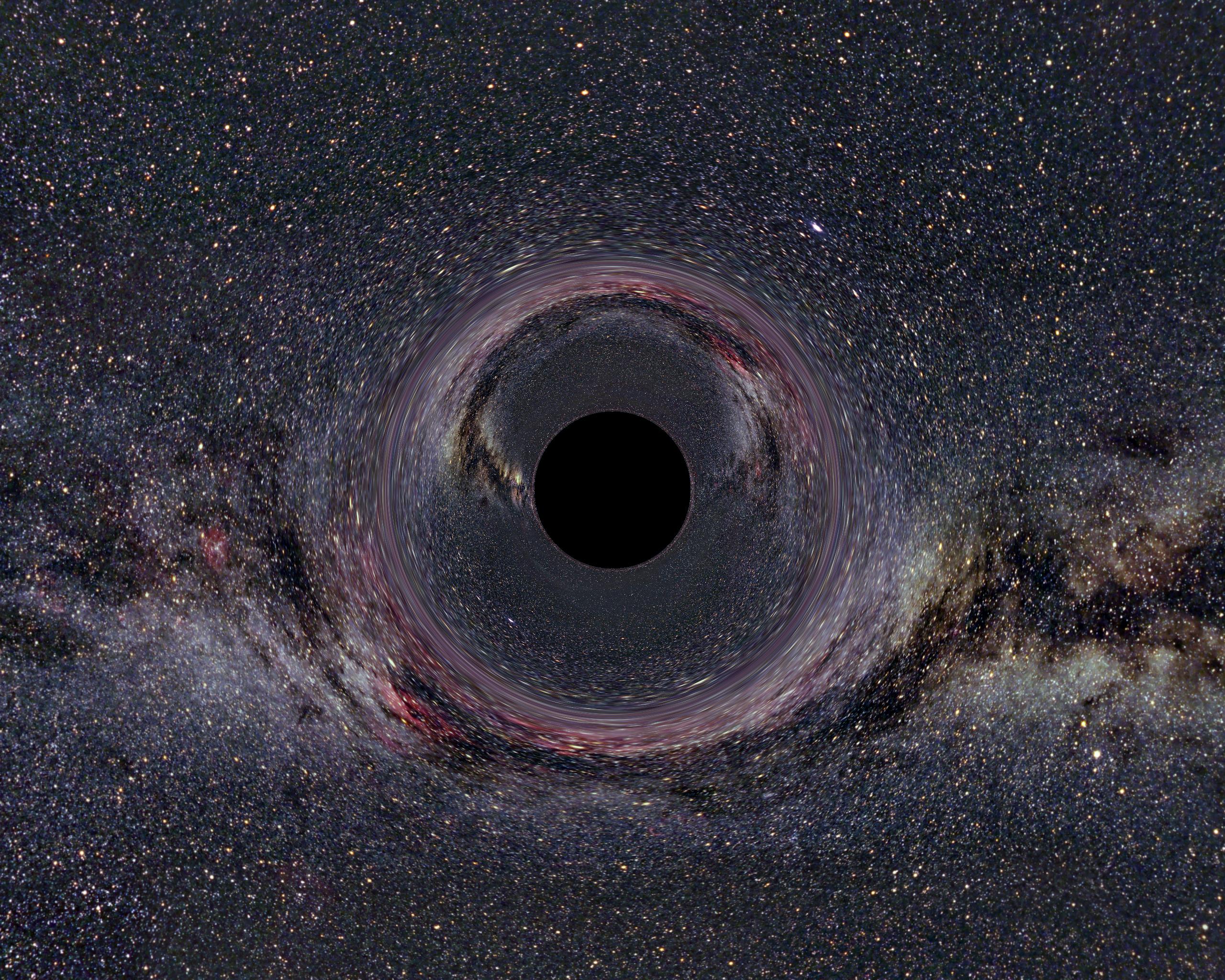
Image credit: Ute Kraus, Physics education group Kraus, Universitat Hildesheim.
By time the event horizon should be the size of the full Moon on the sky, it's actually more than four times as large as that! The reason, of course, is that spacetime curves more and more severely as you get close to the black hole, and so the "lines-of-light" that you can see from the stars in the Universe that surround you are bent disastrously out of shape.
Conversely, the apparent area of the black hole appears to grow and grow dramatically; by time you're just a few (maybe 10) Schwarzschild radii away from it, the black hole has grown to such an apparent size that it blocks off nearly the entire front view of your spaceship.
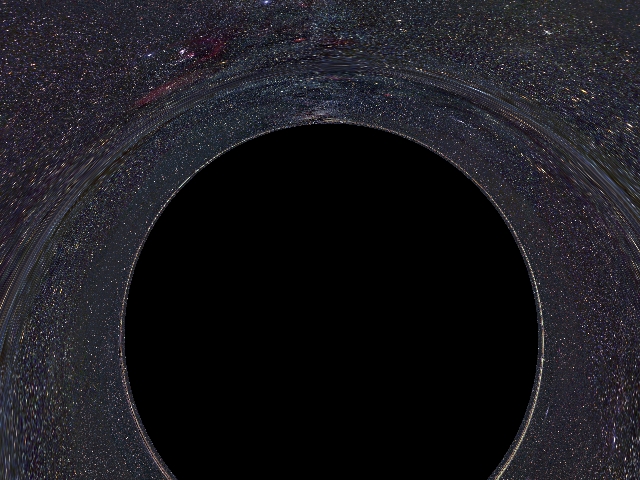
Image credit: Andrew Hamilton, who has some great visuals at jila.colorado.edu.
As you start to come closer and closer to the event horizon, you notice that the front-view from your spaceship becomes entirely black, and that even the rear direction, which faces away from the black hole, begins to be subsumed by darkness. The entirety of the Universe that's visible to you begins to close off in a shrinking circle behind you.
Again, this is because of how the light-paths from various points travel in this highly bent spacetime. For those of you (physics buffs) who want a qualitative analogy, it begins to look very much like the lines of electric field when you bring a point charge close to a conducting sphere.
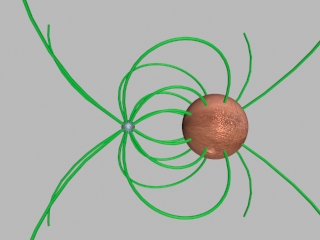
Image credit: J. Belcher at MIT.
At this point, having not yet crossed the event horizon, you can still get out. If you provide enough acceleration away from the event horizon, you could escape its gravity and have the Universe go back to your safely (asymptotically) flat spacetime. Your gravitational sensors can tell you that there's a definite downhill gradient towards the center of the blackness and away from the regions where you can still see starlight.
But if you continue your fall towards the event horizon, you'll eventually see the starlight compress down into a tiny dot behind you, changing color into the blue due to gravitational blueshifting. At the last moment before you cross over into the event horizon, that dot will become red, white, and then blue, as the cosmic microwave and radio backgrounds get shifted into the visible part of the spectrum for your last, final glimpse of the outside Universe.

Image credit: ZetaPrints.com.
And then... blackness. Nothing. From inside the event horizon, no light from the outside Universe hits your spaceship. You now think about your fabulous spaceship engines, and how to get out. You recall which direction the singularity was towards, and sure enough, there's a gravitational gradient downhill towards that direction.
But your sensors tell you something even more bizarre: there's a gravitational gradient that's downhill, towards a singularity, in all directions! The gradient even appears to go downhill towards the singularity directly behind you, in the direction that you knew is opposite to the singularity! How is this possible?
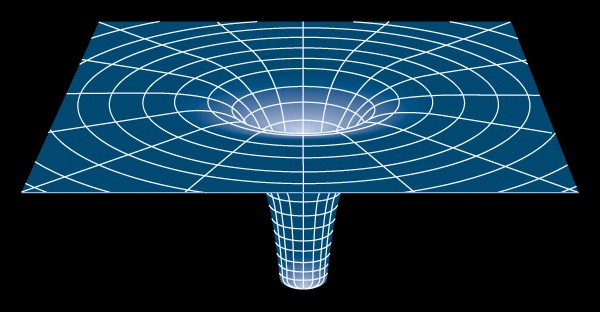
Image credit: Cetin Bal.
Because you're inside the event horizon, and even any light beam (which you could never catch) you now emitted would end up falling towards the singularity; you are too deep in the black hole's throat! What's worse is that any acceleration you make will take you closer to the singularity at a faster rate; the way to maximize your survival time at this point is to not even try to escape! The singularity is there in all directions, and no matter where you look, it's all downhill from here.
Like I said, General Relativity is a harsh mistress, particularly when it comes to black holes.
(* -- This is all done for a non-rotating, or Schwarzschild black hole. Other forms of black holes are similar, but slightly different, and much more complicated, quantitatively.)
I can see the headline now
Nice account, but I can't help trying to pick some nits . . .
Are you sure there will be blue shifting even if I'm in free fall as I cross the horizon? If I'm accelerating to remain a fiducial observer, then I'll see blue shift -- but if I'm freely falling in, then the only thing I'd notice would be tidal effects (which can be arbitrarily small for a sufficiently large black hole).
Unless I'm missing something, this claim isn't quite right either. Look at a Penrose conformal diagram of a black hole. It's obvious that the null rays still intersect the world line of an infalling observer inside the event horizon. Seems to me that we still get to see what's going on in (some of) the outside world even when we're inside (until we go squish, of course).
And while I assume that you're right that accelerating will reduce my proper time, it would allow me to see more of the outside world (blue-shifted, of course) before I go squish.
Ethan, you say "For a black hole the mass of the Earth, it'd be a sphere about 1 cm in radius, while for a black hole the mass of the Sun, the sphere would be closer to 3 km in radius..." Is there a minimum mass needed to form a singularity? Can 1 cm black holes be formed in nature?
Wesley, what you're asking about is called a quantum black hole, and theoretically they could have been made during the Big Bang, when the titanic forces involved could have compressed any size mass into a black hole. However, as black holes slowly "evaporate" through Hawking radiation, they eventually shrink, and the smaller ones shrink faster. So a small black hole would probably be gone by now, 14+ billion years later. Otherwise, I think it takes a star a couple times larger than our sun to make a black hole.
It might deserve mention that it's only totally black, as you say, if you are the only thing falling into the black hole. If anything emitting light is falling in ahead of you, you'll see that, at least until you get very near the central singularity.
Something that I didn't really appreciate until recently is, when you start on this journey, the event horizon is an infinite proper distance away. You reach it in finite time because as you fall in, you gain momentum, and the fiducial distances are Lorentz-contracted in such way that you cover infinite proper distance in finite proper time. (From the perspective of a distant observer, you would still have to travel infinite proper distance, but your increasing speed grants you the benefit of a diverging time dilation factor, which is how she understand that you will reach the horizon in finite proper time on your clock even as it takes infinite time on hers.) I say this because I think the imagery is vivid yet I've never heard it used in a popular description.
Wouldn't the light falling in behind you become red shifted? The light once you're past the event horizon from an object nearer than infinity would still, for a while, be visible to you, it's just that the universe would get SMALLER (rather than 15 bn light years, it would drop to 5Bn, then 1Bn, then 1 light year, then 1 meter, since nothing further away would be "visible" to you, and likewise visible in return).
Although the geodesics of highly curved surfaces may ensure that this "obvious" flat-world view doesn't hold. When entirely within the horizon, where all geodesics lead toward the singularity, there would be nowhere for light to come from except from something else inside that volume. And so that, if emitting, would be receding quickly and therefore redshifted.
But there would be nothing available from outside the range of the (now closed) geodesics, therefore "black".
:D Care to elaborate?
I too am disturbed by the blithe assertion that the Universe behind you is blueshiftef to infinity. If you are freely-falling, there should be no shift at all, either way (I think). Could you elaborate?
":D Care to elaborate?"
He already did :-P
"Because you're inside the event horizon, and even any light beam (which you could never catch) you now emitted would end up falling towards the singularity; you are too deep in the black hole's throat! What's worse is that any acceleration you make will take you closer to the singularity at a faster rate; the way to maximize your survival time at this point is to not even try to escape! The singularity is there in all directions, and no matter where you look, it's all downhill from here."
I don't understand how time-dilation would behave upon close approach to the singularity. Is it not true that a body would never be able to reach the singularity, due to the nature of time changing in relation to light speed? In that case, nothing around you would change as you fell, since time would change as well, making things seem rather normal.
On another note, I believe (correct me please) Hawking's theory on the evaporation of black holes has been revised. See Leonard Susskind's writings on the subject, namely The Black Hole Wars.
"He already did :-P"
I read the rest of the paragraph, but i don't see, how this could affect gravity gradients ....
Is it not true that a body would never be able to reach the singularity, due to the nature of time changing in relation to light speed?
To an observer remaining far from the event horizon, it takes an infalling body an infinite amount of time to reach the event horizon. In the frame of the infalling body, it takes a finite amount of time. Mathematical explanation: the coordinate transformation (specifically the timelike coordinate) between the two frames blows up at the event horizon.
I'm less sure about the blueshifting which others have commented on. I understand the argument that, since your speed is approaching c (assuming you have made no attempt to slow down) as you approach the event horizon, this should produce a redshift. OTOH, these photons are also gaining energy as they fall inward, which would be the source of the blueshift mentioned in the original post. I haven't done the math, so I'm not sure whether one effect wins out over the other or whether they cancel exactly.
"I don't understand how time-dilation would behave upon close approach to the singularity"
From the POV of the fallee (yes, I made a cromulent word!), there is no time dilation.
From the outside, past the event horizon, there can be no singularity seen.
When talking about extreme science, you have to be VERY precise in your definitions!
re: 11, then you should have said what you wanted elaborated. The reason for the "because"? The reason for the gravity lines to all bend toward the singularity? What?
"this should produce a redshift. OTOH, these photons are also gaining energy as they fall inward, which would be the source of the blueshift mentioned in the original post"
Energetically, a photon "falling down" toward you will gain energy from the gravitational field and be blueshifted (since this is the only way a photon can express a higher kinetic energy). However, you are accelerating away from the source, therefore redshifting.
Which wins?
Well, since Ethan can actually DO the maths, I'd take his word for it as long as he'd noted the confusion over the tussle here. Blueshift for a non-accelerating body in/near the event horizon would see blueshifting.
But if you're freefalling, you're accelerating.
So does that change things?
What about something "further in" the hole that is emitting? Is that redshifted too, or does this discussion not discuss help signals from other doomed astronomers, falling to their doom? Is that where we're getting confused here?
What I don't understand, or rather, what I really don't understand, is why is Hawking radiation so special that it can "escape" the black hole, where nothing else can? Also, why can't we detect Hawking radiation? Seems it would be a real easy way to find black holes.
Why should a black hole be a real point-like object, and not just be normal space, like the eye of a hurricane that is a region of mostly calm weather, and around which all pressure and density circulates. We aren't falling straight into the sun so why should it be the case for light and a black hole? Just a regular fast rotating matter processing transit-zone, just like any other swirling whirlpool / tornado.
http://upload.wikimedia.org/wikipedia/commons/5/52/Hurr_cross.jpg
Marty @16: As I understand it, Hawking radiation is related to virtual particles. Energy and time obey a similar uncertainty relation to that of position and momentum, so that one can temporarily create a particle-antiparticle pair as long as they annihilate within a time interval inversely proportional to the particle energy. The trick is that near the event horizon of a black hole, one of these virtual particles can escape while the other one is sucked back into the event horizon. Result: the escaped virtual particle is now a real particle, and the mass of the black hole is that much lower. The probability that a virtual particle will escape is inversely related to the mass of the black hole, so stellar mass black holes won't disappear by this route (at least over reasonable time scales).
Chelle @16: The reason your analogy does not work is because maintaining an orbit just outside the event horizon requires a speed higher than c, which is not allowed. Once you fall inside the radius of the innermost circular orbit (which turns out to be 1.5 Schwarzschild radii), you are doomed to fall into the black hole if you do not have a sufficiently powerful propulsion system. It's true that the singularity need not be a point (I believe that for rotating black holes the solution is a ring rather than a point). There has also been speculation about black holes being wormholes, but so far that is purely speculation.
Mostly Correct- : -If photons (light) have no mass as many areas of physics believe then you would not be able to see while traveling the speed of light, much less see light comming from outside of the ship while entering the even horizon. (I suspect it would be nearly impossible or difficult to see while traveling even near the speed of light.)
Because photons have no mass it will not be like dropping a baseball while moving in a car (or even the spaceship) where the ball would 'appear' to fall straight down to the floor of the car or ship. A ball has mass, and is moving in perspective to ones observation. Photon's have no mass and would therefore not follow this same rule of physics. And because of this, simply put and assuming that you could: if you move at or faster than light then light will not be able to reach your eyes for you to see anything.
This would be especially true for light from coming from outside of the ship if it uses some sort of "bubble warp" like in *cough* the Star Trek theory around ship. Sorry for the Star Trek reference, but their theory is valid if a similar method is used. Meaning light produced from within the ship would remain in observable perspective to anyone else in the ship. Therefore if this be the case one could see only things from within the ship. However, if it were possible it were possible to travel at or faster than light and no bubble "warp" method were used then you'd not be able to see outside or inside of the ship either. It would be perfectly dark.
Thanks Eric-
I can kind of grasp the Particle/Anti particle concept. Is that the particles that manage to escape are so few that we can't detect the radiation? Sounds like what you are saying is that the larger the balck hole, the smaller the amount of Hawking radiation it emits.
"Sounds like what you are saying is that the larger the balck hole, the smaller the amount of Hawking radiation it emits."
It emits more.
The "surface" is more curved, therefore there is more chance of capture of one of the pair without the other.
Entropically, the surface area of the event horizon defines the entropy of the black hole (inversely), therefore the smaller the sphere that it makes, the more entropy it has, the higher the "temperature" it has and the more energy it radiates (Stephan's law).
Odd way to think, but it's an excellent display of using a consequence of a scientific theory to "prove" that theory (prove in the old sense of "test").
"What I don't understand, or rather, what I really don't understand, is why is Hawking radiation so special that it can "escape" the black hole, where nothing else can?"
Anything outside the event horizon can escape, anything within cannot.
Hawking radiation is no different.
It's a consequence of just that feature in virtual particles.
If they appear ON the event horizon (the centre of action is on that geometric plane), then one is within the event horizon and one is outside the event horizon.
One cannot get out, the other can.
If the one that *can* get out goes in instead, then it doesn't radiate at all.
If the one that *can* get out goes a different direction, then the partner cannot get there and the virtual pair cannot annihilate.
And therefore that lucky partner is real and can go anywhere.
It never was inside the event horizon.
Its partner was not so lucky.
Is that the particles that manage to escape are so few that we can't detect the radiation?
If by "few" you mean relative to other possible sources of such particles, then yes, that is why we can't detect Hawking radiation. I haven't crunched the numbers to see what kind of experiment would be needed to get good enough statistics on this (Ethan might have a better idea), but for stellar mass black holes the resource requirements (in terms of detector area and time) are likely to be well beyond what is currently feasible.
Yes, the rate of Hawking radiation emission decreases as black hole mass increases. There is a narrow range of quantum black holes we might be able to detect--the ones that are just finishing their evaporation now--but anything smaller than that will be already gone, and anything much larger than that won't be emitting enough to be detectable. And that assumes that such black holes actually exist; at present we have no evidence either for or against this proposition.
I can't even come close to understanding the physics but what he describes is eerily similar to some of my relative's homes!
@17 - Eric Lund
Who says that photons can't be just squashed into Gamma Rays at that pressure area just outside the event horizon, generating those bubbles that are up and bellow our Milky Way. There would be no need to have something within the event horizon, just regular empty space. There is no logic in stuff falling straight into a gravity hole, everything always circulates around...
http://tinyurl.com/gamma-ray-emitting-bubbles
In an addition to my previous post: I'd like to add a comment for those who believe photons do have mass:
Regardless to whether they do or do not. If you out-run or go at or near the same speed as photons "light" then the photons will never hit your eyes (hit them properly at near/same speeds) for you see any objects in your ship or the light from stars as well. This is true regardless as to whether photons have mass or not and regardless to the ball being dropping inside of a moving vessel analogy that I used.
I am no physicist, so these questions may seem simple, but I am curious. Black Holes emit jets of radiation from their centers. Are these jets fixed in their relation to the event horizon? If so, does that mean that a black hole can be approached from different angles that would mean differences in the expected effects on the observer? What if, for example, I approach a black hole from behind it? If I had a starship that could bridge the distance between us and a black hole, then certainly I could plot a course beyond it - not through, naturally - and then approach it from that angle. What, if anything, would be different? Would the jet of radiation be pointed at me, or would it point away from me, to the point where it would not be detectable?
Image credit: Andrew Hamilton, who has some great visuals here.
The videos at that site don't show the outside universe disappearing when you cross the event horizon. One of them has the caption "Notice that you cannot tell when you pass through the horizon."
Isn't this entire article pure speculation? Since nothing can escape from a black hole how can we or any other sentient entity know what goes on inside of it?
We know that TIME slows down in a gravity field. A clock on Mars runs slightly faster than a clock on Earth for example. And our GPS satellites correct for this.
It's entirely possible that inside the event horizon of a Black Hole, TIME may stop completely.
@26 (tom)
"Black Holes emit jets of radiation from their centers..."
No, jets are not emited from the center. Jets are formed by the matter coming in the black hole. When matter gets sucked in, huge tidal forces make some of the matter eject at the poles with huge energy. It's not coming from within, but rather from outside of event horizon.
Ethan, a question from a non-expert. Shouldn't matter spaghettification near the black hole singularity, combined with quark confinement, basically create a never ending hadron jet?
If the indestructible spaceship was equipped with an indestructible tow-chain connected to a ship outside the black hole could it be pulled out?
@32 Bob
nope, the second ship will get pulled in along with the first ship if they are connected. unless the tow engine is powered by another black hole of a greater size.... etc.
Two points:
1) The post is incorrect - you can see the outside universe once you cross the event horizon
2) Also, it propagates the "the more you struggle, the less time you have" mistake. This is *only* true if you fall from rest at the event horizon. If you pass through the horizon with any velocity, then you can fire your rockets to maximize the time you experience before hitting the singularity.
http://xxx.lanl.gov/abs/0705.1029
No Way Back: Maximizing survival time below the Schwarzschild event horizon
Geraint F. Lewis, Juliana Kwan
(Submitted on 8 May 2007 (v1), last revised 15 May 2007 (this version, v2))
It has long been known that once you cross the event horizon of a black hole, your destiny lies at the central singularity, irrespective of what you do. Furthermore, your demise will occur in a finite amount of proper time. In this paper, the use of rockets in extending the amount of time before the collision with the central singularity is examined. In general, the use of such rockets can increase your remaining time, but only up to a maximum value; this is at odds with the ``more you struggle, the less time you have'' statement that is sometimes discussed in relation to black holes. The derived equations are simple to solve numerically and the framework can be employed as a teaching tool for general relativity.
"There is no logic in stuff falling straight into a gravity hole, everything always circulates around..."
Of course it wouldn't fall 'straight in', it would 'circulate'... but once beyond the event horizon then no matter how fast it went it's orbit would be an inward (downward?) spiral.
It's a curvature of spacetime, which only gets more distorted as you get closer to the center of mass. It's nothing like a hurricane.
"Isn't this entire article pure speculation? Since nothing can escape from a black hole how can we or any other sentient entity know what goes on inside of it?"
Yep! It's some very fun math done with the theory that predicted many of the properties we are able to see, and describing the geometry and effects the math is describing. Sucks that if the theory is right then we can never test it. Sucks that it's probably true that we can't test the interior of black holes if the theory is wrong.
>> how can we or any other sentient entity know what goes on inside of it?"
Just find one and fall in - just because you can't communicate with the outside world doesn't mean you can't experience what happens.
@30 Oh, okay. I understand. Thanks!
Here's my question.
Since solar systems and galaxies are ALL rotating (aren't they); it would seem that collapsed star black holes and center of galaxy black holes would ALL rotate.
And yes I read your footnote "(* -- This is all done for a non-rotating, or Schwarzschild black hole. Other forms of black holes are similar, but slightly different, and much more complicated, quantitatively.)"
But it seems to me that rotating blackholes are extremely different. To the best that I can follow it seems that all matter and energy crosses the event horizon (of a rotating black hole) tangentially rather than perpendicularly to the event horizon (as with a non-rotating black hole). As well it seems that all matter and energy crossing the event horizon of a rotating black hole has been accellerated to relativitic speeds and will rotate with the black hole and around the black hole for several or many rotations before crossing the event horizon. Hence the tidal effect ripping planets or astronauts apart would be much greater. etc.. Which means that the structure of any classical object will have been ripped apart and thus crossing the event horizon will be a quantum event.
So the more I understand or think that I understand; it seems that rotating black holes are very different than non rotating black holes. (e.g. relativistic and frame dragging at the event horizon; and ring singularities rather than point). But most important, I can think of no physical situation which leads to a non-rotating black hole.
So such simple physical descriptions for a non-rotating black hole "As you start to come closer and closer to the event horizon, you notice that the front-view from your spaceship becomes entirely black, and that even the rear direction, which faces away from the black hole, begins to be subsumed by darkness." seem entirely wrong for any plausible physical situation. Because all physically plausible situations are rotating; thus the front of the spaceship will be travelling tangentialy toward the black hole event horizon NOT perpendicularly toward the event horizon. Thus crossing a plausible physical black hole event horizon will be a more more dynamic (e.g. relativitic, tidal and quantum) event than crossing a Schwarzchild (non-rotating_ event horizon).
If I misunderstand, please educate me. Much thanks.
@35 - CB
I think you are brainwashed, and have lost some common sense on how physical things work in the reality. If you have stuff that spins around at the most highest pressure you form a ring just like you would have 2 arches that are being pressed against each other, such a structure would block al the rest from entering the core, and keep pressure out, just like a hurricane does, the opposite structure of a Magdeburg-hemispheres type of object. Once the construction breaks apart you get a supernova. Think about how you can't break an egg because of its hard shell, the pressure goes perpendicular. The pressure area just outside the event horizon of a 'Black Hole' would form a shell ... people need to think for a moment, instead of looking at this point-like object that sucks everything to its core, it is against all logic, only in your head can you come up with a fantasy like object, not in real life. Lets say if a BH is real, as described, than its gravity lens would have a focus point where all the bundled light generates one immense hot spot which would be in contrast to the cold-spot that the BH would be when it is sucking up all that heat (light) gravity wise, look at the core of galaxies and what you see are burning spots like a how you would start a fire by using friction with a piece of wood and a wire, no such thing as that type of BH's, please.
http://www.schoolofhowto.com/wp-content/uploads/2011/07/handdrillfirest…
@39 (chelle)
sometimes you really check yourself how things really work physically. What you have written above really has no place on a science blog.
@38 (okthen)
there's a good article on wiki about rotating black holes
http://en.wikipedia.org/wiki/Rotating_black_hole
think it will answer couple of your questions. And check Kerr metric and Ker-Newman metric as solutions.
@38 (okthen)
there's a good article on wiki about rotating black holes
http://en.wikipedia.org/wiki/Rotating_black_hole
think it will answer couple of your questions. And check Kerr metric and Ker-Newman metric as solutions.
Well written informative article.
@ Chelle
I've been brainwashed? Well, that makes sense. I was wondering what the part with the straps and eye clamps was for. Seems rather suspicious now. They put me off Beethoven, you know.
I have a philosophical objection to any speculation as to what goes on beyond the event horizon. With extreme certainty we have no data, and unless everything we know is wrong, we never will.
>>I have a philosophical objection to any speculation as to what goes on beyond the event horizon. With extreme certainty we have no data, and unless everything we know is wrong, we never will.
This is wrong - you can find out - just jump in one and see if the mathematical models hold or fail.
"But it seems to me that rotating blackholes are extremely different"
They are extremely different. Or at least the mathematics of their physics are. They can even be toroidal and lack any concealed singularity.
But the tensors you need to do and the operations on them are REALLY hard.
And to be massively different, you need a lot of rotation.
There is one star (a variable) that spins so fast it sheds its atmosphere regularly (the reason for its variability). I can't remember the ID off the top of my head, because it's something like ND1304355. Or some other memoryless crud like that.
"It's entirely possible that inside the event horizon of a Black Hole, TIME may stop completely."
From the POV of an observer watching a clock fall in, time will stop as it approaches what you see as the event horizon.
Then, rather like that classical greek tortoise racing the arrow, it never actually gets to reach that horizon.
Even odder, you can speed time up on that clock as far as you can tell by dropping closer to the black hole, and slow it down by moving out.
"I'd like to add a comment for those who believe photons do have mass:"
They have mass while they exist.
"Regardless to whether they do or do not."
So belief or not in photon mass has nothing to do with your post. So why did you use that opener?
"If you out-run or go at or near the same speed as photons "light" then the photons will never hit your eyes"
From your POV, travelling at light speed, light from other objects STILL go at light speed.
However, since your spacetime path at light speed occurs over zero perceived distance, taking zero perceived time, there's no chance for anything to actually hit you to be detected before you reach your destination.
@40 - Sinisa Lazarek
Why not, are you 100% sure that the core of a galaxy is a black hole, and not a transition area like a hurricane? Take a look at the linked-to-image below, and that one of deep the pit in time-space above, and tell me what makes scientifically the most sense.
http://tinyurl.com/Hurricane-Galaxy
@44 - CB
Haha, the Ludovico technique is so passé when it comes to mind control, a bit of sensationalism is more than enough to get the dopamine flowing : D
"Why not, are you 100% sure that the core of a galaxy is a black hole"
Why 100%.
The chances of it being anything else are so close to zero as to be able to see it on a clear day.
Are you 100% certain that your ideas are not planted there by an alien probe in your brain?
@ Chelle
Well this was a while ago, you see.
Now if you'll pardon me, my brainwashing requires me to ask a question or two: In this "galaxy=hurricane" idea, what is causing the "down force" to counter the "updraft" in the center and allow an eye to form? Gravity does this in a hurricane but in a galaxy the gravity is "inward". And how does this "spinning will hold everything out" idea work when the eyewall, the fastest spinning part of the hurricane, doesn't actually block air and it's inside the wall where the greatest updraft exists? It seems like the idea doesn't even work in hurricanes, much less other types of vortices or spinning objects...
And is your evidence really just that hurricanes and grand spiral galaxies look kinda similar? Convenient, but there are more than a few important differences...
I think you might want to ponder the brainwashing power of the ego. And also Superfriends.
"Are you 100% certain that your ideas are not planted there by an alien probe in your brain?"
I've thought before that Superfriends -- the only other place I've heard this "spinning creates impenetrable force fields (or whatever else the plot needs today)" idea -- was created by aliens so as to cripple the minds of earth's greatest superheroes.
"And is your evidence really just that hurricanes and grand spiral galaxies look kinda similar?"
Although their causation is completely different.
The movement of the spiral arms are the result of density waves moving, and the resulting birth then death causing the arms to appear to rotate.
The arms rotate faster than the stars do.
"The movement of the spiral arms are the result of density waves moving, and the resulting birth then death causing the arms to appear to rotate."
And hurricanes are powered by convection and the Coriolis Effect.
But I guess what makes the most scientific sense is whatever is also the most superficial answer of visual similarity that ignores underlying mechanisms. If I wasn't brainwashed I would have realized that "how" doesn't matter. Sucks because it sounds so much easier the other way, not having to understand anything... :(
@52 - CB
no no gravity is not (only) inwards, the core of a galaxy is the center of mass, but you have to look at is as one giant plate. Look at our sol as one dot in the system and that it sends it's gravity arrows in all directions, also straight up into space perpendicular to the flat shape of the Milky Way, the gravity of a galaxy is not inwards only. Now look also at the giant plasma field that a galaxy is (interplanetary magnetic field) vs. the open universe that is cold, there you have your pressure differences, between hot and cold. You can look at a galaxy as two hurricanes sticked together back 2 back, and the centrifugal force that makes a galaxy stretch out, similar to how a hurricane is stretched out around its core.
Yes it does, the core of the galaxy /hurricane is where the hot plasma / air can shoot into space this is the weak-spot or one could say the focus point (eye), around which everything turns, look again how gravity is spread all over the place / plate, but the weakest is in the core, so everything can shoot out, that is the complete opposite of a black hole.
@53 - Wow & CB
Ha-ha, it is the other way around the Black Hole is indeed an Alien idea to cripple the minds of earths greatest scientists (hint) and Superhero's, that is how the plans works, don't you get it, but I'm a Super-Villain aka Dr. Doom and that type of BH s**t does not work on me :D
"Look at our sol as one dot in the system and that it sends it's gravity arrows in all directions, also straight up into space perpendicular to the flat shape of the Milky Way, the gravity of a galaxy is not inwards only."
Um perpendicular to the plane of the galaxy but still pointing towards the galaxy is 'inward'.
"Yes it does,"
No it doesn't the eye wall is necessarily permeable. It's the downward force of the secondary cyclone that forms above the hurricane that exerts a downward force pushing out the eye. Without that the eye wouldn't form.
"You can look at a galaxy as two hurricanes sticked together back 2 back, and the centrifugal force that makes a galaxy stretch out, similar to how a hurricane is stretched out around its core."
And when you do that and see what is predicted by this, and the mechanisms required, and you find neither. It doesn't match reality at all. It just superficially looks like it does in a still image of a galaxy if you don't look very hard.
"look again how gravity is spread all over the place / plate, but the weakest is in the core"
LOL! Try looking at reality some day, man, instead of your imagination of how it might be based on the "kinda looks like a hurricane, donnit?" observation.
"I'm a Super-Villain aka Dr. Doom"
Dr. Doom was defeated by Squirrel Girl, so... yeah, sounds about right.
@58 - CB
I do, perhaps you should do the same, instead of dreaming of black holes. Here is an infrared image of a hurricane: http://tinyurl.com/hurricane-infrared
"Today's imagery of powerful Hurricane Igor showed the storm's perfect form and the warm ocean waters around it that are keeping it fueled. NASA's infrared data also revealed a huge difference of 170 degrees between the cold cloud tops in Hurricane Igor and the warm sea surface temperatures powering it below."
By focusing on the simplicity of gravity you loose the complexity or reality out of sight.
I mean "look at" as in beyond the most superficial, not "Look, a spiral! All spirals are the same! Derp!" And even that brief description and the image itself show at least 4 things which show there is absolutely no more connection between the two than "Derp! A spiral!" I guess sunflowers are really hurricanes too.
Did you know Dr. Doom was a self-proclaimed doctor with no real credentials? Sounds apropos.
Chelle likes to toss physics around, focusing on some aspect he finds relevant, and absolutely disregarding everything else he finds inconvenient, or doesn't understand fully. So you just let him explore his fancies, because sound scientific arguments won't really work with him.
I have no intention of writing long essays on why hurricanes and galaxies can't be compared.
But I will write that there's another spiral vortex that forms every time you flush the toilet. Why get so obsessed with hurricanes, when the toilet mechanics describes the galaxies so much better.
Hm, yes, that works much better as an analogy. And since analogy == fact, I guess this means we can expect that black holes will occasionally "back up" and what was previous sucked into them will spew back out all over the floor right when you're about to leave for work and oh god the smell -- the smell!
@60 and 62 - CB
Yes, that is why Vincent van Gogh sunflowers are such an extraordinary pieces of work. btw in this one you can see the Doctor peeping around the corner:
http://en.wikipedia.org/wiki/File:Vincent_Willem_van_Gogh_128.jpg
Anyway, in all cases it is an organizational matter; the seeds in the sunflower plate need to be fed while evolving into the objects they are, the water molecules in the toilet needs to flow out, the hot air at see needs to get out, and for a galaxy it is the plasma of the whole that is wrenched out into Gamma- and X-Rays.
btw I have to proclaim myself as a doctor for I am the one who is teaching you and all the others who do not see the light, a lesson here ... cause otherwise we will all be Doomed.
@61 - Sinisa Lazarek
True.
That is not correct, what is there difficult to understand about the concept of a black-hole. The same goes for gravity, it is a force between point A and point B. But in the case of using a black hole as the core for a Galaxy, you swoop away many of the other underlying dynamics.
That is indeed also a good example, a structure where matter is looking for the exit in a spiraling motion, and the exit is in all cases not a black hole.
It makes no difference to me, I could have brought up this example of angular momentum and secondary flow, but in that case there is no coriolis effect because of the orientation of the plumbing, so a hurricane is an event in a more natural open space setting.
@63 (chelle)
"That is not correct, what is there difficult to understand about the concept of a black-hole. The same goes for gravity, it is a force between point A and point B."
well... see, that's not actually correct. As I'm sure you know, gravity is the amount of curvature of space-time. To quote Wheeler: "Matter tells space how to curve, and space tells matter how to move." And it's much more difficult to really understand than the newtonian approach of two bodies attracting.
I say you disregard what you don't like because you do. You disregard evidence, experimental observation. And in my book that's not how scientist would work. I have no objection to you believing in plasma universe. It's your right. But other than pretty pictures, think about causes and effects, and then think about experimental evidence. If there is none, than sorry.. but it just doesn't hold water.
In your hurricane model.. what do stars in the center of our galaxy orbit? Isn't the eye of the storm suppose to be calm? Use relativity or use newton, matters not, you plot the rotations and you get immense mass in the center. What is it? Fine.. you don't believe in black holes, then what is it? All the talk about Coriolis and pressures has no relevance here. Simple mechanics... what is it in the center that causes the stars to rush around it? Thank you if you can answer.
Nice article but a few hairs to split, which I did in a short article; take it as, what did you call it, right, "link-love", he he:
http://www.science20.com/alpha_meme/riding_long_train_down_black_hole-9…
@64 - Sinisa Lazarek
Nothing special, it is the interaction of all the particles, magnetism, thermodynamics (inside warm plasma vs. outside cold empty space), along with gravity increase towards the center, that cause the generation of a spiral. The cenral area is more specific because it is the place where the most friction happens and matter / energy is released into space (Gamma- & X-Rays).
Anyway Victor Von Doom wouldn't be Dr. Doom if he didn't brought up some Doom Metal and an other educational example to prove his point, check out this clip and how a circle pit is formed out of nowhere:
http://youtu.be/ou158S-FUGM
It's all a matter of interaction, there doesn't need to be one central point around which it all turns, such as a black hole, it more or less rotates around itself, just like a hurricane, or many other whirlpools do.
@66 (chelle)
"there doesn't need to be one central point around which it all turns, such as a black hole, it more or less rotates around itself"
Haha.. OMG.. you are serious aren't you.. But see here, THERE IS a central point. And it's not a made-up thing, it's OBSERVED with telescopes.
And since you like linking youtube.. here it is
http://www.youtube.com/watch?v=fE_uPcRV5hE
http://www.youtube.com/watch?v=E-BM5_JyTeY&feature=related
Your model doesn't agree with observation. Sorry dr Doom. No highly energized plasma or whatever. All of that would show in telescopes and other measuring equipment.. but it doesn't. So like I said before. If it's not in agreement with observation, it's not even a theory.. it's daydreaming.
@67 - Sinisa Lazarek
Yeah sure, if you use a microscope to study the water and air drops (molecules) that are flying around on the inside a hurricane, than you'll also get some pretty interesting cyclic observations that shall be very similar to those vague images.
And isn't it a very lucky coincidence that we can look from our little planet straight into the heart of the forest (a galaxy with 200-400 billion other stars), without having our view blocked by some other three (star). One picometer to the left, right, up or down, and we wouldn't have seen a thing, how lucky can one be.
"Yes, [sunflowers are hurricanes]"
Bwa ha ha ha! Oh my, that's rich. Other than both being a spiral, there's literally nothing similar between them. The mechanisms are utterly different. Sunflowers don't spin. They grow outward in a way that optimizes the use of growth hormone. There is no secondary cyclone creating an "eye". There is zero involvement of the Coriolis effect (just like in the galaxy).
I could go on all day about just that incredible revelation of stupidity.
Suffice it to say: You're exactly like the Electric Universe fools. You want to declare everything in the universe to be the result of a single phenomenon, but you don't even understand that phenomenon at the most basic level, much less the rest of the universe, and so can't even begin to understand why it fails to explain what you want it to.
The only thing you have to teach is how making one superficial observation of similarity and then never bothering to go beyond that is foolishness.
But I think most of us already knew that. Thanks for nothing... but laughs! =D
@69 - CB
You don't read what I write, and no I don't want to declare everything in the universe to be the result of a single phenomenon.
When I said that the spiral of a sunflower was similar to that of a galaxy, I said that it was because of an organizational reason, just like you say: "They grow outward in a way that optimizes the use of growth hormone. "
You are laughing for the wrong reasons, anyway a laugh is a laugh, so I guess it's all good, it even puts a smile on my face : )
This blog always gets such amusing cranks in the comments.
@ Chelle
The "organizational reason" a sunflower has a spiral is nothing like the reason a hurricane has a spiral which is nothing like the reason a galaxy has a spiral -- the spiral in a spiral galaxy isn't even the result of the motion of its constituent parts!
Also, the spiral of a sunflower isn't very similar at all to a galaxy. In a sunflower you can find at least 3 different sets of spirals each bearing a relationship to the Fibonacci sequence. Do that with a galaxy, and maybe you'll have actually made a useful observation.
Though it would be no surprise at all if the golden ratio shows up somewhere, but that still doesn't imply any similarity between the underlying mechanisms.
Sunflowers are only superficially like galaxies and there is no meaningful implications from one to the other. Same with hurricanes. You can say I misunderstood you as saying the former, but there is no doubt you've claimed the latter -- so I'm laughing at you for all the right reasons.
@72 - CB
Why all the fuss?
Botanists have shown that plants grow from a single tiny group of cells right at the tip of any growing plant, called the meristem. There is a separate meristem at the end of each branch or twig where new cells are formed. Once formed, they grow in size, but new cells are only formed at such growing points. Cells earlier down the stem expand and so the growing point rises. Also, these cells grow in a spiral fashion, as if the stem turns by an angle and then a new cell appears, turning again and then another new cell is formed ...
---
Now check this out:
http://en.wikipedia.org/wiki/Spiral_galaxy#Origin_of_the_spiral_structu…
So stars orbit (turn) the galaxy center in much the same way the planets go around (turn) the Sun, but in this case the stars themselves are contributing to the overall gravitational field of the galaxy. As they orbit in a disk (turn), sometimes there are "waves" of gravity that propagate through that disk. This can cause a galactic traffic jam, making matter pile up at these positions, and stretch out in between the waves. Because stars are relatively small, they are not affected much by these traffic jams. But gas clouds can be huge, trillions of kilometers across, and when they hit the traffic jam they can collide. This can collapse some of the clouds. When clouds collapse, they form stars. The brightest stars will light up the clouds, making them visible.
Now how do you think that gravity spreads throughout a galaxy? Wouldn't it be step by step, and turn by turn as each time new turning stars are being formed, and gravity becomes concentrated, thus in a way it is very similar to how cells grow on a plant, step by step after each turn, forming a spiral disk, evolving over many many years from a few cells into the giant structure it has become.
---
For the hurricanes the Doctor prescribes you this clip:
http://www.youtube.com/watch?v=4f45jA5UxB0
See how it is just like a galaxy ... any small event can trigger an initial eddy (turn) such as a dust devil, a first wave, later to become a group of eddies (turn) that strengthens and grows into one giant spiral (turn).
For the hurricane the movement above the hot water plays a decisive role, now don't you think that clouds of dust that turn into stars emitting plasma and heat isn't something rather similar, or a flower that evolved during the summertime, sucking up all that heat.
---
btw have you read on that Wiki-page:
Recent results suggest that the orientation of the spin axis of spiral galaxies is not a chance result, but instead they are preferentially aligned along the surface of cosmic voids. That is, spiral galaxies tend to be oriented at a high angle of inclination relative to the large-scale structure of the surroundings. They have been described as lining up like "beads on a string," with their axis of rotation following the filaments around the edges of the voids.
And check this, and think how the seeds of the sunflower are limited to certain positions to organize themselves, as they also need some void in-between to evolve in the seeds they are, otherwise they would have become one giant seed, almost like a coconut.
http://krazydad.com/tutorials/circles/showexample.php?ex=phyllo_animate
(btw don't forget to press play I>)
Black Hole Capture
When geodesics go over a hyperbolic minimum point, the course of filaments running (world line) on surfaces of revolution is shown in the attached sketch depicting three possibilities.
Filaments (world lines) are wound along geodesics (zero geodesic curvature in R^3) at an angle w to the axis, varying along axis.There are three types of geodesics: A returning, B trapped Black Hole very special case, and C the shoot-through after local bend.
http://i49.tinypic.com/154c6l2.jpg
The radius when filaments touch Rmin finally as at A and B running along circumferential direction is a Clairaut constant, Rmin = any radius* sin(w); for cases A (returning geodesics ) B ( Black hole asymptotically rotating geodesics never reaching Rmin as a trap and case C (escaping after some bending of light)].
To me it appears that all three possibilities must exist in the real physical world. Just as we cannot,imho,say that a set of conditions cannot exist that allow escape from near a black hole is impossible as at C, we cannot likewise say that return and backward retrace is impossible as definitely happens at C if this simple analogy is assumed valid. All three are apecial cases where energy level and injection orientation vary.
Narasimham GL
17 May 2012
"Why all the fuss?"
Indeed. Why all the fuss? You were quite wrong with your characterisation of the spiral patterns, yet you kick up one hell of a fuss over being called on it.
A *SCIENTIST* expects to be called wrong, and even expects they will be wrong (skepticism, it's called. see the OPERA group for an example).
Yet you, however, are incapable of accepting you may be wrong.
This is why you're not a scientist.
Well, among many other reasons.
@75 - Wow
I do not pretend to be a *astro* scientist / physicist ... nonetheless Dr.Doom I am.
I came here only to ask questions and I will not let myself be pushed away just like that. That doesn't mean that I can't accept that I might be wrong. But then again you are the clairvoyant that says in regard to a Black Hole in the center of our galaxy:
"The chances of it being anything else are so close to zero as to be able to see it on a clear day.
In my eyes the proof is not nearly good enough to say that there is a 50/50 % chance over a hurricane type of mechanism. I guess you are more something of a true-believer, than the sceptic that I am.
"nonetheless Dr.Doom I am."
A cartoon figure?
Yes, I'd agree with that.
"I came here only to ask questions"
No, you came to peddle your ideas. You prattled on about your "new paper" and how we'll all be gobsmacked and chagrined when your opus dei is published.
You weren't here to only ask questions.
You were here to preen your own self importance in public.
"That doesn't mean that I can't accept that I might be wrong."
Oh, I agree that *in theory* you could accept you might be wrong. However (*in practice* you can't. As long as it remains a hypothetical case, you're willing to say you can accept you're wrong. Just when it comes to an example, you're unable.
"In my eyes the proof is not nearly good enough to say that there is a 50/50 % chance over a hurricane type of mechanism"
I have ABSOLUTELY NO IDEA what you're talking about here.
A hurricane type of mechanism for what?
Who is saying "50-50" apart from you here right now?
If you don't believe there's evidence for a 50-50 chance there, then NOBODY HERE DOES.
@77 - Wow
This makes me even more skeptical about your visionary abilities, believe it or not but I come here to learn. If there wasn't anything interesting here and/or interesting people, I wouldn't hang around. I have learned lots of new things during this discussion, I think that the others who joined might have also learned a thing or two, maybe I'm wrong. I'm new to a lot of this stuff, but I do like to provoke, and follow my intuition, and come up with the best arguments that I can find, this way the answers that I get, are those that I am looking for.
Are you serious? Luckily for you this blog gives u the opportunity to jump back into time without needing Dr. Doom's imbuing time machine, so you can just go up to post 16 and find your answer right there.
"For the hurricane the movement above the hot water plays a decisive role, now don't you think that clouds of dust that turn into stars emitting plasma and heat isn't something rather similar, or a flower that evolved during the summertime, sucking up all that heat."
In a metaphorical sense, sure. Otherwise, no, absolutely not, as all those links amply show. A flower's shape has nothing to do with convection; the flower turns the sun's energy into chemical energy and then chemistry is what controls what the flower looks like. If you try to use convection to describe a flower you don't get the right answer. If you try to use chemical reactions to get a hurricane you don't get the right answer. If you get rid of the earth and it's gravity and use only the mutual gravity of air molecules in a hurricane you don't get a hurricane no matter how many hot things you put in the air to try to simulate the ocean's role. Similarly if you try to model the galaxy as the result of either convection or chemicals you, once again, don't get the right answer.
This would be fine if you wanted to be Dr. Metaphor, pointing out the beauty of the universe where things look (vaguely) similar at so many scales. Atoms are like tiny island universes, like galaxies! It's true. Until you decide to actually treat this analogy as though it were physical reality and then it breaks down completely. And that's what you're doing -- claiming this analogous similarity means the same mechanisms and thus same specific results are at play.
The mechanisms which create a hurricane make no sense in the galactic context. There is no uniform gravity field to create convective forces, no fixed rotating frame to create coriolis forces. Earlier you said any spinning would create an eyewall but that is flagrantly wrong both in general and to explain how eyewalls form in a hurricane, where it depends on a specific interaction between earth's gravity and convection. As soon as you try to apply this to the galaxy you run afoul of simple observational evidence.
So, you know, it's great that you had an "intuition", but part of following it is to realise when it doesn't work and then try something else. It's not about "true belief" it's about what works and it doesn't take long looking at this to see it doesn't.
As far as your rejection of the gravitationally-driven view of the galaxy which your own dang link explains and black holes, all I have to add is this, Mr. "Visionary": http://www.youtube.com/watch?v=iMDTcMD6pOw
"I have ABSOLUTELY NO IDEA what you're talking about here.
A hurricane type of mechanism for what?"
He means that the galaxy is powered by convection and that a hurricane-like eye wall should form at the galactic center.
Yeah. I agree, it's bulletproof.
"believe it or not but I come here to learn"
Nope, you came to preen.
Otherwise, if you were here to learn, you'd learn. Whereas you prefer to prattle on about your un-baked ideas and insist they are right.
" "A hurricane type of mechanism for what?"
Are you serious"
Yes. And since you still couldn't answer, I guess YOU don't know what the hell you're talking about here either.
@81 - Wow
Go Fuck yourself.
Awww.
So, just because I don't stroke your ego, you get petulant.
No one here stroked my ego and I don't expect anyone to do so, you seem to be the only one here that has the need to express what state I'm in, or why I'm doing the things I do ... it just makes no sense, besides the fact that apparently you want to irritate me, so you left me no chose than to say GFY. Anyway, am I petulant? No, I just wanted to make something clear.
I know nobody stroked your ego (well, one troller did, but that doesn't count).
That, however, has no bearing on what you came here for.
"it just makes no sense"
A truer word has never been said by you. Your pet ideas make no sense. Your current one doubly so.
"Anyway, am I petulant?"
Yes. You made that very clear.
Chelle
"I guess you are more something of a true-believer, than the sceptic that I am."
* There is a difference between being a skeptic and being a fool. No scientifically minded person can be a true-believer nor can they be skeptical without reason.
"I came here only to ask questions."
* That's a good start, so ask a reasoned question; AND THEN listen to the answer. You asked a question @16; Eric Lund @17 answered your question about hurricanes. Eric gives reasoned scientific explanations. Yet in @76 you are still bow-wowing about hurricanes. Go back and read answer @17; and if you don't understand it; then put a little effort to understand(e.g. search wiki or do something positive).
"That doesn't mean that I can't accept that I might be wrong."
* Let's be clear. If you are scientifically minded; then you will be wrong more often than not. You have a hypothesis (even a learning hypothesis as a layman); then you search the literature (even wiki is enough) and you find that you misunderstood, you were wrong. That is good news, (no you don't like being wrong); but we are glad to see our best hypotheses broken, because we learn something about nature, the world, ourself (e.g. our biases)
"I come here to learn."
* Then don't grandstand about hurricanes, starting fire by friction, and seeds of a sunflower. Believe it or not, black hole theory is well beyond such primitive observations.
Listen, learn and bring something to the table. It's up to you.
@86 - OKThen
"Believe it or not, black hole theory is well beyond such primitive observations."
Sure BH theory is way, way, waaaay beyond that ... now you only need some valid proof.
Some of you guys seem to be rather members of a BH cult, with your own inquisitor that loves to make some false accusations. It's all too fishy for me.
Salu2.
chelle
@87 Chelle
Wow.. you really lost it.
@87 Chelle
Wow.. you really lost it.
p.s. not "Wow" as a member here, but "Wow" as in.. you REALLY lost your marbles somewhere along the way.
I admit it gets confusing.
Sometimes I take it the wrong way and some friendly fire (which is never any more friendly than enemy fire, really. Often, a lot closer, so worse. Meh).
Note how Chelle wants proof, yet denies there's any need for proof for their hurricane universe theory, it's "just a possible explanation".
I wonder if it's possible to time travel by using video tape and very tiny magnets. Using some type of dense barrier like LEAD. Huge ball of lead to be exact. And using a tiny magnet that you can barly see.
Hmmm I wonder.
@90 - Wow
Yet another false claim ... where did I deny that there's any need for proof?
I just think that its very likely that a spiral galaxy is a phenomenon driven by the rotary dynamics of the individual stars, the global thermodynamics and the gravity distribution throughout the structure/network/system. Not exactly the same like a hurricane, but similar.
btw it is not "their hurricane universe theory" as in an opposing cult-group, I'm just saying what anyone can observe, so why does one has to go look for a black hole when there is apparently no need for? It's like going looking for a killer, and make up a whole lot of theories/plots about "why?" and "how?" someone has done it, when nobody got killed (proof 4 nothing). It seems to be making not a lot of sense, unless you like to make up stories ... just like Agatha Christie did, or if you are a preacher that likes to talk about something increÃble to get a little attention.
And where did I put forward that it's a "universe theory"... a single river is full of eddies and whirlpools, it are just basic phenomenons that happen all the time, they are only one part that make up the whole system, that doesn't make the river a spiral universe.
"Yet another false claim ... where did I deny that there's any need for proof?"
Sure BH theory is way, way, waaaay beyond that ... now you only need some valid proof.
Posted by: Chelle | May 18, 2012 3:27 PM
Why not, are you 100% sure that the core of a galaxy is a black hole, and not a transition area like a hurricane?
Posted by: chelle | May 14, 2012 8:58 AM
@92 Chelle
"I just think that its very likely that a spiral galaxy is a phenomenon driven by the rotary dynamics of the individual stars..."
... and yet anyone who doesn't share your point of view (alsmost all of us) you call "brainwashed" or a "memeber of a cult".. etc. That, to me, speaks a lot about your intentions and manners. It is one thing to have a heated debate, sure Wow and I had a few of them. But it's all good in the end because we are man enough to admit when we made a mistake (i.e. my comment about plasma not being a form of matter, which I took back. Or his about my explanation of Hawking radiation). Yet, you never seem to accept that you are wrong. Not that you might be, but that you are. OKThen wrote in #86 a great post for you, and I really thought it would get you to think a bit, yet what do you do? .. You call him a member of a cult. You present yourself as a rude and ignorant person. Am not sure you want to be taken for one, but that's what your last couple of posts make you.
"... so why does one has to go look for a black hole when there is apparently no need for?"
Apparently?? You see Chelle, you are among scientist here (both professional and amateur). I for one am not a professional one. And I admit that openly. But my love for science is genuine. And there is a certain way science works. You present a claim, you offer evidence, and if it's valid then it's a good claim or theory (no need for predictions for the purpose of this comment). Yet you just claim and claim without any evidence (sorry, but a video of people jumping on a metal concert is no evidence for anything related to the topic of cosmology), and when people who are way smarter than you in this field (like CB, or Wow or OKThen) honestly and politely tell you that it's not so; instead of saying "thank you" for explaining something new to me, you insult them and bite their heads. That's not science, that's not debate. That's your ego going before your brain. And it's childish and foolish.
I understand perfectly, believe it or not, what type of person you are. You stick to the plasma cosmology and other crack theories, purely because you have a thing for conspiracy theory. Doesn't matter if there is any truth to it, but as long as it's someone small vs. establishment, you get your kick. It gets you excited. Perhaps if you dedicated 30% of your spare time to actually studying physics which you claim is wrong, you might be better of in the end. Who knows, you might even discover something new. Plasma cosmology is wrong, not because of some alien conspiracy theory, but because physics of it are wrong. No one denies that there's plasma in the universe or our galaxy. What do you think x-ray telescopes see? The thing is that gravity dominates as a force on large scales, not electromagnetism. But don't take my word for it. Don't take anyone's. Study yourself! I did, and that's why I can say that plasma cosmology is wrong. Yet it seems to me that you are too lazy to actually take the books and study for couple of months. You see enemies all around, yet it's your lack of knowledge that is your biggest enemy.
There is data online for everything we talk about here. From EM radiation to gravity strenght to temperature etc... everyone can check everyone else. So why don't you take the data and plug it in your theory? Are you afraid of the outcome or do you lack the knowledge to do so? If you don't like the methodology of science, fine... no one is forcing you to be on a science blog. But you are one step to people here completely ignoring you, because you are really not bringing anything to the table. It's up to you.
@93,94 - Wow
I ask in these two examples each time for proof of a Black Hole, now where do I deny that a 'hurricane' hypothesis needs any proof? Nowhere. I'm very much in favor for every theory to be proven, that's also why I was asking in those two cases.
So what was actually your point with your last two posts, besides proving your own false claim? Perhaps proving how you can make someone look stupid, by deliberately leaving out a part of the text, well you failed.
@95 - Sinisa Lazarek
Never make the fault in life to think that someone else is just like you, because he or she does something similar to something that you have done. For instance go to the It's supposed to hurt to think about it!-topic, and check the knowledge that I bring up there, and think for a second why nobody attacks those critical facts.
@97 Chelle
"Never make the fault in life to think that someone else is just like you..."
I don't.. especially if you are implying that I think you and I are alike. I don't see enemies here, you do.
"For instance go to the It's supposed to hurt to think about it!-topic, and check the knowledge that I bring up there, and think for a second why nobody attacks those critical facts."
Your knowledge and critical facts? What might those be in your post there? All I see is again, your conspiracy theory about how LHC will kill us all. And Markk answered you nicely explaining why that will not happen. But of course, you disagree. I haven't seen anyone under that topic who agrees with you. Sorry man.
"I ask in these two examples each time for proof of a Black Hole"
Yup, you demand proof of one.
@98 - Sinisa Lazarek
⢠All I see is again, your conspiracy theory about how LHC will kill us all.
Again?? I didn't say that its a conspiracy theory that is something that you like to imagine. Nor am I saying that it will kill us all. I am only pointing out that the events at the Large Hadron Collider, are far beyond any reference frame we have in regard to frequency and density in a very limited space.
⢠And Markk answered you nicely explaining why that will not happen. But of course, you disagree.
Of course, Markk brings up the example of a silicon computer processor, while I pointed out:
"A bolt of lightning can travel at speeds of 220,000 km/h, and can reach temperatures approaching 30,000 °C, hot enough to fuse silica sand into glass."
btw fulgarities formed by lightning striking the soil, you know the same sand of what computers are made of, can run almost 5 meters deep.
"And in comparison, the LHC smashes heavy lead ions together at close to the speed of light, generating temperatures of more than 1.6 trillion degrees Celsius, 100,000 times hotter than the center of the Sun."
⢠I haven't seen anyone under that topic who agrees with you.
Neither have you seen anyone disagreeing, and neither did I hear anything from Markk again, guess why? ... and that is my point, I do study and check out facts.
@99 - Wow
Yup, you demand proof of one.
Finally we are getting somewhere.
@100 (Chelle)
"Nor am I saying that it will kill us all"
then what are you saying? You certainly use words like combustion, and imply ..."might shake up a whole lot more in the void and its surroundings".. So what are you saying will happen?
"btw fulgarities formed by lightning striking the soil, you know the same sand of what computers are made of, can run almost 5 meters deep."
... and this is relevant to anything on that topic or this how?
"and neither did I hear anything from Markk again, guess why?"
Hmmm.. because he thinks you are a bit looney?
"... and that is my point"
yup..
"Neither have you seen anyone disagreeing"
Nope, we see everyone disagreeing with you.
"I didn't say that its a conspiracy theory that is something that you like to imagine."
Then you're going to have to explain in detail every claim you make because everything you've said infers just that.
@101, 102 - Sinisa Lazarek & Wow
⢠So what are you saying will happen?
⢠Then you're going to have to explain in detail every claim you make because everything you've said infers just that.
My point is that the safety report doesn't take frequency and density in a very limited space into account, nor does it look at the nothingness wherein it all happens. They claim nothing will happen because everything is equal to the energies of Cosmic Rays, and that's only one part of the truth. It's like with this image that I posted earlier ...
http://tinyurl.com/Hand-Drill-Fire-Starting
... and saying, do one turn and nothing will happen, its all safe. But the moment you increase the frequency and density at one spot in the fabric, you do start to heat up everything at that specific point, and sparks start to develop, and the easy flammable surrounding matter can start to combust.
It is not a matter of me saying that it will happen, it is a matter of the people who are responsible for the safety assessments, that are overlooking some possible hidden factors when they're say there is nothing, and so they claim that nothing can happen, which may be far too optimistic. These are also the hidden contradiction that Alan Turing warned Wittgenstein about.
⢠"fulgarities formed ... 5 meters deep."
... and this is relevant to anything on that topic or this how?
That the comparison of 'Markk' was useless, as there are lightning currents that make what he was talking about completely futile.
@103 (Chelle)
You need to express yourself precisely. And when you introduce some statement, back it up.
"My point is that the safety report doesn't take frequency and density in a very limited space into account,"
What safety report? Where? Link plz, or quote of the sentence, otherwise I may be inclined to believe you are making things up. Further, what is the temperature they claim, and the temperature you claim?
"But the moment you increase the frequency and density at one spot in the fabric, you do start to heat up everything at that specific point, and sparks start to develop, and the easy flammable surrounding matter can start to combust."
Do you know what heat is? And sparks? Flammable surrounding matter? Again, be precise in your terms, otherwise you sound like a crackpot. What is an easily flammable matter inside LHC as opposed to non-flammable matter. What is a flame inside the proton beam? Can you explain? Because what you have written makes no sense in the real world.
"It is not a matter of me saying that it will happen, it is a matter of the people who are responsible for the safety assessments, that are overlooking some possible hidden factors when they're say there is nothing,"
Well... sounds to me a lot like a conspiracy theory. Or at least you claiming that you have a better grasp on all this than scientists working at LHC. But if they have a grasp, then they're conspiring and not making it public. So which is it?
Here's a link to the safety report, the numbers you can look up yourself:
http://cern.ch/lsag/LSAG-Report.pdf
⢠Well... sounds to me a lot like a conspiracy theory. Or at least you claiming that you have a better grasp on all this than scientists working at LHC. But if they have a grasp, then they're conspiring and not making it public. So which is it?
Conspire: make secret plans jointly to commit an unlawful or harmful act.
The fact of the matter is that they know that frequencies & densities are 10 billion times higher in their lab than in nature, but they chose to ignore it, because they believe that the distance in-between collisions/interaction are galaxies apart, like 'Markk' pointed out. Such a way of thinking implies that they ignore the fact that the vacuum/nothingness isn't just nothing.
As a risk they like to focus on Black Holes being created by one single hits, but this isn't imho the issue, it is the continuous bombardment / shaking-up of things for a very long time in one specific place that I find worrying.
All matter is build-up out of elementary particles that have vibrational patterns, and these particles interact with each other. Now when these particles find themselves in a bath of nothingness that gets be shaking up with high energies, that it isn't unthinkable that at some point these organisms get to be disturbed in their dynamics, causing them to decompose (combust) and release a lot of energy. So a whole bunch of protons might start to splash open all at once, just like as if they where collided at high frequencies & densities, and this sudden eruption of energy would have the same effect in the nothingness, as the first collisions that started it off, and a chain of events might be set in motion.
That's why I also alluded on the double-slit experiment, where photons can sense the second slit that is millimeters away, or galaxies apart as some would like to say.
@105 (Chelle)
". Now when these particles find themselves in a bath of nothingness that gets be shaking up with high energies, that it isn't unthinkable that at some point these organisms get to be disturbed in their dynamics, causing them to decompose (combust)...."
it's useless to discuss physics with you... utterly useless.
@105 Chelle
I must commend you for your superior and singular worrying. regarding the LHC.
" So a whole bunch of protons might start to splash open all at once, just like as if they where collided at high frequencies & densities, and this sudden eruption of energy would have the same effect in the nothingness, as the first collisions that started it off, and a chain of events might be set in motion." Yes, yes and I presume you mean set off another Big Bang.
Well let me assure you from high authority, that your worrying is not quite enough.
No there is no conspiracy theory. Sorry.
Nor will the LHC go Big Bang. It is not nearly powerful enough for it to so agitate the quantum nothingness.
But there are other advanced civilizations within your galaxy and others. And the most advance of these has quite recently initiated another Big Bang. Sorry to say, it always starts and ends the same way.
Anyway that superinflationary wave is rippling towards planet Earth as we speak.
No it is not travelling at the speed of light; it is superluminal. To be technically correct it is wormholing its way to Earth.
No I am not at liberty to identify the galaxy and star system of cataclysmic origin.
But the end should reach planet earth within a mere 5,261 years. So human make your plans accordingly.
No you cannot hope to outrun it.
So my worthy Chelle, the deed has been done, your worrying days are over.
@106 - Sinisa Lazarek
it's useless to discuss physics with you... utterly useless.
How do you think that a candle is lit?
The last six posts are missing ... what happened?
@106 – Sinisa Lazarek
I am currently reading Dr. Einstein's biography by Walter Isaacson and I found it funny how the doctor uses; trains, jugglers on a boat, and elevators to build up thought experiments, who he than works out with his friends into theories such as Special and General Relatively. But when I come up with one, it's utterly useless. I don't think its fair of you to say so.
btw I dug around in my cache file and found the comment's that went missing:
http://tinyurl.com/missing-comments-pdf
"But when I come up with one, it’s utterly useless."
Yes. This is because an analogy can be either suitable or not.
You pick ones in the "not" category.
Sure, I love to pick them forbidden fruits : )
Anyway a slightly different question/statement, why would your darling black hole still be able to emit gravity, while it can no longer emit light, shouldn't it be totally paralyzed just like your master is? I know light is energy, and gravity is rather a manifestation of mass, but still those gravity waves need to be send out, and Einstein says that gravity isn't something that happens instantaneously, it should move with the speed of light, therefor the model of General Relativity. So who's to say that a BH shouldn't stop its own gravitons from being emitted, it would be a logic thing to happen, no?
"why would your darling black hole still be able to emit gravity"
It doesn't. It doesn't have to, either. General Relativity has gravity warping space-time for one. Space still exists, as does time.
"I know light is energy, and gravity is rather a manifestation of mass"
Only to the same extent as "gravity is a form of locomotion", i.e. "you can fall down".
"and Einstein says that gravity isn’t something that happens instantaneously"
WTF? You REALLY don't understand a lot more than I thought. Information about the change in state of a body doesn't get transmitted faster than light.
Please, your problem seems to be that your horrendous misunderstandings of what science says doesn't make sense to you, therefore science must be wrong.
Consider whether maybe your understanding of the science is wrong first.
Wow, you say a lot, but you don't answer my point/question: that a Black Hole cannot exist because it would lose its property to emit gravity just as it loses its ability to emit light. There is a paradox, that a BH cannot become a BH, because it would no longer be something that can emit gravitons and thus gravity. How could it curve space when it has no longer any grip on space? It's like having an incredible strong magnet that attracts all matter, but at some point it gets to be so strong that it no longer can attract, than it is no longer a magnet but an impotent thing, a bubble that bursts. Why wouldn't the event horizon (nothing, not even light, can escape from inside the event horizon) cut gravity off? Could you answer that, with some proof, nah.
@ Chelle
http://math.ucr.edu/home/baez/physics/Relativity/BlackHoles/black_gravi…
this should explain it. But on a side note, you treat gravitons as they are "matter of fact" thing when they are nothing but. We can't observe them, detect them.. yet. Have no idea if they exist or of their properties.. etc. We don't even know if gravity can be quantized.. Graviton is a quantum gravity "maybe" unit. It's not a particle. If it exists it's a quantum field of certain "value". And of course this is just speculation. So using gravitons as a "if/then" for black holes is not a good idea.
But the above article should explain your question clearly.
Hi Sinisa Lazarek,
I agree with what you say, although the difference between GR and QM rather trivial nonetheless correct.
... and thanks for the link but I'm a bit skeptical towards his explanation, he says:
" virtual particles aren't confined to the interiors of light cones: they can go faster than light!"
With all due respect but I don't think that he's a real valid source.
Small correction, this guy is very interesting and a valid source. But the points he makes seems to me open to a lot of speculation and discussion.
@Chelle
"But the points he makes seems to me open to a lot of speculation...."
Don't understand to what you are referring. If it's about virtual particles, then I suggest reading the FAQ of virtual particles. They are "virtual" for a reason. You can't transmit information by virtual particles so no EPR paradox.
Chelle
Let me try a different bit of reasoning.
Consider a black hole of a certain mass within an event horizon, spinning, rotating, charged, magnetic (or not, not, not, not)
First let's consider electromagnetic radiation (i.e. light emitted from this black hole). Yes, "Hawking radiation is black body radiation that is predicted to be emitted by black holes, due to quantum effects near the event horizon. "
Now consider a non black hole object, a lump of coal in a fire. "Flame color depends on several factors, the most important typically being blackbody radiation and spectral band emission" wikipedia.
Now as a non black hole object becomes more like a star, it's color spectrum (which is a surface phenomenon) follows more perfectly the blackbody radiation spectrum.
So the electromagnetic spectrum of star (any type you wish) versus a black hole are not so different; both are black body radiation spectrum determined primarily by the surface temperature of the object,
Of course, you can put a lot of complex thinking into black holes; but not thermodynamically. Now mechanisms may differ, but thermodynamic thinking doesn't depend upon whether the object is made of molecules or individual atoms or some kind of quark gluon soup.
------
Now let's consider the gravitation emitted if you will (i.e. gravitons) from a star versus a black hole.
Gravity radiates hypothetical gravitons (hypothetical because we've never directly detected them yet). So we don't know the mechanism of gravitation in the sense that we understand the mechanisms of electromagnetism.
But we do understand the quantum mechanical mechanism by which a blackbody would emit any type of particle (i.e. photon, electron, quark, neutrino, graviton, gravitino, whatever particle we can invent the dark matter particle) And that mechanism is the mechanism of quantum virtual particles. A particle and antiparticle are created at the event horizon etc, etc,
Now all particles (not just photons) have a blackbody radiation spectrum. It's just that massive particles like electrons at the low surface temperatures of a black hole; well the blackbody energy spectrum isn't high enough to create very many electrons and antielectron pairs; because you need 2 x .511 MeV to create an electron/positron pair. So not many massive particles are created.
Now the graviton is massless like the photon. But gravitons carry energy, and have a blackbody radiation spectrum just like any other particle.
So first, gravitons do get out of a black hole (at the event horizon), by the exact mechanism (quantum mechanics virtual pair production at the event horizon, etc. etc) and with the same energy spectrum (blackbody radiation spectrum) of any particle.
But other factors determine how much? How many?
How many gravitons get out? I mean we know the spectrum but do we know the force of gravity? 100 photons of 1,000,000 photons in a given period of time? Now we have to think general relativistically.
From our point of view, yes here on earth, time has stopped at the event horizon of a black hole. So in an observational sense, for us on earth, all that mass never gets swallowed across the event horizon of a black hole (let alone down the gullet of a black holes singularity). So for us (from our non event horizon point of view) all of the mass of the black hole is AT the event horizon. (i.e. time dilation)
So now we know two things
1) the hypothetical gravitons have a blackbody spectrum
2) there are enough hypothetical gravitons to communicate the Mass of the blackhole to us on earth. Thus with our telescopes and our calculations (given sufficient observation detail of orbits); we can determine the mass of the black hole at the center of our Milky Way Galaxy.
OK, that's my explanation.
I defer to all experts in their corrections to my details or to my overall explanation.
@Sinisa Lazarek,
Thanks for the extra link on Virtual Particles ... What it looks like is that you end up running into the conflict between GR and QM. Many many discussions already have taken place about this subject, I'm going to leave it at this ... as a I need a lot of catching up to do.
@OKThen,
Thanks for your extended explanation ... this part I like the most:
"Of course, you can put a lot of complex thinking into black holes; but not thermodynamically. Now mechanisms may differ, but thermodynamic thinking doesn’t depend upon whether the object is made of molecules or individual atoms or some kind of quark gluon soup."
Here you have also a lot of open ends, temperature and thermodynamics don't come in just one set form or shape (what if it is caused by the friction in the dark-matter, on the boundary of the BH phenomenon that would be in the center of our Milky Way, and it would be due to a hurricane like effect whereby a lot of thermodynamics is involved). It is like the complications between GR and QM, you have also a difference between a statistical temperature vs. advection and pressure gradients ... muy complicado (for me).
btw somewhere I saw that there is even a book (the black hole war) discussing entropy ... sigh.
My conclusion is that its time for Dr. Doom to take a break : D
Could you explain the difference between spiraling into a (non-rotating, chargeless) black hole and falling into it straight down? I find very different descriptions of a journey into a black hole in various web discussions, and I suspect it is because the physicists answering the question are not making it clear what the assumptions are. Your description describes what we would see (i.e., the entire history of the universe as a small dot over our head) if we were to fire our retro-rockets furiously and hover just above the horizon. If we were unable to hold on, and we slipped just beyond the horizon, you say we would see nothing! Could we even see our feet (assuming we are pointed feet first toward the black hole, and assuming we are holding flashlights between our toes)? Could any light from within the black hole reach our eyes after we passed the horizon?
However, other experts say we would see the outside universe as a narrow band around our head as we approached and slipped beyond the horizon. I wonder if the discrepancy is because they are assuming we are free-falling into the hole from a nearly circular orbit, and you are assuming we are decending straight down.
Maybe I can make my question even more dramatic:
Suppose those extremely powerful retrorockets on our back were able to hold our back and head above the horizon, but our feet sank beneath (sort of treading water, so to speak). Could we see our feet? Would the accelerations rip our feet from our body at the horizon (even for a very large black hole) if our feet slipped inside but our head were held stationary outside? (A purely hypothetical question, of course).
Of course, my scenario is ridiculous (our space traveler "treading water" half-in, half-out); but, we could conceive of a somewhat more plausible thought experiment by considering a plumb bob with a very long tether. What happens as the plumb bob passes the horizon but the space craft holding the tether is anchored a safe distance away? Now, shrink the length of the tether to zero ... . And, what if we try to reel in the tether?
Here is an academic site that suggests we would see the entire future of the universe compressed into a thin band (not a dot) as we passed over the horizon (see my questions above).
http://jila.colorado.edu/~ajsh/insidebh/intro.html
@Steve W
To talk scientifically about a black holes you first need to find one, all the rest is science fiction. There are some hints and suggestions but nothing concrete. I guess your reference: "we would see the entire future of the universe compressed into a thin band" - says it all, those who like to talk about BH's are often out of touch with reality and like to make stuff up, just like some people who like to fantasize about aliens. I wonder what the next Sci-Fi fashion topic might be.
Steve, there is no solid wall demarcation of the event horizon.
The spacecraft would either have to have an extremely long bit of string or be within the event horizon (from another sun's POV) itself.
If the spacecraft gets close enough for its string to reach beyond the event horizon from the POV of that spacecraft, then letting the plumb line drop beyond that event horizon would break the string and the weight would be lost.
If the spacecraft got closer still, the event horizon they see retreats too (though not as much as they have moved).
This would be the same in the case of your backpacker near the event horizon. Indeed in that case, the tidal forces would likely rip any human being apart.
I'm afraid that your queries are merely misinformed assumptions about what the event horizon is and are only problematic when based on that false premise.
Wow, I think you are right, of course, that an attempt to hover just above the horizon would rip the backpacker's feet from his body, but I think it is misleading to attribute that to "tidal" forces; to hover would require a tremondous upward acceleration (force) just to stay in place, like the Red Queen who runs with Alice but gets nowhere. The reason the backbacker has to accelerate so much just to stay in place is that his feet, being closer to the horizon, have grown incredibly heavy (infinitely heavy, actually, just at the horizon). These are not tidal forces as we normally think of them; tidal forces are the differential stretching (acceleration) our backpacker would experience if he were to give up trying to fight the pull and let himself free-fall through the horizon. Initially, if he might feel nothing if the black hole were large enough; but, soon enough, he will sink down far enough into the hole to experience tidal forces.
The question that really puzzles me is how to resolve the discrepancy between the "dot above our head" and the "ring around our head" as alternative description of what we would see as we pass the horizon (the former is the view of this blogger's Ethan and the latter the view on http://jila.colorado.edu/~ajsh/insidebh/intro.html).
Also, I would still like some insight into the question: could any light emitted either inside or outside the horizon reach our eyes once we fell beneath the horizon (could we see our toes)?
@SteveW
On Wednesday NASA has launched its Nuclear Spectroscopic Telescope Array (NuSTAR) into space, its mission is to unveil secrets of buried Black Holes and other exotic objects. - http://www.nasa.gov/mission_pages/nustar/news/nustar20120613.html
I guess it might start to answer some of your questions in the nearby future, or in my case as a Black Hole skeptic ... this could be the Michelson–Morley experiment that puts an end to all this BH mambo-jambo.
THis whole ordeal is so scary.. Think of it. BLack Hole! WHat's in there? How does it look? If there is something called a soul or life energy existing after you die, what happens if you die in a black hole? Dis is crazy stuff I tell you. I believe it. But it's scary. Little earth... Hello.
there a lot of ppl named wow o n here
Theories Theories Theories. Nobody knows if Black Holes even exist. Prove It. Man is just playing God, pretending to know the Unknowable.
We know that Galaxies and stars emit a huge amount of heat and light energy. It travel up to a very long distances, but this energy is invisible unless it collide with dense particles like earth atmosphere. This invisible energy is all over in the universe.
But in my opinion Black holes are not a ball of very huge mass, as it is supposed these days, but at is a low pressure areas of this invisible energy and they are like whirl pool of the energy. They are sucking the heavenly bodies and throwing them away in the other direction after converting them into energy and gasses. These gasses again form new bodies and the cycle goes on.
" Man is just playing God, pretending to know the Unknowable."
Prove it.
"an attempt to hover just above the horizon would rip the backpacker’s feet from his body, but I think it is misleading to attribute that to “tidal” forces"
I definitely didn't intend it to come across as me saying it was tidal forces.
It isn't.
If the passing of the event horizon meant you could never come back out even a little bit (e.g. a molecule's width), then that would mean that hovering just above would let you find precisely where the event horizon was.
Because that would never come back out, even though it was a part of you. Not even its electric field that attached it to the rest of you could get out.
IF the event horizon geometry meant never getting out AT ALL.
And I MEAN *precisely* too. You'd be able to tell to the plank scale, irrespective of what that stuffy uncertainty principle said!
Two ridiculous counter-factual consequences for one supposition?
I'd call that two bloody great steaks in the heart of that idea!
ALL the formulations of the event horizon have been ones that have assumed you meant leaving as in "leaving the potential well", but we don't have to give enough energy to break out of earth orbit to fall into, say, the moon's gravitational well.
Consider the event horizon to be "How close to I have to get so I can't get back *here* again" and asked that from nearer and nearer the black hole.
The value changes based on your starting distance for "here".
But it gets to the same value as if "here" is "at infinity" quite quickly.
"(infinitely heavy, actually, just at the horizon)"
g is not infinite at the event horizon of any black hole. However, that would be one way to have the Shwartzchild radius equal the event horizon at any distance from the black hole.
And being unphysically impossible, another indication of why making those two equate a bit broken as an idea.
Tidal forces (the change of g over r) of a large supermassive black hole could let you pass easily. Alive. If a little lonely.
Couldn't you use the slingshot effect of the black hole's gravity along with your propulsion system to escape the gravity of the black hole?
You can't escape a black hole even at light speed, which would require infinite energy.
Though the definition of escape changes slightly. The equations take "escape" to be "enough energy to eventually get to infinity" as in there is no gravitational binding any more.
E.g. you can't "escape" the earth by jumping, you need 11kps speed to do that, but you CAN leave the surface temporarily by jumping, and you can get to the moon with less than "escape" velocity.
I don't believe what this person is saying but what im saying I know you cant escape a black hole but whatever this person is saying I will never believe especially since its a science blog no offence I am not trying to be mean but people have different opinions
And an opinion can be wrong.
So if your opinion is wrong, but you have it anyway and refuse to change your opinion, in what way is this a good thing?
I realise I was unclear in #137.
You can't escape the black hole if you pass its event horizon (at that location you are measuring from).
Light passing a radius less than the Schwartzchild (seriously, can we rename him? It's not an easy name to type, never mind spell...) radius will be unable to get to infinity even if it had net positive energy (e.g. could have gone to infinity if it hadn't passed a black hole).
It would be diverted from the "straight path" by gravity and would turn, looking like a slingshot is possible, but it cannot escape to the same places it could have managed if it had gone a different way. Therefore not, actually, a slingshot.
Why not?
As Ethan points out without much of the nastly maths, because the nominal event horizon changes the light-like curves so that the entire universe is not available any more. Just outside that? Infinity (and beyond) are still possible post-apogee trajectories.
Hi!
We ar loking fore help wit our physics and just wondredd if yo now wat hapens if you go insid a blak hol? plese help!!
It seems that the jets that shoot from a black hole would be the energy being pushed out as all of the space within the matter being sucked in is being squashed into an absolutely solid piece of matter with no space whatsoever in it anymore.
Density requires space to exist, so a piece of something with no space would be infinitely dense? But, that doesn't seem right to me.
If I take a hydrogen atom and remove all the space and squeeze it into a single piece of matter with no space at all, would that not end up converting all of the mass to energy. If so, there would be no mass added to the singularity. Unless, not all of the energy escapes. At which point, some of the energy would be converted back into mass and join the singularity, increasing it's mass.
It's not that the sum of the whole is less than the some of it's parts, but that perhaps a great deal escapes as energy as it approaches the event horizon. So, far less was added then what you think.
I love this stuff and am seriously considering going back to school to play with the secrets of the universe!
I do apologize for any potential ignorance here...
Forgot to add...it seems nothing can cross the event horizon in it's entirety because of the violent forces at work just prior to passing. Part of you would be shot out as energy and part of you would cross it. You wouldn't witness anything because you're not quite yourself anymore....
There is no violent force at the event horizon, Kevin.
The forces are the same ones you'd get with any gravitational field of that strength, so a really big black hole's event horizon is entirely passable in comfort.
Tidal and shear forces are the only things that would rip you apart, and they are only big enough to rip even squishy human flesh on very small black holes.
There's nothing magic about a black hole.
It's just very heavy.
I have never seen a black hole and I have always wanted to.
hmm..how about if i go to the black hole and try to escape....
AWESOME!!!
i want to try!!!
HAHAHAHA
or maybe the "Dot" thing is a Core or soething..that explode always
very few people grasp the reason why we can't escape from a black hole...
the culprit is not gravity, as one might expect!
time-dimension curvature is so immense that, in order to get back from a deadly black hole event horizon, you simply HAVE TO GO BACK IN TIME!!!.. and since reversing the arrow of time is impossible, we in no way can escape from a black hole.....