

"Space is big. You just won't believe how vastly, hugely, mind- bogglingly big it is. I mean, you may think it's a long way down the road to the chemist's, but that's just peanuts to space." -Douglas Adams
Here inside the Milky Way galaxy, all you need are some dark skies and a decent set of eyes, and you'll be greeted of a spectacular, close-up view of the galaxy you inhabit.
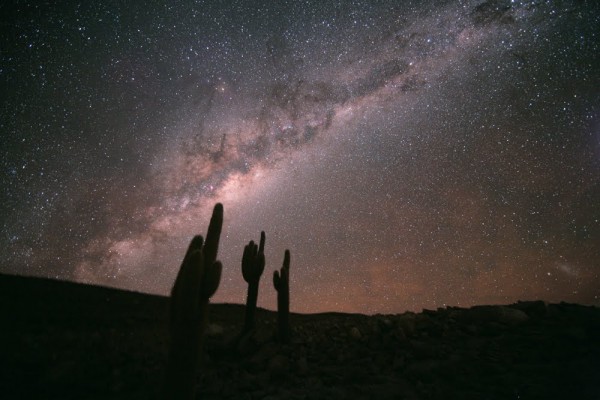
Image Credit: ESO / Stephane Guisard, from http://www.astrosurf.com/sguisard/
But getting a handle on the size and scale of our Milky Way? Perhaps paradoxically, that's a question we're still figuring out the answers to! Which is remarkable, when you think about it, because in many ways it was so much easier to learn these things about galaxies located many billions of light years away! The reason behind this? It's the same reason you'd never know your own eye color if you never saw your own reflection: we don't have a clear view of our Milky Way from inside it!
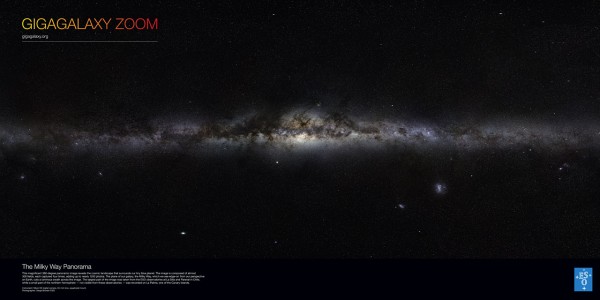
Image credit: ESO / S. Brunier.
The best we can do is make careful measurements from within it, mapping out the location of stars, pulsars and gas clouds through the dust and haze in a myriad of wavelengths, and try to reconstruct exactly what we'd look like to an outsider. The acquisition of knowledge has been painstakingly slow, and it's only relatively recently that we've determined some of the most basic properties of our galaxy.
But this would be easy for anyone outside of our Milky Way. We know this because, for all the other galaxies, where we're the outsider, these characteristics are easy to see.
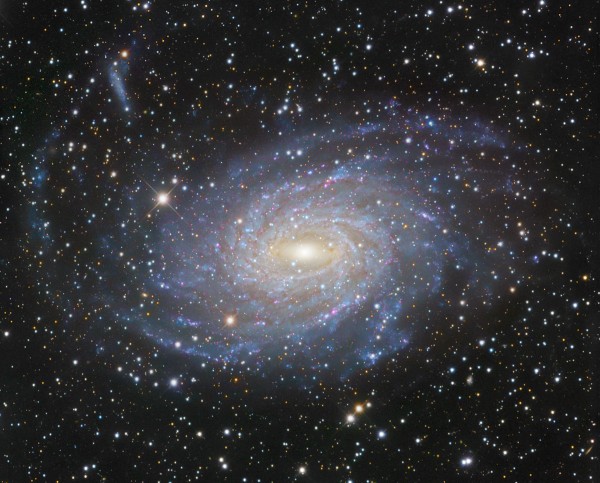
Image credit: Robert Gendler's astrophotography, via http://www.robgendlerastropics.com/
Above, the galaxy NGC 6744 is often referred to as the Milky Way's twin, and for many good reasons. Much like our own galaxy, there's a small, central bar around the galactic center, there are two main spiral arms that curl around the galaxy multiple times and with many branches, making it a flocculent galaxy. There are deep dust lanes (appearing dark) and a few regions of intense star formation (in pink), and there are small, dwarf satellites (like the one on the upper left) being gobbled up.
And much like our own galaxy, this one is about 100,000 light years in diameter. All of this, for a distant galaxy, we can learn just from a glance through a telescope across the Universe, some 30 million light years away. Indeed, many galaxies have some of these similarities to our own.
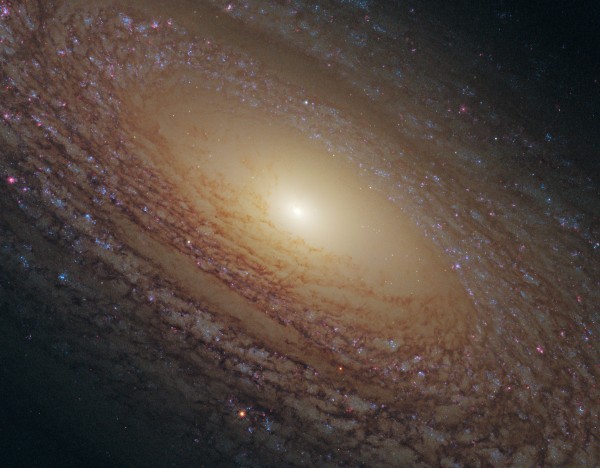
Image credit: NASA, ESA and the Hubble Heritage (STScI/AURA)-ESA/Hubble Collaboration.
Most of them are not directly face-on to us; they typically, like NGC 2841, above, come inclined at some angle. And in extremely serendipitous circumstances, we'll get to view a galaxy that appears much the same as our own galaxy appears from inside of it, 26,000 light years away from the center: edge-on. The beautiful NGC 4565, below, appears much as our Milky Way would if it were edge on, but nearly 50 million light years distant!
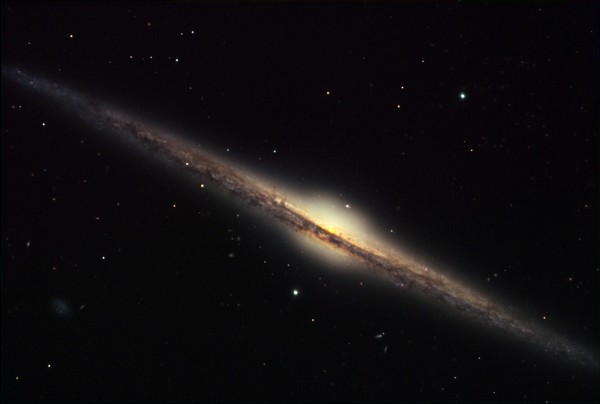
Image credit: Bruce Hugo and Leslie Gaul/Adam Block/NOAO/AURA/NSF.
We may know that our galaxy is 100,000 light years across, but much less well-known is how thick our galaxy's disc is. Yes, we're thicker at the center, with that same spheroidal bulge that NGC 4565 has, but the bulk of the disc, such as out where we are, is a roughly uniform thickness. But what is that thickness?
If you ask wikipedia, they'll send you here, which as of today -- I'm sorry to say -- gets it wrong by quite a bit. Our galaxy is much thicker than the 1,000 light years figure they quote. But how much thicker? Even among scientists today, that's up for debate. And the reason that's up for debate is that you get different answers depending on how you look. It might occur to you, for instance, to simply look at stars.
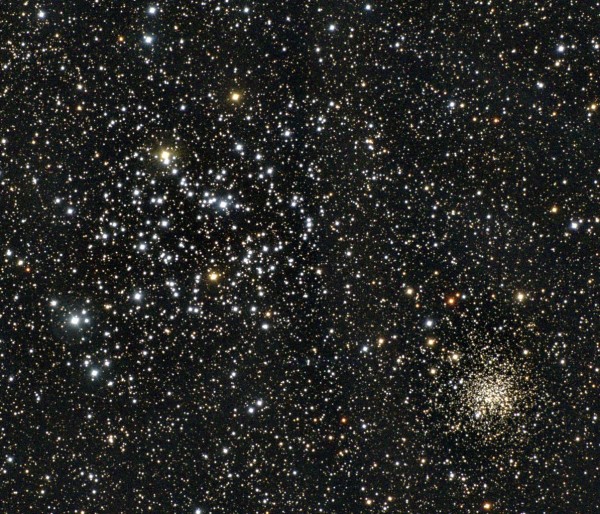
Image credit: Twin City Amateur Astronomers, of star cluster Messier 35.
Take a look around our Solar neighborhood, look out of the plane of the galactic disc, and measure the star density directly. Our equipment is good enough, these days, that a group has done exactly this. Their findings, lifted from figure 3 from their paper, below, show us how thick the disc is, at least in terms of stars.
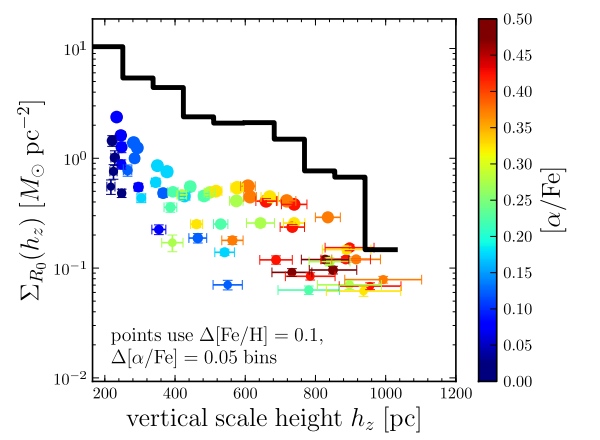
Image credit: Jo Bovy, Hans-Walter Rix, & David W. Hogg, 2012.
They find that, although the density of stars is greatest about 300 parsecs (1,000 light years) in either direction about the center of the galactic plane, we continue to have a solid abundance of stars out to about 900-1000 parsecs (more like 3,000 light years) in either direction, giving us a thickness estimate for the galactic disc of 6,000 light years.
Size-wise, this would make our galaxy about the equivalent of a stack of six DVDs. But what if you didn't look at the stars within our galaxy: what if you looked at the warm, ionized gas?
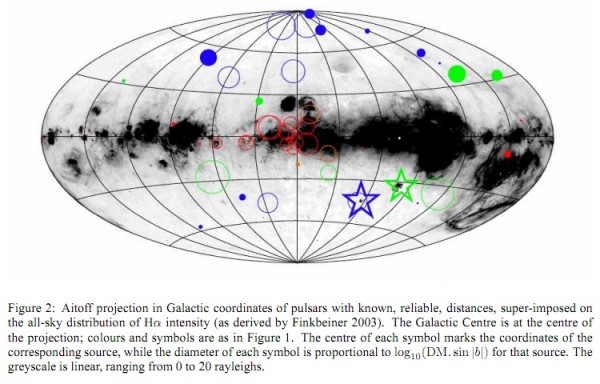
Image credit: B. M. Gaensler, G. J. Madsen, S. Chatterjee and S. A. Mao, 2008.
A team led by Bryan Gaensler did just this in 2008, by looking at a set of pulsars of varying distances and varying galactic latitudes. What they intended to do was to determine how much intervening gas there was between these pulsars and us, and thus to determine the extent of the gas and how it was distributed.
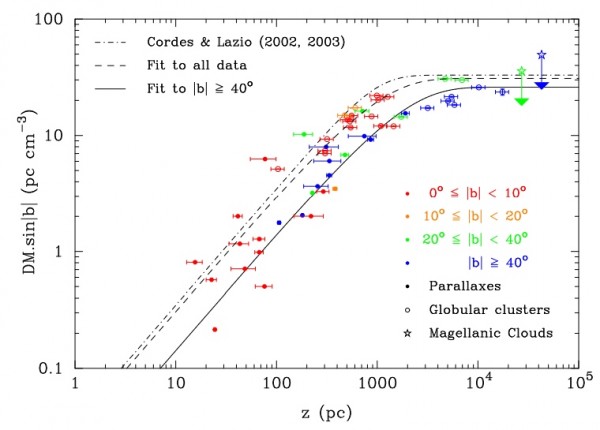
Image credit: B. M. Gaensler, G. J. Madsen, S. Chatterjee and S. A. Mao, 2008.
One can do this, because pulsars emit electromagnetic radiation of different frequencies, but the different frequencies are affected in different ways by the warm gas. And when they deduced where this gas was, what they found was -- at least, based on where the stars are -- a bit shocking! (You'll want to read the graph that says "H" to see the height of the gas above/below the galactic plane, in parsecs.)
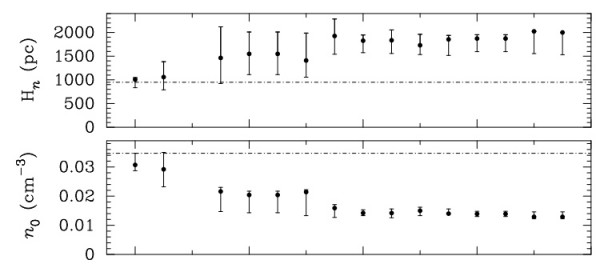
Image credit: B. M. Gaensler, G. J. Madsen, S. Chatterjee and S. A. Mao, 2008.
Amazingly, they found that the gas is double the thickness of the stars in the galaxy. If you want to be safe, you can say that the thickness of the Milky Way is somewhere between 6,000 and 12,000 light years, based on the stars and the warm ionized gas as the lower- and upper-limits, respectively.
But after all this time, living in our galaxy and watching the skies, the Milky Way is still one of the least understood galaxies, all because we're right in the thick of it. Or, if you want to be more accurate, right in the thin of it! However you slice it, it's still a remarkable story, and I hope you have a better appreciation for how hard it is to figure out something so simple: the shape and size of our galaxy!
Even when the star density is 1000 times less than here, the average interstellar distance will be 50 ly rather than 5, so astrographically it's still within the Galaxy.
Is there any agreement as to what constitutes intergalactic star density and how far away from the MW it is attained?
Nice summary.
"If you want to be safe, you can say that the thickness of the Milky Way is somewhere between 6,000 and 12,000 light years, based on the stars and the warm ionized gas as the lower- and upper-limits, respectively." This suggest that the thickness is a matter of definition or convention ( e.g. does a galaxy include ionized gas or not).
But I thought that a galaxy also includes it's globular clusters. "A globular cluster is a spherical collection of stars that orbits a galactic core as a satellite... These globular clusters orbit the galaxy out to large radii, 40 kiloparsecs (approximately 131,000 light-years) or more." (i.3. the diameter of the galaxy)
But apparently globular clusters aren't considered part of a galaxy. Doesn't make sense to me.
It's kind of like asking is the microflora on an in the human body part of the human body? "It is estimated that 500 to 1000 species of bacteria live in the human gut[2] and a roughly similar number on the skin.[3][4] Bacterial cells are much smaller than human cells, and there are at least ten times as many bacteria as human cells in the body (approximately 10^14 versus 10^13). .. Bacteria make up most of the flora in the colon[24] and 60% of the dry mass of feces." wikipedia. So that might be a few pounds of everyman's weight.
So if someone asks you, "What's you're mass?"; do you subtract out 1 to 5kilograms associated with the bacteria or do you include them.
Net I think the human organism should be thought of as the living system including various symbiotic organisms that live in and upon the human body. Similarly, I think a galaxy should include all of the matter and energy that move with the galaxy; and I think that would include globular clusters as well as hypothetisized dark matter.
Here's a few quotes from http://www.umich.edu/~lowbrows/reflections/2006/dsnyder.19.html.
"We now know of approximately 150 globular clusters in our galaxy and have found globular clusters in other galaxies... recent computer simulations suggest physical collisions (between stars) happen more often than originally suspected. These collisions are most likely in crowded parts of the galaxy, such as globular clusters."
So if globular clusters are part of galaxies (as I think) then the thickness of a galaxy is approximately equal to its diameter.
But at this point I feel like arguing with my own opinion; because visually our galaxy or our twin looks like a CD not a sphere. So please someone clarify my thinking with simple sensible physical reasoning. thanks.
"It’s kind of like asking is the microflora on an in the human body part of the human body? "
Seems to me it's more like asking if the fly buzzing around your head is part of your body.
If the globs were actually inside what we'd call the galaxy not considering the globs, then it'd be clear that they are part of the galaxy. But they aren't, and so they aren't. Instead, they are satellites of our galaxy. Globular clusters and dwarf galaxies orbit the Milky Way, but aren't part of them.
You could consider them part of the galaxy, sure. But they don't orbit in the plane of the galaxy's angular momentum like all the stuff we usually call a galaxy does, and while locally quite dense with stars they are rather spread out and thin. Would you take a toenail that is undeniably part of your body, but then cut it off and throw it across the room and claim to be twenty feet wide?
Of course then if you think about the dark matter that is theoretically dominating the mass of the galaxy and is not a thin disk and you'd have to say that it's all 'inside' the galaxy and thus everything else, globs and maybe dwarf galaxies too, are part of the Milky Way.
Let's make it much simpler and ask "how big is the *disk* of the Milky Way?" which gets to your point about the visual appearance of our galaxy, the thing that most of us picture when we say "galaxy".
So the disk is between 6000-12000 ly across depending on how you measure. How big "the galaxy" is depends on a whole lot more open questions. :)
Here's my short version.
What can we take away (in our models) from a galaxy like the Milky Way and the galaxy will continue to be identified as the Milky Way galaxy?
So if we take away dark matter will the visible observed galaxy (i.e. the disk) hold together? Answer, No. So to my way of thinking, dark matter is a necessary part of the definition of a galaxy.
So if we take away globular clusters will the visible observed galaxy (i.e. the disk) hold together? Answer, I don't know. So are globular clusters a gravitational necessity for a galaxy to hold together or not? If I don't have globular clusters, will I need more dark matter to hold a galaxy together? I don't know.
Any thoughts, thanks.