

“We are much closer today to being able to send humans to Mars than we were to being able to send men to the moon in 1961, and we were there eight years later. Given the will, we could have humans on Mars within a decade.” -Robert Zubrin
This is what we can accomplish when we invest in something big.
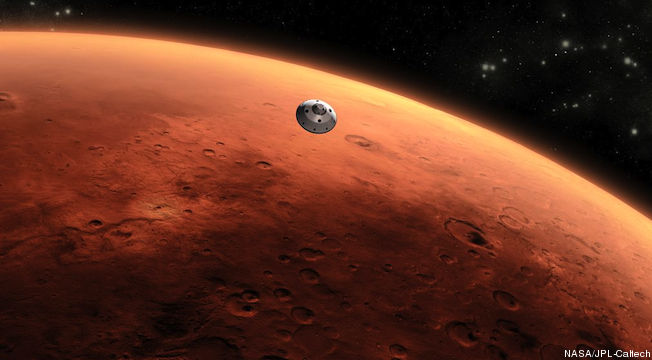
Image credit: NASA / JPL-Caltech / Mars Science Laboratory.
I'm not talking about the Olympics, of course. I'm talking about investing in science, in exploration, in robotics, in engineering, in technology, and in humanity, and what can we accomplish?
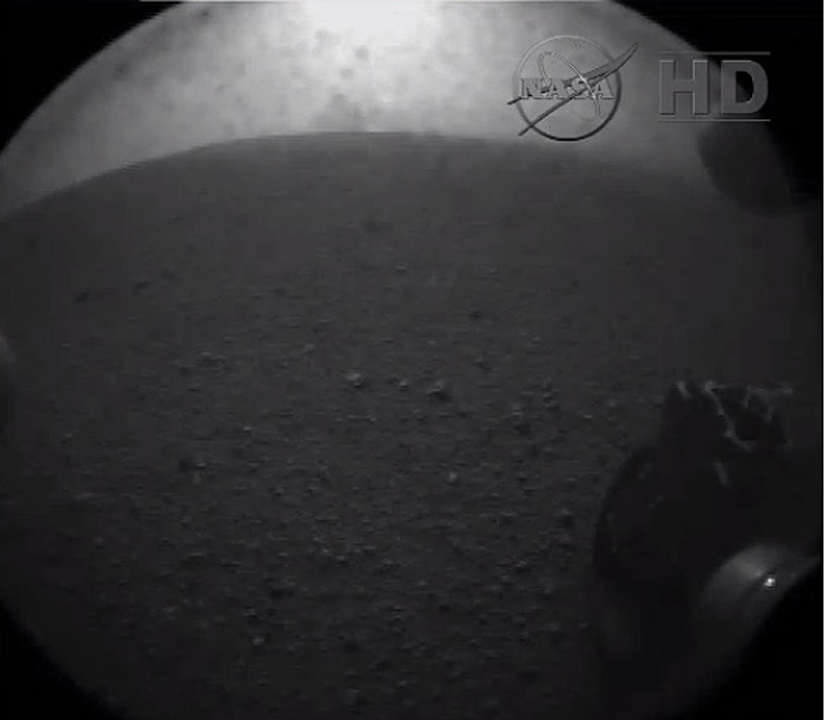
Image credit: Mars Curiosity / NASA / JPL.
For just the seventh time in history, we've successfully landed a spacecraft on Mars. This time, however, is different.
This time, we landed the largest, heaviest, most advanced robotic science laboratory ever constructed. Or, I should say, we got it to land itself.
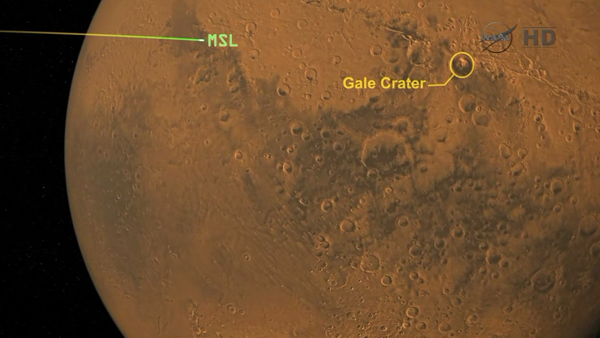
Image credit: NASA graphic.
After a journey of more than 350 million miles through space -- from Earth through interplanetary space, all the way to Mars -- Mars Science Laboratory had to hit an entry window towards Mars that was less than 15 square miles in size. By time it was set to arrive at Mars, the Red Planet was more than 150,000,000 kilometers away from Earth, meaning that it takes light (and all forms of communication) more than 15 minutes to travel from Mars Science Laboratory to Earth and back to the spacecraft again.
This time delay is so large that we couldn't simply send commands to this spacecraft and tell it what to do; we need to empower it to make intelligent decisions on its own! And this was especially challenging because of how ridiculously powerful and awesome this new science laboratory is.
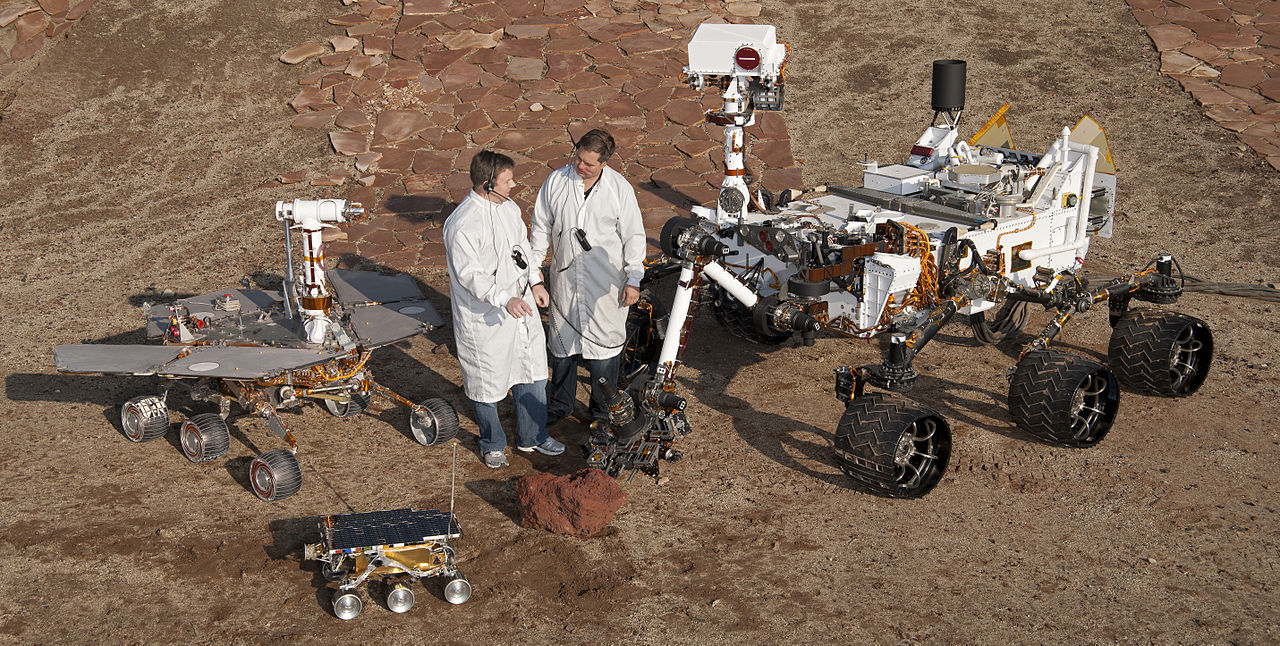
Image credit: NASA / JPL-Caltech / JPL's Mars Yard testing area.
Mars Science Laboratory, shown all the way at the right, not only dwarfs all other laboratories ever sent to Mars in terms of size (it weighs nearly a tonne and is the size of a small SUV), but also in terms of technological power. With 17 cameras on board, a specially designed martian weather station, and a sample analysis kit capable of detecting organics (among other things), this spacecraft has a total of 10 major science instruments.
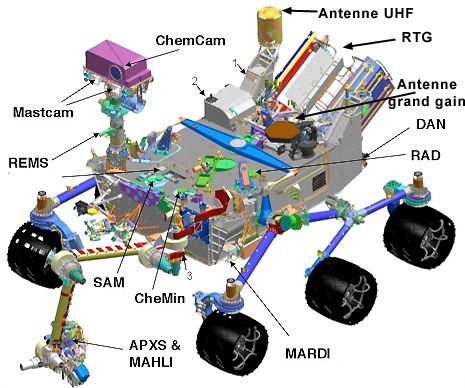
Image credit: NASA / JPL.
And, as you can imagine, it didn't come cheap: all told, it cost $2.5 billion dollars to make this science laboratory, complete with the rover, launch, and landing systems. (For those of you wondering, Curiosity is the name of the rover, while Mars Science Laboratory is the name of the NASA mission.) This was how much it cost to do it right, which is the only way to do it if you want to land on Mars, considering the failure rate.
Because not only is it difficult to get there and land successfully under the best of circumstances, we've never landed anything on another world that was this combination of large, heavy, and fragile, which means that a whole new landing system needed to be designed. For $2.5 billion, you only get one shot at getting it right.

Image credit: NASA / JPL.
And the landing site in Gale Crater -- 96 km across in its entirety -- required an unprecedented precision. In order to land on Mars, Curiosity could be moving no faster than just a couple of miles-per-hour upon touchdown, which would make it the slowest, easiest landing ever performed on another world, and it needed to be performed with (by far) the heaviest device ever attempted to land on another world.
And there were plenty of worries. First off, the journey from the edge of Mars' atmosphere to touchdown on the surface took seven minutes, meaning that by time the device is a few thousand kilometers above the surface of Mars, it's on its own, as we can no longer send it a signal to correct its course. So it needs to be able to do literally everything on its own.
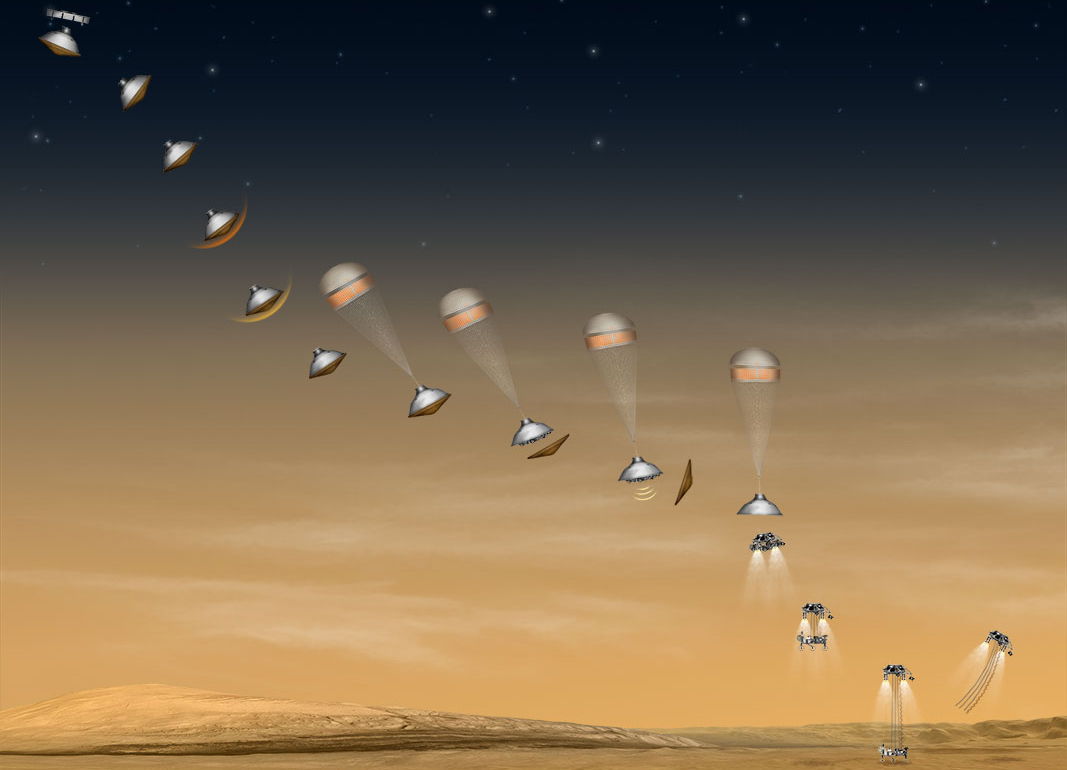
Image credit: NASA / JPL.
It needs to successfully hit the atmosphere at the correct angle so that the heat shield can absorb the intense energy of decelerating from 13,000 miles-per-hour down to about Mach 2. If even a small fraction of that heat made it through to the instruments, Curiosity would be ruined.
Then, the parachute needed to deploy properly, which means at the right time and speed to slow it down to a reasonable (about 180 miles-per-hour) by time it's ready to jettison its heat shield.

Image credit: NASA / JPL / University of Arizona, via Mars HiRISE.
This was a rousing success, and was even imaged (above) by the passing Mars HiRISE mission! This itself is very dangerous, because unlike the Moon, Mars has a significant atmosphere and rapid winds that can easily accelerate spacecraft to speeds over 100 km/hour; an impact at that speed would doubtlessly mean the demise of Curiosity.
In the past, we had used giant airbags to protect rovers from these speeds upon impact, a technology with an incredible track record of success that included Pathfinder, Spirit, and Opportunity.

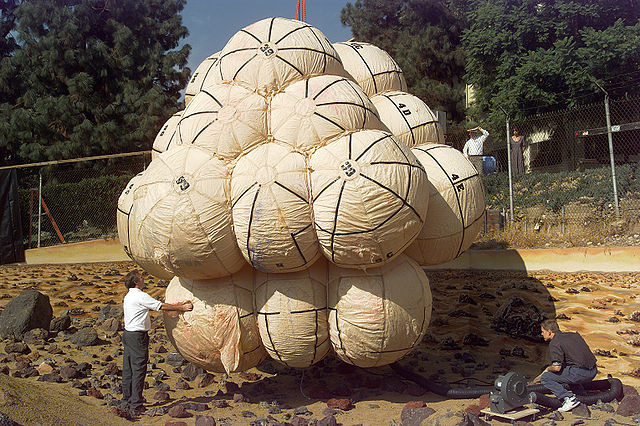
Image credit: NASA / ILC Dover.
But the weight of the Curiosity rover meant that this method would be inadequate, and that a new, never-before-attempted landing technique would be required. As about 50% of all attempted Mars landings have failed, this was where the real terror kicked in. Because now, we need to go from falling at about 180 miles-per-hour not just vertically, but also with significant horizontal speed, and slow down to make a landing that's no harsher than dropping an egg from a height of about 6 inches (or 15 centimeters).
How was this to happen?
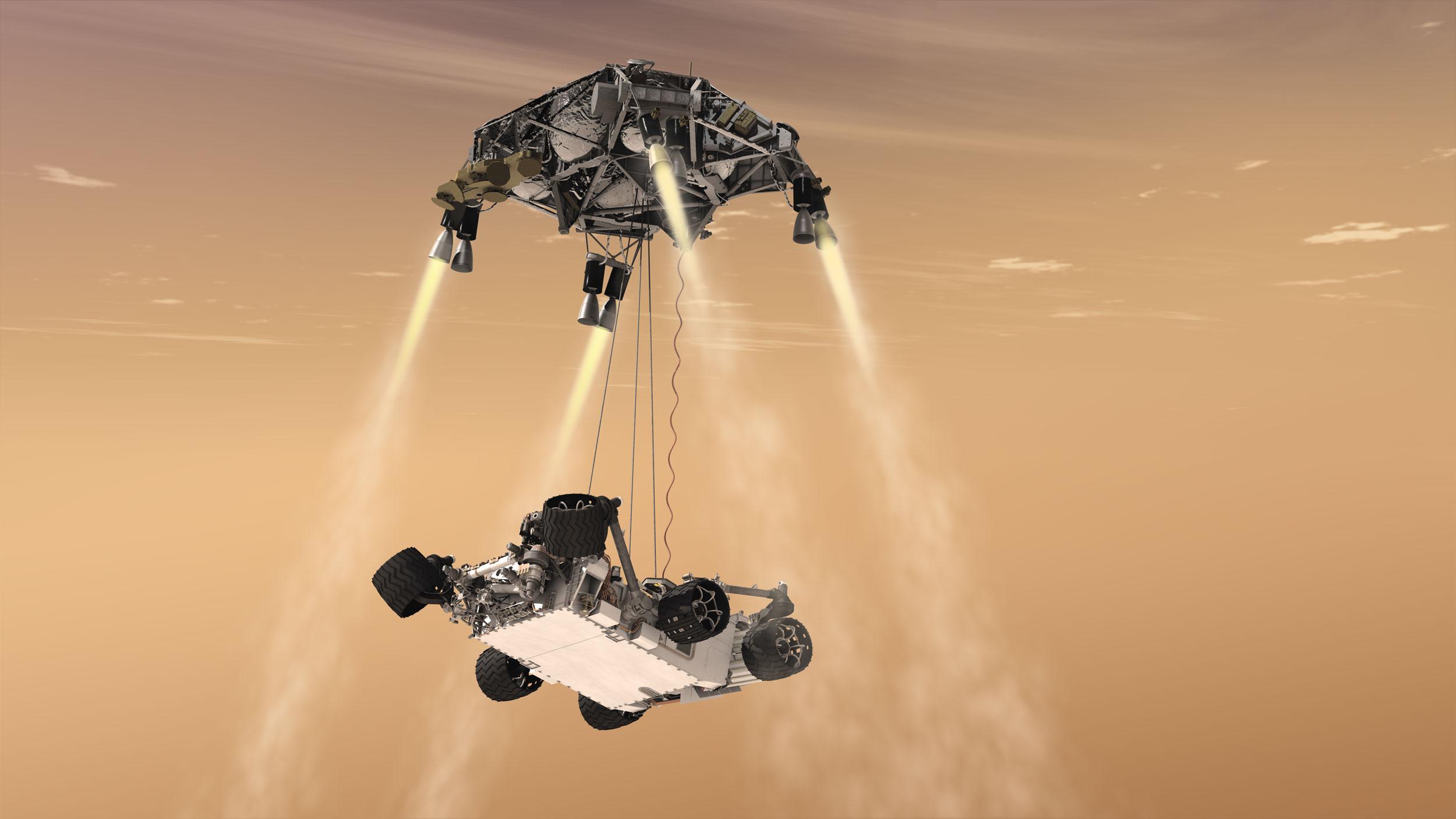
Image credit: NASA/JPL-Caltech.
A brand new descent system, outfitted with eight retro-rockets, would bring the entire system to a virtual standstill just a few dozen feet above the martian surface, where it would then lower the rover down onto the ground ever-so-delicately.
This was the most critical stage, and meant the difference between two-to-six years of unprecedented science and a very public, $2.5 billion failure.
After maybe two minutes of total silence, the critical signal arrived.
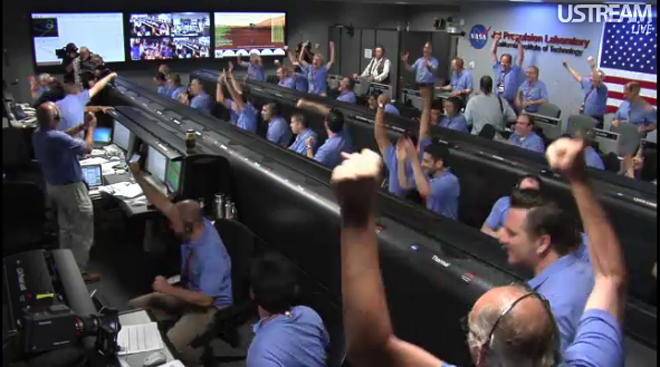
Image credit: screenshot from NASA TV.
Curiosity had landed, successfully! Almost immediately, the rover set out to do its pre-programmed photography sequence, snapping images of where it landed. Unsurprisingly, the landing (and the retro-rockets) had kicked up a large amount of dust, but one spectacularly impressive picture stood out.
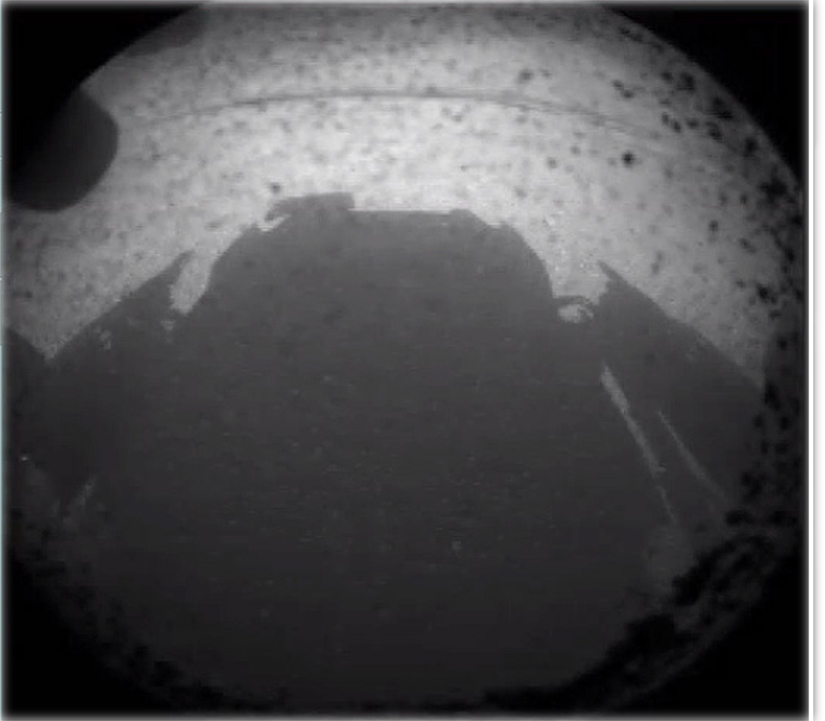
Image credit: NASA / JPL-Caltech / Mars Science Laboratory's front Hazcam.
More photos (including real-color images) are undoubtedly forthcoming, so sit tight (and follow along as the news comes out in real-time), but we know already that this landing means two outstanding things.
First, we made it! We are inside Gale Crater -- where we are almost certain a liquid lake once existed -- and ready to investigate the soil beneath our wheels, the atmosphere and weather above us, and the cosmic rays plunging all the way through the atmosphere. It looks like it's in fantastic shape to meet all six of its science goals, including learning about radiation levels that humans will be exposed to.
But second, it means that if we can land something this complex and heavy this delicately, we can do this.
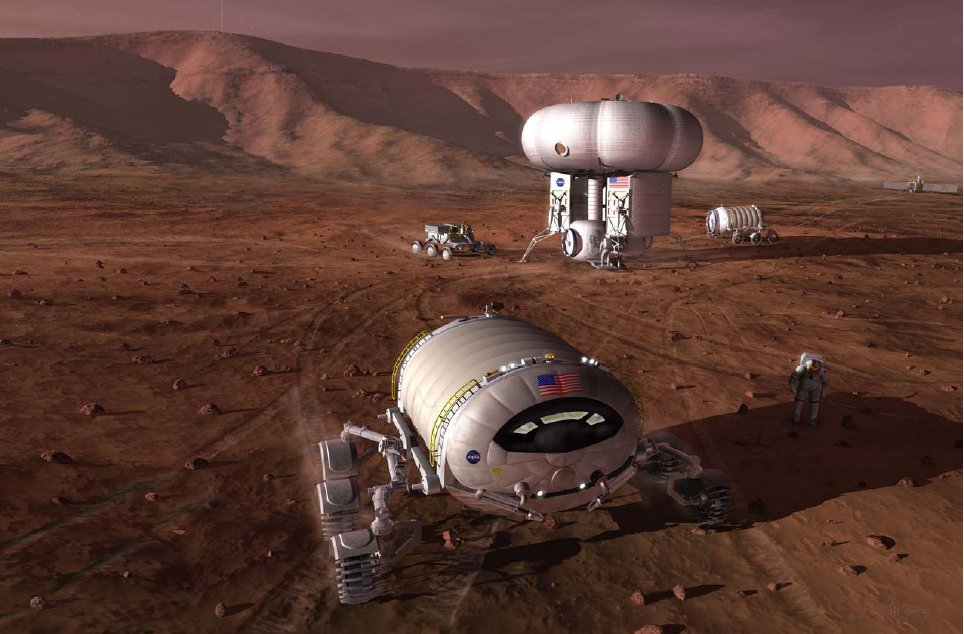
Image credit: NASA.
We can send a manned mission to Mars. We've already learned about radiation during the 9-month journey to the red planet, and we've successfully developed and used the technology necessary to make a heavy, controlled landing on Mars.
All that we need to make this a reality is to invest in the people who can make it happen. We've got the know-how, we've got the experience, we've got the astronauts and we've got the plans; all we need is the decision that this is worth investing in and we can be on Mars within a decade. After all, we've come so far already.
Image credit: NASA / Mars Science Laboratory / Honeybee Robotics.
I can't wait to see what Curiosity learns, and I am so hopeful that this success means that exploring the Universe won't mean quibbling over budgetary table scraps anymore; there's a feast to be had if only we're willing to make the investment of planting the seeds. From last year to this, NASA's budget was just cut by another 2%, taking it down to about 18 billion dollars annually for everything: astronauts, launches, Earth-monitoring satellites, employees, contracts, telescopes and facilities, and all of NASA science.
But if we can achieve all of this with so little, imagine what we could do if we actually invested in science, in exploration, in robotics, in engineering, in technology, and in humanity.
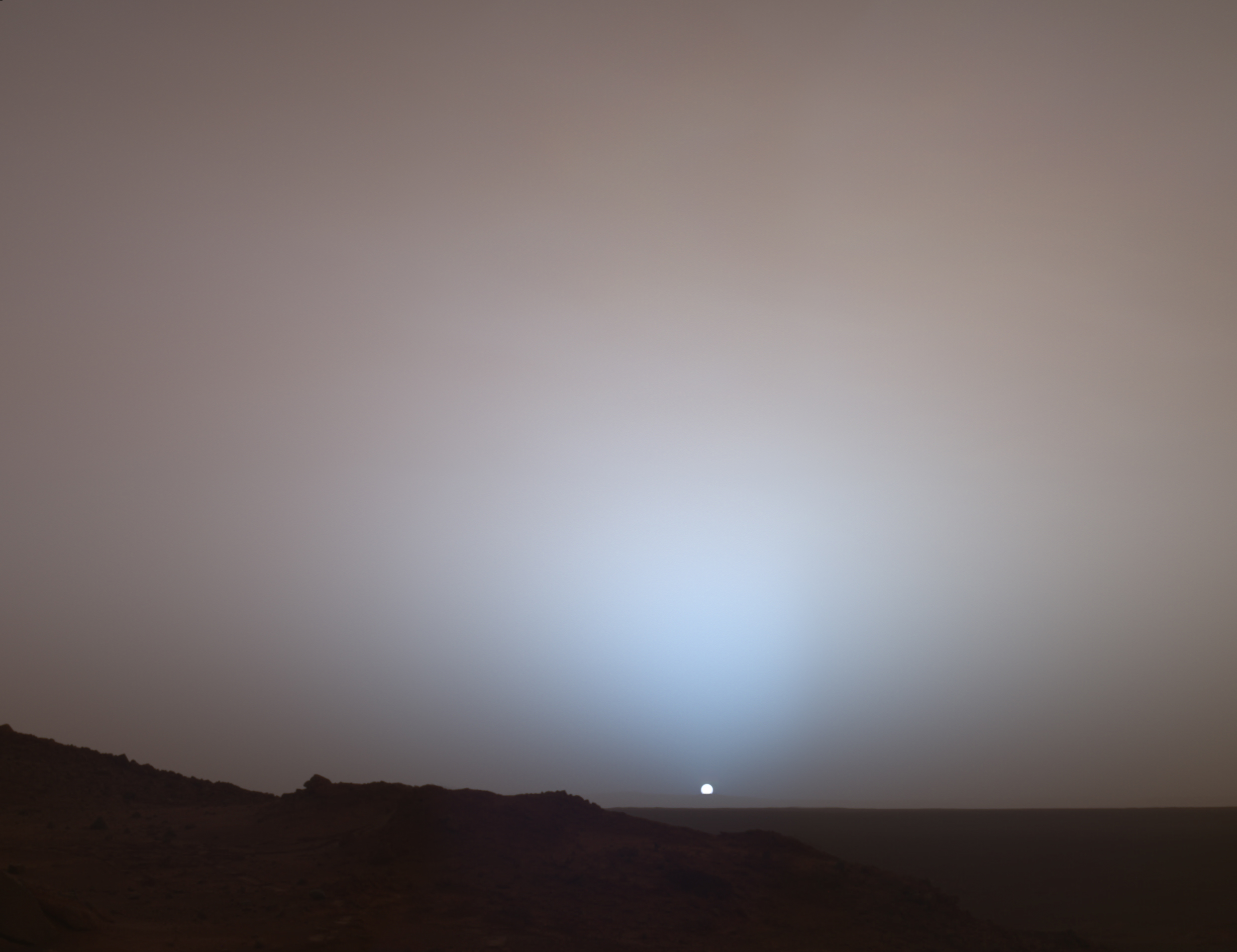
Image credit: NASA / JPL-Caltech / University of Arizona, Mars Exploration Rover (Spirit).
Here's looking forward to an amazing mission, sure to be full of unprecedented discoveries. I'm so excited about it that -- once again -- I'm headed out tonight onto my local news (KGW NewsChannel 8), talking about the amazing landing of Curiosity on Mars and what it means for all of us.
One correction to your post: 2.5 billion dollars is not expensive; it is incredibly cheap. IIRC, it's less than the cost of a day at the London Olympics, and somewhere around the cost of five minutes of an American war overseas.
2.5 billion dollars is, on the federal level, pocket change.
This is a really important point. Compared to all the other things developed nations do, space exploration is a drop in the bucket.
This is incredible; it's always good to see a remote probe successfully arrive at its destination. Now the really exciting work can begin.
I noticed in the NASA TV feed people spoke of the wonderful power source they have, but everyone avoided calling it a "Radioisotope (aka Radionuclide) Thermal Generator". Why is RTG such a bad word these days? I wonder what the ageing characteristics of the RTG is like - how long can Curiosity last?
Now to find some martians and anal-probe them!!
Now if I could only get a RTG for my iphone.
$2.5 billion is pocket change for the USA maybe. Keep in mind the USA has one of the biggest debts in the world. The rest of the world is trying to focus on keeping the stupid countries like your own from going under...
@MadScientist:
I wondered the same thing. The half-life of Plutonium-238 is about 88 years, so even though the heat (and therefore the power) generated will taper off, Curiosity should be viable until humans can land and install fresh modules, however long that takes. They also used RTG power sources on the Viking and Voyager missions. Voyagers 1 and 2, launched 35 years ago, are both still sending back data from billions of kilometres away, even though instrument heaters have been shut down to conserve energy. At the Monday morning press conference, project manager Pete Theisinger said something very interesting (paraphrase): "There are no materials on board subject to depletion. We tested components to twice their projected lifespan. We did NOT test to destruction. No one should be surprised if Curiosity is still functioning at twice the projected mission length. And that's the first time I've talked about 'more than two years.' " My immediate thought: Theisinger was project manager for Spirit/ Opportunity, each projected to last 90 days. Opportunity is alive and well eight years on -- and counting. With budget cutbacks looming for any new projects, I think Theisinger built this rover to last indefinitely. Sharp move, Pete!
Nice work from NASA!
Money-wise, they should team up with the Saudis or those people from the Emirates they got lots of cash, and it's in their genes to live in the desert, it's nothing new to them. Anyway them Arabs are now wasting time and money on building skyscrapers, and trowing money at football players ... why not invest in a base on Mars, to proceed to Saturn and its moons. Think big, aim for the Stars, if you fail, you'll land on Mars.
The NASA video clip on NASA's own youtube channel has been taken down because a news corp has claimed copyright infringement of THEIR work by it. Under the DMCA.
REJOICE! The artists are saved!
Bah.
Can't wait to see what comes out from this mission.
Corgratulations to the team that did tha
Thanks!
Madscientist, an RTG is basically a radioactive pile that is hot and, since this is in space, barely shielded. They're good for a couple hundred watts, but you wouln't want one in your phone.
As to why it's bad, basically if your launch goes fubar on takeoff,you have a fair bit of cleaning up to do.
If you think this is only a worry to anti-nukes, then consider the hysteria about a "dirty bomb" from terrorists with the world governments.
This pile is pretty much the same thing if the rocket goes titsup.
What is the practical benefit of sending humans to Mars just to plant a flag and have a photo op?
It'd be better to take a long term approach and keep sending our robots to learn all there is to learn, then have them begin building habitats for future colonists.
Assuming society doesn't collapse climate change and peak oil before that...
What is the practical benefit of sending humans to Mars just to plant a flag and have a photo op?
It'd be better to take a long term approach and keep sending our robots to learn all there is to learn, then have them begin building habitats for future colonists.
Assuming society doesn't collapse from climate change and peak oil before that...
Double post. My comment must have double awesome.
"What is the practical benefit of sending humans to Mars just to plant a flag and have a photo op?"
I was thinking the same. I understand the big old motivation mantra about the moon landing, but the Mars is quite a different thing. While Ethan is right about that we are approaching the time when our technology is given for an crewed interplanetary mission, I don't see why not starting to use these capabilities to establish a proper presence in space by building large space stations, build space launch systems for cheaper, and start to colonize the Moon first (which could provide some materials for space stations and can also be a great place for launching shit, not to mention the science that could be done only couple of hours away from home).
The planetary bodies can wait until we have a better access to space. As a counter point though, if the MSL finds extractable water, carbon and nitrogen source on Mars, Mars would be a better choice perhaps, because despite the great distance, a colony could be independent of the Earth supply. Never the less, Mars is pretty much a one-way ride still. Years away from Earth, years in higher radiation levels, cramped living quarters, relying purely on technology, limited human presence is still a big limit.
What's the practical benefit of living?
Let me take the question a bit further: Assuming the purpose of a manned mars mission is exploration, what can a human do that a unmanned rover can not. The human will visit mars in a can (space suit), so much info that would be available on earth is not there. The rovers cameras can operate over a much wider band width than human eyes, and the human would likely have to have the same equipment. In particular since we are talking post 2030 for any manned mission, if Ray Kurzweil is at all correct the rover may be as smart as a human as well. Yes there might be a couple of days delay with a unmanned rover in discoveries but thats about it. It should be possible to build a virtual reality environment that provides someone on earth with at least as much as would be seen walking around on mars.
Adapt to an awkward situation. Can also carry instruments that can operate over a much wider bandwidth than the human eye.
Downsides: needs feeding, water, handling and a ticket home.
Proboem with a VR suit is that your reaction times go from around 0.22sec to around 15 minutes.
MadScientist: "Why is RTG such a bad word these days?"
Because everything with the magic word "nuclear" today is referred as evil stuff. That what happens if people are allowed to preach about stuff which they don't understand...
lyle, Gyula, etc.: I don't think there are any short-term benefits to sending humans. You're right, robots can do most everything a lot cheaper. But, if we ever want to move into space, we're going to have to make the very high up-front investment of establishing bases beyond LEO.
The first step of an off-earth base is big, expensive, dangerous, and not worth it on its own. Its the steps that come after which could make it worth it.
@ William and Gyula
"What is the practical benefit of sending humans to Mars just to plant a flag and have a photo op?"
Other than scientific benefits, for one, as far fetched as it might seem today, we are gonna run out of living space on earth sooner than you might think. Think of colonization and what economical prospects it provided several centuries ago here on earth (but without the bloodshed). We are becoming more numerable and earths resources are only getting smaller. Don't have to be a genius to figure out what will happen. It's an exponential function with a growth of 1% per year roughly nowdays. Take 7 billion and do the projection... it's scary.
"Because everything with the magic word “nuclear” today is referred as evil stuff."
Ah, I see. You don't know why people may be against nuclear power, therefore you make something up so that you can feel superior.
Got it.
@Chelle
"... and it’s in their genes to live in the desert, it’s nothing new to them. Anyway them Arabs are now wasting time and money..."
So in addition to being ignorant, you're also a racist. Wonderful....
Excellent science and engineering!
Not to diminish the Mars landing which was amazing!
And acknowledging that autolanding on Earth is easier than on Mars; because of runways, beacons, GPS satellites, etc. (not to mention Earth's atmosphere). But airliners have autolanded (e.g. in heavy fog ) for years. As well the most difficult parts of the space shuttle landing sequence required faster than human reflexes and were handled by computer (with a backup computer on standby to copilot should the primary autolanding computer fail). Once the most difficult part of landing a space shuttle was done by computer; control was given back to a human pilot.
Having a human pilot is more about politics and public relations than performance.
"Automatic landings are relatively easy to do. Since the return of the shuttle to earth is already highly automated, its range of automatic operation would simply be extended... In 1988, the Russians sent their Buran shuttle aloft on an unmanned mission; it made a faultless, fully automatic return... From the start, the American shuttles were envisioned and built for automatic return. That capability is used on all missions until astronauts take manual control minutes before touchdown. The brains behind the guidance system are the shuttle's on-board computers." New York Times
Once that google driverless car is available for a modest price; I'll switch to a computer chauffeur for my car.
Sinisa,
These people have a history of traveling for many day's through the desert to reach a well and move forward to sell their camels, do you never watch any David Attenborough documentaries? I could have suggested some other people like the Spaniards who sailed the oceans for weeks discovering new places, but they are as broke as can be, even the Americans are short on cash, so why not ask the people who are sitting on a lot of money ... There is nothing wrong with that, and there is no need to act like an overly politically correct individual, just to get at me.
I know their history Chelle, and even spent some time among them. And it's not about being overly politically correct since I couldn't care less for politics. But I know very well what claim's to "races being genetically predisposed to this and that" leads to...
And I will lash out at anyone who downgrades any race for whatever reason.
I bet you're hanging around here just to make sure that there is no 'downgrading' going one when those green martians show up on camera :mrgreen:
"These people have a history of traveling for many day’s through the desert to reach a well"
Not the arabs who live in the UK.
Therefore it cannot be from their race they get this trait.
Here's a thought. Maybe that trait is a result of living in a desert and that whiteys like you would trek many days through a desert to reach a well.
And none of that indicates in any way that "arabs" (whoever they are, because there's no "arabia" where all arabs live) are "wasting money".
none of that indicates in any way that “arabs” ... are “wasting money”.
Yes in football they are:
• Qatar & FC Barcelona : €171million
• Qatar & Paris Saint Germain : $122 million
• Emirates & Manchester City : £400million
• Emirates & AC Milan : £52 million
• Emirates & Arsenal : £100million
• Emirates & Real Madrid : €50 million
• Emirates & Hamburg SV : €8.5M
The numbers may slightly differ, but that's about a billion dollars going to 6 teams of guys that are just kicking against a ball. Ok, perhaps you might really like football, but I find this to be a waste.
oops 7 teams
"• Qatar & FC Barcelona : €171million"
So Arabs are Quatar.
"• Emirates & Manchester City : £400million"
Oh, hang on, Arabs are Emirates.
Oh, hang on, arabs aren't either.
I guess honkeys waste money too.
Swiss Bank Threatens to Sue NASDAQ Over Facebook IPO
Mark Zuckerberg's Big Facebook Mistake
Algorithmic Trading Glitch Costs Firm $440 Million
Right?
WASPS waste money.
Hooray JPL and NASA! Go Curiosity! I watched the live feed and listening to all the stages of the landing (thanks to Odyssey relaying telemetry from Curiosity) going off as planned and without a hitch and the cheers when the "We're safe on Mars!" was announced was simply epic.
Now while this is obviously promising for future landing of heavy objects (including people), I do NOT want an 8-year push to do it. I do not want Apollo on Mars -- bootprints and flag and let's bring a couple rocks back bye. I really want humans to visit Mars, but I want it to be after we've done extensive robotic exploration and preparation. There should be habitats and fuel for the return trip all ready and waiting for their arrival. The first human to set foot on Mars should be the beginning of a continuous human presence.
To frame the debate in terms of the opinions of legendary astronauts, I'm more Buzz Aldrin, less Neil Armstrong.
"Right?"
Yes, you are right.
Have fun!
Troll.
Actually the comments about humanity expanding are interesting. Some projects show that by 2200 the population may crash as children become more and more an economic liability. (Of course they are pure conjecture). Of course if the population keeps expanding it will likley collapse before we can do any serious colonization as Gia clears the earth of the Homo Sapiens infection she has.
If you really want to see what US scientists and engineers could do in space, just swap the current US military budget with NASA's for the next 20 years.
Sinisa: No one is saying we shouldn't go to space.
What were saying is that it has to be done in steps that are practical and have long term prospects. Humans are squishy products of a specific biosphere entering a place that is hostile to life. A manned trip to Mars should be done after we use our machines to make sure we've prepared the support we squishy bags of meat need.
Well long term human exploration is going to have to happen, so manned exploration has long term prospects.
Most naysayers really seem only to care about the money being spent, lots likely only because its government spending.
@William
well, you're previous question was "why send humans...". So don't know what you're saying now. Either you're for it or against it :)
It was WONDERFUL. America needed some good news for a change, and that wonderful rolling science lab was made in America too--though the first press conference was wonderful explaining how five countries worked together on this. If only this is what developed countries always did: work together in peace to develop great science. Why should people go there? We are born explorers. Someone is going to go. We should help them. We might need colonies out there someday.
Lately I've been thinking that humans are going to simply take a second seat to computers in the future. Once computers and robots are advanced enough, why even send humans into space? Won't AI be able to do the job much better once it can think many times faster than a human brain? I'm being serious here, I'm not trolling.