

"Who are we? We find that we live on an insignificant planet of a humdrum star lost in a galaxy tucked away in some forgotten corner of a universe in which there are far more galaxies than people." -Carl Sagan
Our night sky, quite literally, is our window to the Universe.
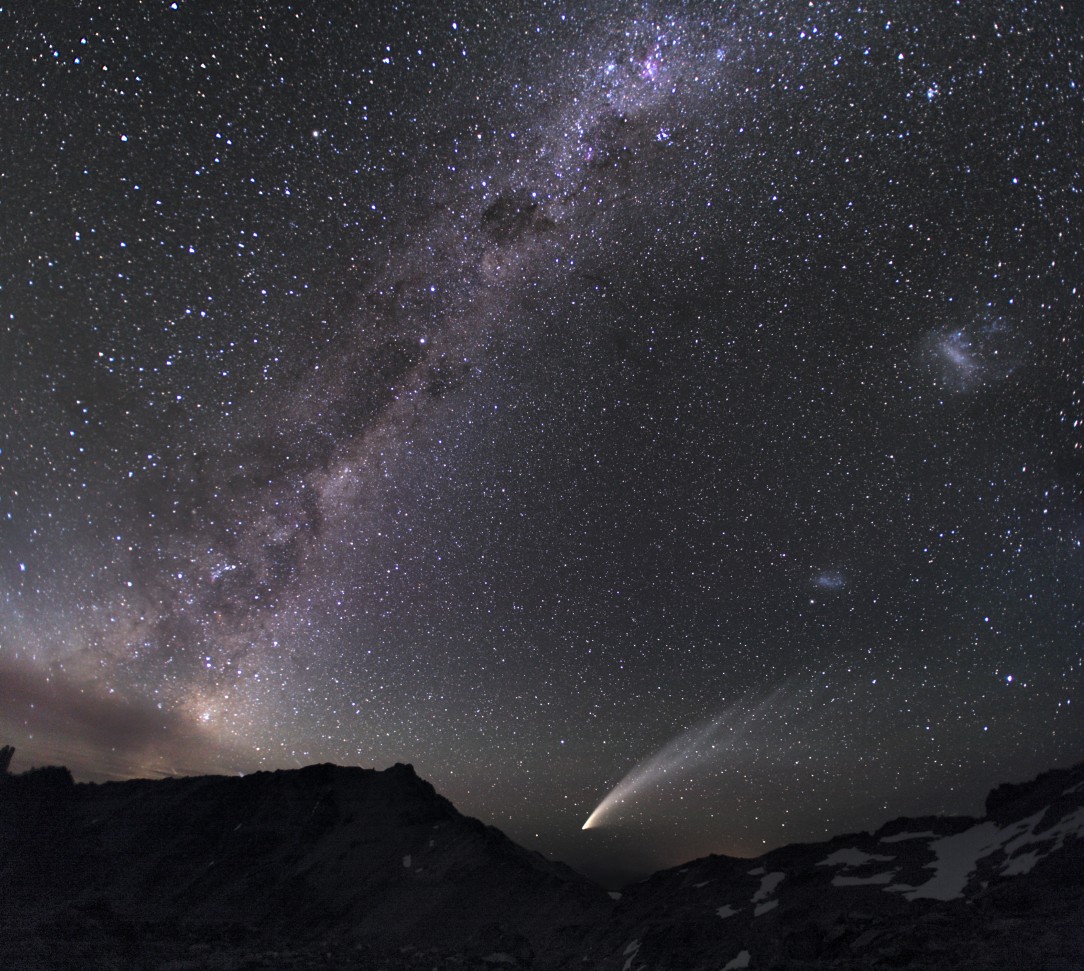
Image credit: Miloslav Druckmuller, Brno University of Technology.
Well, it's kind of a window to the Universe. I say only "kind of" because, with the exception of those two faint, fuzzy clouds in the lower right, everything else visible in the image above is part of our own Milky Way galaxy. In fact, practically everything we've ever seen or heard of in the Universe we learned from observations of our own Milky Way. It is vast, beautiful, and full of hundreds of billions of stars, trillions of planets, and much, much more.
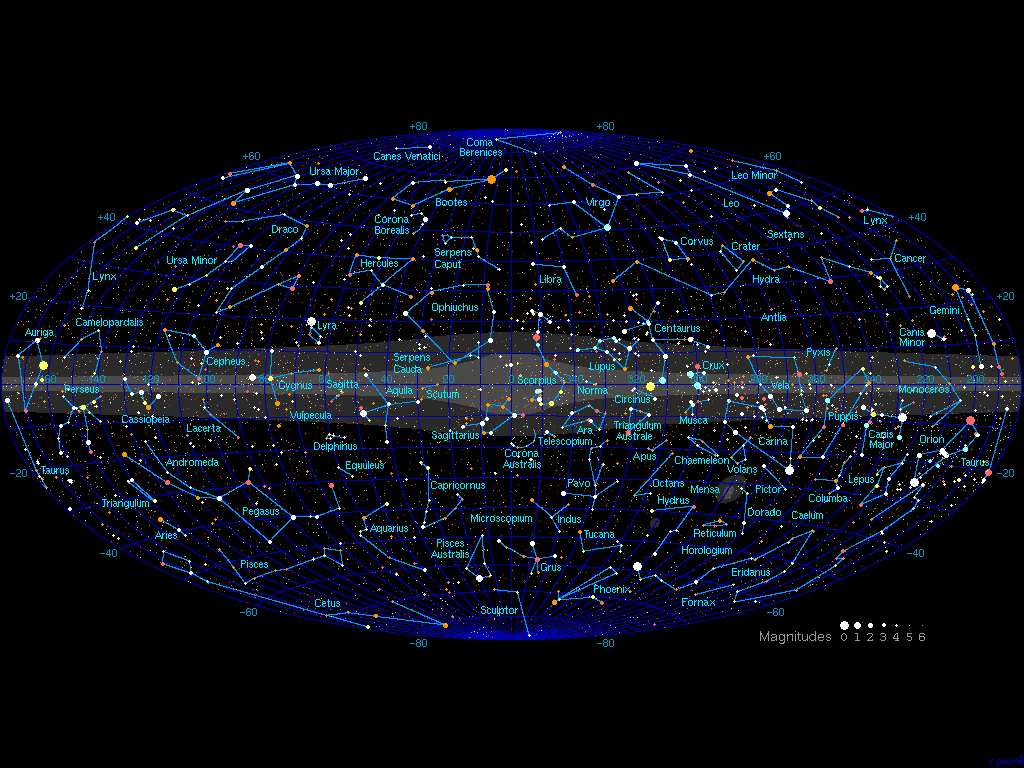
Image credit: Richard Powell, Atlas of the Universe.
But this is only one of hundreds of billions of galaxies in the Universe! We know this most convincingly through deep-sky observations of regions of the Universe where there happen to be no (or very few) galactic stars, gas, or dust in the way of our telescopes.
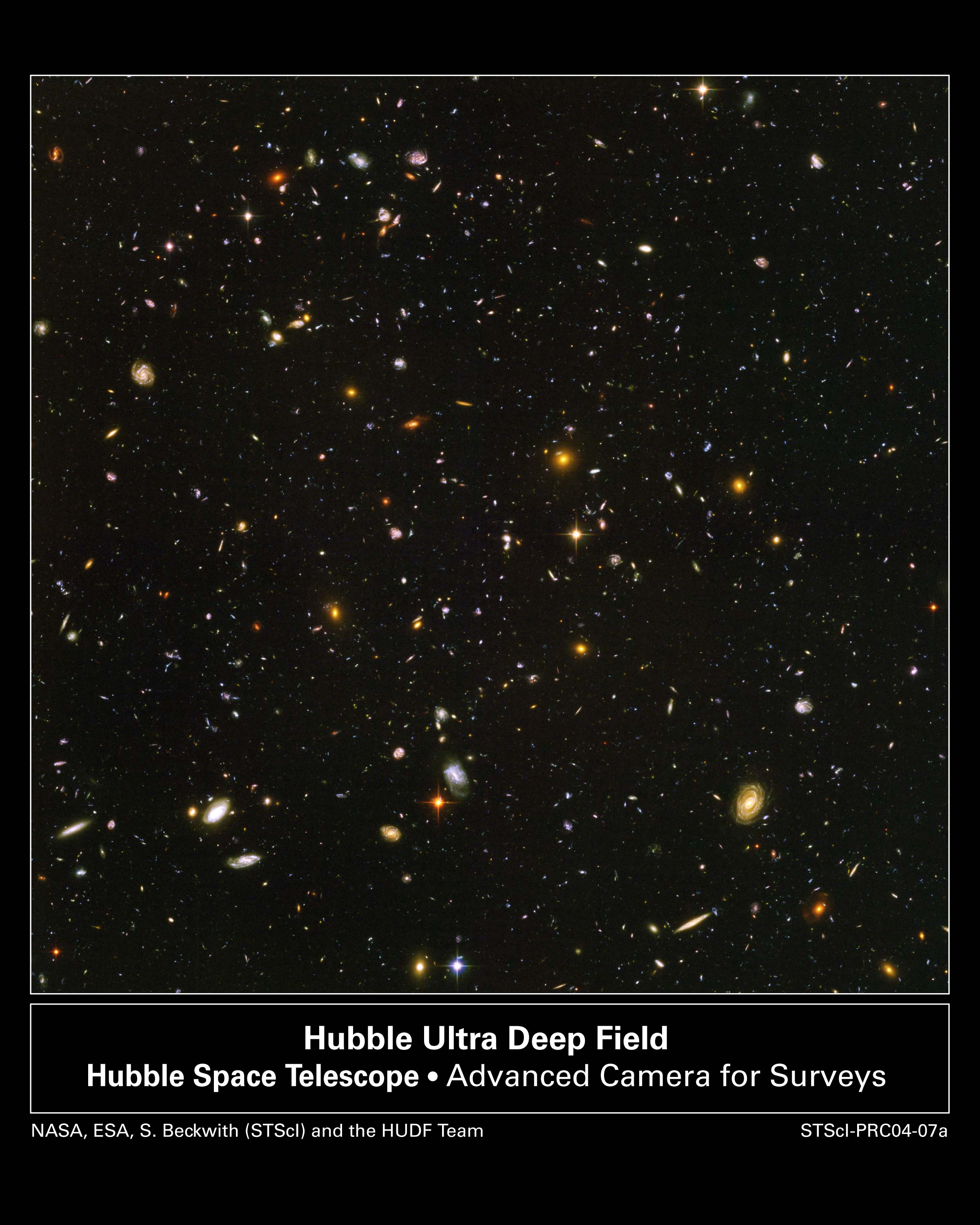
Image credit: NASA, ESA, S. Beckwith (STScI) and the HUDF Team.
What we find, by treating these regions as representatively typical of the rest of the Universe, is that there are at minimum over 100 billion galaxies in the Universe. But there's more to learn than just a number; among other things, we want to know:
- how these galaxies cluster and clump together,
- how far away they are from us,
- how quickly they're moving either towards or away from both us and one another,
- how massive they are,
- what type of galaxy are they, and
- when was the last time they underwent intense star formation?
In other words, we want to know what the Universe looks like -- in detail -- beyond our own galaxy!
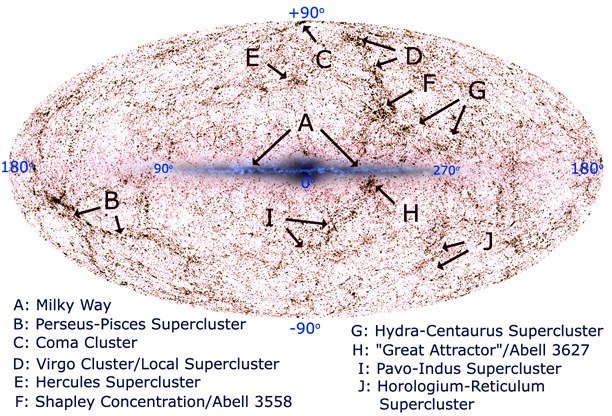
Image credit: Thomas Jarrett (IPAC/Caltech), 2MASS (2-Micron All-Sky Survey).
And what we've known, for many decades now, is that galaxies are neither distributed uniformly throughout the Universe nor are they distributed randomly. Instead, they are clumped and clustered together in a very particular and intricate way. Looking in detail at our own corner of the Universe, we've constructed detailed maps of hundreds of thousands of nearby galaxies.
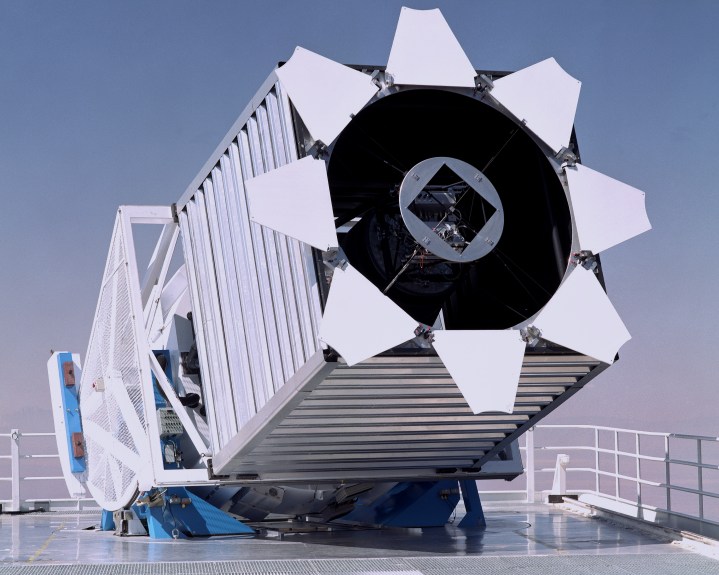
Image credit: 2010-2012 SDSS-III.
The wide-field camera and imaging system aboard this 2.5-meter diameter telescope is the most advanced in the world, and has allowed us to construct the most detailed map of the cosmic web of all time.
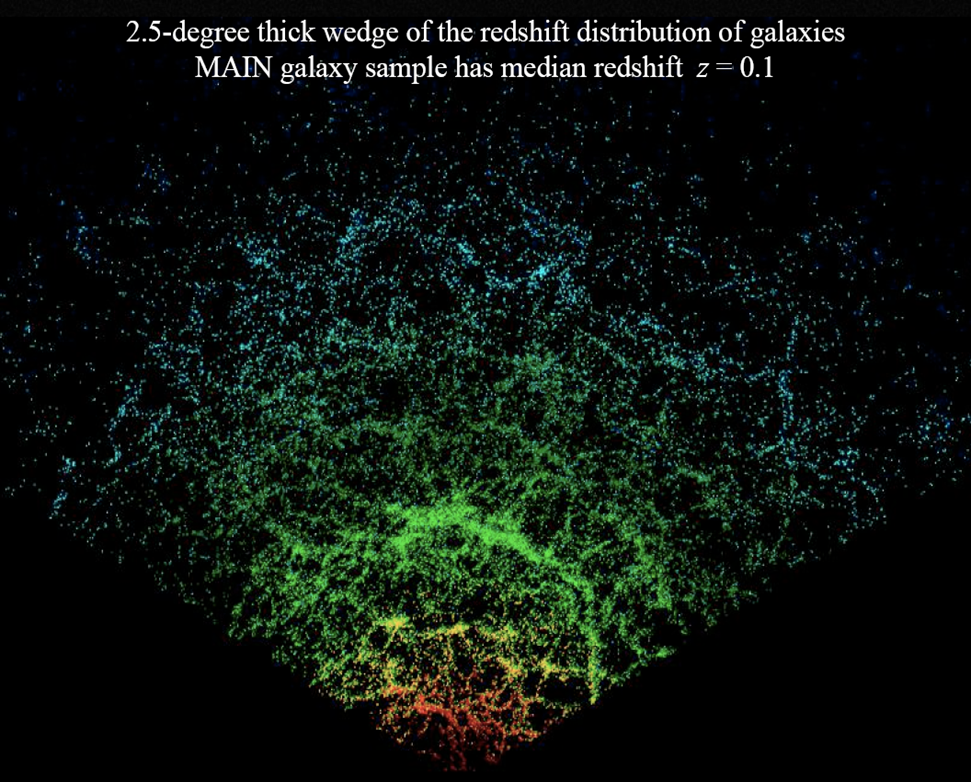
Image credit: Sloan Digital Sky Survey team.
What we've learned from looking at the Universe and the way galaxies cluster together in it includes information about how galaxies form, merge and evolve, but also about what makes up the Universe we're in.
How much of the Universe is made up of normal (protons, neutrons, and electrons) matter? How much is dark matter? Is the dark matter hot, warm or cold? By plotting how a large sample of these galaxies cluster on different distance scales, we can learn about the ratio of normal-to-dark matter by looking at the size of the "wiggles" in the graph (known as a Power Spectrum), below, and by looking at the scale of when there's a vertical plummet towards zero, we can learn about dark matter's temperature.
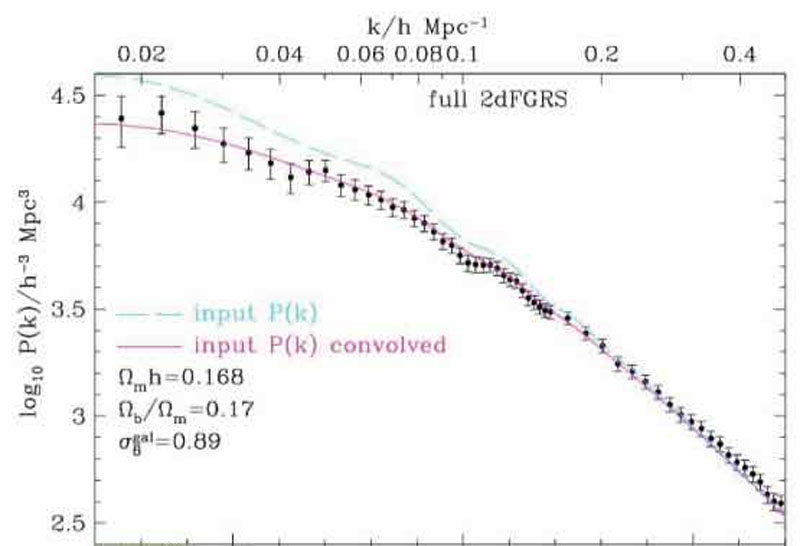
Image credit: Shaun Cole et al., 2005, for the 2-degree Field Galaxy Redshift Survey.
A Universe with no normal matter would have no wiggles and would have a totally smooth power spectrum; a Universe with no dark matter would have wiggles that extended down to the bottom of the graph. A Universe that had dark matter of a certain temperature would have a "cutoff" in the spectrum where it simply dived down towards zero on small scales. What we see tells us that the Universe has about a 1:5 ratio of normal-to-dark matter, a total amount of matter that's equal to about 25% of the Universe's total energy density, and that dark matter is cold enough that if it has any temperature at all, it's well below what we've been able to observe. (See here for more on Dark Matter.)
Combined with information about the flatness and expansion of the Universe (from, say, the cosmic microwave background and observations of distant supernovae), we've arrived at the model of the Universe we have today, complete with dark matter, dark energy, and the tiny bit of normal matter we actually understand.
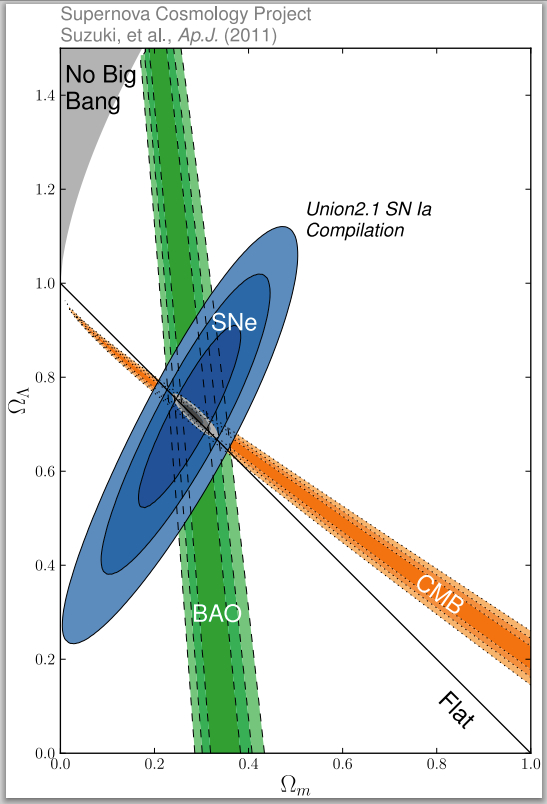
Image credit: Suzuki et al., 2011 (The Supernova Cosmology Project).
The "BAO" label stands for baryon acoustic oscillations, which are the pressure waves in the normal matter that cause the wiggles in the graph of the power spectrum (and the specific clustering features of the galaxies themselves), above.
But you might enjoy a much more visual approach to knowing what the Universe looks like, beyond our galaxy. Well, the SDSS team has outdone themselves, with Miguel Aragon, Mark Subbarao and Alex Szalay teaming up to create the following video of a fly-through of approximately 400,000 galaxies in our Universe, of a journey spanning 1.3 billion light years.
The universe is really, really, really, really big. I wonder whether we will ever get to travel throughout it. Oh to be alive in another few thousand years.
I read for about 5 minutes before my brain exploded.
The video is very impressive, unraveling the foamish bonding structure of the universe is one of the greatest things I've seen, thanks for sharing.
Now that was cool. Where do I get the SDSS (Sloan Digital Screen Saver)?
One slight quibble. In the beautiful image of the southern hemisphere night sky (with the large and small megallanic clouds as described) you can also see the Omega Centauri globular cluster (above Alpha Centauri and to the left). This is also outside our galaxy proper - and about 15 000 light years away. It consists of somehwere around 1 million stars. Just thought I should mention it, in case it feels left out of the "extra galaxtic club".
Most globular clusters would get into that club, though, by that definition.
Indeed there is one and I can't remember its catalogue number off the top of my head, but it's the mist distant globular and probably not actually ours, but an ejected one from another galaxy we have captured.
What causes the clusters (or super-clusters)? Are the clusters (or super-clusters) expanding from each other? Is there any dark matter in the spaces between galaxies, clusters, super-clusters, etc? If so, what percentage? If any, shouldn't this be greater than that around galaxies, etc. After all, there is far more intergalactic space than space within galaxies. Break, break! Does vacuum energy have any mass or mass effect. If so, how would/does it effect the visible universe. What about the vacuum effect of universe beyond which we can observe?
Phwoarrrrr! Cue Star Trek theme! Thank you, Ethan, I'm with
Little, Hottman and crd2. We need wonder in our everyday!
yep -my brain hurts
Based on the video at the bottom of this post, can anyone make a guess as to how fast the "spaceship" would have to be traveling in order to be able to see the various galaxies fly by like this?
Jeff W,
At times there seem to be 10 galaxies per second flashing by, so my rough guess is that it's about 100 trillion times the speed of light, considering that the distance between the Milky Way and Andromeda is 2.5 million lightyears. I might be wrong though, these numbers don't feel very realistic :)
btw warp 9 the maximum safe speed is 'only' 1.000 x c
http://en.wikipedia.org/wiki/Warp_drive_(Star_Trek)
If we survive long enough, I believe we will find that what we think we know now will be about as right as when we believed that the sun and stars revolved around the earth. as we have come a long way, but we just don't have the tools yet to really understand what is out there. One place I think we really are mis-measuring is that everything is flying apart from everything else at an expanding rate. I just don't believe it, unless our known universe is part of something much bigger than we can detect now.
Why do I question the red shift? No galaxies should be colliding with other galaxies, but they are.
Well, M81/M82 are a recent collision between galaxies.
Andromeda and ours will pass through each other soon, and the LMC is a dwarf galaxy being ripped apart right now.
And observations from 10 billion light years will see the same thing going on here.
But they will see a redshift appropriate to 10 billion light year range too.
Why?
Because they're independent of each other.
Ken,
Red shift is a measured phenomenon, there is no discussion about it. What you're contesting is the expansion of the Universe, and among the majority of scientists (99.99%) this is the most accepted theory and the model mathematically works, that doesn't mean that there isn't a very tiny fraction of scientists who think that it might be a different mechanism, just like Fritz Zwicky, one of the godfathers of Dark Matter, who suggested that it was Tired light.
'course, people laughed at the Pastafarians too.
Laughing is fun, unless you want to bully someone away. Anyway, here's an interesting quote regarding Fritz Zwicky:
What is that supposed to mean? YECs noticed that Olklo was a little odd. They were not listened to becuse they were using it asproof of insane ideas, rather than something to investigate and try to explain.
If zwiky was using it to say "look, the universe is odd,therefore it must be proof of tired light", then it is correct to'ignore him. He's not trying to explain the phenomena.
Tired light is on the same level as "inteligent falling". Cuckoolander idea.
Should have gussed chelle was lying out her arse.
That was a quote she gave from someone writing about him. There is no more context or verification than a he said/she said hearsay.
Zwiky also didn't agree with expansion because the rate was too high. When the standard candles were calibrated for extinction by dust, he no longer disagreed.
The wiki page also noted that he had many innovative ideas and it was not possible to work out which ones would pan out or not.
I.e. there's no indication that even he thought tired light was necesarily right. Given that , unlike chelle, science moves on, hisproblem with standard cosmology may well no longer have existed.
But chelle prefers only the parts that infer the dumbest ideas merit serious appraisal. Because she only has dumb ideas.
Here's an example in a different sphere of valid ignoring.
Roy Spencer, when talking about satellite measurements in the microwave region gets listened to. But when he starts talking about genesis being the most scientific and corect explanation about the origin of life, the universe and everything, he gets, quite rightly, ignored.
Lowell thought he saw canals on mars and drew them with great precision and detsil.
Hoyle insisted on continuous creation.
Newton persued akchemy.
Even Gallileo investigated and drew diagrams of perpetual motion machines (and considered them, eventually, impossible).
"What is that supposed to mean?"
Ken said that he didn't believe in the expansion, I made clear that almost everybody does, but that there are still some people who are like him, one of them was famous. So if he wants to try to come up with a different theory that works, than he is entitled to try do so, without some smart-ass mocking him. Science is full of cases of people that came up with something unexpected that changed the course of science, therefor it won't be Ken and/or in cosmology, I'm just saying let him be, and don't shove the Big Bang down his throat or stigmatise him if he doesn't want to swallow it (yet). A minority has also its reason for existence.
p.s. stop accusing me of lying, I said that it was a quote.
And the unexpurgated text says that his problem with the expansion was resolved.
I.e. he changed his mind.
Unlike you.
PS read up on what lying by ommission means. You lied.
@ Ken
" I just don’t believe it, unless our known universe is part of something much bigger than we can detect now."
But this is in fact the case. And it's an accepted fact. Ethan even wrote an article on the subject a month or so back. Our "observable" region of the universe is only a small percentage of the whole universe which we will never be able to observe.
"Why do I question the red shift? No galaxies should be colliding with other galaxies, but they are."
There is a big difference in scale of things of those two. On scales larger than galaxy clusters, gravity becomes less and less important (strong) and the overall expansion or "dark energy" is a dominant force, thus the redshifts. But on scales smaller than galaxy clusters, gravity and other forces can be stronger than the expansion rate thus the different dynamics of galaxies (mergers, collisions etc.)
Hope this helps with your questions.
This is YOUR conclusion, and it is insinuated by the Wiki-article but is not necessarily the case. Here is the article, and there is NO talk of him changing his mind, so I'm not 'omitting' here anything:
As a matter of fact that 1929 article is an interesting read, wherein he makes a couple of suggestions:
I'm not saying that he could have changes his mind, but there is no proof of it, and if you can find a reference of him doing so, than please post it, otherwise I would suggest you to refrain, and stop accusing me of lying.
Yes, my conclusion.
Are you saying that making a conclusion with insufficient evidence is wrong, chelle?
Are you?
Nice overview; but too static a picture; even the movie tour of our universe is a tour of a rather static universe.
"One of the biggest unanswered questions in astrophysics is “what is the origin of the rotation (angular momentum) or spin of all objects: from galaxies, stars, star clusters, etc""
So, I'd like to see is a more dynamic description of the universe that includes rotations at all appropriate levels i.e. planets , stars , galaxies clusters of galaxies and superclusters.
First what is the status of observation data? e.g. "spiral galaxies line up like beads on a string, with their spin axes aligned with the filaments that outline voids " http://universe-review.ca/F03-supercluster.htm There must be other provocative observations.
"Presumably rotation of clusters of galaxies is difficult to be established with certainty. have shown that it is extremely hard (if generally possible) to distinguish the case of a single cluster in rotation from the case of two overlapping clusters, which are merging or departing from each other." Rotation of the cluster of galaxies A2107
So yes the observations are difficult; but observations of cluster and supercluster rotations are the new James Webb and others supertelescopes planning soon?
And second, what are the candidate theories that try to explain, "One of the biggest unanswered questions in astrophysics is “what is the origin of the rotation (angular momentum) or spin of all objects: from galaxies, stars, star clusters, etc""???
GLOBAL AND LOCAL EFFECTS OF ROTATION: OBSERVATIONAL ASPECTS
Wlodzimierz Godlowski
"In the paper we discussed the observational aspects of rotation in the Universe on different scales. We show dependence between the angular momentum of the structures
and their size... The theoretical and observational
aspects of possible global rotation of the Universe were discussed as well." http://arxiv.org/pdf/1103.5786v3.pdf
But truthfully, this paper is pretty much unreadable by me. So I'd like an explanation of how rotation is a part of our universe at all levels which we have so far carefully observed.
Do superclusters rotate, any evidence yet???
And my non rotating question:
Are old superclusters (i.e. 10 billion light years away) smaller than current superclusters (i.e. 1 billion light years away)?
I understand that superclusters are 100 million lightyears in diameter?
In 1929, Zwicky published ON THE RED SHIFT OF SPECTRAL LINES THROUGH INTERSTELLAR SPACE; he heard his critics; and he choose never to publish a rebuttal paper or even make a rebuttal remark.
Thus Zwicky's implicit scientific position is acceptance of his critics' views.
As to whether Zwicky's private thoughts turned this way or that; he probably thought every which way in his most creative meanderings.
'Do superlusters rotate' is a bit like "is that flock of starlings turning left or right' based on a single photograph.
And it's precisely because we don,t know that scientists somewhete will keep looking.
But it's a bit premature to start nagging if we're there yet.
When there's a reasonably supported answer, it'll take some time to get changed into digestible information for those behind the cutting edge.
Asking questions about rotation of superclusters seems a lot less premature than making predictions about "a trillion years from now."
e.g. Ethan, "a trillion years from now, we never would have learned about the cosmic microwave background, about distant galaxies, clusters, or have seen a single “spiral nebula” in the night sky."
Let's start with some basic observational questions and my best guessed answers:
1) Do all galaxies rotate? yes
2) Are all supermassive black holes at the center of galaxies rotating? yes
3) Do all galaxies or just "spiral galaxies line up like beads on a string, with their spin axes aligned with the filaments that outline voids"? All galaxies.
4) Are the cosmic voids (including the filaments around the voids) OR superclusters (i.e. the filaments made of galaxies that surround the cosmic voids) the cosmic building blocks of the universe? Cosmic voids (including filaments).
5) Do cosmic voids (or superclusters) rotate? Both rotate.
Now there are my five questions and five answers. Let's not quibble whether my answers are supported by any observations; let's just agree that my answers are my personal speculation. AGREED?
Now here is my point. Any theoretical astronomer who makes predictions of " "a trillion years from now" has implicitly assumed answers to my FIVE questions in the model universe simulation that gives him such predictions. You can't build a simulation of the universe without ASSUMING things like rotation of superclusters yes/no; rotation of cosmic voids filaments yes/no; etc..
I mean all of the galaxies star systems, planets, and elementary particles spin. Why would we ASSUME that rotation stop at the supercluster or cosmic void level IN ANY toy model universe simulation? All model universe simulation has implicit or explicit assumtions about rotations>
So I'm just asking
1) what do we know about supercluster and cosmic void and relation to galaxy rotation? 1 thing or 100 things is OK. What do we know??? A lot or next to nothing and can you be explicit about that next to nothing; because I doubt if my list is very complete list of what we know or suspect.
2) what do we speculate about such rotation??? explicitly and implicitly simulations and other theoretical work.
So yes I think that asking questions about rotation of cosmic voids and superclusters seems very appropriate for any scientist today who dares to run or listyen to results of simulations that predict how the Universe will look "a trillion years from now".
So I will nag about rotation because when we don't understand something it is very appropriate to ask questions, ask about observations and to ask about various hypotheses.
e.g. on dark matter (which we don't understand yet) I was very interested in a article
Theory of superconductivity of gravitation and the dark matter enigma by Wenceslao Santiago-Germ´an http://arxiv.org/pdf/1112.1179v1.pdf
"the Einstein general theory of relativity is formally equivalent to the Ginzburg-Landau theory of superconductivity... If this hypothesis proves correct, the whole phenomenon of dark matter may count, after all, as another triumph for Einstein’s theory of gravity." Now this article may prove to be bogus or it may prove to have merit. I am not capable of evaluating it. But I am capable of understanding the importance of the question and the hypothesized answer. And yes I fully understand that any hypothesis has to be supported by observation>
Back to rotation questions, I'm not nagging.
In contrast any prediction about "a trillion years from now" needs to be heard with the greatest poetic license; such predictions are hubris (not science) especially when the thing evolving is the whole Universe.
(Yes I can accept a half life of a proton as 10^32 years; that is different, it is a current measurement.)
"Thus Zwicky’s implicit scientific position is acceptance of his critics’ views."
Fritz Zwicky proposed a lot of different ideas in that paper, and yes most parts got to be disproven over the years. But it's not so simple to say that the concept of 'Tired Light" is finally disproven:
So yes until you discover some 'new principle' TL stays on the fringe of physics, while Big Bang is the leading theory. If Ken what's to contest Big Bang he know's what to look out for, ... but isn't every one always looking to find some new physics?
Not really. Predicting a universe that expands expands so far is a lot easier than working out if there is any rotation to the universe.
How, for axample, would you work out the rotation of a galaxy? Have a look at the transverse lorentx contraction and compare it to bothe the linear component AND the errors in attributing a value to the vsriables.
It's a far harder job.
It's far further from the truth to omit saying that there's nothing saying tired light still holds traction with the proponent when his objections have been addresed and you have no evidence for your position.
Chelle:
"Fritz Zwicky proposed a lot of different ideas in that paper,"
I am interested in your analysis of the paper. Do be so kind as to provide me with your learned commentary (something other than a c&p from Wikipedia that is). Where do you think Zwicky has good points (and why) and where do you think he went wrong (and why)? Please include all math necessary to support your position.
"isn’t every one always looking to find some new physics?"
Well yes, but
Getting from a new insight to a working hypothesis that agrees in the detail with current experiments and observations and makes some new testable predictions (or even postdictions) is difficult (in the detail).
If Zwicky's paper helps you understand physics and gives you insight; read Zwicky. Nevermind that this or that idea of his was not accepted. I mean poor old Albert Einstein last years were spent bungling around some grand unification ideas and since then thousands of other physicists have been bungling around some kind of grand unification theory.
So what's wrong if you or I bungle around a bit as we try to understand?
But I do not take my bungling ideas too seriously; rather I take my curiosity very seriously. My best ideas are forged to be tested and broken; that's how I learn. Only a few of my bungling ideas can suffer to be forged, tested and broken repeatedly.
Wow & OKThen,
It's true what you say.
--
skeith,
" ... where do you think he went wrong ... "
What I understand is that Zwicky was looking for straight interaction. I think that it might be the energy (gravity & light) we emit from our position (Earth/Sun/MilkyWay) is something that has an effect on the Aether (DM&DE/Higgs) that surrounds us. Thus over a longer time period, an ever increasing affected zone is created that surrounds us. This continuos expanding zone might explain the reason why the deepest Galaxies are moving away at almost the speed of light, it would be in accordance with the speed that we emit light & gravity.
Look at is as an endless pool of water with in the middle a heating element (us), yes the water would start to vibrate over a wider zone, making incoming light more blurry, but if you look at light as a torpedo that is coming in from a distance, the torpedo wouldn't get to be 'blurry' but it would be warmer and warmer the wider the zone becomes, and the longer it has been within that heated zone.
Well said at 8:26.
You can gain insight by looking at how the great mings got things wrong too.
Plato believed that thought alone was the sole way to truth, and if physical evidence were contrary to the thought, the evidence must be hidden and denied.
Rather like chelle here.
The biggest problem for society can be seen in the results of that cabal's emforced popularity: the greks could have gotten the industrial revolution goung 1000-2000 years earlier. They were excellent engineers. But plato's teachings meant the engineer was the ignorant peddler of trinkets.
Which is also the probkem chelle's idiocy is trying to reproduce.
Cgelle, light is not to be looked at as a torpedo.
You might as well ask "if you look at light as a cat, eventually, rather than going a straight line, it'll stop to wash itself and slep for a bit".
"What I understand is that Zwicky was looking for straight interaction. I think that it might be the energy (gravity & light) we emit from our position (Earth/Sun/MilkyWay) is something that has an effect on the Aether (DM&DE/Higgs) that surrounds us."
Zwicky's paper (written in 1929, when we lacked good telescopes and a ton of the info we have today, to the degree that he wasn't even 100% certain that the "nebula" [sic] he was talking about were other galaxies) is packed full of supporting math. Your explanation has zero math. It is probably the first supposedly-scholarly analysis of an astrophysical hypothesis that doesn't come with any math whatsoever that I have seen.
What is the reason for this? Did you not have time to include your calculations? If so, I can wait until you do have time.
Or is it that you have NO math to back up your idea? That your idea has no factual or theoretical back-up whatsoever? That its only mode of existence is a popular-science, movie-style "layman's explanation"?
Naw, it couldn't be that! Again, I ask for your mathematical calculations.
" I ask for your mathematical calculations.
So you want me to quickly figure this out for you, while we still don't know what Dark Matter is ... Good to know that you can wait.
You insist you have already worked it out, chelle.
Or are you coming to a conclusion without sufficient evidence?
Didn't you think that a bad thing to do earlier in this thread? Or is it only bad when someone else does it?
Chelle:
If its a not-disproven-yet-unfruitful hypothesis, that is reason enough to igore it. Ideas need to lead somewhere: to new insight into known phenomena, to novel predictions, to experiments. You can't just say 'tired light' or 'heating element' and expect to be taken seriously. You have to operationalize it. As far as I can tell, you haven't done that yet.
It seems everyone likes to style themselves as an "idea man" (or "idea person"). Earn a Nobel prize, and after you do, people might consider your ideas important enough to let you have that job. Until then, like the rest of us, you are responsible for doing the hard work of fleshing out your ideas before anyone else will act on them.
"As far as I can tell, you haven’t done that yet."
As far as I can tell, Ken addressed an issue he had, next I gave him an explanation of what the current situation is. After that the focus of the discussion shifted to Tired Light, and 'skeith' asked "where do you think he went wrong", and I gave him my basic opinion, this isn't about me presenting a whole theory etc., I'm just sharing some thoughts, and I don't expect you or anyone else to 'act on them'.
It is amazing how you start to whine about some seriousness and how you need to earn a Nobel prize, while this is the commenting section of blog, If I would have some serious predictions and calculations about Redshift I would publish a paper, we're doing nothing else here than a little bit of chit-chatting and like 'OKThen' said:
@ Ken
"Why do I question the red shift? No galaxies should be colliding with other galaxies, but they are."
This makes no sense. Why shouldn't galaxies be colliding with each other? Because you imagine the universal expansion should be pushing them apart? That only dominates on extremely large scales. On "small" scales like the size of our local group of galaxies the individual proper velocities of each galaxy dominates. Which is why we're going to collide with Andromeda in a few billion years. Space between us is expanding, but the effect is much less than our relative velocity.
So it's fine that you "just don't believe" in universal expansion. But I don't think you have a good reason for doing so. I think you're like so many others who say "I don't understand it, therefore I don't like it, therefore it's wrong... and it's *everyone else* who is blind to reality."
"So you want me to quickly figure this out for you, while we still don’t know what Dark Matter is … Good to know that you can wait."
You're claiming sufficient expertise to be able to say that "tired light" has not been disproven based on this one guy's paper from 1929 and the fact that he personally never got around to saying oopsie on it. Other people (his contemporaries and later) objected to his conclusions, but you apparently have enough expertise to say that those objections aren't worth much, and Zwicky's 1929 conclusions in particular are to be exalted over them.
I am asking for your demonstration of why you agree with this particular paper over all the others.
You MUST have some expertise in this, and be able to provide your supporting calculations, because otherwise you would be simply relying on an argument from authority! And although you have previously demonstrated that this is your SOP, this is a different thread and I'd like to think you're a different person, and that you're not doing that here.
I wrote a book A Critique of Pure Physics because I couldn't get professional physicists to talk with me. It can be read online on google books. Since posted 82,153 pages have been read; so my ideas have been considered.
My explanation of redshift is not Zwicky's tired light; though one professor dismissed it as Zwicky's tired light theory. See pages 30 to page 44, my calculation starts on page 36.
I post annonymously for several reasons.
First, I really don't want to promote my ideas and myself as that crackpot. Rather I want my ideas discussed and broken if possible; that's how I learn.
Now regarding my redshift idea and calculation. I did a simple Newtonian calculation (not in the book) and two professors kindly spent about 45 minutes each with me. They separately each had only one objection, I didn't use special relativity. I disagreed that special relativity was important.
But I redid my calculation with special relativity and got essentially the same result. But this time I could get no professional physicist to review my idea. And I was furious at being summarily ignored because (though an amateur) I am serious.
About that time, I found Ethan's blog. I began arguing my ideas on his blog. And I've communicated personally with Ethan and I've appreciated the time and advise he has given me.
But one commentor out here named Bjorn (a professional physicist) took it upon himself to argue my ideas by email. And we argued my pages 30 to 44 via email. I would not accept handwaving that I was wrong. Show me what is wrong with my calculation.
Bjorn showed me, that what was wrong with my idea was not my calculation; it was fine. But I had made an itty bitty assumption. My assumption was not explicit; it was hidden from even me.
And the physicsits who were kind enough to review my calculation did not find my important implicit assumption. Thus they ultimately dismissed my idea with a wave of a hand. Obviously, I must be wrong.
To Bjorn's credit he persisted until he found my hidden assumption.
My calculation assumes that the universe is anisotropic! I didn't even know what that meant. But sure enough; all observations show that the universe is isotropic.
Well my mind whirled; maybe from a certain theoretic point of view the universe is anisotropic. I've search; but NO.
All by myself, I have broken my every good bungling ideas about how the universe is really somehow anisotropic. And I've searched others ideas about how the univverse might be anisotropic; but none satisfy me. So I must accept that my calculation is incorrect.
And with that and a few other nails in the coffin; I must accept the standard model interpretation of the big bang. I don't like the big bang; but I've got no alternative. My best ideas are bustedI got nothing. And by the way there is one implicit assumption that I figured out that undermines my calculation.
I do have my 5 or 10 year plan of self education and a dozen plus very difficult books that I will learn. etc.
But I do continue with my learning hypotheses. I have no desire to parrot what Simon says or Willie Wonka, Einstein, Witten or Zwicky. I need to learn and understand for myself with my own mind.
I try to reason as best I can. It is a disservice to myself to accept some authority's reason; I must see for myself right up to the limit of my understanding and then push myself a little farther. It's hard to learn, to be honest, to have my best ideas busted; but it is harder to be a parrot.
Out here, I don't promote my ideas but I do try to understand the limit of what we know about important things. Hence my questions about rotation, etc. Sometimes I get an insight and that is great. And sometimes I just have to accept that this stuff is really really hard, thus silence.
skeith,
"I am asking for your demonstration of why you agree with this particular paper over all the others."
I am not claiming that there is NO Big Bang, and that Tired Light IS the right answer, it is not this one "over all the others". Personally for me, intuïtive wise, BB-theory is an ugly beast, and I think that some sort TL-theory with an Aether might be far more elegant. So all I'm doing is leaving a door open for some TL-theory to stand besides the Big Bang.
OKThen (Thomas?),
Interesting read, and yes there is a lot of handwaving.
What I don't get is this:
When I read on the wiki-page of Anisotropy:
Perhaps you should write a follow up book on (an)isotropy :mrgreen:
First I need to learn and understand a lot more. And that includes not only what others know and hypothesis; but more importantly knowing what I don't know and what my best questions are and which can be reflected upon productively.
Only then will I consider writing papers or a book. And they must be of a on a quality that is publishable in arXiv.org. When I wrote my book, I didn't even know arXiv existed.
Finally, there are tradeoffs in an examined life; priorities every bit as important as art and science, family and friends.
Chelle:
"Personally for me, intuïtive wise, BB-theory is an ugly beast, and I think that some sort TL-theory with an Aether might be far more elegant."
Elegant in what way? An elegant theory is one that explains many things via a single mechanism, or a very small number of mechanisms. The more junk you need to inject into your theory to explain all the phenomena you observe, the less elegant it becomes.
Example:
Heliocentrism is elegant - it explains all of the observed motions of the planets and other non-stellar heavenly bodies with a single mechanism. This mechanism needed to be refined a bit with later discoveries (elliptical rather than circular orbits, the effects of relativity especially on Mercury, etc.) but even with the additions it is far more ELEGANT than geocentrism, which did not adequately explain all observations without adding in a bunch of extra junk. The more epicycles you need to adequately explain all your observations, the less elegant your theory becomes. "Tired light" requires a whole lot of epicycles before it even starts to adequately explain everything we observe. You can't just say "well, this explains redshift" and that's the end. There is more to the universe than redshift alone.
One other thing: desirability is not a substitute for reality, and testability is required for any legitimate scientific hypothesis. You may PREFER tired light/aether but the universe doesn't care what you want. A lot of people would prefer to believe that an invisible friend created the universe, but that doesn't make it true.
OKThen,
"First I need to learn and understand a lot more."
I don't get you. You wrote:
... and I do one quick Wiki-search and it turns out that the universe is full of (extremely tiny) anisotropies, there is even a spacecraft launched in 2001 which is called "Wilkinson Microwave Anisotropy Probe" (http://en.wikipedia.org/wiki/WMAP)
--
skeith,
You are right, but it cuts in both ways, btw it was a priest, Georges Lemaître who came up with the original idea of the Big Bang, so yes you might be right that; "a lot of people would prefer to believe that an invisible friend created the universe, ..."
Yes you don't get me; but the issue is you don't get anisotropy.
There are lots of anisotropies.
The universe is very anisotropic on a small scale. Hence the lump called planet Earth.
But the universe is very isotropic on the largest cosmic scales and this is my gotcha (among others).
The advantage of a quick wiki search is that it is quick; the disadvantage is that it is quick. What I need to do is a dozen google searches, a dozen wiki searches, a dozen http://arxiv.org/. And not stop with the first simple apparent answer; I need to keep daisy chaining through my ideas. Then pause and reflect about what I've learned, what I might have learned, what was too difficult for me to understand, and what I thought I knew that was completely wrong. Then at this point, I have a question to ponder and reflect upon.
Science is not a game of trivial pursuit; where every question has an answer or even where every question is reasonable. For me a reasonable question is one that I can research myself and learn something. Before asking my questions on rotation, I did a dozens of google, wiki and http://arxiv.org/ searches, scanned abstracts and read (as best I could) 3 or 4 articles. So I knew there weren't many answers; but I also know that I don't know a lot and maybe somebody can give me or point to a helpful perspective or summary.
If not, I still have my guiding learning question. What is the nature of rotation of the universe from elementary particles all the way up to the whole universe? For me this is a good question; not yet ripe for a quick answer, but a question that I will follow, research and reflect upon for decades as I learn more. Learning, following one's curiousity, requires patience, effort, understanding what others have thought before and imagination.
I have no problem understanding this, but what I don't understand is why a Non-Expanding-Universe, couldn't have the same properties.
"I have no problem understanding this, but what I don’t understand is why a Non-Expanding-Universe, couldn’t have the same properties."
Perhaps it could in the most abstract "I can't prove it can't" way.
The thing is to figure it out if it really could, you have to come up with a mechanism by which to explain things, rigorously define it mathematically, figure out both the assumptions being made and the implications, and then crunch a bunch of math to see if the answer is compatible with reality.
This is what OKThen did -- though it turned out this only worked if the universe was anisotropic, which it wasn't. Their idea contradicted reality. Reality wins, OKThen goes back to the drawing board/arxiv.org.
This is science.
"I don't understand why not, therefore it is (retroactively insert 'maybe' qualifiers as necessary)" is not.
Chelle:
"You are right, but it cuts in both ways, btw it was a priest, Georges Lemaître who came up with the original idea of the Big Bang,"
And this saves "tired light" from the dustbin in what way?
Yes I know the protocol. I was just wondering what OKThen's idea was to make the universe anisotropic on the largest cosmic scale, it makes me think of a Flat-Earth model, where the water is falling off. If the Universe is stable than it should only fluctuate locally, as is confirmed by the measurements, anything else and it would have large differing pressure regions and all kinds of currents, there would certainly be a lot of weird stuff going on.
"And this saves “tired light” from the dustbin in what way?"
For hundreds of years the holy church had a perfect scientific system that was created by One God out of nothing, as mentioned in the bible, whereby Earth was the center of the Universe and it predicted a lot of things very well, but after Copernicus it was proven to be wrong. So when it turns out that Stars are Redshifting, there appears this priest out of nowhere, who comes along with a new creation idea where the whole Universe evolved out of One central dot. It is just like those people who start to see UFOs after they have seen an episode of the X- files, this guy reads the Bible as if he was watching Mulder & Sculley, having been thought that One God had created the Universe, and out of what else could he have created it than out of nothing. And guess what, the whole brain washed Abrahamic science community picks up this 'great' centralised idea, and makes it work along with some predictions, and an other basic down to earth concept of 'Tired Light' goes in the dustbin, now doesn't that ring a bell, … make belief.
"For hundreds of years the holy church had a perfect scientific system that was created by One God out of nothing, etc. etc."
Absolutely none of your stream-of-consciousness here saves "tired light," gives me any reason to believe it at all, or gives me any reason to think that somehow the problem of the last scattering surface has ceased to exist.
"and an other basic down to earth concept of ‘Tired Light’ goes in the dustbin, now doesn’t that ring a bell, …"
That bell-like sound you hear is the sound of Chelle making a heroic effort to change the subject and distract me.
You are very, very, very fond of relying on other people, their stories and theories to support your positions. Why is this? Is it because you're not aware of the fact that this is a logical fallacy? Do you just not understand WHY it is a logical fallacy? Do you know and understand the substance of the fallacy and just not care? Are you aware and comprehending but using the fallacy cynically in hopes that other people aren't aware?
Seriously, what is the reason?
Tired light has been shown to be wrong in past decades
http://www.astro.ucla.edu/~wright/tiredlit.htm
Any new proposal for it has to overcome observational evidence. So far none have.
"I was just wondering what OKThen’s idea was.. "
NO! Focus upon your ideas; forge them, test them and try to break them YOURSELF. LEARN!!
Also a necessary part of scientific imagination development is understanding the best science in the idea space that interests you. For example, I've bookmarked these to wonder about:
-- Eternal inflation http://arxiv.org/pdf/hep-th/0702178v1.pdf
-- Squashed Kerr-G¨odel Black Holes http://arxiv.org/pdf/0803.3873v1.pdf
-- The Experimental Status of Glueballs http://arxiv.org/pdf/0812.0600v3.pdf
-- The Gravitational Properties of Antimatter http://arxiv.org/ftp/arxiv/papers/0710/0710.4316.pdf
-- The orientability of spacetime http://arxiv.org/pdf/gr-qc/0202031v4.pdf
Obviously,my understanding of these papers is weak. But I must educate myself (as best I can) to what others have thought. As well I must always pay strong attention to experiment and observation results.
Finally Ethan's blog serves my needs very well. It focuses upon important ideas and sends me on tangents toward better understanding.
Mental Fun Da!
I'm outta here.
skeith,
"Seriously, what is the reason?"
My reason is very simple, trying to discredit Big Bang using the similar arguments that you used on me the other day:
Oops, I placed the wrong closing tag after that first quoted paragraph. A preview option might be helpfull ...
OKThen,
I think you actually are a crackpot. I asked you a straightforward question and you start teaching me a lesson, even bringing up; Inflation, Blackholes, Glueballs and the orientation of Spacetime. wtf I don't care about these exotic ideas, please do tell me why a Non-Expanding-Universe can't be naturaly isotropic.
I'm fascinated by the video(s) of the large scale structure of the universe. However, I also have reservations with it that I don't see anyone posting or arguing.
My criticism is thus. The farther away an object is ( i.e. a galaxy) the less certain you are about it's position. Galaxies are moving after all, and light speed is finite, so galaxies are no longer where we see them and the more distant the greater the uncertainty. Graphing the position of galaxies does not actually represent where the galaxies currently are, but instead graphs a cone through time of the galaxies positions. It's like taking a multiple exposure picture of a room, at different times, with different people in the room over the course of many years, yes you know who was in the room but you lose a lot of information. Your view would be "distorted".
To summarize the graph ( or video representation) does not represent a relationship among galaxies at the same time, but through time. So if you were to travel at the speed in the video the galaxies would not be distributed as shown in the video. So can you justify conclusions based on this distorted view?
Contemplating this I realized the obvious, pick any galaxy in the sky no matter how distant, and the large scale structure should look similar from that galaxy as it does from ours.
@ Chelle
At times (most of the times actually) I think you don't even understand what you are proposing or saying.
"and what isn’t better than thousands of kids that got to be indoctrinated with the Big Bang singularity at a young age,"
I don't know if you are aware, but no serious cosmologist or astrophysicist holds that old notion of big bang and singulairty (like you depict it) to be true. Yes, once, some 40-50 years ago they did, but not any more. Stop living in the past. Instead of reading and quoting some long gone dead guys, try reading papers that are being published today. Not saying you shouldn't know your history, but science evolves, try to keep up.
"nobody in those books talks about the history of tired light, nobody, nowhere, isn’t that weird."
No, it's not. Because it's been shown over and over again that tired light doesn't work and is not in line with observations. Why would you teach kids something that is not correct?
"please do tell me why a Non-Expanding-Universe can’t be naturaly isotropic."
it can. But it's not what OKthen wrote about. In his paper it needed to be ANisotropic. Not isotropic. So let's rephrase, why can't it be anisotropic? It can, it might even be that at some point we might change our views. But at the moment, all observations show it's isotropic on largest scales. And unlike your ideas which needn't be rooted in reality, astronomy has to be rooted in reality and experimental findings.
" wtf I don’t care about these exotic ideas, "
hahahah, I really laughed on this one. Funny how you don't care about those but really care about your own pseudo-scientific ideas which are not even touching reality... What was it... thermodynamics of DM? Haaha.. there's an oxymoron if I ever heard one. Why? I'll let you figure that one out for yourself.
Sinisa,
"no serious cosmologist or astrophysicist holds that old notion of big bang and singularity"
It still says so on the Wiki-page:
--
"Why would you teach kids something that is not correct?"
For the same reason that you still teach Big Bang theory, while it has three major problems.
--
"In his (OKThen) paper it needed to be ANisotropic.
And that's what I am asking HIM, why does it need to be so, Read again what I wrote about this, I agree with the fact/reality that it should be isotropic on a large scale, don't say I don't do so.
--
"hahahah, I really laughed on this one. Funny how you don’t care about those but really care about your own pseudo-scientific ideas which are not even touching reality…"
Of course I don't care, why should I start talking about those things during an argument about the expansion of space. And yes I use Crazy Aether as a group-name for whatever fills spaces up, but the content of that package is no pseudo-scientific.
--
"thermodynamics of DM? Haaha"
What is so funny about Thermodynamics and Dark Matter, there are plenty of papers discussing this topic, here's one as an example:
http://arxiv.org/pdf/0910.0822v3.pdf
Sinisa,
“no serious cosmologist or astrophysicist holds that old notion of big bang and singularity”
It still says so on the Big Bang Wiki-page:
–
“Why would you teach kids something that is not correct?”
For the same reason that you still teach Big Bang theory, while it has three major problems.
–
“In his (OKThen) paper it needed to be ANisotropic.
And that’s what I am asking HIM, why does it need to be so, Read again what I wrote about this, I agree with the fact/reality that it should be isotropic on a large scale, don’t say I don’t do so.
–
“hahahah, I really laughed on this one. Funny how you don’t care about those but really care about your own pseudo-scientific ideas which are not even touching reality…”
Of course I don’t care, why should I start talking about those things during an argument about the expansion of space. And yes I use Crazy Aether as a group-name for whatever fills spaces up, but the content of that package is not pseudo-scientific.
–
“thermodynamics of DM? Haaha”
What is so funny about Thermodynamics and Dark Matter, there are plenty of papers discussing this topic, here’s one as an example:
http://arxiv.org/pdf/0910.0822v3.pdf
@ Chelle
"It still says so on the Big Bang Wiki-page:"
keep on reading Chelle. There is much more in that article than just the title and first 3 sentences. Inflation, and other additions to the 1920's BB picture were added precisely because Lamietre's concept doesn't hold water. Singularity arises in GR. And we know it's wrong. It means that the theory is not complete. There are no singularities in QM. There can't be. That's one of the reasons why so much hope lies in quantum gravity. It is hoped that it will eliminate singularities in the maths used in GR.
"What is so funny about Thermodynamics and Dark Matter"
nothing, what is funny is Thermodynamics OF Dark Matter. Which you wrote as a comment in some other post recently. By the way the arXiv paper is something totaly different. Again... read more than just titles and conclusions. It mainly deals if DE and not DM. So I'll leave you to ponder why Thermodynamics of DM is an oxymoron.
Chelle:
"My reason is very simple, trying to discredit Big Bang using the similar arguments that you used on me the other day:"
Are you daft? I said that that was a PROBLEM with Abrahamic religions. Do you have any reading comprehension skills?
The Big Bang theory is not (NOT) the current model because someone, priest or otherwise, said so. It is the current model because it fits facts, and its fit to facts can be tested by anyone who has the right tools. Scientists test the Big Bang theory ALL THE TIME.
You haven't discredited the Big Bang theory using "my" arguments, you've used your own arguments which I previously said were bogus and stupid.
"See Big Bang and Tired Light were, and still are, both full of fallacies"
You don't even know what the word fallacy means, just like you obviously don't know what the word logic means. Let me give you an example of real logic and explain to you exactly why the argument from authority is a FALLACY:
The argument from authority goes something like this: "Fritz Zwicky was a respected and intelligent scientist, therefore his theories are reliable and you can always trust them to be true so I don't need to prove them to you - the fact that he held them is proof enough of their truth." Now, it may not be immediately obvious, but if you examine this closely you'll see that what you have here is an incomplete syllogism. There are three terms ("Zwicky," "respected scientist" and "true theories"), a conclusion and one premise. All it lacks to become a syllogism is a second premise.
So allow me to clean this up and show you what kind of syllogism the argument from authority actually is. Because categorical statements are always plural, "Zwicky" must be rearranged to be plural and becomes the grammatically =hilarious= "early 20th century scientists named Fritz Zwicky." The conclusion is therefore:
"All early 20th century scientists named Fritz Zwicky are persons whose theories don't need proof because they are always true."
Which is a type A statement. This also defines for us our major term ("persons whose theories don't need proof because they are always true") and our minor term ("early 20th century scientists named Fritz Zwicky.")
The one premise that we have works out to be "All early 20th century scientists named Fritz Zwicky are respected scientists," which is also a type A statement. The presence of the minor term means that this is the minor premise, and it also gives us our middle term ("respected scientists").
The argument from authority therefore takes the form:
???
All early 20th century scientists named Fritz Zwicky are respected scientists.
Therefore: All early 20th century scientists named Fritz Zwicky are persons whose theories don't need proof because they are always true.
This syllogism takes a ?AA mood and is either figure 1 or figure 2.
What can the major premise be? Well, we will want a syllogism which is VALID, because we want our conclusion to flow logically from the premises. If we use an invalid syllogism, then the argument from authority is completely meaningless.
It turns out that the only valid syllogism that fits this pattern (?AA figure 1 or 2) is the Barbara syllogism, which is AAA figure 1:
All M are P
All S are M
Therefore: All S are P
We've already figured out what our major and middle terms are, so all we need to do is plug them into the formula to get:
All respected scientists are persons whose theories don't need proof because they are always true.
All early 20th century scientists named Fritz Zwicky are respected scientists.
Therefore: All early 20th century scientists names Fritz Zwicky are persons whose theories don't need proof because they are always true.
This is an airtight syllogism, and the conclusion cannot possibly be false if the premises are both true. Furthermore, this is the ONLY form the argument from authority can take and be a valid argument in any sense. So now the only thing to ask is: are both premises true?
Is it true that ALL respected scientists are ALWAYS persons whose theories can ALWAYS be trusted absolutely to be true?
This statement is false if you can find even one respected scientist anywhere in the history of time who had a theory that turned out to be not true. There's no way out of this - you can't say that most respected scientists have theories that are always true, or that all respected scientists have theories that are mostly true. It has to be a 100% absolute statement or the truth value of your major premise fails.
And you can't change your major premise to "Some respected scientists are persons whose theories don't need proof because they are always true" because then the mood changes to IAA and IAA-1 is an invalid syllogism. You have zero wiggle room if you want your syllogism to be valid.
This is why the argument from authority is a fallacy - the word "fallacy" means an illegitimate use of logic. The argument from authority fails because the truth value of the major premise is lacking, and therefore the conclusion cannot be stated to be true.
This is what logic looks like, and this is what a fallacy looks like, so don't use these words anymore until you learn their proper use.
"the exuberant Big Bang is ‘reality’ even when proven to be wrong,"
I eagerly await your proof that the current Big Bang model is false. I'm sure a lot of cosmologists and astrophysicists are hanging on your every word.
skeith,
FYI : "fallacy = a misconception resulting from incorrect reasoning"
My reasoning is pretty fine despite your great effort, to prove that it is not.
I guess you're not going to argue that TL has a problem with for example; the reasoning (cause) of kind of Compton effect that is suggested. Now let's look at some of the reasoning behind BB where the expansion causes deep-space galaxies to move away from each other at a speed that is faster than the speed of light, here it IS the reasoning behind the Big Bang that causes whole Clusters to move faster than what is logically and technically possible.
Sinisa,
Are you seriously having 'fun' because I've used OF instead of AND?
Chelle:
You need to stop depending on Wikipedia and online dictionaries for your education. Have you ever studied logic? Every time you put your hands to the keyboard, you tell me that NO you have never cracked open a book about formal logic or spoken with a logician, ever. You're like a middle-schooler who thinks that Internet access is an adequate replacement for education.
"My reasoning is pretty fine despite your great effort, to prove that it is not."
Really. To demonstrate your "fine" understanding of logic, do point out to me where my proof that the argument from authority is a fallacy fails.
"here it IS the reasoning behind the Big Bang that causes whole Clusters to move faster than what is logically and technically possible."
Again you use the word "logic" without comprehension. Demonstrate to me, using LOGIC, that the Big Bang's explanation of cosmic expansion is a fallacy. It's okay, you don't have to use syllogisic logic if that doesn't fit (or if it's too tough for you). You can use truth functions instead, or any other kind of formal logic that you prefer.
But I want to see LOGIC. Not your intuition. Not your emotional dislike of something. And I especially don't want to see the nonsense where you throw in the word "logic" inappropriately and think that means you're using logic, a habit you clearly acquired from watch Mr. Spock on Star Trek.
In one of Robert Heinlein's science fiction books there was a mule that could reason logically; but even here in Paradise, a mule can not LEARN to reason logically.
skeith,
Ok, I see what you're getting at.
So I came up with a concept for a test, it's a bit the same as the Michelson-Morley experiment, maybe it's too simplistic and there is something wrong with it, anyway here it is:
http://tinyurl.com/Expansion-test
- In the left frame:
There is a light pulse at the bottom-right, that goes in-between two mirrors A & B, an x-numbers of times back and forth, until it reaches the sensor. Next to the path between the mirrors, there is a second lane where the light reaches the sensor directly.
- In the right frame, there has happened a (0.1) expansion:
If the Universe would be expanding in all directions, than the sensing of the pulse would start to differ, even if the speed of light expands along with the expansion. If space isn't expanding, than it all should stay in tune.
I'm curious if this is a valid concept, or if I'm overlooking something. btw the numbers of the distance are fictional, but I don't think it's relevant to present the idea. I guess that in practice the expansion might be to small do get a result on an earthly scale.
Oops, I made a small mistake, the last zig-zag number in the right frame should be 13.2
@ Chelle
am trying to figure some things about your experiment, could you offer some more insight please.
1. What is the experiment testing? You never said that. This way of testing expansion just doesn't work.. I mean what is the total light travel distance? Couple of hundred meters at best? And testing how?
2. "If the Universe would be expanding in all directions, than the sensing of the pulse would start to differ," - I don't understand this. Would start to differ how? What would happen? And why do you think anything would happen at all? And what's the point of the beam that doesn't bounce of mirrors? is that some "control" sample?
Thanx.
p.s. am interested in no.2 question much more than no.1
Chelle:
There's no logic in that, but if you're willing to give up using that term when what you really mean is that you worked something out in a completely non-rigorous fashion, I'm okay with it.
"even if the speed of light expands along with the expansion."
What on earth does this even mean?
If your issue (and this is the only thing I can come up with, correct me if I'm wrong) is that you don't think two galaxies on opposite sides of the universe can expand at a rate that is effectively faster than the speed of light, then you just don't understand. No THING can move faster than light, but spacetime is not a thing and it can do whatever it wants.
Consider the black hole: it is not so much that stuff flows down into the hole. It's that the hole itself is flowing inward and this flow carries things along with it. At the event horizon the flow rate equals the speed of light, and closer to the singularity the flow rate exceeds lightspeed. At that location, something can flee the singularity at lightspeed and not escape because spacetime is pulling it in faster than it can escape.*
Nothing can go faster than lightspeed, but spacetime is not a thing. It is almost the definition of no-thing - it's just a set of properties with no "things" in its makeup. It is not necessary to change the speed of light to accommodate this.
*This explanation has been dumbed down.
Sinisa,
The test is to confirm the expansion of the universe.
- In the left frame, the zig-zag beam does a distance of 12 units in a time of 12 units, if you take a speed of 1. There is also a direct way that has a distance of 2 units, and that straight line takes a time of 2 units to get to the sensors.
So if you generate every two time units a pulse, both receiving sensors are in tune.
- Now if the Universe expands in all directions, than the zig-zag distance increases relatively much more than the straight connection, because that path goes also sideways. As a result the 2 receiving sensors should get out of tune.
The trick is the incorporation of the sideway-movement that should cause to 'double' things up when there is an expansion in both directions (x- and y-axis). If we live in a Non-Expanding-Universe nothing would change, and all the distances would stay the same.
And yes in practice there might be too much leeway relative to the expansion that you want to measure. But if you have a laser beam and 2 mirrors with a distance of 2 meters between them, and you use a sharp enough angle than you might be able to cover a lot of space. I might be wrong though :mrgreen:
skeith,
You should check Ethan's post from a couple of days ago:
http://scienceblogs.com/startswithabang/2012/08/03/another-trip-around-…
And Wow's comment (August 5, 1:48 am): "From our pov, the universe got bigger and therefore the photon got stretched to fit the same number of ‘beats’ in this longer path."
.. and the small discussion that happened there.
Chelle:
Ethan's post says jack-all about the speed of light "expanding." Neither does your quote from Wow. Despite the fact that this is yet another reliance on authority from you (and what an odd authority you've selected in Wow I must say) I will address it anyway by saying that if you think this is some indication that the speed of light is changing, you just don't get it.
The SPEED of light is not altered by cosmic expansion. The WAVELENGTH is altered. Wavelength =/= speed. Do you honestly have these two properties confused?
skeith,
Yes, you're right, I meant the wavelength getting stretched, sorry.
@ Chelle
couple of things I notice are wrong, just from the top of my head.
"So if you generate every two time units a pulse, both receiving sensors are in tune." - doesn't matter the frequency of the pulse generation. If one beam has 12 units to cover, and the other just 2, how are they in tune? By what miracle do you think they will reach the sensors at the same time??? Or maybe I misinterpret "in tune"? what do you mean by this?
" Now if the Universe expands in all directions, than the zig-zag distance increases relatively much more than the straight connection, because that path goes also sideways. As a result the 2 receiving sensors should get out of tune." - how are they in tune in the first place. It's the metric of spacetime that expands by the way.
"The trick is the incorporation of the sideway-movement that should cause to ‘double’ things up when there is an expansion in both directions (x- and y-axis)" - this just makes no sense
"If we live in a Non-Expanding-Universe nothing would change, and all the distances would stay the same."- just a continuation of your ideas here, so nothing to comment, since they arise from your first premise, which i can find true... 12 units vs 2 units..
p.s. sorry.. my last sentence should've been: ".... which I can't find true.."
Chelle:
So going back to your nonsense statement:
"If the Universe would be expanding in all directions, than the sensing of the pulse would start to differ, even if the speed of light expands along with the expansion."
And replacing it with:
"If the Universe would be expanding in all directions, than the sensing of the pulse would start to differ, even if the *wavelength* of light expands along with the expansion."
This statement still makes zero sense because the wavelength of light is unrelated to its speed and a changing wavelength would not alter the line-up of your pulses.
If you were to run your experiment IRL as a real experiment, and you actually moved your mirrors farther apart, then yes you would detect that the longer travel distance would increase the length of time it takes for your pulses of light to reach the sensors.
If you waited for the expansion of the universe to do it for you (as I suspect you are proposing) then you'll be waiting a long, long, long, long, long, long, long time to detect any changes. The % change is so minute that it only makes any difference across the vast distances of the universe. It won't be detectable in your back yard, not even with the cool femto-camera I watched today on youtube.
Sinisa,
- "By what miracle do you think they will reach the sensors at the same time?"
You have to look regarding the 'in tune' at the Michelson-Morley experiment and how they handled the phase of the signals, I took here a very loose interpretation.
--
"how are they in tune in the first place."
That's a good question perhaps they would go in- and out of sync, while a NEU would stay in-sync.
--
"It’s the metric of spacetime that expands by the way."
Yes. The angles keep their topology, even when expanding, and if you would use a 'meter' and lay it next to a straight line expanding in the y-direction (vertical) you would never be able to measure the expansion because the 'meter' would also expand at the same rate and scale, so the clock tick's constant. But if you 'also' make the light go sideways (zig-zag) than you can measure the expansion that is going in the x-direction (horizontal), because your meter in the y-direction is set expansion or no expansion.
Skeith, 2:07, you're incorrect.
At the event horizon, the escape velocity is equal to the speed of light.
It doesn't suck anything in.
And chelle, looks like you're clueles about geometry too.
Doubling the sides of a square also doubles the size of the diagonal chord. Your experiment would show time dilation of lorentz but not isotropic expansion.
Yes, this is what I was afraid of, that the proposed expansion is on a local scale far too tiny to be detectable. But you do agree that the theoretically this would be a way to possibly measure expansion? y/n
Chelle, your idiocy is rather like that of the climate denier who insists that the warming is not from co2 but from a heavier atmospgere, citing the ideal gas law
PV=nRT
And saying that a higher pressure means it is getting hotter.
Forgetting that the volume is fre to change.
Speed of light x frequency of light = wavelenght of light.
Now, to get a longer wavelength you couls change speed or change the frequency.
Now consider why they call ir "red shift"...
Chele, no. You need a long time to emit to allow an accurate enough location of the photon and its frequency to note a diference.
Why do you think the second is defined by a decay of a metastable decay of caesium? Because the longer it takes to decay, the more accurate you can assign to the frequency. Therefore the more accurate the definition of sn interval between a number of beats.
Chelle:
"But you do agree that the theoretically this would be a way to possibly measure expansion? y/n"
There are many more complications to this experiment than you perhaps realize.
The distance between the two mirrors will (imperceptibly) eventually expand.
But the internal distance between one side of each mirror and the other side of the same mirror will also expand. Spatial expansion is not limited to just empty (or air-filled) space. The size of the mirrors will also change.
Your detection equipment will also change size, as will whatever you're using to generate your light pulses. So will anything else involved in your experiment (including you).
All of these alterations will be on such a miniscule scale that they will EASILY fall within your margin of measuring error.
Theoretically? I think that theoretically the best thing to do would be to take advantage of the experiment-in-progress already going on in intergalactic space. The distances involved are such that the itty-bitty % change is magnified into something that is measurable, and which has actually been measured.
You just don't believe the measurements.
Wow,
But in the Michelson–Morley experiment they simply split one signal up by using mirrors, it is not about measuring time but mainly synchronization, so ...
skeith,
"The distance between the two mirrors will (imperceptibly) eventually expand."
Yes, but with 2 mirrors with a meter in-between them, you could cover a lot of distance, if you manage to get a super small angle (0.00001°) than you're on your way to start multiplying the distance with a thousand or a million ... just some wishful Sci-Fi thinking here. I can accept that it would be far too difficult (impossible), thanks.
Chelle:
Yes, it is wishful sci-fi thinking, and I'm glad we both now understand that. The margin of error in any experiment is never zero and the effect you would be trying to measure is too small. You wouldn't be able to measure it if your mirrors were on opposite sides of the solar system.
Chelle... I heard enough. Sad that you don't even understand you're precious MM experiment. You "took a loose interpretation".. omg.. ROFL!!!!! The light travel distance is same for both rays!! HAHA.. not 1:12 or 1:5 or 1:1000.. lol.
Dude.. how old are you by the way? 7? 8? I mean.. can you do basic addition?
Wow and others are wasting their breath on trying and trying to explain. The sad thing is that you need elementary school physics geomtry and math first. Once you grow up, things will be clearer:))
This is officialy the last time I comment on any of your posts. It's a waste of time. You won't change, you're to thick and ignorant.
Sinisa,
My experiment is not bad because this way you create a wave, that should move slower than the particle due to the expansion.
But anyway there are indeed a lot more complexities and the corners would start differ over time, as space expands overtime, so the result would become exponential ... I made an adjusted drawing, just to give you an idea of how complex it becomes:
http://tinyurl.com/expansion-nw
The 'exansion-theory' is saved by the bell (for now) only because it is so small on a local scale.
Chelle.
So?
The earth is moving far faster than the expansion of the universe over the scale of a lab room.
For one so frightened by magnitudes when it comes to the LHC, you're very blase about it now. Your fear is manufactured. Fake. Like you.
Chelle:
It is saved by being 100% measurable on extremely large scales, and having been actually measured on those scales. Spatial expansion has already been demonstrated to be occurring.
I know you have a problem with that because your tired light kludge feels more emotionally satisfying to you, but one of the properties of science is that your emotional reaction does not actually change the results.
Why don't you come up with an experiment that would demonstrate whether or not China exists? That would add to the body of scientific knowledge to the same degree as your experiment.
How about finding out whether Puff the Magic Dragon lives by the sea?
After all, there's plenty of room and even caves for a dragon to live by the sea, and since it's -by- the sea, the fact that dragons aren't considered to be fish is satisfied. And all you need to do to detect this is to look by the sea for any magic dragons!
Prove it. There is no proof that the universe is expanding on a local scale, all you can see when you look through that scope of yours is Galaxies that are moving away from each other, just like how you can see from a distance water in the desert, it is called a mirage.
Chelle:
Let's try logic, which I know you LOVE.
There are three possibilities:
The universe is expanding.
The universe is contracting.
The universe is doing neither.
Let's forget for the moment why any of these states would exist. We don't need to explain a mechanism, we're just going to pick one. Which one do you prefer? Or can you think of a fourth possibility?
Option III, the universe is steady, the drawing of my experiment proves that everything (Wave–particle duality) should start to go wrong with some weird exponential effects , even when an 'expansion' or 'contraction' is super tiny, and guess what it is all rock steady, there's no weirdness going on in this Universe, except all those Big Bangers who keep on blowing up this *scientific* bubble.
Chelle:
So our selected state is:
The universe is neither expanding nor contracting.
From here we have two additional possibilities:
The universe has a beginning point.
The universe has no beginning point and has always existed.
Again, the mechanism doesn't have to be explained. Which do you prefer?
That is a metaphysical question, and of no use, but I'd like to play along and pick the first option, it has a start, just like the Pac Man has a start, or the Mandelbrot, or an ocean, or a plant ... What's next?
Chelle:
Logic is a branch of philosophy. Philosophy and math are closely related, in a chicken-egg sort of way, and math is the foundation of reality.
So the universe is neither expanding nor contracting, and it had a beginning point. Two more possibilities present:
The universe began as it is today, with all matter/energy/everything distributed essentially as we see it today.
The universe began in some different state.
One of the basics of logic is to describe all possible options (the above is a y/not-y dilemma) so if I manage to present a choice for you and you can think of a different option that is not included in one of the ones I offer, do bring it up.
Metaphysics transcends physical matter or the laws of nature, this is where the logic that I love stops, but that doesn't mean that I don't adore some magic, perhaps even the most! :mrgreen:
I'm not good at making up creationist stories ... mh, I'm going to chose an alternative version of option I: all ingredients where in the soup before everything started to interact, just like how cements starts to dry out, I guess. ok, next.
Chelle:
This is an exercise in logic. You want to say "well, the universe is steady-state!" and stop there, as though that is the end of the inquiry. It isn't. A steady-state universe implies certain things, just as an expanding or contracting universe imply certain things.
There is no magic here. This is an exploration of the questions implicated by your belief that the universe is steady-state. Where have I asked an invalid question? Where have I gone off over the rainbow on a flying unicorn?
If the universe is steady-state (and, really, if it has any other state) then it must have either a beginning or no beginning. Y or Not-Y. There are no other possibilities. I'm not asking you to explain to me what caused it - this is not a story about God.
Just to clarify, "The universe began largely as we see it today" does not mean necessarily that it sprang into being 5 minutes ago. It COULD mean that, but that is not a requirement of the statement. Only that the general distribution of the matter/etc we observe is essentially similar to what it was at the beginning.
"Where have I asked an invalid question?"
You have asked me if:
• the universe has a beginning point
• or no beginning point and has always existed.
by asking this question, you want me to give an answer to something I or nobody else can not know. If you look everywhere around and see nothing but mirages, than that only means that you are in the desert, and the hotter the sand becomes the larger the mirages become, you, we in our place in the sand can't tell what the beginning or end of the desert is judging from some mirages, only how long the sand has been heating up, and that is something different than the expansion of the Universe AKA Big Bang, perhaps the BigBang was just the Birth of our Solar system/Galaxy in one spot in the whole Universe as we can see everywhere around us, yes we had a beginning when a bunch of stars sprung out of a cloud of dust, but beyond that we can't say what the beginning of this Universe is.
"you want me to give an answer to something I or nobody else can not know."
Having very little knowledge and no expertise has never stopped you before. Why are you letting it stop you now?
Is it because you don't =like= where I'm going? Can you already see the end point and it's not what you want? For any given X -> Y, in which Y =inevitably= flows from X, you can't have X without getting Y.
And yet that seems to be exactly what you'd like. You'd like to have your steady-state universe without any of the inevitable messy consequences. A steady-state universe has some VERY messy consequences, and the only way out of them is to resort to divine power.
More courageous people than you, back in the day, were willing to face up to this problem and start to examine the skies for a solution. You obviously lack that same courage.
You obviously lack that same courage.
Didn't I came with a drawing / thought experiment that showed that things would get messy when there is a continues expansion of space going on? It might be too tiny to measure for a single case, but statistically it should have it's effect, waves should not only proportionally increased in wavelength, but the wave should also lose it composure because the parts that make up the wave have a different speed like I showed you in my second image the corners are also being stretched exponentially, it does not work. In two dimension (x and time) yes , but not when a third one (y) comes into play.
If the universe were steadt state, then gravity would be bringing all mater to one point.
Why isn't it?
Chelke, you moron, prove what? The statement says that the soeed of the earth in its orbit is greater than the speed of expansion over the scale of a lab room.
Why are you asking me to prove that one number is bigger than another????
Did you get taught ANY maths at all?
Not if there is an Aether filling space up and everything is moving around. So it is for the same reason that all the fish in the ocean aren't pulled towards one point.
--
For this to prove, you need to prove first: 'the speed of expansion', and not by pointing your finger to some galaxies that are in the far distance, and the Fata Morgana (Magic) that you are observing and measuring precisely. http://www.beeindruckendes.de/Beeindruckendes/images/FataMorgana2.jpg
Chelle:
"Didn’t I came with a drawing / thought experiment that showed that things would get messy when there is a continues expansion of space going on?"
Two problems with this statement:
1. Your drawing originates from a position of total ignorance. It assumes a 10% expansion. Estimates on the exact value of expansion vary, but the very highest value I've seen is in the vicinity of 100 km/s/megaparsec. That means that it will take about (this calculation took me 2 minutes so please correct me if I forgot to carry the 4) 23 trillion years to reach a 10% expansion and any problems for you.*
2. Current astrophysical theory actually has no problems with what you consider "messy" consequences. If the universe eventually blows itself to pieces, that's no issue at all. Messy consequences = is it actually possible for the universe to exist as we see it today? A steady-state universe says yes ONLY if certain very specific conditions are met. These conditions more or less boil down to "God did it this way on purpose specifically for us." By contrast, the current Big Bang + inflation model requires no coincidences and no imaginary friends to produce a civilization at our point of development right when we could look out and see what we see.
"but statistically it should have it’s effect"
I would like to see you demonstrate, using STATISTICS, that this effect should occur. I have this sneaking feeling that you know as much about statistics as you know about logic (read: nothing). Just as a minimum, I'd like to you to give me your mean, your median, your standard deviation, and the sigma on your findings.
"but the wave should also lose it composure because the parts that make up the wave have a different speed"
What on earth does this even mean? This statement seems to be complete gibberish.
*This number assumes a steady expansion rate, which may not be true if the current hypotheses about dark energy turn out to be accurate. Dark energy would make expansion gradually accelerate and reduce the amount of time, but since you don't believe any expansion is happening at all, an accelerating expansion is probably an even bigger problem for you.
*Upon waking up slightly more, let me amend that a steady rate of expansion is definitely not true whether or not dark energy pans out. With no dark energy the rate will slow on account of gravity. Regardless, the rate will not be constant.
I made an new image to explain this better:
http://tinyurl.com/Moving-vs-Static-Light
See how for light that moves</i< forward through an expanding space, the corners change, and the expansion distances become different for the same wave. Only if the wave was not moving, static, the expansion would be preserved.
Or could the wave be exanding ahead, and thus faster that the speed of light?
Chelle:
I think you need a refresher course on the particle/wave nature of light. Until you start to comprehend what light is and how it behaves, you don't need to go any further with your cute drawings.
skeith,
A wave is a wave, and expansion is expansion. There is nothing special to 'comprehend' about these 2 facts. But you can clearly see that they don't mingle very well. It looks like space can't just contract or expand over time at a constant speed, without deforming the wave. The Wave needs to expand as a whole in percentages. If all the parts would expand at the same speed than you're in trouble. Here is an other image, with some markings:
http://tinyurl.com/expansion-120
Chelle:
You can draw as many charts as you like and convince yourself that you're proving something, but the only thing you're proving with them is your total lack of understanding of what light is and how it behaves. The "problems" you present are not problems at all and if you had any knowledge you would know that.
I suggest you either go to school or just accept that you don't know what you're talking about. I can't even explain to you where you're wrong because you lack sufficient fundamental education to understand the explanation.
skeith,
I don't believe you, give me a reference. Space cannot expand in all directions, the comparison to a balloon that is blown up sucks, it expands outwards from the center, if it would expand in all directions nothing would (visibly) change, only the viewer (reference point) would need to take a step back, what we see is a lensing effect, like the mirage.
Chelle:
"I don’t believe you"
An interesting rebuttal. Lacking logic OR statistics OR any basic comprehension of light, you fall back on the one thing that no one can dispute: that you just don't believe it.
The balloon analogy removes 1 dimension. A balloon is a 2-dimensional surface expanding into 3-dimensional space. The universe is a 3-dimensional "surface" expanding into 4-dimensional space.
It's a hard concept because we don't see or experience a 4th spatial dimension. The balloon analogy tries to make this hard concept easier to grasp by removing 1 of the dimensions and bringing it back into the human experience.
That you fail utterly to comprehend the balloon analogy somehow doesn't surprise me.
"give me a reference"
To what, exactly? I have access to many, many scientific journals, but if you are unable to grasp the very-layman balloon analogy, what makes you think you'll be able to understand a paper? (assuming you can get access to it)
"Space cannot expand in all directions"
Please provide your proof of this statement.
"the comparison to a balloon that is blown up sucks, it expands outwards from the center"
But not from a center that is available on any physics or being limited to the 2d plane of the surface of the balloon.
"if it would expand in all directions nothing would (visibly) change"
Draw dots on a balloon. Double the size. Does it appear to change?
"only the viewer (reference point) would need to take a step back"
Proof of this assertion required.
"what we see is a lensing effect, like the mirage."
Proof of this assertion required.
If someone walks away from you, chelle, do they appear to shrink in size as they do so?
If so, then distances between objects getting bigger would be visible without having to find a different vantage point.
chelle, that diagram you have seems to pretend that a photon waves like a water wave moves on water. Why else do you have your photon's wave getting bigger as you expand your box containing it?
I have to ask again: do you even know what a photon is?
Chelle:
Without knowing what you want in regards to a reference, I found you an introductory course in astrophysics presented by Yale. It is online and free:
http://oyc.yale.edu/astronomy/astr-160
Click "Download course pages" to get your material, and then click "View class sessions" to get started.
This is a real Yale University course, which you can "take" online for free, and whatever your burning question may be that you are dying for a reference, I'm sure it will be answered somewhere in there, and maybe even in language you can grasp.
Ignore this Chelle child without attention he will take needy game elsewhere.
I don't mind proving that I'm dumb, that's a given. What I would like to have gotten as a reference, was a topic that explains how expansion has no effect on a wave, this is where I didn't believe your statement that it is "not a problem at all". When I have the reference I can accept it or not, not a matter of believe in that case.
--
For the balloon comparison there is the basic fact that it all is moving away from the center, so space wouldn't be moving away in ALL directions, it would stay foot.
Here is a new drawing:
http://tinyurl.com/Expansion-space-png
If space really would be expanding it could only expand outwards, or contract inwards, otherwise Space just IS, and you can cut the space in-between with as much divisions as you like, talking about expansion but relatively it would all stay in place. So the visible expansion is only there because of a magnifying effect (Tired Light) originating from our POV.
--
Yes, but what about using a lens, and what you see becomes suddenly a lot bigger, ta-taa! *Magic* In a similar way you could look at the energy (gravity & light) that we put into space causing a distortion of what we see. This energy output happens over time, and increases over time, so the 'distortion' expands. Just like how an ambulance can sound like it is moving away, while you can have the same effect if it was standing still and having an increasing wind blowing in the direction of the ambulance. The sound-waves would start to shift (Doppler-effect), and guess what, we are doing nothing but blowing light- & gravity waves into space.
To actually know what is going on you need to step away from your vintage point, and have go have a look, otherwise it could be an illusion.
--
Isn't a photon also a wave, twist and turn it as you wish, a wave is a wave, and having it expand in all directions in all directions, while moving forward causes distortion. There is the same problem as shown in my latest drawing, that you just can't just expand space …. Yes you could make for instance the wave thicker but that makes no sense, the ripple can only expand at different speeds unless it stands still, but 'skeith' knew that this problem was no problem at all, I only would like to see a reference.
--
"I found you an introductory course in astrophysics presented by Yale"
Thanks, perhaps you can point me out where the equal expansion of the wave is addressed.
"perhaps you can point me out where the equal expansion of the wave is addressed."
What wave?
"Yes, but what about using a lens, and what you see becomes suddenly a lot bigger, ta-taa!"
What about using "getting closer" and what you see becomes suddenly a lot bigger, ta-daa!
"In a similar way you could look at the energy (gravity & light) that we put into space causing a distortion of what we see"
Oh deary me.
What we see is what light through yonder window breaks.
Look, go off and learn how to speak.
"What wave?
Light is also a Wave.
--
"What we see is what light through yonder window breaks."
Exactly. The energy that we put into space forms a coating around us, a 'window' as you say. Because we are within the energize zone, it does not 'break' the light but it shifts it:
http://upload.wikimedia.org/wikipedia/commons/f/f5/Light_dispersion_con…
... and the thicker the coating gets, the further the light shifts.
OK, light is a wave. What about it?
And, no light doesn't form a coating. Even though poets may liken sunrise to a golden river, it isn't syrup.
"OK, light is a wave. What about it?
So you have a Wave(~), and Space that is Expanding in 3 directions (x,y,z). Now lets look at a comment of yours on the 'Another Trip Around the Sun' - topic, August 5, 1:48 am
- What you are saying here is that the Wave got stretched, so is this only along the axis it is moving on, towards us, or is it being stretched in all 3 directions (x,y,z), while it is moving towards Earth.
- And if the Universe got Bigger (Expansion/Big Bang) from our POV, doesn't that mean that we are in the middle of that expansion, and that it is most likely that the cause of this expansion is a visual effect from our POV, and that the Universe would have a 'set size' like the photon sees it, if so than it isn't it Static?
Yes, only along the direction of travel, chelle. Another photon travelling in another direction (say, along the y direction) is stretched in that direction of travel.
If you stretch all three directions on a cube, any join between any two points on the surface of that cube is stretched to the same ratio.
Where is the problem here with three dimensions being stretched?
And no, it doesn't mean we are in the centre if the universe is expanding. Did you understand what the baloon surface analogue was telling you at all?
Definitely you don't have the faintest clue about geometry.
There is no limit to your ignorance, is there.
Wow,
The Wave of a photon is 3 dimensional, thus it should get to be stretched in 3 dimensions and not 'only along the direction of travel'.
--
The 'balloon surface analogue' is interesting in the sense that every spot on the surface is in the center, but the problem with it is, that once you start blowing it up and stretching it, there is a center from which the surface is also moving away, thus the surface expands only 5 directions while a cube of space as 6 sides. This proposed expansion of space in ALL directions does NOT work. Yes you can subdivide the space in between in all 6 directions, but relatively everything stays in place. The only option is, that it is an expanding visual effect that surrounds us, so we ARE in the middle of it.
"The only option is, that it is an expanding visual effect that surrounds us, so we ARE in the middle of it."
We are retreating from everything else. Your only option is NOT the only option. You even say so yourself:
"there is a center from which the surface is also moving away"
That center is not on the surface. You are one of those dots on that surface. Even though everything is moving further away from that dot which is you, you are not in the center of the balloon.
"The Wave of a photon is 3 dimensional"
Prove it.
I think I get it. And it's HILARIOUS!!!!!
Chelle thinks photons wiggle like a wave on a string!!!!
Exactly, so not every dot on the surface of the balloon can be the center as it could be without expansion, and thus it should be measurable from which 'actual' center the Galaxies are moving away IF there is an 'expansion'. And like a said a few times now; on the balloon 'space' is expanding in ONLY FIVE directions, if it should be expanding in ALL SIX directions like a cube, than there is NO EXPANSION POSSIBLE.
--
Are you suggesting that we can do the 'Double-slit experiment' only with slits in a vertical position, what about polarization.
"Chelle thinks photons wiggle like a wave on a string!"
Yes, I think the 'Wave' is a 3 dimensional vibration in the Aether, and the 'Particle' itself could be a string object with a wave-like structure, both making up the Photon.
"Yes, I think the ‘Wave’ is a 3 dimensional vibration in the Aether"
Yup, like I said HILARIOUS!
No, it isn't a three dimensional vibration in the aether.
Remember: it's been proven there IS NO AETHER.
"so not every dot on the surface of the balloon can be the center as it could be without expansion"
Do you want to try that with proper english? It doesn't make any sense as a sentence.
"what about polarization."
What about it?
Right hand rule. Ever read it?
Check this out:
http://youtu.be/i1UC6HpxY28
at 1:53: "So even if it looks like we are at the center of ...
With "... as it could be without expansion ...", I mean that it could 'look' as if we are at the center, like that guy says. Here I meant that it could only look so when it is static, and in the sense that the surface of a ball has no center.
But with "so not every dot on the surface of the balloon can be the center", I meant that when there is an 'expansion' going on, it can no longer 'look' as if we are at the center, positionally yes, but during an expansion everything moves outwards from One Point ( (o) ), and this should show where that actual center (o) of the expansion is, because we are moving towards the light that has been emitted by the Stars who are further away from the center than us, looking outwards these Stars are in front of us; and we should be moving along with the light from the Stars that are behind us and closer to the center of the expansion; and away from the light of the Stars that are roughly at the same distance from the center as we are. Simply because there is a outwards direction during an expansion of a volume. The actual expansion can only move away in all 6 directions at the center; sure space can grow in all directions, but direction of The Expansion of the Big Bang should show, and everything around the center can only move outwards in 5 directions, so the inside of a cubic volume that faces the center of the expansion moves and grows along outwards in the same direction as it's opposite side.
--
"Right hand rule. Ever read it?"
"Prediction of direction of field, given that the current I flows in the direction of the thumb." Yep, I learned this long time ago. So what has this got to do with it? For example in a slightly different setting, the electric current through a wire goes around the wire and forward, and there is a also a field around it, do you think that it would be so much different for light ... I can't see why the 'right hand rule' should rule out that the wave of a photon hasn't got 3 dimension, not to mention the particle itself.
"Check this out:
http://youtu.be/i1UC6HpxY28"
Did YOU? You don't seem to have done it. 15 seconds in completely says you're wrong.
"Since the universe is expanding, it would seem logical that it was expanding from a particular point. But the universe doesn't actually work like that."
Right in the opening statement. First words said.
Did you check it out?
No, it looks like you didn't.
"when there is an ‘expansion’ going on, it can no longer ‘look’ as if we are at the center"
But we never were at the center. Except at the singularity. But it CAN *look* like we are at the center because everything else is moving away from us.
Chelle:
I suggest you go through the Yale course. It will educate you on many things. If you choose not to utilize this free, readily-accessible resource, then you are remaining willfully ignorant on purpose, and you should stamp PREFERS TO BE STUPID on your forehead. Just, y'know, to warn anyone new you might meet.
Here we are saying the same thing, we are both talking as if it 'looks' like we are in the center.
Yes, we can measure that everything is moving away from us, so it *looks* like an expansion. But when you suggest Big Bang and the Expansion of the Universe out of a singularity in the past, than there is not only space that grows, but ALSO an expansion from one particular point outwards. This doesn't need to mean that it is like an explosion blasting stuff away, it could be space itself that is expanding, like the guy in the clips says.
But the fact remains that there evolves a volume out of one point and it grows outwards, like I said in my previous post:
Look for instance at the clip at 0:50 where the space moves outwards around the guy, and where the space at his left-side goes to the left, and the space on his right-side goes to the right; but for the guy on the right, the space on his left side goes also towards the right side; and for the guy on the left its the opposite, everything goes to the left. If it wouldn't be doing this than there would be no Expansion out of a singularity, some parts of space have to move; left, right, up and down to cause an expansion out of that point. And there is always a line (direction) between the past and the present, you just can't grow something without direction, unless you can wipe away history.
"Here we are saying the same thing, we are both talking as if it ‘looks’ like we are in the center."
Yup.
"But when you suggest Big Bang and the Expansion of the Universe out of a singularity in the past, than there is not only space that grows, but ALSO an expansion from one particular point outwards."
Nope.
"But the fact remains that there evolves a volume out of one point and it grows outwards, like I said in my previous post:"
Where you keep bleating on about how the Big Bang theory says we're standing on that center point.
Well, what can you expect from a one-dimensional thinker like Chelle when trying to explain fourth dimensions, or even two.
Chelle:
"Thanks, perhaps you can point me out where the equal expansion of the wave is addressed."
Perhaps you should actually do the course, and then you might (might) understand why this request is utterly nonsensical, and akin to asking for proof that a unicorn's horn is made of gold instead of ivory.
Wow, I don't know why you even bother with him. It's obvious he doesn't want to learn, so why waste energy?
What I mean is that from our POV everything is expanding and moving away, so in a way yes it looks like we are in the center. But the Big Bang should have it's own actual 'real' center, going back to when the volume of space was still a singularity. There should be a direct line from the volume of space (cube) that we are moving in towards that center, and this should be the case for all the other volumes that make up the universe. And if so than:
I've made a short animation to show what I mean, here it is:
http://youtu.be/GZFcmv6rNzc
The qualitiy is rather poor, but in the discriptions there is a link to download the actual .blend file, and the program 'Blender' you can download for free, if you Google it.
See how it all expands, and at 0:23 you get the view from the camera that is placed in between the two emitting stars. You can see how everything stays in its place, while everything is expanding and thus moving away, from each other, and from the camera, as if we are in the middle of the Universe. But the light that is emitted by the Star on the outside generates a beam that the camera runs into, and the Star on the inside has a beam that goes along with us, although it looks like we are standing still, there's a difference that should help us point out where the center of the Universe is, if it would be expanding.
--
skeith,
Thanks for the offer to help and the suggestion for a marking on my forehead, but this thing here should make a lot clear, along with what I wrote about the photon (wave-particle) being expanded when it is 3 dimensional.
"this thing here should make a lot clear, along with what I wrote about the photon (wave-particle) being expanded when it is 3 dimensional."
Photons are not 3-dimensional. They do not behave like water waves, sound waves, or any other kind of physical wave, being a quantum phenomenon. The wave property of photons is only one aspect to them, and you are absolutely incorrect in your assumptions about them. It should not surprise you in the slightest that you come up with nonsense conclusions based on your nonsense beliefs - garbage in, garbage out.
You can write all you like about the properties of the unicorn's horn, but the fact is that you just invented this yourself and it doesn't exist. The problems you think are so consequential don't actually exist. Create all the drawings you like to prove that the unicorn can't eat grass like a horse. You made it all up in your head and you are WILLFULLY IGNORANT since correct information is literally a click away and you can't be bothered to go look at it.
Skeith,
I don't know if you know any electronics, but a measuring device turns the results of the measured quanta (photons), into a flat graphical image, it is the capturing of action over a period of time. The process turns and bundles the action into a current that runs through a wire, just like the single rods- and cones cells in our eyes pick up a signal and its intensity, and sends it through the optic nerve to the brain, where we can form an image of what we see.
I gave 'Wow' the example of the 'Double-slit experiment' and asked him if we can do the experiment 'only' with slits in a vertical direction, if not, than Yes light would only 2 dimensional, but I don't think that this is the case. Here it is that you start getting in trouble with your expansion model and the stretching light, on a blackboard you can do it easily, as probably shown in the online introductory course in astrophysics from Yale, sure no problem; but in the real 3 dimensional world you just cannot simply stretch a wave, unless you do it in percentages giving different speeds to the expansion.
Look at how light is curved by gravity, it contracts the photons from one side, and it starts to make a curve. Do you really think that stretching it in all 3 directions at an equal speed wouldn't cause it lose it's composure, like I showed you in my drawings.
Anyway I'm hoping for a valid argument why the wave of a photon hasn't got multiple dimensions. If you can't find one and you like to stick to your 1 dimensional wave than I guess that we simply have a difference in opinion (logic), and this is where our discussion ends.
"But the Big Bang should have it’s own actual ‘real’ center, going back to when the volume of space was still a singularity."
There is.
"I gave ‘Wow’ the example of the ‘Double-slit experiment’ and asked him if we can do the experiment ‘only’ with slits in a vertical direction, if not, than Yes light would only 2 dimensional"
Does not follow.
According to Big Bang theory there shouldn't be one:
... and if so, than we should be able to point out where it is, cause everything accept the center itself is expanding away from it. So where is it?
--
On August 20, 10:11 am, you aked me to prove that; “The Wave of a photon is 3 dimensional”.
By rotating the 'Double-slit experiment', and generating an interference pattern that is in-line with the rotated slits, you simply prove that the wave of a photon has more than one dimension, just like how molecules (3D) create an interference pattern after passing through the two slits in the same experiment, or are you saying that a molecule is as well just a one dimensional thing? Are you, Wow, perhaps also a single dimensional thingy ... it seems to getting more and more clear who the 'mule' is that the Angel Gabriel was talking about, the pattern is starting to show. :mrgreen:
"According to Big Bang theory there shouldn’t be one:"
There isn't one we can point to.
"On August 20, 10:11 am, you aked me to prove that; “The Wave of a photon is 3 dimensional”."
And you didn't.
Why can't we point it out, when everything is expanding away from it?
--
Depth (x), hight (y) and width (Z) are 3, turn the 'Slit' and you have your prove, so it's not like the flat 2 dimensional horizontal ripple of a water-wave, there are 3 dimensions to the wave of a photon.
Chelle:
"Depth (x), hight (y) and width (Z) are 3, turn the ‘Slit’ and you have your prove, so it’s not like the flat 2 dimensional horizontal ripple of a water-wave, there are 3 dimensions to the wave of a photon."
Thank you so much for giving me a massive laugh this morning. Your ignorance is breathtaking and the fact that you LOVE being ignorant and are not at all interested in learning makes you even more hilarious. You think that elementary particles behave like water, have "dimensions," and that their properties can be proven by declaration rather than by experiment or evidence. These are common and understandable mistakes made by CHILDREN.
Are you a child? Because I'll go a lot easier on you if you are. If you're a child, you're a particularly bizarre one - children usually love to learn, whereas you hate learning.
Photons are not 3-dimensional. They are not 2-dimensional or even 1-dimensional. They have 0 dimensions. You can demonstrate this EASILY by showing that it is impossible to bounce a photon off a photon. Any stream of light crossing a second stream of light produces 0 particle collisions. Two crossed streams of any particle with mass will produce some number of collisions (perhaps a very low number, but the number is not zero).
The propagation of the photon through space is 1-dimensional. This 1-dimensional line does demonstrate a 2nd dimension if you force it to do so.
"Anyway I’m hoping for a valid argument why the wave of a photon hasn’t got multiple dimensions."
Instead of an argument, why don't you try a practical experiment? Take 2 polarized lenses. Turn them 90-degrees to each other. Look for light coming through (hint: unless your lenses are cheap crap, you will see 0 light). Explain your result in terms of 3-dimensional light.
"Why can’t we point it out, when everything is expanding away from it?"
Because it IS NOT! It's not an explosion type of expansion. It's not like that. It is the METRIC that expands. Read, learn what it is.
wiki: " It is an intrinsic expansion—that is, it is defined by the relative separation of parts of the universe and not by motion "outward" into preexisting space. The universe is not expanding "into" anything outside of itself."
ye, it's hard to visualize, but that's how it is.
"Depth (x), hight (y) and width (Z) are 3, turn the ‘Slit’ and you have your prove,"
Nope, we have no proof that photons have extent.
The double slit experiment is a demonstraton of the wave nature of light, not the particle nature of it.
Photons are particles.
"Two crossed streams of any particle with mass"
I meant to say "with dimensions" here, not "with mass."
It doesn't matter, chelle thinks that the double slit causes interference patterns because photons can't get through if they're wibbling the wrong direction.
Doesn't even know how light clasically behaves, nor the geometry that the double slit experiment relies upon.
https://en.wikipedia.org/wiki/Double-slit_experiment#Classical_wave-opt…
would make her brain explode. If she had one.
skeith,
My level of intelligence might not be so high, but I know what waves are and they can just run through each other in water and even through reinforced concrete, so your argument about the fact that waves of photons would have no dimension is ridiculous.
--
Why not ask me to go stand for a wall and ask why I can't see through it, anyway for a 3D (x,y,z) animated gif, go look and read here: http://en.wikipedia.org/wiki/Polarization_(waves)#Polarization_state
--
Sinisa,
Yes, but not the Volume of Space itself, it is like I wrote at August 20, 3:17 am:
"If space really would be expanding it could only expand outwards, or contract inwards, otherwise Space just IS, and you can cut the space in-between with as much divisions as you like(METRIC), talking about expansion but relatively it would all stay in place."
--
You know why it is hard to visualize, because it is not possible, so it can not be. Even 'Wow' agreed that there is a central point, but then his starts twisting and turning like a snake to find some way to get in line with that bogus definition.
Like I said before, either you expand out and the volume grows out of 1 singularity, or it doesn't grow at all, and yes you can start adding increasingly more 'spaces' (metric) in between but no real space (volume).
"I know what waves are"
No you don't.
"they can just run through each other in water and even through reinforced concrete"
There's the proof.
" "It is the METRIC that expands."
Yes, but not the Volume of Space itself, "
Nope, the volume of space expands.
"Like I said before, either you expand out and the volume grows out of 1 singularity"
Yes, that's what it does.
PS Can you point to last tuesday?
Wow,
>"It doesn’t matter, chelle thinks ..."
Why don't you just put your hands over your ears and start yelling Ya-lalalalaa ... because you don't like to here the truth.
"because you don’t like to here[sic] the truth."
Giggle.
PS when you start talking the truth, let us know. It'll be a red-letter-day occasion.
> "PS Can you point to last tuesday?
Yes, I can point out where i WAS last tuesday, only Big Bang theory doesn't seem to need to prove where the expanding volume of space WAS last tuesday, it was nowhere and it is going nowhere. That is what I call standing still, and NOT expanding.
"> “PS Can you point to last tuesday?"
Yes, I can point out where i WAS"
So, no, you can't point to last tuesday.
> "So, no, you can’t point to last tuesday.
Since when is Spacetime only time?
Like I said, "Ya-lalalalaa …
"Since when is Spacetime only time?"
Never.
When was spacetime only space?
Wow, go back to your comment at 5:55 am and figure out why you started talking about only time, while I have been talking about the expansion of Space (volume) over Time. So we should be able to point out where the center of the Universe is IF there ever WAS and IS a Big Bang
Chelle, you lied. You cannot point to last tuesday. Despite saying "Yes".
We're moving away from the big bang event through time. So, just like you insist we should be able to point to the origin of expansion in space, you should be able to point to the origin of expansion in time.
If you can't point to a time, then there's no requirement to point to a direction either.
Go on, point to last Tuesday.
Or are you going to man up and admit that you can't point in every dimension of spacetime?
Heck, point to you standing where you were standing last tuesday.
The Chelle child cries at the center of his Universe for attention.
Kind Wow engages nurturing the Chelle child's need for attention.
Chelle's tantrums protest against his unreasonable expulsion from his point of origin (not the big bang) the womb.
Leave Chelle alone; ignore his ridiculous words to provoke. Chelle will whine; but eventually he will get over being the center of his Universe.
It helps show people how dumb people like chelle have to be before they can continue with their idiotic fantasy.
Wow,
You should be able to measure where Space was on Tuesday, because of the light that is traveling through Space, like I explained when I posted that YouTube video on August 20, 5:12 pm:
http://youtu.be/GZFcmv6rNzc
Just like how you can calculate where a volume of water in a river was on Tuesday, depending on it's speed and direction, or where a drop of rain was a few seconds ago, so you should be able to measure where the center is, if there is an expansion.
chelle, who said "look at the light that shone off me last thursday". I asked can you POINT in the direction of Tuesday where you stood in a place.
Check this out:
http://youtu.be/i1UC6HpxY28
“Since the universe is expanding, it would seem logical that it was expanding from a particular point. But the universe doesn’t actually work like that."
Hey, chelle, how about pointing out where the universe is spiralling out to to make it all "like a hurricane", huh?
Go on, point in the direction it's going.
I know that clip, I posted it first, and pointed out why the theory does not work, and what is wrong with it, here's one of my comments regarding that clip from August 20, 4:00 pm:
At some point you need to think and reflect for yourself, instead of just blindly following what the books teach us, or some guy on the internet as DavidL teached me some time ago.
--
Yes, I can point in the direction of the place where I stood on Tuesday, can even lazer beam towards it. Didn't you get what was going on in that YouTube clip I made.
"and pointed out why the theory does not work"
Nope, you just proclaimed the theory doesn't work.
But your "theory" depends on you being able to point in any direction in spacetime.
Except you can't point to Thursday.
I never spoke about the Universe being “like a hurricane” I suggested that spiral Galaxies would have similar principles as an Hurricane, get your facts straight, when it comes to the Universe I suggested a number of times now that it should be isotropic and Non-Expanding-Universe (static) on a large scale.
"I suggested that spiral Galaxies would have similar principles as an Hurricane"
And with a hurricane, the air is going UP.
So, where is the universe going UP, huh? Go on, point the direction the universe is going UP like with a hurricane.
@ Chelle
"You should be able to measure where Space was on Tuesday, because of the light that is traveling through Space, like I explained when I posted that YouTube"
ok, you do that and you'll win a Nobel price in physics. No kidding. Do it.
" I posted it first, and pointed out why the theory does not work, and what is wrong with it......At some point you need to think and reflect for yourself, instead of just blindly following what the books teach us"
For someone saying all that, you spend a hell of a lot of time on a blog that deals only with BB cosmology. Heck, even the blog name is BB. So what are you doing here? There are many sites and blogs for people that share your ideas... why not hang there? Why instead be here?
Another observation I have is that not once did you object to Ethan's posts. Why? Are you afraid of something? Never ever have you said that anything Ethan posts is wrong when dealing with BB and expansion... so again, why? You mock all of the readers here that "blindly follow" BB scenario.. so why leave the Author of all that out of it? Eh?
Sinisa,
If it would be measurable, than someone would have already done it, that's the point why there is no Big Bang imho. Although I could make a more extended simulation that precisely shows what I mean instead of this very basic simulation, and I might win a price on SIGGRAPH, but someone can always say, no no, for the Universe it doesn't work like that, the expansion is very *special* and unlike anything you have seen.
--
This blog covers a lot of ground and is mainstream, mostly I'm here to gain new insights, the rumbling here in the comment section is for fun, ... and what's in a name?
--
Isn't it obvious that I object some of the stuff that Ethan says, he doesn't engage with me, that's a different story. I think he's smart enough not to do so, not because I'm a though and/or stupid competitor, but because some discussions can go on endlessly, and there is no judge who can say at the end of the day who's wright or wrong, there are still some loose ends in cosmology. I guess at some point you need to settle with one concept and move on, probably Ethan embraced BB because the idea of everything moving away while staying in place is just a cool thing to see and grasp, and lots of the evidence is there, and he stopped questioning it, and focused on other things such as teaching us, writing his blog, and investigating Dark Matter and Dark Energy, for a scientist it is important to find your niche ... and for me Aether plays an important roll in my project.
btw I don't mock you by saying:
I think it's the hippie-outlaw in me that was talking, to free your mind :mrgreen:
"Those who don't believe me, find your souls and set them free."
http://youtu.be/R82OM5tzcrk
An interesting discovery ...
By following Chelle's youtube post and image links, I have discovered who he is.
Definitely a troll.
"If it would be measurable, than someone would have already done it"
And if your "theories" were right, someone would have already proven them.
"Definitely a troll."
I realised YEARS ago. Got whined at for "jumping to conclusions" by lots of people. OKThen, for example, thought for a long time and argued against my assertion as rude, insupportable and wrong.
A few months ago agreed that chelle was merely trolling.
They just needed more evidence.
Chelle is that most pitiable type of troll: the crank.
Cranks are common on political message boards. They protest, when you call them out on trolling, that they are not REALLY trolls, because they aren't just trying to stir the pot but are trying to have a reasoned discussion.
But they are trolls because they believe nutty things, and are slightly unbalanced such that no amount of reasoned discussion will ever wake them up to reality. I once met (IRL) a woman who was perfectly lovely, except that she believed that no bodies are ever buried in the US. Instead, all bodies are switched before burial, or else exhumed after burial, and cremated instead.
No amount of reasoned discussion will ever change Chelle's mind, because his Aether delusion is central to his internal model of the world. It looks like he's been doing experiments to figure out how to harness the Aether as a motive force, but has not yet had any success (lemme know when that pans out for ya, Chelle).
“Definitely a troll.”
http://800millionparticles.blogspot.com/
http://michelvandegaer.blogspot.com/
Michel Vandegaer who likes to call himself "goldenboy"...mgmm..ok..lol
Michael, stick to scetching and drawing, you have a hand for it. Some of your scetches are nice. Stay away from physics.... it's not for you.
If you really want to have a laugh, read some of the things he writes on that 800 blog.. couple of months back, or a year.... it's not even pseudo-science, it's looney.
skeith,
Yeah sure I'm a troll, a crank, someone who lacks courage and an other time I was a religious nut ... why start shifting the discussion from Expansion (y/n) towards me as a person, I guess your arguments where hardly any good so you need to find a way to discredit the poster, it's a bit lame don't you think.
Note, I've already posted a link to my blog and some of clips here in the comment section and I guess that even Ethan has already seen it, I'm happy to see that you have discovered it now as well. Anyway, I post anything that comes to mind on that blog, I am not a reference of any sorts, and I don’t have the intention to be otherwise.
I wrote in my previous post "… for me Aether plays an important roll in my project", and of course my project is a Science-Fictional one, I also say so in the descriptions on my blog, but I like to figure how much it could be in touch with reality, that's why I visit this blog and engage in discussions, and to be quite frank, you nor the others have been able to convince me very much that it is absolutely not possible. And yes there are many post on my blog that are completely wrong, as I have learned by now, but I leave them in because it shows the ideas that came to mind back then. I'm planning to make a new site that distills what is useful, but it would be me more about the technical aspect of particle simulations, and the pressure in the medium that is related to physical reality, it's quite complex, here's an example that I mentioned a few weeks ago: http://youtu.be/CTqaiMpcOJg
--
Sinisa,
There is nothing wrong with calling myself the 'Golden boy', I could have used 'Start Child' judging from some of the comments here ... it's a bit of a joke because I once found an golden bracelet on the streets ... btw Ethan posses here on his blog with a pair of Wolverine claws ... so relax.
--
That's not true, because these simulations are new and done with the latest technology, and for the ones with 2.7 million particles it takes almost 20 hours to do the calculations, so it's very time consuming. In the time of Maxwell people would have been doing this, but back then there wasn't the computer technology, so now it is possible to do these simulations, it is a good opportunity to give it a try and find out if there is some merit in it or not; if not, than so be it, but if you don't try you'll know.
"why start shifting the discussion from Expansion (y/n) towards me as a person"
Because you won't accept that the answer is "y", you're not willing to discuss "Expansion (y/n)". So why bother if you're not?
"it is a good opportunity to give it a try and find out if there is some merit in it or not"
There's a good opportunity for you to try to find out if there are unicorns in your sock drawer. Find out if there is merit in the idea.
Whatever, I'm not unique in questioning the Big Bang, this was in the news today:
Chelle:
"why start shifting the discussion from Expansion (y/n) towards me as a person"
Because you're a crank and a troll and it is pointless to talk to you. No amount of reasoning or evidence would convince my acquaintance that her ideas about cremation in the US were a bizarre fantasy, and you're the same with the Aether. There is nothing to be learned from you, and you are incapable of learning from anyone else.
So: go away, troll.
"Whatever, I’m not unique in questioning the Big Bang,"
No, indeed. There are plenty of braindead cranks on the planet.
skeith,
I wrote at 12:24 am: "my project is a Science-Fictional one, I even said that I've written it on my blog. What's wrong with you?
“my project is a Science-Fictional one,"
Yes, we know it's fiction.
Why the hell do you want us to engage in your fantasy, though?
See my post at 12:24 am:
" ... I like to figure (out) how much it could be in touch with reality, that’s why I visit this blog and engage in discussions ...
"I like to figure (out) how much it could be in touch with reality"
Well if you only want to be the one to say how much "in touch" with reality they are, go and do it.
But when we tell you "completely nutjob insanely out of touch with reality", we're telling you how much in touch with reality it is.
Don't like it?
Go somewhere else.
Sure, just like you guy's are telling me that:
hi hi :mrgreen:
@ Chelle
don't understand what is so funny in the above quote?
> don’t understand what is so funny in the above quote?
Perhaps this is something that Ethan could address one day in a topic; "if a photon (wave/particle) has dimenisions or not". I'm calling it a day, have fun!
@ Chelle
"Perhaps this is something that Ethan could address one day"
perhaps you can find that out for yourself. You like wiki, read it. Take a moment from your dharma machine and learn about photons. If you find anything dealing with dimension, size, volume and so fort about photon, let us know.
“if a photon (wave/particle) has dimenisions or not”
And the answer is "No, it does not".
But you won't accept that.
Which is why you're trolling.
Wow, you know before the second World War there were 800.000 Germans put into camps because they didn't agree with the ideas of the Nazi party, and during the war there were small groups in Germany that trolled against them, 59 of them where sentenced to death just for putting small stickers on Nazi propaganda posters and such, that's how fascist regimes work, they don't like that their system is being criticized, and intimidate those who do it away, so others won't get the same ideas. Anyway I don't mind being called a troll, and certainly not by a bully like you. Take care.
I did know that. Are you going to try and put me in a concentration camp because I don't agree with your ridiculous and insane ideas?
Are you going to commit mass murder because nobody with half a brain can help but criticize your half-assed thoughts?
Or are you now working on your snuff fantasy after your rape of science fiction was turned down?
And Chelle proves Godwin's law.
Congratulations! That's right, crank physics ideas are EXACTLY like Jews in Nazi Germany. How could I have missed the similarity??
skeith,
I'm glad you noticed :mrgreen:
But when it comes to similarities you are wrong, it has little to do with jewish people, it where just regular people who made up those small groups that trolled, and the main argument is that people who oppose a strong system get to be smacked hard, like Wow does, just to make sure that others don't give it a try. Look at those other people who came up with that different ' Big Chill theory', and how Wow quickly paints them black (2:54 am): "There are plenty of braindead cranks on the planet.". It's a subtle form of intimidation, packed in sinister humor, you question Big Bang, Bam! You get the crank-stamp on your forehead, that's how it goes, and you have taken over the routine. Someone mentions Aether, Bam! You get the crank-stamp. It is no longer about debating, but pure intimidation and creating outcasts, it makes it soo much easy to defend something. Society no longer hangs people, but but we call them cranks, and every serious young scientist does no longer dare to question it, because once are a crank, or a crackpot you might as well be dead.
btw here's a trailer from a film about those groups:
http://youtu.be/fFX6-xhet7U
"it has little to do with jewish people"
We know.
>We know.
You 'know' what the real problem is, and that of science in this case, that the simulations that I'm working on are very complicated and you need to be (almost) a doctor in computer science to program it. But people are afraid to work on them, and experiment, because it might jeopardize their career, they love the idea and love to do the programming but they are very afraid of being affiliated to Aether, afraid that they would and will get the Crank-stamp. Doing research on the ebola-virus is an even much safer research topic than this, and that is the sad reality, of how the behavior of people like you ,Wow, intimidate young scientists who like to try something new.
"You ‘know’ what the real problem is"
You.
You are the real problem.
I hope this clears things up for you.
Many years of hard study to finally grasp General Relativity and being able to teach others how it all works, and than there are some CFD formulae that could change the game, giving dimensions to particles and shifting the focus point to virtual simulations instead of real particle collisions. Indeed it is me who could be "the real problem", better call him a crank, instead of encouraging him.
See, this is why nobody gives a damn about your ideas. You're a loon.
CFD? You don' t even understand geometry. BFD is all you have.
> " CFD? You don’ t even ..."
Well I might have exaggerated in my last comment, but I'm tired of always hearing the same insults over and over again; of being a crank and loon. While I want to have some fun and try things out, and allow other to do the same without being stigmatized.
I have uploaded some other CFD sims, they are done with a 3D XSPH simulator:
https://www.youtube.com/user/virtualorganics
This one has 3.3 million particles, and 9 different output sections it's done on a Xeon Quad-core 2.33 GHz with 8 GB RAM and took almost 20h to calculate: http://www.youtube.com/watch?v=ldu6V4xpgMQ
"but I’m tired of always hearing the same insults over and over again; of being a crank and loon"
That's what you are.
Sorry to break the apparently shocking news to you, but you're a crank and a loon.
Wow,
Who are you, and what do you do besides insulting people on this blog?
chelle, who are you and what do you do besides insulting people on this blog?
Oh, that's right.
You troll it.
Sure, keep on hiding, and call me a troll.
All the links of who I am and what I do are in this thread.
Who are you?
Hey, you said you were tired of being called a loon and crank. Obviously you can't actually STOP being one, so I did the next best thing for you: identified you as a troll.
Who are you?
A troll.
It's ok.
It is?
Yes, if you are afraid to tell who you are, than that's ok. Perhaps over time you have the guts to come out. But now you know how it feels to risk your reputation in the real world.
Oh, I'm not afraid.
Just uninterested.
And do you only have the one name. chelle?
"Many years of hard study to finally grasp General Relativity...
my project is a Science-Fictional one...
the simulations that I’m working.. you need to be (almost) a doctor in computer science.."
Well with such knowledge, imagination and skills; I am especially tired of your stupidity.
Procrastinate no longer; show your intelligence, self honesty, insight.
First of all the Universe is real only to the extent of our human intelligence of our earth, which may be very very smallest 0.000000000000000000000000000000000.....1% when taken in to consider the entire Universe, what about the facts of remaining 99.99999999999999999999999999...% planets and galaxies? Answer to this question will be highly debatable and unimaginable. But we would like to know the facts, only god will know the facts.
KARUKALI
IF YOU SHOT AN ARROW INTO THE SKY THROUGH AN OPEN SPOT HOW FAR WOULD IT FLY?
WITH ENOUGH THRUST WOULD IT CONTINUE TO SOAR?
WOULD IT HIT A WALL OR GO THROUGH A DOOR AND WHAT TO THE OTHER SIDE COULD BE?
MORE OF THE SAME OR NEW THINGS TO SEE?
EGG SHAPED PLANETS? STARS LIKE BARS? PERHAPS AN IDENTICAL TWIN GALAXY? OR MORE OF THE SAME THROUGH ETERNITY?
MY ANSWER IS FOREVER, THIS IS HOW FAR IT WOULD ASCEND, THERE IS NO OTHER WAY, THERE CAN NOT BE AN END, FOR ENDING THIS FLIGHT COULD ONLY HAPPEN AT ALL SHOULD THE ARROW MISS A DOOR TO END UP IN A WALL
From a book of Painted Poems
JWP
yes this is good