

“If you want total security, go to prison. There you're fed, clothed, given medical care and so on. The only thing lacking... is freedom.” -Dwight Eisenhower
One of the greatest feelings is the freedom to travel, whether by your own power or a mechanical motor, far faster than your own legs can take you. Kimya Dawson understands how delightful this is (and how much is missing when you can't have it), as you can likely tell from her song,
I've always loved the feeling of biking, fast, along a deserted road, feeling the wind rush past me and seeing the world go by.
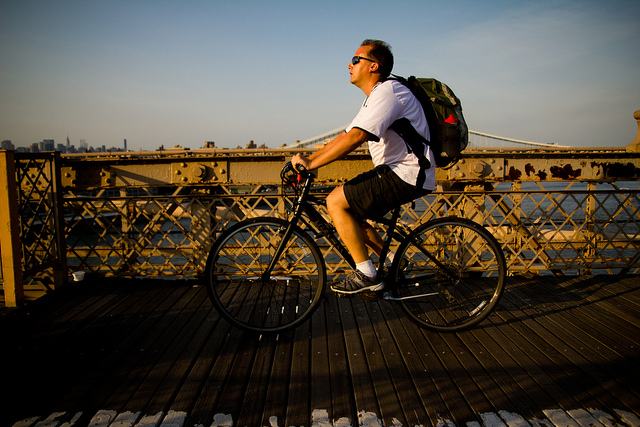
Image credit: Flickr user Hello Turkey Toe. And no, that's not me.
Many people (who have hair) also love the feel of the wind in their hair, but there's a trade-off for getting to experience that. Namely, in an accident, your head is completely unprotected from collisions with very solid objects such as cars or the pavement.
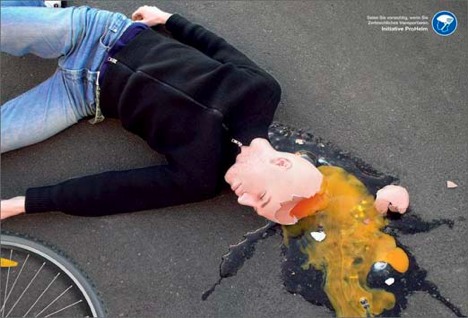
Image credit: German advertisement for "Initiative ProHelm".
For most of us, the tradeoff of wearing a helmet is well worth the reduction in fatalities and the severity of traumatic brain injury resulting from such accidents. I myself only began wearing a helmet after getting hit by a car while on my bicycle about a decade ago, but protecting my head is worth the discomfort, inconvenience and reduced field-of-view that comes with wearing a helmet.
But let's not kid ourselves; they are uncomfortable, inconvenient, sweaty and unsightly, even when worn by the best cyclists in the world.

Image credit: EPA / Gero Breloer; Stage 21 of the 2005 Tour de France.
I've seen a few attempts to make fashionable helmets, and while they've been amusing, I've yet to see something that I'd call a good option, just something that could perhaps be considered the least worst option.

Image credit: Jenn Hall of http://phillyrawrblog.blogspot.com/.
Because it's clearly smarter to be safe, I still hope everyone chooses to wear one. But I did wish there were better options than the currently existing helmets.
Apparently, someone else not only had the same idea, but went ahead and did something amazing about it.

Image credit: Hövding, Anna Haupt and Terese Alstin.
The woman shown, above, is wearing a bicycle helmet. Yes, yes she really is.
How's that?
In 2005, two students at Lund University in Sweden, Anna Haupt and Terese Alstin, came up with an idea for a bicycle helmet for adults that was completely invisible, but that would protect you in the event of a crash. Over the past seven years, they researched and developed Hövding, the world's first bicycle helmet that only self-activates when a crash is imminent.

Image credit: Hövding / Anna Haupt and Terese Alstin.
This remarkable device -- the collar around the woman's neck -- is an inflatable airbag (which takes just 0.1 seconds to inflate completely) powered by a cold helium inflator that's one of the smallest on the market. But what's truly amazing is the sensors, which are accelerometers and gyros, that pick up the abnormal movements of a cyclist in the early stages of an accident. That was the part that took the longest to design and test, and to meet the EU's strict helmet safety standards. How do the sensors work? From the site itself:
When Hövding is switched on, the sensors are constantly monitoring the wearer's movements. A bicyclist's movement patterns are divided into two different categories:
Normal movements: All bicycling in the city and on main roads, as well as all the normal movements you make before, during and after a bicycle ride such as running up and down steps, locking your bicycle, braking suddenly, giving way, pumping the tyres, etc. are defined as normal movements. Normal movements won't cause Hövding to inflate.
Abnormal movements: The movement patterns of a bicyclist in an accident are defined as abnormal movements. In an accident, a bicyclist's movements are completely different from those seen in normal bicycling. That's why the airbag is only triggered by accidents*.
To be able to distinguish between these two categories of movements, we've spent the past few years gathering data on the movement patterns of a large number of bicyclists in everyday bicycling situations. We've also re-enacted all known types of bicycling accident and recorded the movement patterns of bicyclists in these accidents. We staged fatal bicycling accidents using crash test dummies, while other bicycling accidents were re-enacted by stunt riders, male and female. We put all these movement patterns into our database and have developed a unique, patent pending, mathematical method for distinguishing between normal and abnormal movements. This method combined with the sensors is Hövding's brain.
The sensor turns on simply by snapping it closed around your neck, and can be recharged via USB.
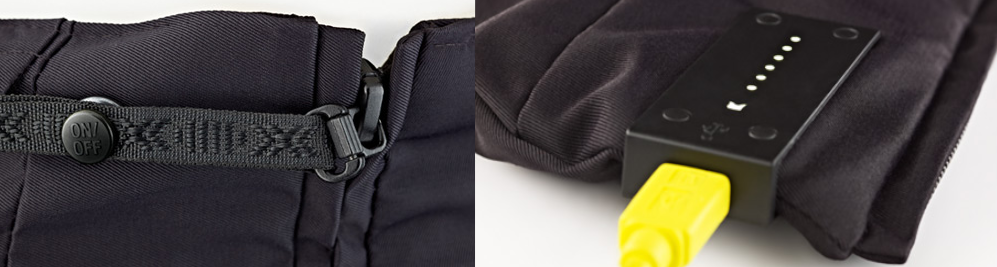
Image credit: Hövding / Anna Haupt and Terese Alstin.
They have a number of videos and films showcasing the different aspects of this product, including its fashionability. The safety of this helmet is perhaps the most impressive, but my favorite video showcasing this innovative (innoventive?) helmet is this one, below, by Focus Forward Films.
- Log in to post comments
I cycle, and I always wear a helmet. I wouldn't think of cycling without one. Putting it on is as automatic as putting on the seat belt on the very rare occasions I drive.
This is the second time I've heard of the inflatable bike helmet. This time, there's more detail. I'm put off slightly by the price. What does make me doubtful is the possibility that it might not actually work in an emergency - there's no way of telling (as also applies to the airbags in cars) that they're functioning properly.
it's obvious that seatbelts and rigid bicycle helmets are capable of functioning as designed by just looking at them.
Uncomfortable? You haven't found the right helmet brand. A properly fitted helmet is not uncomfortable at all. (Different brands have different shapes, kind of the way certain brands of shoes are wider or narrower.)
Sweaty? Good helmets have lots of ventilation. If you have no hair (like me), wear a bandana under it.
Inconvenient? Easy to lock to your bike.
Unsightly? I suppose, but to a regular biker they look pretty natural.
The airbag helmet looks like a good idea for urban riding, but would not be much good for off road riding where flying over the handle bars is less than rare. If that thing inflated over your head, you would have a hard time finishing the ride.
Very nice. My wife would buy one.
And with cost improvements, Anna and Teresa will soon work on the fully inflatable body suit; so if I go over the handle bars.
Now wait just a minute, I might slip on a banana peel or fall off a cliff; and I suspect a fully inflatable body suit would protect against drowning and hypothermia not just inconvenient impact.
Yes of course, eventually Kevlar, we do not want accidental puncture.
Well done Anna and Teresa; keep going!
And every octogenarian should have a fully inflatable body suit; the baby boomers are aging fast.
My octogenarian father has slipped down the stairs twice in the last year. He needs an invisible helmet now.
And I'd wear an invisible helmet when driving an SUV (You know rollover accidents and head injury.)
Anna and Teresa, your market is much bigger than bicycle helmets. Go girls go!!!
I cycle every single day and I never use a bike helmet. Neither does anyone else in this city. There are no rules forcing you to wear them and as a result, everybody uses their bicycle all the time.
I wear my cycle helmet when going offroad because you can fall off for a number of reasons. But your helmet won't help you much when a car runs over you.
I've been riding on and off for 50 years without a helmet, but am considering one now. Bradley Wiggins has come out in public in favour, which may decide many people on the subject.
Oh, and the helmet above with knobbly bits outside is plain dangerous - it's designed to break necks at any decent speed.
Almost no one in the Netherlands uses helmets when biking to or from work, for shopping or cycling recreationally (the only ones using them are sports cyclists and small children until about the age of 12). A big part of this comes from excellent infrastructure where bike lanes are separated from motorized traffic (it helps that virtually all car drivers will have bikes too so they know how cyclists behave). Every dozen years or so there's a smallish debate about mandatory helmets but politicians quickly realise that forcing 16 million people (virtually the entire country) to wear helmets is a sure vote loser.
Invest in proper segregated infrastructure and maintain bike road surfaces and deaths will fall much quicker than mandating helmets.
Having said that I would never dream of cycling outside the country without a helmet where people are often forced into highways and on the same lanes as cars.
There's a nice youtube channel of a dutchy detailing specific infrastructure to make biking safer. Here's some nice ones:
http://www.youtube.com/watch?feature=player_detailpage&list=UU67YlPrRvs…
http://www.youtube.com/watch?feature=player_detailpage&list=UU67YlPrRvs…
Of course this does require using taxes and investing those. We call this civilisation. Too bad many Americans seem to think it's called socialism.
Brilliant! I saw this yesterday and it's absolutely the first 'helmet' I'd actually choose to wear. Pity though it's not yet suitable for off-road riding, but I suspect they'll sort that out soon. If I had spare €400 though, I would certainly use it for daily trundling around Berlin.
This one is also nice, mostly because I live about 100 meters (to the left) of 1:51, just where there is a small jump in the video: http://www.youtube.com/watch?v=_R8kX499D_M
There is no evidence cycle helmets are effective. Find some good studies if you believe otherwise.
Mandating helmets reduces cycling as many cities have found.
Also, these things have a LOT of teething troubles.
Nice design from those girls, although a bit thick for during the summer, it might become more advanced and something like a neckless.
--
@Dave Hodgkinson,
"There is no evidence cycle helmets are effective.
Here is one:
http://forum.fok.nl/topic/559306/1/25
Look at the graph from his boardcomputer how he went from 34km/h to zero, and scroll down to see the helmet and his face, and where the helmet abosorbed the collision.
"Seven percent of the case patients (bicyclists with head injury) were wearing helmets at the time of their head injuries, as compared with 24 percent of the emergency room controls (bicyclists with non head injury same hospital).. In regression analyses to control for age, gender, income, education, cycling experience, and the severity of the accident, we found that riders with helmets had an 85 percent reduction in their risk of head injury... We conclude that bicycle safety helmets are highly effective in preventing head injury. Helmets are particularly important for children, since they suffer the majority of serious head injuries from bicycling accidents." (N Engl J. Med 1969;320:1361-7)
And guys use a prostate relief bicycle seat too. But only if you're satisfied with the evidence.
Awesome invention,
but a bit expensive for only city driving. Those crash test videos show a stationary bike getting hit. And from their description it comes that "usual" movements are considered normal. What I'm concerned with is their sensor detecting any off-road riding as a crash situation. Am curious about the G treshold of those sensors. Do a little jump with a bike and the helmet might pop-up, causing you to have spent 600$ on nothing. Am also interested if these are "one time use only" devices, or if they can be re-used once activated.
Problem. When you wear a helmet, drivers don't take as much care over you any more.
The number of accidents go up.
In the Netherlands, wearing a helmet for everyday cycling (commuting/relaxing) is pretty pointless. I only wear a helmet when I'm out on my racing bike/"road bike" and cycling at 30 to 40 km/h (like the guy Chelle linked to).
When I'm not in the Netherlands, I probably wouldn't even dare get on a bike, with or without helmet.
(What can I say, I'm spoiled by the seperated cycle lines / routes.)
Hm, so instead of wearing a helmet it just looks like you're wearing a posture collar.
I'm not a cyclist, but I don't think bike helmets are unfashionable for the same reason I don't think harnesses with gear dangling from them (and a helmet) are unfashionable on a rock-climber -- it's gear for a sport, worn in the pursuit of said sport. Shoulder pads/shin guards look ridiculous when you're not on the (whichever kind of) football field, you know?
And think about this: When you reach your destination on your bike, you take your helmet off.
But you're still wearing your cycling shorts.
So,
why aren't you advocating for pedestrian and car helmets? Both have similar risk of head injury (actually the car drivers have a higher risk of serious head injury), and yet. You North Americans are obsessed with bike helmets instead of fostering a culture of cycling that would reduce the individual risk.
Michael, thanks for that awesome idea of promoting bicycle safety in order to reduce accidents rather than solely relying on helmets to save people when accidents occur! This is a revolutionary idea to us here in North America and will surely change everything about how bicycle safety is viewed.
I like it but I disagree with you about helmets. I mostly mtn bike and I think they look cool, but I gotta have the visor. Nutcase makes some nice ones for the city and I like Kali for MTB. I also motorcycle and as with MTB and now also skiing, I can't go without, like not wearing a seatbelt, I feel exposed.
I believe in personal choice, but I just cringe when I see others not wearing helmets. It takes so little to seriously damage your head even on a bike, fall just right on he gutter and you're out.
Also, I've been knocked out twice from head trauma, so I love helmets.
"It takes so little to seriously damage your head even on a bike, fall just right on he gutter and you’re out."
And you have to fall "just right on the gutter" and do so hard enough to kill yourself. These are not easy to arrange events.
Did you know there's enough energy in a four foot fall to kill you, if you "fall just right" and break your neck? That's right: if you're more than about 4' 8" tall, YOU CAN KILL YOURSELF FALLING OVER!
Pedestrians are more at risk than cyclists (in terms of real numbers) and drivers are more at risk in terms of numbers AND percentages of head injury.
Get them to wear a helmet too.
CB the foam shell with a thin plastic outer that is the bycicle helmet is only rated to protect your head in a 14 mph accident and since it can only disperse so much energy and that increases with the square of the speed, that falls to practically nothing very quickly.
Additionally, drivers will drive less carefully around a cyclist with a helment. Because they too believe that this is somehow proof against any collision and that death or serious injury is no longer a risk to a cyclist with some foam plastic on their head.
And injuries to cyclists increase when helmet use increases.
This innovative idea is really immpressive, but to make things more commercial we need products that could be cost-effective inorder to make them easily avialable for a common person.
Wow, I missed out on your comments here, but its clear that you mostly comment here just to disagree. And what a clever thing to say: "drivers will drive less carefully around a cyclist with a helmet.", that's just some lame talk coming from someone who doesn't like to put a pot on his/her head, if you have kids you'll hear excuses like that all the time. Everybody knows that a cyclist is fragile, helmet or no helmet.
"“drivers will drive less carefully around a cyclist with a helmet.”, that’s just some lame talk "
Nope, it's proven.
Fine, show the proof.
And when I have, you'll do what?
Ignore it ever happened? Say that the proof is wrong? Slate the source?
This is the mechanism:
http://en.wikipedia.org/wiki/Risk_compensation
And here is a survey:
http://www.bath.ac.uk/news/articles/releases/overtaking110906.html
http://www.bath.ac.uk/news/articles/releases/overtaking110906.html
for the measurements of this in fact.
> "And when I have, you’ll do what?
You haven't got the proof, because there is no proof.
I know the argument, and what they say is that when you 'have' to wear a helmet, than less people ride a bike, and with less cyclists around people take less notice of them, so it is not that “drivers will drive less carefully around a cyclist with a helmet.",that's it. No need to start whining about me to avoid the fact that your motivation is wrong, nice try though.
Oh dear. Do you feel silly now?
Wow,
Yes, it is proof. An average of 8.5 cm closer, on a total average of a 133 cm distance, also proves the dangers of our helmets, now let's trow them all away!
And no I don't feel silly, because there is this guy of a Dutch Cycling Union 'Theo Zeegers' who has been saying the things I wrote, it's a bunch of people that don't like to wear a helmet.
http://www.dutchnews.nl/news/archives/2012/02/helmets_make_cycling_less…
Hmmm.
Did I hear a WHOOSH of moving goaposts from you, chelle? I think I did.
" it’s a bunch of people that don’t like to wear a helmet."
Well, they don't like to wear a helmet because it's dangerous.
Is there something wrong with that? Or are you just pissed?
"Well, they don’t like to wear a helmet because it’s dangerous.
Now I know why you first wrote this before presenting your proof:
Anyway I hope you'll never fall on your head when having an accident with your bike, I would miss you, take care.
What on earth are you pretending to be nice now? You're just being condescending.
"“Well, they don’t like to wear a helmet because it’s dangerous."
Now I know why you first wrote this before presenting your proof:"
See, this is an example of how you don't need any logical connection from one fact to whatever insane conclusion you wish to provide.
I note that you've ignore that evidence has been given of the statements.
And you've implied that they're wrong by claiming this is due to them not wanting to wear helmets. I.e. there was no other reason. When this is patently untrue.
Why?
God knows. Nobody knows why you get some insane little wasp thoughts in your head to come spewing out your mouth, but you do it.
Wow,
I said that the proof was correct, but that some people like to take this single fact as a claim for not having to wear a helmet, just like you say it is unsafe! while I say that their claim is mainly because they don't like wear it because of the burden.
When I draw a conclusion I also look at the bigger picture, your line of thinking is the same as with the safety-report of the LHC where it is said that single cosmic ray collisions don't cause any dangers, so it's all safe. While in reality you're only basing your conclusions on single events, you also need to look at the frequency & density numbers, and then the situation drastically changes.
"I said that the proof was correct"
What? In invisible ink? Funny how that would require this: "also proves the dangers of our helmets, now let’s trow them all away!" to be honest rather than sarcastic.
And stop with the histrionics, chelle.
You don't know that your sandwich bread is safe. but you have no ideological bone to pick with foodstuffs, so you don't pretend they really scare you.
The evidence that wearing a bicycle helmet is biase and unblinded survey with a "control" that included wearing a wig? Yeah. That's not evidence. That's actually pretty problematic, in fact.
Try reading the report, James.
I too decided that the Bath study was binworthy when I got to the bit about the wig - what's wrong with using a real woman as the subject?!
He may have a point, but I'd like to see the same study done with multiple cyclists (male, female, young, old - all with and without helmets), also constantly measuring their distance from the curb in the same way his system measured the distance from cars, and done in different countries.
How many of the close passes were due to narrowing of the road or other traffic effects?
I have another theory he could test: at work they gave me a fluoro jacket to wear when cycling. After a few days I noticed I was pushing the envelope more than usual, quite often chiding myself for taking silly risks. Maybe with helmets too there's an aspect of 'It's OK, I'm indestructible now'.
My helmet was the best investment in my life. I fell in a forest during my commute, head first on a pointy rock . I dislodged my elbow, I had a rib crushed and it was NOTHING compared to being probably dead after such a fall.
The helmet broke down but perfectly protected my head (I did not feel a thing)
I bought the same model and thanked the company - they rock.
I watched a friend go over his handlebars and land directly on his head when his front wheel came off at decent speed (due to improper use of the quick release). The energy absorbed by the crushed and broken foam would have been enough to crack his skull otherwise. Bicycle helmets save lives. Period.
To those flapping their arms and saying "Why don't we make drivers and pedestrians wear helmets too?": Regarding pedestrians, they're usually not travelling 20mph in a somewhat prone posture (i.e. head first). Meanwhile, drivers have an airbag, seatbelt, and car frame with crumple zones that absorb energy (just like the foam in a helmet).
I'm intrigued by the idea of inflatable garments for elderly people. Breaking a hip in a fall is a serious event. Perhaps augment the G sensors with ultrasonic sensors that activate when contact is about to be made at fast speed.
"The energy absorbed by the crushed and broken foam would have been enough to crack his skull otherwise."
Completel arrant made-up nonsense!
ABSOLUTELY untrue.
The standard allows for a fall of no more than four feet stationary on a bike or 12 miles per hour collision.
Any energy you assert would crush a skull would be barely intercepted by the foam of the helmet.
"binworthy when I got to the bit about the wig – what’s wrong with using a real woman as the subject"
What about some bloke wearing a wig to appear as possibly feminine makes the study binworthy? What's wrong about someone who is doing the test themselves who is a bloke NOT asking someone else to risk their safety and dressing up as feminine as possible to see what the gender effect would be?
No, you wish to bin the study for other reasons and are merely rationalising it.
"My helmet was the best investment in my life. I fell in a forest during my commute, head first on a pointy rock . I dislodged my elbow, I had a rib crushed"
So you're wearing a full-body helmet?
Yet more bollocks.
Why?
Why do you make up such rubbish all of you and even worse such obviously made up crap to boot?