

"I am always ready to learn, although I do not always like to be taught." -Winston Churchill
My very first time leading a classroom -- on my own -- was back in June of 2000. I was 21 years old, fresh out of college, and was teaching science in a middle school classroom. And I asked what I thought was an innocuous question, designed to pique their curiosity. I asked the class, "What are we -- you, me, and all human beings -- made of?"
I was expecting many possible answers common to all living things, ranging from "blood and guts" to cells, molecules, or atoms. From a scientific standpoint, there are many possible answers with different levels of sophistication, and I would have been happy with any one of them.
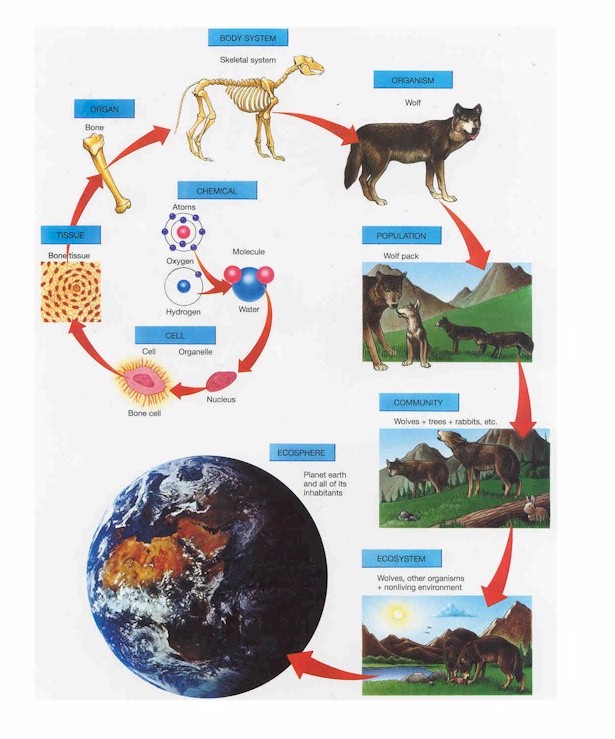
 Image credit: John S. Choinski, Jr., of the University of Central Arkansas.
But that wasn't the answer I got. I was very surprised when a girl in the front row raised her hand and said, "clay."
Clay!
This was one of those trial-by-fire moments that new teachers experience so frequently, that no amount of education can prepare them for. As the wheels raced in my head, I knew my response would be critical.
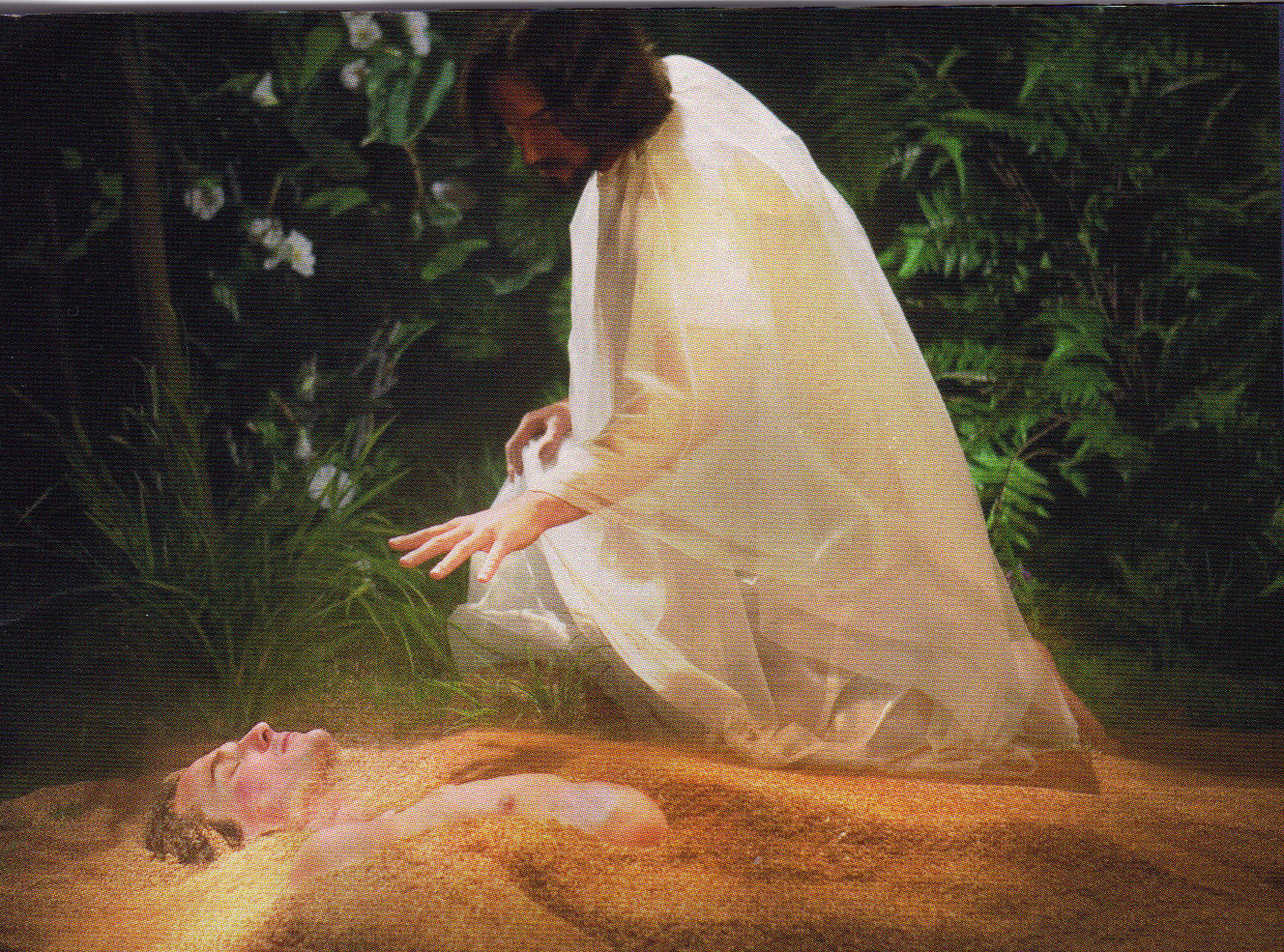 Image credit: First man Adam and perfect man Christ, via http://heavenlytours.us/images/creating_adam.jpg.

Clay, of course, was a reference to the biblical story that God created Adam out of clay, and I was keenly aware that the wrong response could cause me to lose the class. On the fly, I came up with the best response I could, which went something like this:
That's one way of looking at it, but this is a science class. In science, if you want to figure something out, you need to admit that you don't know the answer ahead of time, and come up with a way to test your ideas. So, if we wanted to figure out what we're made out of, how would we do it?
This is the most important part of science: that you investigate ideas to determine whether they have validity or not. For a living thing, looking inside -- whether with the naked eye, a microscope, or something more sophisticated -- will teach you what we're made of. But other questions are more difficult.
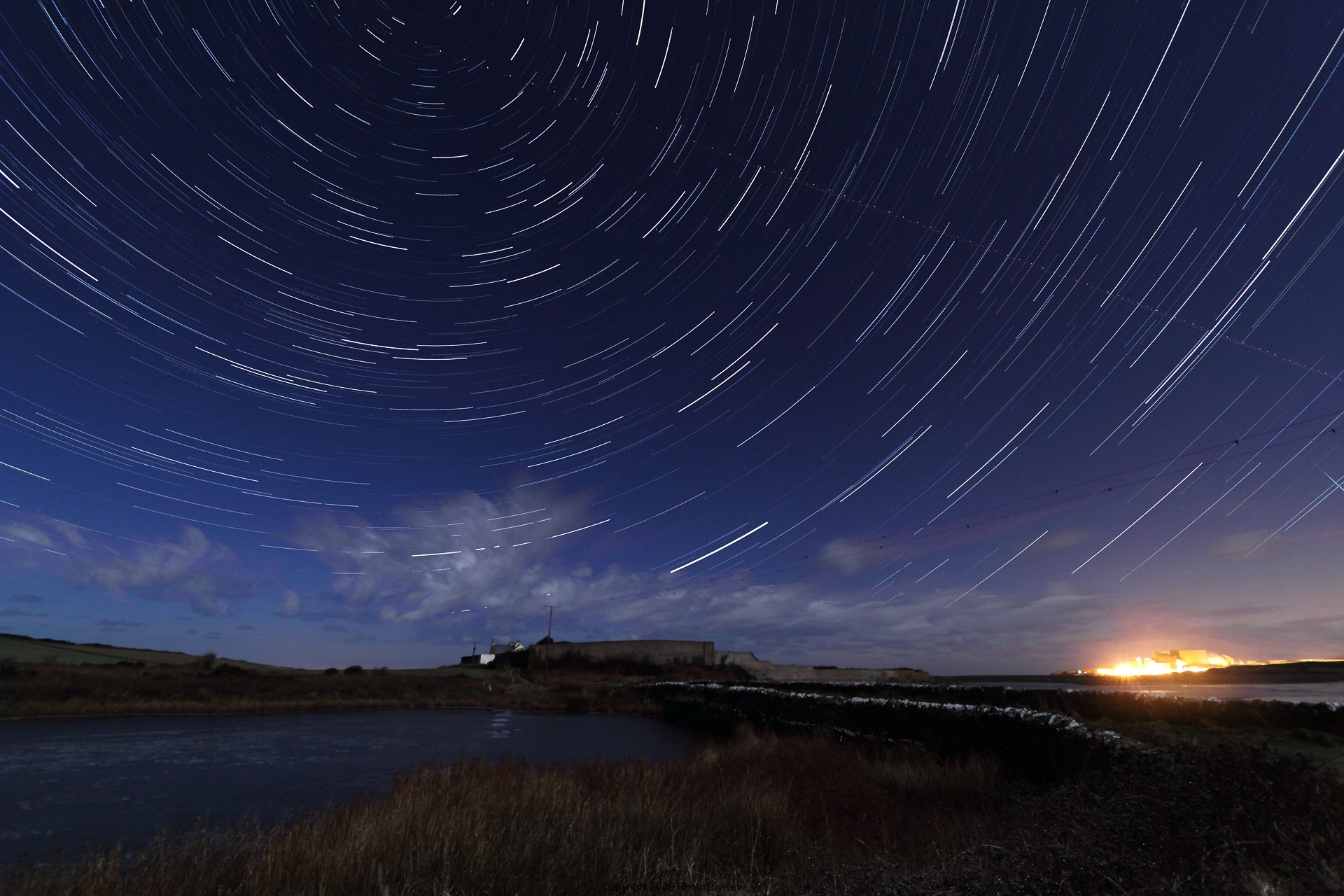 Image credit: Kevin Lewis of http://www.photosbykev.com/.
When you look at the night sky, you'll notice that it appears to rotate about a particular point in the sky. This point changes dependent on your location on Earth, and the stars further away from this point appear to rotate faster.
Without knowing what the answer is in advance, there's more than one reasonable explanation for this. For example, the Earth could be rotating once-per-day, and that's what's causing the stars to appear to rotate. Or, the heavens could actually be rotating, with the Earth stationary beneath our feet. With no further observations, either one of these explanations has an equal claim to being the correct one.
 Images credit: Retrieved from the One Minute Astronomer, http://www.oneminuteastronomer.com/.
But they can't both be correct; they're mutually incompatible solutions to the problem. If you want to know which one (if either) is correct, you have to figure out a way to test both of these ideas against one another, and do an experiment that allows you to discern which one is the most valid explanation.
That's what science is, and in a sense, that's perhaps the only way, as a species, that we enable ourselves to learn about the Universe and move forward in our knowledge and understanding of it. Otherwise, you're talking about untested (or, sometimes untestable) ideas, which can be fun to think about, but don't help us understand the way things actually are.
 Image credit: Turtles All The Way Down by Kenneth Rougeau of http://artfamilia.etsy.com/.
The beauty of science is that, so long as you're willing to revise your conception of the Universe based on new evidence that comes in, you'll always be learning, and your perception of reality will become ever more closely aligned with the way thing actually are. (And you'll be in very good company.)
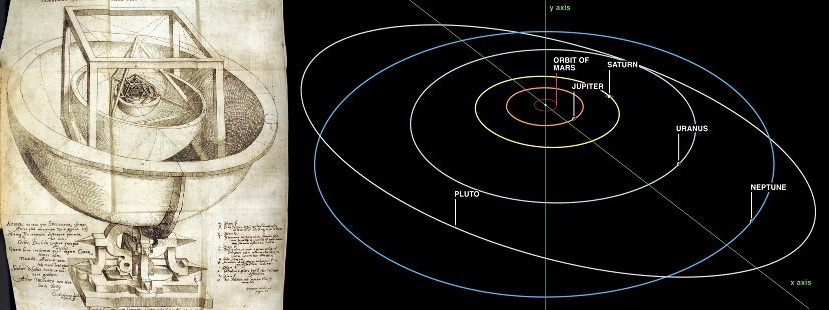 Johannes Kepler's Mysterium Cosmographicum, 16th Century (left), from his notebook, and his later, more successful 17th Century model (right) of elliptical planetary orbits. Images credit: J. Kepler (left), Phillip Brown and James Braselton (right).
There is no shame in being wrong before you've become informed; on the contrary, nobody knows the right answer before they've got the information to figure it out. But you must ask those questions, you must do those experiments, and -- when it's called for -- you must revise your conception of the physical Universe to agree with what the Universe tells you about itself.
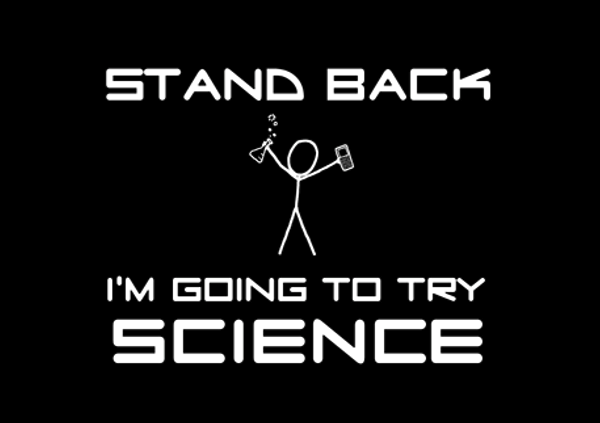 Image credit: Randall Munroe of xkcd.
That's all that science is: what we learn by asking the Universe about itself.
"When you make the finding yourself - even if you're the last person on Earth to see the light - you'll never forget it." -Carl Sagan
So ask your questions: about the Earth, the origin of humans, where matter comes from, even the Universe itself. Ask all of it. If you're willing to listen, there's a Universe of stuff out there for you to learn. All you have to do is ask it the right questions.
That's why you're a great teacher, sir. Even in my misguided youth as a (temporary) bible-thumper, I found the literal creationist brigade totally embarrassing.
I'd have laughed her out of the classroom.
I fell in love with space when Neil Armstrong stepped onto the surface of Mars (yes, it really happened, and the Egyptians really built the pyramids). I saw pictures of his burial at sea and had a precious moment remembering that fateful day for him and me. I am now an artist tinkerer with a healthy respect and curiosity about science. I love the sky and notice where the sun goes when it's getting to be solstice time. I enjoy reading your blog and am very happy that the much younger audience of StumbleUpon still keeps sending your pages up. Good for you--you deserve it.
OOPS! I meant the MOON, not that I hope it doesn't happen on Mars! I am just now re-reading Heinlein's "The Moon is a Harsh Mistress", which is a totally different take at 62 than 20 something, and submitted this shortly after a visit to NASA's Curiosity page. Sorry about that!
The scientific method is the result of deduction from axioms. For example, that there is an objective universe, that the universe behaves lawfully, that our senses provide generally reliable data about it.
Does this not suggest that deduction (or logic in general), not empiricism, is the fundamental tool for learning about the universe?
Nope, it is deduction from evidence. The only axiom that really exists in science is that the laws of nature are predictable and consistent.
That's all. Just empiricism.
There used to be a theory that the original self-replicating structures were clay semi-crystals; the original protein-like molecules were enzymes produced by and facilitating the clay structures. Difficult thing to demonstrate to be sure, but perhaps "clay" could be a reputable answer: nothing supernatural.
... seems to me empiricism is abstraction from nature rather than deduction. That is, postulation precedes experimentation, which precedes evidence. Which precedes assertion, properly done. I think that's what Ethan said.
I think science can best be regarded as neither entirely inductive nor entirely deductive, but as a pretty effective mixture of the two. Science certainly uses induction; that's not even in question. When you observe, for instance, that there is an attractive force between two bodies, that this force depends directly on the mass of both bodies and is inversely proportional to their separation, you are NOT entitled to deductively assert that this observation will hold for ANY two bodies. This remains true even if you observe millions or billions of such interactions; it is theoretically possible that the next pair of bodies you observe might not interact in this fashion.
Deduction, too, plays a significant role. Typically, deduction is necessary to devise experiments to differentiate between competing explanations. For instance, historically, there was a debate as to whether light is a wave or a particle (before we found it to be both). One of my favorite examples of the experiments used to answer this question was the experiment of placing a small disk-shaped object in the path of a light beam. Particle enthusiasts ridiculed the wave proponents because, by deduction from the wave theory, they predicted that the shadow of such an object should contain a bright spot at the center (assuming the object is small enough for diffraction to be singnificant). This was obviously a very counterintuitive result, and the wave propenents despaired when they realized that this was a prediction of their theory. That is, until the experiment was actually performed, and the bright spot was found in the center of the shadow as predicted.
The main point of this example is that it is unlikely that an experiment such as this would have EVER been performed without using deduction to predict a counterintuitive result. Without the deduction from wave theory, who would ever have thought to look for a bright spot at the center of a shadow? This experiment, along with others that resulted from deductions from wave theory, ultimately led to the triumph of wave theory.
Marshall,
You have a point about the self replicating clay theory, but I highly doubt that a middle school student had that in mind when she said that we are made of clay.
I'd like to copy a comment that was entered last March, by Michael Richmond. (March 8, 9:14 am)
Kepler published a second edition of the “Mysterium Cosmographicum” 25 years after the first. The second edition came after he had published the works in which one can find his First, Second and Third Laws. The preface to the second edition makes it clear that he regards the ideas of the “Mysterium” still to be valid.
Because Kepler left so complete a record of his thoughts as he worked through his life, we have many instances in which he manages to keep several conflicting ideas together without realizing that they conflict.
Give the guy a break Cleon. Ethan's diagram seems to credit him with the discovery of Uranus, Neptune and Pluto by the 17th Century!
"Clay" could also be a reference to Brin's novel "Kiln People". Very good SF.Personally, I would love to be able to upload myself into a couple of golems to catch up with the workload.
The image "Turtles All The Way Down" is my own original composition. Thanks so much for sharing it! For anyone interested, prints are available from my Etsy shop http://artfamilia.etsy.com & you'll find other items bearing the image on Cafepress. Thanks for your support!
Thank you Kenneth, for finding this and for revealing yourself as the creator. I have credited you in the post directly under your image, and have provided the URL to your website there.
It's a very nice piece!