

"Man alone is born crying, lives complaining, and dies disappointed." -Samuel Johnson
But the stars, as opposed to humans, are born shining, with hundreds (or more) of brothers and sisters, shine ever more brightly over their lifetimes, and die in spectacular fashion. As far as we can tell, here's the past, present and future story of all the Sun-like stars in our galaxy.

Bok Globule Barnard 175; image credit by Jerry Lodriguss of http://www.astropix.com/.
At some point in the far distant past, every star in our galaxy was once no more than a molecular cloud of gas, with gravity attempting to contract the cloud down into a point.
But gravity typically can't do this on its own; the cloud needs to be cool enough and the internal pressure needs to be low enough. Simply waiting around for long enough will do it, if you wait for the internal temperature and pressure to drop. But -- unless you're some of the very first ones to form -- it helps to get a nudge.
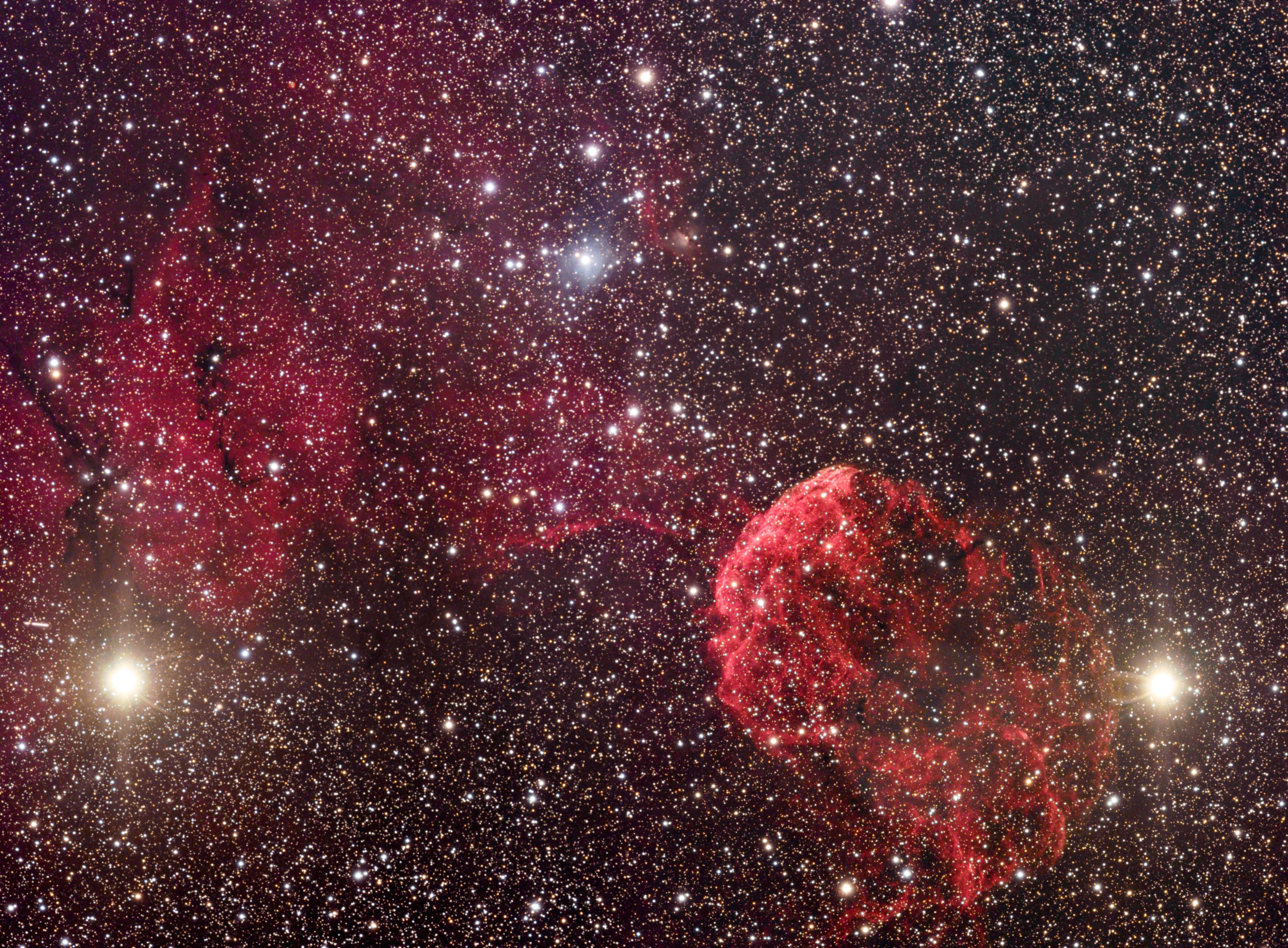
Molecular cloud IC 443; image credit: Bernhard Hubl of http://astrophoton.com/.
And a nearby supernova can be just the thing necessary to goad a molecular cloud into collapsing.
Once that collapse starts, you'll inevitably get one region that begins to accumulate more mass than the other regions around it. Because of the way that gravitation works, that region will start to attract more and more mass, and you'll eventually get runaway gravitational growth. But the cloud is still going to be dark, and it won't yet be visible to your eyes.
But you can see something, if you look just right.

Image credit: NASA/JPL-Caltech/N. Evans (Univ. of Texas at Austin)/DSS; Spitzer Space Telescope.
Inside these dark molecular clouds where gas and dust is collapsing, the pressures and temperatures are rising faster than they can radiate that heat away. While the outer layers of gas and dust continue to block the visible light, the infrared light coming from the stars formed inside can pass straight through. Thanks to infrared space telescopes (like Spitzer), we can see the newly formed star clusters that are still in the earliest stages of infancy, as shown in yellow (with the red halo) above.
The thing is, these molecular clouds are far bigger than just a single solar mass.
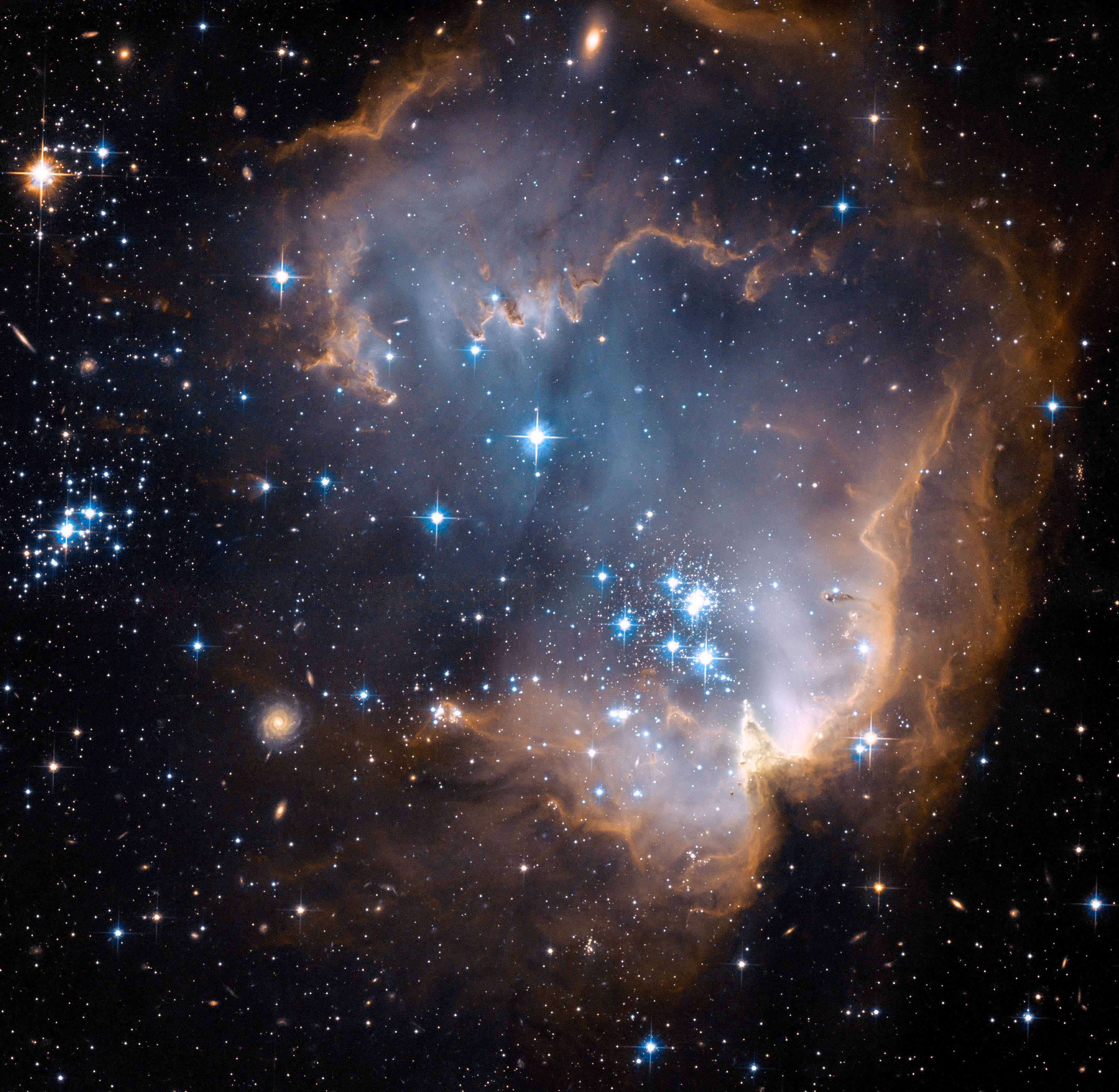
Image credit: NASA, ESA and the Hubble Heritage Team (STScI/AURA)-ESA/Hubble Collaboration.
Instead, these clouds range from many thousands to hundreds of thousands of solar masses. Maybe 10% of each cloud will contract to form stars before the radiation from the newly formed stars blasts the remaining cloud apart into the interstellar medium, where they will someday find new molecules and begin gravitational contraction. But the high mass of those clouds means that there are literally many hundreds to up to hundreds of thousands of stars in a new star cluster.
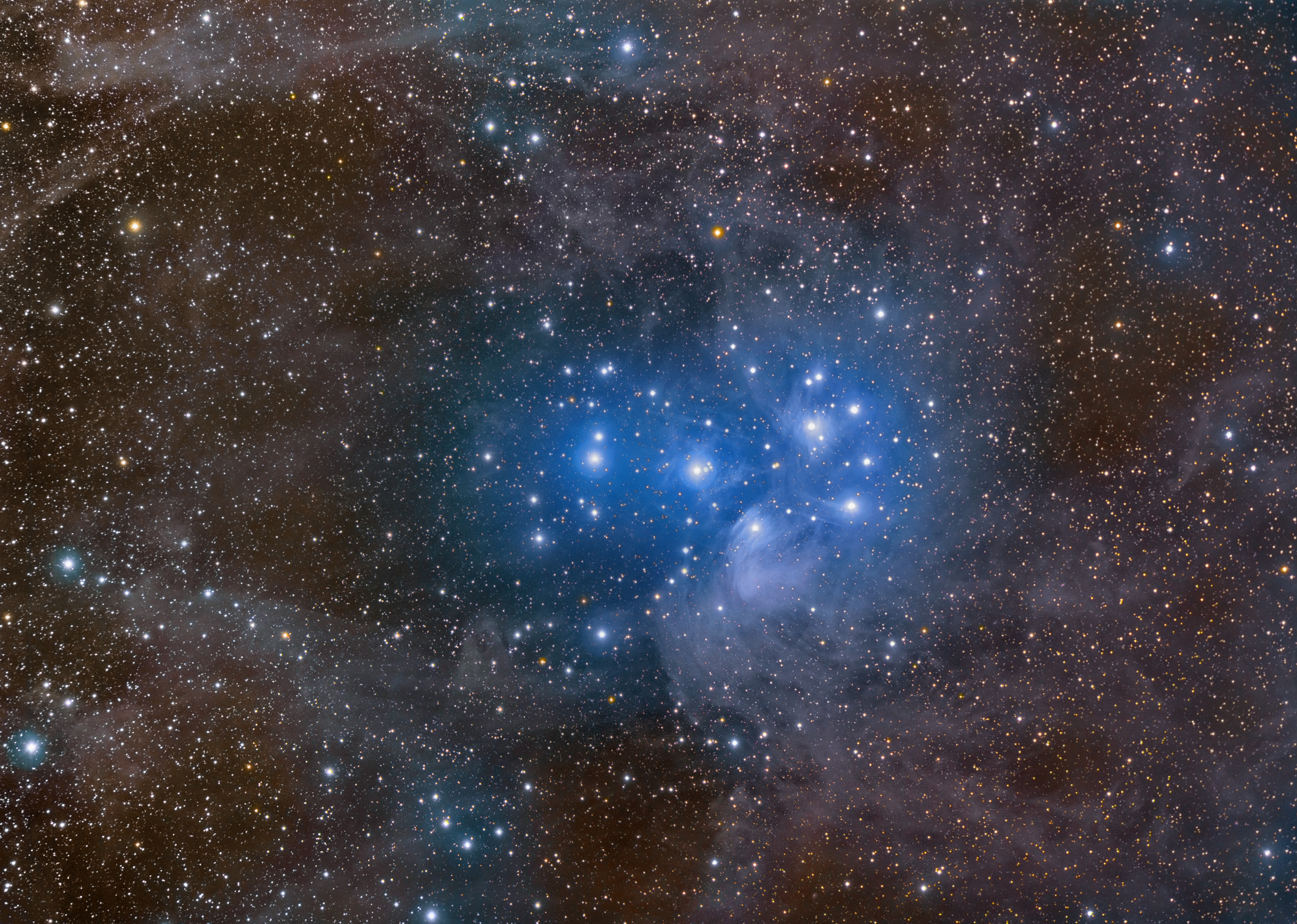
Image credit: Rogelio Bernal Andreo (Deep Sky Colors).
Our Sun formed in a star cluster much like this -- the Pleiades -- some 4.5 billion years ago. The brightest, bluest stars are the most massive and will die too quickly to be anything like our Sun. The Sun-like stars are longer-lived, and will by-and-large outlive even the cluster they were born into.
Over time, gravitational passes between this star cluster and other objects in the galaxy, as well as close passes between the individual stars, will cause the cluster itself to dissociate over time, with individual stars being flung across space. (Break out your red-green glasses to see what's happening to the Hyades, our closest star cluster.)

Image credit: Alexander Meleg.
Most star clusters dissociate within the first few hundred million years, while Sun-like stars typically live much longer, with lifetimes in the billions or even trillions of years, depending on what their mass is.
Over most of their life, Sun-like stars burn at a relatively even rate, turning hydrogen into helium at a very even pace. The only variation is that, as a star burns through its fuel, the interior core region in which fusion can occur gets slightly larger, meaning that over its entire lifetime, it eventually and very gradually gets hotter and more luminous.
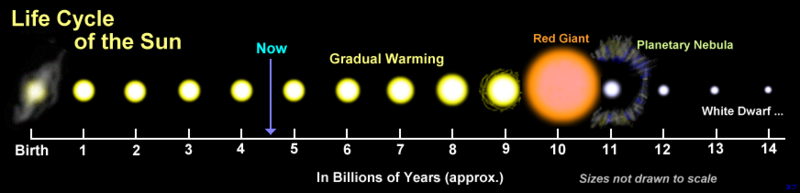
Image credit: wikimedia commons user Oliverbeatson.
Eventually, it will have burned through so much fuel in the core -- and it does so faster than new fuel can fall in from the outermost layers -- that the core will run out of hydrogen, so that fusion only occurs in a shell around the core. This causes the star to become significantly more luminous, resulting in our star (and other Sun-like stars) becoming a subgiant star.
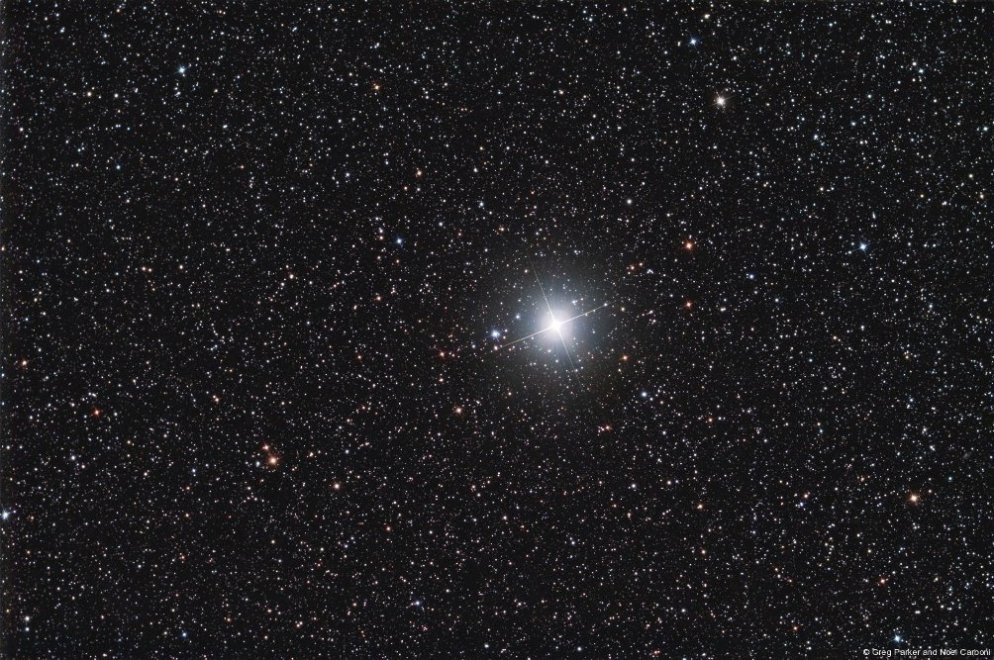
Image credit: Greg Parker and Noel Carboni.
Procyon (above), the 7th brightest star in the sky, is a subgiant star, a phase of stellar evolution that lasts a few hundred million years, on the star's way to becoming a true red giant, when it begins fusing heavier elements (like helium, carbon, oxygen, etc.) in its core!
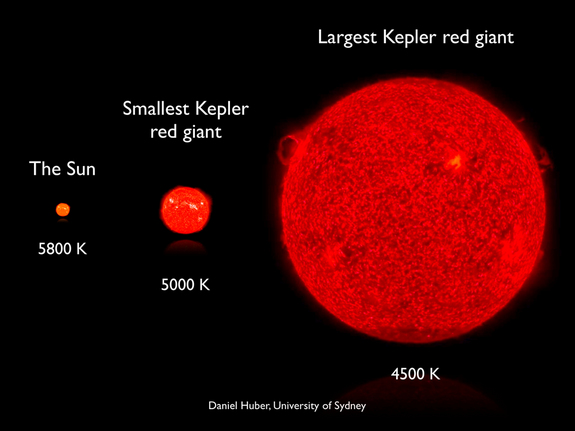
Image credit: Daniel Huber, University of Sydney.
At this point, the star becomes many, many times its original size, so large that the Sun will likely engulf Mercury, Venus, and possibly even Earth when this happens.
Eventually, all the material that can be fused in the star's core will be used up, while the outer layers of hydrogen and helium will be blown off. This happens slowly and in pulses at first, creating a protoplanetary (or preplanetary) nebula,
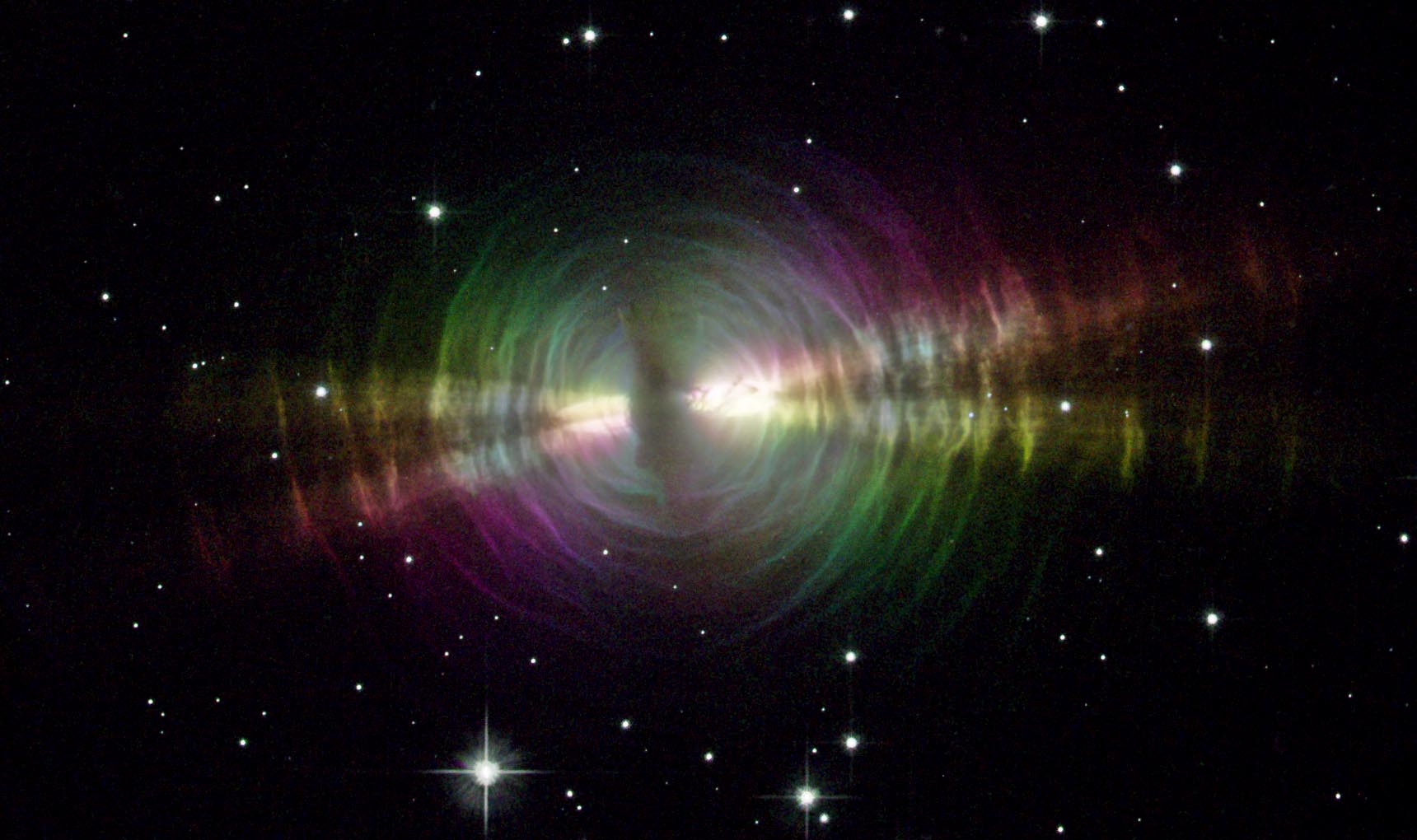
Image credit: NASA and The Hubble Heritage Team (STScI/AURA); Acknowledgment: W. Sparks (STScI) and R. Sahai (JPL).
followed by a full-blown planetary nebula, where maybe 50% of the star's original mass (and 97% of that will be pristine, unburned hydrogen) is returned to the interstellar medium,
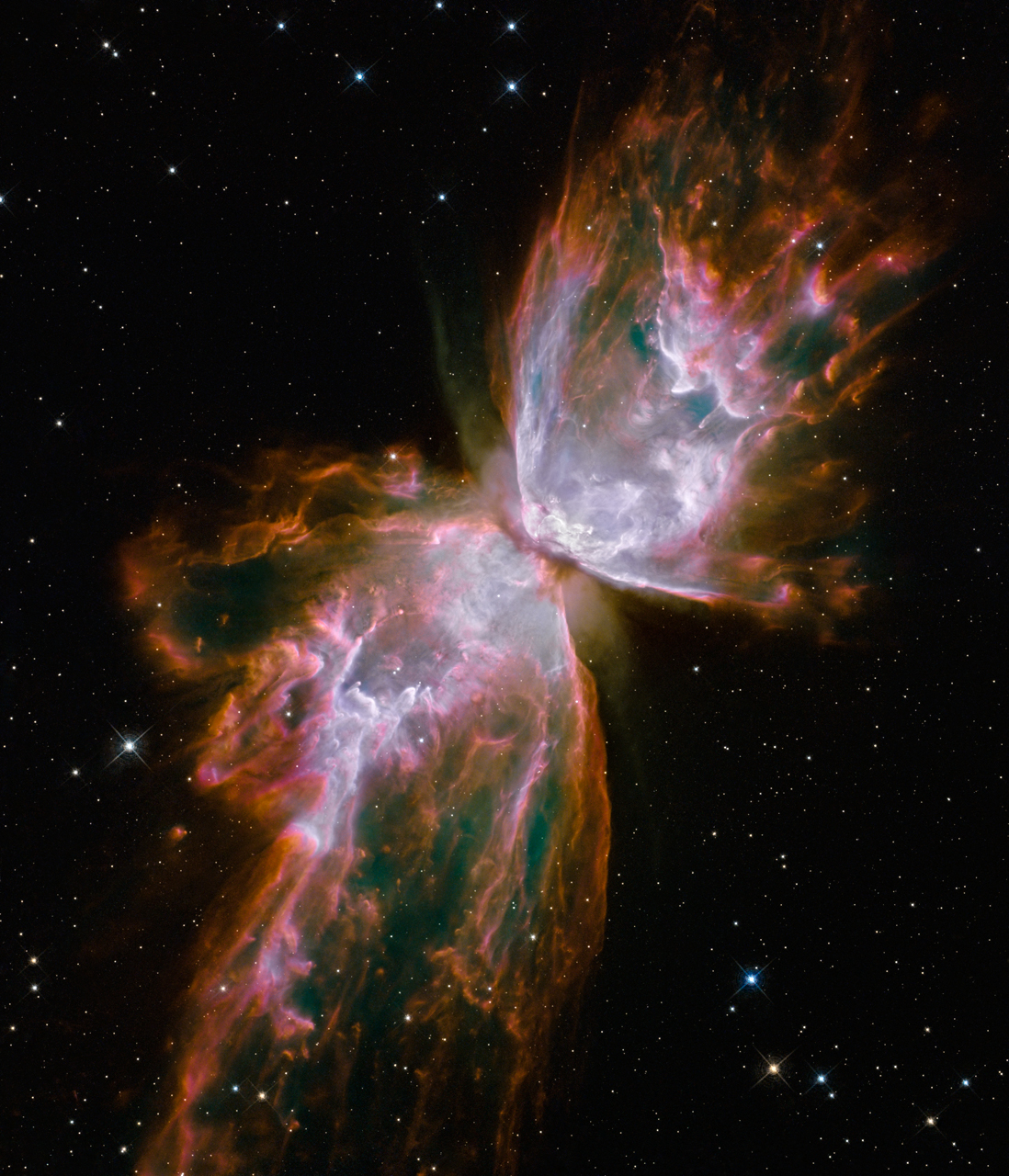
Image credit: NASA, ESA, and the Hubble SM4 ERO Team.
and a white dwarf star, a degenerate core of carbon, oxygen, and in some stars, sulphur, silicon and even iron, will be left behind. While it may be 50% of the mass of the original star, it's thousands of times dimmer and over a hundred times smaller in diameter.
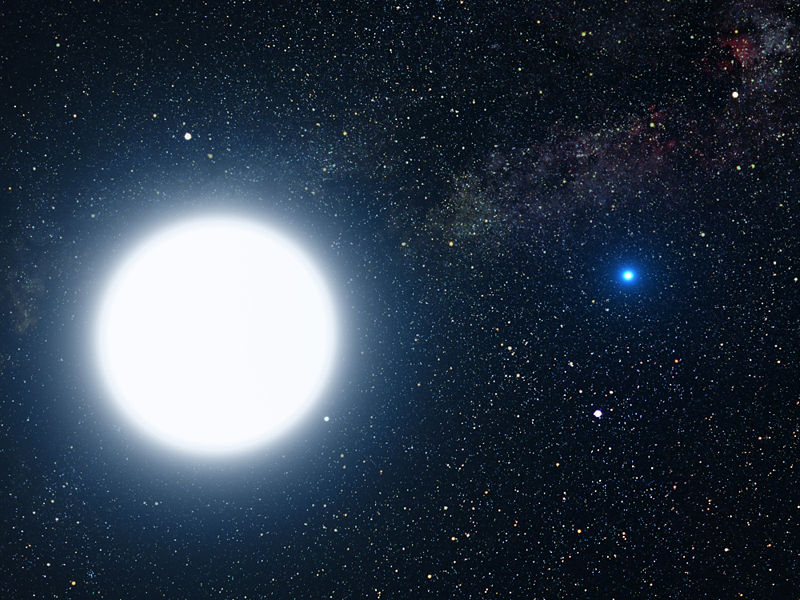
Image credit: NASA and ESA; an illustration of Sirius A and B by: G. Bacon (STScI).
It will take many trillions of years for this white dwarf to eventually radiate its heat away and cool to become black, and that's the eventual fate of all Sun-like stars.
But given that 95% of all the mass that it took to form these stars was eventually returned to the interstellar medium as burnable fuel, we'll still have stars lighting our night sky for trillions upon trillions of years, and the atoms from our Solar System will be a part of countless future generations of them.
"But given that 95% of all the mass that it took to form these stars was eventually returned to the interstellar medium as burnable fuel, we’ll still have stars lighting our night sky for trillions upon trillions of years"
Ethan, It's nice to know that we have a bright future, dark energy notwithstanding... I didn't realize that most of a star's hydrogen was unburned, and blown outwards at its end. I guess that makes sense since H is a lot lighter than He, C, N, O, etc., so most of it can't enter the core where it could fuse.
Great summary, thanks for bring it all together.
Here's a few of the links to topics that I still needed to search:
Star cluster: http://en.wikipedia.org/wiki/Star_cluster
molecular cloud: http://en.wikipedia.org/wiki/Molecular_cloud
Thanks. I needed to see how the pieces of the story all fit together.
Is there a similar story for the life cyle (the life and death) of spiral galaxies. I have look but not found it.
So I can find the life cycles of:
- planet earth,
-the sun
- the universe
But not of a spiral galaxy.
A pointer to a book, web site or article will be appreciated.
Thanks.
Isn't it 50% of the mass that gets returned to space as (97%-pure) reusable fuel, not 95% of the mass?
Still very cool though. I thought they used it all up - and that the galaxy didn't have much spare gas left either. 10x more mass in gas than in stars, and the stars give most of it back anyway... Quite a cheery thought, really. The Milky Way will be here for a while yet!
PS. How much reusable fuel do supernovae blast out?
Mark, yes to the first part; it is 50% of the mass of a Sun-like star that gets returned to space, with 97% of that as hydrogen.
But this means that, of the initial molecular cloud that formed into the star cluster that formed Sun-like stars, 95% of that mass winds up getting returned to the interstellar medium.
I don't know the exact figure for how much reusable fuel supernovae blast out, but I would assume that it's significantly more than 50%, as the higher mass stars have shorter lifetimes and less time to convect hydrogen into the core.
Stars that are smaller than Sun-like stars (the M-class stars, or red dwarfs) do eventually convect 100% of their hydrogen into their core, and will not return any hydrogen to the ISM. Sun-like stars range from low-mass B-class stars (the 2nd hottest, brightest, most massive class) down to K-class stars (the only one above M). If you want more information than that, you'll have to talk to an astronomer/astrophysicist who specializes in stars. Sorry (but not really); I picked the large-scale Universe!
Sorry for posting something completely off-topic, but since you (Ethan and all readers :)) can help John Nunn answer his question he asks here: http://www.chessbase.com/newsdetail.asp?newsid=8523 (forget the chess part if you're not interested and scroll to the bottom of the page, where John asks a question about the double galaxy NGC750/751). Anyone here able to help him ? :) Thx...
Thanks Ethan. This addresses some fundamental questions I had.
Is the interplay of gas temperature and pressure how super massive stars kept accumulating material from their dust cloud without igniting earlier and blowing it away?
Is there any info back tracking the sun's history to give an indication where in the galaxy it formed and migrated to its present location; or is it pretty much in the location where it formed? Thanks! Good blog!
Thanks for this wonderful overview of stellar evolution!
But one should do something about this wasteful behavior by stars. Blowing all that stuff into the interplanetary medium? And even ending the conditions for life on Earth? These stars are surely bastards, one should demand energy efficiency labels for stars or something.
Philipp,
I should have answered this for your months ago; I don't have a chessbase account and so can't post there. There is an outstanding image of NGC 750/751 (which is actually the interacting pair known as Arp 166) by the avid astrophotographers Paul and Liz over at http://paulandliz.org/Galaxies/Galaxies_ARP_151to200.htm
Over there, you'll find this picture which clearly shows the separation and a connective filament. Pretty amazing stuff.